~ 13 ~ WWJMRD 2018; 4(6): 13-19
www.wwjmrd.com International Journal Peer Reviewed Journal Refereed Journal Indexed Journal Impact Factor MJIF: 4.25 E-ISSN: 2454-6615
Guo-Hui Xie
Visiting Professor, Special Needs & Inclusive Education Universidad de Sago José, Macao
Correspondence: Guo-Hui Xie
Visiting Professor, Special Needs & Inclusive Education Universidad de Sago José, Macao
Understanding the Different Levels of
Learning/Behavioral Disabilities & Disorders in
Educational Therapy: A Nosographical Classification
Scheme
Guo-Hui Xie
Abstract
In educational therapy, the term nosography comes from two ancient Greek words, i.e., nosos, meaning 'disease', and -graphē, meaning ' description '). It is borrowed from the medical field to provide educational therapists and diagnosticians a structured scheme to describe and classify learning and behavioral disabilities/disorders for the purpose of diagnostic identification, differentiation and intervention planning. While the medical practitioners have their diagnostic scheme of classification known as the International Classification of Diseases (ICD) and psychologists have their Diagnostic and Statistical Manual (DSM) system, the special education professionals also need a scheme of their own, resulting in the publication of the Educator‟s Diagnostic Manual (Pierangelo & Giuliani, 2007) based heavily on the IDEA 2004 categories of disability. The aim of this paper is to provide special education professionals a pre-nosographical classification scheme to describe the different levels of disabilities/disorders in order to help them distinguish the intricate network of related or associated symptoms.
Keywords: Complex; Disability; Disorder; Multiplex; Syndrome.
1. Introduction to Educational Nosology
In this paper, I use the term “educational nosology” to refer to a study of classifying difficulties, disabilities and/or disorders of learning and/or behavioral challenges according to a structured scheme that applies to how they are best described and categorized by causes, pathogenesis1 (i.e., mechanism by which a disability or disorder is caused), or by symptoms. Like the medical nosology used by medical professionals to identify a disease, the aim of the educational nosology is to provide a proper classification scheme that can provide a good description of learning and behavioral difficulties, disabilities and/or disorders (i.e., nosography) to help special education professionals (e.g., early interventionists, educational therapists and educational diagnosticians) in the clinical identification of these disabilities/disorders as well as differentiation of the subtypes within each category. Unless these special education professionals are certain what exactly they are looking at and working with, it will be very difficult to plan or design an appropriate treatment plan or program to intervene and help individuals with disabilities/disorders (or special needs)2. According to the IDEA 2004, there are 13 disability categories: (1) Specific Learning Disability is a big umbrella term covering a wide range of challenging issues related to learning affecting an individual‟s ability to read, write, listen, speak, think, reason or do sums.
1
The word pathogenesis – originally used to describe the cause(s) of a disease – is used in educational nosology of disabilities and/or disorders referring to the biological and/or psychological mechanism(s) that lead to the disabled or disordered state. The term pathogenesis “can also describe the origin and development of the disability or disorder, and if it is acute, chronic, or recurrent” (Wikipedia, 2017, para.1).
2
Disabilities, disorders and special needs will be used interchangeably throughout this paper.
~ 14 ~
Examples include dyslexia, dysgraphia, dyscalculia, auditory processing disorder, and non-verbal learning disability; (2) Other Health Impairments refer to the conditions that limit an individual‟s strength, energy or alertness. A good example is the Attention Deficit/Hyperactivity Disorder (ADHD); (3) Autism, a neuro-developmental disorder, whose symptoms include impaired social and communication skills, can co-exist with other challenging medical conditions such as temporal lobe epilepsy and may also cause challenging behaviour such as pathological demand avoidance; (4) Emotional Disturbance includes several mental disorders such as anxiety disorder, schizophrenia, bipolar disorder, obsessive-compulsive disorder and depression; (5) Speech-Language Impairment covers several communication problems that include stuttering, impaired articulation, language impairment or voice impairment; (6) Visual Impairment includes vision problems as well as with partial sight and also blindness; (7) Deafness refers to a severe hearing impairment and also those with deafness are not able to process language through hearing; (8) Hearing Impairment refers to a loss of hearing not already covered by the definition of deafness and should not be mistaken for auditory processing disorder; (9) Deaf-Blindness, i.e., having both hearing and visual impairments; (10) Orthopedic Impairment refers to any impairment to an individual‟s body, regardless of its cause, e.g., cerebral palsy; (11) Intellectual Disability refers to individuals with below-average intellectual ability and have poor communication, self-care and social skills, e.g., Down syndrome; (12) Traumatic Brain Injury is a form of acquired neurological injury; and finally (13) Multiple Disabilities concern having more than one condition covered by IDEA 2004 (see Florian & McLaughlin, 2008, for more detail).
2. Nosographical Levels of Disabilities/Disorders
As mentioned in the abstract, this paper does not delve on the educational nosological classification scheme, which is already covered elsewhere by Chia and Camulli (2017) in their proposed symptomatological-nosological classification system. The aim of this paper is twofold. Firstly, it wants to introduce a systematic description of disabilities/disorders according to the different nosographical levels of complexity, ranging from a disability/disorder per se through comorbid disabilities/disorders, syndromes, syndromic disorders and complexes to multiplexes. Secondly, it hopes to serve as the starting point for educational therapists to distinguish the intricate network of related or associated symptoms of these disabilities/disorders if they want to be more effective in planning targeted intervention and see more positive outcomes at the end of their intervention program.
The author of this paper proposes the following six nosographical levels:
Nosographical Level #I: Disability/Disorder per se
According to the updated definition of disability, Merriam-Webster Online Dictionary (2018) provides an updated definition of the term as “ The two terms disability and disorder are often used interchangeably but they do not mean the same thing. One key difference is that disability is a legal term appears in the U.S. federal laws such as the Individuals with Disabilities Education Act (IDEA) 2004 and the Section 504 of the Rehabilitation Act, while
disorder is a medical term taken from professional
authoritative guide such as DSM and ICD (Kasten, 2014). The Difference Between/Descriptive Analysis and Comparisons (2018) provides an interesting comparison between the two terms differentiating those under three sub-headings: Meaning, Parts Affected, and Types.
Meaning: disability is described as “a disadvantage that restricts the functions or movements of a person” while disorder “is the disruption caused to the normal functions of a person” (para. 6.1).
Parts Affected: Disability “is often associated with
body parts” while disorder “is often associated with mental competency” (para. 6.2).
Types: Examples include partial disability, complete disability, etc., while examples of disorder include anxiety disorder, psychological disorder, etc. (see para. 6.3).
An example of a disability/disorder per se is dyslexia. According to Lyon, Shaywitz, and Shaywitz (2003), dyslexia is defined as “a specific learning disability that is neurobiological in origin. It is characterised by difficulties with accurate and/or fluent word recognition and by poor spelling and decoding abilities. These difficulties typically result from a deficit in the phonological component of language that is often unexpected in relation to other cognitive abilities and the provision of effective classroom instruction. Secondary consequences may include problems in reading comprehension and reduced experience that can impede growth of vocabulary and background knowledge” (p.2). The three core symptoms based on the above operating definition of dyslexia are (i) difficulties with accurate and/or fluent word recognition, (ii) poor spelling and (iii) decoding abilities. The underlying or corelated symptom is the deficit in the phonological processing or component of language. The secondary or consequential symptoms are (i) problems in reading comprehension, and (ii) reduced experience. And as a result, the tertiary symptoms include (i) impeded growth in vocabulary as well as (ii) background knowledge. Figure 1 provides the model of the triad deficits in dyslexia.
Fig.1: A model of the triad of deficits in dyslexia
NosographicalLevel#II:Comorbid Disabilities/Disorders
~ 15 ~
by a cross + in the model of the comorbidity of disabilities/disorders. An example of such comorbid disabilities is a child diagnosed with dyslexia and who also
manifests classical symptoms of ADHD (see Figure 2) in his current challenging condition.
Fig.2: A model of the comorbidity of dyslexia and AD/HD
Another interesting example is the term childhood
psychosis, which was utilized before the 1970‟s, for
childhood-onset schizophrenia (COS) as well as for autism [14]. Years later, both disorders were considered as incompatible and were divided (in DSM-III) and finally they were considered together in a possible comorbidity (in DSM-V) (Starling & Dossetor, 2009).
Nosographical Level #III: Syndromes
A syndrome is a condition characterized by a set of associated core symptoms. According to the British Medical Association (2002), a syndrome is defined as “a set of … signs and symptoms not correlated with each other and, often, with a particular disorder” (p. 536). The word
syndrome is derived from Greek “σύνδρομον”, meaning
"concurrence" (Dorland, 2011). In some instances, a syndrome is so closely linked with a pathogenesis or cause and hence, the terms syndrome, disease and disorder are used interchangeably to mean the same thing. This is especially true of rare inherited syndromes such as Wolf-Hirschhorn Syndrome and Andersen Syndrome. The most commonly known syndrome is Down Syndrome.
Figure 3 shows an example of a syndrome known as the Attentional Deficit/Perceptual-Motor Behavioral Syndrome (ADPMBS) with no official diagnostic code yet given to it. Chia and Camulli (2017) have called this syndrome by another name: Generalized Attention Behavioral Syndrome, which is shared by two disorders.
Fig.3: A model of a syndrome of ADPMB
In ADPMBS, the key core symptom is attention deficit (not
inattention3) in which “an individual‟s tendency to go
3
Inattention is not the same as attention deficit. The former includes off-task behaviour due to fatigue, lack of sleep or boredom. The latter is a medical or psycho-behavioral problem.
~ 16 ~
disorganization.
The symptom of attention deficit in ADPMBS is shared between ADHD and another disorder known as Deficits in Attention, Motor Control and Perception (DAMP). The latter is sometimes used to describe individuals who have signs of both Developmental Coordination Disorder and ADHD (Dyspraxia Foundation, 2013). “DAMP is diagnosed on the basis of concomitant attention deficit/hyperactivity disorder and developmental coordination disorder in children” (Gillberg, 2003, p. 904). According to Gillberg (2003), a clinically severe form of DAMP “affects about 1.5% of the general population of school age children; another few per cent are affected by more moderate variants … There are many comorbid problems/overlapping conditions, including conduct disorder, depression/anxiety, and academic failure. There is also a strong link with autism spectrum disorders in severe DAMP” (p. 904). The term DAMP is most commonly used in Scandinavia.
Nosographical Level #IV: Syndromic Disorders
Chia and Camulli (2017) did not differentiate between a syndrome and a syndromic disorder. According to Chia and Camulli (2017), a syndrome “is also known as syndromic disorder” (p. 136), but they have used a different term for a syndrome that co-exists separately with a disability/disorder per se: syndromic comorbid disorder (see Chia & Camulli, 2017, p. 137). However, I beg to differ from them: a syndromic disorder is already different from a syndrome and has always been confused with it. In simple terms, it is a comorbidity of a syndrome and a disability/disorder per se. Hence, there is no need to add the
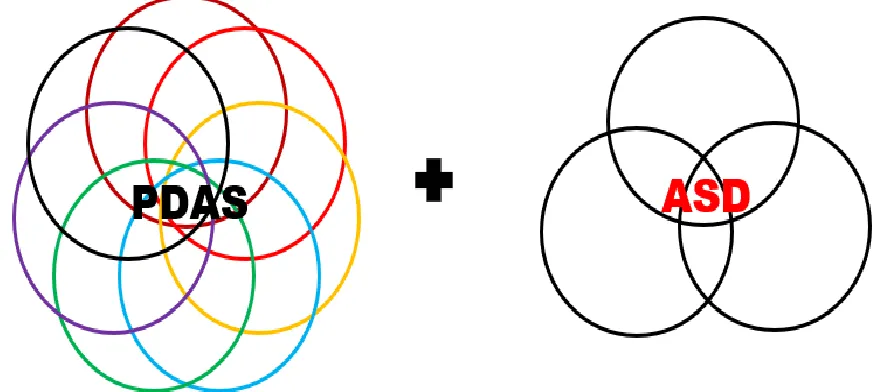
word “comorbid” in the term. An example is a comorbidity of Pathological Demand Avoidance Syndrome (PDAS) with autism, whose classical core symptoms constitute a triad of impairments in communication, social interaction and imagination. According to Newson (2002), there are six defining criteria for the syndrome: “(i) passive early history in first year and often with delayed developmental milestones; (ii) resistance to and avoidance of ordinary demands of life, especially in social and cognitive skill and also displays most obsessional preoccupation; (iii) surface sociability with an apparent lack of sense of social identity, pride or shame; (iv) lability of mood, impulsive, led by need to control in response to perceived pressure, and may turn aggressive to protest or in fear reaction, or even in affection, and any activity must be on child's terms and he/she can change mind in an instant if suspects someone else is exerting control; (v) comfortable in role play and pretending, and may appear „bossy‟ in behavior towards peers, can mimic and extend styles to suit mood, or to control events or people; (vi) language delay seems to be a result of passivity with social mimicry being more common and brief echoing in some, and often asks repetitive questions to distract, but may signal panic; and (vii) obsessive behavior; and (viii) soft neurological signs seen in the form of clumsiness and physical awkwardness” (p. 1-2). Figure 4 shows the model of a syndromic disorder of PDAS with ASD or what Chia and Camulli (2017) would have described it as a syndromic comorbid disorder. Each of the colored rings represents the defining criterion for PDAS while the three rings of ASD represent the classical triad of impairments.
Fig. 4: A model of a syndromic disorder of PDAS with ASD
Nosographical Level #V: Complex Disorders
In psychology, a complex disorder, also known as a psychological complex, is a core pattern of emotions (e.g., emotional disturbance), memories (e.g., memory deficits), perceptions (i.e., disperception4 rather than misperception),
4
Disperception refers to dysfunctional/malfunctional perception and must not be mistaken for misperception which is due to a wrong or incorrect understanding or interpretation.
and wishes (i.e., repressed/suppressed unfulfilled desires) in the personal unconscious organized around a common theme (e.g., power, status, sex) (Shultz & Shultz, 2009) (see
Figure 5). According to Ray (2015), it is “a distorted
~ 17 ~
Fig.5: A model of a complex disorder
One example of a complex disorder comes about if two or more disabilities/disorders co-exist together but they do not share common symptoms. One example is the Uriah Heep Complex Disorder consisting of three emotional dysfunctions: inferiority, sycophancy and untrustworthiness. Uriah Heep is a fictional character in Charles Dickens‟ novel David Copperfield whose character represents “cloying humility, obsequiousness, and insincerity, making frequent references to his own "'umbleness" (Wikipedia, 2018, para. 1). This name has become synonymous with sycophancy, which means obedient flattery. Figure 5 shows a model of a complex disorder.
In educational therapy, especially in educational diagnosis
of more intricating issues related to overlapping learning and/or behavioral disabilities/disorders, a complex disorder refers to a complicated set of co-existing syndromes as well as disabilities/disorder per se in one same related condition. In one interesting complex syndrome that Chia and Camulli (2017) have described in their paper is the kuklosyndromic complex – a term derived from the Greek word kuklos, which means "ring" or "circle", and syndrome comes from two Greek derivatives, i.e., syn which means “together” and
dramein which means “to run” – which is a rare
combination of overlapping disabilities/disorders such as the following autistic kuklosyndromic complex (see Figure 6).
Fig.6: Autistic kuklosyndromic complex
Nosographical Level #VI: Multiple Complex Disorders (Multiplex Disorders)
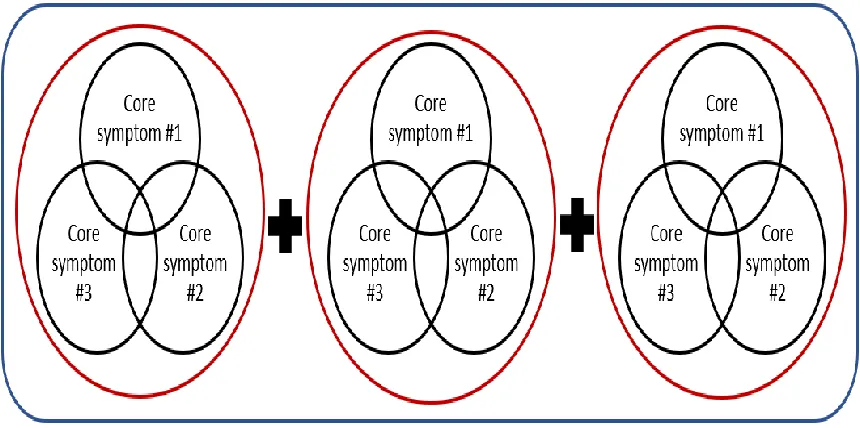
When there is a comorbidity of two or more complex disorders, they constitute a multiple complex disorder or multiplex disorder (see Figure 7). A good example is the Multiple Complex Developmental Disorder with or without
~ 18 ~
Fig.7: A model of a psychological multiplex disorder
3. Conclusion
Unlike the medical and psychological fields, the domain of educational therapy is still young and certainly new, too. It will take a long while before it is widely recognized and be taken seriously as a professional specialization that needs its own nosographical description of disabilities/disorders before establishing its own nosological classification scheme. The EDM (Pierangelo & Giuliani, 2007) has become dated and it needs to be revised and updated like DSM-5 (American Psychiatric Association, 2013) and ICD-10-CM (National Center for Health Statistics, 2003) in order to remain useful to the practitioners in the special education, specially the educational therapists and diagnosticians.
4. References
1. Ad-Dab‟Bagh, Y., & Greenfield, B. (2001). Multiple complex developmental disorder: The “multiple and complex” evolution of childhood borderline syndrome construct. Journal of the American Academy of Child and Adolescent Psychiatry, 40(8), 954-964.
2. American Psychiatric Association (2013). Diagnostic and statistical manual of mental disorders (DSM-5®). Washington, DC: The Author.
3. British Medical Association. (2002). BMA illustrated medical dictionary: Essential A-Z quick reference to over 5,000 medical terms. London, UK: Dorling Kindersley Ltd.
4. Chia, K. H., & Camulli, J. E. (2017). A proposed symptomatological-nosological classification system for learning and behavioural disruptions: What educational therapists should know from disabilities/disorders per se to multiplex disabilities/disorders. European Journal of Special Education Research, 2(6), 124-145.
5. Difference Between/Descriptive Analysis and Comparisons (2018). Difference between disability and disorder. Retrieved from:
http://www.differencebetween.info/difference-between-disability-and-disorder.
6. Dorland, W. A. N. (2011). Dorland's illustrated medical dictionary (32nd ed.). Elsevier Health Sciences.
7. Dyspraxia Foundation (2013). What is DAMP? Retrievedfrom:https://dyspraxiafoundation.org.uk/ques tions/damp/.
8. Florian, L., & McLaughlin, M. J. (2008). Disability classification in education: Issues and perspectives. Corwin Press.
9. Gillberg, C. (2003). Deficits in attention, motor control, and perception: A brief review. Archives of Disabled Children, 88, 904–910.
10. Kasten, J. (2014). Disorder, Disability or Difference: What‟s the Right Term? Retrieved from the National Center for Learning Disabilities (NCLD) website: https://www.ncld.org/archives/blog/disorder-disability-or-difference-whats-the-right-term.
11. Kiasuparents.com (2018, 8 May). There is more to
ADHD. Retrieved from:
https://www.kiasuparents.com/kiasu/forum/viewtopic. php?t=91224&f=75&sid=d9e541e743710203a2b486ca b9c590b9#p1846313.
12. Lyon, G.R., Shaywitz, S.E., & Shaywitz, B.A. (2003). A definition of dyslexia. Annals of dyslexia, 53(1), 1-14.
13. Merriam-Webster Online Dictionary (2018, 12 Apr). Disability [Updated]. Retrieved from: https://www.merriamwebster.com/dictionary/disability. 14. Merriam-Webster Online Dictionary (2018, 4 May). 2.
Disorder [Updated]. Retrieved from:
https://www.merriam-webster.com/dictionary/disorder.
15. National Center for Health Statistics (2003). International Classification of Diseases, 10th Revision, Clinical Modification (ICD-10CM). Centers for Disease Control and
Prevention (CDCP). Retrieved
from:http://www.cdc.gov/nchs/about/otheract/icd9/icd10cm. htm.
16. Newson, E. (2002). Defining criteria for diagnosis of pathological demand avoidance syndrome. Nottingham, England: Child Development Research Unit, University of Nottingham.
17. Pierangelo, R., & Giuliani, G. (2007). The Educator‟s
Diagnostic Manual of disabilities and disorders (EDM). San Francisco, CA: Jossey-Bass/John Wiley & Sons.
~ 19 ~
19. Shultz, D., & Shultz, S. (2009). Theories of Personality (9th ed.). Boston, MA: Wadsworth-Cengage Learning. 20. Starling, J., & Dossetor, D. (2009) Pervasive
developmental disorders and psychosis. Current Psychiatry Reports, 11, 190-196.
21. Wikipedia (2018, 5 May). Uriah Heep [Updated]. Retrievedfrom: