Development of Semantic-CBR
Framework for Virtual Enterprises in
Project Management
Chouyin Hsu
Associate Professor
Department of Information Management, Overseas Chinese University
Email: [email protected]
Abstract—The information communication technology definitely encouraging global collaboration among enterprises on a project basis makes virtual enterprises possible and popular. However, the existing constraints of virtual enterprises, such as distributed resources, heterogeneous data and different definition, easily resulted in many difficulties as managing a project. Accordingly, the semantic support becomes rather important as solving these problems. Therefore, Semantic-CBR framework is proposed for improving the communication and integrating the project experiences for virtual enterprises. OWL and RDF are applied for the implementation of the semantic structure of the framework. Moreover, case-based reasoning is utilized for selecting the related project experiences according to the user requirement. Therefore, the semantic support increases the understanding for virtual enterprises and enhances the facility of reasoning mechanism for project management in the research.
Index Terms
—
Case-Based Reasoning; Virtual Enterprises; Semantic Web ServiceI. INTRODUCTION
Virtual Enterprise is regarded as the most competitive management model of enterprises that faces the resource of the globe. Globalization leads to an efficient new business paradigm of virtual enterprises, where companies increasingly concentrate on their core competencies and outsource all other functions to their partners on a project basis. A temporary network aims to share
skills, resources, costs and benefits to achieve one or more projects answering to the market opportunities for products and services [16]. The advanced information technology is certainly important as processing a project in virtual enterprises since the distributed project resources and the inevitable communication barriers. Fortunately, Web services are changing the way applications communicate with each other on the web. They promise to integrate business operations, reduce the time and cost of web application development and maintenance as well as promote reuse of code over the Internet. Moreover, semantic descriptions are increasingly being used for exploring the automation features related to web services. The meaningful content and service are helpful for accurate searches as browsing the overwhelming information on Internet. Therefore, the semantic representation is rather emphasized in the research for responding the adequate project experiences for supporting further project management in virtual enterprises.
We propose the Semantic-CBR framework for integrating the previous project experiences with consistent and meaningful descriptions. Moreover, Case-based reasoning is applied for modeling the use and retrieval of previous project experiences. Case-based reasoning is an artificial intelligence methodology that uses specific encapsulated prior experiences as a basis for reasoning about similar new situations [1]. Moreover, the case structure in semantic representation is reliable for organizing the consistent content of project experiences. Therefore, developing reasoning mechanism for accurate search result becomes essential and promising mission in the proposed framework.
II. VIRTUAL ENTER PRISE AND PROJEC T MANAGEMENT
Virtual enterprises are temporary networks of independent companies, which cooperate on a short-term basis for a certain project and are perceived to be a single unit from outside.
Corresponding author. E-mail: [email protected]
Internally the companies act as partners and bring in their core competences in a synergetic way [1]. As existing organizations are challenged by new entrants using direct channels to undercut prices and increase market share, solutions have to be found that enable organizations to successfully migrate into the electronic market [3]. The advantage of virtual enterprises provides a form of cooperation of independent market players (enterprises, freelancers, authorities etc.) which combine their core competencies in order to manufacture a product or to provide a service. The innovative concept of virtual enterprises combines large pool of distributed resources and flexibility to adapt to the turbulent markets.
Virtual enterprises are mostly formed to work on a single project. Long term virtual enterprise need to be provided with an own identity and profile to offer their services to the market. A project is a temporary endeavor, having a defined beginning and end, usually constrained by date, but can be by funding or deliverables, undertaken to meet unique goals and objectives, usually to bring about beneficial change or added value. The primary challenge of project management is to achieve all of the project goals and objectives while honoring the preconceived project constraints. The nature of virtual enterprises increases the difficulties as managing the projects. Therefore, modern information and communication technologies are critically important for integrating the project processing among distributed services.
III. CASE-BASED REASONING Case-based reasoning (CBR) is a problem solving paradigm that in many respects is fundamentally different from other major AI approaches. Instead of relying solely on general knowledge of a problem domain, or making associations along generalized relationships between problem descriptors and conclusions, CBR is able to utilize the specific knowledge of previously experienced, concrete problem situations. In CBR terminology, a case usually denotes a problem situation. A previously experienced situation, which has been captured and learned in a way that it can be reused in the solving of future problems, is referred to as a past case, previous case, stored case, or retained case. Correspondingly, a new case or unsolved case is the description of a new problem to be solved. Case representation in case-based reasoning makes use of familiar knowledge representation formalisms from Artificial Intelligence (AI) to represent the experience contained in the cases for reasoning purposes. A large variety of representation formalisms have been proposed. However, three major types of case representation have arisen:
1.Feature vector fir propositional cases, 2.Structured formation for relational cases.
3.Textual representation for semi-structured cases.
4.Other specialized representations of cases for specific tasks.
Case-based reasoning is a cyclic and integrated process of solving a problem, learning from this experience, solving a new problem, etc. Figure 1 shows Aamodt & Plaza’s (1994) classic model of the problem solving cycle in CBR. The individual tasks in the CBR cycle (i.e., retrieve, reuse, revise and retain) have come to be known as the ‘4 REs’. The cyclical process is typically described as follows [1]:
RETRIEVE the most similar case(s).
REUSE the case(s) to attempt to solve the
problem.
REVISE the proposed solution if necessary. RETAIN the new solution as a part of a new
case.
A new problem is matched against cases in the case base and one or more similar cases are retrieved. A solution suggested by the matching cases is then reused and tested for success. Unless the retrieved case is a close match the solution will probably have to be revised producing a new case that can be retained.
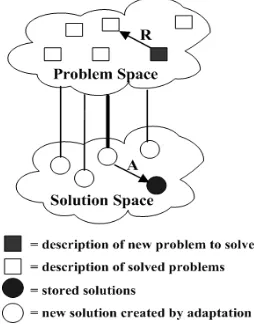
As illustrated in Figure 2, Leake (1996) expresses the role of similarity through the concepts of
Figure 1. The CBR cycle
retrieval and adaptation distances. Also captured in Leake’s diagram is the relationship between problem and solution spaces in CBR. In Figure 2, the retrieval distance R increases as the similarity between the input problem description and a stored problem description decreases, lower similarity means greater distance. A common assumption in CBR is that the retrieval distance R is commensurate with A, the adaptation distance or effort [13] The concept is helpful for constructing the project experiences for supporting further users’ requirements in the research.
IV. SEMANTIC WEB AND WEB SERVICES A web service is a software program identified by an URI, which can be accessed via the internet through its exposed interface. Also, web services can be defined as software objects that can be assembled over the Internet using standard protocols to perform functions or execute business processes. The barriers to providing new offerings and entering new markets will be lowered to enable access for small and medium-sized enterprises.
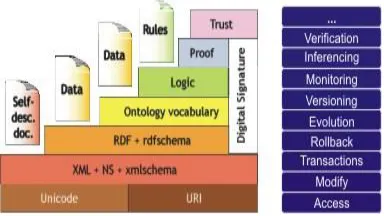
The Semantic Web layer cake shown in figure 3 was presented by Tim Berners-Lee at XML2000 Conference [2]. Both the static and dynamic parts of the Semantic Web layer are discussed as follows. On the static side, Unicode, the URI and namespaces (NS) syntax and XML are used as a basis. The Resource Description Framework (RDF) may be used to make simple assertions about web resources or any other entity that can be named. RDF Schema extends RDF with the concepts of class and property hierarchies that enable the creation of simple ontologies. The Ontology layer features OWL (Ontology Web Language) which is a family of richer ontology languages that intend to replace RDF Schema. The Logic, Proof and Trust layers aren't standardized yet.
Syntax is the structure of data and semantics is the meaning of data. Two conditions necessary for interoperability: one is to adopt a common syntax and the advantage enables applications to parse the data, and another is to adopt a means for understanding the semantics. The advantage of
semantics is to enable applications to use the data DAML (DARPA Agent Markup Language) was created as part of a research program started in August 2000 by DARPA, a US governmental research organization. It is being developed by a large team of researchers, coordinated by DARPA. DAML and OIL merging in 2001 becomes OWL W3C standard in March 2003 [13].
RDF is a data model the model is domain-neutral,
application-neutral and ready for
internationalization. RDF model can be viewed as directed, labeled graphs or as an object-oriented model (object/attribute/value). RDF Schema (RDFs) defines small vocabulary for RDF, including Class, subClassOf, type, Property, subPropertyOf, domain and range. Vocabulary can be used to define other vocabularies for your application domain. OIL extends RDF Schema to a fully-fledged knowledge representation language [9].
The dynamic aspects apply to data across all layers. It is obvious that there have to be means for access and modification of Semantic Web data. Like in all distributed environments, monitoring of data operations is needed, in particular for confidential data. Finally, reasoning engines are to be applied for the deduction of implicit information as well as for semantic validation.
As shown in figure 4, web is organized around URIs, HTML, and HTTP. Web services require a similar infrastructure around Universal Description, Discovery, and Integration (UDDI), Web Service Definition Language (WSDL), and Simple Object Access Protocol (SOAP).
UDDI provides a mechanism for clients to find web services. Using a UDDI interface, businesses can dynamically look up as well as discover services provided by external business partners. SOAP is a message layout specification that defines a uniform way of passing XML encoded data. It also defines a way to bind to HTTP as the underlying communication protocol for passing SOAP messages between two endpoints.
WSDL defines services as collections of network endpoints or ports. In WSDL the abstract definition of endpoints and messages is separated from their concrete network deployment or data format bindings.
Figure 4. Web Services enabling standards Figure 3. Static and dynamic aspects of the
Semantic web provides intelligent access to heterogeneous, distributed information, enabling software products to mediate between user needs and the information sources available [2][8]. Web services deal with the orthogonal limitation of the current web. Semantics web enabled web services have the potential to change our life to a much higher degree than the current web already has done, identifies the following elements necessary to enable efficient inter-enterprise execution: public process description and advertisement; discovery of services; selection of services; composition of services; and delivery, monitoring and contract negotiation[3]. Accordingly, the advantage of semantic web provides the conveniences to develop customized applications for virtual enterprises based on the infrastructure which are benefited by web services.
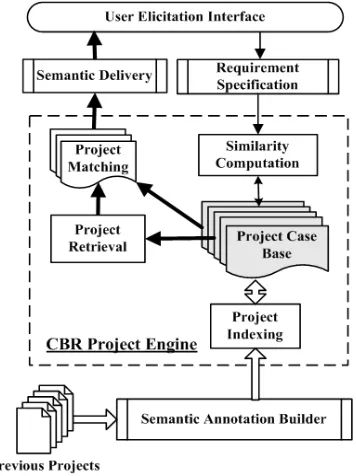
V. THE SEMANTIC-CBR FRAMEWORK We propose the Semantic-CBR framework for improving the semantic communication and understanding for virtual enterprises as processing projects. There are two main roles: CBR Project Engine that is responsible for the manipulation of Semantic Project Base and Semantic Annotation Builder that described the valued previous projects in the consistent semantic representation. Figure 5 is the schematic diagram for the proposed framework.
A. The operation of the framework
Semantic-CBR framework allows the requestor to provide project description and search for the
useful references in Semantic Project Base. The basic operation of the framework is explained as follows:
1. First, the administrator settles the Project Case Base with semantic representation formats for previous projects. The representation is used to annotate the execution experiences of web services for project solutions. Moreover, the Project Indexing module in CBR Project Engine systematically organized project descriptions and solutions with proper indexes for further efficient search.
2. Second, the requestor can input the project requirements and service references details. Then, the Requirement Specification module summaries the key requirement for Similarity Computation module to compute the similarity with previous situations in Project Case Base. Similarity Computation module can store different similarity algorithms for comparing the relations among the requirement and the previous project descriptions. Currently, the similarity assessment is performed using the nearest-neighbour technique. It processes retrieval of cases by comparing a list of weighted attributes in the target case to source cases in the CBR library [17]. The similarity measurement is shown as follows.
(1)
Where
T is the target case description S is the source case description
n is the number of attributes in each case i is an individual attribute from 1 to n f is a similarity function for attribute i in cases T and S
w is the importance weighting of attribute i 3. Third, the Project Retrieval module will select the suitable project cases based on the result of Similarity Computation module. 4. Forth, Project Matching module will
determine the proper solutions from the previous result according to user requirement. Several operations, such as sorting, ranking or classifying, for the result of Project Retrieval module are such valued for efficient references.
5. Last, Semantic Delivery module will describe the project solutions for the requestor. The advantage of semantic representation is helpful for understanding and accessing the previous project solutions. 6. After the project is finished, the valued
project information will be recorded in Figure 5. The Semantic-CBR framework
nj
i i
j
S
Wi
T
f
S
T
Similarity
1
)
,
(
)
Project Case Base with consistent semantic description by Semantic Annotation Builder module. To maintain the semantic Project Case Base is the most important mission of Semantic Annotation Builder module. Accordingly, the performance result of the framework can integrate the project experiences and help users to reuse the related part of experiences to improve the further projects. The semantic support is rather emphasized since the dynamic environment in virtual enterprise increases the difficulties of resource identification, communication, understand and sharing.
The proper structure of semantic Project Case Base can store the complete project knowledge, as well as improve the understanding among project participants in virtual enterprises. The participants including the people, systems, machines or other devices are distributed in different places.
B. The structure of a project case
The task of project management becomes rather difficult in virtual enterprises since a project is developed for solving a certain problem across different organizations. That is, different definitions, locations, data structures, and even heterogeneous cultures will confuse the participants as processing a project. Therefore, the proposed framework emphasizes the semantic representation for integrating project resources in virtual enterprises.
The major structure of Project Case Base is designed for collecting the project problems and solutions. The entire description of project problem and solution is the essential component in a case. Therefore, we adopt frame structures for case representation since frame is highly structured and modular which allows handling complexity involved in case.
A frame system is a hierarchy of frames and each frame has a name and slots. Slots have dimensions that represent lower level elements of the frame, while fillers are the value range the slot dimensions can draw from. Moreover, the natural transition between semantic web descriptions and frame structure is very important for the semantic support in virtual enterprises.
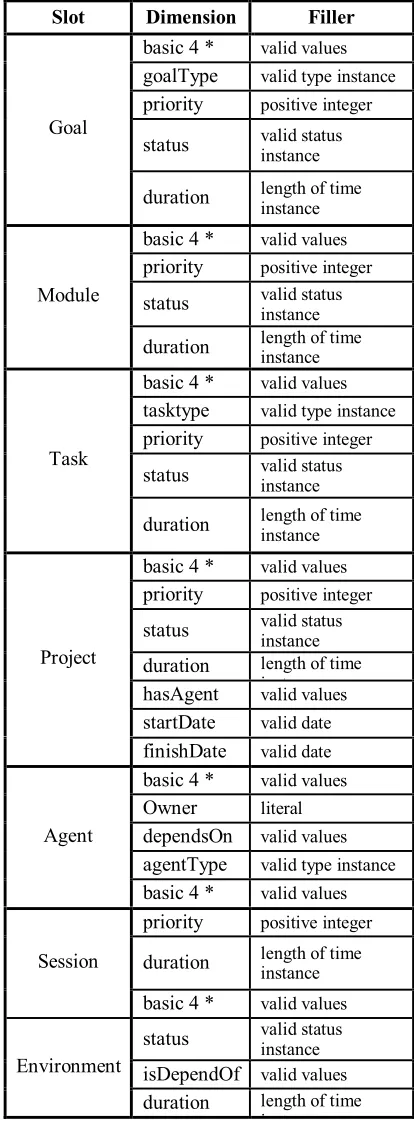
In order to improving the consistent and interoperable understanding among virtual enterprises, we refer to the project ontology designed publicly for defining the frame structure in the research [20]. Basically, Goal, Module, Task, Project, Agent, Session and Environment are proposed for slots in a case frame. Many properties are provided for the usage of dimensions, including name, logo, version, hasGoal are the basic four dimensions for all slots. More useful defined properties can be applied for the dimensions, including goalType, taskType, priority, status, duration, submittedDate, startDate, targetDate, finishedDate, dependsOn, isDependOf, isHelpedBy,
helps, has Agent, owner, report, agentType, role, hasReport and branchTag which are used for describing different slots. The dimensions are useful annotations for slots to describe more project details. An example case frame is shown in Table 1.
Table 1. The Illustration of the Case Frame structure
Slot Dimension Filler basic 4 * valid values
goalType valid type instance
priority positive integer
status valid status instance Goal
duration length of time instance basic 4 * valid values
priority positive integer
status valid status instance Module
duration length of time instance basic 4 * valid values
tasktype valid type instance
priority positive integer
status valid status instance Task
duration length of time instance basic 4 * valid values
priority positive integer
status valid status instance duration length of time
instance
hasAgent valid values
startDate valid date
Project
finishDate valid date
basic 4 * valid values
Owner literal
dependsOn valid values
agentType valid type instance
Agent
basic 4 * valid values
priority positive integer
duration length of time instance Session
basic 4 * valid values
status valid status instance isDependOf valid values
Environment
duration length of time instance
C. The semantic expression in OWL
OWL is the latest standard in ontology languages (W3C Recommendation February 2004). It is layered on top of RDF and RDFS, and has a rich set of constructs. There are three categories of OWL: OWL-Lite, OWL-DL and OWLFull [24]. The rich expression of OWLFull is useful for describing the complex relationship of project management in the research.
Not only the defined properties are useful, but al so many properties provided by OWL are meaningful for describing the meaningful relationships in the framework. For example, a relation between a project and an agent can be described as follow.
Next, iff the development of a framework is one of goals in the project, the OWL expression can be described as follows.
Some restriction expressions in OWL are also useful for illustrating the real constraints in the project. For example, the projectKK is exclusively prepared for developing the framework. The syntax of hasValue is herein useful as follows.
If some of the programming tasks are helped by AgentK, then the syntax of someValuesFrom is useful for the situation.
Otherwise, if the task of programming is exclusively assigned to AgentK, then the syntax of allValuesFrom is suitable for the situation.
Moreover, the usage of owl:intersectionOf, owl:unionOf, owl:complementOf and owl:oneOf are properly indicated the relations of intersection, union, complement, and Enumeration. Next, the cardinality constraints in OWL, containing owl:maxCardinality, owl:minCardinality, and owl:cardinality are useful for indicated for a specific number of values for that property, or to insist that a property must not occur.
In addition, OWL property characteristics, containing basic four rules, are useful for reasoning in the research.
1. Functional:- For a given individual, the property takes only one value.
2. Inverse functional:- The inverse of the property is functional.
3. Symmetric:- If a property links A to B then it can be inferred that it links B to A.
4. Transitive:- If a property links A to B and B to C then it can be inferred that it links A to C.
The OWL semantic expression capability is indeed helpful for integrating the heterogeneous project resources for virtual enterprises in the framework.
VI. CONCLUSIONS AND FUTURE WORK We have illustrate the facility of Semantic-CBR framework of using semantic web description and integrating CBR cycle to allow project experiences sharing and reuse to occur in virtual enterprises. The fundamental idea in the research is to depict the importance of semantic support for virtual enterprises in project management. The proposed framework can help avoid past errors and learn from the errors and success. Also, the system keeps a record of each situation that occurred for future reference. Then, OWL, developed as a vocabulary extension of RDF, is effective for delivering complex project experiences. The semantic and conceptual support is accordingly fulfilled by OWL and RDF in the research.
More implementation and system simulation are the essential work. We will also involve investigating the case adaptation, which is necessary when the available cases can not meet the project problem requirements. Also, the reasoning methods required improving. The fundamental idea is to depict the importance of semantic support for virtual enterprises in project management.
REFERENCES
[1] A. Aamodt and E. Plaza, “Case-Based Reasoning: Foundational Issues, Methodological Variations, and System Approaches,” AI Communications, vol.7, pp. 39-59, 1994.
<owl:ObjectProperty rdf:about=“#hasAgent”> <rdfs:domain rdf:resource=“#ProjectAA” /> <rdfs:range rdf:resource=“#AgentCC” /> </ owl:ObjectProperty >
<owl:Class rdf:ID=“Framework”>
<rdf:subClassOf rdf:resource=“#Goal” /> </ owl:Class
<owl:Class rdf:ID=“Framework”>
<rdfs:subClassOf rdfs:resource=“#Goal” /> <rdfs:subClassOf>
<owl:Restriction>
<owl:onProperty df:resource=“#dependsOn”/> <owl:hasValue rdf:resource=“#ProjectKK”/> </owl:Restriction>
</rdf:subClassOf> </owl:Class>
<owl:Class rdf:ID=“Programming”> <rdfs:subClassOf rdfs:resource=”#Task" />
<rdfs:subClassOf> <owl:Restriction> <owl:onProperty
rdf:resource=“#isHelpedBy”/> <owl:someValuesFrom
rdf:resource=“#AgentK”/>
</owl:Restriction>
[2] T. Berners-Lee, J. Handler and O. Lassila, “The Semantic Web,” Scientific American, May 2001.
[3] C. Bussler, “The Role of Workflow
Management Systems in B2B Integration,” In Proceedings of the Fourth International Conference on Electronic Commerce Research (ICECR-4), Dallas, TX, USA, November 2001. [4] J. M Burn,. and M. L. Barnett,
“Communicating for Advantage in the Virtual Organization,” IEEE Transactions on
Professional Communication, vol.42, no.4, pp.1-8, 1999.
[5] J. Byrne, “The Virtual Corporation,” Business Week, Feb 8, pp. 98-104,1993.
[6] L. Cabral, J. Domingue, E. Motta, T. Payne, and F. Hakimpour, “Approaches to Semantic Web Services: An Overview and
Comparisons,” 1st European Semantic Web Symposium, Heraklion, Greece, 2004. [7] D. Fensel, “The Semantic Web and Its
Languages,” IEEE Intelligent Systems, vol. 15, no. 6, pp. 67–73, 2000.
[8] D. Fensel , J. Hendler, H. Lieberman, and W. Wahlster, (eds.), “Semantic Web Technology,” MIT Press, Boston, 2002.
[9] F. Gandon and N. Sadeh, “Semantic Web Technologies to Reconcile Privacy and Context Awareness,” Web Semantics Journal, Vol.1, No.3, 2004.
[10]F. Gandon and N. Sadeh, “Semantic Web Technologies to Reconcile Privacy and Context Awareness,” Web Semantics Journal, vol. 1,no. 3, 2004.
[11]H. J. ter Horst, “Completeness, decidability and complexity of entailment for RDF Schema and a semantic extension involving the OWL vocabulary,” Journal of Web Semantics, vol. 3, pp. 79–115, 2005.
[12]J. Kolodner, “Case-Based Reasoning,”
Morgan Kaufmann Publishers, San Mateo, CA, 1993.
[13]O. Lassila, and R. Swick, “Resource Description Framework (RDF) Model and Syntax Specification,” W3C Recommendation, World Wide Web Consortium, Feb. 1999.
[14]DB. Leake, “CBR in Context: The Present and Furture,” Case-Based Reasoning Experiences, Lessons, & Future Directions, pp. 3-30, AAAI Press, 1996.
[15]M. Lenz, and H.D. Burkhard, “Case retrieval nets: Basic ideas and extensions,” in KI-96: Advances in Artificial Intelligence, Berlin: Springer, pp. 227–239,1996.
[16]A. Mowshowitz, “Virtual Organization,” Communications of the ACM, vol.40, No.9, 1997.
[17]Project Management Institute, A Guide to the Project Management Body of Knowledge, fourth Edition (PMBOK Guides), 2009. [18]E. Sirin, J. Hendler, and B. Parsia,
“Semi-automatic composition of Web services using semantic descriptions,” In Proceedings of Web Services: Modeling, Architecture and
Infrastructure, 2002.
[19]I. Watson, Applying Case-Based Reasoning: Techniques for Enterprise Systems, Morgan Kaufmann Publishers, Inc., San Francisc,1997. [20]SchemaWeb,
http://www.schemaweb.info/default.aspx
[21]Semantic Web layer cake:
http://www.w3.org/2004/Talks/0412-RDF-functions/slide4-0.html.
[22]W3C, Semantic Web, URL:
http://www.w3.org/2001/sw/,2002
[23]W3C, RDF, http://www.w3.org/RDF/,2004
[24]OWL Web Ontology Language Reference,
http://www.w3.org/TR/owl-ref/
Chouyin Hsu received the M.S. degree in computer