ISSN (Online): 2320-9364, ISSN (Print): 2320-9356
www.ijres.org Volume 1 Issue 5 ǁ Sep. 2013 ǁ PP.46-50
Proceed Requirements Meta-Model For Adequate Business
Intelligence Using Workflow
Bami Khadija
1, Ziyati Elhoussaine
1, Khalid Bouragba
1, Ouzzif Mohamed
11
(RITM laboratory, Computer Science and Network Team ENSEM-ESTC-UH2C Casablanca Morocco)
ABSTRACT
:
MDA (Model Driven Architecture) [5] is presented as an approach to system specification, defined by the use of several formal models in order to describe the complete lifecycle of applications. Beside, many conceptual methods have been exposed to solve different parts of a Data Warehouse (DW) system. However, they do not cover all the process, they are a partial solutions dealing with subset of DW aspects and do not offer designers an integrated method to oversee different stages of DW (Data Source, ETL process, DW repository and so on).based on these models we apply multidimensional model to manage high level specification designed as a workflow. In this paper, we explain briefly the dependently concepts of Data Warehouse and propose a model to check and control properties during data warehouse design based on generic CIM, PIM and PSM.Keywords
–
MDA, ORM, Warehouse,reliability, MaintainabilityI.
INTRODUCTION
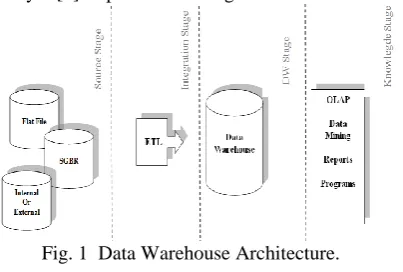
The architecture of a DW is usually depicted as a multi-tier system in which data from one layer is derived from data of the previous layer [2] as presented in Figure. 1.
Fig. 1 Data Warehouse Architecture.
Such proposition has been presented for solving such a level of DW (ETL process or dimensional modeling (MD)). Interoperability and integration may produce additional problems. [3] Try to deal these problems by proposing a method based on UML (Unified Modeling language) [4] and the UP (Unified Process).
MDA [5] looks ideal for this task to design the complete lifecycle of developing applications by using models in software development; it is a standard for defining requirements, and non-functional conditions that should be taken in consideration, such as reliability, security and maintainability.
As known in other hands Workflow Management Systems enable the automation of business operations by allocating and dispatching work according to process models [6], it may contain a set of activity and an activity may be associated with different process definitions. So Business process such as data warehouse performance can be measured in terms of a workflow’s temporal properties, based on this we will affect at each stage a set of requirement given by the designer.
So the goal of this paper is to verify that the implementation worked as desired in term of a set of requirements and specifications.
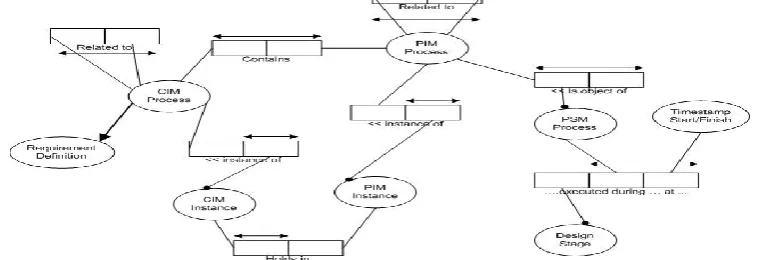
Fig. 2 Metamodel workflow for MDA using ORM and instance
There are many works implying MDA in DW design, [7]-[8] align the design of Data warehouse with MDA process, the model Driven data warehouse, this is for one level (ETL e.g.) or all levels. Also [15] define a framework using MDA, the main idea at this point is once the platform independent specifications are developed the rest of models from them can automatically derived by corresponding transformations, they define set of non-functional – requirement for design process. This interaction between MDA and DW is benefit, in the end of process, DW schema is generated, others benefits of this junction are:
Business perspective: focus on developing conceptual models. Portability: adopted for different technologies.
Adaptability: since PIM as described above is Independent platform.
In other hands, computer dependability [15] a set of concepts involving reliability, availability, security and maintainability. Capturing non-functional requirements without implying them into the conceptual model for different levels may cause problems, so it is recommended to involve and measure theses dependability components throughout the phases of data warehouse design based on their importance.
As an example for this requirement Security; security policy known to ensure authorization on the DW scheme. Authors in [17], defines a model which propose a security concept for OLAP. According to these security rules, a restriction of data is related to each role. In [18] authors show how security policy for both stages DW and OLAP focus specifically on expressiveness and usability, but only focus on acquisition, storage and on the front-end side. None of them examine the representation of security at the early stages of the DW design.
Other proposition [19] a security design methodology similar to the classical database methodology (requirement analysis, conceptual, logical and physical design) which covers requirements and concrete implementations in commercial systems.
In addition to security many aspects can be treated in the same way, and satisfy all requirements for different layer of conception and cover all stages.
III.
P
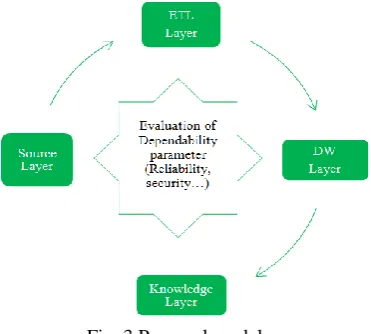
ROPOSAL MODELFig. 3 Proposal model
The framework will deal with three dimensions stages, dependability and finally timestamp. Figure. 4 depict these dimensions with hierarchies.
Fig. 4 Dimensional schema of our approach
The cost of dependability is not covered at this stage, a simplified cost is adopted by considering exist or not during a process or the percentage importance.
As shown in Figure. 5, Dependability is considered as a dimension where we define a hierarchy (CIM>PIM>PSM Higher level to lower level) of aggregation, for dimensional Modeling.
As an example for the data in MDA (dependability) dimension is shown as follow in figure 5:
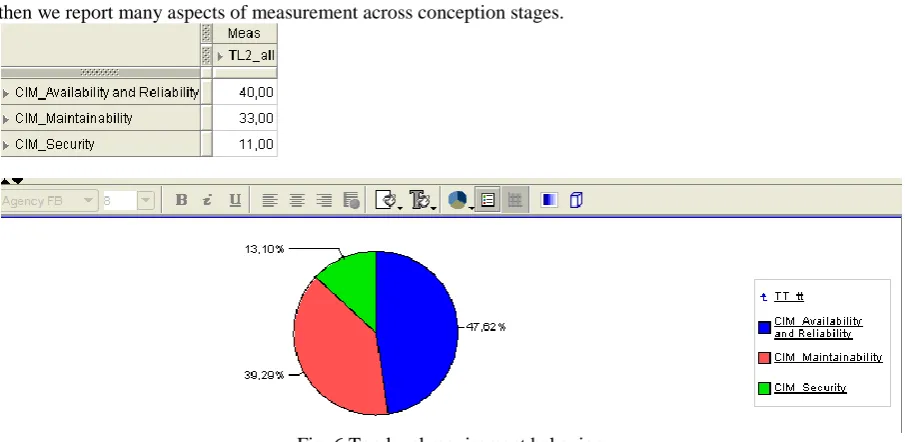
Fig. 6 Top level requirement behavior
Figure. 6 gives a global vision for the whole process of design by considering Reliability, maintainability and security throughout the project design (Data Source, DW, ETL…), thus, a comprehensive view of the behavior of the rules imposed initially.
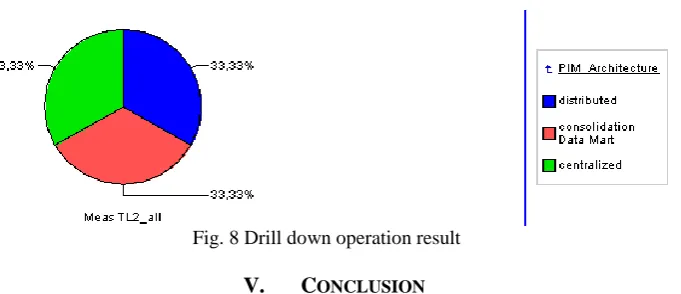
Drill down to specify a dependant factor to see its impact and behavior for all stages during time will give other additional information to designer for balancing requirements Figure. 7.
Fig. 7 Example of specified requirement‘s measures for all DW stages
Fig. 8 Drill down operation result
V.
C
ONCLUSIONIn this paper, we presented some research works which focused on the DW design using MDA approach. Those works were proposed for limited parts of DW. In fact, we present a framework schema to imply and oversee different requirements involved for designers during DW lifecycle. Experiments are then exposed to prove the usefulness of our method, thus, administrator can verify at any stage of DW process the correctness of his proposition overlooked to the earlier specification. As future work, we propose to enhance our framework by dealing with an effective cost of each specification such as (security, availability…).
This work gives the opportunity to measure the accuracy to a designed data warehouse, up to now directly adopted after design for a given enterprise
VI.
Acknowledgements
This work has been supported by RITM laboratory research group unity in association with ENSEM institute (National School of Electricity and Mechanics), Support for the carrying out doctoral study program’s and support for the development of doctoral studies at Hassan II, Ain chock.
R
EFERENCES[1] Jacobson I., Booch G., Rumbaugh J. The Unified Software Development Process. Object Technology Series. Addison-Wesley. 1999.
[2] Jarke, M., Lenzerini, M., Vassiliou, Y., Vassiliadis, P. Fundamentals of Data Warehouses. Springer. 2000.
[3] Luján-Mora S., Trujillo J. A Data Warehouse Engineering Process. Proc. of the Conference on Advances in Information Systems (ADVIS’04). Lecture Notes in Computer Science, Izmir, Turkey, October 2004. Springer-Verlag.
[4] Object Management Group Language Specification 1.5. http://www.omg.org/cgi- bin/doc?formal/03-03-01 [5] J. Miller and J. Mukerji, MDA guide version 1.0.1, 2003.
[6] [1]Workflow Management Coalition. Workflow Reference Model, January 1995.
[7] Poole J. Model Driven Data Warehouse (MDDW). www.cwmforum.org/POOLEIntegrate2003.pdf, 2003.
[8] J.Mazón, J.Trujillo, An MDA approach for the development of data warehouses, An MDA approach for the development of data warehouses, 1st issue, Vol. 45, Elsevier Science Publishers, 2008.
[9] OMG Common Warehouse Metamodel (CWM) Specification 1.0.1. http://www.omg.org/cgi-bin/doc?formal/03-03-02, 2002. [10] Almeida, J.P.A., 2006, Model Applications, Ph.D. Thesis, Centre for Telematics and Information Technology, University of
Twente, Netherlands.
[11] Kim, H., 2008, Modeling of Distributed SyMDA, IAENG International Journal of Computer Science, 35:4, 20 November 2008 [12] Vidales, M.A.S., García1, A.M.F., and Aguilar, L.J., 2008, A new MDA approach based on BPM and SOA to improve software
development process, Tékhne, 2008, Vol VI, ISSN: 1645-9911.
[13] Pokraev, S.V., 2009, Model-Service-Oriented Applications, Ph.D. Thesis, Centre for Telematics and Information Technology, University of Twente, Netherlands
[14] J.-N. Mazón, J. Trujillo, M.A. Serrano, M. Piattini, Applying MDA to the development of data warehouses, Proc of DOLAP 2005, ACM 8th International Workshop on Data Warehousing and OLAP, Bremen, Germany, November 4-5, 2005, Proceedings [15] I. Hilal, R. Hilali, M. Ouzzif Modeling Dependability of Data Warehouse System, IJCSIS, International Journal of Computer
Science and Information Security, Vol. 11, No. 6, June 2013, pp 47-54. [16] www.oracle.com fr technologies datawarehousing
[17] R. Kirkgöze, N. Katic, M. Stolba, A.M. Tjoa, Asecurity concept for OLAP, in: Proc.8th International Workshop on Database
and Expert System Applications (DEXA’97), Toulouse, France, 1997, pp. 619–626.
[18] W. Essmayr, E. Weippl, F. Lichtenberger, W. Winiwarter, O. Mangisengi, An authorization model for Data Warehouses and OLAP, in: Workshop on Security in Distributed Data Warehousing, in Conjunction with 20th IEEE Symposium on Reliable Distributed Systems (SRDS’2001), USA, 2001, pp. 9–13.
[19] T. Priebe, G. Pernul, Towards OLAP security design – survey and research issues, Proc. the 3rd ACM International Workshop on Data Warehousing and OLAP (DOLAP’00), VA, USA, 2000, pp. 33–40.