Data Dissemination Methods in Wireless Sensor
Networks: A Survey
S.Raj Barath Anuja Sajeev
Assistant Professor UG Scholar
Department of Electronics Communication Engineering Department of Electronics Communication Engineering CCET, OddanchatramTamilnadu – 624619 R.V.S College of Engineering
Ditty Tom Lissa Sebastian
UG Scholar UG Scholar
Department of Electronics Communication Engineering Department of Electronics Communication Engineering R.V.S College of Engineering R.V.S College of Engineering
Abstract
The main purpose of Wireless Sensor Networks(WSN) is to aggregate data from natural and manmade resources. In this process various sensor nodes senses data and disseminates them to the data aggregation centre termed as Sink node, which acts as a bridge between real time and digital world. This data dissemination process must be proper without node failures, data loss, and redundant occurrence of packets in order to provide a better Quality Of Service (QOS). Various data dissemination schemes in WSN are studied in this paper aiming to achieve a better QOS in the platform of data aggregation.
Keywords: Data Dissemination, Smart home, Smart Grid, Network Reprogramming, Quality of Service
________________________________________________________________________________________________________
I. INTRODUCTION
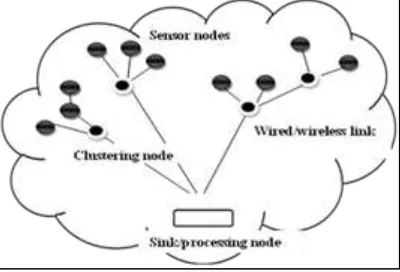
Wireless Sensor Networks (WSNs) are the type of networks with distributed autonomous sensors. They are one of the largest growing types of networks today.They are used in several areas including environmental monitoring, battlefield management, emergency response, medical monitoring and management. They also play an important role in areas like agriculture and industries as well. These are reliabile, cost effective, easily deployable. They contains number of nodes and each of the nodes having a number of sensors , processors and radios are operated by battery power and arranged in an ad-hoc manner.
Fig. 1: Architecture of wireless sensor network
In wireless sensor network data and queries are routed this process is called data dissemination. A source node is the node where data is generated and these information is transmitted to another node. Node which is interested in data called the sink node . After receiving a message from the sink the source transmit the data or event to sink.
II. DATA DISSEMINATION
(IJSTE/ Volume 2 / Issue 10 / 050)
Wireless Sensor Networks is a wide and open area in networking research, which is increasingly being deployed for monitoring applications. This demands the need for quickly and efficiently disseminating data and code to sensor nodes to reprogram them to suite the current needs of the application. This is achieved by making use of data dissemination protocols. In this paper, a brief survey work is done on the existing various data dissemination methods for wireless sensor networks.
III. DATA DISSEMINATION METHODS
The data dissemination is an important building block for wireless reprogramming. Dissemination for reprogramming is required to be fast and energy efficient.
Tiny Os: an Operating System for Sensor Networks
TinyOS is a tiny, flexible operating system from a number of reusable components that are assembled into an application specific System. A Tiny OS program is a graph of components. Commands events and tasks are the computational abstractions of the component.
The execution model consists of run-to-completion tasks that represent the ongoing computation.The scheduler can execute tasks in any order, but must follow the run-to -completion rule. The standard TinyOS scheduler follows FIFO mechanism Merits:TinyOS provides an efficient, flexible platform for developing sensor network algorithms, systems, and full applications. Demerits:Tiny OS cannot be used for higher level –real time operations.
Protocols for Self-Organization of A Wireless Sensor Network
Wireless sensor networks are growing information technology constructs which overcome the limitations of the traditional wired network and provide universal mode of information connectivity. A sensor network must be able to operate under very dynamic conditions. Specifically the protocols[2] must be able to enable network operation during start-up, steady state, and failure.
Steps involved :
SMACS –The Self-organizing Medium Access Control for Sensor networks for the network startup and link layer organization. EAR - the Eavesdrop And Register algorithm will be presented.Thisalgorithm enables seamless connection among the mobile nodes.
SAR - Sequential Assignment Routing algorithm that facilitates and Single- and Multi-Winner Election algorithms that takesdata transfer tasks in the networks.
Merits:
The algorithms exploits the low mobility and abundant bandwidth.
Demrits:
some layering of signal processing functions is required to produce energy-efficient operation.signal processing algorithms are expensive
Canopy Closure Estimates with Greenorbs:Sustainable Sensing In The Forest
Canopy closure, defined as the percentage of vertically shaded ground area by overhead foliage [3], is used to indicate the conditions of a forest ecosystem.The measurement procedures are also restricted by the subjectivity of the surveyor, the landform and the undergrowth. Therefore conventional approaches does not provide accurate estimateS.To overcome this,GreenOrbs [1] are used, In GreenOrbs, a number of commercial off-the-shelf programmed sensor nodes are deployed in the forest.
Steps involved :
Canopy Closure Estimates
Due to the lack of accurate measurement approaches, canopy closure is restricted. ground and aerial measurements are the existing approaches.[3,5]
System Framework –Theoretical Foundation
Canopy closure estimates with GreenOrbsare based on the Monte Carlo Theory [10].
Design
The design of GreenOrbs mainly consists of three components: a) Pre-deployment Training
b) Online Data Processing c) Sink-side Data Translation
Merit :
Canopy closure estimates are a fundamental task in ecosystem management, theGreenOrbsmethod helps to WSN deployments in forest ecosystem.
The Dynamic Behaviour of A Data Dissemination Protocol for Network Programming at Scale
A node operates in three states: MAINTAIN, RX, or TX.The MAINTAIN state is responsible for (i) the newest version of the object profile and (ii) all available data for the newest version.A node in the RX state actively request the remaining packets to complete page. Each request operates as a selective negative acknowledgment (SNACK)[4].
To gather data,a testbed consists of Mica2-dots, a Tiny OS supported hardware platform.Each node contains a 7MHz, 8-bit microcontroller as CPU, which offers 128KB program memory and 4KB RAM.A 512KB external flash chip used for storing application generated data.The Mica2-dot transmits about 37 packets per second at a size of 36 bytes each.
Merits:
Deluge propagates large data objects from one or more source nodes to many other nodes over a multihop WSN. Deluge can reliably disseminate data to all nodes at a rate of 90 bytes/second.
Demerits:
Very hard to improve the rate obtained by Deluge.
Exploring Link Correlation for Efficient Flooding in Wireless Sensor Networks
In WSN, flooding is a protocol that delivers a message from one node to other node.Every node estimates its transmission effectiveness based on three factors: (i) neighborhood size, (ii) link quality, and (iii) link correlation among neighboring nodes. The most effective node will start to rebroadcast.
Key Mechanisms in Collective Flooding
Collective Flooding (CF) is to reduce redundant transmissions in a network.There are two key mechanisms in the CF protocol: Collective ACKs: In CF, the rebroadcasting not only indicates that the node has received the packet, but also a collective
ACK of reception for the neighboring nodes.
Dynamic Forwarder Selection: The forwarder is selected dynamically through competition among nodes that already receive the broadcasting packet.
Steps involved:
Standard Flooding (FLD): Every node rebroadcasts the first-time received packet exactly once.
Reliable Broadcast Propagation (RBP): In every unconditional rebroadcasts, received packet adjusts the number of retries based on the neighborhood density.
Merits:
CF provide efficient and reliable message dissemination with low complexity.CF protocol has low dissemination delay, and high reliability in unreliable wireless environments.
Correlated Flooding in Low-Duty-Cycle Wireless Sensor Networks
To ensure service continuity, a sensor network operates at a very-low-duty-cycle[6]. Low-duty-cycle operation reduces the performance of many network operations.Due to the loss of connectivity the performance of flooding gets degraded.Each node is duty-cycled with two states, the active state and the dormant state.
Correlated Flooding is divided into two- the sender side and the receiver side.In sender side, it divides all its possible flooding receiver nodes into groups.Nodes within the same group are highly correlated.The node with the worst link quality in the group is named as the critical node or the c-node. Due to the limited number of ACKs only the c-nodes send ACKs back to the sender.We select the optimal sender from which a node receives the flooding message,to minimize the expected energy consumption for receiving ACK.
Design and Implementation of A Wireless Sensor Network For Smart Homes
Hardware design :
Coordinator and network node are key components of the system. ZigBee module is responsible for sending the messages to the family network. Hardware system design development of the network coordinator and the ZigBee node is important.
Software design:
a) Monitoring Software: it adopts C/S architecture based on Socket communication mechanisms of TCP/IP protocol written by C# language.
b) Node Software: cordinator node software realizes the collection and transmission of data. connect to other modules.
Routing algorithm:
By using an improved Dijkstra algorithm which determine the shortest path in the network.
Merits:Provide feasible routing for smart home systems.It solve the problem of optimal path selection in a wireless network.
Security Analysis and Improvement of A Secure and Distributed Reprogramming Protocol(Sdrp) for Wireless Sensor Networks for Design
(IJSTE/ Volume 2 / Issue 10 / 050)
Merits: compared to Deluge, Rate less Deluge has reducing latency at moderate levels of packet loss. A user may want to hide his/her reprogramming privacy from anyone else.The identity based signature algorithm for security and efficiency consideration.
Demerits: Inherent weak design in the user pre-processing phase.
Opportunities And Challenges of Wireless Communication Technologies for Smart Grid Applications
Smart Grid provide modernization of the electricity delivery system. Major Challenges
1) 1.Develop interoperable communication protocols .
2) 2. Determine suitable communication technologies for smart grid communication infrastructure. 3) 3. Cyber security for intra-domain and inter-domain communication interfaces.
Applications
Wireless LAN
1) Increased transformer differential protection 2) Communication aided line protection
Cellular
1) SCADA interface for remote distribution substation 2) Metering and Monitoring of remote DERs
ZigBee
1) To Control home appliances 2) Direct load control
Other Potential Wireless Technologies
1) Mobile Broadband Wireless Access IEEE 802.20 standard 2) Digital Microwave Technology
3) Bluetooth
Merits:Low installation cost, mobility, remote location coverage, rapid installation. Demerits:.They are costly
Link Correlation Aware Data Dissemination in Wireless Sensor Networks
CD employs a Novel Structure called Correlated Tree, which explicitly considers both Link Correlations and Link Qualities or Efficient Dissemination.
The Initialization phase:
The network nodes transmit and exchange necessary control information. The sink node initiates a flooding for each network node to obtain its hop count.
Correlated tree construction phase:
In this phase, nodes construct a correlated tree in a distributed manner.
Coding decision phase:
Here,each node builds a model to estimate the transmission delay in its group in order to decide whether to employ rateless codes.
Data dissemination phase:
CD disseminates the bulk data according to the established correlated tree and transmission strategy.
Merits: CD improves the dissemination performance in terms of completion time, transmissions and energy consumption. Demerits: When the wireless is highly dynamic during the dissemination, CD’s performance will degrade.
IV. CONCLUSION
Wireless Sensor Networks is a wide and open area in networking research, which is increasingly being deployed for monitoring applications. This demands the need for quickly and efficiently disseminating data and code to sensor nodes to reprogram them to suite the current needs of the application. This is achieved by making use of data dissemination protocols. In this paper, a brief survey work is done on the existing various data dissemination methods for wireless sensor networks aiming to achieve better Quality of Service in data aggregation.
REFERENCES
[1] P.Levis, S.Madden, J.Polastre, R.Szewczyk, K.Whitehouse, A.Woo, D.Gay, J.Hill, M.Welsh ,Brewer, “Tinyos: An operating system for sensor networks,” Ambient Intelligence, vol.35, pp. 115-148, 2005.
[2] K. Sohrabi, J.Gao, V.Ailawadhi, and G.J.pottie, “Protocols for self organization of a wireless sensor network,” in Proc. IEEE INFOCOM, 2008, pp. 1247-1255.
[5] T. Zhu, Z. Zhong, T. He, and Z. Zhang, “Exploring link correlation for efficient flooding in wireless sensor networks,” in Proc. USENIX NSDI, 2010, pp. 49-64.
[6] S. Guo, S. Kim, T.Zhu, Y. Gu, and T.He, “Correlated flooding in low-duty-cycle wireless sensor networks,” in Proc. IEEE ICNP, 2011, pp. 383-392. [7] Ming Xu, Longhua Ma, Feng Xia, Tengkai Yuan, “Design and implementation of a wireless sensor network for smart homes”, Seventh international
conference on Autonomic and trusted computing (UIC/ATC), 2010
[8] D. He, C. Chen, S. Chan, J. Bu, and L. T. Yang, “Security analysis and improvement of a secure and distributed reprogramming protocol for wireless sensor networks,” IEEE Trans. Ind. Electron., vol. 60, no. 11, pp. 5348-5354, 2013.
[9] Palak P Parikh, Mitalkumar G Kanavar, Tarlochan S Sidhu, “Opportunities and challenges of wireless communication technologies for smart grid applications,” inIEEE Power and Energy Conference 2010.
[10] Zhiwei Zhao, Wei Dong, Jiajun Bu, Yu Gu, Chun Chen, “Link correlation Aware data dissemination in wireless sensor networks”,IEEE Trans .Ind. Electron., vol.62, issue 9, Sep. 2015
[11] L. Huang and S. Setia, “Cord: Energy-efficient reliable bulk data dissemination in sensor networks,” inProc. IEEE INFOCOM, 2008,pp. 1247–1255. [12] W. Dong, Y. Liu, C. Wang, X. Liu, C. Chen, and J. Bu, “Link quality aware code dissemination in wireless sensor networks,” in Proc. IEEE ICNP,
2011, pp. 89–98.
[13] S. I. Alam, S. Sultana, Y. C. Hu, and S. Fahmy, “Syren: Synergistic link correlation-aware and network coding-based dissemination in wireless sensor networks,” in Proc. IEEE MASCOTS, 2013,pp.485–494.
[14] N. Accettura, M. R. Palattella, G. Boggia, L. A.Grieco, and M. Dohler, “Decentralized traffic aware scheduling for multi-hop low power lossy networks in the internet of things,” in Proc. IEEE WoWMoM, 2013, pp.1–6.
[15] R. Sivakumar and I. F. Akyildiz, “Garuda: Achieving effective reliability for downstream communication in wireless sensor networks,” IEEE Trans. Mobile Comput., vol. 7, no. 2, 2008.