ISSN (e): 2250-3021, ISSN (p): 2278-8719 Vol. 08, Issue 4 (April. 2018), ||VI|| PP 28-35
An Efficient Multi-Modal Biometric Verification System Using
FKP and Iris
Sukhdev Singh
[1], Chander Kant
[2]1- 2
(Department of Computer Science & Applications Kurukshetra University, Kurukshetra, Haryana, India) Corresponding Author: Sukhdev Singh
ABSTRACT: Today an extensive range of systems require sophisticated identification to verify or determine the identity of a person. The principle of these systems is to make sure that the services provided are accessible by a genuine user only. In this paper, an efficient and robust multi-modal biometric system is proposed that used Finger Knuckle Print (FKP) and iris as input biometric modalities for verification. To extract feature set from FKP, scale invariant feature transform (SIFT) and speeded up robust features (SURF) methods are used. Log-Gabor Wavelet is used to extract iris feature set. In proposed system, matching scores of two biometric modalities FKP and iris are fused for verification. The performance of proposed system has been examined by public database PolyU for FKP and CASIA iris database in MATLAB R2009a.
KEYWORDS: FKP, Feature Extraction, Fusion, Iris, SIFT, SURF.
--- Date of Submission: 05-03-2018 Date of acceptance: 12-03-2018
---I. INTRODUCTION
Biometrics is the safest method to meet the digitization necessities of identity and virtualization in the field of information society. It refers to the automated authentication of a person through the use of physiological or behavioral traits [1]. Such as fingerprint, iris, face, finger knuckle print, signature, palm print, voice, and hand etc. Practically, no modality is best as each modality has its own merits and demerits. Biometric systems are used in authentication to reduce financial fraud and increase security in various fields. In many applications for authentication or verification, two biometric modalities are used to achieve high performance and high security. These systems are called multi-modal biometric systems and these are considered more reliable due to multiple biometric modalities [2]. From the start of this technology, the fingerprint is considered as one of the most popular forms of biometric technology than others. Recently the Finger Knuckle Print has proven to be a robust biometric identifier for authentication. Researcher has found that finger knuckle print is correlated modality with a fingerprint. Finger-knuckle print is one of the emerging and more secure biometric modality. This motivated to propose a new efficient multimodal verification method using FKP and Iris. Multibiometric systems were introduced to overcome few of the limitations of uni-biometric systems. Multibiometric system works by using multiple sensors or multiple algorithms. A multibiometric system where we use multiple modalities of the same user for identification is called as a multi-modal biometric system [6-7]. In the multi-modal biometric system, it is impossible for an imposter to spoof multiple biometric modalities of a genuine user to get access to the system. In this paper, FKP refers to the outside of the finger phalange joints which has creases pattern [3-4]. Secondly, Iris recognition is a type of biometric technology, which uses iris as an accurate, secure and unique biometric modality. Iris recognition has got too much concentration in the past decade because of its characteristics such as high speed, high accuracy etc [5]. In this paper, we extract the feature set from both modalities and fuse them using match score fusion. Fusion of different modalities provide trustworthy biometric performance particularly for high-security concern processes like immigration process, Internet banking process, access of government issue documents, to control the crucial access, crossing from one border to another etc. Multi-modal biometric fusion levels are classified into two categories: (i) fusion before matching and (ii) fusion after matching. The sensor level fusion and feature level fusion are called fusion before matching. The match score level fusion and decision level fusion are called fusion after matching. The organization of the paper is as follows, section II illustrate related work. Section III illustrates the proposed multi-modal biometric method. Section IV describes the results of the proposed method. At last, the conclusion is given in the V section.
II. RELATED WORK
90% at EER 0.13%. Chaudhary et al. [15] proposed a robust multimodal biometric recognition system that integrates iris, face, and voice. The merging of three biometric features takes place at the match score level. The performance of the proposed system is compared with each of the three individual biometric characteristics when plotting the ROC curves. These curves show that fusion of multiple biometric data improves recognition performance over individual biometrics. Zhang et al. [16] presented a novel approach based on LGIC for FKP recognition. They extracted local orientation by Gabor filters and achieved competitive coding scheme as the local feature. LGIC develop both local and global features from FKP verification. Their experiment result shows that this scheme could achieve the best performance in terms of EER
III.PROPOSED WORK
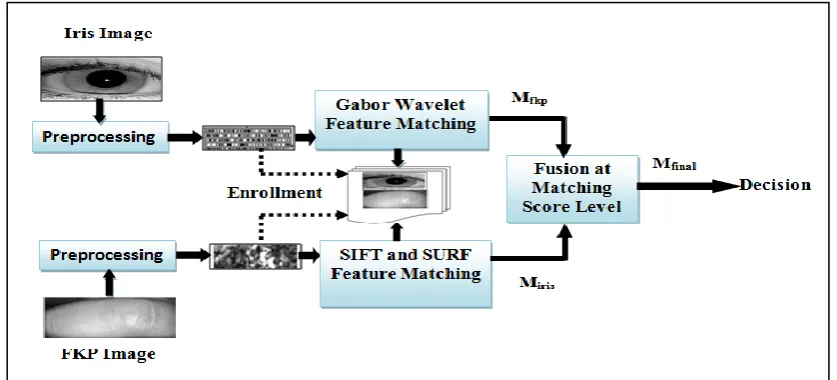
In this paper, a novel method is designed for human verification using FKP and Iris. Figure 1 describes the fundamental architecture of the proposed method for an efficient, robust multi-modal biometric verification system using FKP and Iris biometric modalities.
Figure 1. Architecture of the proposed multimodal recognition method.
A. Proposed FKP Recognition Method
Figure 2. Architecture of proposed FKP recognition method.
a) Enhancement Of FKP Image
The surface of the knuckles represents a surface of curvature and produces irregular reflections. Finger knuckle image has a little contrast and an uneven intensity. To achieve a well-distributed texture image the following action has been applied to the FKP image: (a) image divided into sub-blocks 10*10 pixels to estimate the reflection of the block. (b) bi-cubic interpolation is used to expand estimate coarse reflection for FKP original size. (c) Subtraction of estimated reflection to obtain the regular intensity of FKP. (d) Improve the contrast of blocks 10*10 of FKP texture through histogram equalization.
b) Feature Extraction Of FKP
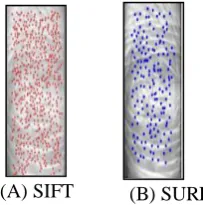
The features are extracted from FKP images using SIFT and SURF. Both SIFT [17] and SURF [18] were designed to extract highly distinctive invariant features from images. The key SIFT and SURF points extracted from the FKP images are shown in Figure 3. SIFT algorithm involves mainly four steps, which are following:
Step 1: Find out the approximate location and scale of salient key-points Step 2: Filter their location and scale
Step 3: Find orientation for each key-point. Step 4: Find descriptors for each key-point.
Two major steps involve in SURF algorithm to find out the key-points as following: Step 1: Key-points Detector
Step 2: Key-points Descriptor
(A) SIFT (B) SURF
Figure 3. Key-points extracted using SIFT & SURF
c) Matching And Fusion Of FKP Feature Vector
The features of FKP is represented by the feature vector of local features extracted with SIFT and SURF algorithm. The matching scores between the corresponding feature key-points are calculated using the nearest neighbor relationship method as follows:
Let MS and MU are matching scores SIFT and SURF respectively among the query FKP and an enrolled FKP. The respective matching scores MS and MU are fused with weighted sum rule [19] to achieve the final matching score S as:
S=WS*MS+WU*MU (4)
Where, WS and WU, are weights assigned to SIFT matching score MS and SURF matching score MU respectively with WS+WU=1. Here, WS=CS/(CS+CU), and WU=CU/( CS+CU) are considered where CS and CU are the correct recognition rate of the method for SIFT and SURF individually
B. Iris Recognition Method
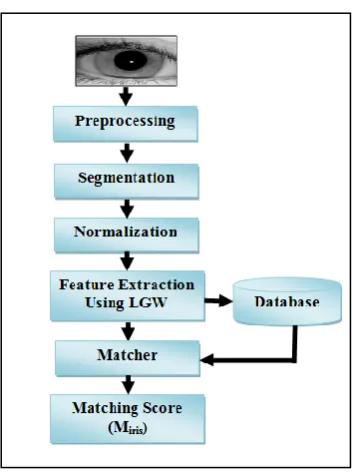
Figure 6. Iris feature extraction method
a) Segmentation Of Iris Image
This step is performed to get the iris region of interest (ROI) from the image of iris. Hough Transform is used to find out the region of interest (ROI) in this process.
b) Normalization
Daugman’s Rubber Sheet approach is used to normalize the iris region [20]. This approach assigns to each pixel within the ROI to a pair of polar coordinates. The center of the pupil is assumed as the orientation point, and radial vector passes through the ROI.
c) Iris Feature Extraction
Feature extraction is the main process in which the 2-D image becomes a vector of mathematical parameters. The important feature of the iris should be coded so that comparisons can be made between the enrolled and the query template. There are many techniques to extract the feature from iris texture like Gabor filter and the wavelet transform. Here, the Log Gabor wavelets [21-22] used for extracting iris feature from the normalized iris pattern.
d) Matching Of Iris Feature
In the matching process, we determine whether two feature vector are the same or not or belong to a genuine person or not. Comparison of bit feature vectors takes place through the Hamming Distance [20].
C. Fusion Of Matching Scores
This multi-modal biometric recognition method is designed for the human verification purpose. Its objective is to decide whether an identity belongs to the original class or not. The scores generated by the individual biometrics features are combined using the weighted sum rule. Mfkp and Miris are matching scores generated from FKP and Iris. The matching scores generated by these modalities are different. It is mandatory that scores should be in the same numeric range. So, score normalization is needed which is discussed below:
NSfkp=
(5)
NSiris=
(6)
B. Comparative Analysis Of FKP Unimodal , Iris Unimodal And Multimodal System
The accuracy and performance of proposed method is measured by plotting false acceptance rate (FAR) and false rejection rate (FRR). False acceptance rate is the incorrect acceptance of an imposter. The false rejection rate is the false rejection of the authentic user. The following equation is used to calculate the accuracy of proposed method:
Accuracy= 100- (10)
It is clear from figure 9 that the performance of proposed multimodal method (FKP+Iris) is better than individual biometric i.e. FKP and Iris. Table 1 shows that proposed method has higher performance and low error rates other than uni-modal biometric.
Table 1. Comparison of proposed methods
Recognition Type FRR (%)
FAR (%)
Accuracy (%) FKP Recognition 0.82 0.740 99.22 Iris Recognition 0.87 0.611 99.26 Proposed Method 0.79 0.051 99.58 Figure 7. Finger Knuckle Image (Polyu Database)
V. CONCLUSION
This paper presents a multi-modal biometric system based on fusion of FKP and iris at score level. The feature set of FKP is obtained by fusion of feature vectors extracted from image of FKP by apply SIFT and SURF. The results indicate that by adopting this method matching performance is increase. In iris recognition, we proposed the method with Log-Gabor wavelet for feature extraction. By fusion of the two FKP and Iris the accuracy and performance of proposed multi-modal biometric recognition is high as compared with FKP and iris recognition method. As compared to unimodal biometric, it provides the minimum FAR and FRR. Thus the proposed recognition method is an efficient, effective and secure method for human verification.
REFERENCES
[1] Jain, A.K., Bolle, R., Pankanti, S., Biometrics: Personal Identification In Networked Society. Kluwer Academic Publishers, 2001.
[2] Down, Michael P., And R. J. Sands. "Biometrics: An Overview Of The Technology, Challenges And Control Considerations." Information Systems Control Journal 4: 53-56, 2004.
[3] Woodard D.L, Flynn P.J., Finger Surface As A Biometric Identifier, Computer Vision And Image Understanding 100 (3) 357–384,2005.
[4] Morales, Travieso A., Ferrer C., And Alonso M.,“Finger-Knuckle-Print Verification Based On Band-Limited Phase-Only Correlation,” Electronics Letters, Vol. 47, No. 6, Pp. 380-381,2011.
[5] Ross, A. And Jain, A.K. “Human Recognition Using Biometrics: An Overview”, Annals Of Telecommunications, Vol. 62, No. ½, Pp. 11-35, Jan/Feb 2007.
[6] Jain, A.K., Ross, A., Prabhakar, S., An Introduction To Biometric Recognition. IEEE Trans. Circ. Syst. Video Technol 14 (January (1)), 4—20 (Special Issue On Image- And Video-Based Biometrics) , 2004. [7] Jain, A.K., Flynn, P., Ross, A., 2008a. Handbook Of Biometrics. Springer Science, ISBN
[15] Chaudhary, Sheetal, And Rajender Nath. "A New Multimodal Biometric Recognition System Integrating Iris, Face, And Voice." International Journal Of Advanced Research In Computer Science And Software Engineering 5.4: 145-150, (2015).
[16] Zhang L., Zhang L., Zhang D., And Zhu H., “Ensemble Of Local And Global Information For Finger-Knuckle-Print Recognition,” The Journal Of Pattern Recognition, Vol. 44, No. 9, Pp. 1990- 1998, 2011. [17] David G. Lowe. Distinctive Image Features From Scale-Invariant Key Points. International Journal Of
Computer Vision, 60:91–110, 2004.
[18] Herbert Bay, Andreas Ess, Tinne Tuytelaars, And Luc Van Gool. Speeded-Up Robust Features. Computer Vision And Image Understanding, 110:346–359, 2008.
[19] Jain A. K., Nandakumar K. & Ross A., “Score Normalization In Multimodal Biometric Systems”, The Journal Of Pattern Recognition Society, 38(12), 2005, 2270-2285.
[20] Daugman John, “How Iris Recognition Works” Circuits And Systems For Video Technology, IEEE Transactions On, 14(1):21–30, 2004.
[21] Jain R., Kasturi R., And Schunk B.G., “Machine Vision”, Mcgraw-Hill, 1995
[22] Marr D., Hildreth E., “Theory Of Edge Detection”,Proceedings Of Royal Society Of London, 207, Pp.187-217, 1980.
[23] Polyu Finger Knuckle Print Database., Available
At:Http://Www.Comp.Polyu.Edu.Hk/~Biometrics/FKP.Htm Last Visited 2017
[24] Chinese Academy Of Science - Institute Of Automation, Database Of The Eye Grayscale Images. Http://Www.Sinobiometrics.Com Last Visited 2017.