A Model for Managing and Evaluating Quality in
Architectural Projects
Om Prakash Bawane Principal
RV College of Architecture Bangalore, India
Abstract
Quality is obscure; hence difficult to define its attributes in precise terms. The perception of quality has been always subjective; thus the quality assessment of a product or service may vary with individuals. Manufacturing industry has successfully evolved a system of managing and evaluating the quality of industrial products. However, much greater challenge is involved in managing and accessing the quality of something which is yet to be translated into a product. Architectural design is one such creation where conventional approach of evaluating quality cannot be applied. This paper attempts to explain the concept of quality as applicable to architectural projects. This paper outlines a model that can be applied to in managing design quality in architectural projects. The paper provides an overview of some tools that are in use to assess the design quality. These tools define the relationship among three vital aspects of design quality i.e. impact, functionality and build quality. The buildings are major contributors to climate change. Hence, it is imperative that the issue of sustainability is addressed by the architecture community at early design stage. This necessitates to recognise ‘sustainability’ as fourth aspect of design quality. The paper proposes a pyramidic model with sustainability being the fourth vital indicator of design quality.
Keywords: Quality, Design Quality, Design Audits, Quality Indicators, Sustainability
________________________________________________________________________________________________________
I. INTRODUCTION
The concept of quality is ambiguous and has different meanings in different context. Most dictionary definitions refers quality as, degree of excellence that something has; notion of benchmark that reflects excellence; or the characteristics or features of something. Quality in context of design can be defined as “degree to which design fulfils the needs and expectations.”(Nelson, 2006). The ISO definition of quality which sates quality as “the degree to which a set of inherent characteristics fulfils requirements,” can be interpreted in context of architecture by elaborating the meaning of word ‘Requirement’, which stands for ‘need or expectation that is stated, implied or obligatory.’ Accordingly, quality can be stated as “the degree to which a set of inherent characteristics fulfils stated, implied or obligatory needs or expectations.” In architectural projects word ‘Obligatory’ would mean compliance with codes, standards, byelaws and statutes. ‘Expectations’ means the requirements defined by the ‘customer’, which include client or end users.
II. QUALITY IN ARCHITECTURE – HISTORICAL PERSPECTIVE
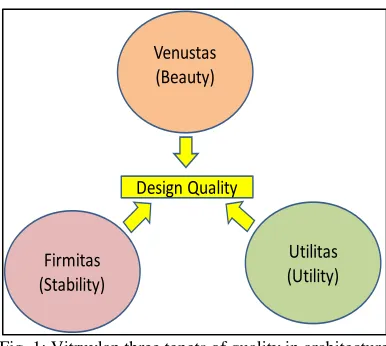
Fig. 1: Vitruvlan three tenets of quality in architecture
Notably, most tools employed in evaluating the design quality are derived from the Vitruvian model of quality.
III. QUALITY CHARACTERISTICS OF AN ARCHITECTURAL PRODUCT
An architectural product is a corollary of a creative design process and a well-conceived construction operation. When an architectural design is transformed into a physical facility, the product may demonstrate several characteristics. These characteristics can be classified under three groups as shown in the Table 1 below.
Table - 1
Quality Characteristics of an Architectural Product
Characteristics Elements
Functional Characteristics Spatial aspects, appropriateness for intended use, accessibility, light, ventilation, etc. Structural Characteristics Strength and stability of structural elements.
Sensory Characteristics Elements that influence the visual quality of built environment, character, innovation, form and material, etc.
Time-Oriented
Characteristics Sustainability, durability, maintainability, scope for future expansion, etc. IV. SIGNIFICANCE OF DESIGN QUALITY
Buildings are fundamental part of our physical environment; hence the quality of their architecture becomes vital in shaping this environment. A well designed project will contribute significantly to the environment in which it is located. An enhanced built environment which incorporates the principles of good design can improve the quality of life of those who use it. The design costs of a building is merely about 0.5% of its life cycle costs but it is the design that makes the largest impact on the building’s life time costs. Good design may initially cost a little more but economic, social and environmental benefits will far exceed the design costs. It is estimated that 5-7% of all construction costs are attributed to deficiencies in design, leading to rework. A good design demonstrates the personal perception of architecture but arises from the careful synthesis of several interrelated factors such as; creativity, functionality, efficiency, structural integrity, build-quality, flexibility, sense of space, responsiveness to site and context, security, lifetime costing, and sustainability. Fig. 2 illustrates the factors contributing to design quality.
Fig. 2: Constituents of quality design Utilitas (Utility) Firmitas
(Stability)
Venustas (Beauty)
Design Quality
V. MODEL FOR MANAGING DESIGN QUALITY
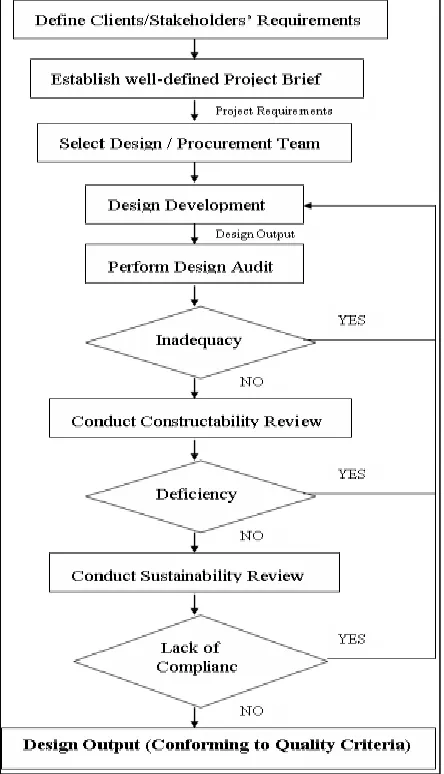
Managing design quality calls for a well-defined approach which begins with defining the aspirations of the primary stakeholders. A six-stage model for managing the design quality is illustrated in Fig. 3. The proposed model is an inclusive one which encompasses the issues pertaining to constructability and sustainability also.
Fig. 3: Model for managing design quality
Client’s/Stakeholders’ Requirements
An important definition of quality is “meeting or exceeding the client/customer’s needs/expectations.” It is therefore crucial that the client’s requirements are fully understood. The client must be clear about the scope of the project. He must carefully define and assess the project priorities in consultation with all the stakeholders. An effective consultation among the stakeholders will help establishing a clear and well defined project brief.
Well-defined Project Brief
A well-defined project brief is vital to achieve high quality design. The project objectives derived from stakeholders’ aspirations forms the basis for establishing the project brief which serves as reference during the design stage. The project brief must clearly spell out the quality priorities as agreed by the stakeholders.
Design/Procurement Teams
Design Audits
Design audit is crucial to quality design output. Design auditing is a systematically planned and documented activity to ensure the compliance with the objectives of the project as established in the project brief. The design input should confirm to the quality aspirations of the stakeholders. Auditing should be performed against the approved checklist. Thus it is necessary that a well-planned quality audit program is developed before the commencement of the design process to assure the conformity with the quality parameters. Audits should be scheduled periodically at the frequencies consistent with project and stakeholders’ needs.
Constructability Reviews
The objective of performing the constructability review is to verify that the project can be constructed in adherence to design. The constructability review includes the validation of numerous considerations. Most of the items requiring validation are clearly the responsibility of the project design team. Constructability reviews contribute significantly towards the enhancement of the design quality as it minimizes the design related changes, helps developing a construction friendly specifications, improves contractors’ productivity, promotes construction safety and reduces conflicts.
Sustainability Reviews
Sustainability is extremely vital in light of the impact of building activities on the climate change. The buildings contribute up to 40% of greenhouse gas emissions and approximately one-third of CO2 emissions mostly from energy use during their life time. Hence, it is imperative that stakeholders address the issue of sustainability throughout the life cycle of the building. A sustainable design forms the basis for creation of buildings that will have minimum adverse effect on the natural environment. As much as 80% of operational cost.
VI. DESIGN QUALITY ATTRIBUTES OF ARCHITECTURAL PROJECTS
The subjective attributes of design quality relate to the individuals taste and perception; however other aspects of design those relate to functional, structural and time oriented characteristics of design can be assessed objectively. There is no particular globally accepted procedure of evaluating the design quality in architectural projects. However, there are few quality tools that are being widely used in UK, Singapore and Malaysia.
Design Quality Assessment Tools
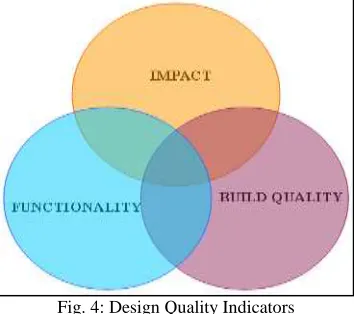
Design Quality Indicators (DQIs), Achieving Excellence Design Evaluation Toolkit (AEDET Evolution), Design Excellence Evaluation Process (DEEP) and Quality Indicators in the Design of Schools (QIDS) are some of the design quality assessment tools that have been developed in UK and Scotland during last one decade and being widely used by architectural and construction organisations worldwide. DQIs tool was launched by Construction Industry Council, UK in 2002. The DQIs is generic in nature hence can be applied to all types of building projects. Whereas AEDET Evolution, DEEP and QIDS happen to be the sector specific tools designed for healthcare buildings, defence projects and educational buildings respectively (CIC, 2002. OGC, 2007. Scottish Executive, 2006). The noteworthy commonality among these tools happens to be the recognition of fundamental aspects of design quality described by Vitruvius as utilitas, firmitas, and venustas. The contemporary interpretation of Vitruvian framework of design quality refers these aspects as function, build-quality and impact respectively. The contribution of these aspects to design quality is illustrated through Venn diagram (Fig. 4), which shows that greater the overlap between the three, the higher the design quality.
Fig. 4: Design Quality Indicators
resulting from amalgamation of innovation, character, form, use of materials, and urban and social integration. It also refers to the ability of the building to create a sense of place and the influence it may have on the local community and the environment.
There are other quality systems which do not deal exclusively with architectural design quality but view architectural work as one of the constituents of overall project quality. Quality Assessment System in Construction (QLASSIC) and Construction Quality Assessment System (CONQUAS) are two such systems that are being used in Malaysia and Singapore respectively. QLASSIC system was developed by the Construction Industry Development Board Malaysia with objectives to establish quality benchmark for workmanship in the construction industry and to establish a standard quality assessment system. However, the system does not address the design quality issues during the development stage. It deals with assessment of quality of architectural work at the completion of the project. CONQUAS (BCA, 2008) was developed by the Building and Construction Authority Singapore. The objectives and the process adopted to measure the quality of a construction project are similar to that of QLASSIC. The scope of the system is limited to assessment of quality of workmanship of architectural finishes and components, hence has little utility at addressing the design quality issues.
VII. SUSTAINABILITY AS FORTH INDICATOR OF DESIGN QUALITY
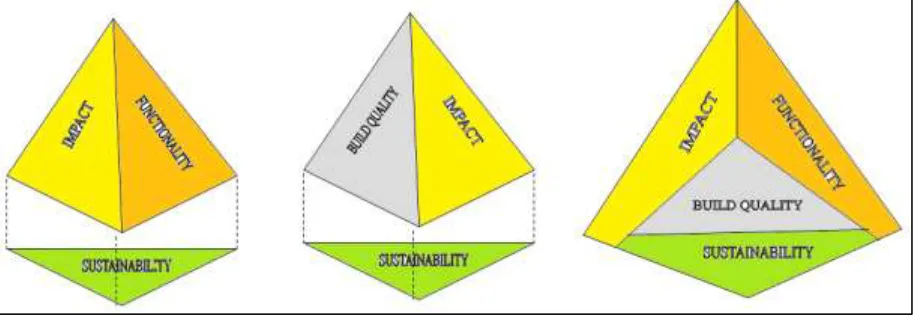
The threat posed by the climate change to the survival of human race is real and architectural and construction community can ill afford to ignore it. The impact of building activities on the climate change has been well documented. The carbon dioxide emissions are directly linked to the energy intensiveness of the building during its complete life cycle. Most design decisions will have direct bearing on the natural environment. Thus, it is imperative that vital facets of design viz; impact, functionality and build-quality are built around the fundamental aspect of sustainability. The pyramidic model of design quality evaluation is illustrated in Fig. 5. The three facades of the pyramid representing impact, functionality and build-quality are built on the base called sustainability. The sustainability indicator must focus on consequences of design decisions on use of energy during the life cycle including the embodied energy, conservation of natural resources, and reduction and recycling of waste products, etc.
Fig. 5: Sustainability the fundamental indicator of quality
VIII. CONCLUSIONS