TRAINING AIRPORT CAPACITY
DEVELOPMENT USING
DISCRETE-EVENT SIMULATION
CEM CETEK
*Assistant Professor, Department of Air Traffic Control, Faculty of Aeronautical and Space Sciences,
Anadolu University, Iki Eylul Kampusu 26470, Eskisehir, Turkey [email protected]
Abstract:
Rapid growth in the air transportation industry raises serious concerns regarding operational and training capacity of airports, the key components of the system. Airport capacity development, therefore, is a critical issue not only for the sustainable growth of the air transportation industry but also for providing sufficient number of trained pilots to airlines. This study aims to develop a practical discrete-event simulation model to analyze the traffic flow and capacity in maneuvering areas of flight training airports under various traffic scenarios. Total traveling times, average airborne and ground delays are selected as for the analysis of baseline and alternative configurations. The simulation model has been developed using SIMMOD for Anadolu University Airport as the sample study. The model can contribute to the efficient use and development of runway capacity as well as effective planning of flight training at airports.
Keywords: Airport Capacity Development, Discrete-Event Simulation, Flight Training
1. Introduction
Air transportation system has been growing rapidly with the increasing demand for air travel. The number of commercial flights has increased by more than 30% worldwide since 2001 [A4A (2012)]. Various projections state that air traffic growth will continue to rise at an annual rate of 4.7-5.1% worldwide for the period 2011-2030 [Airbus (2011), Boeing (2011)]. Thus the industry will globally require 52,506 new airline pilots per year between 2010 and 2030 according to the most likely scenario [ICAO (2012)]. This strong demand raises serious concerns regarding the operational and training capacities of airports.
Airports, as complex service production systems, are the key components of the air transportation system since any problem in their capacity leads to system-wide congestions, delays and economic losses. Airport capacity development, therefore, is a critical issue not only for the sustainable growth of the air transportation industry but also for providing sufficient number of trained pilots to airlines.
Airport capacity can be increased through physical expansion; however, such a practice requires high investment costs and sufficient physical land for expansion. On the hand, operating existing airports at maximum capacity with minimal improvements in their physical infrastructure is usually a more feasible alternative. Such a study requires an accurate analysis to determine the measures of improvement using both analytical or simulation methods.
Analytical methods, such as time-space analysis and various queuing models, are simplified mathematical representations of airport operations for capacity analysis [Wright and Ashford (1992), Horonjeff and McKelvey (1994), Janic (2000)]. These methods are extremely efficient for the analysis of systems with a low level of detail but they do not provide accurate results when the level of detail increases. Simulation methods, on the other hand, are the most convenient tools for analyzing the behavior of complex industrial systems under different scenarios [Kelton and Law (1991)].
[Bazargan et al (2002)]. In the analysis, two proposed expansion alternatives are compared in terms of maximum throughput capacity at Philadelphia International Airport.
This study aims to develop a practical discrete-event simulation model to analyze the delays and traveling times in maneuvering areas of airports serving training flights under various operational scenarios. Under the current and projected scenarios, capacity development alternatives can be tested efficiently. The model can contribute to the development and efficient use of runway capacity as well as effective planning of flight training at airports.
2. Method
In this study, a two-stage method based on fast-time simulation technique was used for the analysis of the air traffic flow in a selected airport maneuvering area primarily serving for flight training operations. The airport system was modeled using SIMMOD discrete-time simulation tool with a fine level of detail. The first stage comprised the analysis of traveling times and delays for the baseline and alternative maneuvering area configuration of the selected airport under the peak day traffic of 2011. This traffic scenario is referred as to ‘current’ demand scenario. The baseline configuration includes maneuvering area layout of the selected airport according to the most-recent Aeronautical Information Publication (AIP). Based on the baseline analysis, the alternative layout including a new taxiway exit has been tested under the current peak-day traffic demand. In the second phase, the baseline and alternative layouts have been compared for the projected demand to estimate possible congestions. In this demand scenario, the current peak-day traffic was selectively increased with a 50% probability for both arriving and departing traffics using flight cloning function of SIMMOD.
2.1. Problem Description
The term ‘capacity’ can be defined as the physical capability of an airport system to accommodate flight operations (i.e. arrivals and departures) for a specified period of time [Wright and Ashford (1992)]. Capacity analysis for an airport is generally performed separately for its landside and airside components. Landside component includes ground access systems and various service buildings i.e. passenger and cargo terminals, maintenance and/or training facilities, while airside component consists of runways, taxiways, aprons and parking positions. The airside elements excluding the apron constitute the maneuvering area of the airport [ICAO (2001)]. If an airport primarily serves flight training operations rather than commercial air transportation operations, its airside capacity will be more critical than its landside capacity.
The airside capacity can be defined as the number of flight operations accommodated by the airport in a certain period of time. If the demand is close to this capacity or exceeds it, delays and congestions arise in the system. Many factors affect the airside capacity such as the complexity of maneuvering areas, type of operations and aircraft type mix, weather conditions etc. When flight training airports are considered, maneuvering areas usually consist of single runway and relatively simple taxiway configurations. Aircraft types used for training purposes are also restricted to small single and/or twin-engine propeller aircraft having similar performance characteristics. Although these characteristics simplify the capacity analysis, variety of operations in different stages of training and differences in skills and performances of trainees complicates the problem. Depending on these factors, careful analysis for traveling times and delays should be performed to ensure safe and efficient capacity development.
Two critical traveling times are considered during the analysis: landing runway occupancy (ROT) and arrival taxi times for arriving traffic. Landing ROT begins as the aircraft crosses the runway threshold and ends as it leaves the runway plane at the tail clearance point. Arrival taxi time, on the hand, is the ground traveling time of the aircraft between tail clearances and parking points. Any configuration change in taxiway exits affects landing ROT and arrival taxi times, therefore, delays on the airborne and ground delays. Two sets of delays are analyzed in this study: airborne and ground delays. Airborne delays are considered for arriving traffic during the analysis. It indicates the amount of holding time in the aerodrome circuit in case the runway is occupied by a landing or takeoff operation. For departing traffic, ground delays include the holding time waited at the departure queue or line-up point to enter the runway and delays occurred during departure taxi movement. The only ground delay for arriving traffic includes delays occurred during arrival taxi movement due to interaction between the other arriving or departing traffic.
2.2. Assumptions
While performing the analysis, the following assumptions have been made:
(1) No simultaneous aircraft occupancy is allowed for the runway and final approach path.
(2) Safe separation minima between aircraft are determined according to relevant separation standards [ICAO (2007)].
(3) Landing and take-off operations are performed in one-direction. (4) Changes in the direction and magnitude of wind are disregarded. (5) Aircraft traffic mix is restricted to general aviation category aircraft.
2.3. Simulation Model
Anadolu University Airport is chosen for the sample study since it primarily serves for flight training operations. According to the traffic data between 2007 and 2010, 85% of its operations consist of various training flight exercises such as landing, take-off, touch-and-go and traffic circuit exercises in the control zone of the airport. Although, the airport also serves for domestic and international flights, these operations are infrequent and irregular compared to the training flights and therefore, they do not change the main operational characteristics of the airport.
Based on the records of Anadolu University Tower Control Unit, the peak-day traffic has been found in October, 6th 2011 with 80 operations (40 departures and 40 arrivals). Hourly distribution of the traffic is shown in Fig. 1. The peak traffic occurred between 17:00-18:00 with 12 operations (7 departures and 5 arrivals). The current traffic scenario is set according to this traffic distribution. All of the traffic consists of single-engine aircraft (50% Cessna C172 and 50% Socata TB20 Trinidad). Take-off and landing roll probability distributions are estimated based on their performance data [Aybek (2007)].
Fig. 1. Hourly distribution of peak-day traffic (October, 6th 2011) at Anadolu University Airport.
The airport includes a 3000x45m runway in 09/27 direction, five taxiways (A, F,G,H and L) and four taxi exits (B, C, D and E) as shown in Fig. 2. There are also three aprons: east, west and general aviation apron. West apron is currently not in use. In addition to the existing taxi exits in the baseline model, taxi exit J is added to the model as an alternative in Fig.2.
Fig. 2. Anadolu University Airport Layout [DHMI (2012)].
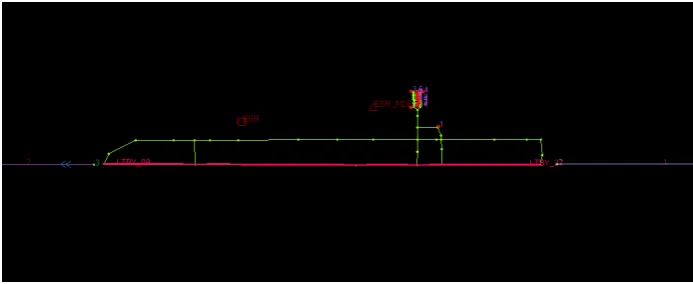
The current traffic scenario was tested for the baseline and the alternative configurations during the peak-day traffic demand. In the projected traffic scenario, the peak-day traffic demand was increased with 50% probability using flight cloning functions. Replicated flights were distributed randomly for each hour between 05:00-20:00 by SIMMOD. The baseline and alternative models were tested for this increased demand. Data obtained as a result of testing these scenarios were compiled from standard SIMMOD report files (SIMU26 and SIMU48). These data included quantitative evaluations related to system performance parameters (travel times and delays). Other outputs obtained were computer animations representing the traffic flow during each simulation (Fig. 4). These outputs enabled the analysis of the traffic flow in the system in the baseline state and the determination of congestion points and their levels.
Fig. 3. Image of the SIMMOD model of Anadolu University Airport maneuvering area.
Fig. 4. Animation of traffic scenario in SIMMOD Animator.
3. Results
3.1. The Current Baseline and Alternative Scenarios
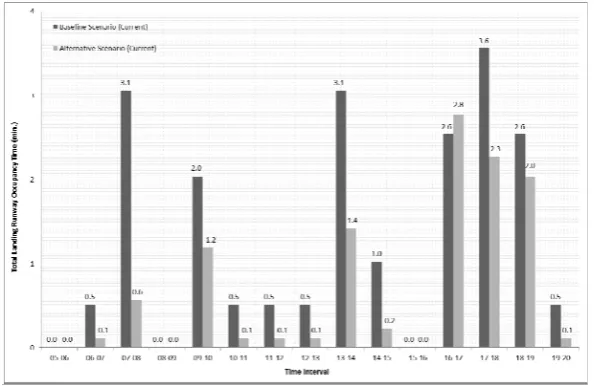
Fig. 5. Total landing ROT distribution for baseline and alternative models under current traffic scenario.
Fig. 6. Total arrival taxi time distribution for baseline and alternative models under current traffic scenario.
Fig. 8. Average departure ground delays for baseline and alternative models under current traffic scenario.
3.2. The Projected Baseline and Alternative Scenarios
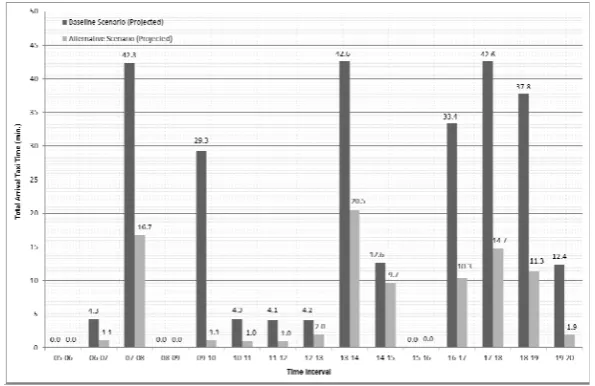
When the traffic demand is increased by 50% probability, significant increases in landing ROT and arrival taxi times has been observed for the baseline model (Fig. 9 and Fig. 10). Besides the increased number of operations, the high interaction between the arrival and departure traffics leads to higher traveling times during taxi maneuvers. In the baseline scenario, the lack of an intermediate exit results in system-wide inefficiencies and congestions especially during the peak hours. The alternative model, however, mitigates these inefficiencies considerably as shown in the figures.
Fig. 10. Total arrival taxi time distribution for baseline and alternative models under projected traffic scenario.
For the projected traffic, both ground and airborne delays have been increased for the baseline and alternative scenarios (Fig. 11 and Fig. 12). In Fig. 11, the maximum ground delay per departure (6 mins.) occurs between 15:00-17:00 for the baseline model. The alternative model slightly decreases the daily average departure ground delays except for the periods of 07:00-09:00 and 17:00-18:00 due to increased arrival traffic during these hours. The daily average is also reduced from 3.3 minutes to 3.1 minutes per aircraft in the alternative model. Although this reduction in the average ground delay is slight, it leads to significant decreases in total daily delay.
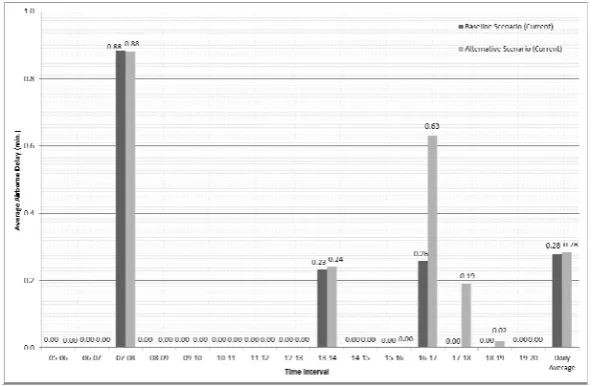
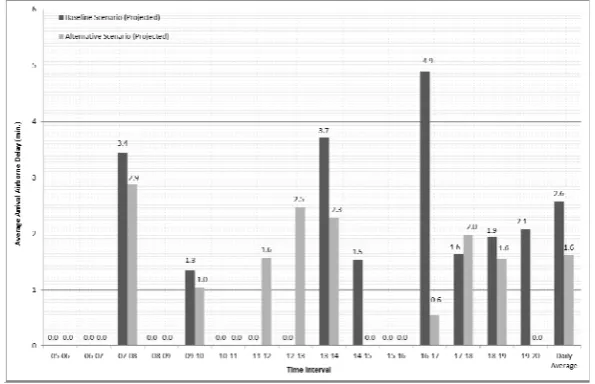
For the projected scenario, it is also observed that the average airborne delays per operation increases sharply for both the baseline and alternative models (Figure 12). The alternative model reduces the daily average airborne delay by 38% (Figure 12). Such a reduction indicates a significant decrease in the total airborne delay which contributes the total capacity of the airport as well as flight safety.
Fig. 12. Average airborne delays for baseline and alternative models under projected traffic scenario.
4. Conclusion
A practical discrete-event simulation model has been developed using SIMMOD to analyze single runway capacity of airports serving for training flights. Simulations have been run for four different traffic scenarios. In each scenario, landing runway occupancy and arrival taxi times, average ground and airborne delays have been evaluated as the system outputs for baseline and alternative models. The model provides a fast and sufficiently accurate analysis for flight training airports for capacity improvement. The touch-and-go capacity of the runway can also be estimated with modifying service times and the operation mix accordingly. Therefore, it allows trainers and air traffic controllers to plan the efficient use of runway capacity as well as effective planning of flight training for various alternative traffic scenarios. Although this study focuses on maneuvering area, the results of the analysis provide an important insight for aerodrome circuit patterns and procedures within the control zone.
References
[1] A4A. “Annual Traffic Results: World Airlines”, available at: http://www.airlines.org/Pages/Annual-Results-World-Airlines.aspx (Accessed 01 Feb 2012), 2012.
[2] Airbus. Delivering the Future - Global Market Forecast 2011-2030, Blagnac Cedex, Airbus, 2011. [3] Boeing. Current Market Outlook 2011-2030, Seattle, Boeing, 2011.
[4] ICAO. Global and Regional 20 Year Forecasts- Pilots, Maintenance Personnel-Air Traffic Controllers, Doc 9956, Montreal, ICAO, 2012.
[5] Wright P. H. and Ashford N. Airport Engineering, 3rd ed., John Wiley & Sons, New York, 1992, pp. 186-191. [6] Horonjeff R. and Mckelvey F. X. Planning and Design of Airports, 4th ed., McGraw-Hill, Boston, 1994,pp. 263-422.
[7] Janic M. Air Transport System Analysis and Modeling, Gordon and Breach Science Publishers, The Netherlands, 2000, pp. 9-49. [8] Kelton D. W., Law A. M. Simulation Modeling and Analysis, 2nd ed., McGraw-Hill, New York, 1991, pp. 115.
[9] Odoni, A. R., J. Bowman, D. Delahaye, J. J. Deyst, E. Feron, R. J. Hansman, K. Khan, J. J. Kuchar, N. Pujet, and Simpson, R, Existing and Required Modeling Capabilities for Evaluating ATM Systems and Concepts, National Aeronautics and Space Administration Ames Research Center, International Center for Air Transportation, Final Report, March 1997.
[10] Mumayiz S. A. and Schonfeld P. Airport modeling and simulation: An Overview, Airport Modeling and Simulation Conference, Arlington, Virginia, 1997, p. 1-7.
[11] Zografos K. G. and Madas M.A, Development and Demonstration of an Integrated Decision Support System for Airport Performance Analysis, Transportation Research Part C, Vol.14, No. 1, 2006, p. 1-17.
[12] Chao W., Xinyue Z., Xiaohao X, Simulation Study on Airfield System Capacity Analysis Using SIMMOD, International Symposium on Computational Intelligence and Design, 2008, p. 87-90.
[13] Wei, G. and Taobo, W, A Simulation Study on airport capacity and the factors, IEEE Computer Science and Information Technology (ICCSIT), 3rd IEEE International Conference, 2010, p. 390-393.
[14] Bazargan M., Fleming K., Subramanian P, A Simulation Study To Investigate Runway Capacity Using TAAM, Proceedings Of The 2002 Winter Simulation Conference, 2002, p. 1235-1243.
[15] ICAO. Air Traffic Services Annex 11, Thirteenth Edition, Montreal, July 2001, p.1-6.
[16] ICAO. Rules of the Air and Air Traffic Services Doc 4444 ATM 501, “Air Traffic Management”, Fifteenth Edition, 2007.
[17] Aybek F. Control Zone Capacity Modeling of Airports Used for Flight Training Operations, Master’s Thesis, Anadolu University (In Turkish), 2007.