328 |
P a g e
GRAIN COUNTING METHOD BASED ON MACHINE
VISION
Swati
1, Richa Chanana
21,2
Deptt. Of Electronics and Communication, Greater Noida institute of Technology, UPTU, (India)
ABSTRACT
Determining grain type and quality is of paramount importance at several stages during grain handling
operations. Grain handling operations is usually performed by trained inspectors which is rather expensive and
is determined by operators’ inconsistency and subjectivity. In this respect, a machine vision system that is
capable of applying the evaluation criteria consistently, objectively, and without fatigue would be invaluable
tool for grain handling and quality monitoring. Machine vision technology offers objective solutions for all
these problems and it is considered to be a promise for replacing the traditional human inspection methods.
This work represents a new efficient method for separate and counts multiple touching scenarios where kernels
are defected and results indicate accuracy of the results up to 95%.
Keywords- Counting, Dilation, Erosion, Grains, Images, Separation.
I.INTRODUCTION
Determining grain type and quality is of paramount importance at several stages during grain handling
operations. Despite technological advances in the transportation and handling of grain, the analysis of quality
attributes and grading of grain is still performed manually by skilled personnel. Manual analysis of grains is
prone to many problems: (i) it is highly subjective and is influenced by human factors and working conditions;
(ii) the rate of cleaning and recovery of salvages is limited; and (iii) human perception can easily be influenced
by external factors resulting in grading inconsistencies. In this respect, a machine vision system that is capable
of applying the evaluation criteria consistently, objectively, and without fatigue would be invaluable tool for
grain handling and quality monitoring. This would also mean that automated grain separation and grain cleaning
could be performed with ease. Machine vision systems are widely used for the inspection of fruits vegetables
and grains. Classification of grains based on measurements of morphological, optical and textural features of
various grain types such as wheat, rice, corn, and lentils has been reported. A number of studies have been
conducted to classify grains based on their physical attributes. Most of the previous feature extraction
algorithms have been applied to grain kernel images that were presented to the imaging systems manually in a
non-touching fashion. This is to avoid clusters of touching kernels that make the feature extraction procedure
difficult. Despite the use of vibrating beds to present grain kernels in a monolayer, the presence of touching
scenarios cannot be avoided. Morphological methods used to separate fused object in binary images are
generally based on watershed transform (Beucher, 1990) on the complimentary of the distance function
329 |
P a g e
a certain point. Watershed algorithm may be insufficient to produce an appropriate segmentation algorithmsrequired all kernels to be non-touching. The majority of touching kernels appeared in groups of 2, with less than
4% of all kernels appeared in groups of 3 or 4. Therefore, it is necessary to develop an algorithm to separate
touching grain kernel images to solve this problem. Also, such an algorithm should focus on separating two or
three touching kernels, because multiple kernels touching instances can be eliminated by using mechanical
systems (Crowe et al. 1997). Although domestic and overseas scholars made some beneficial research [5],[6],[7]
on the overlaps and conglutinations among grains, but the universal simple and high-precision methods were not
proposed to resolve them. Image recognition and processing technology is use to finish the grain counting. In
addition to providing a high effective, shortcut and new technique of grain counting for breeding works, this
study also provides essential theory and practice foundation for further studies on cereal grains, such as
recognition, classification, selection etc
II.METHODOLOGY
This work represents separation of touching kernels and count those separated kernels also, where kernels are
broken also. This work applied the morphological operation “erosion followed by dilation” that is called
“opening” also. The opening of A by B is obtained by the erosion of A by B, followed by dilation of the resulting
image by B. But in “opening” process same structuring element is used for both erosion and dilation. But here
different structuring element was used for both erosion and dilation. Image erosion is an operation of
mathematical morphology, whose action is eliminating boundary point, and makes it shrink toward center. So,
the conglutination among grains may be separated by it. Image dilation is also a operation of mathematical
morphology, whose action is add boundary point or add pixel to the boundary of the object. The image types
that can be processed are the grayscale, binary, or packed binary image. If the image A is eroded by B, then B is
called a structuring element. The shapes and sizes of structuring element are selected according to the need of
specific problems, and the shapes usually used are line, diamond, disk, rectangle, etc. In this diamond
structuring element was used.
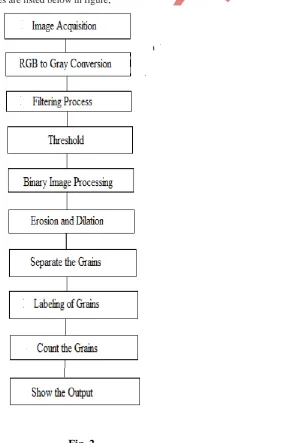
Fig.1
III. EXPERIMENTAL SETUP
Following steps were done to acquire the images and analysis further;
330 |
P a g e
RGB to GRAY conversion.
Filter that grayscale image using median filtering process
Take a threshold value and perform binary image processing
Binary process means whole image has two colors white and black
Then create a structuring element with the help of that structuring element
Image erosion and dilation is performed.
Then grains are separated.
Then label those separated kernels to count them.
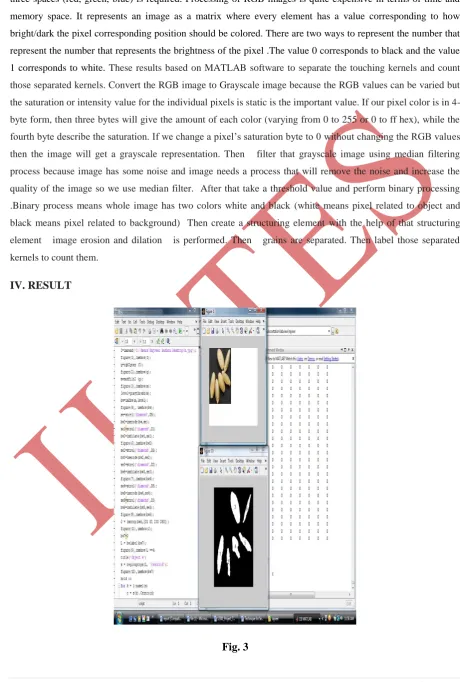
The images taken and processed ones are listed below in figure;
Fig. 2
Firstly took some kernels and then take the image of these kernels in RGB camera and then read that image
into MATLAB by image acquisitions. First stage of any vision system is the image acquisition stage. After the
image has been obtained, various methods of processing can be applied to the image to perform the many
331 |
P a g e
model for products classification complicates the classification algorithms since simultaneous analysis of thethree spaces (red, green, blue) is required. Processing of RGB images is quite expensive in terms of time and
memory space. It represents an image as a matrix where every element has a value corresponding to how
bright/dark the pixel corresponding position should be colored. There are two ways to represent the number that
represent the number that represents the brightness of the pixel .The value 0 corresponds to black and the value
1 corresponds to white. These results based on MATLAB software to separate the touching kernels and count
those separated kernels. Convert the RGB image to Grayscale image because the RGB values can be varied but
the saturation or intensity value for the individual pixels is static is the important value. If our pixel color is in
4-byte form, then three 4-bytes will give the amount of each color (varying from 0 to 255 or 0 to ff hex), while the
fourth byte describe the saturation. If we change a pixel’s saturation byte to 0 without changing the RGB values
then the image will get a grayscale representation. Then filter that grayscale image using median filtering
process because image has some noise and image needs a process that will remove the noise and increase the
quality of the image so we use median filter. After that take a threshold value and perform binary processing
.Binary process means whole image has two colors white and black (white means pixel related to object and
black means pixel related to background) Then create a structuring element with the help of that structuring
element image erosion and dilation is performed. Then grains are separated. Then label those separated
kernels to count them.
IV. RESULT
332 |
P a g e
V. CONCLUSION
In order to overcome the classification errors and inconsistencies involved in grain counting, type and quality
done through human inspectors, an automated computerized inspection system has been discussed in this paper.
Use of machine vision using morphological operations has been illustrated to demonstrate the separating and
counting the grains. Accuracy to the level of 95% has been achieved in experimental results. 5% Error present
may be due to system calibrations vis-à-vis human grading and/or variation of Hue parameter with respect to
light variations which should not be there ideally. This inaccuracy leaves a scope for further investigation.
A
CKNOWLEDGMENTI would like to express my deep-felt gratitude to my advisor and Supervisor Prof. Bhupinder Verma, as my Thesis
guide and Dean of Discipline ECE for giving me an opportunity to work with him and for his advice,
encouragement and constant support. He always gave me his time, in spite of his busy schedule. I thank all my
friends and colleagues here at Lovely Professional University for all the wonderful time I have had with them.
Your valuable comments and suggestions have been vital to the completion of this work. I want to thank the
faculty of Electronics and communication Department and for all their hard work and dedication, providing me
the means to complete my degree and prepare for a career. And finally, I must thank my family for supporting me
during the development of this work with no complaints and continuing, loving support.
REFERENCES
[1] Newmann T.S, Jain A.K, “A survey of automated visual inspection”, Computer Vision and Image Understanding Vol: 61, No. 2, pp.231-262, 1995.
[2] Zhong et al. 2009, “combined watershed and concavity algorithm:,” M.Sc. thesis, Univ. of Georgia, Athens, 2009
3] ZHAO Ping,”Grain Counting Method Based On Image Processing” Transactions of the ASAE, 2009.
[4]Wang & Paliwal, “watershed segmentation” CSIR Madras Complex, Taramani, Chennai - 600 011,2006
[5] Zhang et al., “an ellipse-fitting algorithm” (978-1-4244-2083-4/08/$25.00 ©2008 IEEE), Feburary, 2005.
[6] Visen, Shashidhar, Paliwal & Jayas, “concavities based algorithm”Institute of Information Sciences and Technology, Massey University, New Zealand,2001
[7] Shatadal, Jayas, & Bulley ”morphological operations”department of electronics systems engineering, university of essex, colchester, essex co4 3sq, united kingdom,2000..