PARALLEL GENETIC ALGORITHM
Swati
Assistant Professor,
Dept of CS, C.R.M. Jat PG College, Hissar, Haryana (India)
ABSTRACT
Genetic Algorithms are modern and powerful search techniques that have been used successfully to solve
difficult problems in optimization, neural networks, pattern recognition, robotics and data mining etc. The
problem of premature convergence of simple GA led the research towards the implementation of various
Parallel Genetic Algorithms to achieve a balance between exploration and exploitation of the search space. The
main objective of this paper is to review and present the important research works in PGAs in a unified manner.
To point the possible direction for further research, the paper also highlights the unresolved problems that have
remained unaddressed or have not been studied in a systematical manner. After giving the initial benchmark
studies, the main focus is on relatively recent research advances. Finally, a parallel and promising Gradual
Distributed GA and Hierarchical Genetic Algorithms is discussed, using crossover and migration operators
having different degree of exploration and exploitation, to solve the difficult search problems.
Keywords: Parallel Genetic Algorithms, Master-Slave Genetic Algorithms, Distributed Genetic
Algorithms, Gradual Distributed Genetic Algorithms, Hierarchical Genetic Algorithms.
I. INTRODUCTION
GAs are generally applied to difficult and bigger problems where other methods of finding adequate solutions
fail due to their high algorithmic complexity. The two important factors to measure the performance of GA are
the quality or accuracy of the solution and the time needed to reach the solution of required accuracy. The
simple GAs were soon stretched to their limits in case of some rather difficult search spaces. To reach a
reasonable solution for a problem, the GA needs to keep a balance between exploitation and exploration. To
reach a global optimal, it is essential to have enough diversity of sampling points in the search space and then
refine the solution focussing on individuals of higher fitness. Many a times, this balance of exploration and
exploitation is very difficult to reach and simple GA ends up converging in a local optimal solution. This is
known as problem of premature convergence [1-5]. Some tools like different selection schemes, scaling, ranking, dynamic and optimized parameters setting have been suggested to avoid premature convergence [6,7].
The solutions suggested could improve the diversity by varying selection pressure but could not eliminate the
problem of premature convergence. Parallel or Distributed GAs have become the most important method to
maintain the diversity based on spatial separation. [8-10]. DGA preserves the diversity due to semi-isolation of
sub-populations.
This paper is an attempt to present the some of the most important, relevant and relatively recent research done
on parallel GAs and to highlight the unresolved problems. Though all kind of parallel GAs are introduced,
however, the paper focuses on distributed GAs and Hierarchical GAs. The research work done in this field is
those research work that are considered important someway and have contributed to the growth of field of
Parallel GAs and some of the problems posed in those papers are still an open area of research.
II. THE PARALLEL GENETIC ALGORITHMS
The basic idea behind most parallel programs is to divide a task into smaller pieces and solve the pieces
simultaneously using multiple processors. The general idea to parallelize a GA is to divide the population into
several sub-populations, each one of them is processed by a GA independently from the other. The operator
migration produces exchange of genetic material between the sub-populations.
There are mainly five types of parallel GAs based on their method of parallelization.
Global Single population Master-Slave Aas
Single population Fine-Grained GAs based on Spatial Structure Multiple-Populations Distributed GAs
Gradual Distributed GAs Hierarchical GAs.
2.1 Global Parallelization: Master Slave Gas
The evolution of fitness and sometimes the application of operators are carried out in parallel. In this, the fitness
evaluation for sets of individuals could be assigned to different processors. The communication occurs only at
the start and at the end of the phase. This can be done in master slave fashion, where master is responsible for
synchronization i.e. sending the individuals to the other processors for evaluation, collecting the results and
applying the genetic operators to produce next generations. Global parallelization does not change the overall
nature of the GA but a speedup proportional to the number of processors minus the cost of communication is
expected. Almost all the work in Master Slave parallelization has reported sub-linear speed-ups due to the
communication cost [11-13].
2.2 Fine Grained Ga
In this model the population is divided into large number of small size populations. In extreme case a single
individual could be assigned to one processor. They are also known as massive parallel GA. The fine-graineded
GA has spatial structure that limits the interactions between the individuals and selection mechanism and
crossover operator are only applied to the neighbouring chromosomes. Every chromosome selects the best
neighbour for recombination and resultant individual shall replace it. Since the neighbourhood overlaps, good
solutions may disseminate across the entire population. These are also known as cellular GA and implemented
on massive parallel computer [15-23]
2.3 Distributed Genetic Algorithms
In case of Distributed Genetic Algorithms, the population is divided into small sub-populations that are
processed on different processors. Each sub-population evolves independently and simultaneously. Periodically,
migration operator exchanges individuals among the sub-populations. The Distributed GAs are also known as
Coarse Grained GAs These are the GAs that have got special attention from researchers due to their easy
implementation and capabilities to find better solutions. Some of the important work in this area is summarized
2.3.1 Related Work
Grasso, in his dissertation work simulated the diploid individuals (there were two sub-components for each
gene) by dividing the population into five demes. The demes exchanged the individuals at fix intervals. He tried
several migration rates and noticed the rate of improvement of average population fitness was faster in the
smaller demes than in a single large population.Tanese, did an important work on a parallel implementation of
Course Grained GAs, where demes used a hypercube topology to communicate with other demes. The migration
occurred at fix interval of time along one dimension of the hypercube. The best individuals migrated to the
neighbouring population replacing the worst in the target population. Cohoon, Hedge, Martin and Richard noted
certain similarities between the evolution of solutions in the parallel GA and the theory of punctuated equilibria.
When the environment changes, there is rapid evolutionary change. An important component of the
environment of a population is its own composition because individuals in a population must compete for
resources with the other members. Therefore, the migration of individuals from other population can punctuate
the equilibrium and trigger evolutionary changes.
2.4 Gradual Distributed Gas
GDGAs are a class of heterogeneous DGAs based on real coding in which sub-populations are distinguished by
applying crossover operators with different degree of exploration and exploitation. By doing this, a parallel
multi-resolution is obtained with regard to the crossover operator that allows a spread search (exploration) along
with an effective local tuning (exploitation) to be simultaneously achieved. In this model, sub-populations must
be adequately connected for exploiting the multi-resolution in a gradual way. This offers refinement or the
expansion of the best zone so far emerged. The migration between sub-populations belonging to different
categories produce these final effects. The basic structure of GDGAs is shown in fig 1. They are based on
hyper-cube topology with three dimensions with two important sides to be differentiated.
The front side is devoted to exploration. It is made up of four sub-populations E1 to E4, to which exploratory
crossover operators are applied. The exploration degree increases clockwise starting at the lowest E1 and ending
at highest E4. The rear side is for exploitation. It is composed of sub-population e1 to e4, that undergo
exploitative crossover operator. The exploitation degree increases clockwise starting at the lowest e1 and
e4 e1
1
E1 E4
e3 e2
E2 E3
2.5 Hierarchical Gas
Recent and one of the latest development in the field parallel GA is the creation of Hierarchical GAs. The fact
that there is an optimal number of demes, limits the processors that can be used to reduce the execution time.
Using more than the optimal number of demes is wasteful and would result in slower algorithm. Hierarchical
parallel GAs can use more processors effectively and use the execution time more than the pure multiple deme
GA. Hierarchical GAs have been produced by combining any of two methods to parallize GAs. At the upper
level most of the hierarchical GAs are multi deme GAs. At the inner level they can use any other method of
parallel GAs.
2.5.1 Related Work
Gruau implemented Hierarchical GA in which each deme was placed on a 2-D grid and demes themselves were
connected as 2-D torus. Migration between demes occurred at regular intervals and good results were reported
for a novel neural network design and training application Gordon updated ASPARAGOS and its ladder
structure was replaced by a ring and it maintains several sub-population that are themselves structured as rings.
Migration across sub-populations is possible, when a deme converges it receives best individual from other
deme.
2.5.2 Hierarhical Distributed Gas
Another popular method of hybridizing parallel GAs is to use multi-deme GA at both upper and lower level.
The idea is to force mixing at the lower level by using high migration rate and a dense topology while a low
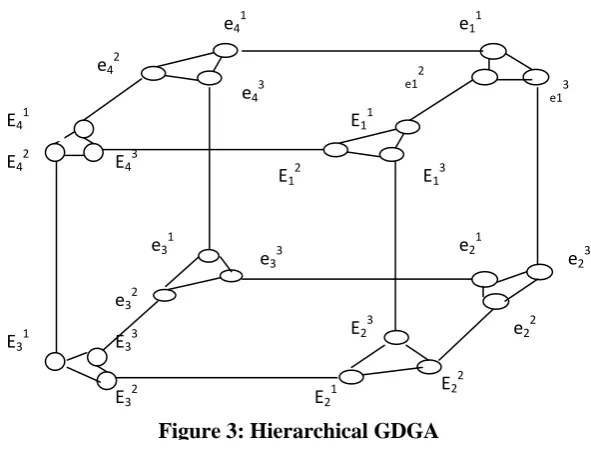
migration rate is used at high level. The remaining of the paper is dedicated to Hierarchical Distributed GA
which is of considerable importance in the advances that have taken place recently. The main idea of these
algorithms is to connect DGAs with other DGAs and this way we get a DGA whose nodes are again simple
DGA. In figure2 below, a hierarchical Distributed GA, with a cube topology,
2.5.3 Hierarchical Gradual Dgas
Hierarchical Gradual DGAs are Hetrogeneous HDGAs based on homogeneous basic DGAs .Herrea and Moraga
implemented Hierarchical GDGA in which they applied a homogenous DGA to every node of GDGA. They
applied the different crossover operator with different degree of exploration and exploitation to the nodes of
GDGAs.
IV. SUMMARY AND CONCLUSIONS
This paper has presented a review of impotant and representative research work on parallel genetic algorithms.
From the research work given above, it is concluded that multiple deme GAs are almost an extension of serial
GAs as far as implementation of deme GAs is concerned. There is relatively little effort required to convert
serial GA into a multiple deme GA but the gain in performance is relatively high. This review has contributed
numerous examples that show that Parallel and Hierarchical GAs are capable of combining speed and efficacy.
We have successfully served the purpose to introduce five kinds of parallel GAs, related research work and
indicated the possible direction of future research by identifying the unresolved problems in this area.We have
given some theoretical work done for DGAs but this is not enough to explain all the mysteries of how PGAs
work? All the above theoretical work makes very simple assumption, does not included all the complexities and
leaves many issues unresolved. The GDGA and HDGA are class of parallel GAs, whose behaviour get affected
with many more parameters, have added extra complexity to the already compounded scene of simple DGAs.
REFERENCES
[1] . John Holland, Adaptation in Natural and Artificial Systems, The MIT Press: London, 1992.
[2]. Goldberg, David E.: "Genetic Algorithms in Search, Optimization, and Machine Learning.", New
York,Addison-Wesley,1989.
[3]. Zbeigniew Michalewicz, “Genetic algorithms + Data Structures = Evolution programs”, New York:
Springer,1992.
[4]. Lawrence Davis, “Handbook of genetic algorithms”, New York: Van Nostrand Reinhold,1991.
[5]. Back T, “Evolutionary Algorithms in Theory and Practice”, Oxford,1996.
[6]. Kalyanmoy Deb, “ Genetic Algorithm in Search and optimization: The technique and applications”,
Department of Mechanical Engineering, Indian Institute Technology, Kanpur, 1997.
[7]. Booker L., “ Improving Search in Genetic Algorithms”, In genetic Algorithm and Simulated Annealing,
Pitman Publication, London, pp 61-73, 19
e11
E22
E21
E23
E33
E32
E31
e23
e22
e21
e32
e33
e31
e41
E13
E12
e13
e12
E43
E42
E11
e42
E41
e43
[8]. Tanese, R., “Distributed Genetic Algorithms”, In Schaffer J. D., Ed., Proceedings of the Third
International Conference on Genetic Algorithms, Kaufmann (San Mateo, CA), pp 434-439, 1989.
[9]. Muhlenbein H., Schomisch M., Born J., “The Parallel Genetic Algorithm as function Optimizer”, In Belew
R. K., Booker L. B., Eds, Proceedings of the Fourth International Conference on Genetic Algorithms,
Morgan Kaufmann (San Mateo, CA), 1991.
[10]. Cohoon, J. P., Martin, W.N., Richards, D.S., In Parallel Problem Solving from Nature 1, Schwefel, H.P.,
Manner R. (Eds.), Springer-Verlag:Berlin, Germany,1990.
[11]. Fogarty,T.C,, Huang,R., “Implementing the genetic algorithm on Transputer based parallel processing
systems”, In Schwefel, H.P., & Manner, R. (Eds.), Parallel Problem Solving from Nature (pp. 145-149).
Berlin: Springer-Verlag, 1991.
[12]. Abramson, D., Abela, J., “A parallel genetic algorithm for solving the school time table problem”, In
proceddings of fifteenth Australian Computer Science Conference (ACSC-15), Volume 14, pp.1-11,1992.
[13]. Hauser, R., Manner,R., “Implementation of standard genetic algorithm on MIMD machines”, In Davidor,
Y., Schwefel, H., & Manner, R.(Eds.), Parallel Problem Solving from Nature, PPSN III (pp. 504-513).
Berlin: Springer-Verlag, 1994.
[14]. Erick Cantu-Paz., “Designing Efficient and Accurate Parallel Genetic Algorithms”, Doctoral
Dissertatation, University of Illinois at Urbana-Champaign.,1999.
[15]. Gorges-Schleuter M., “ASPARAGOS: An asynchronous parallel genetic optimization strategy”, In
Schwefel, J.D, (Eds.), Proceedings of the Third International Conference on Genetic Algorithms, Morgan
Kaufmann (San Mateo, CA), pp 422-428, 1989.
[16]. Muhlenbein H., “ Parallel Genetic Algorithms, population genetics and combinatorial optimization”, In
Schwefel, J.D, (Eds.), Proceedings of the Third International Conference on Genetic Algorithms, Morgan
Kaufmann (San Mateo, CA), pp 416-421, 1989.
[17]. Manderick B., Spiessens P., “Fine-grained Parallel Genetic Algorithms”, In Schwefel, J.D, (Eds.),
Proceedings of the Third International Conference on Genetic Algorithms, Morgan Kaufmann (San Mateo,
CA), pp 428-433, 1989.
[18]. Sarma J., Jong K.D., “ An Analysis of the effects of the neighbourhood size and shape on local selection
algorithms”, In Parallel Problem Solving from Nature IV, Springer-Verlag (Berlin), pp 236-244, 1996.
[19]. Anderson E.J., Ferris M.C., “ A Genetic Algorithm for the assembly line balancing problem, In Integer
Programming and Combinatorial Optimization: Proceedings of a 1990 Conference held at the University
of Waterloo, Waterloo, ON, University of Waterloo Press, pp 7-18, 1990.
[20]. Baluja S., “ A massively Distributed Parallel Genetic Algorithm”, Technical Report No.
CMU-CS-92-196R, Carnegie Mellon University, Pittsburgh, PA, 1992.
[21]. Baluja S., “ Structure and Performance Of Fine-grain Parallelism in Genetic Search”, In Forrest S., Eds,
Proceedings of the Fifth International Conference on Genetic Algorithms, Morgan Kaufmann (San Mateo,
CA), pp 155-162, 1993.
[22]. Shapiro B., Navetta J., “A Massively Parallel Genetic Algorithm for RNA Secondary Structure
Prediction”, The Journal of Supercomputing, Vol 8, pp195-207, 1994.
[23]. Gordon V.S., “ Locality in Genetic Algorithms”, In Proceedings of the first IEEE Conference on
[24]. Grosso, P.B., “Computer simulations of genetic adaptation: Parallel subcomponent interaction in a
multilocus model”, Unpublished doctoral dissertation, The University of Michigan, University Microfilms
No 8520908, 1985.
[25]. Pettey, C.B, Leuze, M., Grefenstette J.J, “ A parallel Genetic algorithm”, In Grefenstette J.J., Ed.,
Proceedings of the Second International Conference on Genetic Algorithms, Lawrence Erlbaum
Associates (Hillsdale, NJ), pp 155-161, 1987.
[26]. Tanese, R., “Parallel Genetic Algorithms For A Hypercube”, In Grefenstette J.J., Ed., Proceedings of the Second International Conference on Genetic Algorithms, Lawrence Erlbaum Associates (Hillsdale, NJ), pp
177-183, 1987.
[27]. Tanese, R., “Distributed Genetic Algorithms for function optimization”, Doctoral Dissertation, University
of Michigan, Ann Arbor, 1989.
[28]. Cohoon, J. P., Hegde, S. U., Martin W.N, Richards D., “Punctuated equilibria: A parallel Genetic
Algorithm”, In Grefenstette J.J., Ed., Proceedings of the Second International Conference on Genetic
Algorithms, Lawrence Erlbaum Associates (Hillsdale, NJ), pp 148-154, 1987.
[29]. Cohoon, J. P., Martin W.N, Richards D.S, “A Multi-population Genetic Algorithm for Solving the
K-partition Problem on Hyper-cubes” , In Belew R. K, Booker L.B, Eds., Proceedings of the Fourth
International Conference on Genetic Algorithms, Morgan Kaufmann (San Mateo, CA), pp 244-248, 1991.
[30]. Bianchini, R., Brown, C. M., “ Parallel Genetic Algorithms on distributed-memory architectures.”,
Technical Report 436, Computer Science Department, University of Rochester, 1992.
[31]. Bianchini, R., Brown, C. M., “ Parallel Genetic Algorithms on distributed-memory architectures.”, In S.
Atkins and A.S. Wagner, editors, Transputer Research and Applications 6, Amsterdam: IOS Press, pp
67-82, 1993.
[32]. Cantu-Paz E., Mejia-Olvera M. “ Experimental Results in Distributed Genetic Algorithms”, In
International Symposium on Applied Corporate Computing, Monterrey, Mexico, pp99-108, 1994.
[33]. Lin S.C, Punch W., Goodman E., “ Coarse-Grain Parallel Genetic Algorithms: Categorization and New
Approach”, In Sixth IEEE Symposium on Parallel and Distributed Processing, IEEE Computer Society
Press (Los Alamitos,CA), October 1994.
[34]. Braun H.C, “On solving Travelling Salesman Problems by Genetic Algorithms”, In Schwefel H. P.,
Manner R., Eds, Parallel Problem Solving from Nature, Springer-Verlag (Berlin), pp 129-133, 1990.
[35]. Marin F. J., Trelles-Salazar O., Sandoval F., “ Genetic Algorithms on LAN-message passing architectures
using PVM: Application to the routing Problem”, In Davidor Y., Schwefel H-P., Manner R., Eds, Parallel
Problem Solving from Nature, PPSN III, Springer-Verlag (Berlin), pp 534-543, 1994.
[36]. V. Scott Gordon, Darrell Whitley, “Serial and Parallel Genetic Algorithms as Function Optimizers”,
Proceedings of the Fifth International Conference on Genetic Algorithms, ICGA-93, Urbana Champaign,
pp 177-183, 1993.
[37]. Belding, T., “ The Distributed Genetic Algorithm revisited”, In D. Eshelmann, Eds, Proceedings of the