ADVANCEMENT OF HYDROGEN TECHNOLOGY IN
IC ENGINES- AN IDEA TOWARDS SUSATINABILITY
ENGINEERING
Rishabh Kumar Jain
1, Pranav Ravi
21,2
Department of Manufacturing Technology, JSSATE, Noida, (India)
ABSTRACT
In this manuscript, research on hydrogen internal combustion engines is discussed. The objective of this project
is to provide a means of renewable hydrogen based fuel utilization. The development of a high efficiency, low
emissions electrical generator will lead to establishing a path for renewable hydrogen based fuel utilization.
The electrical generator is based on developed internal combustion engine technology. It is able to operate on
many hydrogen-containing fuels. The efficiency and emissions are comparable to fuel cells (50% fuel to
electricity, ~ 0 NOx). This electrical generator is applicable to both stationary power and hybrid vehicles. It
also allows specific markets to utilize hydrogen economically and painlessly. The incentives for a hydrogen
economy are the emissions, the potentially CO-free use, the sustainability and the energy security. In this paper
the focus is on the use of hydrogen in internal combustion engines (ICE), or more precisely, hydrogen fuelled
spark ignition (SI) engines. Currently the hydrogen production is the cheapest through the steam reforming of
methane, but CO2 emissions cannot be avoided. Renewable energy, e.g. solar power, hydroelectric, tidal etc.,
can give “CO2 free” electricity to electrolyze water to hydrogen. The downside is that these electricity costs are
mostly expensive. Other possibilities are solar thermal, biomass, bacterial etc. Several solutions are possible for
the hydrogen storage. Liquid storage gives a high mass density but asks a high energy demand. Mostly used is
the compressed storage, vessels with a compression pressure of 350 bar are mentholated and up to 700 bar are
demonstrated.
Keywords
:
Combustion, Compression, Fuel Cells, Hybrid, Mentholated.
I. INTRODUCTION
For more than a century, hydrocarbon fuels have played a leading role in propulsion and power generation.
However, increase in stringent environment regulations on exhaust emissions and anticipation of the future
depletion of worldwide petroleum reserves provides strong encouragement for research on alternative fuels [1].
As a result various alternative fuels (such as liquefied petroleum gas (LPG), compressed natural gas (CNG),
hydrogen, vegetable oils, bio gas, producer gas) have been considered as substitutes for hydrocarbon-based fuel
and reducing exhaust emissions. Of these, hydrogen is a long-term renewable and less-polluting fuel. In addition
hydrogen is clean burning characteristics and better performance drives more interest in hydrogen fuel. When it
is burnt in an internal combustion engine, the primary combustion product is water with no CO2. Although NOx
1.1 Combustive Properties of Hydrogen
There are several important characteristics of hydrogen that greatly influence the technological development of
hydrogen internal combustion engine.
1.1.1. Wide Range of Flammability
Compared to nearly all other fuels, hydrogen has a wide flammability range (4-75% versus 1.4-7.6% volume in
air for gasoline). This first leads to obvious concerns over the safe handling of hydrogen. But, it also implies that
a wide range of fuel-air mixtures, including a lean mix of fuel to air, or, in other words, a fuel-air mix in which
the amount of fuel is less than the stoichiometric, or chemically ideal, amount. Running an engine on a lean mix
generally allows for greater fuel economy due to a more complete combustion of the fuel. In addition, it also
allows for a lower combustion temperature, lowering emissions of criteria pollutants such as nitrous oxides
(NOx) [3].
1.1.2. Small Quenching Distance
Hydrogen has a small quenching distance (0.6 mm for hydrogen versus 2.0 mm for gasoline), which refers to the
distance from the internal cylinder wall where the combustion flame extinguishes. This implies that it is more
difficult to quench a hydrogen flame than the flame of most other fuels, which can increase backfire since the
flame from a hydrogen-air mixture more readily passes a nearly closed intake valve, than a hydrocarbon-air
flame [3, 17].
1.1.3 Flame Velocity and Adiabatic Flame
Hydrogen burns with a high flame speed, allowing for hydrogen engines to more closely approach the
thermodynamically ideal engine cycle (most efficient fuel power ratio) when the stoichiometric fuel mix is used.
However, when the engine is running lean to improve fuel economy, flame speed slows significantly [3].
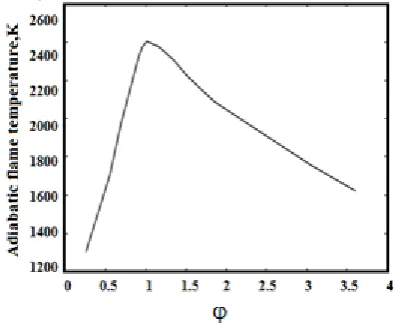
Flame velocity and adiabatic flame temperature are important properties for engine operation and control, in
particular thermal efficiency, combustion stability and emissions. Laminar flame velocity and flame
temperature, plotted as a function ofequivalence ratio, are shown in Fig. 1. and Fig 2., respectively.
Fig.2. Laminar flame velocity for (—) hydrogen, oxygen and nitrogen mixtures and (◦, - -)
gasoline and air mixtures [5].
1.1.4 Minimum ignition source energy
The minimum ignition source energy is the minimum energy required to ignite a fuel-air mix by an ignition
source such as a spark discharge. For a hydrogen and air mix it is about an order of magnitude lower than that of
a petrol-air mix 0.02 mJ as compared to 0.24 mJ for petrol - and is approximately constant over the range of
flammability. This is illustrated in Fig 3. Unfortunately, the low ignition energy means that hot gases and hot
spots on the cylinder can serve as sources of ignition, creating problems of premature ignition and flashback
[4,17].
Fig. 3.Minimum ignition energy of hydrogen in air [4]
The low minimum ignition energy of the hydrogen-air mix means that a much lower energy spark is required for
spark ignition. This means that combustion can be initiated with a simple glow plug or resistance hot-wire. It
also ensures prompt ignition of the charge in the combustion chamber.
1.1.5 High diffusivity
Hydrogen has very high diffusivity. This ability to disperse into air is considerably greater than gasoline and is
advantageous for two main reasons. Firstly, it facilitates the formation of a uniform mixture of fuel and air.
Secondly, if a hydrogen leak develops, the hydrogen disperses rapidly. Thus, unsafe conditions can either be
avoided or minimized [6].
1.1.6. Low density
The most important implication of hydrogen’s low density is that without significant compression or conversion
of hydrogen to a liquid, a very large volume may be necessary to store enough hydrogen to provide an adequate
the power output of the engine. Thus when a hydrogen engine is run lean, issues with inadequate power may
arise [3].
1.1.7. High auto-ignition temperature
The auto ignition temperature is the minimum temperature required to initiate self-sustained combustion in a
combustible fuel mixture in the absence of an external ignition. For hydrogen, the auto ignition temperature is
relatively high 585ºC. This makes it difficult of ignite a hydrogen–air mixture on the basis of heat alone without
some additional ignition source. The auto ignition temperatures of various fuels are shown in Table 1. This
temperature has important implications when a hydrogen–air mixture is compressed. In fact, the auto ignition
temperature is an important factor in determining what maximum compression ratio an engine can use, since the
temperature rise during compression is related to the compression ratio [26]..
1.2 Hydrogen Use in International Combustion Engine
1.2.1 Hydrogen Use in Diesel Engines
There are several reasons for applying hydrogen as an additional fuel to accompany diesel fuel in the internal combustion
(IC) compression ignition (CI) engine. Firstly, it increases the H/C ratio of the entire fuel. Secondly, injecting small amounts
of hydrogen to a diesel engine could decrease heterogeneity of a diesel fuel spray due to the high diffusivity of hydrogen
which makes the combustible mixture better premixed with air and more uniform [13]. Hence the formation of hydrocarbon,
carbon monoxide, and carbon dioxide during the combustion can be completely avoided; however a trace amount of these
compounds may be formed due to the partial burning of lubricating oil in the combustion chamber [14]. However hydrogen
cannot be used as a sole fuel in a compression ignition (CI) engine, since the compression temperature is not enough to
initiate the combustion due to its higher self-ignition temperature [25].Hence hydrogen cannot CI engine without the
assistance of a spark plug or glow plug. This makes hydrogen unsuitable for a diesel engine as a sole fuel. Because of this
reason of the reported literature, activities on hydrogen fuelling of a diesel engine were based on dual-fuel mode. In a dual
fuel engine the main fuel is inducted/carbureted or injected into the intake air while combustion is initiated by diesel fuel that
acts as an ignition source. The pilot fuel quantity may be in the range of 10–30% while the rest of the energy is supplied by
the main fuel. Hydrogen operated dual fuel engine has the characteristics to operate at leaner equivalence ratios at part loads,
which results in NOx reduction, and increase in thermal efficiency thereby reducing the fuel consumption. Oxides of
nitrogen (NOx) are the major problem in hydrogen operated dual fuel engine [14]. One method that has been used to
successfully reduce NOx emissions is exhaust gas recirculation (EGR). EGR is very effective in reducing NOx emissions
due to the dilution effect of, where the oxygen concentration of the intake charge is reduced. In addition, volumetric
efficiency reductions with increasing EGR rates are significant (reductions of about 15% compared with hydrogen dual-fuel
operation without EGR are recorded). At the same time, EGR addition to hydrogen dual-fuel operation can increase
particulate emissions compared with hydrogen dual-fuel operation without EGR. As a result, hydrogen dual-fuel operation
with EGR produces smoke levels similar to normal CI engine operation. In addition to reducing NOx, increases in unburned
HC, CO and CO2 emissions with EGR addition are also recorded. Another method of is introducing liquid water into
the combustion chamber. Water injection can also prevent knocking and pre-ignition during hydrogen
combustion. Here water acts in a similar manner to diluents such as EGR, cooling the charge and reducing the
combustion rate. However, water injected into the intake manifold reduces volumetric efficiency [15].
Conventional diesel engines can be converted to operate on hydrogen–diesel dual mode with up to about 38% of
full-load energy substitution without any sacrifice on the performance parameters such as power and efficiency
1.2.2 Hydrogen use in spark ignition (SI) engines
Hydrogen can be used as a fuel directly in an internal combustion engine, almost similar to a spark-ignited (SI)
gasoline engine.. Most of the past research on H2 as a fuel focused on its application in SI engines. Hydrogen is
an excellent candidate for use in SI engines as a fuel having some unique and highly desirable properties, such
as low ignition energy, and very fast flame propagation speed, wide operational range. The hydrogen fuel when
mixed with air produces a combustible mixture which can be burned in a conventional spark ignition engine at
an equivalence ratio below the lean flammability limit of a gasoline/air mixture. The resulting ultra lean
combustion produces low flame temperatures and leads directly to lower heat transfer to the walls, higher engine
efficiency and lower exhaust of NOx emission [17-18-26].
Therefore, the extensive research pure H2 as fuel has led to the development and successful marketing of
hydrogen engine. For example, Ford developed P2000 hydrogen engine, which was used to power Ford’s E-450
Shuttle Bus.
BMW developed a 6 litre, V-12 engine using liquid H2 as fuel. With an external mixture formation system, this
engine has a power out about 170 kW and an engine torque of 340 Nm [17].
1.2.3 Natural gas-hydrogen mixtures engines
Natural gas is considered to be one of the favourable fuels for engines and the natural gas fuelled engine has
been realized in both the spark-ignited engine and the compression-ignited engine. However, due to the slow
burning velocity of natural gas and the poor lean-burn capability, the natural gas spark ignited engine has the
disadvantage of large cycle-by-cycle variations and poor lean-burn capability, and these will decrease the engine
power output and increase fuel consumption. [19]. Due to these restrictions, natural gas with hydrogen for use in
an internal combustion engine is an effective method to improve the burn velocity, with a laminar burning
velocity of 2.9 m/s for hydrogen versus a laminar burning velocity of 0.38 m/s for methane. This can improve
the cycle-by-cycle variations caused by relatively poor lean-burn capabilities of the natural gas engine. Thus,
natural gas engines can reduce the exhaust emissions of the fuel, especially the methane and carbon monoxide
emissions. Also, the fuel economy and thermal efficiency can also be increased by the addition of hydrogen.
The thermal efficiency of hydrogen enriched natural gas is covered.
There are some challenges when it comes to using the hydrogen-natural gas mixture as a fuel. One of the biggest
challenges using HCNG as a fuel for engines is determining the most suitable hydrogen/natural gas ratio. When
the hydrogen fraction increases above certain extent, abnormal combustion such as pre-ignition, knock and
backfire, will occur unless the spark timing and air-fuel ratio are adequately adjusted. This is due to the low
quench distance and higher burning velocity of hydrogen which causes the combustion chamber walls to
become hotter, which causes more heat loss to the cooling water. With the increase of hydrogen addition, the
lean operation limit extends and the maximum brake torque (MBT) decreases, which means that there are
interactions among hydrogen fraction, ignition timing and excess air ratio [27].
1.3 Hydrogen Internal Combustion Engines Fuel Induction Techniques
As far as the development of a practical hydrogen engine system is concerned, the mode of fuel induction plays
a very critical role. Three different fuel induction mechanisms are observed in the literature [16].
1. Fuel Carburetion Method (CMI)
3. Direct Cylinder Injection (DI)
The engine was operated using all these fuelling modes.
1.3.1 Fuel carburetion method (CMI)
Carburetion by the use of a gas carburettor has been the simplest and the oldest technique. This system has
advantages for a hydrogen engine. Firstly, central injection does not require the hydrogen supply pressure to be
as high as for other methods. Secondly, central injection or carburettors are used on gasoline engines, making it
easy to convert a standard gasoline engine to hydrogen or a gasoline/hydrogen engine. The disadvantage of
central injection in international combustion engine, the volume occupied by the fuel is about 1.7% of the
mixture whereas a carburetted hydrogen engine, using gaseous hydrogen, results in a power output loss of 15%.
Thus, carburetion is not at all suitable for hydrogen engine, because it gives rise to uncontrolled combustion at
unscheduled points in the engine cycle. Also the greater amount of hydrogen/air mixture within the intake
manifold compounds the effects of pre-ignition. If pre-ignition occurs while the inlet valve is open in a
premixed engine, the flame can propagate past the valve and the fuel-air mix in the inlet manifold can ignite or
backfire. In a carburetted hydrogen engine, a considerable portion of the inlet manifold contains a combustible
fuel-air mix and extreme care must be taken to ensure that ignition of this mix does not occur. Serious damage
to the engine components can result when back fire occurs [4-6]. A schematic diagram illustrating the operation
of fuel carburetion method is shown in Fig. 4
Fig.4. Fuel carburetion method [4]
1.3.2 Inlet manifold and inlet port injection
The port injection fuel delivery system injects fuel directly into the intake manifold at each intake port by using
mechanically or electronically operated injector, rather than drawing fuel in at a central point. Typically, the
hydrogen is injected into the manifold after the beginning of the intake stroke. Electronic injectors are robust in
design with a greater control over the injection timing and injection duration with quicker response to operate
under high speed conditions. In port injection, the air is injected separately at the beginning of the intake stroke
to dilute the hot residual gases and cool any hot spots [14]. Since less gas (hydrogen or air) is in the manifold at
any one time, any pre-ignition is less severe. The inlet supply pressure for port injection tends to be higher than
for carburetted or central injection systems, but less than for direct injection systems [6]. A schematic diagram
Fig.5. Inlet manifold and inlet port injection [4]
Inlet manifold or port injection methods of fuel induction, the inducted volume of air per cycle is kept constant
and the power output can be controlled by the amount of fuel injected into the air stream, thus allowing lean
operation. The fuel can either be metered by varying the injection pressure of the hydrogen, or by changing
the injection duration by controlling the signal pulse to the injector [4].
1.3.3 Direct injection systems
In direct in-cylinder injection, hydrogen is injected directly inside the combustion chamber with the required
pressure at the end of compression stroke. As hydrogen diffuses quickly the mixing of hydrogen takes flame
instantaneously. For ignition either diesel or spark plug is used as a source. The problem of drop in power output
in manifold induction/injection can be completely eliminated by in-cylinder ignition. During idling or part load
condition the efficiency of the engine may be reduced slightly. This method is the most efficient one compared
to other methods of using hydrogen. The power output of a direct injected hydrogen engine was 20% more than
for a gasoline engine and 42% more than a hydrogen engine using a carburettor. With hydrogen directly injected
into the combustion chamber in a compression ignition (CI) engine, the power output would be approximately
double that of the same engine operated in the pre-mixed mode [12]. The power output of such an engine would
also be higher than that of a conventionally fuelled engine, since the stoichiometric heat of combustion per
standard kilogram of air is higher for hydrogen (approximately 3.37 MJ for hydrogen compared with 2.83 MJ
for gasoline). While direct injection solves the problem of pre-ignition in the intake manifold, it does not
necessarily prevent pre-ignition within the combustion chamber. In addition, due to the reduced mixing time of
the air and fuel in a direct injection engine, the air/fuel mixture can be non-homogenous [20]. A schematic
diagram illustrating the operation of direct injection is shown in Fig. 6.
Fig.6. Direct injection system [4]
1.3.4 Injector specifications
A fuel injection system performs two basic functions: fuel pressurization and fuel metering. When dealing with
gaseous fuels, only the metering function is required to be carried out by the injection system as the
manifold and direct cylinder injection hydrogen internal combustion engines. As has already been indicated, the
design of inlet manifold or inlet port injectors is less challenging as lower injection pressures are required. For
direct cylinder injectors, not only must the design accommodate for higher injection pressure against the
cylinder pressure, but the equipment must also be capable of withstanding hostile environment of the
combustion chamber[4]. Typical injector construction is illustrated in Fig. 7
Two types of injectors are available for use in D.I. systems. One is a low-pressure direct injector (LPDI) and the
other one is a high pressure direct injector (HPDI). Low-pressure direct injector injects the fuel as soon as the
intake valve closes when the pressure is low inside the cylinder. The high-pressure direct injector injects the fuel
at the end of the compression stroke [14].
Fig.7. Hydrogen injector [21]
1.4 Abnormal Combustion
The same properties that make hydrogen such a desirable fuel for internal combustion engines also bear
responsibility for abnormal combustion events associated with hydrogen. In particular, the wide flammability
limits, low required ignition energy and high flame speeds can result in undesired combustion phenomena
generally summarized as as combustion anomalies. These anomalies include surface ignition and backfiring as
well as auto ignition [22].The suppression of abnormal combustion in hydrogen has proven to be quite a
challenge and measures taken to avoid abnormal combustion have important implications for engine design,
mixture formation, and load control. For SI engines, three regimes of abnormal combustion exist: knock
(auto-ignition of the end gas region), pre-(auto-ignition (uncontrolled (auto-ignition induced by a hot spot, premature back flash,
flashback, and induction ignition; this is a premature ignition during the intake stroke, which could be seen as an
early form of pre-ignition) and backfire. [23].
1.4.1 Pre-ignition
Pre-ignition is often encountered hydrogen engines because of the low ignition energy and wide flammability
limits of hydrogen. As a premature ignition causes the mixture to burn mostly during the compression stroke,
increase in temperature, resulting in another earlier pre-ignition in the next cycle [23]. This advancement of the
pre-ignition continues until it occurs during the intake stroke and causes backfire. Due to the dependence of
minimum ignition energy on the equivalence ratio, pre-ignition is more pronounced when the hydrogen–air
mixtures approach stoichiometric levels. Also, operating conditions at increased engine speed and engine load
are more prone to the occurrence of pre-ignition due to higher gas and component temperatures.
Fig.8 shows the in-cylinder pressure trace as well as the crank angle resolved intake manifold pressure for a
combustion cycle in which pre-ignition occurred. A regular combustion event is shown for comparison. The
data were taken on an automotive-size single cylinder hydrogen research engine at an engine speed of 3200
RPM and an IMEP of 7 bars for the regular combustion case (dotted line). It is interesting to note that the peak
pressure for the pre-ignition case is higher than the regular combustion cycle. However, due to the early pressure
rise that starts around 80 °CA BTDC, the indicated mean effective pressure for the pre-ignition case is around 0
bars. The intake pressure trace for the pre-ignition case does not show any significant difference from the
regular trace, because the pre-ignition occurred after the intake valves closed [22].
1.4.2 Backfire
Backfire is a violent consequence of the pre-ignition phenomena. Should pre-ignition occur at a point when the
inlet valve is open, the enflamed charge can travel past the valve and into the inlet manifold, resulting in
backfire. This problem is particularly dangerous in pre-mixed fuel inducted engines where there is the
possibility that an ignitable fuel-air mix is present in the inlet manifold [4]. The main difference between
backfiring and pre-ignition is the timing at which the anomaly occurs. Pre-ignition takes place during the
compression stroke with the intake valves already closed whereas backfiring occurs with the intake valves open.
This result in combustion and pressure rise in the intake manifold, which is not only clearly audible but can also
damage or destroy the intake system. Due to the lower ignition energy, the occurrence of backfiring is more
likely when mixtures approach stoichiometric.
Limited information available on combustion anomalies also indicates that pre-ignition and backfiring are
closely related with pre-ignition as the predecessor for the occurrence of backfiring. Pre-ignition thereby heats
up the combustion chamber, which ultimately leads to backfiring in a consecutive cycle. Consequently, any
measures that help avoid pre-ignition also reduce the risk of backfiring. Another work has been done on
research engines indicated that combustion anomalies significantly limit the operation regime, optimization of
the fuel-injection strategy in combination with variable valve timing for both intake and exhaust valves [24].
II. AUTO-IGNITION AND KNOCK
When the end gas conditions (pressure, temperature, time) are such that the end gas spontaneously auto-ignites,
there follows a rapid release of the remaining energy generating high-amplitude pressure waves, mostly referred
to as engine knock. The amplitude of the pressure waves of heavy engine knock can cause engine damage due to
increased mechanical and thermal stress. The tendency of an engine to knock depends on the engine design as
well as the fuel-air mixture properties [24].
Knocking combustion is a common problem found in hydrogen-fuelled engines. It is detectable by the human
ear as an audible knocking sound and by oscillations in pressure during combustion. There are many theories
about how knock occurs and different types of knocking combustion have been categorized. The most common,
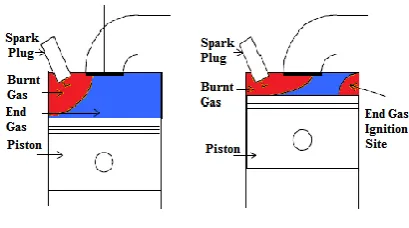
detonation knock, describes an effect due to the self-ignition and explosion of the end gas - the unburned gas
ahead of the flame. This is illustrated in the Fig. 9
Fig. 9 Knock Out end gas Ignition
2.1 Emissions
The combustion of hydrogen with oxygen produces water as its only product:
2H2 O2 2H2O
The combustion of hydrogen with air however can also pro-duce oxides of nitrogen (NOx):
2H2 O2 N2H2ON2 NOx (7)
The oxides of nitrogen are created due to the high temperatures generated within the combustion chamber
during combustion. This high temperature causes some of the nitrogen in the air to combine with the oxygen in
the air. The amount of NOx formed depends on:
The air/fuel ratio
The engine compression ratio The engine speed
The ignition timing
Whether thermal dilution is utilized
In addition to NOx, traces of carbon monoxide and carbon dioxide can be present in the exhaust gas, due to fast
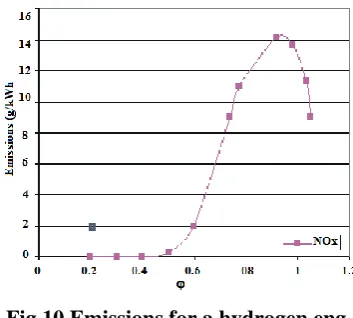
Fig.10 Emissions for a hydrogen eng.
As Fig. 10 shows, the NOx for a gasoline engine is reduced as phi decreases (similar to a hydrogen engine).
However, in a gasoline engine the reduction in NOx is compromised by an increase in carbon monoxide and
hydro-carbons.
2.2 Power Output
The theoretical maximum power of a hydrogen engine depends on the air/fuel ratio and fuel injection method.
Stoichiometric air/fuel ratio for hydrogen is 34:1. At this air/fuel ratio, hydrogen will displace 29% of the
combustion chamber leaving only 71% for the air. As a result, the energy content of this mixture will be less
than it would be if the fuel were gasoline (since gasoline is a liquid, it only occupies a very small volume of the
combustion chamber, and thus allows more air to enter) Since both the carburetted and port injection methods
mix the fuel and air prior to it entering the combustion chamber, these systems limit the maximum theoretical
power obtain-able to approximately 85% of that of gasoline engines. For direct injection systems, which mix the
fuel with the air after the intake valve has closed (and thus the combustion chamber has 100% air), the
maximum output of the engine can be approximately 15% higher than that for gasoline engines.
Therefore, depending on how the fuel is metered, the maximum output for a hydrogen engine can be either 15%
higher or 15% less than that of gasoline if a stoichiometric air/fuel ratio is used. However, at a stoichiometric
air/fuel ratio, the combustion temperature is very high and as a result it will form a large amount of nitrogen
oxides (NOx), which is a dangerous pollutant. Since one of the reasons for using hydrogen is low exhaust
emissions, hydrogen engines are not normally designed to run at a stoichiometric air/fuel ratio [6].
III. CONCLUSIONS
Hydrogen can be used in both the spark ignition as well as compression ignition engines without any major
modifications in the existing systems. An appropriately designed timed manifold injection system can get rid of
any undesirable combustion phenomena such as backfire and rapid rate of pressure rise.
Internal combustion engine powered vehicles can possibly operate with both petroleum products and
dual-fuels with hydrogen.
Because of hydrogen has a wide range of ignition, hydrogen engine can be used without a throttle valve. By
Direct injection solves the problem of pre-ignition in the intake manifold; it does not necessarily prevent
pre-ignition within the combustion chamber.
An appropriate DI system design specifically on the basis of hydrogen's combustion characteristics for a
particular engine configuration ensures smooth engine operational characteristics without any undesirable
combustion phenomena.
Backfiring is limited to external mixture formation operation and can be successfully avoided with DI
operation. Proper engine design can largely reduce the occurrence of surface ignition.
Optimizing the injection timings can also control the onset of knock during high hydrogen flow. Hydrogen engine may achieve lean-combustion in its actual cycles.
REFERENCES
[1]. Antunes Gomes M J., Mikalsen R., Roskilly A.P., An investigation of hydrogen-fuelled HCCI engine
performance and operation, International Journal of Hydrogen Energy, Volume 33, Pages 5823–5828,
2008.
[2]. Saravanan N., Nagarajan G., Sanjay G., Dhanasekaran C., Kalaiselvan M. K., Combustion analysis on a
DI diesel engine with hydrogen in dual fuel mode, Fuel, Volume 87, Pages 3591-3599,2008
[3]. Gillingham K., Hydrogen Internal Combustion Engine Vehicles: A Prudent Intermediate Step or a Step in
the Wrong Direction?, Department of Management Science & Engineering Global Climate and Energy
Project, Precourt Institute for Energy Efficiency, Stanford University, Pages 1-28, 2007
[4]. Overend E., Hydrogen Combustion Engines, The Unıversıty Of Edınburgh, School of Mechanical
Engineering,Pages 1-77,1999
[5]. White M. C., Steeper R.R., Lutz E. A., The hydrogen-fuelled internal combustion engine: a technical
review, International Journal of Hydrogen Energy Volume 31, Pages 1292-1305, 2006.
[6]. COD (College of the Desert), Hydrogen fuel cell engines and related technologies course manual, Module
3: Hydrogen use in internal combustion engines, Pages 1-29, 2001.
[7]. Saravanan N., Nagarajan G., Sanjay G., Dhanasekaran C., Kalaiselvan K.M., An experimental
investigation on hydrogen as a dual fuel for diesel engine system with exhaust gas recirculation technique,
Renewable Energy,Volume 33, Pages 422-427, 2008,
[8]. Bose Kumar Probir, Maji Dines, An experimental investigation on engine performance and emissions of a
single cylinder diesel engine using hydrogen as inducted fuel and diesel as injected fuel with exhaust gas
recirculation, International Journal of Hydrogen Energy, Volume 34, Pages 4847-4854, 2009,
[9]. Saravanan N., Nagarajan G., Performance and emission study in manifold hydrogen injection with diesel
as an ignition source for different start of injection, Renewable Energy.
[10]. Saravanan N., Nagarajan G., Sanjay G., Dhanasekaran C., Kalaiselvan K.M., Experimental investigation
of hydrogen port fuel injection in DI diesel engine, International Journal of Hydrogen Energy Volume 32,
Pages 4071-4080, 2007.
[11]. Bose Kumar Probir, Maji Dines, An experimental investigation on engine performance and emissions of a
single cylinder diesel engine using hydrogen as inducted fuel and diesel as injected fuel with exhaust gas
[12]. Antunes Gomes. M.J ., Mikalsen R., Roskilly A.P, An experimental study of a direct injection
compression ignition hydrogen engine, International Journal Of Hydrogen Energy, Volume 34, Issue 15,
Pages 6516-6522, 2009.
[13]. Szwaja S, Grab-Rogalinski K., Hydrogen combustion in a compression ignition diesel engine,
International Journal of Hydrogen Energy, Volume 34, Pages 4413-4421,2009
[14]. Saravanan N., Nagarajan G., 2010, Performance and emission studies on port injection of hydrogen with
varied flow rates with Diesel as an ignition source, Applied Energy Volume 87,Pages 2218-2229
[15]. Korakianitis T., Namasivayam M A., Crookes J. R., Hydrogen dual-fuelling of compression ignition
engines with emulsified biodiesel as pilot fuel, International Journal Of Hydrogen Energy, Volume 35,
Pages 13329-13344
[16]. Das M. L., Hydrogen engine: research and development (R&D) programmers in Indian Institute of
Technology (IIT), Delhi, International Journal of Hydrogen Energy, Volume 27, Pages 953-965, 2002
[17]. Wahab Abd Bın Aswad M., Addition of hydrogen to gasoline-fuelled 4 stroke SI engine using 1-dımensıonal analysis, Faculty of Mechanical Engineering University Malaysia Pahang, Pages 1-68, 2009 [18]. Abdelghaffar A. W., Spark Ignition Engine Fueled by Hydrogen: Comparative Analysis, European Journal
of Scientific Research, Volume 44, Pages 13-28, 2010
[19]. Huang Z., Wang J., Liu B., Zeng K., Yu J., Jiang D., Combustion Characteristics of a Direct-Injection
Engine Fueled with Natural Gas-Hydrogen Mixtures, Energy & Fuels Volume 20, Pages 540-546, 2006.
[20]. Masood M., Ishrat M.M, Reddy S. A., Computational combustion and emission analysis of hydrogen–
diesel blends with experimental verification, International Journal of Hydrogen Energy Volume 32, Pages
2539- 2547, 2007
[21]. Kim Y.Y., Lee T J., Choi H. G., An investigation on the causes of cycle variation in direct injection
hydrogen fueled engines, International Journal of Hydrogen Energy Volume 30, Pages 69-76, 2005.
[22]. Verhelst S., Wallner T., Hydrogen-fueled internal combustion engines, Progress in Energy and
Combustion Science, Volume 35,Pages 490-527, 2009.
[23]. Verhelst S., Verstraeten S., Sierens R., A comprehensive overview of hydrogen engine design features, J.
Automobile Volume 221,Pages 911-920, 2005.
[24]. Verhelst S., Wallner T., Hydrogen-fueled internal combustion engines, Department of Flow, Heat and
Combustion Mechanics, Ghent University, Sint-Pietersnieuwstraat, Belgium,Pages 1-80, 2009.
[25]. Saravanan N., Nagarajan G., Sanjay G., Dhanasekaran C., Kalaiselvan M. K., Combustion analysis on a
DI diesel engine with hydrogen in dual fuel mode, Fuel, Volume 87, Pages 3591-3599, 2008.
[26]. Gupta B. R, Hydrogen fuel production, transport and storage, CRC Press, ISBN
[27]. Fanhua M., Nashay N., Mingyue W. Long J., Renzhe C. and Shuli Z., Hydrogen-enriched compressed
![Fig. 3.Minimum ignition energy of hydrogen in air [4]](https://thumb-us.123doks.com/thumbv2/123dok_us/9246022.1460602/3.595.207.390.100.241/fig-minimum-ignition-energy-hydrogen-air.webp)
![Fig.4. Fuel carburetion method [4]](https://thumb-us.123doks.com/thumbv2/123dok_us/9246022.1460602/6.595.202.394.404.505/fig-fuel-carburetion-method.webp)
![Fig.5. Inlet manifold and inlet port injection [4]](https://thumb-us.123doks.com/thumbv2/123dok_us/9246022.1460602/7.595.196.396.571.676/fig-inlet-manifold-inlet-port-injection.webp)
![Fig.7. Hydrogen injector [21]](https://thumb-us.123doks.com/thumbv2/123dok_us/9246022.1460602/8.595.214.376.260.492/fig-hydrogen-injector.webp)