A Novel Registration Method for High
Resolution
Remote Sensing Images Based on JSEG and NMI
Chao Wang1,2, Aiye Shi1,2
, Xin Wang1, Fengchen Huang1, and Hui Liu1*
1 College of Computer and Information Engineering, Hohai University,
211100 Nanjing, China [email protected]
2
Engineering Research Center of Sensing and Computing, Hohai University, 211100 Nanjing, China
Abstract: When traditional multi-scale analysis tools are applied to high resolution remote sensing image registration, difficulties and limitations are common in selection of directional sub-bands and distribution optimization of control point pairs etc. Aiming at this issue, a novel registration method based on JSEG and NMI is proposed in this paper. It is the method that incorporates the multi-scale segmentation method (JSEG) into image registration for the first time and proposes an adaptive feature point extraction method on the basis of blocking strategy. Then, NMI is adopted to obtain a set of control point pairs. Finally, the image registration is realized by virtue of Delaunay triangle local transform mapping functions. In accordance with experiments on high resolution remote sensing images collected by different sensors, it is found that the method can not only extract feature points accurately but also ensure reasonable distribution of control point pairs. Meanwhile, compared with traditional multi-scale tools-based methods, the method has relatively high accuracy and robustness.
Keywords: Image registration; High resolution remote sensing images; JSEG; NMI
1.
Introduction
Image registration is a process in which two or more images are compared and matched in the same scene but at different time instances or various viewing angles [1]. Recently, feature-based image registration methods have been generally applied to multi-temporal high resolution remote sensing image registration [2-10]. The basic idea is to achieve registration by extracting feature points in images and then obtain a set of control point pairs on the basis of local spectrum and gradient features of feature points as well as geometric relations between them.
discarded the information in the sub-bands with 45° direction, which would easily cause the damage of edge information of images. On the other hand, it did not have translation invariability. Then, it was difficult for the method to exactly extract edge feature points in the multi-temporal high resolution remote sensing images. To solve this problem, Chen et al. proposed an image registration method based on NSCT, which improved registration accuracy to a large extent for good local and directional characteristics of NSCT in space and frequency domain [16]. However, it also had the problem of sensitivity to direction selection. In other words, selection of different directional high frequency sub-bands has direct impacts on registration accuracy, making the algorithm very fragile, especially for high resolution remote sensing images. Besides, it is worth mentioning that complexities of texture features of different geographical objects in high resolution remote sensing images are different. In order to ensure registration accuracy and reduce influence of local deformation on registration, it is essential to label more control point pairs for objects which have richer internal texture features and more complicated structures. However, less control point pairs are needed for local regions with simple texture features and structures. Since present multi-scale registration methods mainly adopt a uniform threshold to extract edge feature points in images, and they do not restrain distribution of control point pairs, they can hardly ensure reasonable distribution of control point pairs and thus affect registration accuracy [13-16]. Therefore, another important issue in high resolution image registration lies in how to restrain distribution of control point pairs in images.
To deal with the foregoing problems, this paper proposes a novel high resolution image registration method on the basis of J-Segmentation (JSEG) and Normalized Mutual Information (NMI). It is the method that incorporates multi-scale J-images proposed by Deng et al. into image registration for the first time and proposes a adaptive feature point extraction method based on blocking-strategy [17]. Then, to obtain a final set of control point pairs, feature points are matched by using NMI adopted by Studholme C et al. [18]. Finally, the image registration is realized by applying Delaunay triangle local transform mapping functions [19]. According to registration experiments on two different types of high resolution remote sensing images, effectiveness of the proposed method is demonstrated.
This paper is composed of five sections. Section 2 reviews related researches on high resolution remote sensing image registration. Basic principles and specific implementations of the approach will be introduced in Section 3. Section 4 carries out an analysis and a comparison on experimental results. The conclusion is drawn in the last section.
2.
Related Work
methods. At the same time, some new technologies and intelligent optimization algorithms related to modern signal processing are widely applied to image registration, such as wavelet transform [20], simulated annealing algorithm [21], genetic algorithm [22], concurrent computation [23] and fuzzy neural network [24] etc. This section not only summaries recently published researches on image registration but also focuses on registration methods based on point features.
2.1. Registration methods based on gray-level
The best advantage of gray-level based methods that utilize the gray-level information of images directly is their simpleness. However, gray-level statistics is very sensitive and they have both a narrow application scope and relatively large calculation. Therefore, they are not applicable for the situation that there are relatively large radiation distortions. Moreover, they are even not appropriate for registration for images obtained by different sensors. Currently, the most common registration methods based on gray-level are shown as follows:
(1)Cross-correlation method
Cross-correlation method is a kind of basic image registration methods based on gray-level. The registration results can be obtained by calculating a cross-correlation function’s maximum point. There are many improved and optimized cross-correlation methods. For instance, Berthilsson et al. used an improved cross-correlation method to carry out registration for two images with affine transformations [25]. S. Kaneko et al. solved problems in the registration between two images that were covered partially with expanded correlation coefficient method [26]. Based on the traditional correlation method, Barnea et al. put forward a simpler and more effective algorithm, i.e., Sequential Similarity Detection Algorithms (SSDA) [27]. Nevertheless, it cannot be denied that these registration methods based on cross-correlation still have disadvantages, such as relatively smooth similarity measure peak and complex calculation etc.
(2)Fourier transform method
it is only applicable for registration of two images with translation, rotation and scaling rather than registration of images with complex changes.
(3) Mutual information method
The image registration based on mutual information utilizes mutual information to compare statistical dependencies between two images. The reason why it is considered to be better than cross-correlation method and SSDA method in many aspects is that it can register multimodality images. Therefore, once the registration method based on mutual information was put forward, it drew wide attention from scholars and researches. For instance, Josien et al. put forward to improve extreme value performance of images by combining mutual information and gradient information of images [33]. In addition, Philippe et al. adopted a multi-resolution image pyramid method to improve optimization speed of maximum mutual information [34]. Skouson et al. deduced the upper bound of two images’ mutual information so as to put forward deeper understanding about properties of mutual information and propose mutual information could not necessarily get optimized results in some cases [35]. However, calculation of this method is relatively large and it is required that there should be relatively large overlapping regions between the reference image and the image to be registered. Additionally, the energy function established based on mutual information may be morbid and have a lot of local extremum [33].
2.2. Registration methods based on features
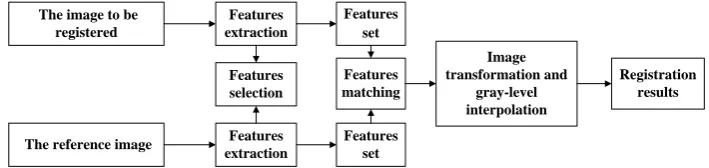
Among registration methods based on features, some common features are extracted from both reference images and images which will be registered as registration elements. Then, it is essential to complete the registration by establishing corresponding relations among registration elements and calculating transformation model parameters. Compared with such methods based on gray-level, registration methods based on features own the following advantages, such as small calculation, strong stability and wide adaptability etc. For this, they are widely applied to researches on the registration between multi-source remote sensing images (images with different time phases, wave bands and sensors). A registration method based on feature consists of three steps, including feature selection and extraction, feature matching as well as image transformation and gray-level interpolation. The basic flow of this kind of methods is shown in Fig.1.
The image to be registered
The reference image
Features extraction
Features extraction Features selection
Features set
Features set Features matching
Image transformation and
gray-level interpolation
Registration results
Currently, there are a great many of registration methods based on features. Their main differences lie in selection of registration elements and feature matching. Point, line and surface features are three registration elements that are used most commonly in feature-based image registration methods, which correspond to coastline, roads, lakes and prominent artificial or natural structures in remote sensing images. Wherein, the point feature based registration method is the most commonly adopted [36], whose basic thought is to extract feature points in images first and then get the set that is corresponding to control point pairs based on local gray-level and gradient of feature points as well as geometrical relationships among feature points, hoping to realize full registration between images.
Generally, point features refer to peripheral points in images, cross points in lines, angular points and the center of gravity of a region etc. The most widely used extraction algorithms involve wavelet transform methods and various corner detection algorithms. Currently, there are two major kinds of methods for automatic extraction of angular points, i.e., methods based on edge detection [37] and the ones on the basis of image gray-level [38]. Generally speaking, it is required that edges of images should be encoded in methods based on the image edge detection, which depends on image segmentation and edge extraction to a large extent. However, operation is very difficult and calculation is very large. Moreover, once the object to be registered suffers some local changes, the image segmentation and edge extraction may end in failure. Therefore, this method has a quite small application scope. On the contrary, methods based on image level avoid the foregoing deficiencies since they focus on gray-level changes in the pixel neighborhood rather than edges of a whole object. In the methods based on the image gray-level, angular points are detected by calculating curvatures and gradients of points. For this kind of methods, great progresses have been made up to now. By adopting the multi-scale analysis theory based on wavelet transform, Fonseca et al. carried out wavelet transforms for images, wishing to calculate the module values of wavelet transforms and local maximum values of modules, i.e., corresponding peripheral points in the images [39]. Kitchen et al. put forward an angular point extracting method based on the first-order differential [40]. However, calculation of this method is very complex. To reduce calculated quantity, Harris et al. proposed another angular point extracting method based on the first-order differential [41]. Smith et al. put forward another more direct angular point extracting method named SUSAN algorithm [42]. Zitova et al. came up with a parameter angular point extracting method without the need to calculate differential, which could be used to deal with distortion and noise data [38].
applicability. It represents development direction of image registration technologies, which acts as the key issue researched in this paper. In this paper, a novel multi-scale analysis tool, sequence of J-images, will be firstly adopted to extract feature points and control point pairs, aiming at putting forward a novel registration method based on point features, as described in Section 3.
3.
High resolution remote sensing image registration method
based on JSEG and NMI
The high resolution remote sensing image registration method based on JSEG and NMI mainly involves three steps, including (1) feature point extraction based on J-image sequences, (2) feature points matching based on NMI and (3) image registration based on Delaunay triangle local transform mapping functions.
3.1. Feature point extraction based on J-image sequences
JSEG is one of the most popular color texture segmentation methods currently. Integrating spectrum, texture and scale features of an original image, multi-scale J-images in JSEG effectively describe color distribution in the image. In the J-J-images of JSEG, J-value of a certain pixel reflects internal homogeneity within the circular neighboring region around this pixel. The J-value serves as an index which combines with spectrum, texture and scale information contained in raw images, and is insensitive to direction information. In order to substitute traditional multi-scale analysis tools for feature point extraction, the multi-scale J-image sequence is selected in this research. The J-value is computed according to the following steps:
The quantization method proposed by Deng et al. is used to compress gray levels of raw image and obtain quantized ones [43]. For quantized image, set the position
( , )
p x y
of each pixelp
as the pixel value, andP
stands for the set for all pixels inthe quantized image.
m
refers to the mean value of all the pixels inP
. Define the setfor pixels with the same gray level as
P
i , with the mean valuem
i and the corresponding gray leveli
. Then, the total variance forP
can be expressed asS
T:T
=
2 p PS
p
m
(1)Define the sum of variance in a single gray level as
S
W :2
=1 =1
=
i
C C
W i i
i i p P
S
S
p
m
Where
C
represents the number of gray levels in the quantized image. Define thedistances between different gray levels as
S
B. Then, the J-value can be defined as:
J
S
B/
S
W
(
S
T
S
W) /
S
W (3)Finally, the J-value of pixel
p
is calculated by using Eq. (3) with a special size circular window. Besides, this J-value is set as the pixel value of pixelp
. The whole image is iterated to obtain the J-image on a single scale. Meanwhile, varying window sizes are used to calculate the multi-scale J-image sequence. Fig. 2 and Fig. 3 are special size windows atp
for calculation of J-values, with the sizes of 9×9 pixels and 18×18 pixels, respectively. To ensure isotropy, corners of the windows are removed so that the windows can be close to the circular shape. It can be seen that smaller windows are more sensitive to image details, while bigger windows reduce effect of noise and isolated points on feature point extraction. Consequently, the image number in a J-image sequence and window sizes to different scales can be manually set in accordance with raw images and specified application background of image registration. Then, J-image sequences of the reference image and the image to be registered are calculated accordingly.
Fig. 2 Window of 9×9 pixels at
p
Fig. 3 Window of 18×18 pixels at
p
According to Eq. (1) and (2), it can be found that, in the J-image on a certain scale, the larger the J-value of a pixel, the more likely the pixel is on the border of a region.
Otherwise, the pixel will be in the center of a region. Therefore, a uniform threshold
T
1can be set to extract different edge feature points on various scales.
To restrain distribution of the extracted feature points further, this paper puts forward an adaptive feature point extraction method based on blocking strategy. Specific steps of the method are as follows:
Step 1: Divide J-images on each scale into sub-images with different sizes. The size of a sub-image is the same as the special window size of the J-image on a corresponding scale. It should be noted that such windows are squares of
N
N
pixels and their corners are reserved.Step 2: Calculate the J-value for the whole raw image by using Eq. (3), which is
Step 3: For the J-image on a certain scale, compare the J-value of a central pixel in the center of the sub-image with
T
a . If the J-value is larger thanT
a , it will be considered that the sub-image contains rich internal texture features and complicated structures. As a result, more feature points should be extracted. Therefore, the pixels withK
biggest J-values are selected as feature points. On the contrary, less feature points are needed. Based on this, the pixels withL
biggest J-values are selected asfeature points, where
2
K
L
.Step 4: Repeat Step 3 for J-images on all scales in order to extract feature points on multiple scales.
3.2. Feature points matching based on NMI
Mutual Information (MI) is a similarity measure that is widely applied to image registration, which has high robustness and accuracy without pre-cutting [44-45]. NMI proposed by Studholme C et al. can smooth the registration function effectively, so the objective function is able to reflect the relation between registration parameters and MI more accurately [18]. Global feature points extracted by NMI are used in this paper. Calculation about NMI is shown as follows:
In the J-image on a certain scale, use control points in reference images and images to be registered as two random variables
C
andD
to calculate NMI among control points. The used window size is the same as the special window size adopted by the current scale J-image. First of all, adopt entropy to describe mutual information. The entropy refers to overall features of information source characteristics in average sense, which may be obtained by information content weight in time. Define the entropy and the mutual informationI C D
( ,
)
as Eq. (4) and Eq. (5).H
kP
klog
2P
k(4)
I C D
( ,
)
H C
( )
H D
( )
H C D
( ,
)
(5)Where
P
k stands for the probability that thek
th situation may occur in all possibilities of a random variable. Then,H C
( )
,H D
( )
andH C D
( ,
)
stand for the entropy that is corresponding to homonymy points in the reference image and the image to be registered and their combination entropy, respectively. According to Eq. (4), we may know:Where
P c
C( )
andP d
D( )
are probability distribution whenC
andD
are completely independent, respectively.P
CD is the combined probability distribution ofC
andD
. Define NMI as follows:
( )
( )
( ,
)
H C
H D
NMI
H C D
(9)To match the corresponding feature points accurately, the maximum bi-directional matching strategy is adopted in this paper. With respect to the feature points matching process based on NMI, it is shown as follows:
Step 1: In the J-images of the reference image and the image that will be registered on the same scale, construct sub-images with a certain size on the basis of this scale. For example, a feature point
p
is extracted from the J-image with a window of 18×18 pixels. Next, the constructed sub-image by using central pointp
is shown in Fig. 3.Step 2: Calculate the NMI according to Eq. (9) between the sub-image of a feature point from the reference image and all sub-images of feature points in the image that will be registered. If a NMI is the biggest among all and larger than the threshold
T
NMI, the two feature points will serve as a pair of control points. The pair of control points, i.e., Set 1, can be obtained by calculating NMI for all points in the reference image.Step 3: Being similar to Step 2 but in inverse direction, compare the NMI between a feature point in the image to be registered and all the feature points in the reference image to obtain the pair of control points Set 2.
Step 4: Compare Set 1 with Set 2 to get a final set of control point pairs by choosing common corresponding points in both sets.
Step 5: Repeat Step 1 to Step 4 for all scales, and map the obtained control point pairs into the raw image in accordance with coordinates.
Step 6: Utilize classical Random Sample Consensus (RANSAC) algorithm in the raw image to reduce mismatching further and obtain the final set of control point pairs [46].
3.3. Image registration based on Delaunay triangle
Because of multiple object classes, rich texture information and large amounts of local deformation in high resolution remote sensing images, it will be difficult to ensure registration accuracy is work is only based on global polynomial mapping functions. However, local triangle transforms, which adopt local mapping functions, can solve this problem effectively [47]. In comparison with ordinary triangulation, the Delaunay triangulation proposed by Rognant et al. has the advantage that the topological relation is unchanged [19]. In another word, the Delaunay triangulation constructed from control point pairs is the same no matter where it starts. Therefore, the geometric mapping functions are constructed by Delaunay triangulations in this research, which re-samples the image to be registered. The mapping function is
0 1 2
0 1 2
'
'
x
a
a x
a y
y
b
b x
b y
Where
( , )
x y
is coordinates of a local triangle in the reference image, and( ', ')
x y
stands for coordinates of the corresponding local triangle in the image to be registered. Knowing the three control point pairs of the constructed triangle, one can solve undetermined coefficients in Eq. (10) directly and easily.4.
Experimental results and analysis
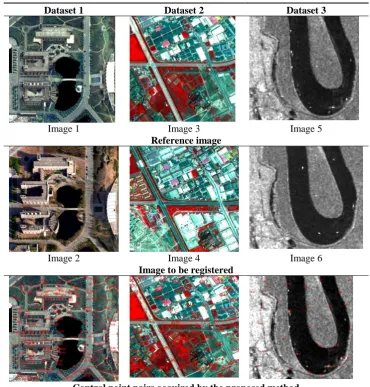
To evaluate both effectiveness and robustness of the proposed method, three datasets of high resolution remote sensing images acquired by different sensors are used for experiments, as shown in Table 1.
Image 1 and Image 2 which are aerially remotely sensed Digital Ortho-photo Map (DOM) data acquired in March 2009 and February 2012, respectively, are chosen as Dataset 1. The geographical region that is located in Dataset 1 is at Jiangning campus of Hohai University, Nanjing City, Jiangsu Province, P. R. China, with a spatial resolution of 0.5 m and an image size of 512×512 pixels.
Dataset 2 consists of SPOT 5 panchromatic-multispectral fusion images, i.e., Image 3 and Image 4 (acquired in June 2004 and July 2008, respectively) with 512×512 pixels image size. Fused bands include panchromatic, red, green and near infrared bands. The geographical region of the Dataset 2 is in Shanghai, P. R. China.
To verify robustness of the proposed method to the noise to a larger extent, a set of ASAR images collected by ENVISA satellite is taken as Dataset 3 for experiments. Image 5 and Image 6 with 512×512 pixels image size were obtained in January 2008 and December 2009, respectively. Additionally, the spatial resolution is 12 m. The geographical region of Dataset 3 is in Wuhan, P. R. China.
In this study, the window sizes for computing J-value are set as 20×20 pixels, 10×10 pixels, and 5×5 pixels, respectively. In other words, J-images on three scales are computed. Parameter settings are shown as follows:
T
1
0.75
,K
6
,L
3
and0.85
NMIT
. Moreover, three levels of decomposition are used for wavelet-based and NSCT-based registration methods.Table 1. Experimental images and registration results
Dataset 1 Dataset 2 Dataset 3
Image 1 Image 3 Image 5
Reference image
Image 2 Image 4 Image 6
Image to be registered
Registration results obtained by the proposed method
Control point pairs acquired by wavelet-based algorithm
Registration results obtained by wavelet-based algorithm
Control point pairs acquired by NSCT-based algorithm
4.1. Visual analysis of experimental results
According to analysis of Table 1 and via Dataset 1, it can be seen that multi-temporal images are composed of aerial images acquired in different viewing angles. There are a large number of changes in viewing angles and local deformations in different parts of such images, especially around buildings with complex structures. Consequently, more control point pairs are needed for correction. Compared with Dataset 1, Dataset 2 has a lower spatial resolution with smaller differences in viewing angles, but it owns richer categories of geographical objects with more complicated background. By comparing registration results from three different algorithms in Dataset 1 and Dataset 2, this paper draws the following conclusions:
(1) The number of control point pairs extracted by the proposed method is the largest compared to that obtained by the other two methods. Furthermore, the point pairs are distributed in the internal region of images reasonably according to different regional structures and texture features. By adopting the adaptive feature point extraction method based on blocking-strategy, large numbers of control points not only mark the objects with detailed features, such as regions with variable internal texture features and man-made buildings with complex structures, but also reduce impacts of viewing angle differences and local deformation on registration effectively. On the other hand, fewer control points mark locations of objects with even internal textures and simple structures, like roads and lakes etc.
(2) Wavelet-based and NSCT-based registration methods use single thresholds in both feature point extraction and feature points matching but ignore local regional texture features and complexity of structures. Therefore, the extracted control point pairs distribute relatively dispersedly so that it can hardly guarantee optimal solution.
(3) Since wavelet-based registration method adopts the geometric correction based on global polynomial fitting, the correction performance becomes relatively poor for regions with much local deformation.
(4) For NSCT-based registration method, it utilizes the geometric correction based on triangular transform, which is sensitive to local deformation of images. Nevertheless, small numbers of control point pairs can hardly mark the shape and structural differences of the local deformation within the images of different time instances sufficiently. Such a situation has significant impacts on final registration accuracy. On the other hand, if we increase the number of the edge feature points and the control point pairs by simply changing the threshold, it will not only increase the computation cost but also incur more mismatching.
4.2. Qualitative analysis of experimental results
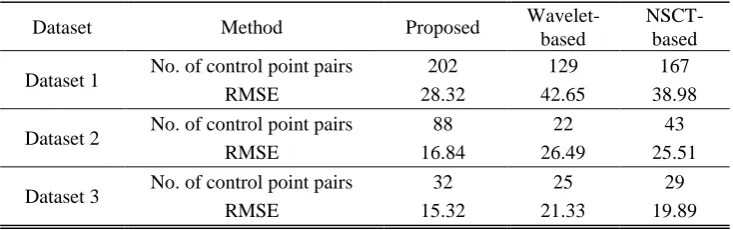
Directing at analyzing the performance of all of the algorithms quantitatively to a larger extent, we choose Root Mean Square Error (RMSE) between the reference image and the image to be registered as the accuracy assessment for different algorithms. The definition of RMSE is given by
2 1
,
1, 2...
nj j
x
j
n
n
(11)
Where
n
refers to the number of pixels in registration results andx
j stands for the pixel differences between the registered resultant image and the reference image. RMSE reflects the divergence of samples. The smaller the is, the closer the two images are and the higher the registration accuracy is. The accuracy assessment on the three datasets is illustrated in Table 2.Table 2. Accuracy assessment for three datasets
Dataset Method Proposed
Wavelet-based
NSCT-based
Dataset 1 No. of control point pairs 202 129 167
RMSE 28.32 42.65 38.98
Dataset 2 No. of control point pairs 88 22 43
RMSE 16.84 26.49 25.51
Dataset 3 No. of control point pairs 32 25 29
RMSE 15.32 21.33 19.89
In the registration experiment in which three pairs of multi-temporal images are used and according to Table 2, we may find that the proposed method extracts the most control point pairs, and achieves the highest registration accuracy among the three methods in each pair of multi-temporal images registration. Meanwhile, the registration results are in consistent with visual analysis. On this basis, we can draw the following conclusions.
(1) Compared with the other two methods, the proposed method uses J-image sequences as a multi-scale analysis tool, which avoids selecting directions of high frequency sub-bands. By virtue of this, the method will not ignore any directional high frequency information. Therefore, the extracted feature points have high accuracy, which guarantees the proposed method has high registration accuracy.
(2) For the registration of high resolution remote sensing images with have large local deformation, the geometric correction method based on triangular transforms can increase registration accuracy effectively.
control point pairs and their distribution should have important effect on registration accuracy.
In Table 2, it should also be noted that registration accuracy parameters of all of the three methods in Dataset 2 and Dataset 3 are significantly improved compared with Dataset 1. The main reason for this may be that the viewing angle changes in Dataset 2 and Dataset 3 are much smaller than those in Dataset 1 so that there are fewer locally deformed regions.
5.
Conclusions
A novel registration method for high resolution remote sensing images based on JSEG and NMI is proposed in this paper. Compared with traditional registration methods based on multi-scale analysis tools, such as wavelet transform and NSCT etc., the proposed method utilizes J-image sequences as a multi-scale analysis tool, which enables the method to overcome the effect of using high frequency sub-bands in different directions on final registration results when feature points are extracted. On the other hand, the adaptive feature point extraction strategy based on blocking and multi-scale feature point matching strategy on the basis of NMI can extract control point pairs accurately, which guarantees that the obtained control point pairs can be distribute reasonably according to textural and structural features of local regions. Finally, by incorporating Delaunay triangle local transform. In accordance with experimental results on three different types of high resolution images using different registration methods, it is shown that the proposed method can achieve high registration accuracy and reduce noise interference with both high stability and high robustness.
Acknowledgements. The work is supported by National Natural Science Foundation of China (No. 61271386), the CRSRI Open Research Program (No. CKWV2013215/KY).
References
1. Zitova B. and Flusser J.: Image registration methods: a survey. Image Vision Computer, Vol. 21, 977-1000. (2003)
2. Ye P. and Liu F.: A implicit similarity method for multi-modal image registration. IEEE International Workshop on Multi-Platform /Multi-Sensor Remote Sensing and Mapping, 1-4. (2011)
3. Cao S. X., Jiang J., Zhang G. J. and Yuan Y.: An edge-based scale- and affine-invariant algorithm for remote sensing image registration. Int. J. Remote Sens., Vol.34, 2301-2326. (2013)
4. Xu M. X. and Wei C. L.: Remotely sensed image classification by complex network eigenvalue and connected degree. Comput. Math. Method. M. Vol. 2012, 632-703. (2012) 5. Jiang J. and Zhang X. S.: Multi-sensor image automatic registration using mutual
information. In Proceedings of the 2012 International Conference on Graphic and Image Processing, Vol. 8768, 1-7. (2013)
7. Wang W. T., Han Z. G. and Liu P. F.: Multi-sensor image registration algorithm based on SIFT points and canny edge features matching. Computer Science, Vol. 38, 287-289. (2011) (in Chinese)
8. Wang W. T., Li Y. L. and Zhao Q. L.: A new approach to automatic feature based registration of multi-sensor remote sensing images. In Proceedings of the 2nd IEEE International Conference on Remote Sensing, Environment and Transportation Engineering, 1-4. (2012)
9. Wang Q. and You S. Y.: Automatic registration of large-scale multi-sensor datasets, Trends and Topics in Computer Vision, Springer Berlin Heidelberg. (2012)
10. An Y. and Sun W. D.: A contour-based approach to multisensory image registration using narrow angle features. In Proceedings of the 2nd IEEE International Conference on Electric Information and Control Engineering, Vol. 1, 24-28. (2012)
11. Do M. N. and Vetterli M.: The contourlet transform: an efficient directional multi-resolution image representation. IEEE T. Image Process., Vol. 14, 2091-2106. (2005)
12. Arthur L., Cun H., Zhou J. P. and Do M. N.: The non-sub-sampled contourlet transform: theory, design, and applications. IEEE T. Image Process., Vol. 15, 3089-3101. (2006) 13. Zavorin I. and Moigne L.: Use of multi-resolution wavelet feature pyramids for automatic
registration of multisensor imagery. IEEE T. Image Process., Vol. 14, 770-782. (2005) 14. Wang H. H., Zeng N. and Lu W.: Edge detection of laser imaging radar based on wavelet
transform and mathematical morphology. Chinese Journal of Lasers, Vol. 35, 903-906. (2008) (in Chinese)
15. Fonseca L. M. G. and Costa M. H. M.: Automatic registration of satellite images. In Proceedings of Brazilian Symposium on Computer Graphic and Image Processing, 219-226.(1997)
16. Chen Z. G., Yin F. C. and Sun F.: Registration technique for high-resolution remote sensing image based on nonsubsampled contourlet transform. Acta Optica Sinica, Vol. 29, 2744-2750. (2009) (in Chinese)
17. Deng Y. and Manjunath B. S.: Unsupervised segmentation of color-texture regions in images and video. IEEE T. Pattern Anal., Vol. 23, 800-810. (2001)
18. Studholme C., Hill D. L. G. and Hawkes D. J.: An overlap invariant entropy measure of 3D medical image alignment. Pattern Recogn., Vol. 32, 71-86. (1999)
19. Rognant L., Chassery J. M., Goze S. and Planes J. G.: The Delaunay constrained triangulation: the Delaunay stable algorithms. In Proceedings of IEEE International Conference on Information Visualization, 147-152. (1999)
20. Le Moigne J., Campbell W. J., and Cromp R. P: An automated parallel image registration technique based on the correlation of wavelet features. Geoscience and Remote Sensing, IEEE Transactions on, Vol. 40, 1849-1864. (2002)
21. Farsaii B. and Sablaur A.: Global cost optimization in image registration using simulated annealing. In Proceedings of the SPIE Conference on Mathematical Modeling and Estimation Techniques in Computation Vision. San Diego, California, 117-125. (1998) 22. Shi J., Wu J. J., Paul A., Jiao L. C. and Gong M. G.: Change Detection in Synthetic Aperture
Radar Images Based on Fuzzy Active Contour Models and Genetic Algorithms. Mathematical Problems in Engineering, (2014). [Online]. Available: http://www.hindawi.com/journals/mpe/2014/870936/
23. Quan S., and Zhang J. X.: Parallel Research and Implementation of SAR Image Registration Based on Optimized SIFT. Telkomnika Indonesian Journal of Electrical Engineering,
Vol. 12, 1125-1131. (2014)
24. Jun L., and Hao Z. C.: Novel image fusion method based on adaptive pulse coupled neural network and discrete multi-parameter fractional random transform. Optics and Lasers in Engineering, Vol. 52: 91-98. (2014)
26. Kaneko S., Satoh Y. and Igarashi S.: Using selective correlation coefficient forrobust image registration. Pattern Recognition, Vol. 36, 1165-1173. ( 2003)
27. Barnea D. I. and Silverman H.F.: A class of algorithms for fast digital imageregistration. IEEE Transactions on Computing, Vol. 21, 179-186. (1972)
28. Bracewell R. N.: The Fourier Transform and Its Applications. McGraw-Hill, New York,
USA. (1965)
29. Alliney S. and Morandi C.: Digital Image Registration using Projections. IEEE Transactions on Pattern Analysis and Machine Intelligence, Vol. 8, 222-233. (1986)
30. Alliney S.: Spatial registration of multispectral and multitemporal digital imageryusing fast-Fourier transform techniques. IEEE Transactions on Pattern Analysis and Machine Intelligence, Vol. 15, 499-504. (1993)
31. Castro E. D. and Morandi C.: Registration of translated and rotated images using finite Fourier transform. IEEE Transactions on Pattern Analysis and Machine Intelligence, Vol. 9, 700-703. (1987)
32. Reddy B. S. and Chatterji B. N.: An FFT-Based Technique for Translation, Rotation, and Scale-Invariant Image Registration. IEEE Transactions on Image Processing, Vol. 5, 1266-1271. (1996)
33. Pluim J. P. W., Antoine J. B. and Viergever M. A.: Image registration by maximization of combined mutual information and gradient information. IEEE Transactions on Medical Imaging, Vol. 19, 809-814. (2000)
34. Thevenaz P., Unser M.: Optimization of mutual information for multi-resolution image registration. IEEE Transactions on Image Processing, Vol. 9, 2083-2098. (2000)
35. Skouson M. B., Guo Q. J., and Lian Z. P.: A Bound on Mutual Information for Image Registration. IEEE Transactions on Medical Imaging, Vol. 20, 843-846. (2001)
36. Adams R. and Bischof L.: Seeded region growing. IEEE Transactions on Pattern Analysis and Machine Intelligence, Vol. 16, 641-647. (1994)
37. Quddus A. and Fahmy M. M.: An improved wavelet based corner detection technique. In Proceedings of IEEE International Conference on Acoustics, Speech and Signal Processing. Vol. 6, 3213-3216. (1999)
38. Zitova B., Kautsky J., Peters G. and Flusser J.: Robust detection of significant points in multiframe images. Pattern Recognition Letters, Vol. 20, 199-206. (1999)
39. Fonseca L. M. G., Costa M. H. M.: Automatic registration of satellite images. In Proceedings of IEEE Brazilian Symposium on Computer Graphics and Image Processing. Campos do Jordo, Brazil, 219-226. (1997)
40. Forstner W. and Gulch E.: A fast operator for detection and precise location ofdistinct points, corners and centers of circular features. In Proceedings of the ISPRS Workshop on Fast Processing of Photogrammetric Data. Interlaken, Switzerland, 281-305. (1986)
41. Harris C. and Stephens M.: A combined corner and edge detector. In Proceedings of the 4th Alvey Vision Conference. Manchester, England, 147-151. (1988)
42. Smith S.M. and Brady J.M.: SUSAN-a new approach to low level image processing. International Journal of Computer Vision, Vol. 23, 45-78. (1997)
43. Deng Y., Kenney C., Moore M. S. and Manjunath B. S.: Peer group filtering and perceptual color image quantization. In Proceedings of IEEE International Symposium on Circuits and Systems, Vol. 4, 21-24. (1999)
44. Viola P. and Wells W. M.: Alignment by maximization of mutual information. Int. J. Comput. Vision, Vol. 24, 137-154. (1997)
45. Thevenaz P. and Unser M.: Optimization of mutual information for multi-resolution image registration. IEEE T. Image Process., Vol. 9, 2083-2099. (2000)
47. Hong G. and Zhang Y.: Wavelet-based image registration technique for high-resolution remote sensing images. Comput. Geosci-uk., Vol. 34, 1708-1720. (2008)
Chao Wang received his master's degrees in Communication and Signal Processing from China University Of Mining And Technology, China, in 2010. He is currently a Ph.D. candidate in computer science at Hohai University, China. His major research interests include remote sensing image processing and pattern recognition.
Aiye Shi is in the College of Computer and Information, Hohai University, China. He obtained his Ph.D. degree from Hohai University of College of Computer and Information of China. His research interests include image processing and remote sensing change detection.
Xin Wang is in the College of Computer and Information, Hohai University, China. She obtained her Ph.D. degree from Nanjing University of Science and Technology of China in 2010. Her research interests include image processing, pattern recognition, and computer vision.
Fengchen Huang is a Senior Research Associate at College of Computer and Information Engineering, Institute of Communication and Information System Engineering, Hohai University, Nanjing, P. R. China. He is a Senior Member of Chinese Institute of Electronic, his research areas are signal processing in remote sensing and remote control.
Hui Liu is currently a Ph.D. candidate in computer science at Hohai University, China. His major research interests include remote sensing image processing and network engineering.