ISSN: 2149-214X
www.jeseh.net
Investigation of the Effects of
Out-of-School Learning Environments on the
Attitudes and Opinions of Prospective
Classroom Teachers about Renewable
Energy Sources
Umit Izgi-Onbasili Mersin University
To cite this article:
Izgi-Onbasili, U. (2020). Investigation of the effects of out-of-school learning environments
on the attitudes and opinions of prospective classroom teachers about renewable energy
sources
.
Journal of Education in Science, Environment and Health (JESEH), 6
(1), 35-52.
DOI:10.21891/jeseh.670049
This article may be used for research, teaching, and private study purposes.
Any substantial or systematic reproduction, redistribution, reselling, loan, sub-licensing,
systematic supply, or distribution in any form to anyone is expressly forbidden.
Authors alone are responsible for the contents of their articles. The journal owns the
copyright of the articles.
DOI:10.21891/jeseh.670049
Investigation of the Effects of Out-of-School Learning Environments on the
Attitudes and Opinions of Prospective Classroom Teachers about
Renewable Energy Sources
Umit Izgi-Onbasili
Article Info
Abstract
Article History
Received: 04 March 2019
The aim of this study is to investigate the effects of energy resources activities on attitudes and views of prospective classroom teachers about renewable energy resources within the context of out-of school learning environments. In the study, quasi-experimental design without pre-test post-test control group was used. The research was conducted in the spring term of 2017-2018 academic year with an in-depth study plan for a total of 14 weeks with 12 prospective classroom teachers within the scope of Community Service Practices course. Out-of-school learning activities are held in Solar Park House and Akkuyu Nuclear Power Plant Information Center which is Turkey's first nuclear power plant, located in Mersin. In the research, Attitude Scale for Renewable Energy Resources developed by Güneş, Alat and Gözüm (2013) was used. Also, the interview form, which consists of open-ended questions developed by the researcher and the diaries kept by the prospective teachers within the scope of the course were examined by qualitative analysis method. As a result of the research, it was found that there was a significant difference between the pre-test and post-test scores of the prospective classroom teachers regarding the renewable energy resources in favor of the post-test scores.
Accepted: 30 December 2019
Keywords
Prospective classroom Teacher,
Energy, Attitude, Out-Of-School Learning
Introduction
The concept of energy and the sustainability of energy resources have been one of the most important issues and problems in the world from past to present (Külekçi, 2009). Energy sources are divided into renewable and non-renewable energy sources. Renewable energy sources are; solar, wind, geothermal, biomass, hydroelectric, wave and tide. Non-renewable energy sources can be listed as fossil fuels (oil, coal, natural gas) and nuclear energy (Külekçi, 2009: 84). In recent years, due to the rapid increase in the world population and the development of technology, the energy has become a global problem as people consume more energy for a more comfortable life. The quality of the training has a great importance because the correct and effective use of energy resources become a bigger problem day by day (Güneş, Alat & Gözüm, 2013). In this context, especially in science education, the value given to this subject gains importance.
In many developed countries there is a decrease in student attitudes towards school perception. Therefore, it is argued that informal learning environments should be utilized more in science teaching. With such science education, students can be more motivated towards school and science. Also out-of-school activities can contribute to students' learning in science. Out-of-school activities should be seen as complementary to formal school rather than competing with the school (Braund & Reiss, 2006). Life experiences of children, both inside and outside the school, have profound effects on school success and functioning in the community (Resnik, 1987).
Informal education environments that allow students to establish an individual relationship with real objects and thus gain positive attitudes, values and new perspectives and acquire persistent information include many social areas (Bozdoğan and Yalçın, 2006: 97). Out-of-school learning is the planned processing of the subjects covered in the curriculum outside the school (museums, science centers, zoos, botanical gardens, aquariums, planetariums, industrial organizations, arboretums, etc.). In other words, it is to use informal education resources for formal education (Salmi, 1993, cited in Ertaş, Şen and Parasızoğlu, 2011). At this point, the most important feature is the controlled, planned and organized out-of-school activities (Aydın, Haşıloğlu and Kunduracı, 2016). When the studies about the learning activities and energy types in the literature are examined, it was determined that out-of-school learning activities had positive effects especially on achievement, attitude and permanent learning. Also it was found to be entertaining and remarkable by the participants (Bozdoğan & Yalçın, 2006; Özdemir, 2010; Ertaş, Şen and Parasızoğlu, 2011; Sontay, Tutar and Karamustafaoğlu, 2016) One of the important details of this study is; Akkuyu Nuclear Power Plant (Turkey's first nuclear power plant) is present in Mersin province. In the case of the establishment of a nuclear power plant, it is frequently encountered in the media (Akkuyu Nuclear Power Plant, 2019) about the returns to the country and the environment, the conditions for the establishment of the power plant and the measures to be taken. For this reason, the opinions of prospective teachers in Mersin are gaining importance. When other studies conducted with prospective teachers in the literature were examined, it was determined that the opinions of prospective science teachers and prospective social science teachers were obtained (Ateş and Saraçoğlu, 2013; Cansız and Cansız, 2015; Çelikler and Kara, 2011; Özdemir and Çobanoğlu, 2008). Differently; Eş, Mercan and Ayas (2016) examined the views of prospective teachers studying nuclear energy in different branches of science (preschool, science, classroom teaching, social science) in Sinop province. It was stated in the media that a nuclear power plant can be built in Sinop province that's why researchers contributed to the field by taking the opinions of prospective teachers in this province. Therefore, as a result of the two trainings on renewable energy and non-renewable energy sources, they were able to learn and compare the advantages and limitations of energy types directly from the experts and institutions. As this is the first study that was carried out simultaneously in Turkey's first nuclear power plant and the Solar Park House, getting importance.
In this sense, the research conducted by Zyadin et al. (2012) on two different energy types is also remarkable. They researched students' awareness and attitudes towards renewable energy in Jordan, a country that uses large amounts of fossil fuels, despite having high renewable energy resources. This study was conducted by applying a questionnaire to 617 students. As a result of the research, it was found that the students' ability to distinguish renewable energy from non-renewable energy resources was limited. Furthermore, more than 50% of students are unaware of biofuels such as biodiesel and bioethanol. Nevertheless, 87% of the students said that they would prefer renewable energy in the future, even at high prices. This research suggests that energy education should be provided at an early age to reduce environmental problems associated with fossil fuels and to promote renewable energy. In this context, the education of prospective classroom teachers at the university about energy becomes more important. They will also guide their students in the future. This study is already gaining importance both in terms of teaching prospective teachers and through them primary school students about the advantages and limitations of different types of energy.
energy types affect prospective teachers' views and whether they make a significant difference in attitudes towards renewable energy sources. Different from other studies, it has been studied especially with prospective classroom teachers. First of all, prospective classroom teachers should be provided with the opportunity of direct practical training. In this way, they can explain better the energy issue to their students. The researcher tried to avoid affecting the opinions of prospective teachers by organizing trips to places related to two different types of energy, especially in terms of objectivity regarding energy types. At the end of the semester, the prospectiveteachers synthesized all the subjects they learned and gave practical training to 4th grade students (80 students) from different primary schools. Through this study, both prospective teachers and primary students learned energy types in detail within the context of out-of-school learning environments. Another important point was that the prospective teachers learned how to organize activities in out-of-school learning environments when they became teachers in the future. They also understood about their students' possible reactions and where they might have difficulty with the process and what they should pay attention to. In this context, the research questions were identified as follows:
1. Do activities related to energy resources within the scope of out-of-school learning environments make a significant difference in the attitudes of prospective classroom teachers towards renewable energy sources?
2. Do activities related to energy resources within the scope of out-of-school learning environments make a significant difference on the sub-dimensions of attitudes of prospective classroom teachers towards renewable energy resources (Demand for Practice, Importance of Education, Country Interests, Environmental Awareness and Investments)?
3. Do the activities related to energy resources within the scope of out-of-school learning environments show a significant difference in the attitudes of prospective classroom teachers towards renewable energy sources according to gender variable?
4. How do activities related to energy resources within the scope of out-of-school learning environments affect prospective classroom teachers' views on the effects of out-of-school learning environments on the education and training process?
5. What are their views on the use of Solar Park House within the scope of out-of-school learning environments regarding energy resources?
6. How do activities related to energy resources within the context of out-of-school learning environments affect prospective classroom teachers' views on energy resources?
7. How do the activities carried out within the scope of out-of-school learning environments affect prospective classroom teachers' views on Akkuyu Nuclear Power Plant?
Method
Research Model
In the study, quasi-experimental design without pre-test post-test control group was used. In this design, the measurements of the dependent variable are obtained before and after the application to the groups (Büyüköztürk et al., 2008). Also qualitative data collection sources were used. The prospective classroom teachers' opinions and the diaries they kept during the semester were analyzed by qualitative analyses. Qualitative analyses can be defined as a qualitative data collection method such as observation, interview and document analysis, and a qualitative process to present perceptions and events in a realistic and holistic way in the natural environment (Yıldırım & Şimşek, 2006).
Study Group
Application Course
Community Service Practices course, which is a compulsory course of 3 hours and 2 credits, 1 hour of which is theoretical and 2 hours of application per week, has been determined as an application course especially in terms of the relationship between the objectives of the course definition and the course directive to the scope of the research. According to definitions, Community Service Practices course is as follows: Students who take this course; 1. Be sensitive to local problems/produces solutions. 2. Be sensitive to universal problems / produces solutions. 3. Participates actively in solving local and universal problems. 4. Produces new projects against local and universal problems. 5. Takes active role / cooperate in new projects against local and universal problems. 6. Communicates effectively both inside and outside the project while conducting projects. 7. Participates in scientific activities such as panels, conferences, congresses, symposiums as audience, speaker or organizer. 8. Develops self-evaluation skills. 9. Uses creative thinking skills in all these activities (Higher Education Council, 2019).
Out-of-School Learning Environments
Solar Park House: This is an energy facility established on a land of 7.5 acres in Mersin in cooperation with Mersin Mezitli Municipality and Chamber of Mechanical Engineers. In the facility where various models and models related to energy types are available, free training is provided to both university students and primary school students by expert engineers. Currently, the Solar Park House part of the facility has been completed and the trainings are given here. Applications are made in an area consisting of indoor and outdoor areas (garden). There'll be solar powered playground, industrial museum, vegetable and fruit drying area, tomato paste and juice extraction station and energy towers prepared for female producers will be located in the complex (Solar Park House, 2019).
Akkuyu Nuclear Power Plant Information Center: This center is located in Mersin and provides information services to the public. In this center; the informations are provided about the history and the development of the nuclear industry, achievements in physics, the level of energy development and the socio-economic development of Turkey. In this center, the working principle of the nuclear power plant is introduced visually. In this center, visitors can learn about the working principle of a nuclear power plant and its reactors. Visitors include children, students, non-governmental organizations, professional organizations, public institutions and organizations, media representatives, tourists, and all persons seeking information. In addition, free training programs, conferences, seminars, roundtables are held at information centers and joint programs are organized with public institutions and local government organizations (Akkuyu Nuclear Power Plant, 2019).
Application Procedure
The researcher planned the activities to be done during the semester and held a detailed meeting with the prospective teachers at the beginning of the semester. The “Renewable Energy Attitude Scale” and open-ended questions developed by the researcher were applied to prospective teachers. In the first part of open-ended questions they were asked; what the out-of-school learning environments are, whether they want to benefit from out-of-school environments during the education process and why, and what role the teacher should have in such activities. In the second part, they were asked to share the types of energy they know, which ones they prefer, and why. At the same time, prospective teachers were asked to evaluate the visits to both centers in detail. Regular weekly meetings were held with prospective teachers. During the 14 weeks, all prospective teachers kept a regular diary and shared with the researcher every week. Each week after the meeting, the researcher asked a daily question to the prospective teachers and they write their thoughts in the diaries.
atmoesphere due to the suitability of physical conditions as an out-of-school learning environment Prospective teachers were divided into three group and designed different activities. Each group went to the Solar Park House in advance and prepared their tables for the event. Plenty of activity materials were provided for each student. Various experiments; digital books, posters about energy with augmented reality, wheel of fortune material, ecological footprint tests were applied under the guidance of the researcher. The researcher worked with prospective teachers at each stage. Thus, in addition to the prospective teachers, 80 primary school students had the chance to participate in an out-of-school activity. The teachers of both classes from the primary school brought the students to the center with the necessary permissions. Prospective teachers prepared a clip reflecting each stage of the research and shared it with the researcher at the end of the semester. The application process is detailed in table 1.
Table 1. Application process
Data Collection Tools
The data collection tools used in the research are presented in detail below.
Attitude Scale for Renewable Energy Resources: As a result of the factor analysis of the attitude scale developed by Güneş, Alat and Gözüm (2013), it was stated that there are four factors named desire to implement, importance of education, country interests, environmental awareness and investments. Scale consists of 26 items
Process Activities
1. week Project content related to out-of-school learning environments was mentioned. Renewable Energy Resources Attitude Scale-pre-test was applied.
Interview questions - pre-test was applied.
2. Week Out-of-school learning environments in Mersin were researched and presented. 3. Week
4. Week
A research paper on topics such as education in school learning environments environmental education, education for sustainable development and energy types was given.
5. Week Research papers were presented.
Necessary interviews were made for the trips to be organized and permission was obtained.
Information was provided on the day and time. 6. Week A trip to Solar Park House was organized.
Prospective teachers participated in practical training by engineers. 7. Week An evaluation meeting was held on Solar Park House trip.
8. Week Akkuyu Nuclear Power Plant Information Tour was organized. Prospective teachers participated in practical training by engineers.
9. Week Akkuyu Nuclear Power Plant Information visit was held for the evaluation meeting. 10.Week As a result of both trips, sample activities related to energy were developed for
primary school students.
11. Week With the guidance of the classroom teacher, permission was given from the school administration in order to organize a trip to Solar Park House at the designated day and time with 4th grade students in a public school.
12. Week A trip to Solar Park House was organized with the participation of all prospective teachers and 4th grade primary school students.
Energy was explained to the primary school students by the prospective teachers with the materials and activities prepared.
13.Week Trip to Solar Park House was organized for the second time (with 4th grade students from another primary school).
Energy was explained to the primary school students by the prospective teachers with the materials and activities prepared.
14. Week Evaluation of the term
Renewable Energy Resources Attitude Scale-posttest was applied. Interview questions - post-test was applied.
including 10 positive and 16 negative. The Cronbach's alpha value for the whole scale is .87 and the reliability of the factors respectively .97, .80, .78 and .72. The variance explained by the final scale is 51.94%.
Interview Questions: The interview form consisting of 10 open-ended questions developed by the researcher based on two expert opinions was used at the beginning and end of the process. The comprehensibility of the questions was applied to two prospective teachers studying in another department. The form consists of two sections. The first section deals with the reflection of out of-school learning activities in science education and the second part deals with questions about energy types.
Diaries: During the semester, all prospective teachers kept regular diaries every week. Each week, they wrote the requested information in their diaries about what was spoken and done in the course within the scope of the questions asked by the researcher for that week. They also shared with the researcher the most interesting events and information that they wanted to share in the process.
Validity, Reliability, Ethics
In order to increase validity and reliability, multiple data collection methods were used to collect the research data. Data diversity method, which is defined as presenting the collected data in a supportive and confirmatory manner, was applied (Yıldırım & Şimşek, 2006). In this study, classroom prospective teachers, Solar Park House and Akkuyu Nuclear Power Plant Information Office as out-of-school learning environments were used as a data source. Forms of open-ended questions, observations held by the researcher in the course each week, and diaries of prospective teachers were used as data collecting method. During the analysis of the data obtained, the relationship and consistency between the information obtained from different methods and sources were examined. The coding of the data obtained from the research was done by a field expert besides the researcher. It was calculated by using Miles and Huberman (1994) 's reliability formula was the reliability of the encoder was found .88. Ethically, the prospective teachers were informed about the research and their names would not be used in the study. Direct quotations are included to indicate remarkable findings. For the confidentiality of prospective classroom teachers’ names, K1 and K2 codes were used.
Data Analysis
Analysis of Quantitative Data
In the study, firstly, it was tested statistically whether the data obtained from prospective classroom teachers’ attitude towards renewable energy sources showed normal distribution. For this purpose, skewness, kurtosis coefficients, box plot, histogram and line graph and Kolmogorov-Smirnov test were used. Kolmogorov-Smirnov test using the above-mentioned methods, it can be said that the distribution of the data is not normal since the p values are less than 0.05, the skewness-kurtosis coefficients are not in the desired range, the graphs do not provide representations of normality and the sample size is well below the expected number for normality. According to these results, since the data did not meet the parametric test conditions, non-parametric statistics were used in the analysis of the data. In this context, Wilcoxon Signed Ranks test was used to determine whether the activities related to energy resources within the context of out-of-school learning environments create a significant difference on the attitudes of prospective classroom teachers towards renewable energy resources and the sub-dimensions of attitudes. In addition, Mann-Whitney U test was used to determine whether prospective teachers' attitudes towards renewable energy sources differ according to gender. In this study, the level of significance was determined as 0.05. In the study, effect sizes (r) were calculated to determine the strength of the relationship between the variables and values of 0.10, 0.30 and 0.50 were interpreted as small, medium and large effect sizes in the same order (Cohen, 1988). Data analysis was performed using SPSS 23.0 package program.
Quantitative Findings and Interpretation
Table 2. Wilcoxen test results of attitudes of prospective classroom teachers regarding renewable energy resources
Attitude Scale for Renewable Energy
Resources
Post test-pre test
n Rank
mean
Rank total
z p r
(effect size) Application request
Importance of education
Country Interests Environmental Awareness and Investments Total Negative rank Positive rank Equal Negative rank Positive rank Equal Negative rank Positive rank Equal Negative rank Positive rank Equal Negative rank Positive rank Equal 0 11 1 0 11 1 0 11 1 0 11 1 0 11 1 0.00 6.00 9.00 5.78 3.00 5.78 3.25 5.50 0.00 6.00 0.00 66.00 9.00 57.00 3.00 52.00 6.50 38.50 0.00 66.00 2.94⃰ 2.16⃰ 2.53⃰ 1.19⃰ 2.94⃰
0.00 ⃰⃰ ⃰
0.03 ⃰ ⃰
0.01 ⃰ ⃰
0.06 0.00⃰ ⃰ 0.85 0.62 0.73 0.85
⃰ based on negative rank ⃰ ⃰ p<0,05
Whether the pre-test post-test scores obtained from the sub-dimensions of the attitudes scale of the prospective classroom teachers about renewable energy resources (application desire, importance of education, country interests and environmental awareness and investments) and the total of the scale showed that the activities related to energy resources within the scope of out-of-school learning environments did not show significant differences. The results of the Wilcoxon Signed Ranks Test are given in table 2. The results of the analysis indicated that the prospective classroom teachers' attitudes towards renewable energy resources application of the activities related to energy resources within the scope of out-of-school learning environments (z = 2.94; p <0.05), the importance of education (z = 2.16; p <0.05) and while country interests (z = 2.53; p <0.05) showed significant difference between the subscale scores and the overall scale (z = 2.94; p <0.05), environmental awareness and investments (z = 1.19; p <0). , 05) shows that there is no significant difference between the scores obtained from the sub-dimension. When the average and rank totals of the difference points are taken into consideration, it is seen that this difference is in favor of the positive rankings, ie the final test score. According to these results, it can be said that the activities related to energy resources within the scope of out-of-school learning environments have a significant effect on increasing the attitudes of prospective classroom teachers towards renewable energy sources apart from the environmental awareness and investments sub-dimension. As a result of the analyses, when the effect sizes for the Wilcoxon signed rankings test were examined for the dimensions and overall scale. It was found 0.85 for the application request dimension, 0.62 for the sub-dimension of the importance of education, 0.73 for the sub-sub-dimension of the national interests and 0.85 for the overall scale of the scale. Accordingly, the sub-dimensions of the scale and the overall impact of the scale are high, and it can be said that the difference between the pre-test post-test scores regarding the attitudes of renewable energy sources apart from the environmental awareness and investments sub-dimension of the activities related to energy resources within the scope of out-of-school learning environments can be said to be large.
Table 3. Mann-Whitney U test results of attitudes of prospective classroom teachers regarding renewable energy resources
Attitude Scale for Renewable Energy Resources
Gender n Rank
mean
Rank total
U p
Application request Importance of education
Country Interests Environmental Awareness and
Investments Total Female Male Female Male Female Male Female Male Female Male 8 4 8 4 8 4 8 4 8 4 6.56 6.38 7.13 5.25 6.44 6.63 6.44 6.63 6.63 6.44 52.50 25.50 57.00 21.00 51.50 26.50 51.50 26.50 53.00 25.00 15.50 11.00 15.50 15.50 15.00 0.93 0.46 0.93 0.93 0.93
Analysis of Qualitative Data
Content analysis was used in the analysis of open-ended questions and diaries of the prospective classroom teachers. The main purpose of content analysis is to reach the concepts and relationships that can explain the collected data. In this research, qualitative datas were analyzed according to content analysis; data coding, finding themes, editing codes and themes, defining and interpreting the findings were analyzed in accordance with the titles (Yıldırım and Şimşek, 2006: 227-228). Creswell and Plano-Clark (2007) emphasize that it is important to strengthen research by different researchers' analyzing codes and categories in qualitative research. In this study, the answers given to open-ended questions were analysed by two experts. Categories and codes were determined according to similarities and presented as tables with frequency values.
Qualitative Findings and Interpretation
Regarding the fourth sub-problem of the study, it was sought to answer the question of how the activities carried out within the context of out-of-school learning environments affected the prospective classroom teachers about the effects of out-of-school learning environments on the education and training process. For this sub-problem answers of these questions were seeked; "What are the out-of-school learning environments, whether they want to benefit from the out-of-school environments in teaching process and what are their reasons, what is the role of the teacher in such activities".The results of the content analysis of the responses of the prospective teachers are stated in the table 4-5-6-7-8.
Table 4. Prospective classroom teachers' views on out-of-school learning environments
Pre-test f Post-test f
Museums 6 Museums 8
Zoos 5 Zoos 8
Public education centers 4 Planetariums 8
Family 3 Arboretums 5
Home 2 Botanical gardens 5
Neighborhood 2 Aquariums 3
Parks 2 National parks 5
Courses 2 Courses 1
Industry associations 1 Field trips 3
Forests 1 Industry associations 5
Science centers 2
Science camps 1
Historical places 1
Caves 1
Nature education 1
out-of-school learning environments. After the education, diversity of information (planetarium, arboretum, national parks, science centers, etc.) and frequency values increased in terms of what is out of school learning environments.
Table 5. Prospective classroom teachers' views on the role of the teacher in the learning environment outside the school
Pre-test f Post-test f
No role
His role is minimal Responsibility
2 2 2
Student responsibility Topic knowledge Good planning Time management
Providing a secure environment Obtaining required permissions Setting up transport
6 4 3 2 2 2 2
In table 5, when the prospective teachers' views on the role of the teacher in the learning environment outside the school are examined; more clear opinions were obtained according to the post-test results. In the preliminary interview, only the superficial answers such as "teacher has no role, his role is minimal" were said. But after the training, they stated all the responsibilities that the teacher should take when the activity is going to be done in an out-of-school environment. Particularly in the last two weeks of the study, since they gave education to students from two different primary schools, they learned the process by living. It is understood that they have learned more clearly what kind of responsibilities they should have as a teacher. Prospective teachers' views on the role of teachers in out-of-school learning environments are as follows:
K3: First of all, required permissions should be obtained. Both from parents and the place of destination. Also good planning should be made. What should be done during the process should be determined in advance. Finally, it is up to the teacher to guide and control the students.
K8: The teacher should guide the child. They should prevent and control children's disintegration. It should lead children to the goal and establish the link between purpose and activity.
Table 6. Prospective classroom teachers' views on the benefits of trainings in out-of-school learning environments
Pre-test f Post-test f
Permanent learning 3 Permanent learning 5
Learning by doing 3 Arouse curiosity 4
See what you can't see at school
2 Learning by doing 3
Learning with fun 3
Socialization 3
Developing creativity 3
Learning information from an expert 2
According to the table 6; when the prospective teachers' opinions about the benefits of the trainings given in out-of-school learning environments are examined, it is seen that the diversity of benefits increases in the post-test. The prospective teachers stated that after the training they attended, it was important that the out-of-school learning environments would provide permanent learning, arouse curiosity, developing creativity, learning information with fun and from an expert person. Prospective teachers' opinions about the benefits of the trainings given in out-of-school learning environments are as follows:
K4: It affects both content and social context. Students discover what they see, do not forget for a long time, persistence is more.
K5: Learning becomes more permanent. They become an active student. It increases students' interest in the subject.
K10: The students get the information from the expert. They enter a new environment and attract their attention.
K11: It is more effective in the learning of the students. It ensures a more permanent learning that the student does not forget.
Table 7. Prospective classroom teachers’ views on the limitations of out-of-school learning environments
Pre-test f Post-test f
Difficult to control 5 Difficult to control 3
Distractions in different environments 2 Environment security 2
The reluctance of students 2 Cost 2
Shortage of time 1
Transportation Permission
1 1
In table 7, when prospective teachers' opinions about possible limitations of the trainings given in out-of-school learning environments are examined, it is seen that prospective teachers have different attention on transportation, cost, shortage of time and environment security. It is also noteworthy that pre-test concerns about the difficulty of controlling the process decreased after the training. Prospective teachers' opinions about the limitations of the education given in the out-of-school learning environments are as follows:
K3: In addition to its benefits, having an out-of-school activity for a crowded group can be problematic. The issue of parent permission may also create problems.
K11: Controlling students can be difficult.
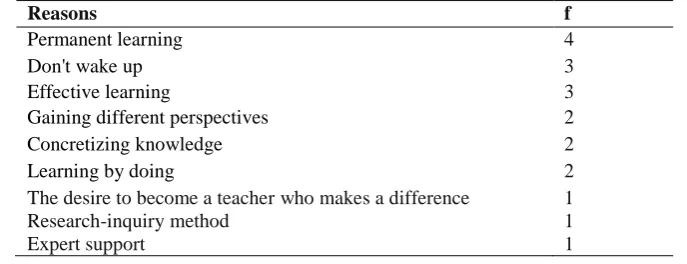
Table 8. Prospective classroom teachers' views on applying out-of-school learning activities
Reasons f
Permanent learning 4
Don't wake up 3
Effective learning 3
Gaining different perspectives 2
Concretizing knowledge 2
Learning by doing 2
The desire to become a teacher who makes a difference Research-inquiry method
Expert support
1 1 1
At the end of the activities an additional question in the final test was asked to the prospective teachers. It was asked that whether they’ll plan to take extracurricular learning activities, or not. All of the prospective teachers expressed positive opinion by emphasizing “Absolutely Yes". Table 8 shows the responses and distribution of why they said "Yes". In table 6, similarities (permanent learning and arouse curiosity, learning by doing) are similar to the findings in their general responses to out-of-school learning environments. The desire to be a teacher who makes a difference" is another remarkable finding. Prospective teachers' opinions about whether they plan to take extracurricular learning activities when they become teachers are as follows:
K1: I definitely think. I want to leave positive permanent traces to students' lives. I would like to take them out of school and embody their knowledge and give them a different perspective on the environment and the world. In the classroom there are just so many teachers who tell the lesson, I want to make a difference for the students who know me, I want to be unique, not one of the thousands. K2: I definitely think. One of my first goals will be to increase my students' interest in research and learning. I believe that it will give them different thinking and different perspectives.
K8: I will do as much as possible. Because something may not be very effective only when they remain in theory. The school may not be very effective when it stays in theory. The fact that there are many elements that show the logic of the event in the learning environments outside the school increases the persistence of the child by seeing the information learned. If the teacher is insufficient, he can get help from the experts and the questions are answered more clearly.
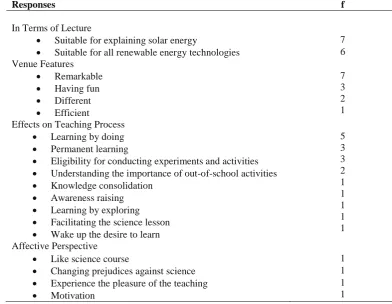
In relation to the fifth sub-problem of the study, it was sought to answer the question of how the views regarding the use of Solar Park House within the scope of out-of-school learning environments related to energy resources, and their views on their suitability in terms of science teaching. The content analysis of the prospective teachers’ responses is stated in table 9.
Table 9. Prospective classroom teachers’ views on suitably of Solar Park House in terms of science teaching
Responses f
In Terms of Lecture
Suitable for explaining solar energy 7
Suitable for all renewable energy technologies 6 Venue Features
Remarkable
Having fun
Different
Efficient
7 3 2 1
Effects on Teaching Process
Learning by doing
Permanent learning
Eligibility for conducting experiments and activities
Understanding the importance of out-of-school activities
Knowledge consolidation
Awareness raising
Learning by exploring
Facilitating the science lesson
Wake up the desire to learn
5 3 3 2 1 1 1 1 1
Affective Perspective
Like science course 1
Changing prejudices against science 1
Experience the pleasure of the teaching
Motivation
1 1
When the answers were examined, it was found that almost all of the prospective teachers (except one) found Solar Park House suitable for science teaching. The responses of the prospective teachers are grouped under 4 categories as "in terms of lecture, venue features, effects on teaching process, affective perspective". According to the codes obtained; it is clearly seen that in science teaching, especially when explaining energy resources, models can be used and students can learn by doing, so this ensures permanent learning. They stated that science subjects can be embodied here, attention can be drawn to science subjects and thus the desire to learn can be increased. They shared that they could enjoy science, break prejudices against science, increase learning motivation through to this kind of extracurricular learning areas. In spatial terms, although the entire Solar Park House is not yet complete; it is a remarkable, colorful, different and fun place. They emphasized that such positive features attracted the attention of both prospective teachers and students. Prospective teachers' opinions about the reasons of the question: Can science teaching activities be held in Solar Park House? are as follows:
K2: Absolutely practicable. In the Solar Park House, not only solar energy, but also other renewable energy types are included and its importance was explained. This will create awareness among the students. It will help shape their thoughts.
K4: When I went to Solar Park House, I told to myself that I could organize trips like this for my students in the future. I realized that the science course was more fun with research, experimentation and excursions, and a really intriguing lesson.
K7: We learned a lot of things during our Solar Park house tour. We found it to be a very effective place in science teaching. Previously, I had some questions about whether such trips would be useful. But after I realized our trip, I saw how important these trips are. Especially Solar Park house is a very suitable place for science course.
K12: It is very boring for the students when the science course is handled in the classroom. Since science course is difficult, Solar Park house has benefited the students in terms of efficiency. The fact that students are always in the same environment also affects the science course negatively. It was very useful for the students to see the materials made and do the activities in Solar Park House.
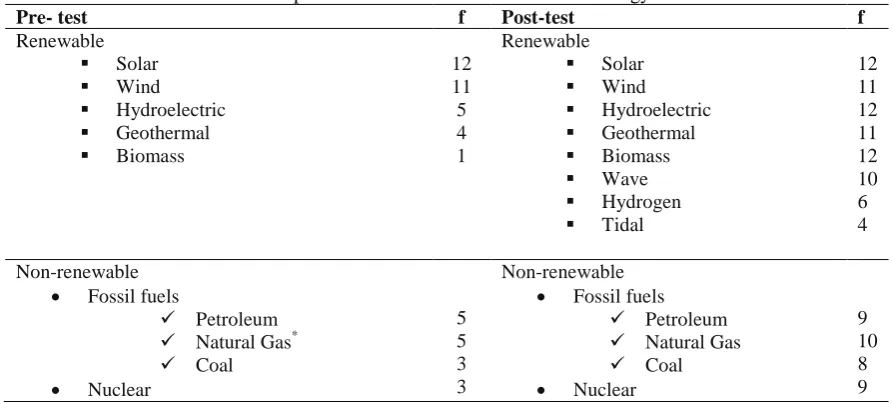
In relation to the sixth sub-problem of the study, it was sought to answer the question of how the activities carried out within the context of out-of-school learning environments affect prospective classroom teachers' views on energy resources. For this sub-problem; it was asked which energy sources they know and which sources they prefer to obtain energy. The results of the content analysis of the answers given by the prospective teachers are stated in tables 10 and 11.
Table 10. Prospective classroom teachers’ views on energy sources
Pre- test f Post-test f
Renewable Solar Wind Hydroelectric Geothermal Biomass 12 11 5 4 1 Renewable Solar Wind Hydroelectric Geothermal Biomass Wave Hydrogen Tidal 12 11 12 11 12 10 6 4 Non-renewable
Fossil fuels
Petroleum
Natural Gas*
Coal Nuclear 5 5 3 3 Non-renewable
Fossil fuels
Petroleum
Natural Gas
Coal Nuclear 9 10 8 9
In table 10, it can be seen that especially in the post-test there is a significant increase in the level of knowledge and corrected misconceptions in the answers given by the prospective teachers (*In the pre-test, two prospective teachers say that natural gas is renewable because it it has no smell, so it is a clean energy source. At the end of process they said natural gas is one of renewable energy resource). The concepts of; "wave, hydrogen, tidal energy" appear in the post-test. It is remarkable that only one person stated biomass energy in the pre-test, but at the end of study all of them stated biomass energy as a renewable energy source. It is seen that the applied trainings have a meaningful effect on the knowledge levels of the prospective teachers about energy sources.
Table 11. Prospective classroom teachers’ views on energy sources preferences
Pre- test f Post-test f
When table 11 is examined, it is seen that prospective teachers preferred renewable energy sources in the pre-test except for one. One of the prospective teachers emphasized that non-renewable energy sources can also be depleted and should be used with carefully. At the end of the training, all prospective teachers stated that they would prefer “renewable energy” sources. One of the prospective teachers (K2) preferred both renewable and non-renewable energy sources in the pre-test, and in the post-test she said she'd prefer renewable energy sources very clearly. (K7) preferred “renewable energy” sources in the pre-test. However, in the post-test, she stated that her priority is again “renewable energy” sources, but non-renewable energy can be utilized when not enough.
For the seventh sub-problem of the study, it was tried to answer the question of how the activities carried out within the context of out-of-school learning environments affect classroom teachers' opinions about Akkuyu Nuclear Power Plant. The content analysis of the prospective teachers' responses ise presented in table 12. Prospective teachers stated that their priorities were "renewable energy" as a result of the trainings they participated in two different out-of-school activities. Seven prospective teacher stated negative opinions, but five of them stated partly positive* opinions about the nuclear power plant as a result of the training (*they could turn to non-renewable energy sources if necessary). As a result of training at Akkuyu Nuclear Power Plant Information Center, prospective teachers increased their knowledge on nuclear energy. They had the chance to ask all the questions about nuclear energy. They asked the engineers about their concerns and shared that they had serious concerns about nuclear power plant. The opinions in table 12 below are also given as to the reasons for their negative judgments.
Table 12. Prospective classroom teachers’ views on nuclear power plant
Reaosons f
Environmental aspects
General probability of damage
Radiation hazard Clean energy demand Concerns
A
ccident that took place in developed countries Probability of error due to human factor In terms of country
Not suitable for every country Foreign dependence as a country
High cost
5 2 1
2 2
1 1 1
When table 12 is examined, the prospective teachers' views on nuclear power plant are gathered in 3 categories in terms of environmental aspects, concerns and in terms of country. According to the codes obtained; prospective teachers stated that they have fears and worries in general due to accidents in developed countries with nuclear power plants in recent years, other human-induced mistakes and possible probabilities such as possible leakage and explosion in the reactors. They shared the concerns that the establishment of a nuclear power plant could cause high costs for our country and that we could be dependent on the country that installed the plant. A prospective teacher stated that it did not seem very convincing that she received a positive answer to every question they asked the expert and therefore did not satisfy her anyway. Prospective teachers' opinions about why they think negative about the nuclear power plant are as follows:
K1: Although we asked all the questions we had in mind during the Akkuyu Nuclear Power Plant tour, I think we should prefer renewable energy sources. The impact of previous disasters is enormous. I think it is necessary to work to use renewable energy sources more efficiently than this type of energy with high costs and side effects.
K4: I saw that the nuclear power plant to be installed on the trip was installed with the latest technology. I think it was built with care and free from all mistakes. However, I do not have a positivie look on the establishment of a nuclear power plant. Why are we opening a new nuclear power plant while the world is slowly closing down its reactors?
of past events, but this should not be an excuse not to be done. But I think the priority should be for the use of renewable energy sources.
K10: It was nice to hear directly how the generation of nuclear power plant was. But I still don't approve of the construction of this plant. It is not right to prefer nuclear when there are more inexpensive, cleaner energy sources. The effects of Chernobyl are still continuing. Although all precautions have been taken, the explosion is unlikely. The realization of this possibility will also ruin natural energy resources, which we do not have the technology to handle.
Discussion and Recommendations
In this study, as a result of the trainings they participated in two different centers, prospective classsroom teachers' opinions about out-of-school learning environments and their attitudes towards energy resources were examined. As a result of the findings obtained from the quantitative data, it was seen that the activities related to energy resources within the scope of out-of-school learning environments had a significant effect on increasing the attitudes of prospective classroom teachers towards renewable energy resources in general. It was also found that gender did not have a significant effect on the attitudes of prospective classroom teachers towards renewable energy sources. In addition, when the answers given to the open-ended questions were analyzed, the answers given to the question of what could be out of school learning environments increased and varied at the end of the application. As a result of the trainings, prospective teachers stated that they could teach especially in planetarium, arboterum, botanical gardens, national parks, science centers, etc. Another finding is that while prospective teachers had more limited information about energy before education, and at some points incorrect information (such as natural gas is a renewable energy type), when the answers given at the end of the trainings were examined, their learning improved and their knowledge levels increased. They shared that both centers can be used while teaching the concept of energy in science course. All of the prospective teachers stated that their education and practices especially at Solar Park House made their views about renewable energy sources more positive and they would still prefer renewable energy sources in the first place. They also stated that although Solar Park House did not end, it was highly equipped and effective in terms of science teaching. They stated that when they become teachers, processing science courses in such out-of-school learning environments would help both to lasting learning and to attract children's interest. Instead of using traditional methods, they shared that they wanted to be teachers who made a difference with this kind of different studies. Five prospective teachers said that after training at Akkuyu Nuclear Power Plant Information Center, they removed their incomplete knowledge about nuclear energy, they still preferred "renewable energy sources" in the first place, but they looked a little more favorable to the establishment of "non-renewable energy sources" in the second place in terms of energy production ; All prospective teachers expressed their concerns about possible risks (explosion and leakage, environmental damage, radiation and man-made fault like Chernobyl), and they think that our country may be dependent on foreign countries. All of the prospective teachers stated that we should use especially renewable energy sources such as solar and wind much more because of the geographical position of our country. When these findings are compared with other studies in the literature, it is seen that there are common and different points.
Özdemir and Çobanoğlu (2008) made the research with 506 prospective teachers studying in social science and science. There was a significant difference between the participants' field of study, class and socio-economic characteristics, and most of the participants (51%) stated that they had no prior knowledge about nuclear energy. The prospective teachers' attitudes towards the establishment of nuclear power plants were determined with their knowledge and epistemological beliefs.Similarly, in this study, prospective classroom teachers stated that they had little knowledge about nuclear energy before training. In the study of Özdemir and Çobanoğlu (2008), male participants had more positive opinion about the establishment of nuclear power plant inTurkey, compared to female participants. In this study, it was found that the gender variable had no significant effect on the attitudes of prospective classroom teachers towards renewable energy sources. It can be concluded that the trainings that have been given affect the prospective teachers at the same level.
Çelikler and Kara (2011) found that social science teachers' awareness of renewable energy was higher than that of mathematics teachers. The main reason for this is that while social science prospective teachers take a course on environmental problems and limitations of natural resources, mathematics prospective teachers do not take any courses. Also acorrding to the results; both group of the prospective teachers stated that wind energy is an important renewable energy source and that all countries should use clean energy sources. In order to maintain the ecological balance renewable energy sources should be used. They also stated that they support the production and use of renewable energy sources.
Liarakou, Gavrilaki and Flouri (2009) investigated the knowledge and attitudes of secondary school teachers towards renewable energy sources in Greece. When the results are analyzed; despite teachers' negativity against nuclear power, 40% think that this resource will dominate the global energy sector in the future, but 27% can not make an estimate. Some teachers involved in this research see nuclear energy as a green energy source for fossil fuels, while others believe it is a threat to humanity and ecosystems. Some teachers see natural gas as the dominant energy source in the future. Although the findings show that teachers are informed about renewable energy sources, they show deficiencies in wind and solar energy technologies. Therefore, the researchers recommend that the integration of these themes into teaching both through out-of-school learning environments. They also proposed to give importance to environmental education for teachers. In this sense, it is seen that applied trainings about different types of energy in out-of-school activities respond exactly to this proposal in this study. As a result of the trainings, significant differences were found in the knowledge levels and attitudes of prospective teachers about energy types. At the end of this study, all the prospective teachers said that they would prefer renewable energy sources. However, 5 prospective teachers partially responded positively to the establishment of Akkuyu Nuclear Power Plant. Although these 5 prospective teachers say that renewable energy sources are still in the first place, nuclear power plants can be established provided that necessary precautions are taken in cases where energy is not sufficient. Therefore, despite their preference for renewable energy, they said "yes" to nuclear energy in case of necessity. Note that in the research conducted by Liarakou, Gavrilaki and Flouri, the majority of teachers said that they would definitely prefer renewable energy, but they could not believe that it would be preferred because of insufficient resources in the future.
Ertaş, Şen and Parusuzoğlu (2011) aimed to determine the effect of out-of-school scientific activities on the levels of “Energy” relating to daily life of 9th grade students. As a result of the research, it was concluded that the out-of-school scientific activities increased the students' understanding of the “energy” issue and their connection with daily life. In this study, as a result of out-of-school activities, prospective calssroom teachers' knowledge level about energy increased. In particular, they corrected their missing and incorrect information. There are positive and negative perspectives on nuclear power in society. Some people think negatively because of the possibility of an accidental radiation spread. In particular, as a result of some nuclear accidents such as Chernobyl, people's concerns have increased (Kaya, 2012). In this study, when the opinions of the prospective teachers were examined, it was seen that those who think negatively expressed similar concerns (possible harm to humanity due to possible accident and radiation probability) and prospective teachers who expressed some positive opinion (possibility of solution due to increasing cost).
After the Fukushima incident, several international surveys were conducted to examine the public's attitudes towards nuclear energy. It is seen that countries have different attitudes towards nuclear energy (Kubato, 2012). And Kubato interpreted the reason for the different attitudes; from a cost-benefit perspective, public concern about a future nuclear crisis may be a possible answer. As can be seen, as a result of the accidents experienced, there may be changes in the society's view of the nuclear power plant. During the study, one of the prospective teachers specifically asked for detailed information about the Fukushima accident during his visit to Akkuyu Nuclear Power Plant. He wanted to know what measures were taken as a result of a similar earthquake at the Akkuyu nuclear power plant. For this reason, it can be said that accidents in the world are effective in forming the attitudes of teacher candidates.
Çavuş, Topsakal and Kaplan (2013) determined that informal learning environments are important for the students to gain environmental awareness. Similarly, in this study the prospective teachers stated that out-of-school learning environments are important and necessary. Türkmen (2015) examined the perspectives of primary school teachers on informal education. He determined the following results: teachers said that field trips provide permanent learning for their students. However, they stated that they could not do such activities due to the intensity of the curriculum, bureaucratic procedures and cost. At the same time, they do not do such activities as they do not visit the places they will organize their trips in advance.
In this study, the researcher visited both places and made observations about there. Then, with the official permission of the university, the prospective classroom teachers went to both centers. After the trainings they pondered about what kind of activities they could prepare for primary school students. Türkmen (2015) stated that teachers had anxiety because of their ignorance about the place. Thus, this study also prevented this possible anxiety. As Ertaş, Şen and Parasızoğlu (2011: 184) pointed out, trends in different energy sources, energy transformations, use of renewable energy sources, wind farms, cars running with solar energy, dams opened in our country, oil, petroleum, petroleum, natural gas and more than that, the fact that energy takes place in our lives makes the issue of “energy" even more important. Media speech about nuclear power plant in Turkey and rapid changes and developments in the world affect all of us as individuals. For this reason, trainings directly received from experts about the use of energy resources become very important. As a result of the visits to two centers, prospective classroom teachers first eliminated their lack of knowledge about energy. In this way, prospective teachers learned how to answer their students' questions about energy in the future.
In this context, the following recommendations can be made based on the research results: Prospective teachers can be given practical trainings about what kind of activities they can do in out-of-school learning environments and possible limitations and advantages of such environments. Similar studies can be conducted with prospective teachers studying in other departments of educational faculty. Different learning environments can be identified in terms of different disciplines such as science, mathematics, social, visual arts, history, and applied trainings can be increased on subjects specific to each discipline. As this study was conducted in Mersin, out-of-school learning environments in Mersin were investigated in detail by prospective teachers. Applied projects can be done in other specified environments. Similar studies can be carried out in other provinces by identifying specific centers. The main purpose of this study is to examine the opinions, knowledge and attitudes of prospective classroom teachers. In the following studies, the effects of the activities carried out in the learning environments on the primary school students can be examined. In this study prospective classroom teachers emphasized especially "permanent learning”, so new studies can be planned to investigate the effect of out-of-school learning environments on permanent learning. Particularly in science courses, trips and activities can be organized to out-of-school learning environments such as botanical gardens, planetarium, arboretum, science centers. Because there are limited number of studies on the effects of such out-of-school learning areas on education. As a result of the trainings given in the areas of out-of-school learning; the effects of students' science achievement, science attitudes, science anxiety, social science attitudes, learning skills, critical thinking skills and etc. can be investgated. The experts are engineers at both centers. However, in order to orginize the activities pedagogically, it may be recommended to cooperate with academicians especially in education faculty.
Akkuyu Nuclear Power Plant (2019, January 11) Retrieved from http://www.akkunpp.com/bilgilendirme-merkezi-2.
Aydın, S., Haşıloğlu, M. A., & Kunduracı. A. (2016). Fen bilimleri öğretmenlerinin ders dışı etkinlikleri kullanmada öz-yeterlik algılarının farklı değişkenler açısından incelenmesi [Investigation of self-efficacy perceptions of science teachers in using extracurricular activities in terms of different variables] Uluslararası Eğitim Bilim ve Teknoloji Dergisi, 2(2), 94-103.
Ateş, H., & Saraçoğlu, M. (2013). Fen bilgisi öğretmen adaylarının gözünden nükleer enerji [Nuclear energy through the eyes of prospective science teachers]. Journal of Kırşehir Education Faculty, 14(3), 175-193. Bozdoğan, A. E., & Yalçın, N. (2006). The effects of science centers on the change of science interest levels of primary education students and on their academic success: Energy Park. Ege University Journal of Education Faculty, 7(2), 95-114.
Braund, M., & Reiss, M. (2006). Towards a more authentic science curriculum: The contribution of out‐ of‐
school learning. International Journal of Science Education, 28(12), 1373-1388.
Cansız, N., & Cansız, M. (2015). Views and knowledge of preservice science teachers about nuclear power plants. International Journal On New Trends İn Education and Their Implications, 6(2), 216-224. Cohen, J. (1988). Statistical Power Analysis For the Behavioral Sciences (2nd ed.). Hillsdale, NJ: Erlbaum Creswell, J. W., & Plano-Clark, V. L. (2007). Karma yöntem araştırmaları: tasarımı ve yürütülmesi [Mixed
method research: design and execution] (Çev: A. Delice). Ankara. Anı Yayıncılık.
Çavuş, R., Topsakal, Ü. U., & Kaplan, A. Ö. (2013). Teachers views’ on awareness of environmental acquiring in ınformal learning environments: the sample of Kocaeli Science houses. Pegem Journal of Education and Instruction, 3(1), 15-26.
Çelikler, D. & Kara, F. (2011). İlköğretim matematik ve sosyal bilgiler öğretmen adaylarının yenilenebilir enerji konusundaki farkındalıkları [Awareness of primary mathematics and social science prospective teachers about renewable energy]. 2nd International Conference on New Trends İn Education and Their Implications (ICONTE), 530- 539.
Ertaş, H., Şen, A. İ., & Parmaksızoğlu, A. (2011). The effects of out-of school scientific activities on 9th grade students’ relating the unit of energy to daily life. Necatibey Faculty of Education Electronic Journal of Science and Mathematics Education, 5 (2), 178-198.
Eş, H., Mercan, S. I., & Ayas, C. (2016). Türkiye için yeni bir sosyo-bilimsel tartışma: nükleer ile yaşam[A new socio-scientific debate for Turkey: living with a nuclear]. Turkish Journal of Education, 5(2), 47-59. Güneş, T., Alat, K. & Gözüm, A. İ. C. (2013). Fen öğretmeni adaylarına yönelik yenilenebilir enerji kaynakları
tutum ölçeği: geçerlilik ve güvenirlik çalışması [Renewable energy sources attitude scale for science teachers: validity and reliability study]. Eğitim Bilimleri Araştırmaları Dergisi- Journal of Educational Sciences Research, 3(2), 269-289.
Kaptan, F. (1999). Fen bilgisi öğretimi [Science teaching]. Ankara: MEB Yayınları.
Kaya, İ. S. (2012). Nükleer enerji dünyasında çevre ve insan [Environment and human in nuclear energy world] Abant İzzet Baysal Üniversitesi Sosyal Bilimler Enstitüsü Dergisi, (24), 71-90.
Kubota, Y. (2012). Facing a crisis with calmness? The global response to the Fukushima nuclear disaster. Japanese Journal of Political Science, 13(3), 441-466.
Külekçi, Ö. C. (2009). Yenilenebilir enerji kaynakları arasında jeotermal enerjinin yeri ve Türkiye açısından önemi [Geothermal energy from renewable energy sources on site and the importance of Turkey]. Ankara Üniversitesi Çevre Bilimleri Dergisi, 1(2), 83-91.
Lee, L. S., & Yang, H. C. (2013). Technology teachers’ attitudes toward nuclear energy and their implications for technology education. Paper presented at the Pupils’ Attitude towards Technology (PATT). Technology Education for the Future: A Play on Sustainability Conference, New Zealand.
Liarakou, G., Gavrilakis, C. & Flouri, E. (2009). Secondary school teachers’ knowledge and attitudes towards renewable energy sources. Journal of Science Education Technology, 18, 120–129. DOI:10.1007/s10956-008-9137-z.
MoNE (MEB) (2018). Talim Terbiye Başkanlığı, Fen bilimleri dersi öğretim programı [Science course curriculum], Ankara.
News About Akkuyu Nuclear Power Plant in Turkey (2019, January 11). Retrieved from http://www.hurriyet.com.tr/haberleri/akkuyu.
Miles, M. B. & Huberman, M. (1994). Qualitative data analysis: an expanded sourcebook (2nd Eddition). Thousand Oaks, CA: Sage.
Ozturk, N. & Bozkurt Altan, E. (2019). Examining science teachers’ decisions about nuclear power plants from the perspective of normative decision theory. Journal of Education in Science, Environment and Health (JESEH), 5(2), 192-208. DOI:10.21891/jeseh.581739.
energy and the construction of nuclear plants in Turkey]. Hacettepe University Journal of Education, 34(34), 218-232.
Özdemir, O. (2010). Doğa deneyimine dayalı çevre eğitiminin ilköğretim öğrencilerinin çevrelerine yönelik algı ve davranışlarına etkisi [The effect of environmental education based on nature experience on the perception and behavior of primary school students towards their environment]. Pamukkale Üniversitesi Eğitim Fakültesi Dergisi, 27(27), 125-138.
Resnick, L. B. (1987). The 1987 presidential address learning in school and out. Educational researcher, 16 (9), 13-54.
Solar Park House (2019, August 11). Retrieved from https://www.enerjibes.com/turkiyede-ilk-defa-gunes-park-enerji-kompleksi/
Sontay, G., Tutar, M., & Karamustafaoğlu, O. (2016). Okul dışı öğrenme ortamları ile fen öğretimi hakkında öğrenci görüşleri: planetaryum gezisi [Student views about “science teaching with outdoor learning environments”: planetarium tour]. Journal of Research in Informal Environments, 1(1), 1-24.
Türkmen, H. (2015). İlkokul öğretmenlerin sınıf dışı ortamlardaki fen öğretimine bakış açıları [Primary teachers point of view about science teaching in outdoor learning environments]. Journal of European Education, 5 (2), 47-55.
Yıldırım, A., & Şimşek, H. (2006). Sosyal bilimlerde nitel araştırma yöntemleri [Qualitative research methods in the social sciences]. Ankara: Seçkin Yayıncılık.
Higher Education Council (2019, October 15). Topluma hizmet uygulamaları dersi yönergesi [Community service practices instruction]. Retrieved from http://www.education.ankara.edu.tr/wp-content/uploads/sites/85/2018/01/Topluma_hizmet_uygulamalari_dersi_yonergesi.doc.
Zyadin, A., Puhakka, A., Ahponen, P., Cronberg, T., & Pelkonen, P. (2012). School students' knowledge, perceptions, and attitudes toward renewable energy in Jordan. Renewable energy, 45, 78-85.
Author Information
Ümit İzgi OnbaşılıMersin University
Education Faculty, Department of Primary Education Mersin/Turkey