GPFI: 2018 Work Plan
Outline
Overview ... 2
Priorities for 2018 ... 3
1. Digitisation and informality ... 3
GPFI Activities in 2018 ... 3
Subgroup work plans for 2018 ... 4
1. Regulation and Standard-Setting Bodies Subgroup ... 4
2. SME Finance Subgroup ... 7
3. Markets and Payment Systems Subgroup ... 10
4. Financial Literacy and Consumer Protection Subgroup ... 12
GPFI Timeline of Outputs ... 13
Overview
The Global Partnership for Financial Inclusion (GPFI) through its four Subgroups conducts its work with respect to the G20 Financial Inclusion Action Plan (FIAP) and on the occasion of the Leaders request.
This document presents the key outcomes for the GPFI during 2017. The GPFI currently organizes its work through four subgroups: Regulation and Standard-Setting Bodies (SSBs); Small and Medium- Enterprises (SME) Finance; Financial Consumer Protection and Financial Literacy; and Markets and Payment Systems.
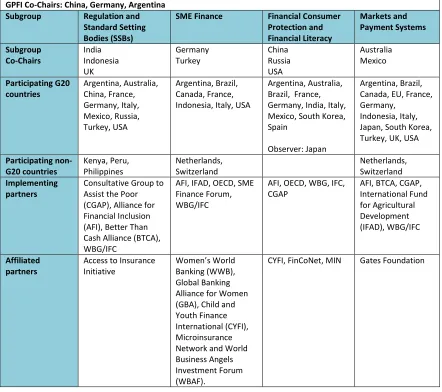
Table 1: GPFI structure, 2018
GPFI Co-Chairs: China, Germany, Argentina Subgroup Regulation and
Standard Setting Bodies (SSBs)
SME Finance Financial Consumer Protection and Financial Literacy Markets and Payment Systems Subgroup Co-Chairs India Indonesia UK Germany Turkey China Russia USA Australia Mexico Participating G20 countries Argentina, Australia, China, France, Germany, Italy, Mexico, Russia, Turkey, USA Argentina, Brazil, Canada, France, Indonesia, Italy, USA
Argentina, Australia, Brazil, France, Germany, India, Italy, Mexico, South Korea, Spain
Observer: Japan
Argentina, Brazil, Canada, EU, France, Germany,
Indonesia, Italy, Japan, South Korea, Turkey, UK, USA
Participating non-G20 countries Kenya, Peru, Philippines Netherlands, Switzerland Netherlands, Switzerland Implementing partners
Consultative Group to Assist the Poor (CGAP), Alliance for Financial Inclusion (AFI), Better Than Cash Alliance (BTCA), WBG/IFC
AFI, IFAD, OECD, SME Finance Forum, WBG/IFC
AFI, OECD, WBG, IFC, CGAP
AFI, BTCA, CGAP, International Fund for Agricultural Development (IFAD), WBG/IFC Affiliated partners
Access to Insurance Initiative
Women’s World
Banking (WWB), Global Banking Alliance for Women (GBA), Child and Youth Finance International (CYFI), Microinsurance Network and World Business Angels Investment Forum (WBAF).
CYFI, FinCoNet, MIN Gates Foundation
In addition, the GPFI benefits from the support of, and supports, Her Majesty Queen Máxima of
the Netherlands, the UN Secretary General’s Special Advocate for Inclusive Finance for
Development (UNSGSA) and Honorary Patron of the GPFI.
Priorities for 2018
Digitisation and informality
Argentina’s Presidency will seek to deliver an integrated policy guide to harness digitisation to address the financial exclusion of individuals and SMEs in the informal economy. This work will build on that of the Chinese and the German Presidencies, in particular by supporting the implementation of the G20 High-Level Principles for Digital Financial Inclusion (HLP-DFI). Its aim is to serve as a practical guide for policymakers in the implementation of the digital financial inclusion agenda. Argentina´s Presidency will focus on a small number of key enablers that hold the greatest promise to harness digitisation to financially include the underserved, especially in the informal economy:
1. Regulatory approaches to enhance financial inclusion through digitisation (digital on-boarding).
2. Development of digital payments infrastructure and incentives to accept digital payments.
3. The use of alternative data to enhance credit reporting.
4. Consumer protection and financial literacy.
To advance this agenda, Argentina´s Presidency will work closely with each of the GPFI Subgroups, integrating their work into a Policy Guide: “Digitisation and Informality: G20 Policy Guide to Harness Digital Financial Services for Individuals and MSMEs in the Informal Economy”. On which, policymakers in G20 and non-G20 countries can rely to advance financial inclusion. Argentina´s Presidency aims to enhance coordination among the GPFI Subgroups and the GPFI Troika, and ensure stronger links with the broader G20 Finance track agenda. Likewise, Argentina will focus on areas where international cooperation is necessary.
GPFI Activities in 2018
GPFI Workshop, 6 February 2018, Buenos Aires, Argentina GPFI Meeting, 7 February 2018, Buenos Aires, Argentina GPFI Plenary, 2 July 2018, Riyadh, Saudi Arabia
GPFI Forum, 3, 4 July 2018, Riyadh, Saudi Arabia
4th GPFI SSBs Conference, 24 and 25 October 2018, Basel, Switzerland
Subgroup work plans for 2018
The work of the four GPFI Subgroups is organized around the objectives (activities) incorporated in
the Subgroup’s Terms of Reference (2017), which take into consideration the action areas outlined in the 2017 G20 FIAP. The Subgroups will strengthen the collaboration with other G20 work-streams to support the overall effort to avoid duplication and to enhance efficiency and effectiveness.
1.
Regulation and Standard-Setting Bodies Subgroup
The 2018 Work Plan of the GPFI Regulation and SSBs Subgroup is organized around the Objectives
(Activities) incorporated in the Subgroup’s November 2017 Terms of Reference. It takes into
consideration the expected results for the Subgroup under the 2017 Financial Inclusion Action Plan (FIAP).
In addition, planned activities continue to build on the Recommendations from Part VI of the GPFI
White Paper, “Global Standard-Setting Bodies and Financial Inclusion –The Evolving Landscape,“
released in March 2016 (2016 GPFI White Paper). The objectives may be summarized as follows:
• To pursue work under the two action areas in the 2017 FIAP that are most pertinent to the Subgroup: action areas 3 (related to SSBs) and 4 (related to financial sector assessments); and
• To support, in the area of regulation and standard setting, the overarching actions of the GPFI under the FIAP, including: the 2018 GPFI priorities under the Argentine G20 Presidency; the work of other GPFI Subgroups (notably of the Markets and Payment Systems Subgroup in the area of regulation and standard setting); and the framing of and
preparation for work to be undertaken during Japan’s G20 presidency.
The Regulation and SSBs Subgroup’s 2018 Work Plan is built upon considerations laid out in the
2017 Subgroup Terms of Reference and updated Financial Inclusion Action Plan (FIAP). Financial technology (FinTech), innovation more broadly, and related developments call for ongoing engagement to help position SSBs and country-level policy makers to keep pace. The SSBs confront, and will continue to confront, a growing range of crosscutting issues on which coordination and collaboration among them is required to harmonize the development and application of their standards and guidance; this calls for further joint work among the SSBs on issues of relevance to multiple SSBs to help countries balance the potentially competing policy objectives introduced by a broad financial inclusion agenda.
The Subgroup will continue to encourage progress towards greater ownership by the SSBs of financial inclusion, including evolving and formalizing over time the way in which the GPFI works with the SSBs and the Financial Stability institute (FSI), within the Bank for International Settlements (BIS). This will go hand in hand with support for financial inclusion-related activities in the work of the SSBs: crosscutting themes in the work of multiple SSBs of relevance to financial inclusion, but also the relevant work of individual SSBs.
This annual Work Plan takes into account the financial inclusion priorities of the Argentine G20 Presidency, as well as the crosscutting issues identified by the GPFI for the engagement of all Subgroups.
2017 FIAP Action Area 3. Mainstream financial inclusion in the work of the global financial standard-setting bodies (SSBs) and other relevant global bodies while enhancing coordination and collaboration among them and increasing understanding of the interdependence of financial inclusion, stability, integrity and consumer protection.
1. Organization of the biennial GPFI-FSI Conference on SSB and Innovative Financial Inclusion (4th GPFI-FSI Conference).
ways for financial authorities and innovative providers to interact. The Conference preparation process may include the production of one or more issues papers designed to frame these topics, taking into account the Observations and Recommendations of the 2016 GPFI White Paper.
Preparation of the Fourth GPFI-FSI Conference will be led by FSI and an ad hoc Conference Preparation Task Group composed of personnel from GPFI Implementing Partners (particularly CGAP and the World Bank Group), interested members of the GPFI Subgroup on Regulation and SSBs, and FSI. The process of content development and broader Conference preparation will begin in January 2018 with the identification of the members of the ad hoc Task Group and the development of a detailed timetable and milestones document for the preparation of the Conference. (See notional timeline, attached.)
2. Support to the UNSGSA in her engagement with the SSBs. The Subgroup will continue to support the
UNSGSA’s engagement with the SSBs, including contributions to the organization of the anticipated Fifth High-Level Meeting of SSB Chairs and Secretaries General convened by the UNSGSA and the Chair of BCBS, maximizing synergies with the agenda and content of the Fourth GPFI-FSI Conference.
3. Digital Onboarding, Digital Identity and Customer Identification analytical paper (working title). This analytical paper will provide insights for country-level implementation of Principle 7 of the G20 High-Level Principles (HLPs) for Digital Financial Inclusion: “Facilitate Customer Identification for
Digital Financial Services.” Intended as a contribution to a planned “Policy Guide" called for under
the Argentine Priorities Paper (Policy Guide), the work will build on existing work of the World
Bank Group’s ID4D program and explore the linkages between digital IDs, digital onboarding, and customer identification in the financial sector. The World Bank Group will lead the development of the analytical paper, with meaningful engagement of Subgroup members and Implementing Partners. The paper will state clearly that there is no intention to interpret the work of the SSBs or
give guidance or instruction to them, as was done in the case with both the HLPs and “Effective Approaches” work with respect to HLPs 1-4.
4. Contributions on regulation and standard setting relevant to other GPFI activities. These will include:
• The Policy Guide to be developed under the Argentine G20 Presidency (see contributions described above);
• In collaboration with the Markets and Payment Systems Subgroup specifically, work with FATF and FSB through the FSB Remittance Task Force to follow up on potential actions to address
the decline in correspondent banking and remittance provider’s access to banking service; and
• Support to the Financial Consumer Protection and Financial Literacy Subgroup on relevant regulatory and supervisory issues (e.g. contributions to the Policy Guide on data privacy, customer protection, and cyber security).
5. Continued regular consultation with SSBs to encourage and support greater ownership of financial inclusion and the pursuit relevant activities, both individually and collectively.
The process of regular consultation with the SSBs will be continued via periodic GPFI SSBs Check-in Meetings, as well related activities in the development and preparation of the Fourth GPFI-FSI Conference.
To contribute to a better understanding of SSB activities relevant to financial inclusion and to identify opportunities for joint work, a rigorous tracking of SSB activities in relation to financial inclusion (notably, but not exclusively, in the area of FinTech and RegTech) will continue, updated semi-annually. A condensed version focused on completed activities and outputs, for dissemination beyond the group of SSBs active in this stock-taking process, is foreseen in 2018. FIAP Action Area 4. Encourage effective and consistent incorporation of financial inclusion in financial sector assessments.
No specific activities under this Action Area are currently envisioned during 2018, beyond deepening the involvement of the International Monetary Fund (IMF) in the activities of the Subgroup and the GPFI more broadly. (The Financial Sector Assessment Program, jointly administered by the IMF and GPFI Implementing Partner the World Bank Group, constitutes an important potential subject of activity under FIAP Action Area 4, as detailed in the 2016 GPFI White Paper.
2.
SME Finance Subgroup
The Subgroup will continue to work in close collaboration with other GPFI Subgroups as well as the Temporary Steering Committee on Financial Inclusion for Forcibly Displaced Persons, and with other G20 groups, Implementing Partners and with non-G20 countries and the private sector, as appropriate.
Key Outcomes
Key outcomes for the Subgroup during 2018 will include:
1. Policy guide - Use of alternative data to enhance credit reporting
Presidency to develop in collaboration with the International Committee on Credit Reporting (ICCR) policy guidance to regulators and policymakers on the application and use of alternative data to enhance the creditworthiness of informal SMEs and individuals.
It will distil key policy tools, guidelines and actions and shall cover policy opportunities, such as: a) Improving availability and accuracy of information from government databases b) Expanding credit information sharing
c) Enabling responsible cross border data exchanges, d) Balancing integrity, innovation and competition.
On-going Activities of the GPFI SME Finance Subgroup
Further, the SME Finance Subgroup will continue to work on activities that have been started in 2017 and will start to work on the implementation of the updated 2017 G20 Financial Inclusion Action Plan.
2. G20 Action Plan on SME financing
The Implementation Framework of the G20 Action Plan on SME Financing that was adopted at the 2016 Hangzhou Summit, has been rolled out in 2017. In 2018, the Subgroup will continue its outreach activities to non-G20 countries to disseminate the knowledge and the approach to encourage its implementation in their country and to join the SME Finance Compact. The implementation of the SME Finance Compact is ongoing in partnership with the Alliance for Financial Inclusion (AFI) and the World Bank Group. Under the SME Finance Compact, several AFI member countries announced their commitment to include SME Finance in their National Financial Inclusion Strategies, as a priority area. In this context, willing AFI SME Finance Working Group members will be encouraged to implement the Action Plan and to undertake the self-assessment to identify and prioritize areas of reform.
3. Data Harmonisation
At both the national and financial institution levels, there are a number of data collection exercises on SME finance that would benefit from better coordination, with a view to a process of harmonization of definitions and methodologies at the national and DFI levels.
In 2017, in a first step an overview/stocktaking of existing and planned multilateral initiatives in data
collection on SME finance was conducted. This examined the “macro” sources of country-level data available. This initial step already revealed substantial data gaps in critical areas, and the lack of regular, comprehensive data supply on SME finance from most countries. The OECD Scoreboard on Financing SMEs and Entrepreneurs is an example of international efforts to increase transparency and improve coordination on definitions across a broad range of countries and indicators1. The next phase of the work, undertaken since the Berlin meeting, has focused on “micro” level data collection by development finance institutions
from individual banks and other lenders/financiers. This work will be reported back to the GPFI at the February meeting in Buenos Aires.
Based on the results of the stocktaking, the GPFI will produce suggestions for review and approval during the Argentine presidency, for how data resources could be improved through coordination of activities by major collectors. This will include how gender, youth and other key cross-cutting information on SME access to finance can be expanded through this data coordination. In the longer run this work will consider how harmonization of collection methods might be supported through the G20 and its implementing partners.
4. Financial Inclusion and Youth and Women
In 2015, the SME Finance Subgroup, together with its Affiliated Partner Child and Youth Finance International (CYFI) launched a Global Platform for young entrepreneurs called Global Ye! Community. Since 2016, CYFI is handing out the Ye! Global Youth Entrepreneur Awards supported by the GPFI SME Finance Subgroup.
In 2017, CYFI and the SME Finance Forum began a stocktaking of successful practices in financing young entrepreneurs. In 2018, this stocktaking will be completed, including recommendations for how good practices can be encouraged through policy reform and other G20-backed initiatives.
Further, the SME Finance Subgroup will conduct some research on the elements of an enabling environment that promotes the emergence and scaling up of DFS technologies for agriculture with focus on women and youth.
5. Access to finance for FDP-run SMEs
The Subgroup will contribute to the development of the G20 Roadmap on Financial Inclusion of Forcibly Displaced Persons (FDPs). It will further start to look at the contributions FDP-run small businesses and start-ups to economic development of refugee and host communities and develop recommendations on how to address existing barriers that hinder access to finance for FDP-run SMEs.
6. Insurance for SMEs
Building on the work of the SME Finance SG on “Climate Smart Financing for Rural MSMEs” the Subgroup
aims to further analyse the insurance needs of SMEs. Access to insurance for SMEs is limited, as is data regarding this topic. There are some insurance products available that in principle can be accessed by SMEs, such products are scarce and often not tailored to their specific needs. Insurance markets for SMEs are in many countries non-existent and consequently, little is known about the insurance needs of this target group and the best way to serve them.
The Subgroup aims to gain a better understanding of SMEs’ insurance needs by conducting a stocktaking of
3.
Markets and Payment Systems Subgroup
The overall goal of the Subgroup is to advance utilization of payment systems, including remittances, in the pursuit of increased, responsible and sustainable financial inclusion. The Subgroup also promotes inclusive digital payment ecosystems, and focuses on emerging technologies and business models that will incorporate strong links to market based approaches through engagement with financial service providers.
The Subgroup responds to the call in the G20’s St. Petersburg Development Outlook for the GPFI to explore
“targeted actions to… harness emerging mechanisms such as electronic payments and mobile technology that can significantly improve access”.
To achieve this goal, the Markets and Payment Systems Subgroup will work on the action areas defined in the 2017 G20 Financial Inclusion Action Plan :
2017 FIAP Action Area 7: Help to analyze and consider ways to address the money transfer operator (MTO) bank account closure issue, including consideration of the various factors affecting de-risking.
2017 FIAP Action Area 8: Reduce the cost of sending remittances taking into account systemic causes of high remittance transfer costs, while ensuring the quality of remittances services and service delivery, and working to establish a supportive policy and regulatory environment for competitive remittance markets, as well as to maximize their impact on local economic development.
2017 FIAP Action Area 9: Expand opportunities for innovative approaches to grow responsible financial inclusion as to incorporate strong links to market based approaches through engagement with financial services providers, including banks and non-banks, and technology providers.
Key Outcomes
Key outcomes for the Subgroup during 2018 are to include:
1. Guidance Note “Achieving Development and Acceptance of an Open and Inclusive Digital
Payments Infrastructure “
As part of Argentina’s focus in 2018 on digitization and informality, MPSS will produce a guidance note
1.1. The first part of this paper, the diagnosis section, will describe the desired interoperable payments system, building on insights already developed in past documents such as BTCA 2016 and 2017 - Accelerators to an Inclusive Digital Payments Ecosystem and Building Inclusive Digital Payments Ecosystems.
1.2. In the second section, policy guidance will provide specific steps and measures to both develop an open and inclusive infrastructure and create the right incentives to increase the usage and acceptance of digital payment services by informal retailers.
2. Supporting the G20’s 2016 commitment to align its work with the 2030 Agenda
The sub-group will also develop actions to support progress towards achieving the targets under the Sustainable Development Goals, in line with the G20 Action Plan on the 2030 Agenda for Sustainable
Development and Argentina’s theme for 2018 of building consensus for fair and sustainable development. Specifically, this will include a series of accessible two-page visual documents capturing how digital financial inclusion helps achieve the SDGs. (This compendium will include SDG 2 on Zero Hunger; SDG on Universal Health Coverage; SDG 4 on Inclusive and Quality education, SDG 5 on Gender Equality; SDG 6 on Clean Water and Sanitation; SDG 7 on Affordable and Clean Energy; SDG 8 on Decent Work and Economic Growth; SDG 10 on inequality, including a separate document on 10c and remittance costs; and SDG 11 on Resilient Cities. This work will be done in close collaboration with Her
Majesty Queen Máxima of the Netherlands, the UN Secretary General’s Special Advocate for Inclusive
Finance for Development (UNSGSA) and Honorary Patron of the GPFI who has agreed to provide a forward to this series.
3. Monitoring progress of the G20 National Remittance Plans
In 2014, G20 Leaders agreed to the G20 Plan to Facilitate Remittance Flows which mandates the GPFI to report on progress made by countries (including interested non-G20 countries) against their national
remittance plans. National remittance plans were finalized under Turkey’s presidency along with a
monitoring framework. This framework outlines that the GPFI will review progress on the national remittance plans annually, and plans shall be updated every two years. Consistent with these arrangements, the Subgroup coordinated the efforts of the G20 members and interested non-G20 members to update their national remittance plans in 2017. The individual updated National Remittance Plans were published at the GPFI Website. In 2018, the Subgroup will monitor progress towards achieving the cost reduction goals and reporting on such progress as contained in the updated national remittance plans.
4. Coordinated approaches to improving the environment for remittances
recommendations in a report to G20 Ministers and Governors in March 2018 who should then implement actions if any. The Subgroup as part of the GPFI will monitor proposed recommendations on innovation through the national remittance plans process.
Additionally, in 2018 the Markets and Payment Systems Subgroup will work on the scoping outline of a policy guidance document that will contain recommendations for policy makers about best practices for reducing costs and making more efficient the sending and receiving of remittances. This outline will be due in December 2018 and will take into consideration the progress monitoring of G20 National Remittance Plans that are due in October-November 2018.
The Subgroup will also continue to work in close collaboration with other GPFI Subgroups, particularly the Regulation and SSB Subgroup on policy guidelines and regulatory approaches, as well as the Temporary Steering Committee on Financial Inclusion for Forcibly Displaced Persons, and with other G20 groups, Implementing Partners and with non-G20 countries and the private sector, as appropriate.
4.
Financial Literacy and Consumer Protection Subgroup
Key Outcomes
1. Improve the capacity of public authorities and other relevant stakeholders to develop, implement, and rigorously evaluate financial literacy and consumer protection initiatives and policies.
2. Promote financial consumer protection and financial education good practices for financial services and products, including existing and emerging technologies.
Detailed expected outcomes:
1. The Subgroup serves as the hub within the GPFI for technical content addressing risks in consumer financial markets and identifying tools and resources that contribute to consumers making well-informed financial decisions. Additionally, the Subgroup provides direct inputs to other GPFI subgroups considering policy options affecting consumers and MSMEs in consumer financial markets.
3. The Subgroup promotes the development of data, conduct of rigorous evaluation, and dissemination of findings on financial literacy and consumer protection policies and initiatives in G20 countries and interested non-G20 countries.
GPFI Timeline of Events
Date Event Location Activities
Regulation and Standard Setting Bodies 22 January 2018 Check-in Meeting with
the SSBs
Basel, Switzerland Discussion of SSB work related to financial inclusion and FinTech: 2018 priorities; discussion of topics for the October 2018 GPFI SSBs Conference
6-7 February 2018 GPFI Workshop and Meeting
Buenos Aires, Argentina
Discussion of issues related to digitization and informality; discussion of various themes at GPFI plenary
7-8 June 2018 GPFI Forum and Plenary Meetings
Saudi Arabia Discussion of SSB work; discussion of topics for the October 2018 GPFI SSBs Conference June or September
2018
Check-in Meeting with the SSBs
Basel, Switzerland Focus on preparation of the October Conference
September 2018 Fifth High-Level Meeting (TBC)
Basel, Switzerland Support for preparation 25-26 October 2018 Fourth GPFI-FSI
Conference
Basel, Switzerland Conference
SME Finance 6 February 2018 GPFI Workshop Buenos Aires,
Argentina
Session on alternative data and improving creditworthiness
7 February 2018 GPFI Meeting Buenos Aires, Argentina
Subgroup Meeting May 15-16 2018 Regional Africa SME
Finance Forum
Nairobi, Kenya Topics include: blockchain & SME finance, incumbent and "challenger" banking, electronic payments and remittances, and youth entrepreneurship finance
2-3 July 2018 GPFI Forum Saudi Arabia
4 July 2018 GPFI Plenary Saudi Arabia Subgroup Meeting 3 July 2018 Ye! Global Youth
Entrepreneur Awards
Saudi Arabia
5-7 November 2018 Global SME Finance Forum
Madrid, Spain
Markets and Payments Systems 6 February 2018 GPFI Workshop Buenos Aires,
Argentina
Consideration of the interaction between digitization and informality
7 February 2018 GPFI Meeting Buenos Aires, Argentina
Discuss activities and agree on work plan for 2018
2 July 2018 GPFI Plenary Saudi Arabia Present outputs (inter alia Guidance Note) for approval
3-4 July 2018 GPFI Forum Saudi Arabia Report on activities as appropriate 24-25 October 2018 GPFI SSBs Conference Basel ,
Switzerland
Implications of FinTech and Other Developments for Supervision
Relevant Events from GPFI Implementing Partners
8-10 May 2018 Global Forum on Remittances, Investment and Development. The Central Bank of Malaysia will host the event, in collaboration with IFAD and the World Bank.
Kuala Lumpur Regional event bringing stakeholders from the public and private sectors and civil society to facilitate dialogue on the contribution of remittances to development. The 2018 Forum will be the first of a series of regional Forums.
Financial Consumer Protection and Financial Literacy
GPFI events
6-7 February GPFI Workshop/Plenary meeting
Buenos Aires
7-8 June GPFI workshop Plenary Buenos Aires
Relevant events from GPFI implementing partners
12-14 March G20/OECD Task Force on financial consumer protection and Open seminar on product governance
Finconet meeting
Paris The Task Force will include na open workshop on product governance and will be followed by FinConet meetings. The focus of the task force will include progress on the policy guidance on FCP in a digital age, consumer credit and the development of the FCP risk dashboard as well as the task force programme of work for 2019-20
16-18 May 10 th OECD/INFE Technical Committee; 5th
OECD/GFLEC global
policy research symposium on financial literacy
financial education for MSMEs and financial literacy core competencies. The INFE technical committee and its working groups are open to INFE full members only.
The back to back symposium will be an occasion to celebrate the 10th anniversary of the INFE with a focus on taking stock of progress and linking financial literacy with the global picture and in particular sustainable and inclusive development.
July (tbd) Conference on
financial literacy in CIS
Armenia (Yerevan and Dilijan)
This event is part of the technical
assistance project on financial literacy for CIS supported by the Ministry of Finance of the Russian Federation and implemented by the OECD. This particular workshop will focus on financial literacy for youth and in schools
2-6 October 2018 11th OECD/INFE
Technical Committee; OECD/Russia Global and Conference on Financial Literacy, and workshop on financial literacy in CIS
Moscow The 11th biannual OECD Technical
Committee meeting will be held back to back with a global conference on financial literacy. The conference will be followed by a workshop dedicated to implementing effective financial education strategies in CIS. The workshop will in particular discuss the first outcomes of the technical assistance project in CIS including on measuring financial literacy in the region, support effective national strategies and financial literacy for migrants.
10 October 2018 G20/OECD Task Force on financial consumer protection
Paris The second Task Force meeting of the year will be an occasion to further the work on digitalisation and implementation of the G20 Principles on Financial Consumer Protection as well as make progress on key areas of work such as financial consumer protection risk dashboard and consumer credit. The TF is open to OECD, G20, FSB public authorities as well as relevant SSBs and IOs.
October(tbd/c) OECD/Asia conference and roundtable on financial literacy and consumer protection
potentially be held back to back with IMF/WB events in Bali.
September/Decem ber 2018 (tbd)
Annual regional programme on financial literacy and consumer protection in CLMV
Laos or
Cambodia (TBD)
This event will focus on financial education and consumer protection policies to support the implementation of financial inclusion strategies in Cambodia and Laos.
6-8 November 2018
FinCoNet Annual General Meeting
Brasilia The AGM will assess the implementation
of FinCoNet’s PoW, with the presentation
of the deliverables of its Standing Committees including two new standing committee on financial advertising and governance and culture. It will be followed by an international seminar on financial consumer protection.
12-13 November 2018 (TBC)
Annual meeting of the OECD/CVM centre on financial literacy in Latin America and the Caribbean
Sao Paolo (TBC) The third annual meeting of the
OECD/CVM Centre on Financial Education and Literacy in Latin America and the Caribbean will open with the 2nd meeting
of the OECD/INFE Regional LAC Network. It will also be the occasion to release a report on trends in the design and
implementation of financial education and inclusion policies in the region developed by the OECD/CVM Centre.
GPFI Timeline of Outputs
Topic/Work Stream Output Release Date
Tracking of SSB activities relevant to financial inclusion
Semi-annual table of SSBs activities for the previous 12 months and the coming 12 months.
Preparation of a condensed version of the tracking table for broader dissemination
February 2018 Mapping of cross-cutting issues relevant to
financial inclusion in the work of the SSBs and joint work (dissemination TBD)
June 2018
GPFI-FSI Conference Issues Paper(s) for Conference Sept 2018
Topic/Work Stream Output Release Date Conference
Support for SSB/global body specific activities
TBD. Examples could include: (a) support for further work of the BCBS Basel Consultative
Group’s Financial Inclusion Workstream; and (b) contribution to the FSB Remittances Task Force; and (c) support for FATF FinTech work of relevance to financial inclusion.
TBD
Contribution to the preparation of the Fifth High Level Meeting
Digital Onboarding, Digital Identity and Customer Identification analytical paper
Contributions to other GPFI activities
Contributions on regulation and standard setting to Policy Guide developed under the Argentine G20 Presidency
TBD
Contributions to the Roadmap for sustainable and responsible financial inclusion of forcibly displaced persons under the leadership of the FDP TSC
Markets and Payments Systems Promoting the use of digital
payments by informal retailers and individuals
Draft of the policy paper on promoting the use of digital payments by informal retailers and individuals for comment
January
MPSS 2018 work plan 2018 Work Plan agreed February Promoting the use of digital
payments by informal retailers and individuals
Finalized policy paper on promoting the use of digital payments by informal retailers and individuals.
May
Fact sheet on how digital payments support the 2030 Agenda
First in a series of one page documents on how digital payments can support the achievement of SDG 2 on Zero Hunger; SDG 5 on Gender Equality; SDG 7 on Affordable and Clean Energy and/or SDG 8 on Decent Work and Economic Growth.
September
National Remittance Plans Monitoring
Monitoring progress of G20 National Remittance Plans and report
October/November
Outline for “Best practices” for
reducing remittances costs.
Scoping outline for a document to be produced in 2019 containing recommendations for policy makers on reducing remittances costs.
December
SME Finance
SME Finance 2018 Work Plan 2018 Work Plan March 2018 Use of alternative data to
enhance credit reporting
Policy Guide - on the application and use of alternative data to enhance the
creditworthiness of informal SMEs and
Topic/Work Stream Output Release Date
individuals
Financial Inclusion and Youth Stocktaking Report of financial products for youth entrepreneurs
June 2018 Data Harmonisation Stocktaking Report: Data enhancement and
coordination in SME Finance
June 2018 Financial Inclusion of Women
and Youth
Policy Paper with recommendations to improve financial inclusion of women and youth in agriculture through digital financial services
June 2018
Insurance for SMEs Concept Note/ Outline July 2018 Access to Finance for FDP run
SMEs
Contribution to respective Cluster of G20 Roadmap on financial inclusion of FDPs
Tbd.
Financial Consumer Protection and Financial literacy
OECD/INFE
Work on data and evaluation
• Revised version of the toolkit on financial literacy for adults including sustainable finance issues
• Preparation of PISA financial literacy 2021 ( framework) and implementation of PISA financial literacy 2018 in 21 participating countries
• Development of a database on evaluated financial literacy initiatives by the OECD/INFE with support from GPFI and other IP
OECD/INFE
OECD
OECD with other IP
OECD/INFE
Course of the year
Ongoing throughout 2018
Topic/Work Stream Output Release Date • Development of a
survey instrument on financial literacy of micro and small entrepreneurs ; pilot in volunteering countries
Work on Standards and Good Practices
Timeline of Events in 2018 (FCPFL)
Output Responsible IP Release date
Work on data and evaluation :
• Revised version of the toolkit on financial literacy for adults including sustainable finance issues • Preparation of PISA financial
literacy 2021 ( framework) and implementation of PISA financial literacy 2018 in 21 participating countries • Development of a database
on evaluated financial literacy initiatives by the OECD/INFE with support from GPFI and other IP • Development of a survey
instrument on financial literacy of micro and small entrepreneurs ; pilot in volunteering countries
OECD/INFE
OECD
OECD with other IP
OECD/INFE
Course of the year
On-going throughout 2018
Work on standards and good practices:
• Consolidation of existing principles on financial literacy and education into a global instruments
• Recommendation on consumer credit
OECD/INFE
G20/OECD Task Force on Financial Consumer Protection
Course of the year
Work on digital finance: • Policy guidance on
digitalisation and financial literacy
• Policy guidance on financial consumer protection approaches in a digital age • Finalisation of the financial
consumer protection risk dash board
OECD/INFE
G20/OECD Task Force on Financial Consumer Protection G20/OECD Task Force on Financial Consumer Protection
April/May 2018
April 2018
October 2018
Work on MSMEs:
• Core competencies on financial literacy for MSMEs
OECD/INFE Course of 2018
Support to implementation : • Peer reviews for
volunteering countries on the implementation of financial standards • Policy note on the
evaluation of national strategies
• Series of report to support financial education policies in CIS
• Support and mutual learning initiatives (in Eurasia, Latin America and Asia) to promote
implementation of national strategies for financial education and of targeted
OECD/INFE
OECD/INFE
OECD/INFE
OECD /INFE
Throughout 2018
Throughout 2018
programmes for vulnerable groups
• Report on behavioural insights for financial literacy
OECD in partnership with IOSCO