1
Copyright: John S Plant and Richard E Plant, first edition May 2012, second edition June 2013, third edition January 2014, Guild of One-Name Studies
Getting the most from a surname study:
semantics, DNA and computer modelling
(third edition)
D
R
J
OHN
S
P
LANT AND
P
ROF
R
ICHARD
E
P
LANT
Abstract
We here address such questions as: what does a surname mean; is it single origin; and, why do some surnames grow abnormally large? Though most surnames are rare, most people have populous surnames.1 In this article, we consider in particular the evidence that some frequent surnames could be completely or nearly single origin; this would imply that the whole surname relates to a single family that has grown abnormally large. Some populous surnames have a geographical distribution that might be thought to be consistent with a single origin. As yet, such supposition generally lacks support from adequate DNA evidence.
With the onset of DNA testing, some scientists are becoming more active in surname studies and they might be more reluctant than some traditionalists to infer too much from categories of
surname meaning. It has sometimes been argued, for example, that a surname is single-origin if it is locative, or that it is multi-origin if it is occupational. However, King and Jobling (2009)2 DNA tested forty English surnames and found no statistically significant correlation between the supposed semantic category of a surname and its degree of DNA matching into a single male-line family. Guided by the empirical evidence, our computer simulations identify various possible reasons for a surname family’s unusually prolific growth. In particular, chance is a main factor. Also, overall population growth conditions vary widely between different counties. This can go a long way
1
In 1881 for example, 90% of the population of England and Wales had the most populous 4% of surnames; and, in 1998, 80% had the 1% most populous. D.K. Tucker (2007) Surname distribution prints from the GB 1998 Electoral Roll compared with those from other surname distributions, Nomina, 30, pp. 5-22, esp. 6. Also, D.K. Tucker (2008) Reaney and Wilson Redux: An Analysis and Comparison with Major English Surname Data Sets, Nomina, 31, pp. 5-44, esp. 18.
2
T E King and M A Jobling (2009) Founders, drift and infidelity: the relationship between Y
2
towards explaining the large population of Plant, which is apparently the second largest single-family contender in the favourable growing conditions of Staffordshire. This surname shows relatively little evidence of a significant living population that stems from origins other than that of its dominant family. The initial semblance that Sykes could be the second largest single-family contender in West Yorkshire is more open to debate, since there might be more substantial other origins. To explain its dominant family, it seems necessary to invoke some exceptional characteristics such as more favourable growth factors for its homeland than those pertaining in the available data for the whole county. Also, for the computer modelling, we consider the effects of additional factors such as polygyny, resilience to plague, Y-chromosome linked fecundity, or an early start to an hereditary surname. Such factors can be beneficial in seeing a family through initial precarious times, sustaining its survival through to a small but real chance of subsequent proliferation in more favourable
Industrial Age growth conditions.
Contents
Preface to the second edition ... 3
Preface to the third edition ... 3
Introduction ... 3
Geography, DNA, and some surname distribution evidence ... 5
Some considerations pertaining to early surname migration ... 6
Distribution and other evidence for Smith ... 7
The less clear-cut situation for Metcalf ... 9
Available DNA evidence in connection with the distributions of some other surnames ... 10
Populous single-origin contenders in West Yorkshire and Lancashire ... 11
Industrial Age population growth and the size of single-origin surname contenders ... 14
Populous single-origin contenders in Cheshire and Staffordshire ... 17
Some less-convincing single-origin contenders ... 19
Considering a surname in more detail: Plant ... 19
The available DNA results ... 20
Is the Plant surname single origin? ... 23
Relating the DNA results to the geographical distribution of the Plant surname ... 30
Possible relevance of various meanings of plant ... 30
Did the Plant family arrive in its main homeland from elsewhere? ... 33
Modelling prolific population growth ... 38
Base model computations ... 40
Four alternative further models ... 42
3
Summary of the simulated effects ... 47
Discussion of the evidence for Plant and Sykes ... 48
Conclusions ... 56
Appendix A: The Plant DNA results ... 60
Appendix B: The Simulation Model ... 61
Appendix C: Family inheritance of genetic traits ... 63
Appendix D: Polygyny as a possible explanation of large families ... 66
Preface to the second edition
This is a development of the first edition,3 which was first published in May 2012. We have slightly updated the DNA results, their analysis, the treatment of Y-chromosome linked fecundity, and we have added some further findings from medieval records. In particular, we have extended the simulations, giving more detailed attention to the effects of both national and regional population growth factors, as well as developing other possible theoretical explanations of the evidence for the surnames Plant and Sykes for example, which both appear to be dominated in England by an
abnormally large single family. We have added a Discussion section and amended the Conclusions as well as adding three further Appendices. The first edition of this article was 40 pages long and we have revised and extended it to 63 pages. We are very grateful to Debbie Kennett for some comments on a near-final draft though the responsibility for the final version is ours.
Preface to the third edition
This further edition contains relatively few updates and some clarifications to the text of the second edition. In particular, some further discussion has been added to the section concerning whether the main Plant family arrived in its main homeland from elsewhere.
Introduction
In the past decade, DNA testing has prompted revisions to our understanding of surnames. In some cases, the resulting reappraisals have extended to a surname’s supposed meanings.4
Meaning has long featured strongly in surname studies, with linguists freely accepting such a device as metonymy when postulating a surname’s semantics, often neglecting other considerations arising from a more detailed study of the particular surname. Their discipline’s practical limitations, in
3
http://cogprints/8267 4
4
dealing with a very large number of surnames, typically involves the need to look for general linguistic trends amongst families of surnames, which may or may not in truth be semantically related. Sometimes, a surname’s supposed meaning has been used to suggest a selected hypothesis for its origins, as for Plant which has been claimed to be occupational and multi-origin in order to explain it large population. A fuller investigation, however, reveals that there are at least four different semantic hypotheses for this surname’s origins, with different implications for its development and growth. Despite an assertion in some Surname Dictionaries that Plant simply means a `gardener’, it may have come from any of at least three different languages and be locative, occupational, or a nickname.
Some people have taken summary surname meanings to indicate the likely number of geographical origins to a name: for example, an `occupational name’ is sometimes said to imply many origins unless, of course, it derives from a particular family’s rare adoption of its seminal word(s). Some surnames could perhaps have been coined from a dialect word for a local trade such that, though occupational, they could have arisen with just one, or relatively few origins. Though locative
surnames are sometimes taken to have a single origin there are for example, for the much discussed example of the Sykes surname, several minor places called Syke, meaning a ditch or stream. In 1379, men named `del Syke' or `del Sikes' were taxed in six different townships in the West Riding of Yorkshire and once at Butterworth in Lancashire.5 Most people now consider that it has been overstated that Sykes must be a single-origin surname. Mark Jobling and Turi King6 pointed to the low-resolution of the initial Sykes DNA study though some have perhaps gone on rather to overstate the significance of that single point. A fuller account of the problems in the initial Sykes study has been outlined by Debbie Kennett.7 We outline the underlying statistical considerations in this article.
As we will show, the surname Berry is clustered largely around Bury in Lancashire and has a very large, apparently single-source population in 1881 that seems too large for a ready explanation as a single family. It might simply be that Berry is in fact more than one family. In their Surname
Dictionary, Reaney and Wilson8 state that, in Middle English, the words beri, biri, buri were used for a manor-house and they conclude that the surname must often have meant a `servant at a manor house’. Without sound DNA evidence, we cannot be sure that its large surname population does not arise from many families that originated with some such meaning, especially around the particular
5
G Redmonds, T King, and D Hey, Surnames, DNA, and Family History, (Oxford University Press, 2011), p.19.
6
King, T.E. and Jobling, M.A. (2009) What’s in a name? - Y chromosomes, surnames, and the genetic genealogy revolution, Trends Genet. 25, 351-360.
7
Debbie Kennett, The Surname Handbook: A Guide to Family Name Research in the 21st Century (History Press, October 2012), pp. 154-156.
8
5
place named Bury in Lancashire where they thrived, more so than elsewhere where there are for example other such place-names. It might also be noted that, like Plant, Berry is an English word and as such may have served as a convergence for several similar sounding surnames with originally very different meanings.
Despite some uncertainties, we can look to modern mapping techniques for some clues as to whether a surname might be single- or multi-origin. As supporting evidence, DNA investigations can help to ascertain the male-line relatedness of living individuals and how far a single family, perhaps as one family amongst several for a surname, has spread. With the advance in the popularity of the DNA studies of surnames, there is topical interest in whether chosen English surnames are single-, plural-, or multi-origin, where these terms indicate respectively one, a few, or many distinct origins. A received wisdom is that populous surnames in England are multi-origin9 and a limited DNA study by King and Jobling (K&J) goes some way to support that.10 However, it was following a pioneering DNA study of the Sykes surname, over a decade ago, that there formed a widespread contrary view, which survives as a contested contention that at least some relatively common surnames might be single- rather than multi-origin.
Surnames that are both populous and single-origin are not the norm amongst surnames and so we consider them as atypical arising from exceptional random chance, possibly along with other favourable circumstances. Where possible, in due course, we extend our approach to the relative mathematical probabilities of unlikely events, so that we can assess the relative merits of various explanations for the apparent occurrence of some populous surnames that appear to be single-origin.
Geography, DNA, and some surname distribution evidence
The geographical distribution of a surname provides a relatively ready criterion for deciding whether a surname might be single-origin. Ideally, the surname’s geographical distribution should be traced back to its origins, perhaps as far back as 800 years ago. However, the data for that early are generally incomplete and unreliable. The available studies have been used to generalise that a surname’s geographical distribution often remains largely unchanged until recent times. It is generally held that more widespread mobility has become prevalent only in the last century or so, though we shall not neglect the case for exceptions to this.
9
David Hey, Family Names and Family History (Cambridge University Press, 2000). 10
6
We begin with some surname distribution maps obtained using Steve Archer’s 1881 Surname Atlas CD. For less populous surnames, the chance migrations of a few individuals are likely to affect a surname’s overall geographical distribution significantly. A note of caution is needed even for
populous surnames. If their initial population was small, in medieval times, the chance migration of a few could conceivably have affected the name’s overall subsequent distribution, as also could substantial migrations from rural areas to cities such as to London and Birmingham. There is evidence, for example, that such migrations occurred in the case of the surname Plant. As a simple template however, we follow others in assuming, at least initially, that peasants in medieval times were generally immobile and, once a surname has become populous, relatively small pockets aside, the migration of a few might not greatly affect the general picture of a surname’s distribution by 1881.
Some considerations pertaining to early surname migration
The general evidence for medieval England indicates that most families remained in their small local area. Widespread ramification in medieval England, conceivably beginning as early as the thirteenth or fourteenth century at the start of surname times, seems to have been restricted to only a few members of the general population. At that time, not quite everyone however was a villein, tied by law to their lord’s local land.11 For example, 10% rising to 20% of the population lived in a town. These percentages and the following numbers are taken from a book by Christopher Dyer.12 Below the `tenants-in-chief’ - i.e. the fifty to eighty Dukes, Earls and Barons - there were around 1,100 knights and 10,000 esquires and gentlemen who held their manors from the few principal land holders; the latter were answerable directly to the King. Mobility was possible, if not normal, for these classes and this extended further down the social scale. The 11,100 sub-tenants of the tenants-in-chief were in the “fighting class” of this society, which had a relatively young age profile, and they had legal status and family connections that gave them influence among their peers and power over their own sub-tenants and bondmen. Also, around 2% of adult males in England were clergymen. The church aristocrats were also substantial land holders. Amongst the so-called `peasants’, under the secular and church aristocracy, there were some relatively high status franklins, yeomen, merchants and husbandmen. These were sufficiently free that some might have been moderately mobile.
Such freedom can be ascribed, for example, to some of the recorded early Plants but such evidence for possible mobility is not convincingly frequent. Finally, there were outlaws, as indeed was the case for one early Plant: individuals who were wanted for a crime in one county might flee to another to escape prosecution. Although, as mentioned above, there is evidence, for example, for such
11
Ian Mortimer, The Time Traveller’s Guide to Medieval England (London 2009), pp.38-47. 12
7
migrations in the case of the surname Plant, the geographical distributions of surname bearers, even by 1881, generally appear to show concentrations that can be taken to be near where the surname originated. Such concentrations are, of course, far less readily discernible for surnames that appear to have had very many origins.
Distribution and other evidence for Smith
Smith is the most populous surname both in England and in Scotland. It has a population of 422,733, in the 1881 UK census, in which the evidence shows it to have a widespread geographical
distribution. Both this distribution (Figure 1) and the DNA testing by King and Jobling (K&J) are compatible with Smith being a multi-origin surname. This finding is in keeping with the received wisdom that this name was adopted by many smiths who were distinctive tradesmen in their own separate localities, of which there were many.
8
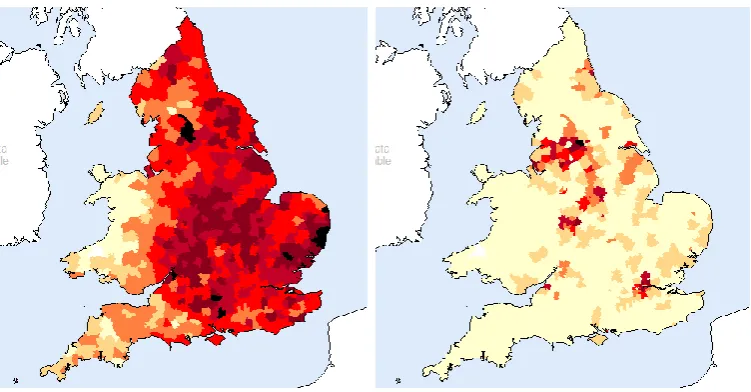
Figure 1: The distribution of the surname Smith in England and Wales in 1881. On the left, the shading represents the number of Smiths per 100,000 people, for each Poor Law Union, whereas the actual number of Smiths in each Union is represented on the right.
Turning away for a moment from distributions throughout a geographical map, the concept of “DNA space” might confuse some people and so warrants some words of explanation: this concept relates to plotting out the genetic differences between DNA-tested men and it has nothing directly to do with these men’s geographical distribution. It has more to do with how closely related people are: a small (or large) genetic distance between DNA signatures, within a hypothetical “DNA space”, suggests a close (or distant) familial relationship. Close cousins down the male line tend generally to be genetically closer, in genetic space, than very distant cousins. Clearly, if individuals with the same surname are geographical neighbours they might be closely related and hence also close in genetic space; but, clustering in “genetic (or DNA) space” displays familial relationships more directly than for geographical maps, even when individuals have migrated far away.
9
evidence, for the occurrence of a particular single family for Smith, where a single family here means one that is male-line related in the past 800 years, since the formation of this very common
surname. That does not preclude that some Smith families might have grown to be larger than others potentially leading to many tighter tiny clusters in DNA space, if many more Smiths were to be tested.
The less clear-cut situation for Metcalf
As a different example, Redmonds et al have suggested that the surname Metcalf is “single-origin”.13 It has been pointed out by Debbie Kennett14 that the DNA results for this surname show six distinct genetic DNA clusters, which might be associated with six different ancestors within surname times. It is relevant, however, to add that this DNA study does not include a discussion of how those tested were selected, leaving some doubt about the extent to which they can be regarded as representing a random sample of the surname. This can have an important bearing on the significance of this Metcalf study’s six mismatching DNA clusters: the clusters might apply partly to disproportionate numbers that have been non-randomly selected for recently-related members of particular families. The six different genetic clusters might represent distinct origins to the surname, rather than a single one, though at least some of the separation into separate cluster might instead have arisen from discontinuities in the male-line descent of the surname by an interposed female passing on the surname. Nonetheless, the available DNA results do not, as they stand, support a single-origin contention for Metcalf. This surname has a UK population of 6,065 in the 1881 UK Census and it is widely spread throughout the north of England (Figure 2(a)). Within the extent of the available evidence, neither the 1881 distribution of this surname nor the available DNA evidence supports a single-origin contention for the surname Metcalf.
According to the Surname Dictionary of Reaney and Wilson,15 Metcalf is thought to have derived as a nickname meaning someone who resembles a calf to be fattened for meat. The variant Medcalf is associated with a calf to be so fattened by lush grass in a mead or meadow. Some people consider that such a nickname is sufficiently distinctive to have not arisen very often, implying only a few, if not just one, origin to the surname. As has been outlined however, this is not supported by other available evidence, so far at least.
13
George Redmonds, Turi King and David Hey, Surnames, DNA & Family History, (Oxford, 2011), pp. 73-4.
14
Debbie Kennett, (Jan-Mar 2012), Book Review of Surnames, DNA & Family History, Journal of One-Name Studies, Vol. 11, Issue 1, p. 29.
15
10
(a) (b)
Figure 2: The widespread distributions of the two populous surnames, (a) Metcalf and (b) King, in 1881. The shading here represents the actual number bearing the surname in each Poor Law Union, as is also the case for Figures 3, 4, 5, 7, 8 and 9.
Available DNA evidence in connection with the distributions of some other surnames King and Jobling (K&J) considered forty English surnames and these ranged from the populous to the rare. Smith, which has already been mentioned, was the most populous. We here display
distribution maps for the next most populous five in their study, each having an 1881 UK population in excess of 4,000.
For the surname King (Figure 2(b)), the UK population in 1881 was 65,233 and this was widely distributed. In the K&J study, its largest DNA cluster was only around 8% of the total number of tested men called King, and this supports the hypothesis that this surname is multi-origin. Reaney and Wilson suggest in their Surname Dictionary that this name originated for those who appeared like, or played the role of, a king; that might have been in a tournament, play or pageant. It is not unreasonable to imagine that such a name could have had a widespread appeal, and such supposition is reinforced by the geographical distribution (Figure 2(b)) and DNA evidence.
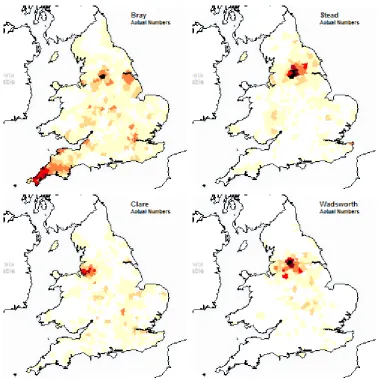
Figure 3 shows the 1881 distributions of another four populous English surnames from the K&J study: Bray (UK population in 1881 of 10,040); Stead (6,130); Clare (4,340); and Wadsworth (4,175). The sizes of the largest DNA clusters for both Stead and Wadsworth are around 30% and 35% respectively of the total of those tested; both their DNA matches and their 1881 geographical distributions suggest that these two surnames each include a significant family amongst others. On the other hand, Bray and, to a lesser extent, Clare are more evenly spread and have less DNA matching: their largest DNA clusters are 0% and 25% respectively. This favours rather more a multi- or plural-origin hypothesis for these two surnames on the left side of Figure 3, particularly for Bray. On the right side, it can be noted that Stead and Wadsworth have particular geographical
11
Figure 3: Distributions in 1881 of some populous surnames from the K&J study.
Populous single-origin contenders in West Yorkshire and Lancashire
Distribution maps for the four most populous single-origin surname contenders in West Yorkshire, in 1881, are shown in Figure 4. These are taken from Steve Archer’s Surname Atlas CD. Though Shaw is more populous than these,16 it is omitted from Figure 4 for being too widely spread. This leaves, for single-origin contenders in the West Riding of Yorkshire: Greenwood; Sykes; Haigh; and, Hirst. These names have West Riding/UK populations in 1881 of respectively: 10,612/22,256; 9,203/14,383; 8,024/10,324; and, 7,646/9,785. The supposition that they contend as single-origin surnames is here based solely on their 1881 distributions; that supposition has not been confirmed by DNA evidence, apart from some supporting evidence for Sykes.
16
12
Figure 4: The four most populous single-origin contenders in the West Riding of Yorkshire.
The 1881 geographical distribution of Sykes is show in the upper-right map of Figure 4. Though this map was apparently not available to George Redmonds, he took the early DNA study for Sykes17 as confirmation of his suppositions from early historical records that some populous surnames in West Yorkshire are single-origin.18 The Sykes DNA study was low resolution and was based on the
measurement of only four Y-STR markers for each tested individual. However, the single-origin contention in this study was supported by DNA mismatches to a small control sample of results from non-Sykes neighbours of the tested Sykes men and also mismatches to a wider sample of non-Sykes men. These Sykes surname results displayed a single genetic cluster made up of DNA matches for 43% of the tested men, though statistically this percentage has a 7% uncertainty when extrapolated
17
B Sykes and C Irven (2000) Surnames and the Y Chromosome, Am. J. Hum. Gen. 66(4), pp. 1417-1419.
18
13
to the whole population of the surname.19 This somewhat surprising DNA result marked a beginning to renewed interest, a little over a decade ago, in whether a single-origin feature might be more common than originally thought amongst populous English surnames. A more recent higher-resolution DNA study for the name Sykes found several large genetic clusters, including the one found in the early English study; but, this American study was both non-random and relied on the descendants of presumably relatively-few emigrants to America who may have had female, instead of male, linkages to an original Sykes family in England – it cannot be ruled out that it may have been by so-called `genetic drift’ that female-linked descendants in England went on to father substantial non-matching families growing profusely in more opportune conditions in America.20 As well as these shortcomings arising from this more-recent largely American DNA study, the early Sykes Y-DNA study for England also has been criticized, such as for sampling the name in only four counties around West Yorkshire. Though the conclusion remains controversial, to say the least, as to whether Sykes is truly a “single origin” name, there does seem some reason to believe from the available evidence that there is a large Sykes family around its main English homeland in West Yorkshire.
For present purposes, later in this article, we will restrict our simulations to family growth conditions in England and then to particular regions of England. We are extending our considerations further, such as to include emigration overseas, in a further paper that is in preparation.
Populous single-origin contenders are found also in the adjoining county of Lancashire (Figure 5). Here, five surnames that are more frequent have been omitted for being widely spread and hence seemingly multi-origin.21 Omitting these, the largest single-ancestor contenders in Lancashire are: Howarth (Lancashire/UK population is 11,424/14,416); Holt (10,556/20,077); Ashworth
(9,554/11,947); and, Holden (9,091/16,421). The largest single-origin contenders in Lancashire are in adjoining regions to those in West Yorkshire.
19
John S Plant (2009) Surname Studies with Genetics, DNA Section, Guild of One Name Studies (21 pages), esp. pp. 3-4. http://cogprints.org/6595
20
See the Chapter DNA and Surnames in The Surname Handbook: A Guide to Family Name Research in the 21st Century by Debbie Kennett (History Press, October 2012).
21
14
Figure 5: The four most populous single-ancestor contenders in Lancashire.
Industrial Age population growth and the size of single-origin surname contenders
Maps are available showing the growth of the total population in each Hundred or Wapentake of the English counties, between 1761 and 1841.22 From these, one might wonder whether, at that time of the Industrial Revolution, the exceptionally high growth rates in parts of Lancashire and West Yorkshire (between 500 to 750% growth) contributed to the high populations of the largest single-origin surname contenders there (Figures 4 and 5). Migration between Hundreds cannot be ruled out, however, as a significant factor in the population growths in specific Hundreds: new work opportunities could perhaps have attracted many to these particular areas of high growth in their overall populations.
22
15
The leading single-origin surname contenders in Shropshire and Wiltshire (the two groups of four at the right side of Figure 6), for example, are strikingly less populous than in West Yorkshire and Lancashire (the two groups of four on the left). This might be compared with the general trends for overall population growths in the Industrial Age. We may note that particularly low growth of the general population took place in Shropshire (between 200 and 300% for the Hundred in that county with the most overall growth) and Wiltshire (between 50 and 100%) through 1761-1841. We might then proceed to wonder whether these low Industrial Age growths offer an explanation of the smaller sizes of the most populous surnames in these counties: the largest contenders on the right of Figure 6 are clearly much less populous, in line with lower growth rates in the counties, than is the case for the counties further to the right.
The bar-chart in Figure 6 shows the populations of the four largest single-origin contenders in respectively West Yorkshire, Lancashire, Cheshire, Staffordshire, Shropshire, and Wiltshire. This shows a general but not uniform fall, from left to right, for which the six counties are presented in the order of falling Industrial Age growth of their overall populations. Irrespective of whether they are single-origin or not, the four most populous surnames in Shropshire and Wiltshire, without omissions, are included in Figure 6.23
Figure 6: Populations in 1881 of the four largest single-ancestor contenders in each of six counties: West Yorkshire; Lancashire; Cheshire; Staffordshire; Shropshire; and Wiltshire.
23
The top four for Shropshire are Cornfield (504/1,693), Gittins (411/1,855), Tudor (323/2,012) and Wellings (299/1,029). For Wiltshire, they are Hillier (821/4,038), Hibberd (498/1,839), Whatley (424/1,158) and Sainsbury (421/1,544).
0 5000 10000 15000 20000 25000
In county
16
From this irregular fall, it is clear that there are other factors, besides large Industrial Age growth, when considering the largest single-origin contenders in particular counties. For example, there was high growth of the overall population in east Cheshire (between 500 and 750%), comparable to that of the highest hundreds in West Yorkshire and Lancashire, and yet the most populous single-origin contenders in Cheshire (Figure 7) have significantly lower populations than those in Staffordshire (Figure 8) which had lower general growth, even in its south-eastern Hundred (300 to 400%). We will show later, for example, that overall growth throughout the whole of the county of Cheshire, rather than in specific Hundreds, was lower at these times than for all of Staffordshire. A persistent
dilemma is also that possible effects of migration cannot be ignored, leaving the question of whether whole-county or Hundred growth rates are more appropriate, not to mention the possible
importance of other conceivable effects on the growth of the apparently single-origin contender surnames.
17
Figure 8: The four most populous single-source surname contenders in Staffordshire.
Populous single-origin contenders in Cheshire and Staffordshire
The single-origin contenders that are included24 in Figure 7, for Cheshire, are: Dutton (1,681/6,783); Swindells (885/1,915); Hulse (850/1,896); and, Bebbington (684/1,329). Of these, Dutton seems relatively widely spread and hence rather more doubtful as a single-family contender.
In Staffordshire, the most populous single-origin contenders have rather lower populations than those in West Yorkshire and Lancashire but considerably higher populations than those in Cheshire, Wiltshire and Shropshire. Figure 8 shows the distributions, in 1881, of the four most populous
24
18
Staffordshire surnames that might be considered to contend as single-origin surnames. Their Staffordshire/UK populations, in 1881, are: Whitehouse, 3,576/7,787; Plant, 2,408/6,615; Salt, 1,963/4,417; and Parkes 1,857/6,143.25 None of these is contained solely in Staffordshire, though their distributions show a concentration there. Plant apparently originated near the east Cheshire border with Staffordshire and migrated further southwards into Staffordshire, as will be described further later.
Figure 9: Less likely, though the best of the feasible, single-origin contenders amongst the 145 most populous surnames in the UK in 1881.
25
19 Some less-convincing single-origin contenders
In the preceding sections, the most populous single-origin contender is Greenwood (upper left in Figure 4) which is ranked 146th in the order of most populous surnames, with a UK population of 23,256 in 1881.
The following are more populous than Greenwood but they have rather less convincing distributions as single-origin contenders: Booth (ranked 106th, population 29,570); Howard (107th, 29,395); Rees (126th, 26,043); Berry (142nd, 23,775). Their distributions in 1881 are shown in Figure 9.
The 1881 surname distributions suggest that the first one hundred or so most populous surnames almost exclusively appear to be multi-origin, on the basis of their 1881 distributions. However, upon reaching the 150th surname, in the list of most populous surnames, a few single-origin contenders begin to appear to be possibly more debatable as single-origin contenders. Many of the most populous contenders appear to be in adjoining regions of West Yorkshire and Lancashire, with perhaps the most populous, on the basis of this subjective assessment, being Berry which is ranked 142nd and which has an 1881 UK population of 23,775. However, Berry might well be plural- or multi-origin instead, as has already been discussed in connection with an apparent meaning for this name.
Taking another county, with moderately populous single-origin contenders, the most populous single-origin contender surname in Staffordshire appears to be Whitehouse, which is ranked 543rd with an 1881 UK population of 7,787, followed by Plant which is ranked 613th with a UK population of 6,615 in 1881. As will be discussed further below, there appears to be only a small plural-origin component contributing to the surviving population of the latter.
It is relevant to check the contention that these surnames could be single-origin, by means of appropriate DNA testing. The early DNA study for Sykes was, as has been shown, for the second most populous contender whose 1881 population is based mostly in West Yorkshire. In the next section, we shall consider in some detail the second most populous contender in Staffordshire: Plant.
Considering a surname in more detail: Plant
20
(a)
(b)
Figure 10: DNA Network diagram for Plant: (a) 12-marker diagram; (b) 37-marker diagram.
The available DNA results
21
taken in this DNA study to consider a random sample of the Plant surname.26 Academic studies have used different procedures and conventional `snail’ mail in trying to guarantee a random sample of a surname. On the other hand, the internet has been exploited for the Plant study.
The green circles in Figure 10(a) are associated with two participants with separate known
ancestries, both in south Lincolnshire. Although no genealogical link has been found between them in the documentary evidence, 25-marker DNA testing confirms that they most probably have a shared male-line ancestor within surname times. Only one of them, who had 37 Y-STR markers measured, is included in Figure 10(b).
Otherwise, there is only one DNA cluster (red circles in Figure 10) yet found amongst the independent volunteers with the Plant surname. This is indicated by the large red circle and red outliers in Figure 10(a) and by the cluster of small red circles in 10(b). Their shared male-line ancestor might well date back to an early bearer of the Plant surname, perhaps located near the fourteenth-century “main” English Plant family homeland, or perhaps originating slightly earlier elsewhere, as is discussed later. There are three recognised methods of estimating the date of the shared male-line ancestor from the Y-DNA data and these all give a rough estimate of around the fourteenth century for the shared ancestor of those corresponding to the red circles.27
The large red circle in Figure 10(a) represents a number of exactly matching Y-STR signatures at the 12-marker level which is resolved by the extra markers in Figure 10(b) into a cluster of
near-matching small red circles. The reason for non-exact near-matching of the red circles in Figure 10 is well understood: a small fraction of the Y-STR markers can be expected to have mutated, from an ancestral Y-signature, down the centuries of surname times. Two of the most distant outliers in 10(b), as well as two others less distant from the Plant modal Y-signature, have been investigated further at the 111 marker level; and, Deep Clade testing also confirms that they belong to the same surname family as those with fewer harmless mutations from the Plant modal haplotype. Those that match exactly in Figure 10(a) almost certainly belong to the main English Plant family and, when most of these and all but one of their red outliers have been upgraded to more markers, they have invariably remained matched to the main English Plant family.
There are those who do not even nearly DNA match with the main Y-STR cluster in Figure 10. For these non-matching yellow circles, one possibility is that some false-paternity events can be expected in the descent of any family. A false paternity event is often called, for example, a
26
John S Plant (2009) Surname Studies with Genetics, DNA Section, Guild of One Name Studies (21 pages) esp. pp. 15-16. http://cogprints.org/6595
27
22
paternity event (NPE) and it refers to any mechanism, such as infidelity or name change or adoption, by which subsequent Plants do not inherit a paternal Y-signature from the initial Plant-named male lineage since they have inherited the surname through a female link, perhaps because of wifely infidelity or an unmarried Plant mother passing on her own surname for example.
The green circles might correspond to an entirely separate origin for the Plant surname or, like each yellow circle, they might perhaps correspond to an NPE from the same surname origin as that for the red circles. Taking the latter case, in the 12-marker data (Appendix A) there are, at present, 23 matches (red circles in Figure 10(a)) and 11 non-matches (green and yellow circles) after discounting those who have had fewer than 12 markers measured and counting only one for the
independent pairs of volunteers. Considering only independent volunteers, the observed non-matches comprise 32.4% of the dataset and this can be compared with theoretical expectation under the assumption that all the non-matches are NPEs. From such an assessment, it turns out that it is perfectly feasible, within the realms of theoretical expectation,28 that surviving Plants descend from a single source for the name with all 32.4% of the mismatches being due to NPEs. We will discuss more fully later an alternative possibility that some of the mismatches might stem from other origins to the Plant surname, particularly for a dataset that applies more restrictively to just England.
None of the Plant volunteers has a Y-signature corresponding to the modal R1b1 signature of the UK general population. This R1b1 modal signature is the Y-DNA signature that is most frequent in the general population of Europe and North America. The available Plant results of those for whom only 9 comparable29 markers have been measured are not far distant from this modal signature.
However, the Plant results are distant from it when 25 or more markers are compared. Indeed, they have no known match with any tested non-Plant in the FT-DNA database at the higher levels of measured markers.30 This supports the hypothesis that the red circles in Figure 10(a), or 10(b), correspond to descent from a shared ancestor who lived within the time span of surname history (say 800 years); they can be associated with a single ancestral source for the Y-signature of the main English Plant family. Apart from the green circles, there is no clear DNA evidence for another origin to the name, in contradistinction to many of the surnames studied by K&J.
28
If the false paternity rate per generation is p, it can be expected that there will be 1-(1-p)n non-matches after n generations. If we assume 23 generations since the origins of the surname, we get a value of p=0.016, to wit an NPE rate of 1.6% per generation. This is within the limits of a “reasonable estimate” of 2% as assumed for a “typical” surname and used by K&J in their computations.
29
23
The modal Y-STR signature for Plant, at a 38-marker31 and higher levels, is given elsewhere.32 Plant volunteers in the main DNA cluster have been found to belong to the P312+ sub-clade
R-DF27+(xZ196,xZ225).33 We will discuss later below how this provides information about the deep ancestry of the main matching Plant family.
Is the Plant surname single origin?
Before the advent of DNA testing, Plant was thought to be multi-origin because it was populous and moderately widespread.34 At that time, the term “single-origin” was usually reserved for relatively rare surnames that were almost entirely in a small local geographical area.35 There was also a contention that Plant meant a `gardener’ and it was accordingly presumed that there were many origins corresponding with many different gardeners. However, this contention has now been thrown into substantial doubt. As early DNA evidence became available, it offered conflicting evidence that indicated that Plant (top right in Figure 8), perhaps like Sykes (top right in Figure 4), might be predominantly “single origin”.36 By this, it is meant that the DNA-tested living Plants can mostly be ascribed to male-line decent from a single male ancestor, who lived within the past 800 years or thereabouts.
In fact, a name such as Plant might have had a few origins in medieval times though the DNA evidence for living Plants displays a distinct single main cluster (Figure 10). This DNA clustering more strictly indicates that one family has survived more prolifically than others down to the living bearers of the surname who have been DNA tested.
31
The number 38 comes from 37 markers measured by Family Tree DNA (FT-DNA) and an additional marker, not included by FT-DNA, which was measured besides 9 others by Oxford Ancestors. A modal signature has also been determined at the 68 marker level and, with less certainty, at the 112 marker level.
32
Fuller details of the DNA results for Plant are given at http://www.plant-fhg.org.uk/dna.html . 33
Here, R-DF27+(xZ196,xZ225) means that the DF27 has tested positive but its sub-clades Z196 and Z225 (and, in fact, some of their sub-clades) have tested negative.
34
The nineteenth Earl lecture, delivered at Keele University, 6 November 1997; published as David Hey (1998) The distinctive surnames of Staffordshire, Staffordshire Studies, 10, pp. 1-28, esp. 14. 35
David Hey, Family Names and Family History (Cambridge University Press, 2000). 36
24
11139-1798 Seat of the noble Planta family in the Upper Engadine
21202 Lands at Chinon and Loudun of Emeric de la Planta alias de Plant’
31262 First known evidence of the name in England; spelled Plaunte
41273 Three Rouen merchants called de la Plaunt and Plaunt
51279 At Burgh-le-Marsh near Bolingbroke, the name Plante is indicated to have been hereditary for 3 generations
61282 The name form de Plantes in Huntingdonshire
71301 First evidence of the Plant name local to the subsequent main homeland of the surname
8ca.1280-ca.1360 Records of Plonte name at Bath, explicitly hereditary by 1328
91350 London priest Henry Plante of Risole: 9a is Risoul; 9b is London
10 1352 James Plant carried away goods from recently lost Warren lands in Norfolk
11 1360 onwardsSeveral records of Plonte or Plont in the subsequent main Plant homeland
121379 A gardener called Plant
25
The DNA results for the living Plants might not relate to all of the first Plants. There might have been some unrelated Plant families that died out or proliferated little so as not to show up as separate distinct clusters in the DNA results for the living Plants of Figure 10. We shall accordingly call Plant an “effectively single origin” surname, though it might well have been plural-origin in medieval times. The Plants with mismatching y-signatures might descend either from random non-Plant men
fathering NPEs within the single Plant family or some might indeed descend from different origins of the Plant surname. The two properties that characterise an effectively single origin surname are that the DNA results are numerically consistent with the matches being NPEs, and that the non-matches to the dominant cluster do not display any structure that would indicate a second familial relationship or more. We shall return to this question in the subsequent computer modeling of the surname.
Figure 11 shows that medieval records for the Plant name were spread throughout France and England. The medieval records indicate that there were early Plants in such classes as the clergy as well as freeholders and merchants and a bailiff.37 Early descent from one such Plant family could have given rise to a relatively widespread “effectively single origin” surname. However, though there were Plants with the means for distant travel (e.g. medieval Plants at 1, 2, 4, 7, 8, 9, and 10 in Figure 11), this does not constitute convincing evidence that all early instances of the name in the medieval records belonged to the same Plant family.
Some early instances of the Plant name could have been by-names that were never inherited; and, even initially inherited lines can be expected to have died out, entirely or largely, to a dramatic extent, as our computer simulations show. By 1400, there is explicit evidence that the English Plant surname was, or had been, hereditary in Lincolnshire (item 5 in Figure 11), at Bath (item 8) and around the northern border of Staffordshire with Cheshire (item 11). This might be taken to suggest three different origins for the surname in England. On the other hand, the social status of these Plants was sufficient that we might venture to postulate that they could have migrated from a single origin. Those with the hereditary surname Plant (Plonte) around Bath might have died out (or perhaps become bearers of a morphed version of the surname, such as Plenty); those in south Lincolnshire may or may not have survived as more modern south Lincolnshire Plants; and, those on the Cheshire-Staffordshire border apparently became the main English Plant family. Our preferred presumption is that this main Plant family was not already more widely spread before it migrated to its main homeland, though we shall also consider an hypothesis that it might have been.
37
26
27
Figure 13: Distribution of Plant baptism records throughout several English counties (1601-1850).
The medieval Plant records at item 11 in Figure 11 correspond in location to a cluster of seventeenth-century Hearth Tax records; these are found particularly in Totmonslow and
28
for the whole of England and those shown in Figure 12 are only for Hundreds around the main Plant homeland. We refer to the area of the larger green circles in Figure 12 as the main homeland of the main English Plant family. The “item 11” location of the medieval records of Figure 11 corresponds closely with the large green circles as well as the peak of the 1881 distribution of Plants in Figure 8.
The other marked points in Figure 11 show a much wider distribution of early instances of Plant-like names - these can be regarded as separate medieval origins to the name that died out though it remains open to speculation that they could conceivably be early locations for a mobile family.
It is not inconceivable that early Plants travelled far and that their name dated back to very early times. It has even been claimed38 that the name Planta (item 1 in Figure 11) dates back intact to a Roman inscription for Julius Planta dated 46AD at Trento, near the Engadine seat of this noble family (1139-1798). This is very contentious, even though it is somewhat more credible that the late medieval name Planta might have morphed to Plante and then Plant.
Certainly, there is evidence that the Plant name was quite widely spread by early modern times. The mapped bar-charts in Figure 13 display the growths in listed Plant baptisms in the IGI,39 from 1601 to 1800, in various counties. This growth is most notable in Staffordshire. However, fairly consistently, about half of the Plants are in the main homeland of Cheshire and Staffordshire and half thinly spread elsewhere, though it should be borne in mind that there are shortcomings with this IGI data and too precise an interpretation of Figure 13 is inappropriate.
The mapped bar-charts in Figure 13 indicate that there were Plants in several counties by the beginning of the seventeenth century. Their numbers grew throughout the eighteenth century, especially in Staffordshire, leading on to the distribution shown in Figures 8 (and by the brown shading in Figure 12) by the times of the 1881 Census. In Figure 8, the 1881 Census data is
aggregated into Poor Law Unions whereas a more broadly smoothed picture is presented in Figure 12, where the 1881 Plant population data (brown shading) is aggregated into whole counties and scaled to represent Plants per 10,000 of the total county population. The bar-charts in Figure 13 indicate the different numbers of Plants in different counties, using data which are not reliably complete but which, with this word of caution, add more of an historical and geographical perspective to the growth in the numbers of Plants.
38
G.R.de Beer (1952) Notes and Records of the Royal Society of London, p.8. 39
29
30
Relating the DNA results to the geographical distribution of the Plant surname
Figure 14 shows the distribution of earliest known ancestors for the DNA matches and mismatches of some tested Plants. As in Figure 12, this is superimposed on brown shading that depicts the smoothed distribution of the Plant population, relative to county totals, by 1881.
The distributed circles in Figure 14 correspond to independent volunteers who represent a roughly random (not uniform) sample of the Plants. In fact, three different Plants volunteered
independently who each thought that their ancestry was in NE Derbyshire. It might just be a random coincidence that all three volunteered independently thinking that they came from the same place. However, only one red circle is shown in Figure 14 for these matching Plants. Also, only one red circle is shown for a pair in south in Leicestershire, who volunteered together and so cannot be considered to be individually independent. The green circle corresponds to a pair whose separate ancestral lines coexisted in south Lincolnshire; they volunteered independently and, though they did not match with the main English Plant family (red circles), they matched one another at the 25-marker level. Whereas the red circles represent DNA matches, the yellow circles correspond to volunteers who DNA match neither the main paternal Plant family (red circles) nor other yellow circles nor the green one.
The dated red circles in Figure 14 show that there was a widely-spread single family of DNA matching Plants by around the eighteenth century. The circles are labeled with the dates of the earliest known male-line ancestors of these tested Plants and they show that broadly, by the eighteenth century, the matching single Plant family extended through and around the peripheries of the county of Staffordshire. Indeed, there were other matching Plants in Ireland (ancestors traced back to 1808) and the USA (back to 1655). The full detail of when and how this single family of matching Plants ramified widely, before the eighteenth century, can only be guessed, with the help of the mapped geographical distributions of all Plants (e.g. Figure 13).
Attempts to trace back the earliest known ancestors, of those Plants who have been tested, to earlier dates than the ones already included in Figure 14 might in time play a role; but, the ease and reliability of such a genealogical extension, back towards early times, should not be exaggerated for this populous surname.
Possible relevance of various meanings of plant
31
meaning, or a newly developed industrial meaning for plant, might be associated with a plural-origin contribution to the surviving Plant population.
First, considering the possibility of a distant initial origin to the name, the form de la Planta (item 2 in Figure 11) might mean from La Planta region, of the Alps for example. This might refer, for instance, to the Engadine which means, in Romansh, `garden source of the River Inn’ (item 1 in Figure 11). The name form de la Planta evidently developed into de Plant’, de la Plaunt, and de Plantes in England (items 2, 4 and 6 in Figure 11) though it has alternatively been suggested that de Plantes might mean from Le Plantis in Normandy . The Avignon Popes (1309-76) tended to favour appointments from their local region, which might explain why Henry Plante of Risole, in the French Alps, was awarded the stipend of a priest in London (item 9 in Figure 11). To this extent, the
semantics and historical evidence suggest one particular hypothesis that lesser members of the noble Planta family might have supplied a “single origin” to at least some of those surviving with the English Plant surname.
As another hypothesis, the by-name Plant has been said to mean a `gardener’ (cf. item 12 of Figure 11). This relates only by theoretical metonymy to the accepted medieval meanings of the word plant. Such a meaning, of course, does not appear in language dictionaries. As we shall show later below, it is not necessary to assume that Plant is a multi-origin occupational name, derived from many different gardeners, in order to explain the large population of the Plant surname. At Hull (item 12 in Figure 11) there might have been a connection with gardening made to the Plant name for the gardiner there called Plant in 1379 but other Plant records give contrary evidence. It is not clear that this gardener meaning was an origin to the hereditary surname of the dominant Plant family or indeed that it contributed at all to the meaning for any of the surviving population of Plants. It can be noted, for example, that recent evidence indicates that the Plant name (with the dialect spelling Plont) existed in the main Plant homeland (item 11 in Figure 11) at least two decades before the isolated evidence for a gardener at Hull (item 12).
32
Various meanings for Plant can be set in the context of the word’s earliest etymology. According to Claiborne,40 plant derives from the Indo-European root plat- meaning `flat’. From there it passed to the Latin planta meaning `sole of foot’, and from there to the later meaning `seedling’, which was pressed into the ground with the foot. The word passed into Gaelic where the initial p underwent a sound shift to c, resulting in clan, meaning the offshoots of a family. Others have pointed to ancient beliefs in the emergence of human life from the land with a lame foot,41 suggesting sole (of foot) as an ontological foundation to man’s existence or soul. Certainly, the word planta means `to breed’42 or `to beget children’ in Welsh in which plant means `children’ and, in contemporary belief, this can be related to the `planting’ of soul from both God and the human father.
In contemporary Middle English, the word has a rather wide range of meanings, some with religious connotations, as outlined in the Middle English Dictionary and the Oxford English Dictionary. A rather complex example of the Middle English usage of the word plant can be illustrated with an extract from William Langland’s late fourteenth-century poem Piers Plowman. This poem states that `love is the plant of pes *peace or peas+’43 which could well allude to Jesus as the vine or divine root; the poem later adds `this tre [tree or trinity] has true-love ... this is a proper plant that brings forth folk of all nations’.44 To help explain this, it can be noted that the late medieval meanings of plant conflate several modern `biological’ concepts. The word plant meant a shoot or an offshoot or a vine or a tree; and the poem, with its medieval philosophy, conflated these now-diverged meanings with the generation of offspring through the soul. Contemporary belief in the human soul involved the generative power of the vegetative seed as well as the divine intervention of God’s planted Word.45
We can consider another developing meaning of plant as well as the possibility of a late conflation with the supposed root plat. Either might be related to a small multi-origin influx of population into a pre-existing Plant surname. Relatively late aliases and name changes are not unknown and they have been claimed to be more common than is generally supposed.46 Two such possibilities are as follows.
40
Robert Claiborne, The Roots of English: A Handbook of Word Origins (1989). 41
C Levi-Strauss, The Structural Study of Myth, Structural Anthropology, translated from French by C Jacobson and B G Schoepf (New York, 1963), pp. 206-231.
42
Also, Samuel Johnson’s 18th century English Dictionary gives the meaning `to procreate’ for plant. 43
C-text version of Piers Plowman, Passus II, l. 149; in the Huntingdon manuscript HM 143, as listed by E Salter and D Pearsall, Piers Plowman (London, 1967), p. 73.
44
Huntingdon manuscript HM 143, Piers Plowman, Passus XIX, ll. 9, 25-26, 101-102. 45
http://www.plant-fhg.org.uk/soul.html 46
33
The surname Platt was concentrated just to the north of the main Plant homeland and it is not inconceivable that there might have been some lexical confusion of Platt with Plant. More generally, there might have been a multi-source influx from any other surname that
was not yet fully fixed and, in particular, this can be related to a tenuously supposed attraction of a relatively late semantic development of the word plant.
The Oxford English Dictionary47 records a new eighteenth-century meaning for plant, which is the tools and equipment required to generate an industrial process. There is general controversy about how this meaning came about, though one might point to a possibility that the generation of an industrial product could have been metaphorically based on the idea of the generation of an offshoot or child or young animal – the verb to plant had meanings `to found’ or `to establish’ from early times, according to the Oxford English Dictionary, and these can be related on to industrial-scale generation as evidenced in the same Dictionary for later times. We might wonder if such a meaning could have appealed to industrial-minded farmers or tradesmen around the Potteries of North Staffordshire, for example, and could perhaps have been attractive enough to induce them to change their family name. Such name changes to Plant so far lack confirmation however, as does the precise way in which the industrial meaning of the word plant developed.
It might be relevant that industrial associations perhaps existed early in this region with a sense `to set’ of to plant. For example, by the seventeenth century, there was engineering in the nearby lead mines of Derbyshire, with `Engines, Pumps, Forces there set and planted’.48 As further speculation on the possibility of an early industrial sense to the word plant, we may note that French was pervasive in Middle English and that the French meaning of plante is a `bed or planting place’; to this we may add that the first known location in the main Plant homeland is for Thomas Plontt at a vaccary (cattle breeding and rearing station) such that Plant might mean`from the planting or breeding enclosure’, possibly leading on to an industrial sense in industrial-scale farming as well as forming a possible explanation of the initial meaning of the surviving Plant surname.
The supposition of a late multi-origin influx into the Plant surname is not necessary to explain the DNA evidence or the prolific growth of the Plant population however. The possible causes of such growth will be investigated more fully in the Modelling section of this paper below.
Did the Plant family arrive in its main homeland from elsewhere?
Recently extended searches of the Macclesfield Court Rolls of the main Plant homeland (item 11 in Figure 11) have revealed evidence that is relevant to the `offspring’ and `gardener’ meanings, as well as to a hypothesis of how Plants might have arrived in their main homeland.
Some key records amongst the earliest yet found for Plant at Macclesfield49 can be summarised as follows:
47
OED, plant n(1) 6a. 48
Nellie Kirkham, Derbyshire Lead Mining through the Centuries (Truro, 1968), p. 88. 49
34
1360 Rand Plont(t) and Willo Plont(t) fined for stray animals in the Forrest
1363 Thom Plont(t) indicted;then in 1365, as an outlaw, committed to prison pending paryment of 20s (i.e. £1)
1370s Seven Plonts are mentioned in 35 separate entries for stray animals and pannage of pigs
1374 Thom Plontt had failed to pay the fine for pasturing a bullock in the Black Prince’s vaccary
1383 Ranulph Plont renting lands in Rainow formerly belonging to John Walshe
1401 Richard Plont is guarantor for John Togard and Nicholas le Gardiner; Ranulph Plont is guarantor for Nicholas le Gardiner
To these can be added a few records for just across the county border into Staffordshire:
1379 Thomas Plonte aided and abetted a beheading on behalf of the Abbot of Dieulacress Abbey but obtained the King’s pardon in 1382
1397 John and Richard Plont sued for trespassing with herds of cows just across the River Dane from the Black Prince’s erstwhile vaccary
1406 Edward Plont granted two mess’ one croft by the Abbot of Dieulacress
Though these records do not generally give clear familial relationships, it can be noted that there are two relevant associations of the Plant name with other names. The surname Walshe (item dated 1383 above) is believed to mean `from Wales' and the Welsh meaning of plant is `children', not gardener, for which the name le Gardiner is here in evidence (item dated 1401 above). This does not prove a semantic association of Plant to either `offspring’ or `gardener’ though it does suggest that both of these meanings were in play in a direct social association with the Plants. It is not impossible that the name, here, initially meant `offspring’, particularly in the context of the name Walshe, and then developed to mean `gardener’ in more of an assimilated English context, if it did not simply mean `from the planting enclosure’ in connection with the Black Prince’s vaccary at Midgley.
Less directly, there is also an indication that is not incompatible with a lexical confusion between Platt and Plant. There is a 1357 record at Adlington, five miles north of Macclesfield town, for a Richard fil Plot.
The name of the main Plant family could have originated in Macclesfield Forest in east Cheshire. Alternatively, however, it might have arrived from elsewhere. For example, it is possible that it arrived with the import of cattle from Wales (item 7 in Figure 11) to the Black Prince’s vaccary for fattening50 at Midgley on the Cheshire-Staffordshire county boundary (items dated 1374 and 1397 in the above lists), at the heart of the main Plant homeland. A subsequent connection with Dieulacres Abbey in Staffordshire (items dated 1379 and 1406) was perhaps initially associated with the
50
35
Cheshire outlaw Thomas Plontt who apparently sought sanctuary across the county boundary to the south. This might have aided a prolific spread of the Plant family into the considerable land holdings of Dieulacres Abbey in Staffordshire. The 1881 distribution (Figure 8) indicates the Plant name’s distribution had subsequently elongated progressively further southwards, reaching as far as the region of the large city of Birmingham just to the south of Staffordshire.
Though far more contentious, another hypothesis has been that the medieval name was displaced to the medieval Cheshire-Staffordshire border from Warren lands elsewhere.51 The last Earl Warren died in 1347 and, further to a 1342 marriage to the Poynton heiress, his illegitimate descent
inherited Poynton in Macclesfield Hundred in 1370. Earlier, the Earl Warren had briefly held the High Peak, adjacent to the main subsequent Plant homeland (position 11 in Figure 11). Displacement to here could have stemmed from the Lancastrians taking over Warren lands after the last Earl
Warren’s death in 1347. One piece of supporting evidence is that, in 1352, James Plant is mentioned for carrying away goods from a recently lost Warren Hundred in north Norfolk (item 10 in Figure 11). Taking an association with Warren lands back further, the Plants at position 8 in Figure 11 were near disputed land during the early fourteenth-century feud between the Earls Warren and Lancaster. Also, position 7 was near the Broomfield and Yale lands of the Earl Warren following the thirteenth-century Welsh Wars. The further back one goes the more tenuous the evidence becomes but one might also note, for example, that the first known hereditary evidence for the Plant surname in England (item 5 of Figure 11) was also near Warren lands. Moreover, in the mid thirteenth century, these lands were under the Wardship of Peter of Savoy, who came from near position 1 in Figure 11. This tenuous possibility of an ultimate single origin, feeding into England, could be supposed to have led on to a subsequent distribution of Plants with roles of modest rank in connection with the Warrens’ lands. However, though the Plants were repeatedly found near such lands, these
coincidences could have been just fortuitous and they cannot be regarded in any way as `proof’ that the main Plant family’s name initially meant `from the Planta region of the Alps’, though early forms of the name might have originated with such a meaning.
It might also be relevant to add a few words about the current thinking, though still developing, for the DNA haplogroup of the main Plant family. Some archaeologists imagine that the parent ancient familial grouping, to wit the haplogroup of the Plants’ male-line ancestors, underwent a mass migration, around 4500 to 4300 years ago, up the river Danube through central Europe into Western Europe,52 where the Y-chromosome of the ancestors of the main Plant family underwent a further SNP mutation (P312 also known as S116). The alternative view, based more directly on DNA
51
John S Plant (2005) Modern Methods and a Controversial Surname: Plant, Nomina 28, 113-133, esp. 120, 131-132. John S Plant (2007) The Tardy Adoption of the Plantagenet Surname, Nomina 30, 57-84, esp. 80-82. http://cogprints.org/5985/ and http://cogprints.org/5986/
52
The date of arrival in Europe of the ancestral DNA haplogroup, with the earlier SNP mutation L11 (aka S127), for example, is still disputed and it may have been before or after the Neolithic
36
evidence, is that the male-line ancestors of the Plants spread up the Atlantic Coast of Europe to Britain sometime between the British Bronze Age and the late medieval period. A nomenclature for the R-P312+ sub-clade53 for the Plants is R-DF27+(xZ196,xZ225).54 A less restricted sub-clade R-P312+(xU152,xL21)55 is found for example amongst 62% of the population in Spain and Portugal, 29% in France, 13% in Ireland, 11% in Switzerland, but only 6% in England where the main English Plant family is found. This suggests that the Plants’ ancestors came from the Continent via France though it remains feasible that they arrived at Macclesfield via Ireland and/or Wales and not necessarily directly from France to England. Further developments of DNA techniques might help in tying down the timescales. Also, finding further SNP mutations in the main Plant family’s genetic ancestral line might eventually tie down more specific locations, with relevant timescales, more tightly.
Recent DNA findings suggest more generally a long history of migration up the Atlantic coast of Europe to re-people Britain after the last Ice Age.56 Aside from the Plants’ specific ancestral line, it has even been suggested that there could have been for example an early influx of words from a North Western Semitic language, associable with the Phoenicians, up the Atlantic coast into Britain, that contributed to some early British place names.57
Similar notions of Atlantic coast trade might conceivably extend to speculation about the early meaning of plant. In Basque, this means `to feign’. This can be considered along with evidence for old Aquitainean deities: these had the names of plants and animals. Conflating the Basque language with early local belief in plant deities, we might note that the feigning of a deity is a concept that is not at odds with the posturings of the medieval nobility. This is consistent with the ninth- and twelfth-century noble names of Plantapilosa (Duke of Aquitaine) and Plantegenest (Count of Anjou).
53
Earlier testing showed that all of the DNA sub-clades M65, M153, U152, L21 and L176.2 test negative, i.e. these further known mutations have not occurred for the main Plant family. 54
Here, R-DF27+(xZ196,xZ225) means that the DF27 has tested positive but its sub-clades Z196 and Z225 (and, in fact, some of their sub-clades) have also tested negative.
55
http://www.goggo.com/terry/HaplogroupI1/y-Haplogroups_I1_and_R1b_in_European_Countries,_plus_Ancient_Migrations.pdf where the sub-clade L21 is called M153.
56
E.g. Stephen Oppenheimer, The Origins of the British (London, 2006).