Diesel
Emission Control
Technology
SYSTEM CONTAJNNG PLATINUM CATALYST AND FILTER UNIT
REMOVES PARTICULATE
FROM
DIESEL EXHAUST
By
I?
N.
Hawker
Johnson Matthey, Catalj tic Systems Division, Royston
Recent concerns over the health effects of particulate emissions from vehicles have focused on diesel engines. While European legislation to limit their emis- sions is now i n place it is expected that future legislation will be more demand- ing. Using a platinum catalyst it has been possible to demonstrate in various trials the practical application of a novel system for the removal of both the soot and hydrocarbon components from diesel powered vehicle exhaust. The back- ground to the development of this successful technology is described here.
Diesel engines find widespread application as power sources in both mobile and stationary applications. Their innate high efficiency and economy have resulted recently in unprece- dented growth in their share of the passenger car market in Western Europe. T h e durability of the diesel engine has also led to its dominance as a source of motive power for the transport industry.
However, the ubiquity of large diesel-engine vehicles in city environments has persuaded reg- ulatory authorities of the need to control the emitted exhaust pollutants. European legisla- tion limiting the quantities of carbon monox- ide, hydrocarbon, oxides of nitrogen and par- ticulate matter were introduced in 1993 and will be strengthened in 1996. However, in spite of the tightening standards, a large fleet of long lived and rather polluting diesel vehicles exists in most cities around the world.
Diesel Exhaust
Diesel exhaust differs from that of petrol engine exhaust in two major characteristics. Firstly, diesel exhaust contains a far higher amount of particulate material, and secondly the exhaust is far “leaner”, that is, it is far more oxidising than the typical exhaust from petrol engines (1).
The health effects of diesel particulate have been a cause of concern for many years, because of both the chemical composition and the par-
ticle size spectrum (2). T h e two major com- ponents of particulate are soot and heavy hydro- carbons - the soluble organic fraction, S O F -
which condenses on it during its collection. The S O F is known to contain carcinogenic poly- aromatic hydrocarbons (3), however, the ben- eficial effect that oxidation catalysts have on the toxicity of diesel exhaust by removing S O F is well documented (4, 5).
A body of evidence implicating the soot h c t i o n of diesel particulate as damaging to human health has recently begun to emerge. The nature of the effect appears to relate not to the chemical nature of the soot, which is predominantly carbon, but to its particle size (6). A significant quantity of airborne urban particulate is known to derive fi-om the exhaust of diesel engines (7). In studies in the United States, very close correlations have been noted between particulate air pollution and mor- tality rates (8) and the California
Air
Resources Board has stated that there is likely to be nothresh-
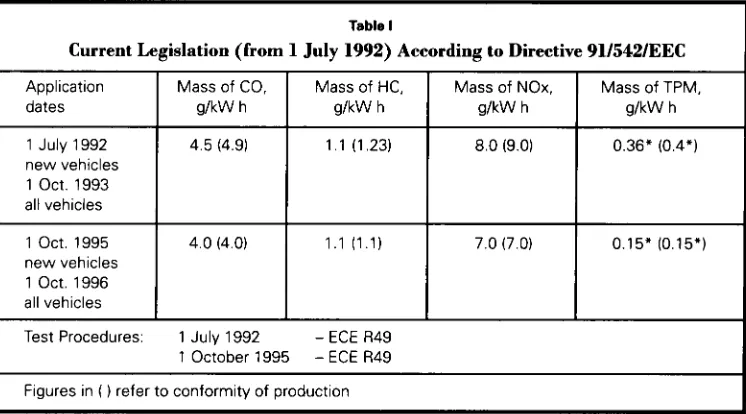
old limit below which particulate does not rep- resent a finite health risk (9).The diesel emissions standards for heavy duty vehicles, extant and proposed for the European Union, are shown in Table I. A bus, for exam- ple, with a 200 kW engine, which meets the 1993 standards for particulate will, if it con- forms to the average emission levels measured in the steady-state test by which its engine is certified for production, emit around 80 grams
I
Table I
Current Legislation
(from1 July 1992) According
toDirective 91/542/EEC
1 Oct. 1995 new vehicles 1 Oct. 1996 all vehicles Application dates
1 July 1992 new vehicles 1 Oct. 1993 all vehicles
4.0 (4.0) 1.1 (1.1) Mass of CO, Mass of HC,
Test Procedures: 1 July 1992 - ECE R49 1 October 1995 - ECE R49
~~~~
Mass of NOx, g/kW h
8.0 (9.0)
7.0 (7.0)
Mass of TPM, g/kW h
0.36* (0.4")
0.15" (0.15")
I
Figures in ( ) refer to conformity of production* In the case of engines of 85 kW or less, a coefficient of 1 7 is applied to the limit for particulate emissions
CO is carbon monoxide. HC is polyaromatic hydrocarbons. NOx is nitrogen oxides and TPM is Total Particulate Matter
of particulate per hour. Therefore, a large fleet of vehicles, which may frequently be older, or may simply not conform to current type- approval standards, will emit a significant mass of particulate into urban environments.
T h e awareness of the growing concern over these issues has caused Johnson Matthey to reassess the methods by which particulate can be removed from diesel exhaust (1 0). While the effect of an oxidation catalyst on the polyaro- matic hydrocarbons in diesel exhaust is clearly beneficial, it has little or no effect on the quan- tity of soot. T h e net particulate mass, which includes SOF, is reduced by an oxidation cat- alyst, because the hydrocarbons, which co-con- dense with soot particles, contribute to it.
Filtration is a technique which has been widely studied for the removal of soot from diesel exhaust (1 1). As soot is collected on a filter placed in the exhaust stream of a diesel engine the pressure drop across the filter increases. The increased engine power which is required to drive the exhaust gases through the filter, causes the exhaust temperature and also the fuel con- sumption to rise. Soot combusts at 550-6OO0C, but it is not sufficient to rely on an increased pressure drop to generate the temperatures required in the exhaust gas to initiate the com-
bustion, and damage to the engine under these conditions is a significant risk.
T h e regeneration of soot filters through soot combustion has been the subject of much work over 20 or more years, and techniques such as in-line fuel burners, catalytic fuel burners and elecmc heaters have all been examined. Catalyst technology has also been investigated in an attempt to lower the temperature at which the oxidation of soot commences (12). For many years it had been assumed that the mechanism by which such systems began to regenerate the filter traps involved the adsorption of particu- late on the catalyst in close proximity to an oxy-
gen activation site.
In the course of experimental work at Johnson Matthey to define the conditions necessary for the catalytic regeneration of traps we uncovered a novel mechanism (13, 14). Carbon, in the form of soot, was being oxidised, not by "acti- vated" oxygen, but by nitrogen dioxide. T h e diesel combustion process is characterised by higher pressures in the cylinders than occurs in spark ignited engines. T h e rate of formation of nitrogen oxides (NOx) in the combustion process is at least partly a function of the oxy- gen available, and so the higher pressure and leaner mixture of diesel engines tend to produce
g/kW h g/kW h
Fig. 1 The platinum catalyst, loaded at 50 glft’, is mounted on a substrate of cell density
400 celllin’. The cordierite soot filter has alternate blocked channels, and is known as a “wall-flow” filter
Test cycle
ECE R49 (13 mode) U.S. HDT, catalyst I U S . HDT, catalyst II Braunschweig (bus)
more NOx. The majority of NOx emerges from the engine as nitric oxide, and it is the conver- sion to nitrogen dioxide, over a catalyst using the excess oxygen present in the exhaust gas, and its subsequent reaction with carbon, which is responsible for the observed depression in the temperature at which a catalysed exhaust fil- ter can be regenerated.
It was also concluded that the nitrogen diox- ide required for the reaction could be supplied upstream of a reactor containing a non-catal- ysed filter trap. The generation of nitrogen diox- ide and the oxidation of carbon were observed to be independent processes. Catalyst formu- lations were investigated and platinum upon alu- mina was found to be the most active. Since the processes of soot trapping and soot destruction are continuous at temperatures above 275”C, we have chosen to refer to a system based on this technology as a “Continuously Regenerating Trap” or CRT.
It was foreseen at this time that application of this discovery would be problematic because of the high level of sulphur which was then pre- sent in diesel fuel. Highly active oxidation cat- alysts convert sulphur dioxide, formed by the
Sulphur content of fuel, Conversion,
per cent per cent
TPM HC
co
0.005 80 96 99
0.05 87 98 99
0.05 92 94 99
0.005 92 96 98
oxidation of fuel-derived sulphur components during combustion, into sulphur trioxide. Sulphur trioxide adsorbs water and condenses on the filter which is used to measure particu- late mass. Thus, if a high sulphur fuel is used, a significant increase in particulate mass will be recorded in standard regulatory tests where a catalytically regenerated filter is used to remove soot and SOF.
We have been prompted to re-examine the applicability of this technique as a consequence of a number of changes that have occurred in recent years. The principal changes are the avail- ability of low sulphur diesel fuel and the wide- spread use of turbocharged diesel engines.
Construction and Performance
of the System
T h e systems that have been tested used both ceramic catalyst substrate and ceramic filters. Ceramic filters consist of an extruded ceramic (cordierite) monolith with a low cell density, typically of 100 channels/in2, in which alternate channels are blocked at one end. As the exhaust gas enters a channel, it is forced through the channel walls into an adjacent channel to exit
Platinum Metals Rev., 1995, 39, (1) 4
Table II
Fig. 2 Semi transient ageing for the Continuously Regenerating Trap system, showing the vari- ations with time of the exhaust temperatures into and out of the filter system and the pres- sure drop across the filter. Back pressure bahaviour remained consistent over lo00 hours
the filter. For this reason these devices are often referred to as “wall-flow’’ filters. The separate catalyst substrate, shown in Figure 1, had a cell density of 400 cellslin2 and was coated with a layer of washcoat having a platinum loading equivalent to 50 gift'. Extruded ceramic mono- liths were chosen for these tests because of their well characterised filtration capabilities and because there is substantial experience on their application to diesel exhaust purification (1 5, 16). Catalyst and filter parts were separately wrapped with a mat of insulating material and welded into steel skins. These were then located in a cylindrical steel shell with appropriate inlet and exit gas dismbution configurations, designed and constructed by Eminox Ltd. of Gainsborough. The degree of sound attenua- tion of this type of device adequately reproduces that of a conventional silencer. Thus, when mounting such a system on a vehicle, the filter system is able to be fitted as a replacement unit with great simplicity, provided that the exist-
ing unit is not located too far from the exhaust manifold of the engine.
In order to assess the performance of the sys- tem it was first mounted on a laboratory engine bench, and tests were conducted using both ECE
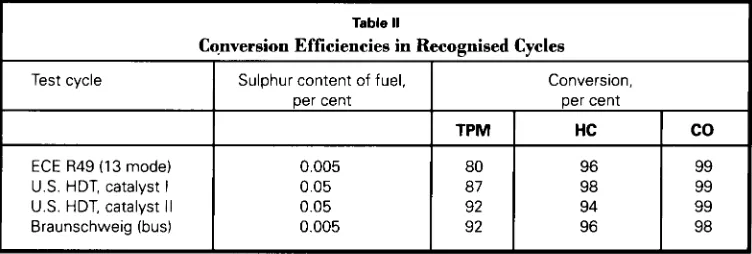
R49 and U.S. Heavy Duty Transient (U.S. HDT) cycles on a 6 litre, 6 cylinder engine. The pol- lutant reductions measured in these two regu- latory cycles are shown in Table 11. In the case of the Heavy Duty Transient test two catalyst variants were used, the first (catalyst I) was of a slightly higher activity and showed a superior hydrocarbon conversion. The slightly lower net particulate conversion is almost certainly due to a small conversion of sulphur dioxide to sulphur trioxide in the hottest mode of the cycle.
The durability of the system was first exam- ined in laboratory tests using an engine of the same type. A “semi transient” ageing cycle was developed to mimic the long continuous oper- ation of an engine under rather cool conditions. The cycle is shown in Figure 2. The pressure
150,
90 k m l h
;i 04 I
19Jan. 13Ftb. loMarch 4 A p r i l 29April 2 4 M a y l 8 J u n e 13July 7 A u 9 1Sep. 26s- 1994
Temperature, Maximum,
"C
I
per centI
250I
99I
98I
98Minimum, Average,
per cent per cent
96 94
I
73I
33 drop across the filter was measured over an age-ing period of 1000 hours during which no increase was observed.
Practical Trials
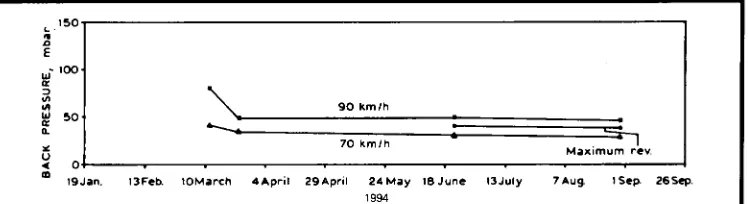
T h e results of these tests were extremely encouraging and several systems have been fit- ted to vehicles in normal use. The stainless steel filter systems were placed in the same location on the vehicles as the original equiIjment silencers. This was achieved without significant alteration to the vehicle, as the systems are dimensionally similar to the conventional silencers. In one trial, a unit which had been aged for 1000 hours in the laboratory was fit- ted to a mail delivery truck which had an engine capacity of 7 litres (245 hp). Pressure drop mea-
95
51
surements taken on the vehicle in service over a period of almost six months, during which it travelled a total distance of 58,000 km, are shown in Figure 3. T h e data shows a remark- ably consistent level of pressure drop with no increase observed during the trial. At the end of the period shown the unit was removed from the vehicle and again tested on the laboratory engine. The results are shown in Table 111.
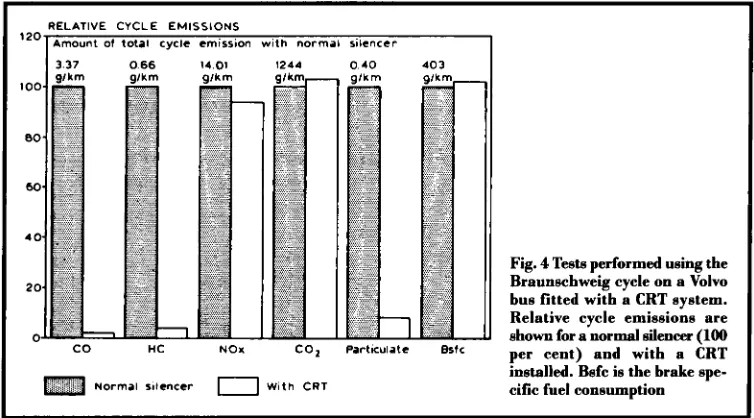
In another example, a system was fitted to a city bus having a 10 litre engine (285 hp). The results of this whole-vehicle test are shown in Figure 4. After running for several weeks the bus was tested on a chassis dynamometer using the so-called Braunschweig driving cycle. This cycle has been designed to reproduce, using a complete vehicle, the type of driving experi-
RELATIVE CYCLE E M I S S I O N S
'''1
Amount of Iota1 cycle emission with normal silencerI
I
3.37 0 66 14 0 1 1244co HC N O x
Normal Salencer
0
With CRT0 4 0 4 0 3 I
Parlculale Bsfc
Fig. 4 Teatrr performed using the Braunschweig cycle on a Volvo bus fitted with a CRT system. Relative cycle emissions are shown for a normal silencer (100 per cent) and with a CRT installed. Bsfc is the brake spe- cific fuel consumption
Platinum Metals Rev., 1995, 39, (1) 6
(Mail truck
CRT
after 1000 hours ageing and 58,000 km) Table 111Particulate Conversions
250 380 450
99 96 73
150-
t
w- 100-
a
3
v)
n
Y
2
0 1enced by a bus in a typical urban application. Normal regulatory tests involve removing the engine from the vehicle and so do not reflect its true on-road dynamic emissions behaviour. Conversions of 98 per cent carbon monoxide, 96 per cent hydrocarbons, 6 per cent NOx and 92 per cent particulate were observed in the cycle. A small increase in carbon dioxide emis- sions was also noted. This derives from the oxi- dation of carbon monoxide, hydrocarbons and soot as well as from a 1 to 2 per cent increase in fuel consumption.
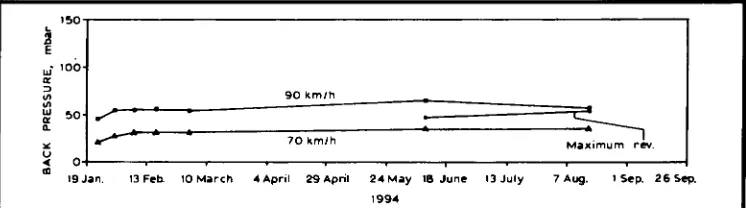
To-date some 23 systems have been fitted to heavy duty vehicles in Sweden including buses, delivery trucks and refuse collection trucks. The observed back-pressure behaviour for a refuse truck which covered only 10,000 km over a period of seven months’ heavy operation is shown in Figure 5. This is a particularly diffi- cult duty cycle for a filter system since the engine spends much of its time operating with rather a cool exhaust, see Figure 6 which shows a typ-
90 k r n l h
2 5 0 - / -
--
-Maximum rev 7 0 krnlh
ical temperature trace. All these systems have demonstrated a similar lack of pressure drop build-up as those described above.
Discussion
The original work on filter regeneration tem- peratures suggested that a temperature of below 300°C was achievable, and this work confirms that regeneration is occurring at or below 275°C. This is important because it must be possible to regenerate the filter at temperatures routinely reached in the exhaust of a vehicle operating under normal conditions.
From the work undertaken so far it is clear that this technology is applicable to situations where three basic criteria have to be met, namely:
0 There should be a reasonable balance between
the levels of NOx and particulate emitted by the engine
0 The duty cycle of the vehicle should regularly
give rise to an exhaust temperature above 275°C
0 The engine should be
run
on low sulphur fuel.Fig. 6 Temperature at the CRT inlet on a refuse collection truck over its normal operating cycle
I
1 2 3i
5 6;
TIME, hours
I" lrn,"
4 o i
19Jan. 13Feb 1 0 M a r c h 4 A p r r l 2 9 A p r i l 2 4 M a y I 8 June 13 July 7 A u g . I 5 c p . 2 6 5 e p . 1 9 9 4
In our tests of normally operating vehicles we have found that a fuel sulphur level of below 100 ppm will give rise to a very satisfactory per- formance. Our laboratory data suggest that we will be able to extend this level of confidence to diesel fuel containing 500 ppm in the near future. This is a key level, since diesel fuel will have a legislated maximum sulphur content of 500 ppm in the U.S.A. and the E.C. by the year 1996.
However, the technology cannot be applied as a panacea to old and dirty engines. In particu- lar it has been noted that old fashioned heavy- duty engines which have pre-chamber com- bustion systems and are not turbocharged frequently give rise to smoky exhausts. The bal- ance of NOx and particulate in such exhausts does not make this a suitable system for them. The experiments we have performed to-date indicate that filter performance has remained remarkably invariant during the trials. This con- trasts to much of the previous experience with filters, and especially experience with wall-flow ceramic filters. With this new technology, the low temperature of filter regeneration, and the fact that regeneration is a continuous process, leads to a sigmficant reduction of thermal and physi- cal stress on the filter units. These considerations would seem to indicate that the filters will have a long lifetime. However, this system does not excuse poor engine maintenance, and in the event
of the failure of, for example, a turbocharger, the balance of particulate and NOx may be signifi- cantly altered so as to prevent effective regener- ation. In order to take account of such servic- ing needs it is envisaged that the system will be of modular construction. The filter unit can then be removed from the vehicle and exchanged with- out needing to demount the whole assembly.
Conclusions
Diesel engines of recent manufacture, and engines which have been designed to meet the current and future emission limits, will continue to emit substantial quantities of particulate into the urban environment. The advent of readily available low sulphur diesel fuel in 1996 brings with it the possibility of using a novel form of exhaust filter regeneration technology which has shown great promise in early trials. To-date more than 20 vehicles have been fitted with systems that have been shown to remove a substantial proportion of the hydrocarbons and particulates in the exhaust gas which are the cause of grow- ing concern amongst health experts.
Further work is being undertaken to charac- terise and develop the performance of the sys- tem. The apparent simplicity of the technology, totally without any moving parts or complex control systems, is an added feature which will appeal to operators and owners of vehicles alike.
References
1 T. J. Truex, R. A. Searles and D. C. Sun, Platinum Metals Rev., 1992, 36, (l), 2
2 “Diesel and Gasoline Engine Exhausts and some Nitroarenes”, Working Group on the Evaluation of Carcinogenic Risks to Humans, Int. Agency for Res. on Cancer, 1989
3 “Carcinogenic Effects of the Exposure to Diesel Exhaust”, Natl. Inst. for Occupational Safety and Health, Health and Human Services (NIOSH)
4 K. F. Hansen, F. Bak, M. Andersen, H. Bejder and H. Autrup, SAE Tech. Paper Series, 940241, 1994
5 B. T. McClure, S. T. Bagley and L. D. Graa, S A E
Tech. Paper Series, 920854, 1992
6 “Pulmonary Toxicity of Inhaled Diesel Exhaust and Carbon Black in Chronically Exposed Rats”, J. L. Mauderly, M. B. Snipes et al, Health Effects
Res. Inst. Rep. No. 68, Oct. 1994
7 “Diesel Vehicle Emissions and Urban Air Quality”, Second Rep. of Quality of Urban Air Rev. Group, for Dept. of the Environment, U.K., Dec. 1993
Publ. NO. 88-116, 1988
8 D. W. Dockery, C. A. Pope, X. Xu, J. D. Spender, J. H. Ware, M. E. Fay, B. G. Ferrisand and F. E. Speizer, New EnglandJ Medicine, 329,1753,1993 9 “Health Risk Assessment for Diesel Exhaust”,
Preliminary Draft, O5ce of Environmental Hazard Assessment, California EPA, June 1994 10 B. J. Cooper and S. A. Roth, Platinum Metals Ra.,
1991, 35, (4), 178
1 1 See various authors in “Diesel Exhaust After-wat- ment”, S A E Tech. Paper Series, ”-943, 1993 12 P. Oeser and U. Thomas, S A E Tech. Paper Series,
830087,1983
13 B. J. Cooper and J. E. Thoss, SAE Tech. Paper Series, 890404, 1989
14 B. J. Cooper, H. J. Jung and J. E. Thoss, US.
Patent 4,902,487; European Appl. 341,832A 15 K. Umehara and Y. Nakasuji, SAE Tech. Paper
Series, 930128, 1993
16 S. T. Gulati, SAE Tech. Paper Series, 920144, 1992