Research Article
Evaluating the use of programming games for building
early analytical thinking skills
H. Tsalapatas
1,*1Department of Electrical and Computer Engineering, University of Thessaly, Argonafton & Filellinon, 38221 Volos, Greece
Abstract
Analytical thinking is a transversal skill that helps learners excel academically independently of theme area. It is on high demand in the world of work especially in innovation related sectors. It involves finding a viable solution to a problem by identifying goals, parameters, and resources available for deployment. These are strategy elements in game play. They further constitute good practices in programming. This work evaluates how serious games based on visual programming as a solution synthesis tool within exploration, inquiry, and collaboration can help learners build structured mindsets. It analyses how a visual programming environment that supports experimentation for building intuition on potential solutions to logical puzzles, and then encourages learners to synthesize a solution interactively, helps learners through gaming principles to build self-esteem on their problem solving ability, to develop algorithmic thinking capacity, and to stay engaged in learning.
Keywords: analytical thinking, learning design, programming, serious games.
Received on 25 August 2015, accepted on 26 August 2015, published on 05 November 2015
Copyright © 2015 H. Tsalapatas, licensed to EAI. This is an open access article distributed under the terms of the Creative Commons Attribution licence (http://creativecommons.org/licenses/by/3.0/), which permits unlimited use, distribution and reproduction in any medium so long as the original work is properly cited.
doi: 10.4108/eai.5-11-2015.150610
1. Introduction
Transversal learning skills, including analytical thinking, learning-to-learn, entrepreneurial thinking, ability to collaborate, and capacity to communicate effectively, among others, are abilities that can help learners excel in learning, both formal and informal, regardless of the subject area. School curricula typically do not address the development of soft, transversal skills, such as analytical thinking, independently; rather these skills are developed in the context of specific school subjects that are part of formal educational programs. For example, analytical thinking is often linked to math and science education. However, teachers in the field point to broad activities that can contribute to the development of analytical thinking skills and go well beyond math and science subjects ranging from critical reading and critical examination to self-evaluation [[3] ].
Analytical thinking is not only relevant to academic pursuit. Levy and Murnane (2005) argue that analytical and non-routine skills are in steadily rising demand by employers while routine cognitive skills are on decline [[14] ]. The New Skills for New Jobs Initiative [[2] ] reports that “there is a growing demand from employers for transversal competencies, such as problem-solving and analytical skills, self-management and communication skills, linguistic skills, and more generally non-routine skills” [[15] ]. The Digital Agenda for Europe [[1] ], in Communication on Rethinking
Education, states that “transversal skills such as the ability to think critically, take initiative, problem solving and work collaboratively will prepare individuals for today’s varied and unpredictable career paths” [[16] ]. The PISA survey, which takes place every two years and aims to evaluate education systems worldwide, introduced in 2012, in its Assessment and Analytical Framework, problem solving capacity as one of the key competences for which it evaluates learner preparedness to meet the challenges of the future [[17] ] [[12] ].
on Serious Games
Analytical thinking is a structured process. It helps learners solve problems by identifying the objectives of a given puzzle, the input parameters, and the goals to be achieved. It further involves breaking down a problem to smaller parts, identifying solutions to each, and then using those to synthesize a solution to the broader puzzle. This activity is highly relevant to programming; writing a program for solving a specific problem engages users in a highly structured and precise process that follows principles very similar to the ones described above. It is impossible for an individual to create a program for performing a specific task without having first solved analytically the underlying problem. Programming is based on universal logic that spans cultures and overcomes language barriers [[5] ] [[6] ] [[7] ] [[8] ] [[9] ] [[10] ] [[11] ]. It can be constructively used not only for building ICT skills, but also towards developing structured mind sets and analytical thinking capacity.
This work evaluates how programming, when used as a serious game, can contribute to the development of analytical thinking and problem solving capabilities of young learners aged 10 to 12. The evaluation took place by using the cMinds visual programming suite [[4] ], which was developed in the context of a research project funded with the support of the Comenius Action of the Life Long Learning Programme. The evaluation engaged two groups of learners over a two month period. The evaluation demonstrated that when used within collaborative learning classroom processes serious games based on programming can promote the capability of learners to deconstruct a problem into smaller parts, to clearly identify problem objectives, to identify inputs and available resources to be used in problem solving, to synthesize effectively a solution, and to explain their rationale to others in the class.
2. Related work on building analytical
thinking through programming
Papert introduced the concept of “microworlds” [18]. Microworlds are simplified digital versions of the real world that include objects and relations between them. They are programmed with the Logo programming language. The first famous microworld involved a turtle that learners could move through programming to form geometric shapes. This led to the introduction of the term “turtle geometry”. Microworlds were part of Papert’s constructionism theory which advocates that knowledge is built and not transferred. Papert further advocates that learners build models with the objective of understanding the world around them [[18] ][[21] ][[22] ].
Papert’s constructivism theory was applied by Resnick and the Life Long Kindergarten Group [[23] ][[19] ][[20] ] at MIT towards the development of the Scratch platform, a visual programming environment through which children can create stories, games, and animations [[24] ]. In Scratch, programming commands are represented visually as blocks that can be interlocked like bricks for creating a program. A community of users is supported by the Scratch group with the objective of promoting use and reuse of user-created
applications. Related work is Lego Mindstorms® [[25] ], which targets primarily young boys aged 8-15. The game was developed by Lego® using the constructivism idea promoted by the Life Long Kindergarten group in an example of productive collaboration between industry and academia towards the introduction of games that promote learning. Through Lego® Mindstorms, users build a construction with bricks, then program a small unit that is attached to the construction, and allows the construction to behave in a particular way. Arduino [[26] ], which is open, allows users to perform comparable activities, namely to build robots and then program them for executing specific tasks.
Additional suites have been developed primarily for promoting the development of programming knowledge, such as the Alice programming environment built by the Carnegie Mellon University, which targets slightly older learners, and helps build object-oriented programming skills [[27] ][[28] ][[29] ][[30] ].
Furthermore, games have been developed for building programming skills such as CodeSpells [[32] ], and Ceebot [[31] ].
3. Using programming as a serious game
towards building analytical thinking
capacity in primary school
The cMinds programming environment was developed with the objective of building analytical thinking skills among primary education learners. The programming environment urges learners to synthesize solutions to well-known logical puzzles through visual programming. cMinds differs from other programming suites developed for a target audience of young children in terms of high level goals; the suite aims at building analytical thinking capacity through programming practices as opposed to building programming skills per se. cMinds uses visual representations of common
programming commands and specifically loops, conditionals, and case statements. Departing from other related approaches, the representations all but eliminate programming syntax putting an emphasis on the visual depictions of commands. The elimination of the requirement by learners to type information that completes a programming command, as for example the number of iterations of a loop, and the elimination of written information as part of command representation implies that cMinds can be used even by learners that cannot yet read or write. This makes the game applicable for use as early as in preschool.
cMinds introduces gaming elements throughout the problem solving process. The gaming elements ensure that learners feel like they are engaged in playing rather than programming. Learners focus on their goal, which is the solution of a puzzle, and not on the visual coding process.
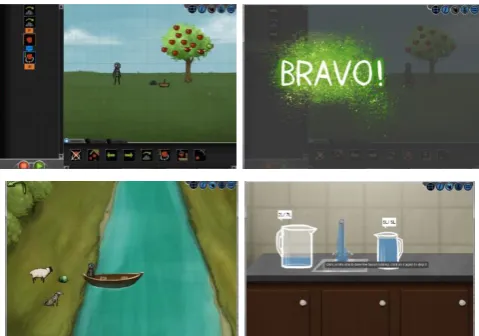
given puzzle through semi-structured experimentation. For example, before synthesizing a program that solves the classic logical puzzle of a wolf, a sheep, and a cabbage all crossing a river safely in a single boat that can carry at most two characters, learners have the opportunity to try different approaches for solving the problem by dragging and dropping the characters manually into the boat and transporting them across the river until all have reached the other shore. These activities allow learners to build a first understanding of a viable solution through game play before engaging in the more structured activity of visual programming.
Difficulty levels is another gaming element that encourages learners to build skills in a step-wise manner. Five levels are supported for each logical puzzle. The basic nature of the puzzle remains the same in each level. The parameters change for adding complexity to the exercise.
Programming is a gaming process in itself. Learners synthesize a program for solving the logical puzzle once they have developed a basic understanding of a viable solution through experimentation. The program is built by dragging and dropping commands from a toolset into a programming zone. Learners get feedback on their solution synthesis efforts visually, through an animation of the execution of their program. This process allows learners to interactively build a complete solution in cycles of programming followed by game feedback. In each cycle, learners have the opportunity to get a little closer to their goal by adding small steps to their visual program that get them closer to their goal.
Awards are presented to learners upon successful completion of an exercise. Upon completing a certain level learners get a “bravo” screen (see figure 1, top right). Upon completing all the five levels of the puzzle, learners receive a “golden medal”.
Finally, even if learners do find a viable solution to a puzzle, they are further challenged to go a step further and to discover the “optimal” solution. For the purposes of the game, optimality is defined as the least number of execution steps. Learners can compare side-by-side their solution to the optimal one, which is pre-stored in the environment. They can further visualise in an animation the execution of both, for developing direct experience on why one is faster than the other.
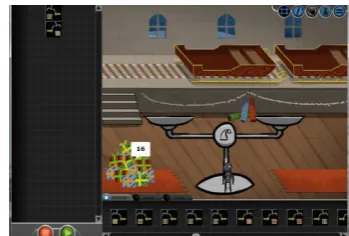
The cMinds game supports six logical puzzles: 1) a sorting puzzle in which learners place decorated eggs into similarly decorated boxes, 2) a pattern matching puzzle in which learners identify a set of repeating shapes in a sequence, and write a program that reproduces the identified pattern, 3) a mathematical puzzle in which learners perform subtraction by repeatedly estimating the distance in steps from the desired goal, 4) a mathematical puzzle in which learners measure the volume of a liquid using three containers of specific capacity (see Figure 1, bottom right), 5) a divide-and-conquer exercise in which they are asked to find a box of heavier weight, in which Santa Claus accidentally placed his dirty socks, among otherwise identical boxes, and 6) the river crossing puzzled described above, and pictured in Figure 1, bottom left.
Figure 1. The cMinds environment (http://cminds.org). Visual representation of commands (top left); rewards (top right); exploration area for the river crossing puzzle
(bottom left); exploration area for the volume measurement puzzle (bottom right).
4. Evaluating the deployment of
programming as a serious game for
building analytical
Evaluation took place over a two month period in 2013. The focus of the evaluation was to establish how, to what degree, and in which broader learning-activity setting the deployment of the serious game helped learners build problem solving capacity.
Evaluation took place with two groups of children, both in primary education. The first group involved twenty 6th
graders aged 11 to 12 enrolled in the 1st Primary School of
Volos. The second group involved eighteen 5th graders aged
10 to 11 enrolled in the 11th Primary School of Volos. The
groups were selected with the objective of providing insight on typical capabilities, pre-existing knowledge, and aspirations of learners aged 10 to 12. The two schools are located in the town of Volos. Volos is a medium sized town of 120.000 inhabitants in central Greece, whose economy is widely dependent on small businesses, following deindustrialization that took place a few decades ago. Learners enrolled in the two schools are the ones whose home address is within specific proximity of the school location. This implies that learners are not selected based on performance, either higher or lower than the average for their age. Learners’ families are broadly middle class facing the typical challenges in the current economic environment. The above are discussed to demonstrate that the selected groups engage learners whose academic capacity is typical for their age.
In both schools learners worked in small groups in the school computer lab. The groups involved two to three learners. However, there were some differences in work organization. The groups in the 1st Primary School worked
(see Figure 2, left). Teacher mediation was limited allowing learners to freely explore the game and providing direction mostly on software functionality. Learners in the 11th
Primary School worked in similarly small groups of two to three which, however, were seated in a round-table setting promoting further collaboration among the teams (see Figure 2, right). Teacher mediation was more evident especially during the description of the puzzle and during the debriefing and explanation of a viable solution [[33] ].
Figure 1. 6th grade learners working on the sorting
puzzle at the 1th Primary School of Volos in small independent groups (left); 5th grade learners working
on the volume measurement puzzle at the 11th Primary
School of Volos in small groups seated in a round table (right).
The activities demonstrated that gaming elements were highly motivational for the longer engagement of learners with problem solving activities. The simple reward of a “bravo” screen had a very positive influence on learners providing a sense of achievement and pride and encouraging further engagement in the higher difficulty levels of the game. Similarly, the “stars” that learners gained upon completion of all five levels of difficulty acted as a motivational element for encouraging learners to complete the entire game. Characteristically, some learners were very persistent in their efforts and unwilling to quit before successfully completing an exercise. This demonstrated that the competition with oneself and with peers introduced by reward elements to be gained upon successful completion provided added value in learning experiences related to problem solving.
The exploration activities for gaining intuition before engaging in visual coding exercises helped significantly in learner engagement and successful execution of an exercise in several ways. It contributed to the development of a clear understanding of problem objectives by learners; it contributed to building an initial understanding of a potential correct solution; it introduced a gaming element that was highly motivational for learners; and, finally, it eased learners into analytical thinking processes before engaging into the perceived more difficult exercise of visual programming. The exploration area aims to provide an interim learning step that may help learners not to feel intimidated by the programming activity.
Upon successfully solving a problem in the exploration area, learners were asked to synthesize a solution to solve the
problem automatically through the programming zone. Interestingly, learners perceived the visual coding activity itself as a game. They were immersed in the problem solving element of describing through commands how their solution works and did not have a feeling of being engaged in programming. This demonstrates that a serious gaming approach can introduce learners at an early age to advanced cognitive activities such as synthesis in a playful manner, easing learners into analytical thinking activities with which they would otherwise be engaged in a much later stage of their educational path.
The above shows that educational games can enhance learning experiences exposing learners to rich blended educational activities when combined with formal instruction in the context of broader learning design. This was further evident during the engagement of learners with logical puzzles with non-trivial solutions. One such activity was a classic divide-and-conquer exercise in the form of the Santa Claus dirty socks puzzle (see Figure 3). The game provided learners with a visual hint to the correct solution by demonstrating a scale. Through this image learners were pointed to a solution of finding the heavier package, which according to the puzzle contains the dirty socks of Santa, by weighing packages against each other. This puzzle has two potential solutions: a straightforward but not optimal solution in which learners can find the heavier box by weighing two packages against each other at a time; and an optimal solution in which they can find the box through fewer steps by weighing half of the packages against the other half and continuing in the same manner with the heavier lot of the two. In the context of this evaluation, learners immediately chose the optimal divide-and-conquer solution. This demonstrates that learners have the capacity to apply non-trivial thinking patterns when exposed to a complex puzzle in a playful manner and provided with the correct context. Thus, serious games can be used for introducing learners to concepts, such as divide-and-conquer, to which they would otherwise be introduced much later, possibly in the first year of higher education studies in ICT.
Figure 3. Visual hints in the Santa Claus exercise provided context and helped learners identify the
The evaluation activities demonstrated that both groups had the capacity to solve all given exercises, although some hints needed to be provided to some of the groups to help them advance. One differentiating factor was that 6th graders
grasped more easily the concept of nesting, in other words the fact that a loop can be inserted inside a conditional statement. 5th graders needed specific explanation of this
concept after which they solved the puzzles with no further problems. This demonstrates that, as might be expected, older learners have higher capacity in understanding abstraction.
The most interesting observation, however, is related to the importance of the organization of the work in the classroom towards building analytical thinking capacity through games. The activities showed that the organization of the work in a round-table, as practiced by the 5th grade
class in the 11th Primary School, helped learners achieve
higher success than the organization in individual groups with lower collaboration between them. The round-table organization and discussion among all class members contributed to a better understanding of a given puzzle’s objectives, clearer identification of smaller problems hidden within the puzzle whose solution could lead to an overall synthesized solution, and better understanding of the final solution. Learners were very eager and proud to explain step-by-step their findings to their peers, which led to the higher overall performance of the class despite their younger age when compared to the other group. This shows that effectiveness of the deployment of games in learning is highly related to the broader learning activities in which games are integrated, to debriefing, and to discussion and collaboration.
5. Conclusions
This work presented an evaluation of the deployment of programming games towards the development of analytical thinking capacity among primary education learners. The cMinds environment was used for carrying out the evaluation due to its direct orientation on building analytical thinking, as opposed to programming capacity, and due to the gaming elements that allow learners to explore, collaborate, and learn from each other. The evaluation took place in a classroom setting, promoting active class discussion and joint exploration of problem solutions in an open environment that promoted peer learning. The evaluation demonstrated that the deployment of programming games is a strong motivational tool for learners for engaging in analytical thinking activities. Gaming elements such as awards and difficulty levels encouraged learners to continue their use of the game engaging in activities in the long run. It further demonstrated that games can be deployed for play easing learners to complex thinking patterns and activities to which they would otherwise be exposed at a much later stage of their education. Most importantly, the work demonstrated that the effectiveness of the games as learning tools is highly related to the overall organization of learning activities in which
games are integrated as value-adding educational tools, and that cycles of gaming and debriefing can effectively contribute towards building structured thinking mindsets.
Acknowledgements.
I would like to acknowledge the support of Ms. Baso Metaftsi, Ms. Argyro Paraskeva, and Mr. George Metaftsis, primary school teachers, for their support in the evaluation activities.
References
[1] N.a. (n.d). The Digital Agenda for Europe. [Online].
Available: http://ec.europa.eu/digital-agenda/
[2] N.a. (n.d). New Skills for New Jobs Initiative. [Online]. Available: http://ec.europa.eu/social/main.jsp?catId=568 [3] TSALAPATAS, H.; C. Florou, C.; Alimisi, R.; Heidmann, O.;
Stav, J. B.; Larsson, S.O. (2011). cMinds Learning Requirements Report. [Online].Available:
http://www.cminds.org/documents/D2.1_UserRequirements_5 09998-2010-COMENIUS.pdf
[4] N.a. (n.d). The cMinds Project. [Online].Available:
http://cminds.org
[5] TSALAPATAS, H.; Heidmann, O.; Alimisi, O.; Tsalapatas, S.; Florou, C.; Houstis, E. (2012). Game-based Learning towards Building Early Analytical Thinking Skills through Visual Programming. In EduLearn Conference.
[6] N.a. (n.d). An Educational Program that Teaches Students Computer Programming in a 3D Environment. [Online]. Available: http://alice.org
[7] TSALAPATAS, H.; Heidmann, O.; Alimisi, R.; Florou, C.; Tsalapatas, S.; Houstis, E. (2012). Supporting Primary School Students in Developing Computational Thinking Skills through the cMinds Learning Suite. In INTED Conference,
March 5-8. (Valencia, Spain).
[8] TSALAPATAS, H.; Heidmann, O.; Alimisi, R.; Tsalapatas, S.; Florou, C.; Houstis, E. (2011). Programming Concepts as a Means of Fostering Analytical Thinking in Primary School Students, EduLearn Conference, July 4-7. (Barcelona, Spain).
[9] H. TSALAPATAS. H. (2012). Developing Analytical Thinking Capacity through Serious Games and Programming. In Educa On-line Conference, November 28-30 (Berlin,
Germany).
[10] TSALAPATAS, H.; Heidmann, O.; Tsalapatas, S.; Alimisi, R.; C. Florou, C., Houstis, E. (2011). “Visual Programming towards the Development of Early Analytical and Critical Thinking. In Future of Education Conference, June 16-17.
(Florence, Italy).
[11] TSALAPATAS, H.; Heidmann, O.; Alimisi, R.; Florou, C.; S. Tsalapatas, S.; Houstis, E. (2012). Game-based Learning towards Building Early Analytical Thinking Skills through Visual Programming. In EduLearn Conference, July 2-4.
(Barcelona, Spain).
[12] PISA. (2012). What Students Know and Can Do. In PISA survery 2012. [Online]. Available:
http://www.oecd.org/pisa/keyfindings/pisa-2012-results-volume-I.pdf
[13] PISA. (2012). What Makes a School Successful. In PISA Survey 2012. [Online]. Available:
http://www.oecd.org/pisa/keyfindings/pisa-2012-results-volume-IV.pdf
[14] LEVY, F.; Murnane R.J. (2005). The New Division of Labor: How Computers are Creating the Next Job Market. (Princeton:
[15] N.a. (n.d). New Skills for New Jobs, Anticipating and Matching Labor Market and Skills Needs. [Online]. Available: http://www.dges.mctes.pt/NR/rdonlyres/955D4EFD-5E99-409F-868B-1A78993C6033/3671/new_skills.pdf
[16] N. a. (n.d.). Communication on Rethinking Education. In Ihe Digital Agenda for Europe. [Online]. Available:
https://ec.europa.eu/digital-agenda/en/news/communication-rethinking-education
[17] N.a. (2012). PISA 2012 Assessment and Analytical Framework. [Online]. Available:
http://www.oecd- ilibrary.org/education/pisa-2012-assessment-and-analytical-framework_9789264190511-en
[18] PAPERT, S. “Mindstorms: Children, Computers, and Powerful Ideas”
[19] M. RESNICK. (n.d.). Origins and Principles of the Computer Clubhouse[Online]. Available:
http://web.media.mit.edu/~mres/papers/Clubhouse/clubhouse-origins.pdf
[20] M. RESNICK. (n.d.). Sowing the Seeds of a More Creative Society. [Online]. Available:
http://web.media.mit.edu/~mres/papers/Learning-Leading-final.pdf
[21] PAPERT, S. (1993). The Children’s Machine: Rethinking School in the Age of the Computer. (New York: Basic Books).
[22] PAPERT, S.; Harel, I. (1991). Situating Constructionism. In
Constructionism book, (Ablex Publishing Corporation), ch 1.
[23] RESNICK, M. (n.d.). Rethinking Learning in the Digital Age.
[Online]. Available:
http://web.media.mit.edu/~mres/papers/wef.pdf
[24] N.a. (n.d). Scratch. [Online]. Available: http://scratch.mit.edu/
[25] Lego Mindstorms. [Online]. Available:
http://www.lego.com/en-us/mindstorms/?domainredir=mindstorms.lego.com [26] Arduino. [Online]. Available: http://www.arduino.cc/
[27] DANN, W.; Cosgrove, D.; Slater, D.; Culbys, D. (n.d.). Mediated Transfer: Alice 3 to Java. [Online]. Available: http://www.alice.org/publications/MediatedTransfer.pdf [28] MOSKAL, B.; Lurie, D.; Cooper, S. (n.d.). Evaluating the
Effectiveness of a New Instructional Approach. [Online]. Available:
http://www.alice.org/publications/EvaluatingTheEffectiveness OfANewApproach.pdf
[29] COOPER, S.; Dann, W.; Pausch, R. (n.d.). Alice: A 3-D Tool for Introductory Programming Concepts. [Online]. Available:
http://www.alice.org/publications/AToolForIntroProgramming .PDF
[30] CONWAY, M.; Audia, S.; Burnette, T.; Cosgrove, D.; Christiansen, K.; Deline, R.; Durbin, J.; Gossweiler, R.; Shiuchi, K.; Long, C.; Mallory, B.; Miale, S.; Monkaitis, K.; Patten, J.; Pierce, J.; Shochet, J.; Staack, D.; Steams, B.; Stoakley, R.; Sturgill, C.; Viega, J.; White, J.; Williams, G.; Pausch, R. (n.d.). Alice: Lessons Learned from Building a 3-D System for Novices. [Online]. Available:
http://repository.cmu.edu/cgi/viewcontent.cgi?article=1197&c ontext=hcii
[31] Ceebot. [Online]. Available:
http://www.ceebot.com/ceebot/index-e.php
[32] CodeSpells. [Online]. Available: http://codespells.org/
[33] GARRIS, R.; Ahlers, R.; J.E. Driskell, J. E. (2002). Games, motivation, and learning: a research and practice model. In