Application of Saw Dust Ash as Partial Replacement for Cement in the
Production of Interlocking Paving Stones
Raheem Akeem Ayinde, Adedokun Solomon Idowu*, Ajayi Babatunde Raphael, Adedoyin Olakunle Adedapo, Adegboyega Biliki Olayemi
Department of Civil Engineering, Ladoke Akintola University of Technology, Ogbomoso, Nigeria
*Corresponding E-mail : [email protected]
Received 24 September 2016; Revised 2 February 2017; Accepted 1 March 2017
Abstract
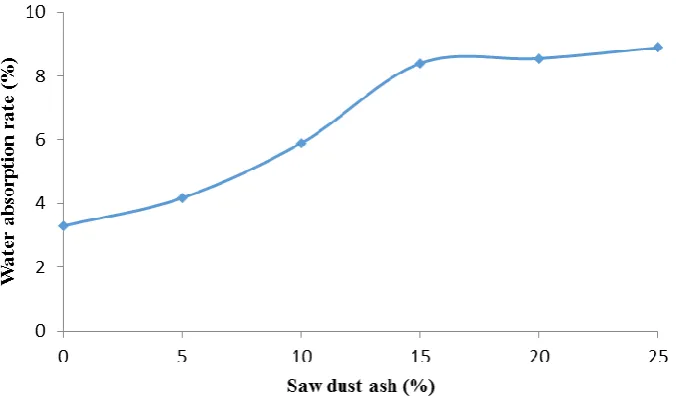
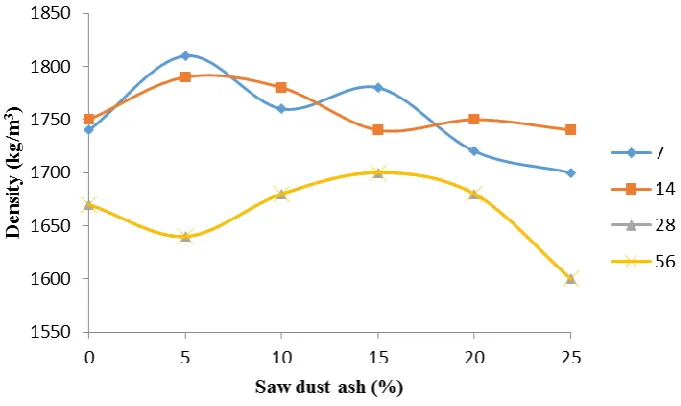
As a way of reusing and converting industrial by-products into useful materials for the construction industry, this paper investigated the application of Saw dust ash (SDA) as partial substitute for ordinary Portland cement (OPC) in the production of interlocking paving stones. The study examined the oxide composition of SDA to determine its suitability as a pozzolanic material. Some characteristics of paving stones with SDA as a substitute for OPC were investigated and the results indicated that SDA is a good pozzolan having satisfied the required standards. The compressive strength of the samples, with substitution levels ranging from 5 to 25% cured for 3–56 days, was lower at initial curing period but improved significantly at later days. 5% substitution level showed an increase in strength compared to 0% SDA paving stones regardless of curing period. Density decreased with increasing ash content, whereas water absorption increased with SDA content. The study therefore indicated that SDA paving stones can gain higher strength than the conventional ones at longer curing periods, which is as a result of its pozzolanic reactions.
Keywords: Saw dust ash, Pozzolan, Cement, Oxide composition, interlocking paving stones
1.0 Introduction
Production of Portland cement is one of the major sources of carbon dioxide emission to the atmosphere. CO2, which is a greenhouse gas, contributes about 65% of global warming [1]. The high energy demand as well as the emission of carbon dioxide, which caused global warming and depletion of limestone deposits are the major problems associated with cement production [2]. Badur and Chaudhary [3] stated that about seven percent of carbon dioxide is released into the atmosphere, and this has adverse effects on human being and its environment, due to global warming. In addition, cement is very expensive in many developing countries like Nigeria and its usage cannot be sustained. The desire for affordable building materials and provision of adequate housing for the teaming populace of the world has become the major concern of many researchers. The price of conventional building materials has continued to increase as the majority of the population continues to fall below the poverty line; this thereby necessitates the search for alternative local materials as total or partial replacement for cement [4-5]. The search has led to the discovery of many industrial by-products and agricultural wastes as potential cementitious materials.
The application of agro and industrial wastes in the production of cement is an environmentally friendly method of disposal of large amounts of substances that would have constituted pollution to land, water and air. The agricultural and industrial wastes that possessed pozzolanic characteristics and which had been studied and applied as partial replacements for cement are Rice husk ash [6-9], Corn cob ash [4, 10-12], Waste burnt clay [13-14], Hair fibre [15] and Saw dust ash [16-17]. The saw dust ash (SDA) which has been proven to be a pozzolanic material was used as a partial substitution for OPC in this study.
a regular activity in sawmill industries which caused accumulations of saw dust to be generated on a daily basis. The need to reuse this waste product is the main focus of the research. The ashes produced from saw dust have been used to substitute for cement in concrete, leading to a significant improvement in the strength of concrete [16-17]. However, studies have not been conducted on the utilization of saw dust ash as a partial substitute for cement in paving stone production. As reported by Raheem et al [17] saw dust is currently being used as fuel for domestic cooking and sand filling ditches; the activities that still constitute nuisance to the environment. The study stated further that converting this waste to saw dust ash (SDA) has dual benefits of controlling the environmental pollution as well as creating job for teaming unemployed youths who could be supplying SDA to concrete industries.
This study investigated the use of SDA as a partial substitute for cement in interlocking paving stone production. It includes the determination of the chemical composition of the SDA, evaluation of the compressive strength, density, water absorption and the abrasive resistance of the paving stones.
2.0 Material and Method
The materials used and methods employed in this study are presented in the following sections.
2.1 Material
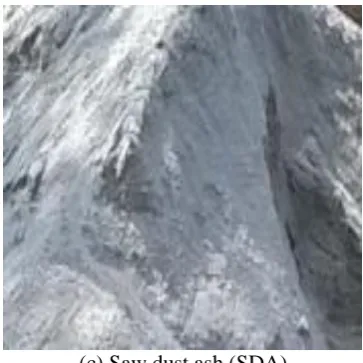
Saw dust was obtained from a sawmill at Wazo-tuntun in Ogbomoso, Oyo State, Nigeria. The saw dust sample was burnt into ashes in a steel container (Fig. 1). The ash obtained was ground after cooling with the aid of mortar and pestle. The yield calculation was carried out and tests were conducted to determine the properties of the saw dust ash (SDA). This ash was analyzed at West Africa Portland Cement Company, Sagamu, Ogun State, Nigeria to determine the oxide composition of the SDA.
The cement (OPC with grade 42.5) used was purchased from a retailed shop in Ogbomoso. The stone dust was also bought from a dealer in Ogbomoso, and water was obtained from a borehole close to the production site of the interlocking paving stones.
(b) Burning of saw dust
(c) Saw dust ash (SDA)
Figure 1: Production of saw dust ash
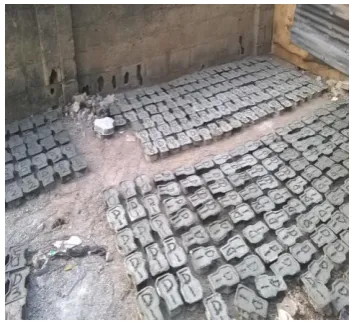
2.2 Preparation of Sample
(a) Paving stone mould (b) Produced paving stones
(c) Curing of paving stones
Figure 2: Production and curing of the SDA interlocking paving stone
3.0 Results and Discussion
The results and discussion of all the tests conducted in this study are presented in the following sections.
3.1
Oxide Composition
Table 1: Oxide Composition of Saw Dust Ash (SDA)
Oxide Percentage composition (%)
Sample 1 Sample 2 Sample 3 Average
SiO2 65.42 66.05 65.79 65.75
Al2O3 5.69 5.12 4.88 5.23
Fe2O3 2.16 2.09 2.01 2.09
CaO 9.82 9.65 9.39 9.62
MgO 4.23 4.11 3.92 4.09
SO3 1.09 1.20 0.98 1.09
K2O 2.38 2.22 2.68 2.43
Na2O 0.04 0.08 0.07 0.06
LOI 4.89 4.05 3.95 4.30
LSF 1.09 1.98 2.07 1.71
SR 10.53 11.03 10.45 10.67
AR 11.35 12.88 12.73 12.32
SiO2+Al2O3+Fe2O3 73.27 73.26 72.68 73.07
LOI = Loss on Ignition, LSF = Lime Saturated Factor, SR = Silica Ratio, AR = Alumina Ratio.
3.2
Physical Properties of SDA
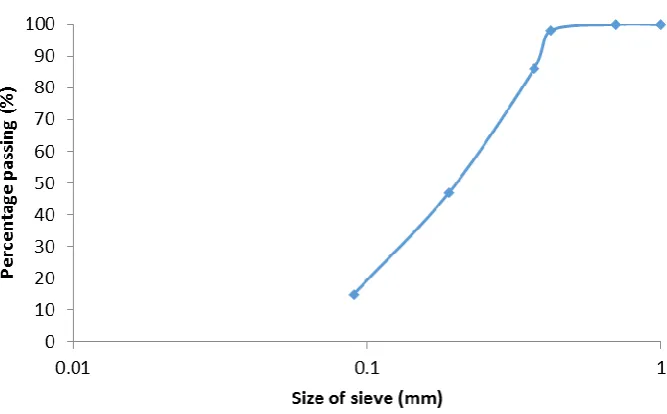
Fig. 3 presents the grading curve of the SDA, which is within the sand zone of the particle size distribution curve ranging from the fine to coarse divisions. The result indicated that SDA has 55% of its particle size in the fine sand division and this material falls within zone 2 of the grad-ing curve [19].The values of bulk density, specific gravity, yield, LOI and moisture content of SDA are1040 kg/m3, 2.19, 3.0%, 4.3% and 0.3% respectively. It can be observed that the specific gravity of SDA is lower than that of OPC which has a specific gravity of 3.01.
Figure 3: Particle size distribution curve for saw dust ash
3.3
Sieve Analysis for Stone Dust
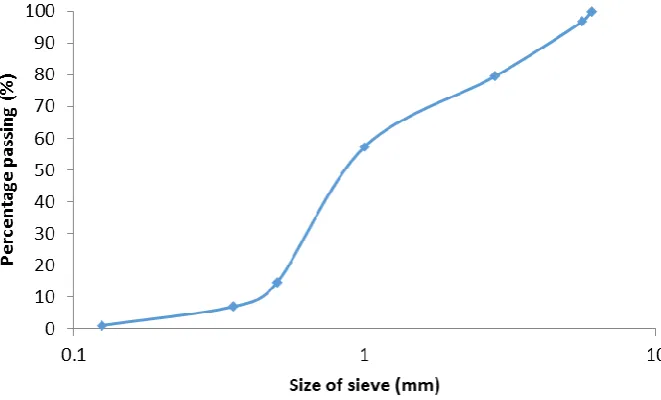
obtained from the figure in accordance with BS 1377 [20] are 0.96 and 3.95 respectively. Thus, the quarry dust can be said to be between the zone of fine sand and fine gravel, which makes the material a suitable material for the production of good interlocking paving stones [21].
Figure 4: Distribution curve for quarry stone dust
3.4
Compressive Strength
The influence of SDA on the compressive strength of interlocking paving stone is presented in Fig. 5. The results from the figure indicated a general increase in compressive strength with both curing period and increasing amount of SDA.
At 3 days curing, the results showed a similar compressive strength between SDA interlocking paving stones and that of the control. The strength of the SDA paving stones increased from 5.00 N/mm2 for the control to nearly 6.00 N/mm2 for 5-15% replacements, but the strength decreased with further replacements of SDA. The highest compressive strength was observed for 5% replacement of cement with saw dust ash.
The results at 7 days of curing for all the SDA interlocking paving stones showed improved compressive strengths compared to that of the control. Highest strength was observed for 15% replacement while lowest strength was observed for 5% replacement. The results at 14 days of curing were similar to that of 7 days, but maximum strength was observed for 5% replacement. The results show that concrete containing SDA gained strength slowly at early curing period, which is in agreement with earlier findings [4, 17, 22].
At 28 days curing, the strengths of the SDA interlocking paving stone were significantly higher than that of the control. However, strength decreased with increasing amount of SDA, with highest and lowest values observed for 5% and 25% replacements respectively. The results at 56 days indicated a higher increase in strength when compared to those of 28 days curing. This increase in strength of SDA interlocking paving stone can be attributed to the pozzolanic activity of SDA.
Figure 5: Effect of the SDA on the compressive strength of the interlocking paving stone
3.5
Water Absorption
Figure 6: Effects of the SDA on the water absorption rate of the interlocking paving stone
3.6
Abrasion
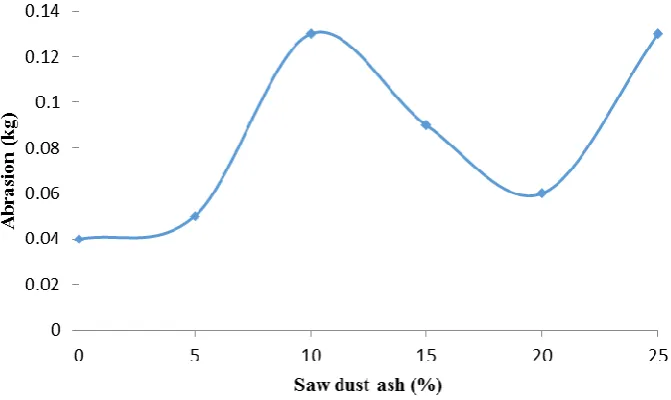
Fig. 7 shows the effects of SDA substitution on the abrasion resistance of the interlocking paving stone. Results from the figure indicated that the abrasion value of the paving stone increased with percentage increase in the amount of replacement of ordinary Portland cement with saw dust ash. It was observed that the interlocking stone made with 10% and 25% SDA substitutions gave highest abrasion value and thus undergone the highest shrinkage. However, the specimen with 0% and 5% SDA replacements showed the lowest shrinkage values, indicating the highest resistance to abrasion. This suggests that 5% substitution of OPC with SDA can perform favourably with the control specimen.
Figure 7: Effects of the SDA on the abrasion rate of the interlocking paving stone
3.7
Density
Figure 8: Effects of the SDA on the density of the interlocking paving stone
4.0 Conclusion
Based on the results of various experimental tests conducted on the SDA interlocking paving stones, the following conclusions were drawn.
(i) Saw dust ash (SDA) is a good pozzolanic material, since it has the total percentage composition of silicon, aluminum and ferric oxides of 73.07%, which is higher than 70%. It therefore satisfied the requirement for use as a pozzolan according to ASTM C618 [18].
(ii) The compressive strength of the interlocking paving stones increased slightly with curing period and amount of SDA in early curing age, but the strength improved significantly at the later curing age, indicating pozzolanic reaction. Only 5% saw dust ash replacement is adequate to achieve maximum strength gain.
(iii)The rate of water absorption of the SDA interlocking paving stone increased with increasing amount of saw dust ash. The rate of abrasion increased with addition of SDA, with the greatest resistance to abrasion observed for 0% and 5% SDA replacements. The density of the paving stones decreased with SDA and curing periods.
(iv) Interlocking paving stones made with 5% SDA replacement is therefore recommended
for use in the building, especially in residential driveway and walkways.
References
[1] G. Vijayakumar, H. Vishaliny, and D. Govindarajulu, “Study on Glass Powder as Partial Replacement of Cement in Concrete Production”, International Journal of Emerging Technology and Advanced Engineering, vol. 3 (2), pp.153-157, 2013.
[2] M. Joel, “A review of partial replacement of cement with some agro wastes, Nigerian Journal of Technology”, vol. 29 (2), pp. 12-20, 2010.
[3] S. Badur, and R. Chaudhary, “Utilization of hazardous wastes and by-products as a green concrete material through S/S process: A Review”, Rev. Adv. Material Science, vol. 17, pp. 42-61, 2008.
[5] I.I. Akinwumi, and O.I. Aidomojie, “Effect of Corncob ash on the geotechnical properties of Lateritic soil stabilized with Portland cement”, International Journal of Geomatics and Geosciences, vol. 5 (3), pp. 375-392, 2015.
[6] B. Waswa-Sabuni, P.M. Syagga, S.O. Dulo, and G.N. Kamau, “Rice husk ash cement – alternative pozzolana cement for Kenyan building industry”, J Civil Eng JKUAT, vol. 8, pp. 13–26, 2002.
[7] J.S. Coutinho, “The combined benefits of CPF and RHA in improving the durability of concrete structures”, Cement Concrete Comp, vol. 25, pp. 51–59, 2003.
[8] M. Nehdi, J. Duquette, and A. El-Damatty, “Performance of rice husk ash produced using a new technology as a mineral admixture in concrete”, Cement Concrete Res, vol. 33, pp. 1203–1210, 2003.
[9] D.D. Bui, J. Hu, and P. Stroeven, “Particle size effect on the strength of rice husk ash blended gap-graded Portland cement concrete”, Cement Concrete Comp, vol. 27, pp. 357–66, 2005.
[10] D.A. Adesanya, “Evaluation of blended cement mortar concrete and stabilized earth made from ordinary Portland cement and corn cob ash”, Construct Build Mater, vol 10(6), pp. 451–456, 1996.
[11] D.A. Adesanya, “The characteristics of laterite bricks and blocks stabilized with corn-cob fillers”. The Professional Builder, pp. 47–55, 2000.
[12] D.A. Adesanya, “The effects of thermal conductivity and chemical attack on corn cob ash blended cement”, The Professional Builder, pp. 3–10, 2001.
[13] P.M. Syagga, S.N. Kamau, B. Waswa-Sabuni, S.O. Dulo, “Potentials of using waste burnt clay as a pozzolanic material in Kenya”. J. Discovery Innovat, vol. 13(3/4), pp. 114–118, 2001.
[14] L.U. Shihembetsa, and B. Waswa-Sabuni, “Burnt clay waste as a pozzolanic material in Kenya”, J Civil Eng JKUAT, vol. 7, pp. 21–28, 2002.
[15] S.I. Adedokun, S.O. Ajamu, and H.T. Aderinto, “Effect of Synthetic Hair Fibre Additions on the Strength Characteristics of Concrete”, USEP: Journal of Research in Civil Engineering, vol.13(2), pp. 928-939, 2016.
[16] F.F. Udoeyo, and P.U. Dashibil, “Sawdust ash as concrete materials”, J Mater Civil Eng, vol. 14(2), pp. 173–176, 2002.
[17] A.A. Raheem, B.S. Olasunkanmi, and C.S. Folorunsho, “Saw Dust Ash as Partial Replacement for Cement in Concrete”, Organization, technology and management in construction - an international journal, vol. 4(2), pp. 474-480, 2012.
[18] ASTM C 618, “Standard Specification for Coal Fly Ash and Raw or Calcined Natural Pozzolan for use as a Mineral Admixture in Portland Cement Concrete”, Annual Book of ASTM Standards, Philadelphia, USA, 2005.
[19] A.U. Elinwa, and S.P. Ejeh, “Effects of the incorporation of sawdust waste incineration fly ash in cement pastes and mortars”, Journal of Asian Architecture and Building Engineering, vol. 3(1), pp. 1-7, 2004.
[20] BS 1377 “Methods of Test for Soils for Civil Engineering Practices”, British Standard Institution: London, UK, pp. 143, 1990.
[21] G.N. Smith, and I.G.N. Smith, “Elements of Soil Mechanics”, 7th ed., Blackwell Science, London, 1998.
[22] K.M.A. Hossain, “Chloride induced corrosion of reinforcement in volcanic ash and pumice based blended concrete”, Cement & Concrete Composites, vol. 27, pp. 381-390, 2005.
[23] F.F. Udoeyo, H. Inyang, D.T. Young, and E.E. Oparadu, “Potential of wood ash waste as an additive in concrete”, J Mater Civ Eng, vol. 18(4), pp. 605–611, 2006.
[24] C. Sashidhar, and H.S. Rao, “Durability Studies on Concrete with Wood Ash Additive”, 35th Conference on Our World in Concrete & Structures, Singapore, 25 – 27 August, 2010.
[26] A.A. Raheem, S.I. Adedokun, E.A. Adeyinka, and B.V. Adewole, “Application of Corn Stalk Ash as Partial Replacement for Cement in the Production of Interlocking Paving Stones”, International Journal of Engineering Research in Africa, vol. 30, pp. 85-93, 2017.