Corresponding Author: Wardatul Hayat Adnan, Department of Mass Communication, UCSI, University, Kuala Lumpur 1, Jalan Puncak Menara Gading, Taman Connaught, 56000 Kuala Lumpur, Wilayah Persekutuan, Kuala Lumpur, +60192891809
1
Journal of Social Science and Humanities, 2 (1): 01-07, 2019 e-ISSN: 2600 - 9056
© RMP Publications, 2019 DOI: 10.26666/rmp.jssh.2019.1.1
A Qualitative Study on Acehnese Exposed to Traumatic Experience: Post Tsunami
Wardatul Hayat Adnan, Mohd Farizi Jamaluddin, Mahathir Yahaya and Lee Gia Hui
Department of Mass Communication, UCSI, University, Kuala Lumpur1, Jalan Puncak Menara Gading, Taman Connaught, 56000 Kuala Lumpur, Wilayah Persekutuan Kuala Lumpur
Abstract: The present study is a documentary based on a true civil war that had transpired between the Indonesian government and Free Aceh Movement (GAM). The insurgency in Aceh was a conflict fought by the Free Aceh Movement (GAM) between 1976 and 2005, with the goal of making the province of Aceh independent from Indonesia. In 2004, Aceh had been struck by the worst Tsunami in history which affected and changed 360 degrees the lives of Acehnese. The building of Aceh Baharu, highlights the Acehnese struggle and development for the betterment of Aceh. Therefore, the present study is aimed to draw factors influence towards traumatic experience amongst the Acehnese. The three factors draws based on the first observations are human violations, Aceh Current Development and Community Social Cohesion. This is a qualitative study which applies a cross-sectional observation and one-to-one in-depth interview. In addition, researchers will be actively present on the field of observation to witness the post tsunami development on exposed traumatic experience among the Acehnese. Apart of finding factors influence on traumatic experience. All recorded in-depth interview as well as observation process will be presented in a documentary form to demonstrate Aceh today with Acehnese new life’s without human violations current development of its infrastructure, economics, culture and continuous community social support which later renamed as ‘Aceh Baharu’. Therefore, the present study hopes to initiate the new beginning of Aceh investors and outsiders to invest and visit Aceh. It will also impact on the tourism sector to improve Acehnese lives.
Key words: Human Violations, Community social cohesion, Traumatic Experience
INTRODUCTION
The civil war conflict in Aceh sparks begin with downfall of Suharto. As a result, there was a growth in dissatisfaction among the Acehnese and developed Free Aceh Movement (GAM), which fought for freedom for Aceh from Indonesia government. After Tsunami hits Aceh in 2004, many GAM supporters returned to Aceh from Malaysia and other parts of the world. Those hiding in the mountains of Aceh also reappeared and began to live again in villages and cities where they worked to disseminate the independence campaigns and slogans. These groups of the Free Aceh Movement began to spread their message by joining religious activities in town and villagers. During the conflict many civilians were killed. Human rights violation has raised due to this war and led to trauma among the Acehnese [1].
After the hits of Tsunami in 2004. It helped trigger a peace agreement between the GAM and the Indonesian government. The mood in post-Suharto Indonesia in the
liberal-democratic reform period, as well as changes in the Indonesian military, helped create an environment more favorable to peace talks. The roles of newly elected president Susilo Bambang Yudhoyono which serve as from 2004-2014 and his vice president Jusuf Kalla, (2004-2009) were significantly impact to the lead of peace agreement [2, 3] Furthermore, GAM leadership was undergoing changes, and the Indonesian military had inflicted so much damage on the rebel movement [4]. Peace negotiations initiate by Juha Christensen in 2005. He is a Finnish Businessman who also an active peace activist. This was formally facilitated by Finland based Non-Governmental Organization (NGO). The resulting peace agreement, generally known as the Helsinki Memorandum of Understanding (MOU) signed on 15th August 2005 witnessed by former president of Finland Martti Ahtisaari, act as a facilitator in Aceh-Indonesia peace agreement [5].
2 have perceptions towards Aceh, as one of the region that is not stable for an investment due to its location as well as it’s histories of natural disasters. Aceh’s histories been taken into account to understand and value its present status. Moreover, development in Aceh are closely monitored by the eyes of researcher to develop its tourism sector [5, 6] as well as its logistics infrastructure such as ports in Aceh to attract more investors [7].
An in depth interview recorded in October 2018, to further identified levels of traumatic experience by Achenese who had experience the event. Tsunami led this phenomenon amongst the one who experienced and witnessed the event [8, 9, 10, 11]. Symptoms such as flashbacks, nightmares and severe anxiety, as well as uncontrollable thoughts about the event were captured during the interview. The civil war brought about the brutal suffering of the people of Acheh including kidnappings, murders, assaults, rapes and to the extent that extensive fear, anger, anxiety, stress, and depression haunted their lives. This breakdown faced by the public was identified as traumatic experience, which according to Kaplan (1997) is a form of an extreme of unstable emotions as a consequence of past events.
Therefore, previous literatures supported that human violations infrastructure development community social cohesion act as factors that helps to reduce trauma amongst the Acehnese. Therefore, the present study will witness and justifies above factors effects towards traumatize achenese who had experience both civil war and Tsunami. In addition it also relate to health-relevant resources includes (1) the exchange of information (2) instrumental support and (3) Emotional support. MATERIALS AND METHOD
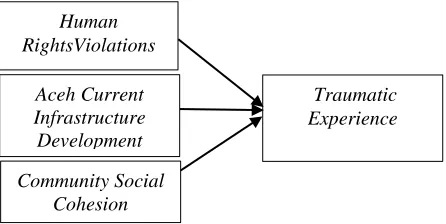
This section discusses the material and method used in present study, there are three (3) factors draws from the observation recorded in our pilot video recorded which later been transcribe into below research model.
Figure 1: Proposed Research Framework outlined from video recorded during in-depth interview
A. Aceh Human Violations
Human Rights is the basic rights of freedom entitled to all humans. However, not everyone able to relish human rights. A place called Banda Aceh, Indonesia is one of the place where human rights hardly to be applied due to its civil war amongst its own country and its own people [12, 13, 14]. Yet, with a sequence of series of confrontations and negotiation rapid development along with the emergence of the community led to a success and increment of human rights in Aceh region [15, 16; 17]. According to Rahiem and Krauss [18] the settlement does influence Acehnese emotions directly. Finally in 2005, the government of Indonesia and representatives of the Free Aceh Movement (GAM) signed a Memorandum of Understanding (MOU) bringing almost 30 years of violent conflict in Aceh to an end. Improvements in the material respect for human rights. With the settlement, Acehnese now living in happier life compared to before the MOU signing. This reflects towards positive influence towards traumatic experience faced among the Acehnese.
B. Aceh Current Infrastructure Development
The current development of Banda Aceh, Indonesia was very rapid after the tsunami in 2004, posing critical challenges in planning for its future ecological development. Its rapid development in terms of its infrastructure secondarily benefits the survivors to feel relieved and help them to build their emotional stability. Studies done by previous researcher shows that due to the changes in its landscape, it has driven to speed up towards its rapid urbanization on its infrastructure including buildings and roads [7, 19]. On top of that, researcher studied that survivor also aggressively participate in building its new infrastructure that steered towards Acehnese survival skill [20]. Moreover, researcher also proves positive development of Aceh infrastructure also led towards the increase of social cohesion [21]. The observations on Aceh infrastructure development has been done through in-depth interview with related subjects and video recorded them.
C. Community Social Cohesion
Community social connectedness and trust factor also been observed among Acehnese during the observation. This is to see the community contributions towards its own people onto bringing and supporting Acehnese to overcome their trauma. However, in the context of Aceh, the present study will be discussed onto examined the impact of community social cohesion or related measures of community connectedness on Tsunami that hits Aceh in 2004. Research shows that Acehnese are well known as people with high spirit of togetherness [19, 20]. Therefore, community social cohesion has significant influence towards reducing traumatic experience symptoms. This is supported by previous Human
RightsViolations
Aceh Current Infrastructure Development
Community Social Cohesion
literature related to natural disaster and high rate of traumatic experience effects towards its people [22, 23, 24]. Literatures supported that community social cohesion will reduce traumatized among the people who experienced a traumatic event such as Tsunami and civil war [25, 26, 27].
D. Traumatic Experience
Traumatic experience is also relate to a disease named Post-traumatic stress disorder (PTSD). PTSD is a mental health condition that's triggered by a terrifying event. It is either experiencing or witnessing it. Symptoms may include flashbacks, nightmares and severe anxiety, as well as uncontrollable thoughts about the event. An example of an intervention available for PTSD victims is through the community social cohesion approach. According to OECD (2011), social inclusion, social capital, and social mobility are important components to build social unity within a community. In addition to social inclusion, a committed community is required to achieve the aforementioned goals of unity. Social mobility, on the other hand, stresses that communities should utilize available social capital to actively engage in development programs or social work.
According to the Australian Human Rights Commission, five (5) elements are required to build social cohesion within a community. First, cooperation from the local government is essential. With the community coming together to help traumatized victims, the government can help through the introduction of policy, systems, and trainings that cater to the strategic planning of the community for itself. Second, the government’s involvement in communal activities will provide a platform for the community to identify persistent issues and problems faced. An inclusive approach should be prioritized as a means to uncover any existing concerns. The third aspect is long-term collaboration. In order to build social unity at the community level, excellent relationship building efforts need to be maintained among the community members, the police force, non-governmental organizations (NGO), and the local government. Fourth, the undertaking of necessary actions toward an appropriate goal is key. Outlining important objectives, issues, and a target group accurately is a requirement for community sustainment in working towards achieving greater social togetherness. Fifth, assessment and partaking in the outcome of social cohesion. Evaluations of social unity is needed to ensure the efficiency and effectiveness of the work carried out within the community. Previous literature supported on how natural disaster affects towards PTSD symptoms [22, 23, 24]. Therefore, in the context of natural disaster happened in Aceh, which specifically referring to Tsunami hits in year 2004. The present study focus on factors affecting traumatic experience using PTSD elements amongst Acehnese in the perspective of (1)
Human Violations (2) Current Infrastructure Development (3) Community Social Cohesion. A study shows that one of the solution that help to reduce trauma is based on time perspective [28]. However none of the study shows that time will definitely make trauma away.
E. Methodology
The present study was conducted in selected few locations in Aceh province. Data collected through field observation. This method allows researcher to act as an observer on the related observation field. Locations include Sabang Island, Meulaboh and Sigli in Aceh. Location has been choose based on the affected areas in Aceh during Tsunami hit in year 2004. The non-probability sampling used in present research where self – select sampling has been done. Data collected from those who respond on reading and connection that we have to interview subject who experienced on the tragic event. Focused interview conducted to all selected subjects to obtain data. Data was recorded in a form of videography. There are three subjects involved in data collection process. Data obtained has been further analyzed to obtain results. The analysis has been coded into three areas which are 1) human violation rights, 2) Aceh Current Infrastructure Development and 3) Community Social Cohesion observational was recorded. The present method used supported by study done by other researchers [28]. In addition, researcher in the present study will act as a complete observer and purely observe and act as an in the role to accomplish research aims.
RESULTS
Based on observation transcribed from video recorded, supported by previous literature, we found that (1) Human Violations (2) Current Aceh Development and (3) Community Social Cohesion does influence the level of Post-Traumatic Stress Disorder (PTSD) among Acehnese. Table below shows the content transcribed from in-depth interview recorded previously. It also explain the elements of three factors that effects towards traumatized experienced amongst the Acehnese. The themes were developed from elements available in Post-Traumatic Stress Disorder (PTSD), in order to extract the content during interview conducted amongst traumatized Acehnese that experience the Tsunami hits in 2004.
Frequency (f) Coding Human
Rights Violation
Infrastructure Development
4 Video 1
(Subject 1)
6 8 4
Video 2 (Subject 2)
5 5 3
Video 3 (Subject 3)
4 5 5
Table 1: Summary of keywords frequencies mentioned during interview
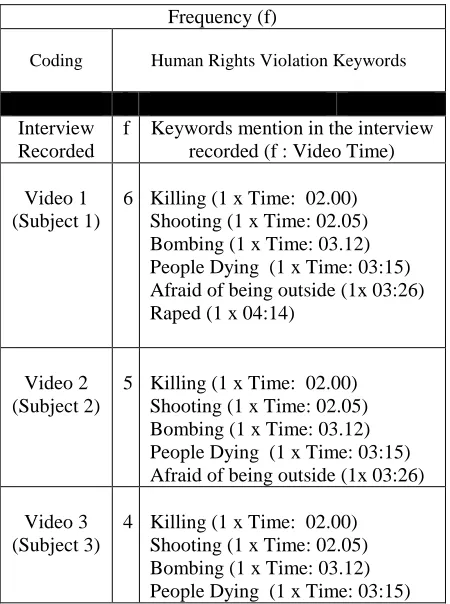
Table 1 is the summary of keywords frequencies obtained during interview session. Each interviewee, used the three main elements that contribute towards the high and low of trauma level using Post-Traumatic Stress Disorder (PTSD) symptoms. All the elements are recorded in a video. The highest frequency is explaining on their happiness of current infrastructure development in Acheh. Despite, the present study also portraying the hardship of Acehnese people before peace. Indirectly motivating and urging the Acehnese to proceed developing its land. In addition, it also helps researcher to further extend present research by analysing it’s economically and statistically. This is due to the limitation of present research whereby it only focuses on participant field observation method which is purely recorded and documented for a documentary film.
Frequency (f)
Coding Human Rights Violation Keywords
Interview Recorded
f Keywords mention in the interview recorded (f : Video Time) Video 1
(Subject 1)
6 Killing (1 x Time: 02.00) Shooting (1 x Time: 02.05) Bombing (1 x Time: 03.12) People Dying (1 x Time: 03:15) Afraid of being outside (1x 03:26) Raped (1 x 04:14)
Video 2 (Subject 2)
5 Killing (1 x Time: 02.00) Shooting (1 x Time: 02.05) Bombing (1 x Time: 03.12) People Dying (1 x Time: 03:15) Afraid of being outside (1x 03:26) Video 3
(Subject 3)
4 Killing (1 x Time: 02.00) Shooting (1 x Time: 02.05) Bombing (1 x Time: 03.12) People Dying (1 x Time: 03:15) Table 2: Coding sheet: Human Rights Violation
Keywords recorded during interview recorded
Table 2 is the coding sheet summary consists of keywords mentioned during the interview. Keywords captured are (1) Killing, (2) Shooting, (3) Bombing and (4) Dying people, (5) Afraid of being outside and (6) Raped.
Frequency (f) Coding Infrastructure Development
Interview Recorded
f Keywords mention in the interview recorded (f : Video Time)
Video 1 (Subject 1)
8 Business activity (2 x Time: 05.00) Housing development (1 x Time: 05.05)
Schools infrastructure improving (1 x Time: 05.15)
Rebuild mosque (2 x Time: 06:10 , 07:20)
Road infrastructure (1x 06:30) Airport Facility (1x 07:15)
Video2 (Subject 2)
5 Business activity (1 x Time: 04.00) Housing development (1 x Time: 04.25)
Schools infrastructure improving (1 x Time: 04.32)
Rebuild mosque (1 x Time: 04:40) Road infrastructure (1x 05:30)
Video 3 (Subject 3)
5 Business activity (1 x Time: 05.25) Housing development (1 x Time: 05.35)
Schools infrastructure improving (1 x Time: 05.50)
Rebuild mosque (1 x Time: 06:02) Road infrastructure (1x 06:10)
Table 3: Coding sheet: Infrastructure Development Keywords recorded during interview
recorded
Frequency (f)
Coding Community Social Cohesion
Interview Recorded
f Keywords mention in the interview recorded (f : Video Time)
Video 1 (Subject 1)
4 Family (2 x Time: 05.00)
NGO Assistance (1 x Time: 05.05) Government Aid (1 x Time: 05.15) Neighbors (2 x Time: 06:10) Relatives (1x 06:30)
Video2 (Subject 2)
3 Family (2 x Time: 05.00)
NGO Assistance (1 x Time: 05.05) Relatives (1x 06:30)
Video 3 (Subject 3)
5 Family (2 x Time: 05.00)
NGO Assistance (1 x Time: 05.05) Government Aid (1 x Time: 05.15) Neighbors (2 x Time: 06:10) Relatives (1x 06:30)
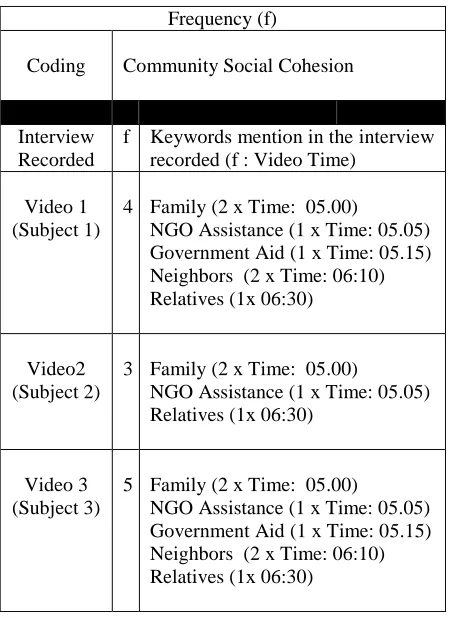
Table 4: Coding sheet: Community Social Cohesion during interview recorded
Table 4 is the coding sheet summary consists of keywords mentioned during the interview relating to Community Social Cohesion. Keywords captured are (1) Family, (2) NGO Assistance, (3) Government Aid (4) Neighbors, and (5) Relatives.
This is one of the method to identify factors contributed towards post-traumatic stress disorder to individual who experience post-traumatic stress disorder by focus group interview which also been documented via videography to be further analyzed. Mentioned keywords used during the interview shows reliefs amongst the subject which contribute towards reducing PTSD. Method used help to avoid researcher from leaving an important input from the interview session as well as to capture their motion that gave an added value to this study. All involved subjects are pointing the three main elements as a factor that affect them to recover from the traumatized environment fast.
DISCUSSIONS
To further justify the present study, another research used as reference that social support system will reduce
trauma experience towards adult that experience a natural disaster [22, 23, 24]. Given the potential for negative mental health outcomes following on natural disasters, social support is equally important to reduce PTSD among adults.
The current study was conceptualized following 2014 floods in Kashmir valley (India) as a way of furnishing the experiences of the people who witnessed the devastation caused by floods, and subsequently adding to the existing literature regarding the factors that influence psychological outcomes following disasters. This is added with the advancement of technology that facilitated to identify trauma risk [29]. A research prepared by other researcher in western countries such as in United States are much more advanced by developing tools that has been tested to identify mental health stage of an individual after the event of natural disaster that led to trauma amongst its people called a super learner algorithm [30]. However the, tools used can only measure the stage of seriousness of one mental health but not identifying what are the factors that can reduce trauma. Therefore, the present study is filling the gap by using in-depth interview amongst the people who experienced the event to identify the external factors in reducing trauma.
Another study conducted in Macao was to see the association of natural disaster exposure by media on trauma. Findings shows that, people who attached with media have higher tendency to experience trauma compared those who are not [31]. These findings also supported by other studies conducted in US that some types of media use and certain media content following a natural disaster are associated with traumatized. This is include, viewing the images and report by government officials. Therefore, media attachment also can be one of the variable that steered trauma.
Thus, to further extend this, present research will also contribute towards Indonesia government policy. This is supported by report made by CNN, 2013 that Indonesia geographical location in on “Ring of fire” which exposed Indonesia to have and earthquake and tsunami. Therefore, development of Aceh can be used as pilot on after tsunami development to gain maturity in handling natural disaster in its country.
CONCLUSIONS
6 proven that the main three factors (1) Human Rights Violations, (2) Current Infrastructure Development and (3) Community Social Cohesion has positively influence towards reducing trauma among the Acehnese who experienced both events; a civil war and Tsunami. REFERENCES
[1]Sulistiyanto, P. (2001). Whither Aceh?. Third World Quarterly, 22(3), 437-452.
[2]Awaluddin, H. (2009). Hamid Awaludin, Peace in Aceh: Notes on the peace process between the Republic of Indonesia and the Aceh Freedom Movement (GAM) in Helsinki.
Ttranslated byScott, T. (2009), Centre for Strategic and International Studies, Jakarta. ISBN 978-979-1295-11-6.
[3]Asia Times Online (2013) Southeast Asia news – A happy, peaceful anniversary in Aceh". Atimes.com. 2006-08-15.
[4] Ross, M. L. (2005). Resources and rebellion in Aceh, Indonesia. Understanding civil war, 2, 35-58. [5] Missbach, A. (2011). The Acehnese diaspora after
the Helsinki Memorandum of Understanding: return challenges and diasporic post-conflict transformations. Asian Ethnicity, 12(2), 179-201. [6] Maulida, Z., Indah, D. R., & Sijabat, F. N. (2015).
Analysis on the Impact of the Development of Lamphuuk Beach as the Tourism Location in Aceh against Business Strategy and Business Doers Welfare and Society around the Beach after 10 Years Tsunami. Journal of Asian Scientific Research, 5(7), 349.
[7] Noer, F., Matondang, A. R., Sirojuzilam, & Saleh, S. M. (2017, November). Effect of space structures against development of transport infrastructure in Banda Aceh by using the concept of transit oriented development. In AIP Conference Proceedings (Vol. 1903, No. 1, p. 060002). AIP Publishing.
[8] Subhan, M., & Abdul Ghani, A. B. (2011). The formulating growth strategy of Aceh port system in Indonesia: An AHP approach. Gadjah Mada International Journal of Business, 13(1).
[9] Hori, A., Morita, T., Yoshida, I., & Tsubokura, M. (2018). Case Report: Enhancement of PTSD treatment through social support in Idobata-Nagaya community housing after Fukushima’s triple disaster. BMJ Case Reports, 2018.
[6] Wickrama, T., Wickrama, K. A. S., Banford, A., & Lambert, J. (2017). PTSD symptoms among tsunami exposed mothers in Sri Lanka: the role of disaster exposure, culturally specific coping strategies, and recovery efforts. Anxiety, Stress, & Coping, 30(4), 415-427.
[10]Hikichi, H., Aida, J., Tsuboya, T., Kondo, K., & Kawachi, I. (2016). Can community social cohesion prevent posttraumatic stress disorder in the
aftermath of a disaster? A natural experiment from the 2011 Tohoku earthquake and tsunami. American journal of epidemiology, 183(10), 902-910.
[11]Kristensen, P., Weisæth, L., Hussain, A., & Heir, T. (2015). Prevalence of psychiatric disorders and functional impairment after loss of a family member: a longitudinal study after the 2004 Tsunami. Depression and anxiety, 32(1), 49-56.
[12] Caspersen, N. F. (2019). Human Rights in Territorial Peace Agreements. REVIEW OF INTERNATIONAL STUDIES.
[13] Shanty, V., Adwani, A., & Yahya, A. (2018). Indigenous Sanction of Expulsion in Central Aceh District (Human Rights Perspective). AL-IHKAM: Jurnal Hukum & Pranata Sosial, 13(2), 254-272. [14] Barr, A. (2017). Human Rights Advocates in the
Post-9/11 Era. In Human Rights in Crisis (pp. 37-44). Routledge.
[15] Stange, G., & Missbach, A. (2018). The Aceh Peace Process: Wheeling and Dealing behind Closed Doors. Aspirations with Limitations: Indonesia’s Foreign Affairs under Susilo Bambang Yudhoyono, 231.
[16]Kingsbury, D. (2016). Timing and sequencing peace in Aceh. Building sustainable peace: timing and sequencing of post-conflict reconstruction and peacebuilding, 375-392.
[17] Kusujiarti, S., Miano, E. W., Pryor, A. L., & Ryan, B. R. (2015). Unveiling the mysteries of Aceh, Indonesia: local and global intersections of women's agency. Journal of International Women's Studies, 16(3), 186-202.
[18] Rahiem, M. D. H., Abdullah, N. S. M., & Krauss, S. E. (2017). Religious Interpretations and Psychological Recovery from the Aceh 2004 Tsunami: The Promise of Heaven, Healing the Trauma. In Disaster Risk Reduction in Indonesia (pp. 495-514). Springer, Cham.
[19] Rani, H. A. (2017). Development priority of Road Infrastructure the Aceh post tsunami in Simeulue District. International Journal of Civil Engineering, 6(3), 9-17.
[20] Meigh, J. D., Minanto, I. M., & Rachim, I. A. (2018). Aceh and Nias, Indonesia post-tsunami reconstruction by survivor participation. Proceedings of the Institution of Civil Engineers-Forensic Engineering, 171(2), 70-79.
[21] White, H., Menon, R., & Waddington, H. (2018). Community-driven development: Does it build social cohesion or infrastructure? A mixed-method evidence synthesis.
[22] Masbar, R., Sabti, A., & Nasir, M. (2018). Social Capital and Survival Strategies of the Poor in the Rural Community in Aceh, Indonesia.
OF ACEH, INDONESIA. Disaster Risk Reduction in Indonesia: Environmental, Social and Cultural Aspects, 217.
[24] N. Sattler, D., Claramita, M., & Muskavage, B. (2018). Natural Disasters in Indonesia: Relationships Among Posttraumatic Stress, Resource Loss, Depression, Social Support, and Posttraumatic Growth. Journal of Loss and Trauma, 23(5), 351-365.
[25] Hatta, K. (2017). The Seriousness Trauma Among Teens in Conflict and Tsunami Victims in Aceh Besar and Kota Banda Aceh. Advanced Science Letters, 23(3), 2075-2078.
[26] Marthoenis, Meutia, I., Sofyan, H., & Schouler-Ocak, M. (2018). Exposure to traumatic events and PTSD in a postconflict and disaster-prone area. Journal of Loss and Trauma, 23(2), 128-139. [27] Bangpan, M., Dickson, K., Felix, L., & Oxfam, G.
B. (2017). EVIDENCE BRIEF.
[28] Vogt, D., Erbes, C. R., & Polusny, M. A. (2017). Role of social context in posttraumatic stress disorder (PTSD). Current opinion in psychology, 14, 138-142.
[29] Dar, K. A., Iqbal, N., Prakash, A., & Paul, M. A. (2018). PTSD and depression in adult survivors of flood fury in Kashmir: The payoffs of social support. Psychiatry research, 261, 449-455. [30] Rosellini, A. J., Dussaillant, F., Zubizarreta, J. R.,