Steganography in Inactive Frames of VoIP Streams Encoded by Source Codec
Y. F. Huang, Shanyu Tang, and Jian Yuan, Senior Member, IEEE
Abstract This paper describes a novel high capacity steganography algorithm for embedding data in the inactive frames
of low bit rate audio streams encoded by G.723.1 source codec, which is used extensively in Voice over Internet Protocol
(VoIP). This study reveals that, contrary to existing thoughts, the inactive frames of VoIP streams are more suitable for
data embedding than the active frames of the streams, that is, steganography in the inactive audio frames attains a larger
data embedding capacity than that in the active audio frames under the same imperceptibility. By analysing the
concealment of steganography in the inactive frames of low bit rate audio streams encoded by G.723.1 codec with 6.3kbps,
the authors propose a new algorithm for steganography in different speech parameters of the inactive frames.
Performance evaluation shows embedding data in various speech parameters led to different levels of concealment. An
improved voice activity detection algorithm is suggested for detecting inactive audio frames taking into packet loss account.
Experimental results show our proposed steganography algorithm not only achieved perfect imperceptibility but also
gained a high data embedding rate up to 101 bits/frame, indicating that the data embedding capacity of the proposed
algorithm is very much larger than those of previously suggested algorithms.
Index Terms steganography, inactive frames, audio streams, VoIP
I. INTRODUCTION
Streaming media, such as Voice over Internet Protocol (VoIP) streams, are broadcasted live over the Internet and
delivered to end-users. Security remains one of the main challenges with this new technology. With the upsurge of
VoIP applications available for use in recent years, VoIP streams become one of the most interesting cover objects for
modern steganography. Digital steganography in low bit rate audio streams is commonly regarded as a challenging
topic in the field of data hiding.
There have been several steganography methods of embedding data in audio streams. For example, Wu et al. [1]
suggested a G.711-based adaptive speech information hiding approach. Aoki [2] proposed a technique of lossless
steganography in G.711 encoded speeches. Ma et al. [3] framed a steganography method of embedding data in G.721
encoded speeches. All these methods adopt high bit rate audio streams encoded by the waveform codec as cover objects, in which plenty of least significant bits exist.
However, VoIP are usually transmitted over low bit rate audio streams encoded by the source codec like ITU G.723.1
codec to save on network bandwidth. Low bit rate audio streams are less likely to be used as cover objects for
steganography since they have fewer least significant bits than high bit rate audio streams. Little effort has been made to develop algorithms for embedding data in low bit rate audio streams. Chang et al. [4] embedded information in
G.729 and MELP audio streams. Huang et al. [5] proposed a steganography algorithm for embedding information in
low bit rate audio streams. But these steganography algorithms have constrains on the data embedding capacity, that is,
their data embedding rates are too low to have practical applications. Thus the main focus of this study was to work out
The rest of this paper is organised as follows. Section 2 summarises some related work, discussing the possibility of embedding data in the inactive frames of low bit rate audio streams. In Section 3, the imperceptibility of the
steganography algorithm for embedding data in the inactive audio frames is analysed. Our proposed steganography
algorithm is presented in Section 4. Section 5 details the experimental set-up and performance evaluation results.
Finally, the paper ends with conclusions and directions for future work in Section 6.
II. RELATED WORK
Analysis by synthesis (ABS)-based speech information hiding approach was adopted to embed speech data in an
original speech carrier, with good efficiency in steganography and good quality of output speech [6]. Recently, linear
predictive coefficients were substituted with secret speech data by using a ABS speech coding scheme [7], but the
experimental results available are very limited.
Krätzer, Dittmann, and Vogel [8] argued that the inactive voice of a speech was not suitable for being used as a cover
object for steganography owing to an obvious distortion of the original speech. By contrast, Huang et al. [9] suggested
an algorithm for embedding information in some parameters of the speech frame encoded by ITU G.723.1 codec,
without leading to distinction between inactive voices and active voices.
It seems that Krätzer, Dittmann, and Vogel’s opinions [8] and Huang and co-workers’ results [9] contradict each other.
Such a contradiction can be attributed to the different speech codecs that were used to compress and encode audio
signals. In [8], audio streams were encoded by a pulse-code modulation (PCM) codec; but an ITU G.723.1 source
the inactive voice cannot be used to embed information since it will lead to obvious distortion. However, the source codec is a hybrid codec, which is based on the source model. This codec compresses the speech at a very low bit rate
and performs on a frame-by-frame basis; each frame is encoded into various parameters rather than the sample volumes.
Thus the volume of the speech does not change imperceptibly even though their inactive audio frames contain hidden
information.
The theoretical analysis above suggests that steganography in the inactive frames of low bit rate audio streams would
attain a larger data embedding capacity if an appropriate steganography algorithm were used. The rest of this paper
details our successful effort on such a new steganography algorithm for embedding data in the inactive frames of low
bit rate audio streams encoded by ITU G.723.1 source codec.
III. PRINCIPLE OF STEGANOGRAPHY IN INACTIVE AUDIO FRAMES
A. Hangover Algorithm for Detecting Active Voices
To reduce network bandwidth in VoIP applications, some source codecs introduce silence compression during the
inactive period of audio streams. The silence compression technique has two components: voice activity detection
(VAD) and comfort noise generator[10]. The VAD is used to decide whether the current audio frame is an active voice by comparing the energy of the frame (Enr) with a threshold (Thr), as shown in (1):
Thr Enr
Thr Enr VAD
0 1
(1)
VAD = 0 means the frame is an inactive voice; otherwise, the frame is an active voice.
239 60 2 ' ) ( 80 1 n tt e n
Enr (2)
where et’(n) is the output signal of the finite impulse response (FIR) filter whose input signal is the current frame,
{s[n]}n=60…239. The FIR filter computes et’(n) using (3)
10 1 ' 239 60 ] [ ] [ ] [ ) ( j not n s n a j s n j n
e (3)
where Ano(Z) = {ano[j] | j = 0,…,10} is the autocorrelation coefficient vector of the filer.
The threshold in (1), Thr, is given by
16384 If 239 . 2 16384 128 If 10 128 If 012 . 5 128 log 05 . 0 7 . 0 2 Nlev Nlev Nlev Thr Nlev (4)
where Nlevt is the noise size of the current frame, and is updated by its previous value, the energy of the previous
frame Enrt-1, and the self-adaptive flag Aent. Nlevt is defined as follows:
else if 75 . 0 25 . 0 1 1 1 1 1 t t t t t t Nlev Enr Nlev Enr Nlev Nlev else 9995 . 0 0 if 03125 . 1 t t t t Nlev Aen Nlev
Nlev (5)
where Aent = [0, 6], and Nlevt is limited to a value between 128 and 131071.
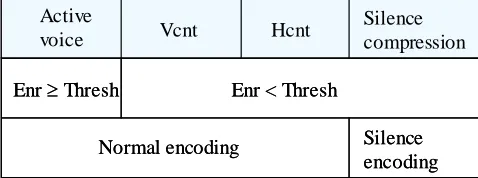
Silence compression Hcnt Vcnt Silence encoding Normal encoding
Enr Thresh Enr < Thresh Active voice Silence compression Hcnt Vcnt Silence encoding Normal encoding
Enr Thresh Enr < Thresh Active
voice
Fig. 1. Illustration of Hangover algorithm
In general, Hangover algorithm is used for detecting inactive voices to avoid noise peaks being extended [10]. If an
using the silence compression algorithm. Having received the SID frame, the decoder generates a comfortable noise at the receiving end. The Hangover algorithm is illustrated in Fig. 1.
The first row in Fig. 1 shows the classification of voice duration before silence compression. Hcnt is the
Hangover-frame number of inactive voices when an active voice begins to change to an inactive voice in the speech.
The second row is an estimate of the energy and the third row includes the corresponding codec algorithms.
An audio stream is actually divided into frames before being encoded. For instance, with G.723 codec the audio stream
is divided into frames 30 ms in length. Suppose the audio stream F contains N frames, F = {fi| i = 0, …, N}. If the
energy (Enr) of the frame fi is less than the threshold value (Thr), Enr < Thr, the frame is the first frame of an inactive
voice. This frame is defined as a Hcnt frame in Hangover algorithm and is then encoded by using the normal codec algorithm rather than the silence compression algorithm. If subsequent frames are still inactive voices, Hangover
algorithm will not perform silence compression until the sixth frame. In other words, Hangover algorithm starts to
encode the sixth frame of the inactive voice into a SID frame until the next active voice emerges. The first five frames
(1st to 5th) of the inactive voice are still encoded into Hangover frames, denoted by f*Hcnt. The active voice of the audio
stream is encoded into active frames f*A by using the normal codec algorithm.
According to Hangover algorithm, audio frames are classified into three types, active voice frame fA, Hangover frame
fHcnt, and silence compression frame fS. The audio speech F can be expressed as
F = {fiA, fjs|i = 0, …, N1, j = 0, …, N2, N = N1 + N2} (6)
The speech F is then encoded into F* by using Hangover algorithm, which can be written as
)
(
F
1 2 3 1 2 3
* * *
* f ,f ,f i 1,...,n,j 1,...,n,l 1,...,n,N n n n
F SID
l Hcnt j A
i
B. Definitions of Inactive and Active Frames
The silence compression technique is an optional function for the source codec. In fact, most source codecs do not use
silence compression in VoIP applications. All audio frames are encoded uniformly by using the normal encoding
algorithm regardless of whether they are active voices or inactive voices. Thus two types of frames are outputted when the speech stream F is encoded by the source codec. For example, ITU G.723.1 codec encodes the speech into two
types of frames, active frames and inactive frames, without using the silence compression algorithm.
Definition 1: The active frame f*A is encoded by the source codec from the active voice of the speech. It is expressed as
1*
,...,
0
N
i
f
f
i A
iA
(8)Definition2: The inactive frame f*S is encoded by the source codec from the inactive voice of the speech. It is expressed
as
2*
,...,
0
N
j
f
f
i S
iS
(9)As the speech is divided into inactive voices and active voices by VAD, all the voices are encoded uniformly by the
source codec to form audio frames, in which inactive frames can be distinguished from active frames. Combining (6) -
(9) yields
F* = {fi*A, fj*S|i = 0,…, N1, j = 0,…, N2, N = N1 + N2} (10)
This section discusses whether the ‘1/0’ distribution pattern of an inactive frame is similar to that of an active frame if the inactive voice of a speech is encoded into inactive frames.
Firstly, we analysed the statistical probability of ‘1/0’ presentation in inactive frames. Assuming an audio stream is
divided into N frames, among them there are N1 inactive frames and N2 active frames, i.e. N=N1+N2. The audio stream
is denoted by F* = {fi*A, fj*S | i = 0,…, N1, j = 0,…, N2}. Suppose each frame consists of M bits, namely f*i={b0, …, bi, …, bM | bi = 0, 1}. The average probability of ‘1’ presentation in all the inactive frames is computed by using (11)
10 1 0
, 1
1
1
1
Ni M
j j i
b
b
MN
(11)where bi,j denotes the jth ‘1’ in the ith inactive frame of the stream. So the average probability of ‘0’ presentation in all
the inactive frames is given by
1 0
1
bb
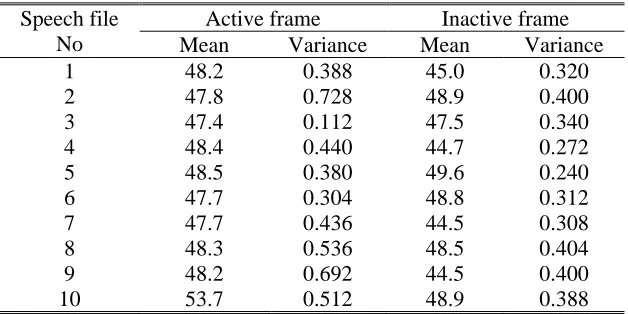
(12)Table 1 lists the experimental results of the statistical probabilities of ‘1’ presentation in the inactive frames and active frames encoded by G.723.1 codec, respectively. Ten speech sample files were used for the experiments, with each file
being tested six times in order to work out the average probabilities of ‘1’ presentation in the inactive and active frames.
Table 1 Average probabilities of ‘1’ presentation in inactive and active frames Speech file
No
Active frame Inactive frame
Mean Variance Mean Variance
1 48.2 0.388 45.0 0.320
2 47.8 0.728 48.9 0.400
3 47.4 0.112 47.5 0.340
4 48.4 0.440 44.7 0.272
5 48.5 0.380 49.6 0.240
6 47.7 0.304 48.8 0.312
7 47.7 0.436 44.5 0.308
8 48.3 0.536 48.5 0.404
9 48.2 0.692 44.5 0.400
The average probabilities shown in Table 1 indicate that there was no obvious difference in the ‘0/1’ presentation probability between the active frames and inactive frames of low bit rate audio streams. In other words, we could not
distinguish inactive frames from active frames by the ‘1/0’ presentation probability.
Secondly, we examined the probability of ‘1/0’ jumping in inactive frames. The ‘1/0’ jumping probability expresses
the chance that the bit ‘1’ changes to ‘0’ or ‘0’ to ‘1’ inversely will occur in an inactive frame. Similarly, the audio stream is denoted by F* = {f
i*A, fj*S | i = 0,…, N1, j = 0,…, N2}, and f*si= {b0, …, bi, …, bM | bi = 0, 1}. Then the average probability of ‘1/0’ jumping in all the inactive frames of the speech file is calculated by
20 1 0
1 2
%
100
1
Ni M
j
i i
c
b
b
N
M
(13)where bidenotes the jth bit in the inactive frame and M denotes the bit number of the inactive frame, such as M = 192
for G.723.1 codec with 6.3 kbps.
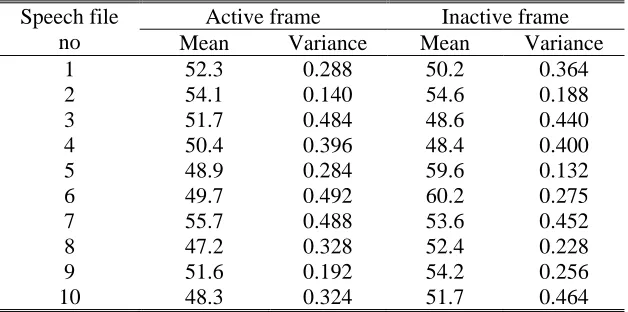
Table 2 shows the average probabilities of ‘1/0’ jumping in the inactive frames and active frames of low bit rate audio streams, respectively. Each mean probability is based on six repeated experiments on a speech file. The results suggest
both inactive frames and active frames were indistinguishable in terms of the jumping probability.
Table 2 Average probabilities of ‘1/0’ jumping in inactive and active frames Speech file
no
Active frame Inactive frame
Mean Variance Mean Variance
1 52.3 0.288 50.2 0.364
2 54.1 0.140 54.6 0.188
3 51.7 0.484 48.6 0.440
4 50.4 0.396 48.4 0.400
5 48.9 0.284 59.6 0.132
6 49.7 0.492 60.2 0.275
7 55.7 0.488 53.6 0.452
8 47.2 0.328 52.4 0.228
9 51.6 0.192 54.2 0.256
Finally, we studied the run-length statistical character of ‘0/1’ in inactive frames. The run-length statistical method was
used to calculate the run-lengths of continuous ‘0’ or ‘1’ presentation in inactive frames. Assuming the audio stream is
denoted by F* = {fi*A, fj*S | i = 0, …, N1, j = 0, …, N2} and fi*s = {b0, …, bi, …, bM | bi = 0, 1}, it satisfies the following
equation: 1 1 1 R k R k i k i k k k b b b b b b (14)
where i = 0, 1,…R, and R denotes the run-length of bk in an inactive frame. Then the run-length of bk (bk = 0, 1) in the
inactive frame is equal to the number of bits from bk to bk+R-1. The distribution pattern of the run-length in inactive
frames is defined as the probability of various run-lengths presenting in all inactive frames of the speech file, given by
2 0 0 20
(
)
100
%
0
,...
1
)
(
N
j
j
i
i
R
M
N
M
i
(15)
2 0 1 21
(
)
100
%
0
,...
1
)
(
N
j
j
i
i
R
M
N
M
i
(16)where j(i), j = 0, 1 denotes the percent of the run-length of the bit ‘0’ or ‘1’ being equal to i in all inactive frames, and M0(i) and M1(i) denote the numbers of the run-length of the bit ‘0’ or ‘1’ being equal to i in all inactive frames,
respectively.
The Mann-Whitney-Wilcoxon (M-W-W) test, one of the best-known non-parametric significance tests, was used to
evaluate whether the difference in run-length probability distributions between the inactive frames and active frames of
a speech file is indistinguishable. To have 95 percent confidence, i.e. with a confidence coefficient (1-) of 0.95, where is called the level of significance, we therefore require z(1 - /2) = z(0.975) = 1.960, where z is the percentile of the
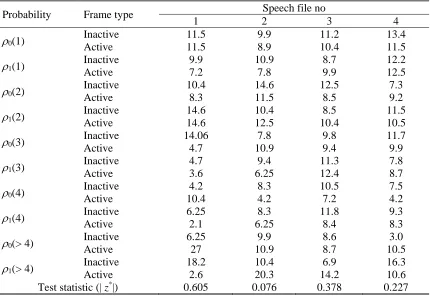
Table 3 describes the distribution patterns of the run-lengths of ‘0’ and ‘1’ in all inactive frames and active frames, and
the M-W-W test results for comparing the probability distributions between the inactive frames and active frames for
four speech samples, respectively. Since | z*| 1.960 for all the cases, we conclude that the probability distributions for both inactive frames and active frames do not differ, indicating that the inactive frames and active frames had a similar
run-length pattern for each speech file.
To summarise, the above three experiments on bit distribution patterns indicate that the bit distribution of inactive
frames is similar to that of active frames for the same speech files. Otherwise stated, it is highly unlikely to use the ‘1/0’
distribution pattern to distinguish the inactive frames from active frames of low bit rate audio streams.
Table 3 Run-length patterns in inactive and active frames
Probability Frame type Speech file no
1 2 3 4
0(1)
Inactive 11.5 9.9 11.2 13.4
Active 11.5 8.9 10.4 11.5
1(1) Inactive 9.9 10.9 8.7 12.2
Active 7.2 7.8 9.9 12.5
0(2) Inactive 10.4 14.6 12.5 7.3
Active 8.3 11.5 8.5 9.2
1(2) Inactive 14.6 10.4 8.5 11.5
Active 14.6 12.5 10.4 10.5
0(3) Inactive 14.06 7.8 9.8 11.7
Active 4.7 10.9 9.4 9.9
1(3) Inactive 4.7 9.4 11.3 7.8
Active 3.6 6.25 12.4 8.7
0(4) Inactive 4.2 8.3 10.5 7.5
Active 10.4 4.2 7.2 4.2
1(4) Inactive 6.25 8.3 11.8 9.3
Active 2.1 6.25 8.4 8.3
0(> 4)
Inactive 6.25 9.9 8.6 3.0
Active 27 10.9 8.7 10.5
1(> 4)
Inactive 18.2 10.4 6.9 16.3
Active 2.6 20.3 14.2 10.6
D. Steganography in Inactive Frames
The source codec like ITU G.723.1 is operated on a frame-by-frame basis. Each frame encoded by G.723.1 codec has
240 audio samples that are encoded according to PCM. First of all, each frame is filtered by a high-pass filter to remove
the DC component and is then divided into four subframes of 60 samples each. A tenth order linear predictive coding
(LPC) filter is computed using the unprocessed input signal for every subframe, and the last subframe is quantized
using a predictive split vector quantizer. For every two subframes (120 samples), the weighted speech signal is used to compute the open-loop pitch period. A harmonic noise shaping filter is then constructed using the open-loop pitch
period computed previously, and a closed-loop pitch predictor is constructed according to the impulse response created
by the noise shaping filter. Finally, both the pitch period and the differential value are transmitted to the decoder and the
non-periodic component of the excitation is approximated. After completion of these operations, all speech parameters
such as LPC, Pulse sign (Pamp) and Pulse position (Ppos) and so on, are obtained.
According to (6) - (10), if the speech, F = {fiA, fjS|i= 0, …, N1, j= 0, ..., N2, N=N1+N2}, is inputted into G.723.1
codec, then the bit stream F* = {fi*A, fj*S|i= 0, ..., N1, j= 0, …, N2, N=N1+N2} is outputted with two types of frames,
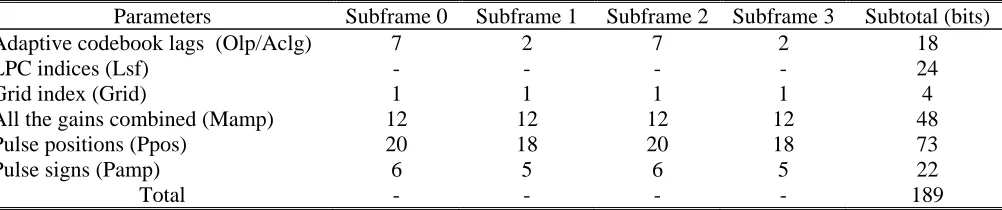
inactive frames and active frames. Moreover, the bit allocation of the inactive frame is similar to that of the active
frame. The bit allocation of G.723.1 codec with 6.3kb/s is listed in Table 4.
Table 4 Bit allocation of G.723.1 codec with 6.3kb/s
Parameters Subframe 0 Subframe 1 Subframe 2 Subframe 3 Subtotal (bits)
Adaptive codebook lags (Olp/Aclg) 7 2 7 2 18
LPC indices (Lsf) - - - - 24
Grid index (Grid) 1 1 1 1 4
All the gains combined (Mamp) 12 12 12 12 48
Pulse positions (Ppos) 20 18 20 18 73
Pulse signs (Pamp) 6 5 6 5 22
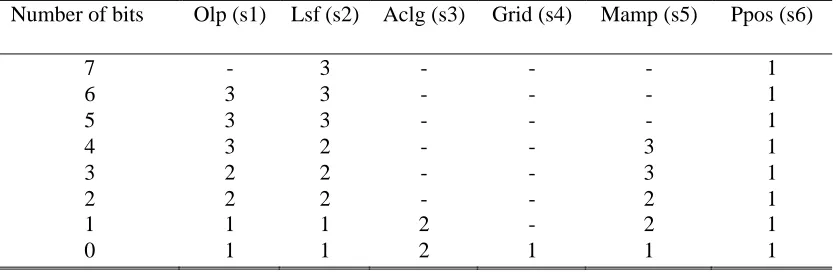
The next step is to determine which speech parameters of inactive frames are suitable for data embedding. All the speech parameters are sorted into three imperceptibility levels of steganography in terms of the distance of signal to
noise ratio (DSNR), which is defined as the difference in signal to noise ratio (SNR) between the original speech and
stego speech. Close analysis of the data in Table 5 shows the imperceptibility levels of steganography for different
parameters of the inactive frames are widely different. So it is possible to choose different parameters and various
parameter bits to embed data on demand of practical applications. In short, the parameters marked with level 1-2 are suitable cover objects for steganography.
Table 5 Imperceptibility levels of steganography in various parameters of inactive frames Number of bits Olp (s1) Lsf (s2) Aclg (s3) Grid (s4) Mamp (s5) Ppos (s6)
7 - 3 - - - 1
6 3 3 - - - 1
5 3 3 - - - 1
4 3 2 - - 3 1
3 2 2 - - 3 1
2 2 2 - - 2 1
1 1 1 2 - 2 1
0 1 1 2 1 1 1
IV. OUR PROPOSED ALGORITHM FOR STEGANOGRAPHY IN INACTIVE FRAMES
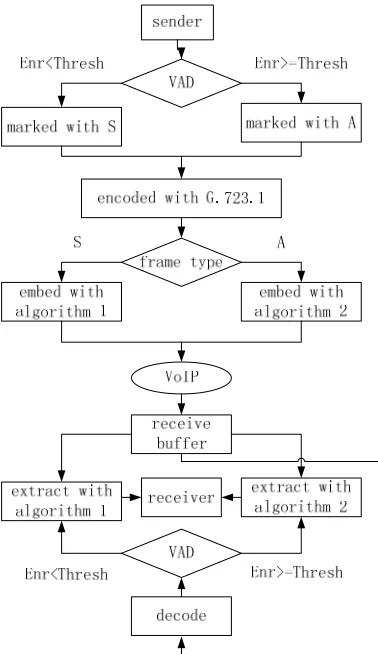
Our steganography model is illustrated in Fig. 2, where VAD, data embedding and audio frame encoding are carried
out sequentially in the speech coding process. The sender samples an audio signal and encodes it into a PCM formatted
audio stream, F = {fi|i = 0, …, N}. The VAD algorithm is then used to detect the inactive voice in the stream. If the
current frame fi is an inactive voice, the frame is marked with S; otherwise, it is marked with A. As a result, the audio stream is divided into a sequence of frames, F = {fiA, fjS|i = 0, …, N1, j = 0, …, N2, N = N1 + N2}. All the frames are then
encoded uniformly by G.723.1 codec into a low bit rate stream, which is called the original speech, F* = {fi*A, fj*S|i =
The low bit rate stream contains two types of frames, inactive frames and active frames. According to the frame type,
two different steganography algorithms are then used, respectively, to embed the secret information, S = (s1, s2, …si, …
sn), si (0, 1), in the stream. That is, the algorithm 1 suggested below is used to embed information in inactive frames; the algorithm 2 presented in [5] is used for steganography in active frames. The low bit rate stream with hidden
information is called the stego speech, denoted by F
f f fi
~ ,..., ~ , ~ ~2 1
, which is transmitted using VoIP. Afterwards, the
receiver receives the stego speech, from which the secret information is finally extracted.
Fig. 2. Flowchart of steganography in inactive and active frames
To sum up, the steganography process has three sub-processes, voice activity detection, data embedding and extracting.
A. Improved VAD Algorithm
Hangover algorithm is normally used for voice activity detection in the speech coding process. To synchronise the
embedding and extraction in steganography, it is very important to keep the VAD result consistent between the sender
and receiver because an inconsistent VAD result will result in errors in the extracting process. Some factors, such as
packet loss, steganography and so on, may have an impact on the VAD result. So an improved VAD algorithm called the residual energy method is suggested below.
The residual energy method adopts the autocorrelation coefficient, which is not affected by the state of the codec, to
detect the inactive voice in the speech. The coefficient vector of the FIR filter on (3), Ano(Z), is computed by
Levision-Durbin algorithm as follows:
0 0 1 ] 0 [ ] 9 [ ] 10 [ ] 9 [ ] 0 [ ] 1 [ ] 10 [ ] 1 [ ] 0 [ 10 1 p p p p p p p p p p E a a R R R R R R R R R (17)
As (17) reveals, the autocorrelation sum of the frame,
R
p[
j
]
, must be computed in advance by using (18) in order toobtain Ano(Z).
1 310
,...,
0
]
[
]
[
t t k k ip
j
R
j
j
R
(18)where Ri[j] denotes the autocorrelation of the subframe i.
As a frame consists of four subframes, each of which has 11 autocorrelation coefficients, all the autocorrelation
subframe, it needs to obtain the data of three continuous subframes. The continuous subframes, (i-1)th, ith, (i+1)th subframes, can be combined to form a sequence, ThreeSubFrmi, which contains 180 samples.
When i=0, the (i-1)th subframe belongs to the previous frame. If the predecessor of the current frame is lost, an error
will occur in calculating the autocorrelation coefficients of the current frame. This is because Hangover algorithm has
memory and error propagation would result from lost or delayed packets. In an attempt to solve this problem, we suggest an improved stateless algorithm for computing the autocorrelation Ri[j]. The algorithm is described in detail
below.
First, ThreeSubFrmHi(n) is computed through windowing/applying a Hamming window in the sequence of frames,
given by
179 ,..., 0 ), ( )
( )
(n ThreeSubFrm n HammiWindown n mH
ThreeSubFr i i (19)
Second, the autocorrelation coefficients of the subframe are computed by
n
j i i
i n ThreeSubFrmH j ThreeSubFrmH n j
R 179
0 ( ) ( )
180 180
1 ]
[ (20)
where n = 0,…,10, which is the number of autocorrelation.
Third, a white noise is used to adjust the first coefficient, Ri [0], as shown in (21):
1024
1025
]
0
[
]
0
[
i
i
R
R
(21)And a binomial window is used to adjust the other coefficients by means of the following equation
0
],
[
]
[
]
[
n
R
n
Binormial
n
n
R
i i (22)be replaced with one of the current frame in (19). Therefore, even if the previous frame is lost, it will not affect the computational results of autocorrelation coefficients for the current frame.
Finally, once all the autocorrelation coefficients of four subframes are obtained for a frame, the residual energy of the
frame can be computed by Yule-Walker equation:
0
0
1
]
0
[
]
9
[
]
10
[
]
9
[
]
0
[
]
1
[
]
10
[
]
1
[
]
0
[
10 1 E
a
a
R
R
R
R
R
R
R
R
R
t t t t t t t t t (23)where Rt[j] (j = 0, …, 10) denotes the autocorrelation coefficients, and aj(j = 1,…,10) are the LPC coefficients. The
algorithm for solving Yule-Walker equation is described below.
Step 1, initialisation: i = 0, E = Rt[j], a
j = 0 and j = 1, …, 10 Step 2, compute k using (24)
E j i R a i R k t j i j t ] [ ] 1 [ 1 1
0
(24)If i – 1 < 0, then [ ] 0 1
1
0
a Rt i jj i
j
Step 3, compute aj by
j i
a k a i j k a j i j j 1 1 (25)
Step 4, compute E as follows:
E
k
E
(
1
2)
(26)A new method of detecting active voices is then suggested here, that is, comparing the threshold with the residual energy of the frame rather than the energy of the frame, as shown in (27)
t t
t t
Thr E
Thr E
if frame Active
if frame Inactive
(27)
where Et denotes the residual energy of the current frame, and Thrtdenotes the threshold, which is an empirical value
obtained from experiments.
The above VAD method that is based on the residual energy instead of the frame energy is only related to the Rt[j] (j =
0,…10) of the current frame when the residual energy is computed. So the improved VAD method is not affected by packet loss, thereby guaranteeing the VAD result to be consistent between the sender and receiver.
B. Embedding Algorithm
The embedding process is divided into four steps as shown in Fig. 2.
Step 1, voice activity detection. The speech with PCM format is divided into frames, F = {f1, …, fi}. Each frame, fi, is
inputted into the VAD detector that adopts the residual energy algorithm above. The frame is marked with ‘A’ if it is
determined to be an active voice; otherwise, the frame is marked with ‘S’. The frames are defined as
else
voice
active
an
is
if
S i i
i A
i i
f
f
f
f
f
(28)
The sequence of the frames with marks is then obtained, given by
Step 2, encoding all frames by G.723.1 codec. Regardless of the frame type, all the frames, fiA and fjS, are encoded by using the standard G.723.1 algorithm with 6.3kbps. The resulting low bit rate audio stream containing active and
inactive frames is then outputted from the codec. The low bit rate audio stream is expressed as
} ,..., 0 , ,..., 1 ) ( ), ( { ) ( } ,..., 0 , ,..., 1 , { 2 1 * 2 1 * * * N j N i f f F F N j N i f f F S j A i S j A i (30)
Step 3, embedding information in frames. According to the frame type, two different steganography algorithms are
used to embed information in the frames. They are expressed as
A i i A i i i S i i S i i i
f
f
S
f
S
f
f
f
f
S
f
S
f
f
* * * * 2 * * * * 1if
)
,
(
~
if
)
,
(
~
(31)The expression 1(fi*, S) means the algorithm 1 is used to embed the secret information S in the inactive frame. The
expression 2(fi*, S) denotes the algorithm 2 is used to embed the information in the active frame. So the stego speech is given by
f f fi
F~ ~1,~2,...,~ (32)
Step 4, encapsulation and sending. The inactive frames and active frames with hidden information are encapsulated in
VoIP packets P{pi |pi
(~fi),i1,...,n}, which are transmitted over the Internet.C. Extracting Algorithm
The extraction of secret information from the stego speech is the inverse process of the embedding algorithm, and it is
Step 1, receiving and decapsulation. The VoIP packets, P = {p1, p2, …, pn}, are received, buffered and then decapsulated by the receiver. The decapsulation algorithm is described as
} ,..., 1 ), ( ~ | ~ {
~ 1
n i
p f
f
F i i
i (33)Step 2, decoding and active frame detection. The buffered frames F~{~fi |i1,...,n} are copied to the decoding buffer and decoded into the PCM formatted audio stream
F
'
{
f
i'|
i
1
,...,
n
}
. The improved VAD method is thenused to distinguish between inactive frames and active frames,
{
,
|
1
,...,
1,
1
,...,
2}
' ' '
N
j
N
i
f
f
F
iSA
i
.Step 3, extracting secret information. The inactive and active frames of the low bit rate audio
stream F~{~fi|i1,...,n} are identified by referring to
{
,
|
1
...
1,
1
,...,
2}
'' '
N
j
N
i
f
f
F
iSA
i
. The secretinformation is then extracted from F~{~fi |i1,...,n} by using Algorithm 1 and Algorithm 2. The Algorithms 1 and 2 are used to extract the secret information from the inactive frames and the active frames, respectively.
V. PERFORMANCE ANALYSIS OF STEGANOGRAPHY IN INACTIVE FRAMES
In our experiments, voice activity detection, data embedding and audio encoding operations were conducted in
sequence for each speech sample by means of the corresponding algorithms detailed in Section IV.
Two parameters, imperceptibility and data embedding capacity, were used to evaluate the performance of the proposed
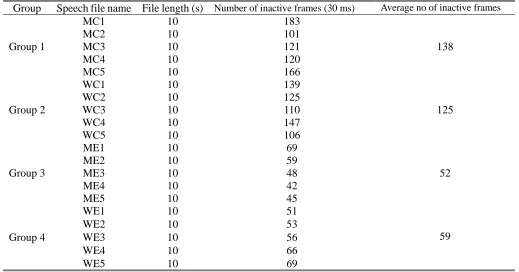
steganography algorithm. Twenty speech samples files with PCM format were employed as cover objects for
steganography, and they are classified into four groups, Group 1, Group 2, Group 3 and Group 4 (Table 6). Secret
was then evaluated, and the data embedding capacity was estimated accordingly for each speech file. The experimental results are discussed in detail below.
Table 6 Numbers of inactive frames of 20 PCM speech files
Group Speech file name File length (s) Number of inactive frames (30 ms) Average no of inactive frames
Group 1
MC1 10 183
138
MC2 10 101
MC3 10 121
MC4 10 120
MC5 10 166
Group 2
WC1 10 139
125
WC2 10 125
WC3 10 110
WC4 10 147
WC5 10 106
Group 3
ME1 10 69
52
ME2 10 59
ME3 10 48
ME4 10 42
ME5 10 45
Group 4
WE1 10 51
59
WE2 10 53
WE3 10 56
WE4 10 66
WE5 10 69
To verify the imperceptibility of steganography in various parameters of inactive frames, the same secret information was embedded in each parameter of the 20 speech files encoded by G.723.1 codec, and the DSNR values of the
resulting stego speech files were then computed. The DSNR is defined as the difference in signal to noise ratio (SNR)
between the original speech and the stego speech, given by
|
|
SNR
bSNR
aDSNR
(34)where SNRb and SNRa arethe signal noiseratios of the original speech and the stego speech, respectively.
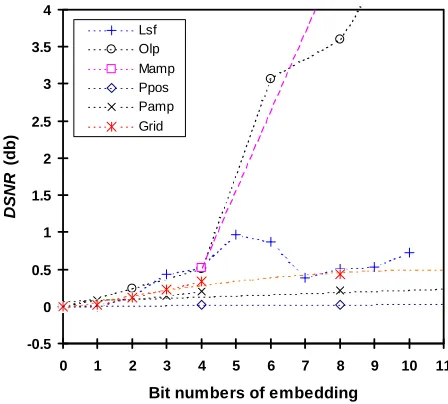
Fig. 3 shows the results of experiments on the 20 speech files listed in Table 6, with the horizontal axis representing the
DSNR value between the original speech and the stego speech was so small that the distortion of the stego speech was unlikely to be perceived as long as appropriate parameter bits of inactive frames were used to embed the secret
information. The overall trend in DSNR was upward with increasing bit numbers of embedding. The parameters with
DNSR values of less than 0.5dB were chosen to embed information.
-0.5 0 0.5 1 1.5 2 2.5 3 3.5 4
0 1 2 3 4 5 6 7 8 9 10 11
Bit numbers of embedding
DSNR
(db)
Lsf Olp Mamp Ppos Pamp Grid
Fig. 3. DSNR for steganography in various parameters of inactive frames
As shown in Fig. 3, when the bit number of hidden information in the Lsf parameter was not more than 3 bits, the DSNR
value was under 0.5 dB; however, DSNR rose significantly when more than 4 bits of information were embedded. This
means no more than 3 bits of information should be embedded in the Lsf parameter. For the Olp and Mamp parameters, even replacing 1 bit in each subframe with secret information (amounting to 4 bits hidden information per frame)
resulted in a larger DSNR value, indicating that both parameters are not suitable for data embedding. By looking at the
DSNR curves in Fig. 3 and the imperceptibility levels of steganography in Table 5, we realised that all bits of the Ppos,
Pamp and Grid parameters could be used to embed information in inactive frames. We therefore selected five
Table 7 Parameters of the inactive frame perfectly suitable for data embedding Parameter name Lsf Grid H_Ppos L_Ppos Pamp Total bits
Number of bits 2 4 13 60 22 101
As a frame of G.723.1 with 6.3 kbps has 192 bits, and the total number of replaceable parameter bits in an inactive
frame is 101 bits, the data embedding capacity ratio Cr for the inactive frame is determined by
Cr = Embedding bits / Total bits = 101/192 = 52.6% (35)
A. Imperceptibility
According to the improved VAD algorithm, we counted the number of inactive frames for each speech file (Table 6),
and encoded these files into low bit rate streams using G.723.1 codec with 6.3kbps. Five parameters of the inactive
frame (Table 7) were selected to embed information. We then evaluated the imperceptibility of the stego speech files in
terms of subjective quality and objective quality.
Subjective Quality
The ‘A/B/X’ test method, ITU P.860 recommendation [12], was utilised to assess the subjective quality of the stego
speech files. This method is described in detail as follows. Suppose there are three types of speech files, denoted by A, B, and X, respectively. A represents the stego speech file containing hidden information, B denotes the original speech
file without any hidden information, and X is either A or B. Five evaluators were employed to listen the speech files,
and then asked to decide whether X is A or B.
Speech samples were chosen randomly from the four groups of speech files listed in Table 6. Each tester made 20 judgments in total, some of which were successful and the other judgments were failures. These failure judgments
Table 8 Percentages of failures using A/B/X test Group 1 Group 2 Group 3 Group 4 Tester 1 55% 30% 50% 55% Tester 2 30% 55% 65% 30% Tester 3 60% 30% 60% 35% Tester 4 55% 45% 50% 60% Tester 5 45% 40% 60% 55% Average 49% 40% 57% 47%
Close analysis of the data listed in Table 8 shows the average percentage of failure judgments was 48.25 percent. This means it was impossible to distinguish the stego speech from the original speech by using the A/B/X testing method
when secret information was embedded in inactive frames. The results also indicate that the subjective quality of the
proposed algorithm for steganography in inactive frames was close to that of the original speech.
Table 9 Testing results with ITU P.862
Group Speech file name MOSLQO value Average MOSLQO
Group 1
MC1 4.250 4.345
MC2 4.384 MC3 4.371 MC4 4.438 MC5 4.305
Group 2
WC1 4.258 4.315 WC2 4.417 WC3 4.278 WC4 4.387 WC5 4.236
Group 3
ME1 4.215 4.379
ME2 4.400 ME3 4.401 ME4 4.431 ME5 4.450
Group 4
WE1 4.413 4.383
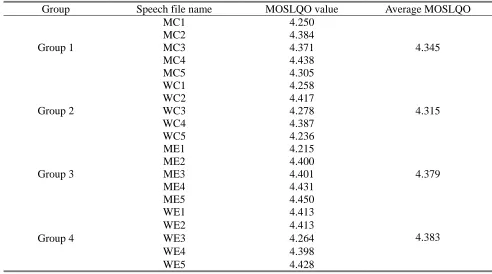
We also adopted the ITU P.862 recommendation to measure the subjective quality of the stego speech. The recommendation describes an objective method for predicting the subjective quality of narrow-band speech codecs. It
uses the perceptual evaluation speech quality (PESQ) value to assess the subjective quality of the stego speech. As the
PESQ is not well matched with mean opinion score (MOS), PESQ-listening quality objective (LQO) is recommended
to evaluate the quality of the stego speech. The PESQ is then mapped to the MOSLQO value. The testing results with
the ITU P.862 method are listed in Table 9.
According to the ITU P.862 standard, the MOSLQO value of the original speech is equal to 4.5. As shown in Table 9,
the average MOSLQO value of the stego speech was estimated to be 4.375. So the difference in MOSLQO between the
original speech and the stego speech was so minor (3.18%) that distortion resulted from steganography in inactive
frames was imperceptible.
Objective Quality
To evaluate further the imperceptibility of the stego speech, we compared the spectrum between the original speech
and the stego speech in the frequency and time domain. For instance, the spectrums of the MC1 speech file having 183
inactive frames with and without hidden information are shown in Fig. 4.
Careful analysis of Fig. 4 shows very little distortion occurred in the time domain as a result of data embedding in
inactive frames; however, we could not perceive any differences between the original speech and the stego speech in
the frequency domain. This suggests steganography in inactive frames at a data embedding rate of 101 bits/frame had
Fig. 4. Spectrum comparisons in the time- and frequency-domain
The mean cepstrum distortion (MCD) metric [11] was used to measure the objective quality of the stego speech. The
MCD is defined as
f
N
k
p
i f
i c i c N
MCD
1 1
2 ~
) ( ) ( 2 10 ln
10 1
(36)
where Nf is the number of audio frames, and c(i) and
~
c
(
i
)
are the cepstrum coefficients of the original speech and thestego speech, respectively, and p is the order of c(i).
Table 10 lists the MCD results of the stego speech files with information embedded in the inactive frames; each average MCD value in the third column is the arithmetic mean of MCDs obtained from six repeated experiments on an original
speech file. As Table 10 shows, all the MCD values and variances of the stego speech files were relatively small,
indicating that the proposed steganography algorithm for embedding information in the inactive frames achieved
Table 10 MCD values of stego speech files
Group Speech file name Average MCD MCD
Mean Variance
Group 1
MC1 1.769
1.353 0.1124
MC2 0.980 MC3 1.157 MC4 1.222 MC5 1.639
Group 2
WC1 1.391
1.268 0.0208
WC2 1.209 WC3 1.164 WC4 1.450 WC5 1.124
Group 3
ME1 0.796
0.613 0.0127
ME2 0.606 ME3 0.620 ME4 0.522 ME5 0.519
Group 4
WE1 0.550
0.644 0.0061
WE2 0.579 WE3 0.655 WE4 0.731 WE5 0.705
B. Data Embedding Capacity
Using (34), we computed the data embedding capacity for each inactive frame. The length of the inactive frame encoded by G.723.1 codec at 6.3kbps was 192 bits; among them, 101 bits were used to embed information. The
following paragraphs describe how to determine the average data embedding capacity for steganography in the active
frames and inactive frames of low bit rate audio streams, respectively.
Suppose the frame number of the original speech is L, and the number of inactive frames is D, then the number of active frames is L-D. And, N bits of the inactive frame, such as N = 101, are used to embed information. Meanwhile, M bits of
the active frame are used to embed information. The average data embedding capacity of the speech file can then be
defined as the data embedding rate v in bits per second (bps), given by
)
192
(
/
)
)
(
(
D
N
L
D
M
L
Several other algorithms, such as CNV [5], MELP [8], [13], and parameter-LSB [9], [14]-[16], were previously
suggested for embedding information in low bit rate audio streams encoded by ITU-T G.723.1. However, these
algorithms are suitable for steganography in active frames only, achieving different levels of data embedding. For
comparison purposes, these previously suggested algorithms and our proposed steganography algorithm were adopted
to embed data in the speech sample files listed in Table 6, respectively. Fig. 5 shows the comparisons in data embedding capacity between our proposed algorithm (denoted as ‘HiF’) and the other algorithms.
0 200 400 600 800 1000 1200 1400 1600 1800
HiF MELP CNV Para.-LSB
Algorithms
Average data
embedding rate
(bps)
Fig. 5. Comparisons in data embedding rates between the proposed algorithm ‘HiF’ and other algorithms
As Fig. 5 shows, the data embedding rate of our proposed algorithm ‘HiF’ was much higher than those of the other
It is worth mentioning that the data embedding capacity of steganography in inactive frames is limited by the number of inactive frames of the original speech file. Research found 30-50 percent of a VoIP session were inactive frames, so
steganography in the inactive frames could attain a higher data embedding rate than other algorithms, which is in
agreement with our experiment results.
VI. CONCLUSIONS
In this paper, we have suggested a high capacity steganography algorithm for embedding data in the inactive frames of
low bit rate audio streams encoded by G.723.1 source codec. The experimental results have shown that our proposed
steganography algorithm can achieve a larger data embedding capacity with imperceptible distortion of the original
speech, compared with other three algorithms. We have also demonstrated that the proposed steganography algorithm
is more suitable for embedding data in inactive audio frames than in active audio frames. However, before the proposed algorithm comes into practical use in covert VoIP communications, it is necessary to explore how to assure the integrity
of hidden messages in the case of packet loss, which shall be the subject of future work.
ACKNOWLEDGMENT
This work was supported in part by grants from the National Natural Science Foundation of China (nos. 60773140 and 60703053) and the National Basic Research Program of China (no. 2007CB310806), and a grant from British
Government (no. ktp6367).
REFERENCES
[2] N. Aoki, “A technique of lossless steganography for G.711 telephony speech,” in Fourth International Conference on Intelligent Information Hiding and Multimedia Signal Processing (IIHMSP2008), pp. 608-611, 2008.
[3] L. Ma, Z. Wu, and W. Yang, “Approach to hide secret speech information in G.721 scheme,” Lecture Notes in Computer Science, vol. 4681, pp. 1315-1324, 2007.
[4] P. Chang, and H. Yu, “Dither-like data hiding in multistage vector quantization of MELP and G.729 speech coding,” in Conference Record of 36th Asilomar Conference on Signals, Systems and Computers, vol. 2, pp. 1199-1203, Nov. 2002.
[5] B. Xiao, Y.F. Huang, and S. Tang, “An Approach to Information Hiding in Low Bit rate Speech Stream,” in IEEE GLOBECOM 2008, IEEE Press, pp. 371-375, Dec 2008.
[6] Z. Wu, W. Yang, and Y. Yang, “ABS-based speech information hiding approach,” Electronics Letters, vol. 39, no. 22, pp. 1617-1619, 2003.
[7] Z. Wu, W. Gao, and W. Yang, “LPC parameters substitution for speech information hiding,” The Journal of China University of Posts and Telecommunications, vol. 16, no. 6, 2009.
[8] C. Krätzer, J. Dittmann, T. Vogel, and R. Hillert, “Design and evaluation of steganography for voice-over-IP,” in Proceedings of IEEE International Symposium on Circuits and Systems, pp. 2397-234, May 2006.
[9] C. Bao, Y.F. Huang, C. Zhu, “Steganalysis of Compressed Speech,” in IMACS Multiconference on Computational Engineering in Systems Applications (CESA), pp. 5-10, Oct 2006.
[10] ITU-T Recommendation G.723.1 Annex A. Available: http://www.itu.int/net/itu-t/sigdb/speaudio/AudioForm-s.aspx?val=1117231, 2009.
[11] N. Kitawaki, H. Nagabuchi, and K. Itoh, “Objective quality evaluation for low-bit-rate speech coding systems,” IEEE Journal on Selected Areas in Communications, vol. 6, no. 2, pp. 242-248, 1988.
[12] Z.M. Lu, B. Yan, and S.H. Sun, “Watermarking combined with CELP speech coding for authentication,” IEICE Transactions on Information and Systems, vol. E88-D, no. 2, pp. 330-334, 2005.
[13] J. Dittmann, D. Hesse, and R. Hillert, “Steganography and steganalysis in Voice over IP scenarios: Operational aspects and first experiences with a new steganalysis tool set,” In Security, Steganography, and Watermarking of Multimedia Contents VII, Electronic Imaging Science and Technology, pp. 607-618, 2005.
[15] H. Tian, K. Zhou, Y.F. Huang, D. Feng, and J. Liu, “A covert communication model based on least significant bits steganography in Voice over IP,” in Proceedings of the 9th International Conference for Young Computer Scientists, pp. 647-652, Nov 2008.