Jessica J. Wong,
BSc, DC, FCCS(C)Luciano Di Loreto,
HBSc, DC2Alim Kara,
BSc, DC2Kavan Yu,
BSc, DC2Alicia Mattia,
BSc, MD3David Soave,
MSc4Karen Weyman,
MD, MEd, CCFP, FCFP5Deborah Kopansky-Giles,
BPHE, DC, FCCS, MSc4,6Objective: To assess second-year medical students’ views on chiropractic.
Methods: A three-step triangulation approach was designed, comprising a 53-item survey, nine key informant interviews and one focus group of 8 subjects. ANOVA was used to assess attitude-response survey totals over grouping variables. Constant comparison method and NVivo was used for thematic analysis. Results: 112 medical students completed the survey (50% response rate). Subjects reporting no previous chiropractic experience/exposure or interest in learning about chiropractic were significantly more attitude-negative towards chiropractic. Thematically, medical students viewed chiropractic as an increasingly evidence-based complementary therapy for low back/ chronic pain, but based views on indirect sources. Within formal curriculum, they wanted to learn about clinical conditions and benefits/risks related to treatment, as
1Department of Graduate Studies, Canadian Memorial Chiropractic College, Toronto, Ontario, Canada 2Private Practice
3Department of Neurosciences, University of Western Ontario, London, Ontario, Canada
4Department of Graduate Education and Research, Canadian Memorial Chiropractic College, Toronto, Ontario, Canada 5Department of Family and Community Medicine, Faculty of Medicine, University of Toronto, Toronto, Ontario, Canada 6Department of Family and Community Medicine, St. Michael’s Hospital, Toronto, Ontario, Canada
©JCCA 2013
Correspondence to: Jessica J. Wong, Graduate Studies, Canadian Memorial Chiropractic College at 6100 Leslie Street, Toronto, Ontario, Canada M2H 3J1; telephone: 416-482-2340 ext 208; email: [email protected]
Funding: This project received private funding from Independent Assessment Services, Toronto, Ontario, which funded the cost of the appreciation gift cards for key informant and focus group participants. This project was awarded the Student Research Award from the Ontario Chiropractic Association and the Canadian Memorial Chiropractic College, and the First Prize Student Poster Award at the World Federation of Chiropractic Congress 2011.
Competing Interests: The author AM was a medical student at the University of Toronto but was not a part of the study population. The author DKG is a guest lecturer at the Faculty of Medicine of the University of Toronto. The author KW is a faculty member in the Faculty of Medicine, University of Toronto.
Objectif : Évaluer les opinions des étudiants de deuxième année de médecine sur la chiropratique. Méthodologie : Une approche de triangulation en trois étapes a été conçue, comprenant un questionnaire de 53 points, neuf entretiens avec des informateurs clés et un groupe de réflexion de 8 participants. La méthode analytique ANOVA a été utilisée pour évaluer le nombre de réponses d’un sondage sur les attitudes par les variables de regroupement. La méthode de comparaison constante et le logiciel NVivo ont été utilisés pour l’analyse thématique.
Introduction
Over the last two decades, an increasing number of North Americans have sought out complementary and alterna-tive medicine (CAM) to address their health concerns.1-6
Chiropractic was the most frequently accessed CAM therapy in 2005, with a utilization rate of 11% reported by Statistics Canada, for addressing musculoskeletal con-ditions.4,7-9 This is likely due to high patient satisfaction
with the quality of care10,11, and growing evidence around
the effectiveness7,12-17 and safety18,19 of chiropractic
treat-ments.
Recent efforts in Canada and worldwide have empha-sized the importance of interprofessional education (IPE) and collaboration to reform the healthcare system.20-22 In
2010, the World Health Organization produced a frame-work to position interprofessional collaboration in edu-cational and practice settings as a strategy for mitigating global health workforce crises.20 In Canada, a focus on
health professional education has moved academic pro-grams toward curricular reforms involving IPE.23
Simi-lar international models have increasingly appeared in peer-reviewed literature and have been incorporated into governmental policies24, with researchers examining
how health professionals interact with and perceive each other. Studies have explored how medical students view CAM25-28, noting that medical students tend to receive less
CAM education than other healthcare students28, despite
having an interest to learn more about CAM25-27. Medical
students26,28-34 and practicing physicians35 alike
recom-mended the inclusion of CAM education within formal-ized medical curriculum especially in the early years6, 36-38,
and this has been shown to improve attitudes towards CAM25,36,39. With increasing utilization and research with
chiropractic, some view the profession as moving away from CAM and towards mainstream healthcare.39,40
A literature search in the Medline database (inception to 2008) was performed, using a combination of MeSH terms and keywords related to medical students, chiro-practic and CAM. Reference lists of relevant articles were hand searched for additional articles. A review of the lit-plus en lit-plus comme une thérapie complémentaire fondée sur des preuves, pour la lombalgie ou les douleurs chroniques, mais ces opinions étaient basées sur des sources indirectes. Dans le contexte d’un programme d’études officiel, les étudiants voulaient en apprendre davantage sur les conditions cliniques et les avantages et risques liés au traitement, car une plus grande compréhension était nécessaire pour l’aiguillage des patients futurs.
Conclusion : Les résultats mettent en évidence l’importance de l’exposition à la chiropratique dans le contexte du programme d’études officiel en médecine pour aider à favoriser la collaboration future entre ces deux professions.
m o t s c l é s : attitudes, médical, étudiants, sondage, interprofessionnel
greater understanding was needed for future patient referrals.
Conclusion: The results highlight the importance of exposure to chiropractic within the formal medical curriculum to help foster future collaboration between these two professions.
erature indicated that there were no studies that explored medical students’ views on chiropractic independent of other CAM therapies at the start of this study. Therefore, the purpose of this study was to assess the attitudes, know-ledge and perspectives of medical students specifically to-wards chiropractic. Understanding how medical students perceive chiropractic may help facilitate collaboration and enhance interprofessional relationships between the two professions in the long term.
Methods
This study utilized a mixed-methods design with three data collection approaches: a survey questionnaire, key informant interviews and a focus group. The purpose of the three-step triangulation approach was to gather rich and in-depth quantitative and qualitative data on poten-tially diverse views towards chiropractic, with increasing-ly detailed probes between the key informant interviews and focus group. First, a 53-item survey was developed by the research team to obtain overall attitude, knowledge and perspective scores on chiropractic and then adminis-tered to a group of second year medical students. Infor-mation from the survey results helped to inform the semi-structured interview guide used in the interviews. The views of medical students to chiropractic were then quali-tatively assessed with key informant interviews, which provided an opportunity for medical students to clarify their personal views.41 Finally, a focus group of 8 medical
students was convened to gather thoughts on chiropractic when presented with potentially differing views of their colleagues.
The target population was second year, pre-clerkship medical students (n=224) in a four year program at the Faculty of Medicine, University of Toronto (UT). Second year students were selected because, at that point, they had one year of formalized education in medical school but no formal curriculum on chiropractic. Previous lit-erature also suggests that early year (years 1-2) medical students are more likely to be enthusiastic about learning CAM than later years (years 3-4).29,36
Inclusion criteria included willingness to participate and fluency in English. Exclusion criteria included failure to provide written consent. The study protocol underwent expedited research ethics board review with approvals from UT and the Canadian Memorial Chiropractic Col-lege (CMCC) in Toronto, Canada.
Quantitative Stage 1 – Survey:
The methods described by Boynton (2004) and Boyn-ton & Greenhalgh (2004) outlining processes of creat-ing, piloting and administering questionnaires were util-ized.42,43 The study’s self-administered questionnaire was
developed through a literature review to discern thematic areas suggested by current studies (Appendix) on medical students’ perceptions of CAM therapies. The question-naire was then reviewed by an experienced qualitative researcher who consulted with the research team and pre-tested on 4 medical students who were not a part of the study population, resulting in modifications to the order and wording of questions. The research team introduced the survey to medical students following a second year community health lecture with the course director’s per-mission. Demographic information (sex and age) was col-lected to describe the study population, without nominal idenitifers. To maintain participants’ anonymity, surveys were returned via a dropbox at the classroom exit.
Qualitative Stages 2 and 3:
Key informant and focus group participants had volun-teered after an approved classroom announcement was made and subsequent emails were sent to university email accounts. Semi-structured question guides were developed through a literature review and expert advice from an experienced qualitative researcher who consulted with the research team, then revised based on trends from survey results. The qualitative researcher also trained two investigators (JJW and LD) in conducting key informant interviews. Written informed consent was obtained from each participant to participate and audiotape the inter-views. Data were transcribed verbatim into written text from the audiotape. Gift cards of $20.00 (with courtesy lunch at the focus group) were provided to each partici-pant in appreciation of their time.
Stage 2 – Key Informant Interviews:
data was obtained.41 Saturation (identified through
simul-taneous and iterative sampling, data collection and analy-sis) was achieved at 9 key informants. After the first 3 interviews, interviewers reviewed all responses and deter-mined, by consensus, that one additional interview probe was needed to elaborate on an early trend. The additional probe was, “Do you think it is important for your medical school curriculum to include education on chiropractic?” The interviewers did not reveal the participants’ identi-ties, but instead assigned pseudonyms to each participant during the transcription process.
Stage 3 – Focus Group:
A one-hour focus group was conducted with 8 medical students, as research suggests that focus groups should be composed of 6-10 individuals.44 This format can elicit
ideas that participants might not have considered on their own and inspire additional thoughts.44 The purpose of this
focus group was for medical students to discuss recom-mendations for addressing possible barriers to collabora-tion, in light of differing views of their colleagues. For the most comfortable setting possible, the focus group was conducted in a private setting on UT campus by a re-search investigator (AM) who was a medical student and not a part of the study population.
A copy of the survey and semi-structured questions for the key informant interviews and focus group is available by contacting the principal investigator.
Statistical Analysis – Survey Questionnaire:
Descriptive statistics (frequencies) were recorded for sex, age and current level of chiropractic understanding. De-termined by team consensus, the questionnaire included 15 question-items assessing knowledge of chiropractic, 4 question-items assessing perspective towards chiro-practic and 30 question-items assessing attitude towards chiropractic. These questions utilized a 5-point Likert scale of strongly disagree(1), disagree(2), undecided/ don’t know(3), agree(4) and strongly agree(5). From the 30 question-items assessing ‘attitude towards chiroprac-tic’, response-totals for attitude-positive (agree/strongly agree), attitude-negative (disagree/strongly disagree) and undecided/don’t know were obtained for each individ-ual to formulate summary measures of attitudes towards chiropractic.
ANOVA was used to assess between-group
differen-ces on the attitude-response totals over various grouping variables. Since the response totals for attitude (positive, negative and undecided) were stratified and compared over 10 different grouping variables, a Bonferonni cor-rected p value of 0.005 was used as the standard for sta-tistical significance. Additionally, where a significant p value (<0.005) was found on a grouping variable with 3 or more levels, post hoc comparisons were done using t tests with a further adjusted significance level of 0.005/ (# of levels in grouping variable). R-Project quantitative software was used to perform the analysis.45
Thematic Analysis – Key Informant Interviews and Focus Group:
Each transcript was independently analysed by two in-vestigators (JJW and LD) using the constant comparison method, where the data was compared and contrasted for significant phrases and sentences.46 The two researchers
met to harmonize individual interpretations until consen-sus was reached on themes, categories and sub-categor-ies. The open coding structure and transcript data were entered into NVivo (v2.0, QSR International Pty. Ptd., Melbourne) for data organization and retrieval.
Results
Quantitative Results:
Demographics:
Of the 224 potential subjects, 112 (50% response rate) completed the survey. There was a relatively equal male (47%) and female (53%) gender split, with the major-ity (94%) of participants in the age range of 20-29 years (Table 1).
Table 1.
Demographic Data (N =112 respondents)
N %
Gender Male 53 47.3
Female 59 52.7
Age 20-24 64 57.1
25-29 42 37.5
30-34 5 4.5
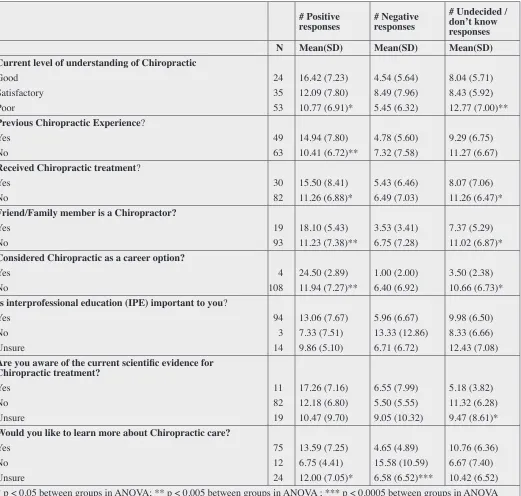
Table 2.
Attitude towards Chiropractic:
Positive, Negative and Undecided/Don’t Know Responses by Grouping Variables (N=112 respondents)
# Positive
responses # Negative responses # Undecided /don’t know responses
N Mean(SD) Mean(SD) Mean(SD)
Current level of understanding of Chiropractic
Good 24 16.42 (7.23) 4.54 (5.64) 8.04 (5.71)
Satisfactory 35 12.09 (7.80) 8.49 (7.96) 8.43 (5.92)
Poor 53 10.77 (6.91)* 5.45 (6.32) 12.77 (7.00)**
Previous Chiropractic Experience?
Yes 49 14.94 (7.80) 4.78 (5.60) 9.29 (6.75)
No 63 10.41 (6.72)** 7.32 (7.58) 11.27 (6.67)
Received Chiropractic treatment?
Yes 30 15.50 (8.41) 5.43 (6.46) 8.07 (7.06)
No 82 11.26 (6.88)* 6.49 (7.03) 11.26 (6.47)*
Friend/Family member is a Chiropractor?
Yes 19 18.10 (5.43) 3.53 (3.41) 7.37 (5.29)
No 93 11.23 (7.38)** 6.75 (7.28) 11.02 (6.87)*
Considered Chiropractic as a career option?
Yes 4 24.50 (2.89) 1.00 (2.00) 3.50 (2.38)
No 108 11.94 (7.27)** 6.40 (6.92) 10.66 (6.73)*
Is interprofessional education (IPE) important to you?
Yes 94 13.06 (7.67) 5.96 (6.67) 9.98 (6.50)
No 3 7.33 (7.51) 13.33 (12.86) 8.33 (6.66)
Unsure 14 9.86 (5.10) 6.71 (6.72) 12.43 (7.08)
Are you aware of the current scientific evidence for Chiropractic treatment?
Yes 11 17.26 (7.16) 6.55 (7.99) 5.18 (3.82)
No 82 12.18 (6.80) 5.50 (5.55) 11.32 (6.28)
Unsure 19 10.47 (9.70) 9.05 (10.32) 9.47 (8.61)*
Would you like to learn more about Chiropractic care?
Yes 75 13.59 (7.25) 4.65 (4.89) 10.76 (6.36)
No 12 6.75 (4.41) 15.58 (10.59) 6.67 (7.40)
Unsure 24 12.00 (7.05)* 6.58 (6.52)*** 10.42 (6.52)
Attitude towards Chiropractic:
Table 2 shows the effect of different grouping variables on totals for attitude-positive, attitude-negative and un-decided/don’t know responses. Respondents self-reported a wide range of ‘level of understanding of chiropractic’, with 24 respondents (21.4%) selecting ‘good’, 35 spondents (31.3%) selecting ‘satisfactory’ and 53 re-spondents (47.3%) indicating ‘poor’. Individuals with a poor ‘current level of understanding of chiropractic’ had significantly more undecided/don’t know responses than their counterparts (p<0.005). However, results of post hoc multiple comparisons of ‘current level of understand-ing of chiropractic’ on undecided/don’t know responses totals yielded no specific pairwise differences following further adjustment. Individuals who reported previous experience with chiropractic were significantly more atti-tude-positive (p<0.005). Specifically, those with a friend or family member who was a chiropractor (p<0.005), considered chiropractic as a career option (p<0.005) or had received chiropractic treatment (p<0.05) were more attitude-positive towards chiropractic. With regards to the question “Would you like to learn more about Chiroprac-tic care?”, post hoc comparisons identified individuals that responded “No” as being significantly different from individuals that responded “Yes” (p<0.0001) and uals that responded “Unsure” (p<0.0001). Thus, individ-uals with no interest in learning more about chiropractic care were significantly more attitude-negative towards the profession.
Knowledge on Chiropractic:
Fourteen items were used to assess subjects’ knowledge regarding chiropractic care/treatment. Participants were asked to select agree, disagree or undecided/don’t know about various types of care (e.g. acute, chronic, prevent-ive) and types of treatment modalities (e.g. joint manipu-lation, soft tissue therapy, exercise prescription) pro-vided by chiropractors. When asked about the types of treatment chiropractors can provide within their scope of practice, subjects either indicated an incorrect response or selected undecided/didn’t know 50.4% of the time. Sub-jects lacked knowledge in the following care/treatment areas: nutritional information (84%), acute care (74.1%), acupuncture (72.3%), preventative care (67.2%), and therapeutic modalities (66.1%). 9.9% of respondents indi-cated that they were aware of current scientific evidence
on chiropractic care and treatment, while 73.2% indicated that they were not aware and 16.9% were unsure if they were aware.
Perspective on Chiropractic:
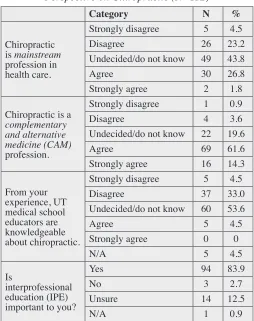
Four questions explored the perspectives of medical stu-dents on chiropractic. These were differentiated from at-titude questions on the basis that ‘perspective’ responses did not have a positive or negative connotation, but were neutral instead. These questions explored whether med-ical students considered 1) chiropractic a mainstream or CAM profession (2 questions) 2) their medical school educators knowledgeable regarding chiropractic and 3) IPE as important (Table 3). In regards to whether chiro-practic was a mainstream or CAM profession, there were 21/112 (18.8%) respondents who endorsed both beliefs.
Table 3.
Perspective on Chiropractic (N=112)
Category N %
Chiropractic is mainstream profession in health care.
Strongly disagree 5 4.5
Disagree 26 23.2
Undecided/do not know 49 43.8
Agree 30 26.8
Strongly agree 2 1.8
Chiropractic is a
complementary and alternative medicine (CAM)
profession.
Strongly disagree 1 0.9
Disagree 4 3.6
Undecided/do not know 22 19.6
Agree 69 61.6
Strongly agree 16 14.3
From your experience, UT medical school educators are knowledgeable about chiropractic.
Strongly disagree 5 4.5
Disagree 37 33.0
Undecided/do not know 60 53.6
Agree 5 4.5
Strongly agree 0 0
N/A 5 4.5
Is
interprofessional education (IPE) important to you?
Yes 94 83.9
No 3 2.7
Unsure 14 12.5
Qualitative Results:
Participants’ use of specific dialogue in the key informant interviews and focus group provided a context for assess-ing their attitudes, knowledge and perspectives toward chiropractic. The following themes were identified:
Exposure to and knowledge on chiropractic:
The subjects’ knowledge of chiropractic and its education process was limited to the program length (4 years), gen-eral anatomy and treatment technique components. They were not familiar with other courses in the chiropractic curriculum. Some participants viewed the intensity and basic course work of chiropractic training similar to that of medical students. Their limited chiropractic knowledge was largely based on indirect sources of information, such as conversations with friends, small group tutors and in student clubs, without formal lectures on chiropractic in their medical curriculum up to that point in second year. Some experiences gave them a negative impression of chiropractic.
“I do remember hearing some injuries that can be caused when people have some specific condition, but I don’t think we’ve ever had anything really too positively that I can recall in lecture.” (FG:23)
Chiropractic in medical education:
Participants were interested in learning about chiroprac-tic in their undergraduate medical education, parchiroprac-ticularly regarding conditions that chiropractors treat, rather than intricacies of treatment methods. Barriers to the inclusion of chiropractic in the curriculum were thought to include lack of emphasis from the medical school administration and lack of time amidst the heavy curricular workload. “Our professors or curriculum may not be recogniz-ing the importance of givrecogniz-ing the value of learnrecogniz-ing what chiropractic does and the value to us, so I think part of the barriers would be advocating toward those who develop the curriculum to engrain it in our syllabus.” (FG:141)
To address these barriers, some students suggested that the information should be taught in appropriate residency specialties, such as family medicine and orthopaedics. Participants noted that the school’s IPE program did not formally include chiropractic and may be a well-suited avenue for chiropractic information.
“We did have an interprofessional development day…
and there weren’t any alternative medicine or chiroprac-tors, and I feel that would be a good opportunity to intro-duce students to it.” (KI 6:284)
Role of chiropractic in health care:
The medical students felt that the chiropractic profession was becoming more evidence-based, but were not fully aware of the chiropractic literature. There was mention of concern regarding safety issues around chiropractic. “If I were the practicing physician, I may not choose (chiropractic) treatment for a patient just because I don’t understand it. If I understood the risks and benefits to particular patients, I would definitely have a positive at-titude towards it and know when to access it.” (KI 7:138) All focus group participants agreed that chiropractic belonged in CAM. The reasons behind this were unclear, as some students mentioned it was because chiropractic was not formally taught in the medical curriculum, while others again questioned the evidence and legitimacy be-hind chiropractic. There was confusion surrounding the differences between chiropractic and CAM.
“(Chiropractic) is not really part of the curriculum, so I don’t really consider it conventional mainstream.” (FG:224)
“It’s been told before in lecture that CAM is not ne-cessarily based on randomized-controlled trials and evi-dence.” (FG:74)
Chiropractic in clinical settings:
In practical settings, the respondents viewed chiropractors as practitioners commonly treating low back and chronic pain with spinal manipulation. Most subjects were aware that chiropractors performed manipulations, but were not familiar with the details of this procedure. There was confusion around the differences in educational training, treatment, and government funding between chiroprac-tors, physiotherapists, and registered massage therapists. “The focus of chiropractors is the spine specifically versus physiotherapists would work on virtually anything, and not limited to the spine…though I don’t know that’s an exclusion per se.” (FG:238)
To transition from education to practice, participants felt that the benefits of learning about and collaborating with chiropractors were based around patient-centred principles. The understanding of chiropractic and its evi-dence was associated with greater comfort in referring fu-ture patients, but subjects wanted to know when to refer and for what conditions.
“If (chiropractors) are part of the same healthcare team then it would be easier for the patient to access all the services in the same place and part of the same group of circle of care.” (FG:274)
Discussion
The majority of respondents considered chiropractic a CAM therapy that was becoming more evidence-based. A number of respondents (18.8%) endorsed both beliefs that chiropractic was a mainstream and CAM therapy, which may reflect the increasing utilization and research with chiropractic that has shifted the perception of the profes-sion from CAM and towards mainstream healthcare.39,40
No previous experience with chiropractic or interest in learning about chiropractic were significantly associat-ed with more negative attitudes towards the profession. When asked about scope of practice and treatment modal-ities of chiropractors, approximately half of respondents had either incorrect or undecided responses. This limited chiropractic knowledge was mainly based on personal conversations or informal discussions at school, some of which promoted a negative impression of chiropractic. Generally, most respondents were unaware of the cur-rent scientific evidence on chiropractic and wanted to learn more about the profession. In key informant and focus group discussions, barriers to the inclusion of chiropractic in the medical curriculum were hypothesized as lack of time, heavy course load and perceived lack of importance given by faculty. The participants suggested that IPE and appropriate residency specialties, such as family medi-cine and orthopaedics, were suitable routes for adding additional chiropractic content into the medical curricu-lum. In one-on-one and group discussions, the majority of participants wanted to learn about conditions deemed most appropriate for chiropractic treatment by its reported effectiveness and safety in research literature. The main motivating factor behind learning about chiropractic was the facilitation of appropriate referrals to chiropractors for patient-centred care.
These findings generally reflect trends in other research that examined medical students’ view on chiropractic amid other CAM therapies. Similar to a 2007 paper-and-pencil survey of 260 (response rates were 65% of all first year students, 91% of all second year students) early year medical students, the majority of subjects wanted edu-cation on chiropractic (deemed the second most desired CAM profession to learn about, after acupuncture) to suf-ficiently advise patients and refer for its use.25 In previous
studies, medical students often relied on external sources for information15, and wanted formal CAM education in
the medical curriculum26,28-34, as increased knowledge has
been associated with more positive attitudes towards that profession25,36,39. To address this, Wetzel et al. (2003)
sug-gested that medical curricula define a core curriculum on CAM, which incorporates CAM into patient cases in stan-dard lectures and offers student exchanges with other pro-fessions for experiential learning.47 This is a multi-faceted
approach that has also been suggested for IPE.48 Having
identified heavy course load and lack of time as barriers, which parallels the concerns of this study’s respondents, this method may be used to introduce chiropractic in an integrated and longitudinal fashion into existing medical curricula.
Specifically, respondents wanted information on the evidence and role of chiropractic treatments for musculo-skeletal conditions, particularly spinal manipulation. This was also reflected in the number of undecided/don’t know responses in the questionnaire, though the percentage of these responses did not vary much across Table 2, which suggests that these respondents were the same individuals. Since spinal manipulation is generally supported by prac-tice guidelines49,50, systematic reviews51-54 and literature
synthesis55 for musculoskeletal complaints, one barrier to
chiropractic understanding may be the limited exposure to its evidence. Safety concerns by some medical students in the study’s qualitative sessions may also reflect the lack of exposure to most recent evidence, particularly around stroke. Although earlier reports suggested an association with vertebrobasilar artery dissection and cervical ma-nipulation56-58, recently published high-quality
methodo-logical studies have failed to confirm this association21,22.
In 2008, an ecological study failed to confirm an asso-ciation between increased chiropractic use and increased risk of stroke18, while a population-based case-control
between chiropractic care and increased risk of stroke as compared to primary care19. In light of feedback from
our participants, it is recommended that evidence-based research on chiropractic efficacy49-54,59-64, safety18,19, and
cost-effectiveness16,62-64 should be highlighted in course
lectures on chiropractic65-67.
With respect to scope of practice, the respondents perceived chiropractors as mostly treating low back and chronic pain with spinal manipulation, but remained un-certain about when to refer patients to chiropractors. This lack of clarity regarding the role of chiropractors in col-laborative practice may become a barrier to collaboration in the clinical setting. This was also suggested by Branson in his 2004 evaluation of a 10-year hospital-based chiro-practic program.68 In a 2009 mail survey of 487 (49%
response rate) orthopaedic surgeons in North America, Busse et al also found that orthopaedic surgeons had di-verse views on chiropractic, ranging from extremely nega-tive to very posinega-tive, and only 51.4% of surgeons referred some patients to chiropractors each year, mainly due to patient request.35 Improved understanding of chiropractic
training and evidence for chiropractic treatment may help medical students later develop a trusting relationship and patient referral network with chiropractors, which is in-tegral to successful collaboration.69 The main reason that
our respondents wanted to learn about chiropractic was to improve patient care, and appropriate exposure is sug-gested to positively impact their future collaboration with chiropractors.29
Other authors have postulated that until education about chiropractic is implemented early in the medical curriculum, medical students may be susceptible to devel-oping negative attitudes.29-36 Parsell et al identified more
negative attitudes at later stages of training and, therefore, education about chiropractic early in the curriculum37 or
at younger years38 may help minimize this occurrence70.
Since participants expressed a desire to learn, an issue may be that students interested in IPE need support from faculty, as recommended by Hoffman et al.71 A lack of
for-mal curriculum may further impede positive learning, as reflected in reports of “hidden curriculum” in medicine72
and marginalization of minor professions by medicine73.
Hidden or informal curriculum occurs when knowledge regarding certain topics is obtained through unintended lessons in education that may promote unplanned in-equalities.74 The negative discussions expressed by this
study’s participants coincide with findings of Busse et al, where 28.6% of orthopaedic surgeons had been exposed to information on chiropractic during medical school, of which only 7.2% reported favourable information.35
This is likely to have further implications in clinical practice. A recent qualitative study, involving focus groups of health professionals, suggested a need for formalized and standardized teaching in interprofessional collabora-tion at the student level to enable future health profession-als to work in teams.75 This need to develop collaboration
among different health care students may begin with ad-dressing negative attitudes that may be present prior to their medical education or start early on in their training.
Strengths and Limitations:
To the research team’s knowledge and based on a thor-ough literature search, there are no existing studies that specifically explore medical students’ views on chiroprac-tic independent of CAM. However, this study has limita-tions. First, the results may have limited generalizability to medical students as a whole. A survey response rate of 50% (112/224) does not allow for confidence that non-responders would have had similar responses to those provided by responders, though their views were likely explored in the key informant and focus group discus-sions. Medical schools similarly structured to UT may have comparable results, whereas schools that integrate chiropractic in the formal academic setting may yield a different outcome. For instance, the Osher Institute at the Harvard Medical School has been reported to use an in-novative integrated care team that includes a chiroprac-tor among other complementary and mainstream profes-sions, which may influence the model of care at its med-ical school.76
inform-ant interviews or focus groups alone may yield varying results.
Future Direction:
The research team is currently examining the same group of medical students’ attitudes after an educational inter-vention (a one-hour lecture) about chiropractic provided in their third year, to identify any future changes in at-titudes longitudinally.29 This study’s results will act as
baseline views on chiropractic in the second study. In an earlier study, a one-hour lecture was found to be effective in changing attitudes of students.26 Based on our results, it
is important that this one-hour lecture covers the evidence supporting chiropractic treatments for certain conditions, scope of practice and the role of chiropractors in health-care teams. Eisenberg et al. found that when healthhealth-care providers were trained together, it was beneficial to future collaboration in practice1,2, so the lecture may ideally
in-clude other healthcare students and utilize an interprofes-sional context.
Future research could include a number of possible directions. The study’s mixed-methods approach could be used by others when examining interactions among a variety of healthcare professions. Further research could also be conducted once students enter into their clinical training years to identify attitudes, knowledge and per-spective of medical students towards chiropractic when transitioning from education to practical application in clinical practice. The one-to-one associations found in this study may have the potential to build a model in fu-ture studies that explore how the grouping variables af-fect one another when combined. Finally, further research evaluating the effectiveness of this three-step triangula-tion methodological approach may also be of value.
Conclusion
The medical students participating in this study expressed an interest in learning about the best available evidence behind chiropractic treatments in order to better under-stand the role of chiropractors within the healthcare sys-tem. This emphasizes the importance of having chiroprac-tic formally taught in the early years of medical curricula and as a part of an IPE program. Further, this formal edu-cation will aim to minimize the need for medical students to rely on anecdotal or informal sources of information on chiropractic, and provide a consistent, evidence-based
and accurate understanding of the profession. Improving interprofessional relations between medicine and chiro-practic through educational reform and research has the potential of benefiting the patient in practice. Ultimate-ly, one can hope to ensure best patient-centred care by empowering future physicians with the understanding of when to collaborate and appropriately refer patients to chiropractors.
Acknowledgements:
The research team would like to acknowledge the con-tributions of: Dr. Ian Johnson at the University of To-ronto (UT) with respect to the research ethics submis-sion and survey administration; Natasha Kachan at UT for her input on qualitative methodology and training in conducting key informant interviews; Daniel Rosenfield at UT for his input on study design and training in con-ducting focus groups; and Dr. Silvano Mior at the Can-adian Memorial Chiropractic College for his guidance on the use of NVivo software.
Authors’ contributions:
Authors JJW, LD, AK, KY, AM, and DKG contributed to the design of the study, data analysis, and drafting of the manuscript. Authors DS and KW contributed to data analysis and interpretation, and critical revision of the manuscript. All authors have read and approved the manuscript as submitted.
Abbreviations:
CAM: Complementary and Alternative Medicine; IPE: Interprofessional Education; UT: University of Toronto References
1. Eisenberg DM, Kessler RC, Foster C, Norlock FE, Calkins DR, Delbanco TL. Unconventional medicine in the United States. Prevalence, costs, and patterns of use. N Engl J Med. 1993, 328(4):246-252.
2. Eisenberg DM, Davis RB, Ettner SL, Appel S, Wilkey S, Van Rompay M, Kessler RC. Trends in alternative medicine use in the United States, 1990-1997: results of a follow-up national survey. JAMA. 1998; 280(18):1569-1575.
3. Astin JA. Why patients use alternative medicine: results of a national study. JAMA. 1998; 279(19):1548-1553. 4. Park J. Use of alternative health care. Statistics Canada.
2005; 16(2):39-42.
in Canada: use and public attitudes. Public Policy Sources. 1999; 21: 1-31.
6. Esmail N. Complementary and alternative medicine in Canada: Trends in use and public attitudes, 1997-2006. Public Policy Sources. 2007; 87: 1-53.
7. Shekelle PG, Markovich M, Louie R. Factors associated with choosing a chiropractor for episodes of back pain care. Medical Care. 1995; 33:842-850.
8. Hurwitz EL, Coulter ID, Adams AH, Genovese BJ, Shekelle PG. Use of chiropractic services from 1985 through 1991 in the United States and Canada. Am J Public Health. 1998; 88: 771-6.
9. Karpman RR. Musculoskeletal disease in the United States: who provides the care? Clin Orthop Relat Res. 2001; 385: 52-6.
10. Breen A, Breen R. Back pain and satisfaction with chiropractic treatment: what role does the physical outcome play? Clin J Pain. 2003; 19(4): 263-8. 11. Sherman KJ, Cherkin DC, Connelly MT, Erro1 J,
Savetsky JB, Davis RB, Eisenberg DM. Complementary and alternative medical therapies for chronic low back pain: What treatments are patients willing to try? BMC Complement Altern Med. 2004; 4:9.
12. Nyiendo J, Haas M, Goldberg B, Sexton G. Pain, disability, and satisfaction outcomes and predictors of outcomes: a practice based study of chronic low back pain patients attending primary care and chiropractic physicians. J Manipulative Physiol Ther. 2001; 24(7):433-439.
13. Bronfort G, Haas M, Evans RL, Bouter LM. Efficacy of spinal manipulation and mobilization for low back pain and neck pain: a systematic review and best evidence synthesis. Spine Journal. 2004; 4:335–356.
14. Haldeman S, Carroll LJ, Cassidy JD, Schubert J, Nygren A. The Bone and Joint Decade 2000-2010 Task Force on Neck Pain and its Associated Disorders: executive summary. Spine Journal. 2008; 33(4S): S5-7.
15. Giles LGF, Muller R. Chronic spinal pain a randomized clinical trial comparing medication, acupuncture, and spinal manipulation. Spine. 2003; 28:1490-1503. 16. Manga P, Angus D, Papadopoulos C, Swan W. The
effectiveness and cost-effectiveness of chiropractic management of low-back pain, Kenilworth Publishing, Ottawa, 1993.
17. Meade TW, Dyer S, Browne W, Frank AO. Randomised comparison of chiropractic and hospital outpatient management for low back pain: results from extended follow up. BMJ. 1995; 311: 349-251.
18. Boyle E, Côté P, Grier AR, Cassidy JD. Examining vertebrobasilar artery stroke in two Canadian provinces. Spine. 2008; 33(4 Suppl): S170-5.
19. Cassidy JD, Boyle E, Côté P, He Y, Hogg-Johnson S, Silver FL, Bondy SJ. Risk of vertebrobasilar stroke and chiropractic care: results of a population-based
case-control and case-crossover study. Spine. 2008; 33(4 Suppl): S176-83.
20. WHO framework for action on interprofessional education and collaborative practice. World Health Organization 2010. Accessed June 12, 2011 at: www.who.int/hrh/ resources/framework_action/en/.
21. Interprofessional care: A blueprint for action in Ontario. Ontario Ministry of Health and Long Term Care 2007. Accessed June 12, 2011 at: www.healthforceontario.ca/ upload/en/whatishfo/ipc blueprint final.pdf
22. The health of Canadians: The federal role 2002. Accessed June 12, 2011 at: www.parl.gc.ca/37/2/parlbus/commbus/ senate/com-e/soci-e/rep-e/repoct02vol6-e.htm
23. Canadian Interprofessional Health Collaborative. Stronger together: collaborations for system-wide change 2009. Accessed June 12, 2011 at: http://www.cihc.ca/files/ publications/CIHC_KEStrategy_Jan09.pdf.
24. Health Professions Networks Nursing & Midwifery Human Resources for Health: World Health Organization. Framework for action on interprofessional education and collaborative practice 2010. Accessed June 12, 2011 at: http://whqlibdoc.who.int/hq/2010/WHO_HRH_ HPN_10.3_eng.pdf.
25. Chaterji R, Tractenberg RE, Amri H, Lumpkin M, Amorosi SB, Haramati A. A large sample survey of 1st and 2nd year medical student attitudes toward CAM in the curriculum and in practice. Altern Ther Health Med. 2007; 13(1):30-5. 26. Hopper I, Cohen M. Complementary therapies and the
medical profession: a study of medical students’ attitudes. Altern Ther Health Med. 1998; 4(3):68-73.
27. Forjuoh SF, Rascoe TG, Symm B, Edwards JC. Teaching medical students complementary and alternative medicine using evidence-based principles. J Altern Complement Med. 2003; 200: 9(3) 429–439.
28. Baugniet J, Boon H, Ostbye T. Complementary/alternative medicine: comparing the view of medical students with students in other health care professions. Fam Med. 2000; 32(3):178-84.
29. Furnham A, Phil D, Litt D, McGill C. Medical students’ attitudes about complementary and alternative medicine. J Altern Complement Med. 2003; 9(2):275-284.
30. Hasan MY, Das M, Behjat S. Alternative medicine and the medical profession: views of medical students and general practitioners. East Mediterr Health J. 2000;6(1): 25-33. 31. Oberbaum M, Notzer N, Abramowitz R, Branski D.
Attitude of medical students to the introduction of complementary medicine into the medical curriculum in Israel. Isr Med Assoc J. 2003;5(2):139-142.
33. Greiner KA, Murray JL, Kallail KJ. Medical student interest in alternative medicine. J Altern Complement Med. 2000;6(3):231-234.
34. Chez RA, Jonas WB, Crawford C. A survey of medical students’ opinions about complementary and alternative medicine. Am J Obstet Gynecol. 2001; 185(3):754-757. 35. Busse JW, Jacobs C, Ngo T, Rodine R, Torrance D,
Jim J, Kulkarni AV, Petrisor B, Drew B, Bhandari M. Attitudes toward chiropractic: a survey of North American orthopaedic surgeons. Spine. 2009; 34(25):2818-25. 36. Nedrow AR, Istvan J, Haas M, Barrett R, Salveson C,
Moore G. Implications for education in complementary and alternative medicine: a survey of entry attitudes in students at five health professional schools. J Altern Complement Med. 2007; 13(3):381-6.
37. Horder W. Structures, cultures and undertows: Inter-agency training for community care. J Interprof Care. 1996; 10(3): 121-132.
38. Anderson ES, Thorpe LN. Early interprofessional interactions: does student age matter? J Interprof Care. 2008; 22(3): 263-282.
39. Meeker W, Haldeman S. Chiropractic: A profession at the crossroads of mainstream and alternative medicine. Academia and Clinic. 2002; 136(3): 216-227.
40. Smith M, Greene B, Meeker, W. The CAM movement and the integration of quality health care: the case of chiropractic. J Ambul Care Manage. 2002; 25(2): 1-16. 41. Creswell J. Qualitative inquiry and research design:
choosing among five traditions. London, Sage; 1998. 42. Boynton P. Administering, analyzing and reporting your
questionnaire. BMJ. 2004; 328:1372-1375. 43. Boynton P, Greenhalgh T. Selecting, designing and
developing your questionnaire. BMJ. 2004; 328:1312-1315. 44. Slaughter P, Pinfold P, Flintoff V, Gort E, Thiel E,
Blackstein-Hirsch P, Axcell T, Paterson M, Cameron C, Estabrooks C, Mercer S, Goel V, Williams J. Focus groups in health services research at the Institute for Clinical and Evaluative Sciences. 1999. Accessed July 20, 2011 at: http://www.ices.on.ca/webpage.cfm?site_id=1&org_ id=31&morg_id=0&gsec_id=0&item_id=1534. 45. R Development Core Team. R: A language and
environment for statistical computing. R Foundation for Statistical Computing 2009, Vienna, Austria. URL http:// www.R-project.org.
46. Strauss A, Corbin J. Basics of qualitative research: techniques and procedures for developing grounded theory. (2 ed.) Thousand Oaks: SAGE Publications. 47. Wetzel MS, Kaptchuk TJ, Haramati A, Eisenberg DM.
Complementary and alternative medical therapies: implications for medical education. Ann Intern Med. 2003;138(3):191-196.
48. Chung C, Di Loreto L, Manga J, Wong J. Student-led interprofessional education revolution: developing the “Diamond Approach”. J Interprof Care. 2009; 23(6):630-2.
49. Chou R, Huffman LH: American Pain Society; American College of Physicians. Non-pharmacologic therapies for acute and chronic low back pain: a review of the evidence for an American Pain Society/American College of Physicians clinical practice guideline. Ann Intern Med. 2007; 147: 492-504.
50. Scholten-Peeters GG, Bekkering GE, Verhagen AP, van Der Windt DA, Lanser K, Hedriks EJ, Oostendorp RA. Clinical practice guidelines for the physiotherapy treatment of patients with whiplash associated disorders. Spine. 2002; 27(4): 412-22.
51. Assendelft WJ, Morton SC, Yu EI, Suttorp MJ, Shekelle PG. Spinal manipulative therapy for low back pain. Cochrane Database Syst Rev. 2004; 1: CD000447. 52. Konijnenberg HS, de Wilde NS, Gerritsen AA, van Tulder
MW, de Vet HC. Conservative treatment for repetitive strain injury. Scand J Work Environ Health. 2001; 27: 299-310.
53. Bronfort G, Haas, M, Evans RL, Bouter LM. Efficacy of spinal manipulation and mobilization for low back pain and neck pain: a systematic review and best evidence synthesis. Spine J. 2004; 4: 335-56.
54. Hurwitz EL, Carragee EJ, van der Velde G, Carroll LJ, Nordin M, Guzman J, Peloso PM, Holm LW, Côté P, Hogg-Johnson S, Cassidy JD, Haldeman S. Treatment of neck pain: noninvasive interventions: results of the Bone and Joint Decade 2000-2010 Task Force on neck pain and its associated disorders. Spine. 2008; 33(4 Suppl): S123-52.
55. Bronfort G, Haas M, Evans R, Leininger B, Triano J. Effectiveness of manual therapies: the UK evidence report. Chiropr Osteopat. 2010; 18:3.
56. Ernst E. Manipulation of the cervical spine: a systematic review of case reports of serious adverse events, 1995– 2001. Med J Aust. 2002; 176: 376–80.
57. Rothwell DM, Bondy SJ, Williams JI. Chiropractic manipulation and stroke: a population-based case-control study. Stroke. 2001; 32: 1054–60.
58. Smith WS, Johnston SC, Skalabrin EJ, Weaver M, Azari P, Albers GW, Gress DR. Spinal manipulative therapy is an independent risk factor for vertebral artery dissection. Neurology. 2003; 60: 1424–8.
59. Aker PD, Gross AR. Conservative management of mechanical neck pain: a systematic overview and meta analysis. BMJ. 1996; 313: 1291-96.
60. Strickland C. Spinal manipulation effective for low back pain. J Fam Pract. 2003; 52(12):925-9.
61. Spitzer WO. Whiplash-associated disorders (WAD): redefining whiplash and its management: Quebec Task Force on whiplash-related disorders. Spine. 1995; 20 (8 Suppl): 1S-73S.
medical management for conditions with identical diagnostic codes. J Occup Med. 1991; 33(8): 847-852. 63. Mosley CD, Ilana GC, Arnold RM. Cost-effectiveness of
chiropractic in a managed care setting. Am J Manag Care. 1996; 2:280-282.
64. Phelan SP, Armstrong RC, Knox DG, Hubka MJ,
Ainbinder DA. An evaluation of medical and chiropractic provider utilization and costs: treating injured workers in North Carolina. J Manipulative Physiol Ther. 2004; 27(7):442-8.
65. Coulter I, Adams A, Coggan P, Wilkes H, Gonyea M. A comparative study of chiropractic and medical education. Alt Ther Health Med. 1998; 4:64–75.
66. Humphreys BK, Sulkowski A, McIntyre K, Kasiban M, Patrick AN. An examination of musculoskeletal cognitive competency in chiropractic interns. J Manipulative Physiol Ther. 2007; 30: 44-9.
67. Redwood D. Presenting chiropractic to medical students. J Manipulative Physiol Ther. 2002; 23(4):290-3.
68. Branson RA. Hospital-based chiropractic integration within a large private hospital system in Minnesota: a 10-year example. JMPT. 2009; 32(9): 740-8.
69. Nelson C, Lawrence D, Triano J, Bronfort G, Perle S, Metz R, Hegetschweiler K, LaBrot T. Chiropractic as spine care: a model for the profession. Chiropractic and Osteopathy. 2005; 13(9): 1-17.
70. Parsell G, Spalding R, Bligh J. Shared goals, shared learning: evaluation of a multiprofessional course for undergraduate students. Medical Education. 1998; 32(3):304-11.
71. Hoffman SJ, Rosenfield D, Gilbert JHV, Oandasan IF. Student leadership in interprofessional education: benefits, challenges and implications for educators, researchers and policymakers. Medical Education. 2008; 42: 654-661. 72. Ozolins I, Hall H, Peterson R. The student voice:
recognizing the hidden and informal curriculum in medicine. Medical Teacher. 2008; 30: 606-611.
73. Ajjawi R, Hyde S, Roberts C, Nisbet G. Marginalization of dental students in a shared medical and dental education programme. Medical Education. 2009; 43:238-245. 74. Lempp H, Seale C. The hidden curriculum in
undergraduate medical education: qualitative study of medical students’ perceptions of teaching. BMJ. 2004; 329:770-773.
75. Soklaridis S, Oandasan I, Kimpton S. Family health teams: can health professionals learn to work together? Cam Fam Physician. 2007; 53:1198-1199.
Appendix:
Relevant articles from literature review considered in development of survey questionnaire 1. Baugniet J, Boon H, Ostbye T.
Complementary/al-ternative medicine: comparing the view of medical students with students in other health care profes-sions. Fam Med. 2000; 32(3):178-84.
2. Chaterji R, Tractenberg RE, Amri H, Lumpkin M, Amorosi SB, Haramati A. A large sample survey of 1st and 2nd year medical student attitudes toward
CAM in the curriculum and in practice. Altern Ther Health Med. 2007; 13(1):30-5.
3. Hopper I, Cohen M. Complementary therapies and the medical profession: a study of medical students’ attitudes. Altern Ther Health Med. 1998; 4(3):68-73. 4. Forjuoh SF, Rascoe TG, Symm B, Edwards JC.
Teaching medical students complementary and al-ternative medicine using evidence-based principles. J Altern Complement Med. 2003; 200: 9(3) 429–439. 5. Furnham A, Phil D, Litt D, McGill C. Medical stu-dents’ attitudes about complementary and alterna-tive medicine. J Altern Complement Med. 2003; 9(2):275-284.
6. Hasan MY, Das M, Behjat S. Alternative medicine and the medical profession: views of medical stu-dents and general practitioners. East Mediterr Health J. 2000;6(1): 25-33.
7. Oberbaum M, Notzer N, Abramowitz R, Branski D. Attitude of medical students to the introduction of complementary medicine into the medical curricu-lum in Israel. Isr Med Assoc J. 2003;5(2):139-142. 8. Perkin MR, Pearcy RM, Fraser JS. A comparison of
the attitudes shown by general practitioners, hospi-tal doctors and medical students towards alternative medicine. JR Soc Med. 1994;87(9):523-525.
9. Greiner KA, Murray JL, Kallail KJ. Medical student interest in alternative medicine. J Altern Comple-ment Med. 2000;6(3):231-234.
10. Chez RA, Jonas WB, Crawford C. A survey of med-ical students’ opinions about complementary and alternative medicine. Am J Obstet Gynecol. 2001; 185(3):754-757.
11. Greenfield SM, Innes MA, Allan TF, Wearn AM. First year medical students’ perceptions and use of complementary and alternative medicine. Comple-ment Ther Med. 2002 Mar;10(1):27-32.
12. Greenfield SM, Brown R, Dawlatly SL, Reynolds JA, Roberts S, Dawlatly RJ.Gender differences among medical students in attitudes to learning about com-plementary and alternative medicine. Complement Ther Med. 2006 Sep;14(3):207-12.
13. Nedrow AR, Istvan J, Haas M, Barrett R, Salveson C, Moore G, Hammerschlag R, Keenan E. Implica-tions for education in complementary and alternative medicine: a survey of entry attitudes in students at five health professional schools. J Altern Comple-ment Med. 2007;13(3):381-6.
14. Rampes H, Sharples F, Maragh S, Fisher P. Introdu-cing complementary medicine into the medical cur-riculum. J R Soc Med. 1997;90(1):19-22.
15. Kemper KJ, Vincent EC, Scardapane JN. Teaching an integrated approach to complementary, alterna-tive, and mainstream therapies for children: a cur-riculum evaluation. J Altern Complement Med. 1999;5(3):261-8.
16. Yeo AS, Yeo JC, Yeo C, Lee CH, Lim LF, Lee TL. Perceptions of complementary and alternative medi-cine amongst medical students in Singapore--a sur-vey. Acupunct Med. 2005;23(1):19-26.
17. Godin G, Beaulieu D, Touchette JS, Lambert LD, Dodin S Intention to encourage complementary and alternative medicine among general practitioners and medical students. Behav Med. 2007;33(2):67-77. 18. Kreitzer MJ, Mitten D, Harris I, Shandeling J