Robust and Efficient Password Authenticated Key Agreement with User
Anonymity for Session Initiation Protocol - Based Communications
Liping Zhang, Shanyu Tang*, Senior Member IEEE, Zhihua Cai *Corresponding author
Abstract
A suitable key agreement protocol plays an essential role in protecting the communications
over open channels among users using Voice over Internet Protocol (VoIP). This paper
presents a robust and flexible password authenticated key agreement protocol with user
anonymity for Session Initiation Protocol (SIP) used by VoIP communications. Security
analysis demonstrates that our protocol enjoys many unique properties, such as user
anonymity, no password table, session key agreement, mutual authentication, password
updating freely and conveniently revoking lost smartcards etc. Furthermore, our protocol can
resist the replay attack, the impersonation attack, the stolen-verifier attack, the man-in-middle
attack, the Denning-Sacco attack, and the offline dictionary attack with or without smartcards.
Finally, performance analysis shows that our protocol is more suitable for practical
application in comparison with other related protocols.
1. Introduction
Voice over Internet Protocol (VoIP)-based communication systems are undergoing rapid
development and attract a great deal of attention. Protection of personal communication
information is one of the most important issues in VoIP communications over public channels.
But the designers of VoIP communications systems mainly focus on a good level of quality of
service and pay little attention to security problems. Due to these reasons, the voice packets
transmitted between participants in VoIP communications are exposed to the unsecured
Internet, which incurs various possible attacks. Long distance calling with Skype is one of the
most popular applications of VoIP communications, and VoIP calls are more likely to be
threatened by attacks compared with conventional telephone calls with public switched
telephone network.
With the widespread applications of VoIP, Session Initial Protocol (SIP) is receiving a lot
of attention. SIP was proposed by Internet Engineering Task Force Network Working Group
in 1999 [1]. Now, it is widely used as a text-based signalling protocol for VoIP. The
architecture of SIP contains five main components: proxy server, redirect server, user agent,
register server, and location server.
Compared with other signalling protocols such as H.323, SIP is more flexible and
lightweight. But the authentication of SIP is vulnerable to several types of security threats and
attacks since it is inherited from HTTP Digest authentication. Most security requirements,
such as confidentiality, integrity, authenticity and privacy, can be addressed by building an
authentication key agreement protocol. In order to achieve a comparable level of network
security with PSTN, an efficient authentication key agreement should be provided to realize
the security requirements mentioned above.
The security requirements of an authentication protocol for SIP can be summarized as
server-spoofing attacks; (2) Mutual authentication and session key agreement; (3) Providing user
anonymity, i.e. the real identity of the user should be kept anonymity from any third party to
protect the privacy of the user; (4) Security in updating passwords; (5) Perfect forward
secrecy and known-key security; (6) Resistance to replay attacks, man-in-middle attacks,
modification attacks and Denning-Sacco attacks; (7) Resistance to offline dictionary attacks
with/without smartcards.
Since original SIP authentication mechanisms could not protect privacy and valuable
information over voice communications, several new authentication key agreement protocols
have been proposed to provide strong security protection for prevalent VoIP services. As
VoIP communication is more sensitive to transmission latency [2], providing a suitable key
agreement protocol for SIP should not only meet security demands but also satisfy the
requirement of transmission latency. The main objective of our study is to address these
problems by constructing a robust and efficient authenticated key agreement protocol that
provides strong security protection for SIP without sacrificing the quality of real-time VoIP
communication.
The rest of this paper is organized as follows. Section 2 describes related work.
Preliminaries are reviewed in Section 3. Section 4 presents our authenticated key agreement
protocol. In Section 5, the security of our protocol is discussed in detail. The performance of
the protocol is evaluated in Section 6, and the paper is concluded in Section 7.
2. Related Work
Developing a secure user authentication protocol is a critical issue in SIP-based
communication services. To date, several protocols have been suggested to seek ways of
strengthening the security of SIP authentication process. The original authentication protocol
one-way authentication, but cannot support integrity and confidentiality protection. So the
original authentication protocol was not good enough for providing acceptable security level in
practice.
Several authenticated key agreement protocols have been proposed in order to strengthen
the security of SIP. In 2005, Yang [3] found that the original SIP authentication protocol
incurred off-line password guessing attacks and server-spoofing attacks; they constructed a
Diffie-Hellman key exchange-based SIP authentication scheme to solve the problems. But their
protocol required the server storing a password table for verification purposes and involved
expensive exponential computation which is not practical for SIP. Huang [4] later claimed that
Yang’s protocol suffered two weaknesses when applied to SIP. One was vulnerable to off-line
password-guessing attacks and the other was requiring the execution of expensive exponential
operations. So Yang’s protocol was not suitable for low computational power devices. With
these points in mind, Huang proposed a new authentication scheme for SIP.
Unfortunately, in [5] Jo discussed the cryptanalysis of Yang’s and Huang’s authentication
protocols and demonstrated that both protocols were vulnerable to off-line password guessing
attacks. To avoid the requirement of large Public Key Infrastructure (PKI), identity-based
cryptography was employed by Ring [6] to construct an authenticated key agreement for SIP.
Wang [7] found that Ring’s protocol suffered escrow key problems, and presented a
certificateless cryptography-based key agreement protocol, but the computational cost was
very high.
In an attempt to improve efficiency, Wu [8] proposed an SIP authentication scheme based
on Elliptic Curve Cryptograph (ECC) [19, 20] and proved its security formally by using
Canetti-Krawczyk security model. Compared with previous schemes, Wu’s protocol was more
efficient, but Liao argued that the distribution of shared secret keys in Wu’s protocol was a
great obstacle to scaling up and the protocol failed to take system reparability into
considerations [9]. To solve these problems, smartcards were employed to construct a
password authenticated key agreement protocol for SIP by using a self-certified public key on
indicated that there was scaling up problems associated with Wu’s protocol, and proposed an
identity-based authenticated key agreement protocol under Canetti-Krawczyk Model by using
elliptic curve cryptography. Furthermore, Yoon [11] demonstrated that Wu’s SIP
authentication protocol could not resist off-line password guessing attacks, Denning-Sacco
attacks and Stolen-verifier attacks; Yoon proposed an authentication scheme to improve the
security and to exploit the key block size, speed and security. Unfortunately, both Pu [12] and
Gokhroo [13] claimed that Yoon’s scheme was vulnerable to off-line password guessing
attacks and replay attacks. In 2009, Tsai [14] suggested a nonce-based SIP authentication
scheme by using only one-way hash function and exclusive-or operations, thus reducing
computational costs efficiently. However, in [15] Yoon argued that Tsai’s scheme was
vulnerable to off-line password guessing attacks, Denning-Sacco attacks and stolen-verifier
attacks. In addition, Tsai’s scheme could not provide perfect forward secrecy, and they
proposed a new scheme to overcome the weakness. In 2012, Xie [16] demonstrated that
Yoon’s scheme [15] could not resist stolen-verifier attacks and off-line password guessing
attacks. They also proposed an improved protocol based on elliptic curve cryptography to solve
above security problems. Moreover, Arshad [17] also indicated some security problems of
Tsai’s scheme. Besides the two attacks mentioned above, they claimed that Tsai’s scheme did
not provide known-key secrecy and perfect forward secrecy. In order to eliminate such security
flaws, they proposed a mutual authentication protocol for SIP based on elliptic curve discrete
logarithm problem. Most recently, He [18] presented a cryptanalysis of Arshad’s protocol and
found that Arshad’s protocol could not resist off-line password-guessing attacks too. Based on
Arshad’s work, He suggested an improved mutual authentication protocol for SIP, which is
immune to several possible attacks.
Nevertheless, the aforementioned protocols have several weaknesses. First, these protocols
require SIP server to store a password or verification table consisting of the passwords or
hashed passwords of all registered users for verifying the validity of users, making these
protocols suffer from some attacks such as password guessing attacks, stolen-verifier attacks
very large, maintaining these tables makes these solutions hard to scale up, and the reset
password problem decreases its applicability for practical use. Second, the aforementioned
protocols failed to address the privacy issue of individuality as the real identities of users are
transmitted in plaintext, adversaries could using intercepted messages to launch some attacks.
Third, the aforementioned protocols cannot provide password-updating functionality for users
to change their password as requested.
To attack the problems mentioned above, we propose a robust and flexible password
authenticated key agreement with user anonymity for SIP in this study.
3. Preliminaries
We first introduce the basic concepts of the elliptic curve cryptosystem and associated
difficult problems, then review original SIP authentication.
3.1 Elliptic curve group and complexity problems
In an elliptic curve cryptosystem, the elliptic curve equation is defined as the form of
2 3
( , ) : (mod )
p
E a b y x ax b p over a prime finite field Fp , where a b, Fp and
3 2
4a 27b 0(mod )p . Given an integer *
p
tF and a pointPEp( , )a b , the scalar multiplication tPoverEp( , )a b can be computed as: tP P P ... P(t times).
Definition 1. Given two pointsPand QoverEp( , )a b , the Elliptic Curve Discrete Logarithm
Problem (ECDLP) is to find an integer *
p
tF such thatQtP.
Definition 2. Given three pointsP, sPandtPover Ep( , )a b for , *
p
s tF , the Computational Diffie-Hellman Problem (CDHP) is to find the pointstPoverEp( , )a b .
Definition 3. Given two pointsPandQsP tP over Ep( , )a b for , *
p
Definition 4. Given two pointsPandsPover Ep( , )a b for
*
p
sF , the Inverse Computational Diffie-Hellman Problem (ICDHP) is to find the point 1
s P overEp( , )a b .
We assume that the four problems above are intractable. That is, there is no polynomial
time algorithm that can solve these problems with non-negligible probability.
3.2 SIP authentication procedure
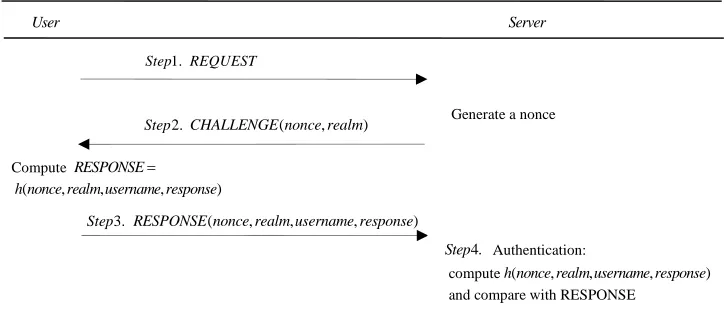
SIP authentication security depends on the challenge-response mechanism. The original
SIP authentication protocol requires the user and the server pre-sharing a password beforehand
[1]. This pre-shared password is used to verify the identity of the user or the server in the
authentication procedure. The original procedure performs the following steps as shown in
Fig. 1.
Fig. 1 SIP authentication procedure
4. Our Authenticated Key Agreement Scheme
This section presents our newly designed SIP authentication key agreement protocol with
user anonymity. In our protocol, there are two entities, the user’s smartcard and the server.
Our protocol consists of five phases: system setup, registration, pre-computation,
User
Generate a nonce
Compute RESPONSE
( , , , )
h nonce realm username response
Server
1.
Step REQUEST
2.
Step CHALLENGE nonce realm( , )
3.
Step RESPONSE nonce realm username response( , , , )
4.
Step Authentication:
authentication and password changing. The notations used in this paper are summarized in
Table 1.
Table1. Notations and Terminology
4.1. System setup phase
In this phase, the user U and the SIP server Sagree on some system parameters.
1:
StepS Server Sfirst generates a large prime pand an elliptic curve equationE a bp( , )with
ordern, which is defined in Section 3.1.
2 :
StepS Sfinds a generator pointPwith ordernoverEp( , )a b , wherenis a large number of
security considerations. Then, Schooses a random integer *
R p
3 :
StepS S constructs two secure one-way hash functions *
( ) : {0,1} {0,1}k
h ,
* *
1( ) : {0,1} {0,1} {0,1}
k
h G G , whereGis a cyclic addition group that is generated
byPoverEp( , )a b .
4 :
StepS Skeeps s secret and publishes information{Ep( , ), , ( ),a b P h h1( )} .
4.2. Registration phase
When UserU wants to register with SIP serverS, it performs the following steps with
Sover a secure channel.
1:
StepR US: ( (h PW c)h username c( ))
S first verifies U through a secure identification protocol. If U is eligible, it freely
chooses its user nameusername, password PW and a random integer *
R p
c Z . Then U computesh PW c( )h username c( )and submits it to S over a secure channel.
2 :
StepR SU:Smartcard contains ( , )R T
After receiving information from U, S computes two secrets 2
( ( ) ( ))
R h PW c h username c s P and TE h PW cs( ( )h username c( )) by using its
secret key s and the received messageh PW c( )h username c( ). Then S stores the secure information( , )R T in the memory of U’s smartcard and issues it to U through a
secure channel.
3 :
StepR Smartcard contains ( , , )R T a
Upon receiving the smartcard, U writes the secret message cto the memory of the
smartcard. Then U’s smartcard contains( , , )R T c . Finally, U keeps PW and the
smartcard secretly for authentication.
For each user, the registration phase performs once.
The smartcard generates a random integer * 1 R p
r Z and computesWr R1 andr P1 . At the end, a three-tuple( ,W r P r1 , )1 is stored into the smartcard. Furthermore, the three-tuple is moved
from the smartcard after authentication. This means the three-tuples are different in each
session.
4.4. Authentication phase
When user U wants to log into SIP serverS, it must inserts its smartcard to a card reader
and types its user name usernameand passwordPW . Moreover, the smartcard has to complete
the pre-computation phase. Then the smartcard and the server cooperate to perform the
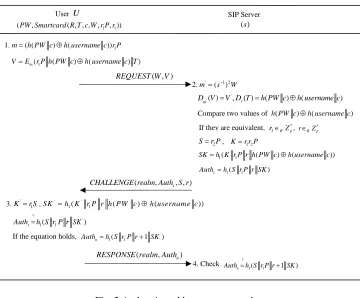
following steps to authenticate each other as shown in Fig. 2.
1:
StepA US REQUEST W V: ( , )
U computesm( (h PW c)h username c r P( ))1 by using itsPW, username and the secret message c r,1 stored in the smartcard. It then uses mto encrypt r P1 and
T asV Em(r P h PW c1 ( )h username c T( ) ) . Next, it sends a request message
( , )
REQUEST W V to S over a public channel.
2 :
StepA SU CHALLENGE realm Auth S r: ( , s, , )
After receiving the request message, Scomputes ' 1 2
( )
m s W by using its secret keys. It then decrypts Vto get r P h PW c1 , ( )h usernamec( )and Tby using
'
m. Next, S
uses its secret key sto decrypt the message T and compares the value of the message
( ) ( )
h PW c h username c in T with that of the h PW c( )h username c( )inV. If they are not equivalent, S rejects the user’s request message. Otherwise, S chooses two
random integers * 2 R p
r Z and *
R p
r Z , computesSr P2 ,Kr r P1 2 , the session key
1( 1 ( ) ( ))
SKh K r P r h PW c h username c and Auths h S r P r SK1( 1 ) by using the
decrypted messages r P1 and h PW c( )h username c( ) . Finally, it sends
( , s, , )
3 :
StepA U S RESPONSE realm Auth: ( , u)
After receiving the challenge message, U computes '
1 1 2 K r Sr r P
and ' '
1( 1 ( ) ( ))
SK h K r P r h PW c h username c . Then it verifies whether the
following equation holds
?
'
1( 1 )
s
Auth h S r P r SK . If held, it computes
'
1( 1 1 )
u
Auth h S r P r SK and sends RESPONSE realm Auth( , u) to S over a public
channel. Otherwise, it rejects the challenge message and terminates authentication.
4 :
StepA After receiving the response message, S verifies whetherAuthu?h S r P r1( 1 1 )
SK . If the message is authenticated, Ssets SKas a shared session key with U ;
otherwise, it rejects the response message and terminates authentication.
Fig. 2 Authenticated key agreement phase
4.5. Password changing phase
3. '
1
K r S,SK'h K1( ' r P r h PW c1 ( )h usernam e c( )) ?
'
1( 1 )
s
Authh S r P r SK
If the equation holds, '
1( 1 1 )
u
Auth h S r P r SK
User U
1 1
(PW Smartcard R T c W r P r, ( , , , , , ))
( , u)
RESPONSE realm Auth
SIP Server ( )s
1.m( (h PW c)h username c r P( ))1
1
( ( ) ( ) )
m
VE r P h PW c h username c T
'
'
( ) , s( ) ( ) ( )
m
D V V D T h PW c h username c
If they are equivalent, *
2 R p,
r Z *
R p
r Z
1( 1 ( ) ( ))
SKh K r P r h PW c h username c
1( 1 )
s
Auth h S r P r SK 2
Sr P, Kr r P1 2
2. ' 1 2
( )
m s W
Compare two values of (h PW c)h username c( )
( , s, , )
CHALLENGE realm Auth S r
4. Check Authu?h S r P r1( 1 1SK)
( , )
If userU wants to change its password, it needs to agree on a session key with Server S via
the authentication phase in advance. The password-changing steps are executed as follows:
1:
StepP U encrypts the new password message * * *
( (h PW c )h username c( )) by using the
session key SK . Next, it sends * * * * *
( ( ) ( ) ( ( )
SK
E h PW c h username c N h h PW c
*
( ) ))
h username c N andNto S, where N is a nonce for freshness checking.
2 :
StepP S decrypts the encryption message and verifies whether the authentication tag
* * *
( ( ) ( ) )
h h PW c h username c N is valid. If not, it rejects the password changing
requirement. Otherwise, it computes a new secret value * * *
( ( ) (
R h PW c h username
* 2
))
c s P and * * * *
( ( ) ( ))
s
T E h PW c h username c . It then sends * *
( ( 1
SK
E R T h N
* *
))
R T toU .
3 :
StepP U decrypts the message and verifies whether the authentication tag * *
( 1 )
h N R T is
valid. If so, Ustores * * *
(R T, ,c ) in its smartcard.
5. Security Analysis
In this section, we discuss the security of our authentication key agreement protocol for SIP.
5.1. Security properties
The security properties that should be considered for SIP authentication protocols are
Replay attacks, Man-in-the-middle attacks, Modification attacks, Denning-Sacco attacks,
Stolen-verifier attacks, Offline dictionary attacks without smartcards, Offline dictionary
attacks with smartcards, Session key security, Known-key security, Perfect forward secrecy,
5.2. Security analysis
Since the formal security proof of smartcard-based authentication key agreement protocols
is still an open problem, all published related protocols have been demonstrated with a simple
proof. In this section, we follow the approaches used by Wu [21] and He [18]. First, we
discuss the security of our protocol by analyzing some possible attacks, and then evaluate the
security of our protocol.
Proposition 1. Our protocol can resist replay attacks.
Proof. With the assumption that an adversary Bob intercepts the user U s' previous request
messageREQUEST W V( , ) in StepA1and replays it to the SIP server S to impersonate the user
U . However, Bob cannot construct a valid Authu and send it to the SIP server inStepA3unless
he can correctly guess the session key '
SK andr P1 . When Bob tries to guess the ' SK and r P1
from the intercepted message W, he still faces the elliptic curve discrete logarithm problem.
Moreover, Bob cannot obtain r P1 and '
SK by decrypting the intercepted messageV without the
knowledge of secret keysand random integerr1, where r1 is a new integer chosen by the user
U randomly in each new session. When Bob tries to guess the secret keys and integer r1
fromW , he faces the elliptic curve discrete logarithm problem. So Bob cannot generate a
valid Authu to pass the verification process of the SIP server inStepA4.
On the other hand, suppose Bob intercepts the
previousCHALLENGE realm Auth S r( , s, , )message from the server in StepA2 and replays it to
impersonate the server S . The user U will find out this attack by checking
?
1( 1 )
s
Auth h S r P r SK since r1is assumed to be generated independently and different in each session. So, Bob cannot pass the verification process of the userU inStepA3. In this case, no
RESPONSE message is sent back to Bob. Therefore, the replay attack cannot succeed in our
Proposition 2. Our protocol can resist man-in-the-middle attacks.
Proof. In order to prevent man-in-middle attacks, the user U and the server S should
authenticate each other, which require Our protocol to provide mutual authentication between
them. In our protocol, the user U and the server Sshare a session key SKonly after mutual
authentication between them. So, an adversary Bob cannot make the independent connections
with the userU or the server Sand relay messages between them, making them believe that
they are communicating directly to each other over a private connection. Only if Bob passes
the verification process of the serverS, he can establish a session key SKwithS, making the
server Sbelieve that it is talking to the userU . When Bob attempts to construct a valid
authentication message to pass the verification process of the serverS, he has to face the
elliptic curve discrete logarithm problem. On the other hand, for the same reason Bob cannot
impersonate the server Sto share a session key with the userU . Thus, Bob cannot launch the
man-in-middle attack to cheat either the user U or the serverS.
Proposition 3. Our protocol can resist modification attacks.
Proof. Suppose an adversary Bob intends to impersonate the userU , he modifies the
REQUEST message by constructing ' '
,
V W and sends a fraud REQUEST message to the
serverS . After receiving the REQUEST message, the server decrypts the '
V by using its
computed decryption key '
m. Since Bob does not know the secret keys, the server can find
the attack by comparing the value of the message h PW c( )h username c( )in T with that of the h PW c( )h username c( ) inV.
Assuming an adversary Bob chooses ' ' 2,
r r randomly and constructs an authentication
message '
s
fraud ' ' ' 2
( , s, , )
CHALLENGE realm Auth r P r to the user U . After receiving the
CHALLENGE message, the user U verifies whether the authentication message Auths is
equivalent to its computed hash value ' ' '
1( 1 )
h S r P r SK . Obviously, Bob cannot go through the
verification process of the user U without the knowledge of password PW ,
usernameusername, noncecand secret messager P1 .
If an adversary Bob attempts to impersonate the user U by modifying the
'
( , u)
RESPONSE realm Auth message and then sending to the serverS, where '
u
Auth is generated
by Bob, for the same reason the server S can easily find the modification by checking
? '
1( 1 1 )
u
Auth h S r P r SK . Therefore, our protocol can resist the modification attacks.
Proposition 4. Our protocol can resist Denning-Sacco attacks.
Proof. Suppose that an adversary Bob compromises an old session keySK and attempts to
find the user’s password or other session keys. In our protocol, the session key SK is
constructed by Kr r P1 2 ,r P1 , r and h PW c( )h username c( ) ,where the random integers
1, 2
r r and rare different in each session process. When Bob tries to guess the user’s password
PW or other session keys from the compromised session keySK and other intercepted
messages, he not only has to face the elliptic curve discrete logarithm problem, but also needs
to break the hash functions, which cannot be solved with non-negligible probability.
Therefore, our protocol can protect SIP against Denning-Sacco attacks.
Proposition 5. Our protocol can resist stolen-verifier attacks.
Proof. An adversary who steals the password-verifier from the server uses it directly to
stolen-verifier attack. Our protocol does not maintain any password or verification table on the
server. Therefore, the protocol can resist the stolen-verifier attacks.
Proposition 6. Our protocol can resist offline dictionary attacks without smartcards.
Proof. Suppose an adversary Bob intends to carry out the offline dictionary attack, and
through eavesdropping communications, Bob intercepts all messages relay between the user
U and the serverS . In order to obtain the user’s passwordPW , Bob needs to extract
( ) ( )
h PW c h username c from 2
1 ( ( ) ( ))
Wr h h PW c h username c s P, which is equivalent to solving an instance of elliptic curve discrete logarithm problem. So Bob cannot launch the
offline dictionary attack by using the REQUESTmessage. Additionally, when Bob tries to
derive PWfrom the information AuthsorAuthu, he faces the elliptic curve discrete logarithm
problem. Therefore, our protocol can withstand against the offline dictionary attack without
smartcards.
Proposition 7. Our protocol can resist offline dictionary attacks with smartcards.
Proof. Suppose an adversary Bob compromises the secret information( , , )R T c stored in the
smartcard of the userU and intercepts theREQUEST message, theCHALLENGE message
andRESPONSE message transmitted between the userUand the serverS. Compared with the
offline dictionary attack without smartcards, the addition information known by Bob in this
attack is( , , )R T c . However, Bob cannot extract h PW c( )h username c( ) from Rand check whether each of their guessed passwords is correct or not. Because computing
( ) ( )
the knowledge of the server’s secret keys. Therefore, our protocol can resist the offline
dictionary attack with smartcards.
Proposition 8. Our protocol can provide session key security.
Proof. In our protocol, at the end of the key exchange, the session key
1( 1 ( ) ( ))
SKh K r P r h PW c h username c is not known by anyone but only the userU and the
server S, since Kr r P1 2 and h PW c( )h username c( )cannot be constructed correctly by the
adversary Bob without the knowledge of ( , ,r c PW username1 , )or the secret keysand the
random integerr2. So, none of this session key SKh K r P r h PW c1( 1 ( )h username c( )) is known to anybody but the user U and the serverS. Therefore, our protocol provides session
key security.
Proposition 9. Our protocol can provide known-key security.
Proof. In our protocol, the random numbersr1and r2 generated independently by the server
S and the userU s' smartcard are different in each session process. So the session key
1( 1 ( ) ( ))
SKh K r P r h PW c h username c of each session is not connected with the session keys of any other sessions. Even if the adversary Bob compromises a session key SKand the
random values r1 and r2 , he cannot compute other session
keys ' ' ' '
1(1 2 1 ( ) ( ))
SKh r r P r P r h PW c h username c . This is because in each session a fresh
session key is generated depending on ' ' ' ' 1 2 1
(r r P r P r, , ), and the secret differs in every session.
Therefore, in our protocol, each run of the authentication and key agreement process produces
a unique session key SKbetween the user U and the serverS.
Proof. In our protocol, suppose the user’s passwordPW and the server’s secret key sare
compromised. The adversary Bob may obtain the correct decryption key mby using the secret
keysand the intercepted REQUEST W V( , )message. He could then use m to decrypt the
message V to get the secret informationr1P,h PW c( )h username c( )and decrypt Tto obtain
( ) (
h PW c h username c). But knowing above information is not enough for computing a
previous session key ' ' ' '
1(1 2 1 ( ) ( ))
SKh r r P r P r h PW c h username c , because Bob cannot
compute a correct ' ' 1 2
Kr r P . In order to obtain K Bob needs to extract the value '
2
r from '
2
Sr Por the value ' 1 r from '
1
r P, which is equivalent to solving an instance of
elliptic curve discrete logarithm problem. Therefore, in our protocol, even if the user’s
password PW and the server’s secret keysare compromised, the secrecy of previous session
keys established by them cannot be affected.
Proposition 11. Our protocol can provide mutual authentication.
Proof. In our protocol, the server Sand the user U authenticate each other by checking
u
Auth andAuths, respectively. Therefore, our protocol can provide mutual authentication.
Proposition 12. Our protocol can provide security in choosing and updating passwords.
Proof. In our protocol, the legitimate user with smartcards can freely choose her or his
favourite password in the registration phase. It makes users easy to remember their own
passwords. Our protocol also provides an update password phase for users to change their
password as requested. Even having been stolen or lost smartcards, any other person cannot
change or update the password without knowing the current session key SKshared between
Proposition 13. Our protocol can provide user anonymity.
Proof. In our protocol, the anonymity of the userU is obtained by hash function, symmetric
encryption technique and elliptic curve discrete logarithm problem. In the registration phase,
the user name is protected by the password PWand a nonce c chosen by the user. The hashed
user’s identity consisting of the usernameusername, the passwordPW and the noncecis
submitted to the serverS. Even the serverS does not know the real username of the userU .
In the authentication phase, the hashed username is protected by a secure symmetric
encryption algorithm and elliptic curve discrete logarithm problem. So, even if an adversary
Bob compromises the secret ( , , )R T c stored in smartcards and record the used messages
transmitted between the user U and the serverS, he cannot derive the real username of the
user without the knowledge of secret key sand user U’s passwordPW.
6. Performance Comparison
In this section, we first summarize the functionality of our protocol and then compare our
protocol with relevant protocols in terms of computational cost.
In our protocol, the user’s password is embedded inh PW c( )h username c( ) . In the registration phase, after receiving the secret message{ (h PW c)h username c( )}, the server
computes two secrets R( (h PW c)h username c s P( )) 2
andTE h PW cs( ( )h username c( )),
the server stores the secrets in the memory of the user’s smartcard, and then delivers the
smartcard to the user via a secure channel. Obviously, during the registration process, the
server does not need to store any password table. Furthermore, in our protocol, the user’s real
username is protected by hash function, symmetric encryption technique and elliptic curve
intercepts all the messages transmitted between the user and the server. Therefore, our
protocol provides user anonymity to protect the user’s privacy. Finally, our protocol provides
a secure updating password phase for users to change their password freely and can resist
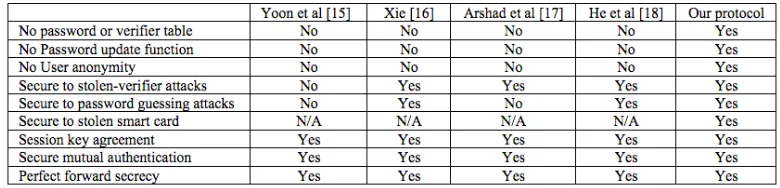
stolen smartcard attacks. As shown in Table 2, our protocol can provide more unique features
such as no password or verifier table, user anonymity and password update freely, which has
not been considered by other related protocols. In fact, these new features are very important
in implementing a practical and universal authenticated key agreement for SIP-based VoIP
communications.
Table 2. Functionality comparisons between our protocol and others
For the convenience of evaluating computational cost, several notations are defined:
(1) Tecsm is the time for executing a scalar multiplication operation of elliptic curve;
(2) Tecpa is the time for executing a point addition operation of elliptic curve;
(3) Th is the time for executing a one-way hash function;
(4) Tinv is the time for executing a modular inversion operation;
(5) Tske is the time for executing a symmetric key encryption operation;
(6) Tskd is the time for executing a symmetric key decryption operation.
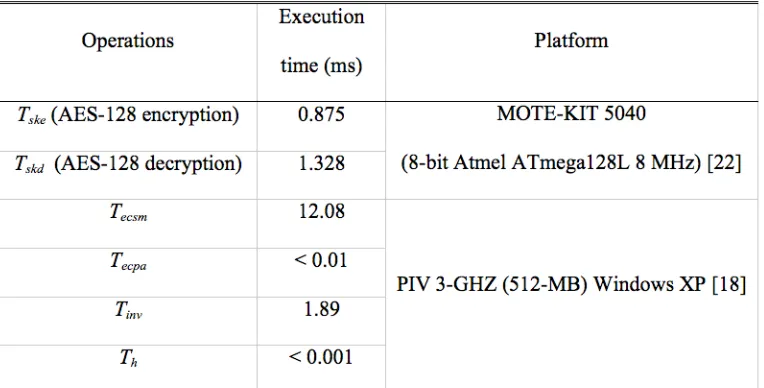
Next, we discuss the implementation data. For the convenience of performance analysis,
assume the AES cryptosystem is the symmetric encryption/decryption operation in our
scheme. Duh [22] implemented AES based on MOTE-KIT 5040 (8-bit Atmel ATmega128L 8
MHz). Their implementation encrypted and decrypted a 128-bit block of plaintext in 0.857 ms
512-MB memory and a Windows XP operation system, He [18] described the implementation
of a scalar multiplication operation of elliptic curve in 12.08ms (Tecsm), and a point addition
operation of elliptic curve less than 0.01ms (Tecpa) respectively (ECC group on Koblitz elliptic
curve 2 3 2
y x ax b defined on F2163 with a1and ba 163-bit random prime). They also
showed that the processor could perform a modular inversion operation in 1.89 ms (Tinv) and a
one-way hash function operation less than 0.001ms (Th). The execution times of related
operations are summarized in Table 3.
Table 3. Execution times of related operations
In the registration phase, our protocol requires two hash operations to compute
( ) ( )
h username c h PW c on the user side, one scalar multiplication operation of elliptic curve to obtain Rand one symmetric key encryption operation to get T on the server side. In the
pre-computation phase, the smartcard takes two scalar multiplication operations of elliptic
curve to obtainWandr P1 . In the authentication phase, the user takes two scalar multiplication
operations of elliptic curve to compute m( (h PW c)h username c r P( ))1 and
' 1
K r S; two
operations to compute h username c h PW c Auth Auth( ), ( ), s, u and '
SK . The server takes one
scalar multiplication operation of elliptic curve and one modular inversion operation to get '
m;
two scalar multiplication operations of elliptic curve to computeSand K; two symmetric key
decryption operation to decrypt V and T; and three one-way hash function operations to
computeSK Auth, s and Authu. In the password changing phase, the user takes four one-way
hash function operations to compute
* *
* * * *
( ), ( ), ( ( ) ( ) )
h PW c h username c h h PW c h username c N and * *
( 1 )
h N R T ; one
symmetric key encryption operation and one symmetric key decryption operation. The server
takes one scalar multiplication operation of elliptic curve to compute a new secret value * R ;
two one-way hash function operations to compute h h PW( ( * c*)h username c( *) N)
and * *
( 1 )
h N R T ; and two symmetric key encryption operation and one symmetric key
decryption operation.
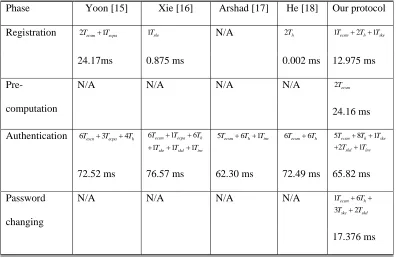
Table 4. Computational comparisons between our protocol and others
Phase Yoon [15] Xie [16] Arshad [17] He [18] Our protocol
Registration 2Tecsm1Tecpa 1Tske N/A 2Th 1Tecsm2Th1Tske
24.17ms 0.875 ms 0.002 ms 12.975 ms
Pre-computation
N/A N/A N/A N/A 2Tecsm
24.16 ms
Authentication 6Tescn3Tecpa4Th 6 1 6
1 1 1
ecsm ecpa h ske skd inv
T T T
T T T
5Tecsm6Th1Tinv 6Tecsm6Th 5 8 1
2 1
ecsm h ske skd inv
T T T
T T
72.52 ms 76.57 ms 62.30 ms 72.49 ms 65.82 ms
Password
changing
N/A N/A N/A N/A 1 6
3 2 ecsm h ske skd T T T T
Table 4 lists computational comparisons between our protocol and other related protocols.
According to Tables 3 and 4, the authentication phase of our protocol is estimated to be
implemented in 65.82 ms, the times for implementing the authentication phase of Yoon’s
protocol [15], Xie’s protocol [16], Arshad’s protocol [17] and He’s protocol [18] are 72.52ms,
76.57ms, 62.30 ms and 72.49 ms.
Since Arshad’s protocol doesn’t provide registration, there is no computational cost for the
registration phase. Unlike our protocol, other protocols don’t contain the Pre-computation and
Password changing phases, thereby suffering from several attacks, so no computational costs
are presented in Table 4 for these two phases.
In the pre-computation phase, since the integer r1 is chosen by smartcard instead of user, the message W=r1R and r1P are computed by smartcard at any time before the authentication phase. Although two scalar multiplication operations of elliptic curve are required in the
pre-computation phase, it would not affect the performance of the real-time VoIP communication
since no data are transmitted during the pre-computation phase. Other protocols without
smartcards cannot execute pre-computation, since users choose r1 differently during each authentication. So the performance is mainly dependent on the authentication phase.
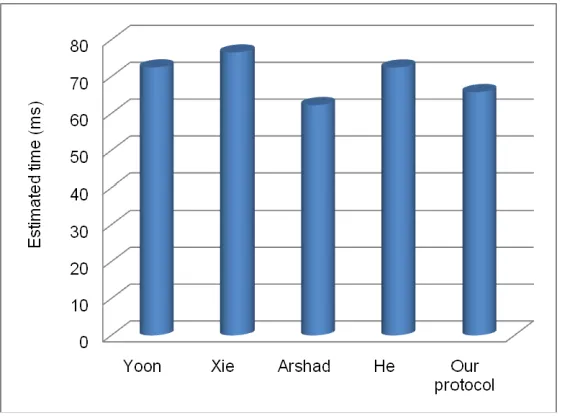
As the authentication phase determines overall performance, execution time comparisons
for authentication between our protocol and others are shown in Figure 3. Clearly our protocol
is as efficient as Arshad’s, but is much efficient than the other three protocols (i.e. Yoon, Xie, He) in the authentication phase, this is because our protocol reduces the number of operations
of scalar point multiplication of elliptic curve.
The total computational overhead of our protocol costs little more, that is because our
protocol possesses many unique features, such as not maintaining any password or
verification table on the SIP server, users being able to choose or change its own password
freely and providing user anonymity to keep user’s identity secret while still allowing the
server to perform its own authentication, which requires more operations. Moreover, for each
user the registration phase performs only once and the password change phase only performs
when users need to update their passwords. Therefore, this minor computational increase is
indispensable for constructing a reliable and trustworthy authenticated key agreement for SIP
used by VoIP-based real-time communications systems.
7. Conclusion
A new password authenticated key agreement protocol with user anonymity for SIP has
been proposed in this paper. In our protocol, the user and the server can achieve mutual
authentication and key agreement by using passwords and smartcards. Meanwhile, our
protocol can withstand replay attacks, impersonation attacks, stolen-verifier attacks,
man-in-middle attacks, Denning-Sacco attacks and offline dictionary attacks with or without
smartcard. In addition, our protocol also provides some unique features such as user
anonymity, no password table needed, revoking lost smartcard conveniently and password
are very important to implementing a practical and universal authenticated key agreement for
SIP.
Acknowledgment
This work was supported by the National Natural Science Foundation of China [Grant
numbers 61272469, 61303237, 61075063],
Wuhan Scientific Research Program [Grant number 2013010501010144] and China
Postdoctoral Fund [Grant number 2012194091].
References
1. Rosenberg J., Schulzrinne H., Camarillo G.: ‘SIP: Session Initiation Protocol’, RFC 3261, June 2002
2. Wang, Chia-Hui, Liu, Yu-Shun: ‘A dependable privacy protection for end-to-end VoIP via Elliptic-Curve Diffie-Hellan and dynamic key changes’, Journal of Network and Computer Applications, 2011, 34, pp.1545-1556 3. Yang, C., Wang, R., Liu, W.: ‘Secure authentication scheme for session initiation protocol’, Computers & Security, 2005, 24, pp.381-386
4. Huang, H., Wei, W., Brown, G.: ‘A new efficient authentication scheme for session initiation protocol’. Proceedings of JCIS 06, Kaohsiung, Taiwan, ROC, October 2006
5. Jo, H., Lee, Y., Kim, M., Kim, S., Won, D.: ‘Off-line Password-Guessing Attack to Yang’s and Huang’s Authentication Schemes for Session Initiation Protocol’. Proceedings of INC, IMS and IDC, Seoul, Korea, August 2009, pp.618-621
6. Ring, J., Choo, K.-K. R., Foo, E., Looi, M.: ‘A new authentication mechanism and key agreement protocol for sip using identity-based cryptography’. Proceedings of AusCERT R&D Stream, Gold Coast, Australia, May 2006, pp.61-72
7. Wang, Fengjiao, Zhang, Yuquing: ‘A new provable secure authentication and key agreement mechanism for SIP using cerificate less public key cryptography’, Computer Communications, 2008, 31, pp.2142-2149
8. Wu, L., Zhang, Y., Wang, F.: ‘A new provably secure authentication and key agreement protocol for SIP using ECC’, Computer Standards & Interfaces, 2009, 31, pp.286-291
10. Ni, Liang, Chen, Gongligang, Li, Jianhua: ‘A Pairing-free Identity-based Authenticated Key Agreement Mechanism for SIP’. Proceedings ofICNCIS2011, Guilin China, May 2011, pp.209-217
11. Yoon, E.J., Yoo, K.Y.: ‘A secure and efficient SIP authentication scheme for converged VoIP networks’, Computer Communications, 2010, 33, pp.1674-1681
12. Pu, Q.: ‘Weaknesses of SIP authentication scheme for converged VoIP networks’, http://eprint.iacr.org/2010/ 464
13. Gokhroo, M.K., Jaidhar, C.D., Tomar, A.S.: ‘Cryptanalysis of SIP Secure and Efficient Authentication Scheme’. Proceedings of ICCSN 2011, Xian, China, May 2011, pp.308-310
14. Tsai, Jia Lun: ‘Efficient Nonce-based authentication scheme for session initiation protocol’, International Journal of Network Security, 2009, 9, pp.12-16
15.Yoon, E, Shin, Y, Jeon, I, Yoo, K.: ‘Robust mutual authentication with a key agreement scheme for the session initiation protocol’, IETE Technical Review, 2010, 27, pp.203-213
16. Xie, Qi: ‘A new authenticated key agreement for session initiation protocol’, International Journal of Communication Systems, 2012, 25, pp.47-54
17. Arshad, R, Ikram, N.: ‘Elliptic curve cryptography based mutual authentication scheme for session initiation protocol’, Multimedia Tools and Applications, 2011, DOI: 10.1007/s11042-011-0787-0
18. He, Debiao, Chen, Jianhua, Chen, Yitao: ‘A secure mutual authentication scheme for session initiation protocol using elliptic curve cryptography’, Security and Communication Networks, 2012, DOI:10.1002/sec.506
19. Koblitz, N.: ‘Elliptic curve cryptosystems’, Mathematics of Computation, 1978, 48, pp.203-209
20. Branovic, I., Giorgi, R., Martinelli, E.: ‘A workload characterization of elliptic curve cryptography methods in embedded environment’, ACM SIGARCH Computer Architecture News, 2004, 32, pp.27-34
21. Wu, C.C., Lee, W.B., Tsaur, W.J.: ‘A secure authentication scheme with anonymity for wireless communications’, IEEE Communication Letter, 2008, 12(10) , pp.722-723