Status and Future Prospects
Michael D. Day, Chris J. Wiley, Julia Playford & Myron P. Zalucki
www.aciar.gov.au
Australian Centre for International Agricultural Research
Canberra 2003
problems in developing countries and to commission collaborative research between Australian and developing country researchers in fields where Australia has special competence.
Where trade names are used this does not constitute endorsement of nor discrimination against any product by the Centre.
ACIAR Monograph Series
This series contains the results of original research supported by ACIAR, or material deemed relevant to ACIAR's research and development objectives. The series is distributed internationally, with an emphasis on developing countries.
© Australian Centre for International Agricultural Research GPO Box 1571, Canberra, Australia 2601.
http://www.aciar.gov.au email: [email protected]
Day, Michael D; Wiley, Chris J; Playford, Julia and Zalucki, Myron. P. 2003. Lantana Current Management Status and Future Prospects.
Canberra. ACIAR Monograph 102
ISBN 0 186 320 374 5 (printed)
0 186 320 375 3 (electronic)
ISSN 1447-090X (online)
Managing editor: Michael Welbourn, BEST Writing and Editing Services, Canberra, Australia Pre-press production: Nanette Mercer, Damson Digital Design, Adelaide, Australia
Printing: Pirion, PO Box 438 Fyshwick, ACT 2609
Foreword
Summary & Recommendations
Acknowledgements
Part I. The Lantana Problem
1. Taxonomy — 4
2. Description of Lantana camara— 5
3. Variability — 5 4. Distribution — 8
4.1. Native distribution of the Lantanasection Camara — 8 4.2. Naturalised distribution of Lantana camara — 9 5. Habitat — 10
6. Ecology — 13 7. Impact — 16
7.1. Impact on the natural environment — 16 7.2. Impact on agricultural areas — 18 8. Uses of lantana — 20
Part II. Control of Lantana
9. Conventional control — 25 9.1. Chemical control — 25 9.2. Mechanical control — 27 9.3. Control by fire — 28
9.4. Post-removal management — 28 10. Biological control — 29
10.1. Aconophora compressa — 31 10.2. Aerenicopsis championi — 35 10.3. Alagoasa parana — 36 10.4. Apion spp.— 37
10.5. Autoplusia illustrata — 37 10.6. Calycomyza lantanae — 38 10.7. Charidotis pygmaea — 39
10.8. Cremastobombycia lantanella — 40 10.9. Diastema tigris — 41
10.10. Ectaga garcia — 42 10.11. Epinotia lantana — 43 10.12. Eutreta xanthochaeta — 44 10.13. Falconia intermedia — 45 10.14. Hypena laceratalis — 46
10.15. Lantanophaga pusillidactyla — 48 10.16. Leptobyrsa decora — 49
10.17. Mycovellosiella lantanae — 50 10.18. Neogalea sunia — 51
10.19. Octotoma championi — 52
10.20. Octotoma scabripennis — 53
10.21. Ophiomyia camarae — 55
10.22. Ophiomyia lantanae — 56 10.23. Orthezia insignis — 57 10.24. Parevander xanthomelas — 58 10.25. Phenacoccus parvus — 59 10.26. Plagiohammus spinipennis — 60
10.27. Prospodium tuberculatum — 62
10.28. Pseudopyrausta santatalis — 62 10.29. Salbia haemorrhoidalis — 63 10.30. Septoria sp. — 64
10.31. Strymon bazochii — 65 10.32. Teleonemia bifasciata — 65 10.33. Teleonemia elata — 65 10.34. Teleonemia harleyi — 66 10.35. Teleonemia prolixa — 67 10.36. Teleonemia scrupulosa — 67 10.37. Tmolus echion — 70
10.38. Uroplata fulvopustulata — 71 10.39. Uroplata girardi — 71 10.40. Uroplata lantanae — 73
11. Species imported, but not released — 73 11.1. Diastema morata — 73
11.7.Phassus argentiferus — 74 11.8.Teleonemia validicornis — 74
12. Factors influencing biocontrol of lantana — 75 12.1. Taxonomy — 75
12.2. Varietal differences — 79 12.3. Climate — 80
12.4. Plant biology and ecology — 84 12.5. Parasitism and predation — 86 12.6. Release techniques — 88
Part III. Future Directions
13. Control and management — 93 13.1. Selecting future lantana biological
control agents — 94
13.2. Agents currently being considered for release — 97 13.2.1. Aceria lantanae — 97
13.2.2. Aerenica multipunctata — 98 13.2.3. Alagoasa extrema — 99
13.2.4. Ceratobasidium lantanae-camarae — 99 13.2.5. Coelocephalapion camarae — 99 13.2.6. Longitarsus sp. — 100
13.2.7. Puccinia lantanae — 100 13.3. Integrated control techniques — 100 13.4. Integrated control recommendations — 101
14. Research
14.1. Classification and identification of naturalised taxa — 103 14.2. Somatic mutations — 104
14.3. Lantana biology and ecology — 105
References — 109
Appendix — 125
CONTACT INFORMATION
Michael D. Day
ALAN FLETCHER RESEARCH STATION
PO Box 36, Sherwood, Qld 4075, Australia Chris J. Wiley
ALAN FLETCHER RESEARCH STATION
PO Box 36, Sherwood, Qld 4075, Australia
Current address:
EVOLUTIONARY BIOLOGY CENTRE Department of Animal Ecology, Uppsala University,
Norbyvägen 18D, SE 752 36 Uppsala, Sweden Julia Playford
QUEENSLAND NATIONAL PARKS AND WILDLIFE SERVICE PO Box 155, Brisbane Albert St, Qld 4002, Australia Myron P. Zalucki
Lantana was the first weed to be targeted for biological control and has been researched longer than any other weed. Yet the program is one of the least successful.
Since 1902, millions of dollars and many years of work have gone into searching for potential biocontrol agents and introducing them to the countries where lantana is a weed. In general, the results have been poor — lantana remains a major weed in most tropical and subtropical countries outside its native home in the Neotropics.
Many reasons have been suggested for this failure, for example the nature of the plant itself, its great diversity and ability to hybridise, and that its origin as a hybrid ornamental plant complicates the search for its centre of origin and thus for potential agents. Searches have been made in Mexico, Central America, the West Indies, and Brazil, and insects have been collected from several different lantana species. These insects have been host-tested and released in Hawaii, South Africa, Australia, several countries in east Africa, south and east Asia, and the Pacific. Over the years, enough papers and reports have been written to fill a library, but many are either unpublished or only published in local journals.
This book brings together the available information about lantana and the insects and diseases that have been studied as its biocontrol agents. The first four chapters deal with the taxonomy and variability of lantana and related plants; it is an indication of the complexity of the weed that these topics occupy four chapters. The next five chapters cover its habitat and ecology, impact as a weed, uses, and non-biological control methods. The following three chapters list the 49 separate agents introduced against lantana or studied for possible use, and discuss possible factors influencing their success or failure. The final two chapters look at potential new research areas and make recommendations for future directions.
As a succinct summary of the mass of information on lantana and its control, this book is intended as a tool for everyone involved in lantana control as well as weed biocontrol scientists in general. We are very grateful to ACIAR for funding the publication of this book and to Paul Ferrar, Crop Science Program Coordinator in ACIAR, for his continued support for lantana biocontrol. It is our hope that this book will mark the completion of a century of biocontrol effort and the beginning of a new and more successful phase of lantana control.
Rachel McFadyen
some 650 varieties in over 60 countries or island groups. It has been the focus of biological control attempts for a century, yet still poses major problems in many regions.
Lantana has a significant impact on economic and environ-mental areas and is difficult to control. The key to good management of lantana is constant vigilance. Repeated control of new regrowth is critical to success. Control of new infestations should be a priority because the species is able to expand its range during good seasons, but does not die out during poor conditions. This book is a resource for land managers and researchers on methods of lantana control, particularly biocontrol.
Twenty-seven countries are deemed climatically suitable to support lantana, yet are reported to not contain the weed. It is recommended that these countries do not allow its importation, even of horticultural varieties.
One of the main reasons for lantana’s weediness and for the limited success of biocontrol is the capacity for hybridisation between varieties of L. camaraand closely related species in the genus. Agents collected from similar lantana species or varieties to those lantana varieties in the target countries, or that have a broad host range, have been more successful at establishing. Also, lantana is found in a wide range of climatic regions, often occurring where biocontrol agents are not adapted. For these reasons
and species of lantana be restricted in countries where the species is identified as a weed.
Fully effective control techniques are not currently available for this significant pest species. In many areas, the sheer size of the infestations coupled with low land values make conventional control not feasible. However mechanical clearing and hand pulling are suitable for small areas, and fire can be used over large areas. Also there are several control chemicals which are most effective when applied to regrowth following other treatments. The integration of all these control methods, specific to situation and variety, should be implemented to produce more successful results. Given the limited success of biocontrol to date in most areas, it is important for land managers to develop improved control through the integration of multiple techniques.
Calycomyza lantanae, Hypena laceratalis, Epinotia lantana and Lantanophaga pusillidactyla are also widespread and seasonally damaging agents; while not being able to control lantana, may make valuable contributions in regions where few other biocontrol agents are present.
Some biocontrol agents show promise for particular envi-ronmental conditions, such as high altitude. Others have only been released in a few areas and would be worthy of further release. There are several recently released agents, such as Aerenicopsis championi and the rusts Prospodium tuberculatumand Mycovellosiella lantanae, that show promise; but their potential has not been determined.
For many countries, some of the more effective and proven biocontrol agents could be introduced to assist in the control of lantana. For other countries where many agents have been released and lantana is still not under adequate control, there are still many potential agents, including a suite of pathogens in the native range, that have yet to be tried.
The more promising areas for future research are the biology, taxonomy and ecology of lantana as well as potential bio-control agents and techniques for improved integrated bio-control. Throughout the text recommendations for managers of control programs are made. These fall into three major categories: controls on import of lantana; methods for control; and the introduction of biocontrol agents.
The authors wish to thank the following people who provided information, photos, or maps or who suggested changes to the manuscript.
Dr R. Sanders,
BOTANICAL RESEARCH INSTITUTE OF TEXAS (BRIT), US Mr B. Noble, Mr M. Reif,
BRISBANE FOREST PARK (BFP), AUSTRALIA Dr C. Ellison, Dr H. Evans, CABI BIOSCIENCES, UK Mr J. Timbilla, CPI, GHANA
Dr A. Grice; Dr K.L.S. Harley, Dr D. Kemp, Dr R. Sutherst, CSIRO, AUSTRALIA
Mr S.N. Lal, MAFF, FIJI Dr A.A. Ismail, MARDI, MALAYSIA Mr W. Orapa, SPC FIJI
Mr M. Bryant, Ms M. Calvert, Mr M. Hannan-Jones, Mr P. Jones, Ms T. McAndrew, Dr P. Mackey, Dr W. Palmer, Dr D. Panetta, Dr J. Scanlan, A. Tomley,
NATURAL RESOURCES & MINES (DNRM), QUEENSLAND, AUSTRALIA Mr J-R. Baars, Ms A. Den Breeÿen, Dr S. Neser, Dr A. Urban, PLANT PROTECTION RESEARCH INSTITUTE (PPRI), SOUTH AFRICA Dr G.P. Chikwenhere,
PLANT PROTECTION RESEARCH INSTITUTE (ZPPRI), ZIMBABWE Mr J. Wright,
QUEENSLAND MUSEUM (QM), AUSTRALIA Dr R. Muniappan,
UNIVERSITY OF GUAM (UG), GUAM Dr R. Messing, Dr E. Trujillo, UNIVERSITY OF HAWAII (UH), HAWAII Dr P.D. Sharma,
UIPS, INDIA
Dr A. Kemp, Dr L. Scott,
UNIVERSITY OF QUEENSLAND (UQ), AUSTRALIA Dr N. Van Cam,
Part I. The Lantana Problem
Lantana,Lantana camara L., is a pantropical weed affecting pastures and native forests in over 60 countries worldwide (Parsons & Cuthbertson 2001). It is a composite species, thought to have originated from two or more lantana species from tropical America. Dutch explorers introduced the plant into the Netherlands in the late 1600s from Brazil (Ghisalberti 2000), and it was then grown in glasshouses in Europe before its importation to other countries as an ornamental. L. camara hybridises easily and there are possibly some 650 hybrid varieties worldwide (Howard 1969).
L. camarais considered a problem weed in many of the coun-tries to which it has been introduced. It flowers prolifically and the seeds are dispersed by birds (Swarbrick et al.1998). The plants can grow in individual clumps or as dense thickets, crowding out more desirable species. In disturbed native forests, it can become the dominant understorey species, disrupting succession and decreasing biodiversity. Its allelopathic qualities can reduce vigour of plant species nearby and reduce productivity in orchards (Holm et al. 1991). It can affect agriculture by outcompeting native pastures by interfering with the mustering of cattle, and by causing death of stock by poisoning (Swarbrick et al. 1998). In plantations in south-east Asia and the Pacific
Island communities, it can reduce productivity and interfere with harvesting. However L. camarahas several uses, mainly as a herbal medicine and, in some areas, as firewood and mulch (Sharma et al.1988; Sharma & Sharma 1989).
1. Taxonomy
The genus LantanaL. (Verbenaceae) includes between 40 (Hooker 1973) and 150 (Gujral & Vasudevan 1983; Mabberley 1997) species. Most are native to South America, Central America or southern North America, with a few species occur-ring naturally in Africa and Asia (Munir 1996). The genus has long been the subject of taxonomic uncertainty (Howard 1969; Stirton 1977), with many species, previously geographically isolated, hybridising freely once co-located (Sanders 1989). Howard (1969) concluded that the genus Lantanawas not an easy one to consider taxonomically, and that a thorough comprehensive investigation into the group was necessary.
Lantanais closely allied to, and difficult to separate from, Lippia L. and PhylaLoureiro. Munir (1993) suggested that they could all be included in the one genus, while Sanders (1987) states that Lantanamay be polyphyletic or derived from a number of ancestors. The major difference between Lantanaand Lippiais that the former has fleshy drupes, whereas the latter has a dry two-parted schizocarp (Jansen-Jacobs 1988; Munir 1993). The two genera are especially difficult to distinguish in dried herbarium material, where fruits may not be present. Indeed even if fruits are present, there may be uncertainty over whether they were fleshy or dry when fresh (Jansen-Jacobs 1988; Munir 1993).
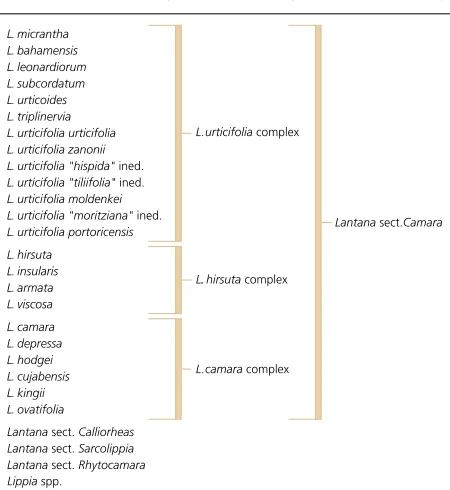
Within the genus Lantana, four distinct groups are recog-nised (Figure 1). The Lantana sections Calliorheas, Sarco-lippiaand Rhytocamaracontain the Lippia-like species, with the latter two sections containing only a few species each. Lantanasection Calliorheasis more diverse and widespread (Sanders 1987). Calliorheasincludes L. montevidensis (Sprengel) Briquet, a weed in some countries, having been naturalised in Australia, Africa and parts of India, as well as L. indicaRoxburgh, L. rugosaThunberg and L. mearnsii Moldenke (Sanders 1987 and pers. comm.). The fourth section, Camarais believed to be monophyletic.
The four sections differ in their haploid chromosome numbers, with x = 12 for Calliorheas, while section Camarahas a base chromosome number of x = 11 (Sanders 1987). Lippiais a poorly sampled genus, but appears to have a haploid chromosome number based on x = 9, 15 and 16 (Sanders 1987; Munir 1993). The diversity of Lantanaand Lippia are shown in Figure 2.
Lantanasection Camarais divided in three complexes based on, L. urticifolia, L. hirsutaand L. camara. The L. camara
Figure 1.
The four sections within the Lantanagenus, and the species within the Lantanasection Camara, based on morphological characteristics.
complex contains the primary weedy lantana commonly referred to asL. camara L. sensu latoand has a pantropical distribution. Lantana camara sensu strictois known from Mexico, Florida, Trinidad, Jamaica and Brazil and has not been recorded from the Old World (Sanders 1987; Sanders, pers.comm.). It is almost without spines, with flowers opening deep yellow, changing to orange with a red centre, and finally to a more or less red-scarlet (Smith & Smith 1982).
In this book we address only the ‘weedy taxa’ of Lantana section Camara, the most widespread and economically and environmentally important taxa within the genus. We reserve the common name ‘lantana’ specifically for the weedy taxa of the section Camaraand we will consistently describe different variants of L. camara as varieties.
2. Description of
Lantana camara
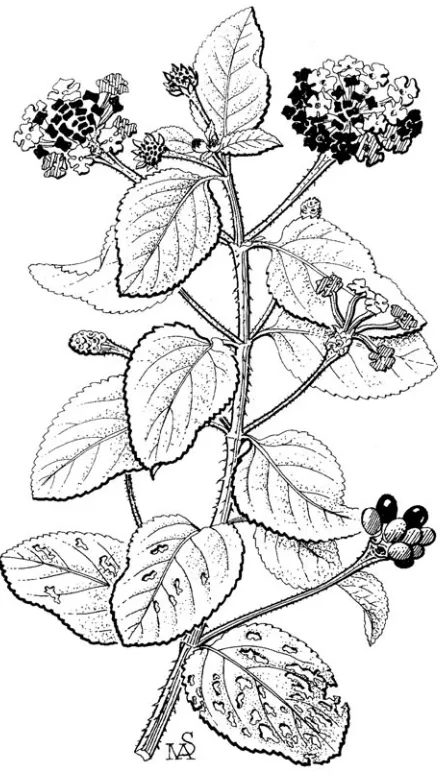
There are many texts available with detailed descriptions of lantana (e.g. Everist, 1974; Swarbrick et al.1998). A line drawing displaying the key features of a square stem in cross-section, recurved stems, paired complex flowers arising from axils and clusters of fruit is shown in Figure 3.
3. Variability
Lantana camarais a variable polyploid complex of interbreeding taxa, resulting from hybridisation with species in the other complexes, such as L. urticifoliaMiller. The resulting taxa have been variously referred to as separate species (White 1929), forms (Everist 1974; Parsons & Cuthbertson 2001), cultivars (Howard 1969), biotypes (Swarbrick 1986), and subspecies or varieties (Anon.1962). These ‘taxa’ differ in their
Figure 2.
The diversity of Lantanaand Lippia: (a) Lantana urticifoliafrom Guatemala; (b) L. camara from Norfolk Island; (c) L. trifoliafrom Brazil; (d) L. fucatafrom Guatemala; (e) Lippia albafrom Australia.
The countries listed are where photos were taken, and do not reflect the native range of the species.
a
b
c
d
toxicity, flower colour, spininess, leaf shape, susceptibility to herbivore attack, and ecology (Diatloff & Haseler 1965; Haseler 1966; Smith & Smith 1982) (Figure 4).
In Australia, most naturalised varieties are tetraploid (x = 44), but several varieties are triploid (x = 33), one is diploid (x = 22), and one is pentaploid (x = 55) (Everist 1974). The ploidy levels of lantana in India are similar to those in Australia. While no weedy variety has been found to be diploid in India (Sinha & Sharma 1984), fertile diploid varieties are being cultivated there (Ojha & Dayal 1992). Studies on the ploidy levels of Lantanaspp. in the Americas suggest that polyploid species are more abundant and widespread than diploid species (Sanders 1987). Ploidy level does not appear to have any phylogenetic significance, since polyploidy exists even within varieties (Khoshoo & Mahal 1967) and repro-duction between plants of different ploidy levels is not greatly hindered (Sanders 1987). However, apart from correlative evidence to suggest that pentaploid forms are better adapted than other forms to high altitude conditions in India (Ojha & Dayal 1992), there is little evidence to suggest that different ploidy levels have distinguishing traits or are of ecological significance.
The diversity of the weedy lantana was not fully recognised until recently (Willson 1993). Therefore, in early literature, the number of varieties reported as occurring in different countries is generally fewer than in more recent literature. Greathead (1971a) recognised only one variety occurring in South Africa, while over 50 varieties have been recognised in the more recent publication by Wells and Stirton (1988). Similarly, only three lantana varieties were recognised in eastern Australia in earlier accounts (Haseler 1963, 1966; Diatloff & Haseler 1965), but 29 varieties are now recognised (Smith & Smith 1982). In most other countries, especially the Figure 3.
Lantana camara.
The reason for these morphological differences is that those varieties that have become naturalised are hybrids. It is thought that lantana was first introduced into Europe in 1636 (Stirton 1977), and was especially popular in cultivation during the second half of the 19th Century (Swarbrick 1986). The material grown in Europe included in its parentage a number of American taxa and, through long periods of hybridisation and selection, modern varieties were developed (Stirton 1977). These have subsequently become naturalised and continue to hybridise in the field to make up a very variable complex species (Spies 1984; Cilliers & Neser 1991). However records of the parental material and the crosses performed have not been kept (Stirton 1977), and the origin of these varieties is therefore unknown.
The situation is further complicated by new, so-called sterile, triploid varieties bred and grown in gardens in most countries where weedy varieties are present (Figure 5). Current evidence suggests that these supposedly sterile varieties are capable of hybridising with fertile weedy varieties (Spies & du Plessis 1987; Neal 1999), potentially increasing the genetic variation within naturalised populations. The rates at which these new combi-nations of genes are being integrated into weedy populations
Figure 4.
Varieties of L. camara showing the diversity of flower colour: (a) Argentina; (b) Hawaii; (c) Brazil; (d) Australia.
island regions of the South Pacific, there are far fewer lantana varieties present than in the continental countries. However, it is possible that the diversity of lantana present could increase, with hybridisation between existing varieties (Wells & Stirton 1988). Worldwide, there are over 650 variety names but many are probably misspellings and synonyms because detailed botanical descriptions of most varieties are generally unavailable (Howard 1969). Nevertheless, this highlights the diversity within this complex species, and the difficulties associated with any attempts to sort and classify this diversity.
The weedy varieties of lantana rarely match morphologically those known from the ‘natural’ range of the complex in tropical America (Smith & Smith 1982). Perkins and Swezey (1924) remarked that in the original shipment of potential biocontrol insects sent to Hawaii the samples of Lantanaspp. that hosted insects from Mexico, looked rather different from that found in Hawaii. It is now widely recognised that lantana is morphologically distinct in different regions of its naturalised range compared to Lantanain its native range. This has important implications for the collection of potential agents for biological control, as discussed under ‘Factors influencing biological control’.
are not known. Moreover, some of these cultivated forms have been re-introduced to the neotropics. This has allowed mixing with the native gene pool, leading to more complex morphological variation (Méndez Santos 2002) which make it even harder to resolve the taxonomy of this group.
4. Distribution
4.1 Native distribution of
Lantana
section
Camara
The genus Lantanais of tropical origin, and reaches its greatest diversity in Central and northern South America and the Caribbean. In addition to the American species, some species are believed to be native to Africa, and at least one to India
(Hooker 1973; Stirton 1977). The native African and Asian Lantanaspecies all belong to the section Calliorheasthat is well represented in the neotropics (Sanders 1987).
Lantanasection Camarais native only to the Americas, with members occurring from Florida and Texas in the north to northern Argentina and Uruguay in the south (Figure 6). Lantana camara sensu strictois found over a wide range in the neotropics (Sanders 1987, 2001), presumably due to naturalisation in regions where it is cultivated.
While it is recognised that the weedy taxa of lantana natu-ralised in the Old World are of hybrid origin, and so do not
Figure 5.
Lantana is grown in gardens all over the world, for example:
(a) Izucar, Mexico; (b) Parkhurst, Australia; (c) Niagara Falls, US; (d) Montpellier, France.
a
b
have a ‘native’ range per se, the hybrids are almost certainly derived from various species within the section Camarathat originated in the Americas. It is likely that the various weedy varieties are derived from multiple parental species, so that the varieties may have progenitors with different geographic ranges. Our knowledge of the parentage of modern varieties is inadequate, but DNA studies suggest that the common pink variety found in Australia, Fiji and Vanuatu is derived from L. urticifoliafound in parts of the Caribbean, Mexico and Central America (Scott 1998). Dr R. Sanders (pers. comm.) believes that L. urticifoliais a highly variable species, possibly with multiple subspecies being recognised, some of which were previously referred to as species in their own right.
Lantanahad not increased in abundance in Mexico over the first half of the 20th Century (Mann 1954a). However, there was a noticeable increase in the abundance and range of L. tiliifolia Chamisso in Brazil following widespread clearing and road construction; yet it is not recognised as a pest in Brazil (Winder & Harley 1982).
4.2 Naturalised distribution of
Lantana camara
Lantana is now naturalised in approximately 60 countries or island groups between 35°N and 35°S (Figure 6). It is found in many African countries, including some arid regions, and is widespread in Kenya, Uganda and Tanzania. In South Africa, it is common along the east coast and in the tableland area of the north near Tzaneen. Lantana is found throughout India, occurring from the north near Jammu to the south near Trichmur, on the west coast near Bangalore, and in the central region near Jabalpur (Thakuret al.1992). It occurs in the Middle East, and on low-lying coral atolls of the Pacific and Indian Oceans (Waterhouse & Norris 1987). In most of the high volcanic island groups in the Pacific, the distribution of lantana is limited by: its inability to survive under dense, intact canopies of taller native forest species; its susceptibility to frosts and low temperatures; its low tolerance to saline soils; its tendency to rot in boggy or hydromorphic soils; it having never been introduced to some islands; insufficient water, due to low rainfall and/or coralline soils with poor water-holding capacities; and high incidence of tropical hurricanes (Thaman 1974).
In Australia, lantana is mainly found along the east coast from Cape York to southern New South Wales. Small infestations occur in the Northern Territory and northern Western Australia (Parsons & Cuthbertson 2001). The plant is grown as an ornamental shrub in these areas and further south in Victoria and South Australia, but has not become naturalised in the south due to regular frosts (Parsons & Cuthbertson 2001). Figure 6.
Areas where the taxa of Lantanasection Camaraare native (green) and introduced or naturalised (red).
The map indicates the presence of lantana in a particular country, but not its distribution within that country. Countries and/or island groups that contain lantana are listed in the Appendix.
0 2000 4000 6000 Km
The distribution of lantana is still increasing, with many of the countries and islands that were listed in 1974 as not having lantana e.g. Galapagos Islands, Solomon Islands, Palau, Saipan, Tinian, Yap, and Futuna Island. (Thaman 1974), being infested with lantana more recently (Waterhouse & Norris 1987; Denton et al.1991; Harley 1992). Even in areas such as South Africa, India and larger islands such as New Zealand, where lantana has been established for long periods of time, there is evidence that it is still spreading (Stirton 1977; Cilliers 1983; Hill & Seawright 1983; Sharma et al.1988; Wells & Stirton 1988).
A CLIMEX model that predicts the potential range of the nat-uralised lantana shows that lantana could expand its range even further becoming a weed in countries where it is not
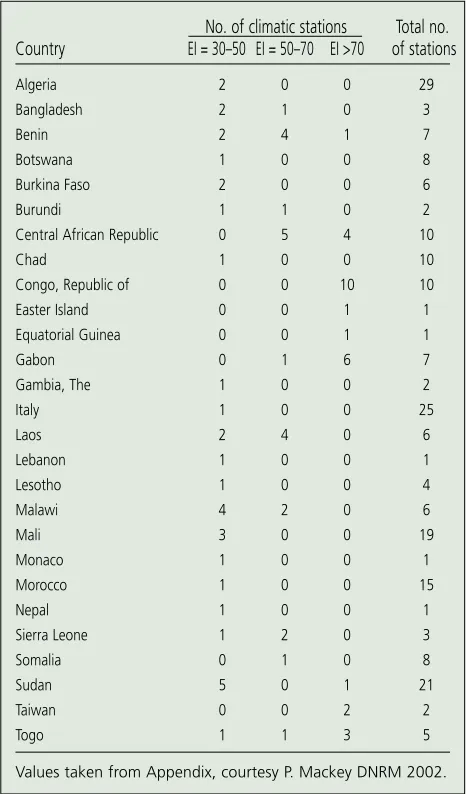
already present. Twenty-seven countries have been identified as not having lantana, but have an Environmental Index (EI) greater than 30 (Figure 7). An EI greater than 30 indicates that lantana could establish (R. Sutherst CSIRO, pers. comm.) and has the potential to become weedy if introduced to those countries. Countries and/or islands with locations with EI>30 are listed in the Appendix. Countries with locations with EI>30, but not reported to have lantana, are listed in Table 1.
Not only is the geographic range of lantana still expanding in many areas, but the density of infestations within its range is increasing. This has been recognised as a future threat to eco-systems in Australia (Haseler 1966), the Solomon Islands and Vanuatu (Harley1992) and is probably occurring in many other countries. Also, there are several regions where lantana is currently limited by the distribution of intact forest, which inhibits its growth (Duggin & Gentle 1998). Increasing logging and habitat disturbance in many regions of the world provides further suitable habitats for the plant (Wells & Stirton 1988). In countries where there are still large areas of native forests, such as in Papua New Guinea, lantana is currently restricted to small, isolated infestations in abandoned settlement sites (W. Orapa SPC, pers. comm.), but it has the potential to spread widely following further clearing of forest for timber or agriculture.
5. Habitat
The diverse and broad geographic distribution of lantana is a reflection of its wide ecological tolerances. It occurs in diverse habitats and on a variety of soil types. It generally grows best in open unshaded situations such as wastelands, rainforest edges, beachfronts, and forests recovering from fire or logging. Disturbed areas such as beside roads, railway tracks and canals are also favourable for the species (Thaman 1974; Winder & Harley 1983; Thakur et al.1992; Munir 1996) (Figure 8). Figure 7.
The predicted range of the naturalised distribution of Lantana camarausing the computer model CLIMEX.
An Environmental Index (EI)>30 indicates locations suitable for growing lantana.
0 2000 4000 6000 Km
EI
Lantana benefits from the destructive foraging activities of introduced vertebrates such as pigs, cattle, goats, horses, sheep and deer (Thaman 1974; Denton et al.1991; Fensham et al.1994), and grows well on rich volcanic soils (Humphries & Stanton 1992). It can grow at altitudes from sea-level to 2000m (Matthew 1971). It can tolerate some shade, growing in plantations and open eucalypt forests in Australia (Humphries & Stanton 1992), but it does not flower readily under these conditions (Wells & Stirton 1988). In Brazil, lantana rarely grows in secondary forest and commercial plantations (Winder & Harley 1983). Wapshere (1970) suggested that when there is reduced herbivory by natural enemies, original habitat restrictions, such as climate and soil type, may become less significant and lantana can expand into previously marginal habitats.
Lantana grows under a wide range of climatic conditions. In Australia, the inland limit of its geographical range coincides with the 750mm isohyet in southern Queensland and the 1250mm isohyet in the north (Harley 1973), with infestations being restricted to creek lines in drier areas (Diatloff 1975). It does not appear to have an upper temperature or rainfall limit and is often found in tropical areas receiving 3000mm of rainfall per year, provided that soils are sufficiently well drained. Lantana seldom occurs where temperatures frequently fall below 5°C (Cilliers 1983), and in South Africa it is found in areas with a mean annual surface temperature greater than 12.5°C (Stirton 1977). Some varieties can withstand minor frosts, provided these are infrequent (Graaff 1986). Prolonged freezing temperatures kill aerial woody branches and cause defoliation.
There is some correlation between lantana varieties and climatic tolerances (Matthew 1971; Stirton 1977). No. of climatic stations Total no.
Country EI = 30–50 EI = 50–70 EI >70 of stations
Algeria 2 0 0 29
Bangladesh 2 1 0 3
Benin 2 4 1 7
Botswana 1 0 0 8
Burkina Faso 2 0 0 6
Burundi 1 1 0 2
Central African Republic 0 5 4 10
Chad 1 0 0 10
Congo, Republic of 0 0 10 10
Easter Island 0 0 1 1
Equatorial Guinea 0 0 1 1
Gabon 0 1 6 7
Gambia, The 1 0 0 2
Italy 1 0 0 25
Laos 2 4 0 6
Lebanon 1 0 0 1
Lesotho 1 0 0 4
Malawi 4 2 0 6
Mali 3 0 0 19
Monaco 1 0 0 1
Morocco 1 0 0 15
Nepal 1 0 0 1
Sierra Leone 1 2 0 3
Somalia 0 1 0 8
Sudan 5 0 1 21
Taiwan 0 0 2 2
Togo 1 1 3 5
Values taken from Appendix, courtesy P. Mackey DNRM 2002.
Table 1.
In Australia, the common pink variety is the only variety found at higher altitudes and latitudes, while the common pink-edged red variety is restricted to the warmer regions (Day et al.2003). While lantana varieties are found in cool regions, such as southern Australia and the highlands of
Figure 8.
Lantana can grow in a wide range of habitats:
(a) rainforest (Gibraltar Range National Park, Australia);
(b) open grazing land (Kooralgin, Australia); (c) drainage ditches
(Florida, US); (d) cleared land (Tzaneen,
South Africa);
(e) roadsides (Hawaii, US).
Papua New Guinea, they do not necessarily become weeds (W. Orapa, pers. comm.; Parsons & Cuthbertson 2001). Whether varieties will grow as well in climatic conditions different from those in which they occur in their naturalised range has not been examined.
a
b
d
6. Ecology
Lantana flowers in most places all year round if adequate moisture and light are available (Gujral & Vasudevan 1983; Graaff 1986), with flowering peaking during the wet summer months. In cooler or drier regions, flowering occurs only in the warmer or wetter months, due to frost or drought damage (Winder 1980; Swarbrick et al.1998). Plants can flower as early as the second growing season.
Inflorescences are produced in pairs in the axils of opposite leaves (Figure 9a). In almost all colour forms, the flower opens yellow and changes to pink, white or red depending on the variety (Figure 9b). In the forms where this does not occur, a yellow ring is present around the opening to the corollary tube (Sinha & Sharma 1984). The yellow colouration is known to be a visual cue to pollinating insects (Barrows 1976; Mohan Ram & Mathur 1984a), and the act of pollination may stimulate colour change (Mohan Ram & Mathur 1984a).
Initially, lepidopteran species were thought to be the primary pollinators of lantana (Dronamraju 1958; Schemske 1976; Kugler 1980; Hilje 1985). Some butterfly species visit certain
lantana taxa more frequently than others due to differences in corolla length, inflorescence diameter and number of flowers per inflorescence. According to this view, different varieties of lantana may have different species of pollinators. Therefore, there may be little cross-pollination between species or varieties of lantana both in the naturalised (Dronamraju 1958) and native (Schemske 1976) ranges of the section Camara.
More recently, it has been suggested that thrips play a more important role in the pollination of lantana than Lepidoptera (Mohan Ram & Mathur 1984b; Sinha & Sharma 1984). Unlike butterflies, thrips are present all year round, and are more efficient pollinators (Mathur & Mohan Ram 1986). In India, the exclusion of butterflies did not reduce seed-set and Mathur and Mohan Ram (1986) proposed the introduction of bio-control agents to reduce thrips populations in an attempt to decrease pollination and the quantities of seed produced by lantana. In addition to butterflies and thrips, sunbirds (India) and hummingbirds (Brazil) are believed to play a minor role in pollination (Winder 1980).
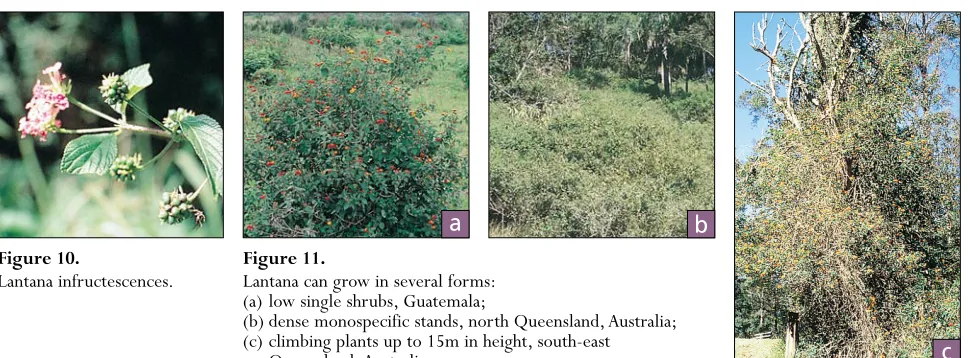
There are conflicting reports over lantana’s ability to selfpolli-nate. Mohan Ram and Mathur (1984b) considered lantana to be self-compatible, but needed insects for pollination. Neal (1999) also found that individual lantana flowers were capable of self-pollination. However, in laboratory experiments, lantana flowers did not self-pollinate (Barrows 1976). Pollination results in 85% fruit-set (Hilje 1985), with each infructescence (Figure 10) bearing about eight fruits (Barrows 1976).
Seeds are widely dispersed, predominantly by birds, but also by kangaroos, bearded dragons, sheep, goats, cattle, foxes, jackals, monkeys and possibly rodents (Bisht & Bhatnagar 1979; Clifford & Drake 1985; Sharma et al.1988; Wells & Stirton 1988). In continental areas, many indigenous bird Figure 9.
Lantana morphology: (a) plant structure; (b) inflorescences.
a
and this may partially explain why Guam has had better success with biological control of lantana than other nearby islands (Muniappan 1988).
Lantana seeds need high light conditions for germination and early growth (Gentle & Duggin 1997b; Duggin & Gentle 1998), and seedlings are unlikely to survive beneath parent bushes. The germination rate of lantana is low under both laboratory and field conditions (Spies 1983–84; Graaff 1986, 1987; Sahu & Panda 1998), with estimates of 4–20% (Graaff 1987) and 44.5% (Duggin & Gentle 1998). Graaff (1987) suggested that the low germination rate was due to seed dormancy and/or low seed viability, while Spies (1983–84) proposed that the meiotic instability of lantana might produce low germination rates.
Germination rates increased from ten per cent to 46 per cent when the fleshy pulp was manually removed from the seed. This higher germination rate is comparable to that obtained from seeds collected from the faeces of wild birds. Seeds species feed on the lantana fruits, while on some of the
island groups, seed dispersal has been mainly facilitated by the introduction of exotic bird species. Birds are very important in exacerbating the weed problem and should not be under-rated. By feeding on exotic species such as lantana, birds may increase the density and distribution of the weed at the expense of native vegetation thereby displacing other bird species (Loyn & French 1991).
Introduction of six bird species (including Chinese turtledove, Streptopelia chinensis, and the Indian mynah, Acridotheres tristis) that feed on lantana berries, has been implicated in the spread of the weed throughout the Hawaiian Islands as no native bird in Hawaii has been observed to eat the fruit (Perkins & Swezey 1924). In Guam, it has been suggest-ed that, as a result of the introducsuggest-ed brown tree-snake preying on native bird populations, there are fewer frugivorous birds to disperse lantana seeds (R. Muniappan UG, pers. comm.). Consequently lantana infestations are increasing more slowly,
Figure 10.
Lantana infructescences.
Figure 11.
Lantana can grow in several forms: (a) low single shrubs, Guatemala;
(b) dense monospecific stands, north Queensland, Australia; (c) climbing plants up to 15m in height, south-east
Queensland, Australia.
a
b
germinate at any time of the year given sufficient soil mois-ture, with most seed germinating after the first summer storms in northern Australia (Parsons & Cuthbertson 2001).
Graaff (1987) suggested that low levels of recruitment may minimise regeneration in lantana eradication programs. However, low germination rates are offset by the extremely low rates of seedling mortality experienced in the field (Sahu & Panda 1998) and lantana’s enormous capabilities for vegetative spread (Khoshoo & Mahal 1967) and seed production. Once established, lantana spreads to form large, impenetrable clumps (Anon.1962). The more common means of spread is through layering, where horizontal stems produce roots when in contact with soil (Swarbrick et al.1998) although suckering can occur.
Lantana can also grow from vegetative material. Prostrate stems can root at the nodes if covered by moist soil, fallen leaves or other debris. In Australia, it is particularly well spread by landholders dumping vegetative material in bush-land. Neal (1999) found that under glasshouse conditions, lantana stems or leaves could develop roots and grow into plants and eventually flower.
Lantanaspp. in tropical America generally occurs in small clumps to about one metre in diameter (Figure 11a), and while it is commonly scattered along roadsides or in open fields, it is not considered a pest (Mann 1954a; Winder & Harley 1982; Palmer & Pullen 1995). In its naturalised range, lantana often forms dense monospecific thickets 1–4m high (Winder & Harley 1983; Swarbrick et al.1998) (Figure 11b), although some varieties may climb trees and reach heights of 8–15m (Smith & Smith 1982; Swarbrick et al.1998) (Figure 11c).
The temporal growth patterns of lantana vary depending on local climatic conditions. In tropical sites, growth is continuous throughout the year, while in cooler climates such as southern
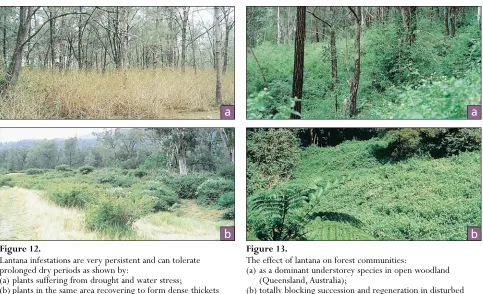
Brazil plants cease growth and defoliate to varying degrees during dry winter months (Winder 1980). This defoliation is often caused by frost and/or drought. Rapid growth occurs over spring and early summer following early rains (Figure 12).
Lantana infestations are very persistent and may block the natural succession of plant communities (Lamb 1991). While lantana infestations usually increase in wetter years, they do not recede during dry years (Waterhouse 1970). Mature lantana is fire tolerant; moreover, removal of other biomass and increase in soil nutrients through burning may increase germination (Gentle & Duggin 1997b; Duggin & Gentle 1998). The mortality rate among mature lantana plants in their naturalised range is very low (Sahu & Panda 1998). In many regions, lantana is defoliated annually by the complex of intro-duced biological control agents or during times of drought. Plants recover once the insect numbers have waned over the winter months and early season rains commence (Greathead 1971b; Gupta & Pawar 1984; Muniappan & Viraktamath 1986; Baars & Neser 1999; Day & Hannan-Jones 1999).
7. Impact
7.1 Impact on the natural environment
Lantana in forest communities has the potential to block succession and displace native species, resulting in a reduc-tion in biodiversity (Lamb 1991; Loyn & French 1991). Under conditions of high light, soil moisture and soil nutrients, lan-tana is a very effective competitor against native colonisers (Gentle & Duggin 1998). Lantana infestations result in marked changes in the structure and floristics of natural communities.
One of the obvious changes that occur with the replacement of forest understorey by lantana is a decrease in community biomass and a proportional increase in the foliage component in the vegetation (Bhatt et al.1994) (Figure 13).
As the density of lantana in forest increases, species richness decreases (Fensham et al.1994). One possible explanation is that allelopathic effects of lantana result in severe reductions in seedling recruitment of almost all species under lantana and a reduction in the girth growth of mature trees and
Figure 12.
Lantana infestations are very persistent and can tolerate prolonged dry periods as shown by:
(a) plants suffering from drought and water stress;
(b) plants in the same area recovering to form dense thickets (Cangai, NSW).
Figure 13.
The effect of lantana on forest communities:
(a) as a dominant understorey species in open woodland (Queensland, Australia);
(b) totally blocking succession and regeneration in disturbed rainforests (NSW, Australia).
a
b
a
shrubs (Lamb 1982; Gentle & Duggin 1997a). Allelopathy may explain why invasive weeds such as lantana can survive sec-ondary succession and become monospecific thickets (Hardin 1960). Allelopathic effects, resulting in either no growth or reduced growth close to lantana, have been demonstrated in the fern Christella dentata(Forsskaol) Brownsey & Jermy (Pteridophyta), milkweed vine Morrenia odorata(Hooker & Arnott) Lindley (Asclepiadaceae), rye Lolium multiflorum Lamarck (Poaceae) and many crops such as wheat, corn and soybean (Achhireddy & Singh 1984; Achhireddy et al.1985; Mersie & Singh 1987; Sharma et al.1988; Jain et al.1989). Singh and Achhireddy (1987) found reductions in the growth of citrus growing in the same pot as lantana under nonlimiting conditions and attributed this to chemical factors excreted by the lantana. Jain et al.(1989) found 14 phenolic com-pounds present in lantana that in combination can reduce seed germination and growth of young plants.
Lantana does not invade intact rainforests, but is found on its margins (Diatloff 1975; Humphries & Stanton 1992). Where wet sclerophyll forests and rainforests have been disturbed through logging, gaps are created; this allows lantana to encroach on the forests. Further logging aggravates the condi-tion and allows the lantana to spread or become thicker (Waterhouse 1970). At some sites, lantana infestations have been so persistent that they have completely stalled the regen-eration of rainforest for three decades (Lamb 1991). Such is its impact that, for example, in south-east Queensland lantana was ranked as the most significant weed of non-agricultural areas (Batianoff & Butler 2002). Lantana competition may have caused the extinction of the shrub Linum cratericola Eliasson (Linaceae), and is a major threat to other endangered plants in the Galapagos Archipelago (Mauchamp et al.1998). The replacement of native pastures by lantana is threatening the habitat of the sable antelope in Kenya (Greathead 1971b).
Lantana can greatly alter fire regimes in natural systems (Humphries & Stanton 1992). Grassy woodlands rarely have sufficient fuel load to produce fires intense enough to penetrate into the surrounding rainforest, but the fuel load provided by lantana has been implicated in a destructive wildfire in northern Queensland (Fensham et al.1994). The fire hazard provided by lantana in rainforest situations is paralleled in deciduous forests of the northern hemisphere (Anon. 1962). Lantana burns readily during hot, dry condi-tions, even when green (Gujral & Vasudevan 1983). Lantana occurring on rainforest margins is seen as a major threat to this community as a result of increased inroads of fire into the rainforest. This is particularly so when lantana occurs on the edges of forest tracks and creeks in natural forests such as in national parks.
Some countries, such as India, USA and South Africa that are infested with L. camara contain some native species in the genus (Hooker 1973; Sanders 1985; Wells & Stirton 1988). For example, in Florida USA L. camara may compete and hybridise with the endangered, indigenous L. depressaSmall (section Camara), thus contaminating the gene pool of this rare plant (Sanders 1985; Anon. 1999). The threat posed to other species in the genus growing in regions that have been colonised by exotic L. camara has not been assessed. Elsewhere in India and Africa, the native species of Lantana belong to the section Calliorheas(Sanders 1987, 2001) so the major threat is competition rather than hybridisation.
patterns in native communities. As lantana is a strong competitor, under conditions of increased soil fertility (Gentle & Duggin 1998) its re-establishment following mechanical or chemical removal may be encouraged.
Lantana has many secondary impacts, especially in many tropical countries where it can harbour several serious pests. Malarial mosquitoes in India (Gujral & Vasudevan 1983) and tsetse flies in Rwanda, Tanzania, Uganda and Kenya shelter in bushes and are the cause of serious health problems (Greathead 1968; Katabazi 1983; Okoth & Kapaata 1987; Mbulamberi 1990). The problem in Rawanda was pointed up by the Africa News Service on 26 October 2001: ‘A total of 25 people in Bulongo and Butansi, Luuka county, Iganga district, have been confirmed to be suffering from sleeping sickness, reports Moses Nampala. A medical clinical officer, James Zironda, said several cases handled by his unit had sleeping sickness, a disease caused by the bite of a tsetse fly. “The biggest percentage of the patients we are handling have fresh irritations that developed as a result of recent bites from tsetse flies,” Zironda said.’ These pests were previously brought under reasonable control through the clearing of the vegetation that harboured them. Subsequently, lantana has colonised cleared ground with the result that these disease-carrying pests have reinvaded some cleared areas inhabited by humans and domestic stock (Greathead 1968).
7.2 Impact on agricultural areas
Lantana is a major problem in agricultural areas in most countries in which it occurs. It is especially a problem in regions where agriculture is a major industry, such as Australia, East Africa, Fiji, Hawaii, India, the Philippines, South Africa and Zambia (Holm et al.1991). Once established in pastures, lantana forms large, impenetrable thickets, outcompeting valuable pasture species, blocking the movement of domestic
stock to waterholes, poisoning stock and interfering with mustering (Figure 14).
Culvenor (1985) suggests that, in Queensland, loss of pasture is the greatest single cost of lantana invasion in grazing areas (A$3m per year at 1985 values). In dense stands of lantana, the capacity of the soil to absorb rain is lower than under good grass cover (Cilliers 1983). This could potentially increase the amount of run-off and the subsequent risk of soil erosion in areas infested with lantana. This contrasts with popular opinion that lantana is a useful cover crop for preventing erosion in fallow plantations (Greathead 1968; Willson 1968; Waterhouse 1970). While lantana may protect bare soil, other cover crops are likely to be more effective and productive.
Lantana has been implicated in the poisoning of cattle, buffalo, sheep, goats (Sharma et al.1988), horses and dogs (Morton 1994), guinea pigs and captive red kangaroos (John-son & Jensen 1998). The field cases occur mainly in young animals that have either been newly introduced into an area where lantana grows (Everist 1974), or are without access to other fodder (Yadava & Verma 1978; Sharma 1994).
Figure 14.
In Queensland, lantana accounts for the deaths of 1000– 1500 cattle per annum, and is regarded as one of the most important poisonous plants in agricultural areas (Harley 1973; Culvenor 1985). In South Africa, lantana poisoning accounts for about a quarter of reported livestock poisonings by plants (Wells & Stirton 1988). Livestock deaths due to lantana have been reported from Brazil (Tokarnia et al.1984), Cuba (Alfonso et al.1982), Fiji (Willson, 1995), Kenya (Ide & Tutt 1998), India (Sharma 1988), Mexico (de Aluja 1970) and Florida, US. (Morton 1994). Poisoning results in cholestasis, hepatotoxi-city and photosensitisation, with the early clinical signs being anorexia and severe constipation (Sharma 1994) (Figure 15). Children and adults in many countries often consume ripe fruits, without any ill effect. However, the consumption of green fruit has caused the deaths of humans in Australia and the US (Morton 1994), as well as in India (Sharma 1994). Apart from causing death of livestock, sublethal doses of lantana toxin cause a reduction in potential production due to abortion, loss of milk production in dairy cows, and chronic wasting in beef cattle (Seawright 1963).
Lantana varieties vary in their level of toxicity (Diatloff & Haseler 1965). The predominant variety in Australia, New Zealand and Vanuatu, common pink, is not toxic (Smith & Smith 1982; Hill & Seawright 1983; Harley 1992) while the pink-edged red variety in Australia is highly toxic. However, because varieties of lantana are known to hybridise freely, the variants now considered safe may not remain so (Gujral & Vasudevan 1983) and efforts to prevent the introduction of toxic varieties should be made by countries containing only non-toxic varieties.
The triterpenoid ester, lantadene A, is believed to be the major hepatotoxin in lantana foliage (Hartet al.1976; Sharma & Sharma 1989). Two other triterpenoid esters, lantadene B and icterogenin have been known for some time and others have been more recently isolated (Wollenweber et al.1997). Not all lantana varieties contain all of the hepatotoxins found within the L. camara complex (Sharma & Sharma 1989) and this may partially explain why some varieties are more toxic to cattle than others. Toxicity cannot be reduced through the making of silage and the plant cannot be processed into cattle feed (Yadava & Verma 1978).
In addition to its impact on grazing lands, lantana often causes a reduction in yield or impedes harvesting in plantations and perennial crops (Figure 16). It is a problem in coconut plantations in the Philippines (Cock & Godfray 1985), Fiji (Kamath 1979), the Solomon Islands and Vanuatu (Figure 16a) (Harley 1992); oil palms and rubber in Malaysia (A. A. Ismail MARDI, pers. comm.); bananas in Australia and Samoa; copra in Vanuatu (Harley 1992); citrus in Florida (Habeck 1976) (Figure 16b); tea in India and Indonesia (Holmet al.1991); and timber plantations in Australia (Diatloff 1975), South Africa (Graaff 1986), Fiji (S.N. Lal MAFF, pers. comm.), Indonesia (Anon. 1962) and India (Holm et al.1991).
Figure 15.
Effect of lantana on animals:
(a) a cow suffering from lantana poisoning; (b) typical symptoms of photosensitisation
(Queensland, Australia).
Lantana affects timber plantations by competeing with young trees for light, moisture and nutrients, adversely affecting their growth rates, adds to the fire hazard and impedes access for thinning and felling operations (Anon. 1962; Graaff 1986). Unlike most grazing situations, it is difficult to control with fire or mechanical means due to possible damage to the plantation. In Queensland hoop pine plantations, lantana is one of the most important weeds and costs of control in 1970 exceeded A$200,000 per year (Waterhouse 1970), while costs of harvesting are greatly increased if lantana is present.
In India’s sandalwood forests, lantana has been implicated in the spread of sandal spike disease, as it is believed to be an alternate but unaffected host for the pathogen (Gujral & Vasudevan 1983). Lantana is recognised as an alternate host for several insect pests of agricultural importance such as Thrips tabaciLindeman and Hoplothrips flavicepsJones (Holm et al.1991).
8. Uses of lantana
Lantana was originally introduced to most countries as a garden ornamental, and it is still popularly grown. In some countries, it is planted as a hedge to contain or keep out livestock (Bradley 1988; Ghisalberti 2000). Today, lantana is seen as a pest in most countries in which it has naturalised. However, it has several minor uses, mainly in herbal medicine. There has been much work conducted, especially in India, on the chemical constituents of lantana and their potential for exploitation. Extracts from the leaves exhibit antimicrobial, fungicidal, insecticidal and nematicidal activity, but not antiviral activity (Chavan & Nikam 1982; Sharma & Sharma 1989; Begum et al.2000).
The use of lantana extracts as potential biocides has been suggested. For example, aqueous leachate at 1–3% can kill water hyacinth, a troublesome weed in many tropical coun-tries (Saxena 2000). Its application as a weedicide would depend on the size of the waterbodies being treated and
Figure 16.
The effect of lantana on horticulture: (a) growing among coconut trees (Vanuatu); (b) in citrus orchards (Florida, US).
the cost of extraction of the leachate. The active constituents have not yet been characterised (Achhireddy et al.1985; Sharma & Sharma 1989). However, verbascoside, which possesses antimicrobial, immunosuppressive and antitumor activities, has been isolated (Mahato et al.1994) while lantanoside, linaroside and camarinic acid have been isolated and are being investigated as potential nematocides (Begum et al.2000).
The essential oils contained in lantana have been investigated for use as a perfumery ingredient. Yields vary significantly among plants from different regions (Sharma & Sharma 1989; da Silva et al.1999) and commercialisation may be difficult because the raw material cannot be dried or stored without losing much of its oil (Morton 1994). Lantana oil is sometimes used for the treatment of skin itches, as an antiseptic for wounds (Anon. 1962), and externally for leprosy and scabies (Ghisalberti 2000). Plant extracts are used in folk medicine for the treatment of cancers, chicken pox, measles, asthma, ulcers, swellings, eczema, tumors, high blood pressure, bilious fevers, catarrhal infections, tetanus, rheu-matism, malaria and atoxy of abdominal viscera (Anon. 1962; Kirtikar & Basu 1981; Ghisalberti 2000).
The stems of lantana, if treated by the sulphate process, can be used to produce pulp for paper suitable for writing and printing (Gujral & Vasudevan 1983). However it is hard to harvest, so is likely to be uneconomical. The roots of lantana contain a substance that may possibly be used for rubber manufacture (Gujral & Vasudevan 1983) although the economic viability of production has not been examined. Lantana twigs and stems serve as useful fuel for cooking and heating in many developing countries (Sharmaet al.1988), although it is less important than other fuel sources such as windrows, woodlots or natural bush (Bradley 1988). Mixed
with cattle dung, lantana has been used for biogas production, while the seeds have supplementary nutritive value when fed with wheat straw to sheep (Sharma et al.1988).
Lantana has been used as a cover crop in deforested areas, helping to enrich the soil and protect against erosion (Anon. 1962; Greathead 1968; Willson 1968; Munir 1996; Ghisal-berti 2000). Lantana is never actively planted for the purpose of a cover crop, although it is often retained in areas, especially those sensitive to erosion, as a cover crop where it has inci-dentally established on disturbed sites. It has already been noted that lantana does not necessarily control erosion, and there has been limited research conducted on its true value as a cover crop.
Lantana has been implicated in increased nitrogen uptake and yield of rice and wheat in India when added to rice or wheat fields prior to transplanting (Sharma & Verma 2000), while long-term additions of lantana residues can improve the structural composition of the soil by decreasing surface cracking (Bhushan & Sharma 2002). However, while lantana may increase the concentrations and mobility of nitrogen compounds beneath infestations (Lamb 1982), there is little evidence to suggest that other minerals are affected.
as fuel or to check soil erosion, and lantana is not indispensable for these purposes.
In many regions, lantana has become a dominant component of natural and agricultural ecosystems. The rapid removal of natural forests without replacement by structurally similar native vegetation may be partially replaced with thickets of lantana. Consequently, the amount of available habitat for native animals may decrease. However, in some areas, weeds such as lantana may provide shelter and vital winter food for many native birds. While native birds prefer native fruit-bearing plant species, exotic weeds may be the only food source available following the clearing of lowland rainforest for agriculture (Crome et al.1994; Date et al.1996).
Lantana can be a useful replacement habitat for birds in gen-eral (Figure 17). A number of endangered bird species utilise lantana thickets when their natural habitat is unavailable. In Australia, the vulnerable black-breasted buttonquail, Turnix
melanogaster, feeds and roosts in lantana thickets adjacent to its more favoured habitat, vine forest (Smith et al.1998). While buttonquails prefer intact vine forest, lantana provides an important temporary refuge for them between forest rem-nants (Smith et al.1998). In central Kenya, where natural riverine thickets have been almost completely cleared, the endangered Hinde’s babbler, Turdoides hindei, has become dependent on lantana thickets, and unless sufficient suitable natural habitat can be restored the survival of this species depends on the retention of lantana infestations (Njoroge et al.1998).
Apart from benefiting some bird species, lantana is a major nectar source for many species of butterflies and moths. As lantana often grows in highly disturbed landscapes where native vegetation has been cleared, it provides an important replacement habitat until native vegetation can be restored.
Figure 17.
Part II. Control of Lantana
9. Conventional control
Biocontrol of lantana, despite its limited success to date, would appear to be the only likely technique for long-term control in pasturelands and native forests.On the other hand, more conventional techniques of control can be used in high-value areas, and much work has been done in this area.
9.1 Chemical control
Herbicide treatments are considered most effective when the target weeds are actively growing. This has been shown in Australia, Zimbabwe and Hawaii (Killilea 1983; Motooka et al. 1991; Hannan-Jones 1998). Three application methods are most effective on lantana: foliar spray, basal bark, and cut stump. Of these, basal bark and cut stump are effective with least impact on native or desirable species. Foliar spray is highly effective, particularly on regrowth (Diatloff & Haseler 1965; Cilliers 1983; Graaff 1986; Erasmus & Clayton 1992), but some collateral damage to other species may occur due to drift.
Detailed studies show that suitable conditions for growth can improve the success of chemical applications. Fluroxypyr and glyphosate were both more effective when rain had
fallen in the six weeks before application and the minimum temperature was greater than 15°C (Hannan-Jones 1998). Most chemicals should be applied late in the growing season (Hannan-Jones 1998), but the application of some chemicals is best carried out when lantana is actively growing in spring and summer (Cilliers 1983).
The addition of a surfactant may provide some improvement in the success of many chemicals such as fluroxypyr (Love 1989), although there was no significant difference when a surfactant was added to metsulfuron methyl (Motooka et al. 1991).
Plant size may affect control success. Smaller plants are better controlled in most cases with 2,4-D and Torfon (picloram +2,4-D) (Master 1985) or fosamine (Killilea1983), while results with glyphosate show improved control on larger plants (Wells 1984). The differences between these results may be explained by the use of the terms ‘small’ and ‘large’ plants. For example, a small plant could be either a young plant with a small root system or regrowth of an old plant with a large root system.
Follow-up treatment is essential. It is reported that control of regrowth is easier than control of mature plants. This is probably due to more efficient penetration of young leaves by the herbicide and low plant resources after previous stress (Hannan-Jones 1998). Chemical control is therefore often more effective after fire or mechanical control. Indeed these techniques are usually ineffective without follow-up chemical control.
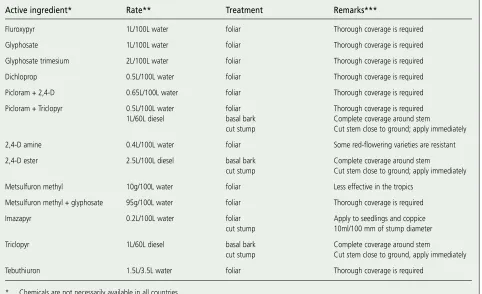
Several herbicide groups are used with effective results on lan-tana and most can be used either as a foliar spray (Figure 18) or as a basal bark application. It is important to follow the directions on the chemical container. Trade names are not used in this book as they may differ between countries (Table 2). Figure 18.
Active ingredient* Rate** Treatment Remarks***
Fluroxypyr 1L/100L water foliar Thorough coverage is required
Glyphosate 1L/100L water foliar Thorough coverage is required
Glyphosate trimesium 2L/100L water foliar Thorough coverage is required
Dichloprop 0.5L/100L water foliar Thorough coverage is required
Picloram + 2,4-D 0.65L/100L water foliar Thorough coverage is required
Picloram + Triclopyr 0.5L/100L water foliar Thorough coverage is required
1L/60L diesel basal bark Complete coverage around stem
cut stump Cut stem close to ground; apply immediately
2,4-D amine 0.4L/100L water foliar Some red-flowering varieties are resistant
2,4-D ester 2.5L/100L diesel basal bark Complete coverage around stem
cut stump Cut stem close to ground; apply immediately
Metsulfuron methyl 10g/100L water foliar Less effective in the tropics
Metsulfuron methyl + glyphosate 95g/100L water foliar Thorough coverage is required
Imazapyr 0.2L/100L water foliar Apply to seedlings and coppice
cut stump 10ml/100 mm of stump diameter
Triclopyr 1L/60L diesel basal bark Complete coverage around stem
cut stump Cut stem close to ground, apply immediately
Tebuthiuron 1.5L/3.5L water foliar Thorough coverage is required
* Chemicals are not necessarily available in all countries.
** These are rates recommended by the manufacturer and may vary for different countries. *** Foliar sprays should be applied during the active growing season.
Table 2.
Registered herbicides used in Australia, India and South Africa in the control of L. camara.
Sources:
Anon. 1998. Pest Facts: Lantana camara. Department of Natural Resources and Mines, Brisbane, Australia.
Ensbey, R. 2001. Noxious and Environmental Weed Control Handbook 2001/2002: A guide to weeed control in non-crop, aquatic and bushland situations. NSW Agriculture, Orange, Australia.
Grobler et al. 2000. A guide to the use of herbicides. National Department of Agriculture, Pretoria, South Africa
Several chemical groups are involved: benzoic acid-based chemicals (dicamba); phenoxy acid-based chemicals (2,4-D, 2,4,5-T, dichloroprop); pyridine-based chemicals (fluroxypyr, picloram, clopyralid, triclopyr); inhibitors of acetolactate synthase (metsulfuron-methyl, Imazapyr); and inhibitors of EPSP synthetase in the shikimic acid pathway (glyphosate). Inhibitors of photosynthesis have very little impact on lantana, possibly due to its ability to drop leaves and re-foliate quickly (Swarbrick et al. 1998).
Glyphosate is effective and widely used on lantana in Australia (Toth & Smith 1984; Hannan-Jones 1998), while 2,4-D produces highly variable results in Africa (Graff 1986). This may be due to varietal differences among the plants. In Australia, the red-flowering varieties are more difficult to kill and the pink-flowering ones the easiest (Diatloff & Haseler 1965). Variable control of different flowering varieties is also reported in Mauritius (Birch 1961 in Swarbrick et al. 1998).
In New South Wales National Parks, glyphosate is used to spray large stands of lantana, particularly where soil stability is important. The roots and stems of the dead plants shelter native plant regrowth, protect native seedlings from grazing marsupials, and reduce erosion. Where preservation of native grasses is important or grass species are important for preventing surface erosion, metsulfuron-methyl is used to kill the lantana but not the grasses (R. Joseph NSW NPWS, pers. comm.).
Herbicides are expensive and the costs of chemicals sometimes cannot be justified for use against lantana. In many areas the cost of chemical control of lantana may equal or exceed the value of the land (Erasmus & Clayton 1992; Thakuret al. 1992; Willson 1995). Costs of six herbicide treatments registered in South Africa for control of lantana were compared. All treatments produced more than 75% mortality of treated plants, however imazapyr in water was cheaper than picloram/triclopyr in diesel, owing to the cost of the
mixers. Glyphosate was also more expensive than imazapyr (Erasmus & Clayton 1992). A large unpublished study in D’Aguilar National Park in Queensland, Australia included a cost-per-hectare comparison. The study found that the cost of 2,4-D ester was much lower than the slightly more effective fluroxypyr, and was therefore promoted for further use (Anon. 1999a).
It has been noted that the requirement for follow up control is rarely considered and yet success requires at least one follow-up treatment in most cases (Erasmus & Clayton, 1992). In some cases, chemical control costs were found to be similar to the value of the land, particularly when follow-up is considered. However, the continuous loss of productive land to lantana must be considered when valuing the land.
9.2 Mechanical control
Blackbutt forests of south-east Queensland, burning damages the trunks of valuable timber trees (Waterhouse 1970).
Fire should not be used in plantation situations when lantana is growing among valuable plant species.Therefore in many tropical countries, where lantana grows under coconut plan-tations, fire is not an option. It is also inappropriate in areas of high conservation value, particularly where, in areas such as rainforest, lantana provides a fuel load that changes the intensity of fires experienced by the ecosystem.
9.4 Post-removal management
Follow-up control has been stressed as significant in all con-ventional control methods. Mechanical or fire removal of large plants is often followed by chemical control of regrowth and seeding plants. Many years of work can be wasted if follow-up does not occur for at least two years following the last seeding.
The mass removal of lantana infestations may result in the exposure of bare soil, which becomes vulnerable both to erosion and re-invasion of lantana and other weeds. To avoid reinfestation, control programs should involve the establishment of competitive plant species, which can grow quickly to shade out developing lantana seedlings (Figure 21). In Australia, exotic grasses and leguminous vines have been utilised in pasture situations (Goodchild 1951; Bartholomew & Armstrong 1978). Establishment of native species is used in many parts of Australia, particularly in areas of high conservation value (B. Noble Qld EPA, pers. comm).
In India, trees such as Ricinus communisL. (Euphorbiaceae) and Ficus elasticaRoxburgh & Hornemann (Moraceae) have been used to shade out regenerating lantana (Gujral & Vasudevan 1983), while Leucaena glauca(L.) Bentham (Fabaceae) has been used in Indonesia and Tithonia diversifolia(Hemsley) A. Gray (Asteraceae) has been tried in Sri Lanka (Anon. 1962). Figure 19.
Mechanical clearing of lantana using a modified bulldozer (Queensland, Australia).
Figure 20.
Fire is often used to manage large infestations of lantana prior to herbicide application (Queensland, Australia).
9.3 Control by fire
Fire is one of the cheapest methods for controlling lantana and is often used in grazing areas. Regular burning will reduce the number of plants. Mature lantana is fire tolerant and regrowth from seeds and basal shoots is common. However, in these situations, regrowth of individual plants can be treated with chemicals more efficiently than large stands; so fire is often used as a pre-treatment to herbicides (Department of Natural Resources & Mines 2001) (Figure 20). Indeed, the Queensland Department of Natural Resources and Mines recommends the use of fire as part of a management program for the