Search engine optimization for Small and Medium Enterprises
(SMEs)
Vani Aul
|
University of West London
This paper shows how Small and Medium Enterprises (SMEs) can implement the
Search Engine Optimization (SEO) elements on their websites and make them
visible on the search engines. Four SMEs have been considered in this study. Two
SMEs had absolutely no web presence whereas the other two had operational
e-commerce websites. For the first two SMEs new websites were created, SEO
techniques were implemented and these websites became visible on Google. On
the other hand, advanced SEO techniques were implemented for the existing
e-commerce websites which enabled them to gain higher ranking on search
engines for their targeted keywords. On gaining these rankings on search engines
the SMEs established their identity on the web, which would ultimately help them
attract visitors and prospective clients searching for their products or services on
the search engines. By undertaking this process it was shown that the websites’
visibility on search engines have a positive contribution for the growth of SMEs’
businesses.
Keywords
|
Search Engine Optimisation, SEO, SMEs, SME, Small and Medium
Enterprises, Google, Yahoo, Bing, Ask, AOL, increased website visibility, website
visibility, website optimisation
Introduction
The main aim of this paper is to identify the tools and technologies that can be adopted by Small and Medium Enterprises (SMEs) to establish their virtual identity through website visibility. A review of the literature is followed by a reported empirical study. This involved creating two test websites (simulating SMEs) which were made visible naturally on the main search engine (i.e. Google), by implementing the techniques of Search Engine Optimization (SEO). Two more SMEs with operational e-commerce websites selling motorcycle clothing on the web were identified to provide a control. As these real websites are competing in a competitive niche, an advanced level of SEO techniques was implemented in order to enable these sites to compete effectively with their competitors and build rankings on Google for their targeted keywords.
Google has been chosen for the study as it is the dominant search engine having the largest share of users as compared to the other two popular search engines i.e. Yahoo and Bing. The outcome of the study is the development of
a set of principles and techniques which SMEs themselves can use to address the visibility of their websites through SEO in order to support their business operations and gain business benefits.
and so on.
Figure 1 Highlighting the top ten
non-paid/organic/natural and
paid results on a Search Engine
Results Page (SERP):
Paid results are the results for which companies pay to get listed on a SERP for the specified keywords. The search engines follow an auction-model of payment in which different companies bid for the same keywords and higher amount bids result in higher ranking of the companies’ websites on the SERP. Paid results are also known as sponsored results and are clearly segregated from the natural results. Non-paid or organic or natural results refer to the results which are delivered naturally by search engines. The websites are awarded rankings naturally by the working of search engine algorithms. To build rankings naturally on the search engines, website owners run SEO campaigns for their websites. SEO plays an important role in making a website visible on search engines.
e-commerce and internet marketing. SEO helps a website to gain top ranking positions on the search engine for its related keywords. When a user searches for those keywords on the search engine, he accesses the top ranked websites and possibly makes an online purchase from one of these websites. Hence if an SME implements SEO on its website and attains higher ranking positions for its related keywords, it increases the likelihood of generating sales through these search engine rankings.
Small and Medium Enterprises: From the perspective of the World Wide Web, SMEs can build their web presence and grow their business through their company websites. Presently, it is the right time for businesses to evaluate if the search engines can become their new marketing channel. On a global level, millions of internet users are using the internet to make their purchasing decisions. Many of them actually buy via the internet through the means of electronic shopping or e-shopping. For meeting their shopping needs, consumers start their search by using the search engines (Thelwall, 2000), as highlighted in the diagram below.
Figure 2 Highlighting the
sequence of events on the World
Wide Web
There is a clear chain connecting different processes that starts with the shopper using a search engine for finding the relevant product and possibly ends with the actual purchase of the product. SMEs need to understand this process and work towards making their websites visible on search engines so that their target audience should find their website and purchase through it.
Shopper Search Engine Finding Ecommerce Website
Shopping on Ecommerce Website
Literature review
Search Engine Optimisation (SEO): SEO may be defined as the optimisation of a website for search engines, so that search engine spiders are able to view it in an optimal manner. It is possible to achieve high rankings and become visible on search engine(s) by using various techniques of search engine optimisation (SEO) (Humayun, 2009). SEO is the process of improving a website’s ranking in the results page of search engines (Hissom, 2010). Weideman, (2007) states that search engine optimisation involves altering the web pages by making them ‘crawler friendly’ and enabling the search engine crawlers to index the page.
Humayun (2009) notes that various techniques exist for optimising the websites for search engines, which are evolving gradually by observing the working of search engine algorithms. Search engines use specialised algorithms to perform the task of ranking the relevant websites in the search engine results page. All the major search engines are powered by their respective algorithms. These algorithms are the ultimate authority for rewarding the rankings to relevant websites in search engine results pages. Website relevance and website ranking are two critical factors addressed by search engine algorithms. Search engine algorithms do have some weaknesses and hence are developing gradually, thus improving continually. In order to take advantage of the weaknesses of search engine algorithms, website owners or SEO professionals tend to observe the shortcomings of these algorithms and manipulate their websites to improve their ranking position in the search engines results pages. In order to address this problem, search engines keep their algorithms up-to-date and constantly improve them in order to keep ahead of the manipulative techniques devised for compromising and challenging the integrity of the algorithms (Chambers, 2005). Hansell (2007) makes a point in this direction by saying that Google introduces about six minor or major tweaks to its algorithm on a weekly basis. Hence it is correct to state that SEO techniques and search algorithms have been developing gradually in a vicious circle where both these elements affect each other.
‘For instance, in order to trick search engines webmasters publish content on the webpage in the same colour as of the background. This content is visible to search engines and not to the visitors. As search engines have developed to detect these techniques they have started penalising websites using such techniques. For minimising such tricks, search engines constantly change their algorithms and tend to keep it very secret for avoiding any possible abuse of their weaknesses by the webmasters’.
(Couzin and Grappone 2008).
As search engines disapprove the manipulative strategies and punish the websites by removing them from their index, therefore it is very important for webmasters to follow the guidelines of search engines for implementing only ethical SEO techniques (Golliher, 2008). There are various ethical techniques which can be implemented for improving visibility in search engines (SEOmoz, 2009). Although none of these techniques assure a particular ranking position in the search engine results pages, the implementation of these SEO techniques and strategies improve prospects of the websites to gain visibility on search engines. Ultimately this results in receiving visitors to the website and consequently leads to increased sales and revenue for the website.
George (2005) asserts that search engines value the sites having good navigation structure with high quality content. Zhang and Dimitroff (2004) note that SEO involves the process of identification of website-factors which impact on their accessibility by search engines. Further it involves optimisation of these factors in order to build higher rankings for the websites in search engines. One of the prime motives of SEO is to provide good accessibility of web pages to the search engines for attaining improved visibility in the search engine results page (Zhang and Dimitroff, 2004).
Off-page factors refer to those factors which are external to and cannot be defined or obtained by the webpage and are not in the control of the webmaster. They generally include hyperlinks on other websites, overall reputation or recognition of the website on the web and the network of the website to which it belongs. Steenderen (2001) argues that SEO is a continuous on-going process which is facilitated by the specialised marketing tools available on the web. Further he observes that it consists of a multitude of small steps, the implementation of which is time consuming. SEO is a quite complex task as it involves an understanding of the working of different algorithmic factors and an implementation of these factors according to the unique algorithmic factors of different search engines (Humayun, 2009). The next section shows the list of SEO factors developed through empirical observation and implementation.
Empirical research: Many researchers attempted to understand the important SEO factors by analysing the high ranking websites on the search engine results pages. They studied and analysed the usage of different elements in the highly ranked pages. They used the deductive research methods for identifying the factors influencing the ranking of a website. Alternatively, some of the other researchers adopted the inductive reasoning method for their research work; they implemented the SEO techniques on websites, analysed the results empirically and formed their observations on the basis of the results achieved. The focus of research in the past has been mainly to identify the on-page SEO factors influencing visibility and ranking of the websites on search engines which is explained in the following sections.
SEO factors influencing ranking in Google: Evans (2007), conducted research, ‘Analysing Google rankings through search engine optimization data’, to identify the popular SEO elements implemented for gaining higher rankings in Google. He analysed top 50 ranking sites in two categories. The factors he examined in the high ranked sites include: the usage of page rank, total number of website pages, number of incoming links to a website, age of the domain, and the popularity on third party sites or web directories, and social bookmarking sites. After conducting this analytic study he found that:
• High number of pages within a website partially influences the ranking
• Although higher page rank does influence the website ranking considerably, but sometimes websites having lower page rank value outrank the websites having higher page rank • High number of incoming links to a website results in higher ranking for the website; at the same time, the quality and relevance of these links is another critical factor
determined by search engines to calculate the actual value of these incoming links • Website listing in the Dmoz directory is a favourable factor for higher ranking
• Old domains with higher age do influence the ranking to some extent
• Social bookmarks from popular sites like Delicious.com have a positive effect on the ranking.
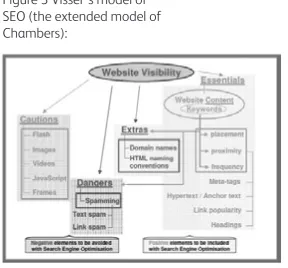
Extending the Chamber’s SEO model: Visser (2006), extended the Chambers’ SEO model by implementing it in the SEO campaigns of five websites. He observed the effects of different elements by monitoring the visibility and ranking of these websites on search engines. As a result, he identified and added some new elements to the SEO model and grouped the elements under four categories: essentials, cautions, extras and dangers.
• Essentials refer to the elements which must be included in a website in order to make it visible on the search engines such as keywords in website content, meta-tags, keywords in hypertext/anchor text, link popularity and headings.
• Extras are the supplementary elements that provide help when used along with the essentials, like: domain names and HTML naming conventions.
• Cautions are those elements which are not crawlable or visible to the search engine spiders. In other words, search engines won’t be able to see the contents of these elements like: flash, images, videos, javascript and frames.
Figure 3 Visser’s model of
SEO (the extended model of
Chambers):
The elements identified in the above model have been explained in this article.
Conceptual framework: Malaga (2007) carried out a similar study on SEO, to assess if implementation of SEO could refer targeted traffic to the website and result in a positive ROI (return on investment). For carrying out this SEO implementation project, he devised the following conceptual framework.
Figure 4 Highlighting the
The above figure may be interpreted as indexing and on-site factors result in search engine ranking which ultimately leads to web site traffic. As shown above, Backlinks and aPay-Per-Click Advertising is shown as a negative factor (dashed-lines).
After the implementation of the above conceptual framework, major improvements were found in the results for the website: in terms of increased visibility on search engines including Yahoo and MSN (now Bing), increase in traffic by 125 times over its prior traffic, increased sales and revenue generation for the website. The limitation of this research was that the website got limited exposure in Google.
Explanation of on-page SEO
elements
On-page SEO elements refer to those elements that are implemented within the webpage or the website and are in the direct control of webmaster. The researchers have identified various factors under the umbrella of on-page SEO. The explanation of the most common elements affecting on-page SEO is given below under different headers of essentials, cautions, dangers and extras:
Essentials: Essentials mean those elements which must be included. These include Meta-tags, Meta-title tag, Meta-description tag, Meta-keyword tag, Meta-header tag, Hypertext / Anchor Text, Meta-robot tag, Alt tags,
Keywords, etc.
Cautions: Cautions are those elements which should not be implemented in perspective of SEO. These are; Frames, Flash, JavaScript, Graphics / Images, Sounds, Video, PDF and other format Files, etc.
Dangers: Dangers are those elements which are not recommended by search engines, and the usage of which might result in penalising of the site by search engines. These are; Spamming, Text spamming, Link spamming, Webpage Cloaking, etc.
Extras: include HTML naming conventions, domain names, etc.
Explanation of off-page SEO elements: Off-page elements are those elements that are executed externally on the web for promoting a specific website. These elements are performed off-page or external to the webpage. One important off-page SEO element is of link building which refers to the process of procuring links on third party sites which are related to a specific website. It is important to note that only high quality and relevant sites should be considered for building links.
Role of a business website for
SMEs
Steenderen (2009) advises that with the current development of technology it is advantageous to create a business website and supplement the existing business through an establishment in the virtual world of WWW. Further he states that it is not only important to have a website but making it visible on the web is even more crucial. A website can reach its full potential by receiving targeted traffic. However, there is no one proven method for developing and promoting a site. (Elderbrock et al., 1997) noted that in the present day scenario, it is easy for companies to get off the track as they face intense pressure from the competition with the challenge to develop their business website having little knowledge about it. In order to make sure that the company makes sound decisions, it is important to determine important business objectives:
• Why the company needs a website? • Which products will be sold and delivered via website?
• Who is the target audience or potential customer?
• How to reach the customer via website?
A business website can be instrumental in deriving direct or indirect revenue generation for the business (Steenderen, 2009): direct revenue generation in the form of product sales, product subscriptions, and site
Thelwall (2000) highlights that a business website can offer different types of financial engagement:
• Company information: where business information and contact information is provided including email, contact number and postal address
• Product information: In addition to the above, product information is also provided • Online catalogue: In addition to the above, pricing details of products are also provided • Online mail-order catalogue: In addition to the above, the website gives the ability to buy via mail-order
• Cyberstore: In addition to the above, the website has the provision of accepting and processing online payments.
By creating a website, the business develops the capability of being seen on the web. It is important to note that the website should be accessible 24 hours of the day, each day of the year. Subsequently it is important to be actually seen by the company’s target audience which can become possible only if the website has visibility on the web search engines. Website visibility can be developed by running an SEO campaign. SEO can help the website to receive its intended audience on a global level, giving national and international coverage to the business.
Adaptation of internet for e-commerce: a potential marketing opportunity for SMEs : The widening of the exposure of SMEs would result in the increase of marketing channels as well as direct and indirect revenue streams (Steenderen, 2009). Berman and McClellan (2002) note that inclusion of e-commerce into the business processes would result in enhanced profitability for the business. E-commerce may be defined as the usage of electronic networks for exchanging information, products or services and payment for
commercial purposes between the individual consumers and businesses, between businesses themselves, within the government, between public and the government or between the business and the government (South Africa’s Department of Communications, 2000).
The SMEs who are adopting e-commerce for their businesses are realising practical benefits in terms of overcoming cost and geographical barriers, getting access to new markets and enjoying the advantages of improved customer relationships, services, accelerated communication and the sharing of information. As the integration of internet with a business is not very costly, SMEs aware of this technology option do make use of it (Boyes and Irani, 2004).
Despite of the problems posed by the adoption of e-commerce for SMEs, it is recommended that SMEs should adopt this marketing channel.
Observing consumers behaviour and
purchasing habits on the internet has become very important for SMEs to integrate internet into their businesses. Porter (2001) asserts that the internet should be adopted to complement the business strategy. Rather than considering whether or not the internet should be
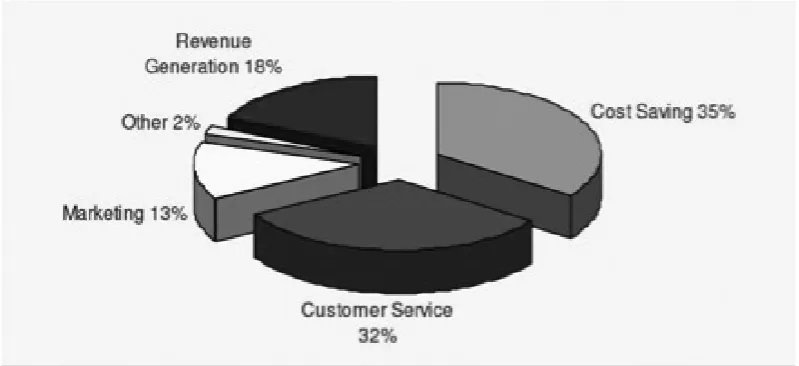
Finally, Singh (2002) has highlighted the benefits realised by the top 100 companies of America by using internet for their respective businesses. The percentage of different benefits gained is shown in the figure :
Figure 5 Highlighting the
different benefits realised by
adopting the Internet
Depending on the scale of a business and the extent of adoption of technology the SMEs can certainly expect to experience considerable benefits.
Limitations of research on SEO and SMEs : Most of the research-work done by different researchers including Chambers’ (2005) SEO Model, Visser’s (2006) Improved Model of Website Visibility, Malaga’s (2007) Conceptual Framework for increasing website traffic and other researchers, as discussed above show that the main focus of study and analysis revolved around understanding the impact of on-page factors of SEO, but side-lining the off-page factors of SEO. The SEO models give a good coverage of the on-page SEO elements only. However, off-page SEO elements
constitute a very important part of the SEO campaign for a website, without which the SEO campaign is incomplete.
Although Malaga (2007) has provided a brief discussion about indexing by Yahoo and Bing, there is very little information about off-page SEO. The current research extends the previous research by showing the implementation of off-page SEO elements in addition to the on-page SEO elements.
Different researchers including Steenderen (2009), Berman and McClellan (2002), Porter (2001), and (Singh, 2002) have highlighted the fact that SMEs can enjoy potential benefits with the adaptation of WWW. They do not highlight the nature and types of these benefits. Moreover, the actual benefits an individual firm could realise from the internet can be better understood by the business owners after they adapt to the technology. Additionally, such benefits would be highly unique and specific depending on the nature of business of each firm. Thus past research leaves the business owners with a vague understanding of the potential business benefits.
It is not only important to have a business website but it is more important to have visitors visiting that website. In view of those SMEs/ businesses already having a website, it can be stated that the majority of them are not aware of the concept of a visible website and the benefits it can generate for their respective businesses.
Investigating the problem area
An empirical study: Technology, internet and the WWW is playing a pivotal role in today’s socio-economic field and has become a significant contributing factor for the survival and growth of SMEs. This can give them access to market their products globally and run their operations effectively. But it has not been adopted by the businesses to its full potential by the majority of SMEs.For businesses of all sizes, a business website has become an indispensable tool for complementing their traditional marketing channels. Specialised technical knowledge is required for creating a visible website and maintaining it effectively. As the creation and maintenance of web presence requires awareness and understanding about this technology, hence the majority of SMEs are hesitant to adopt this marketing channel. In contrast a minority of SMEs who already have a website do not have the sufficient expertise to make their website visible to their target audience through the medium of search engines and get the ultimate business benefits. Six research questions were identified for empirical study.
RQ1: Carry out a study to determine the presence of website of four SMEs on Google.
RQ2: To investigate empirically the feasibility, process and steps to be undertaken, which SMEs can adapt to establish their web identity or website ranking goals.
RQ3: An analytic study of different SEO elements that can help the SMEs to attain their respective website visibility and keyword ranking goals on Google.
RQ4: An evaluation of the main SEO factors instrumental in establishing the visibility of website on Google.
RQ5: To understand the probable impact of a website on the SMEs’ business.
RQ6: To determine the potential for improvements and specifying future performance and visibility benchmarks.
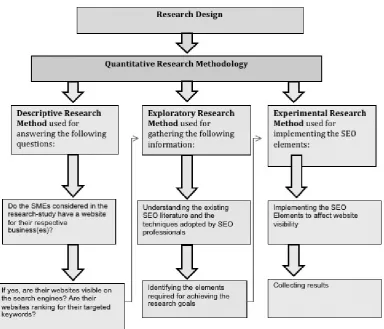
Research design: The research design below was prepared for executing the research methodology in an effective manner. Quantitative research methodology was used mainly, along with its subtypes of descriptive, exploratory and experimental research methods which were executed sequentially. Descriptive research was used to investigate the present status of SMEs’ websites, exploratory research was used to gather authentic information for building web presence of SMEs, and experimental research was used to actually implement the recommended techniques and processes for establishing the visibility of the SMEs’ websites. The main focus of this research was to study the SEO elements affecting the visibility of websites on the main search engine Google. For conducting this research the internet, Google. com and four websites (www.changology.co.uk, www.searoseexim.com, www.leatherup.com, www.motorcyclecenter.com) of four different SMEs have been used. This study has been conducted on the premises of University of West London.
Figure 6 Research design
Figure 7 The details of the four
SMEs considered in this study
S.No. Name of SMEs Description of SMEs
1. Searose Exim A bicycle products manufacturing firm based in India. This company had no web presence. Hence a new website www.searoseexim.com was created (using HTML & CSS) and search engine optimisation was done for this website to make it visible on Google.com.
2. Changology A consultancy firm providing consultation services to organisations for implementing I.T infrastructure. This company had no web presence. Therefore, a new website www.changology.co.uk was created
(using HTML & CSS) and search engine optimisation was done for this website to make it visible on Google.com.
3. Leather Up E-commerce business selling motorcycle clothing and apparels via its e-commerce website: www.leatherup.com. As this website was already established advanced SEO techniques were implemented to help it build organic/natural/unpaid ranking for its targeted 15 key-phrases.
4. Motorcycle An e-commerce business selling motorcycle jackets and related items Center through its e-commerce website: www.motorcyclecenter.com. This
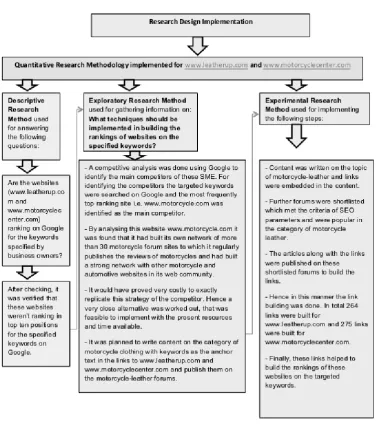
Procedures used in executing the research design: The primary instrument used for data collection was Google.com reflecting the visibility/ranking for the four SMEs’ websites: www.searoseexim.com, www.changology. co.uk, www.leatherup.com and www. motorcyclecenter.com.
In the case of www.searoseexim.com and www.changology.co.uk, it was checked if these websites became visible on Google. com and for www.leatherup.com and www. motorcyclecenter.com it was checked if these websites attained ranking on Google for their targeted keywords.
Figure 8 Execution of research
design for www.searoseexim.com
and www.changology.co.uk:
Evaluation and conclusion
Verifying the hypothesis, null hypothesis and research questions: For conducting this research a hypothesis and null hypothesis, along with six research questions were formulated. To check the effectiveness of this research, it is important to investigate if the hypothesis has been proved true or false and if the research questions have been answered. The following discussion highlights this verification: It was hypothesised that the implementation of Search Engine Optimisation Elements for a website makes it visible on search engines.The stated hypothesis of this research has been proved true as the implementation of Search Engine Optimisation Elements have resulted in making the SMEs’ websites visible on search engines. The table below shows that all the four SMEs’ websites have become visible on Google:
Null hypothesis: In order to check the credibility of implementing the SEO elements for a website a null hypothesis was also formulated as:
The absence of Search Engine Optimisation Elements for a website makes it visible on search engines.
In this experiment, the null hypothesis has been proved false. As found on the website: www.expressprintdirect.com (not illustrated) the absence of search engine optimisation elements did not make it visible on the main search engine. This site has been made in frames which is not recommended by the search engines; therefore it has not been crawled or recognised by Google:
The absence of SEO elements in
www.expressprintdirect.com has not made it visible on search engines, which means that Null Hypothesis has been proved false. Thus the rejection of the above null hypothesis clearly indicates that implementation of search engine optimisation elements are necessary to make
Website Targeted keyword Ranking position attained on
Google for the specified keyword
www.leatherup.com motorcycle jackets 1 www.motorcyclecenter.com motorcycle center 1 www.changology.co.uk changology 1 www.searoseexim.com searoseexim 1
Research questions answered: Furthermore it was found that the research questions formulated for this research have also been answered.
RQ1: Carry out a study to determine the presence of website of four SMEs on Google.
Research conducted on RQ1: It was found that two SMEs didn’t have a website and the other two had e-commerce websites.
RQ2: To investigate empirically the feasibility, process and steps to be undertaken, which SMEs can adapt to establish their web identity or website ranking goals.
RQ3: An analytic study of different SEO elements that can help the SMEs to attain their respective website visibility and keyword ranking goals on Google.
Research conducted on RQ3: SEO comprises of both on-page elements and off-page elements. Both of these elements are critical for running an effective SEO campaign. Hence it was found that firstly the websites should have on-page SEO elements; that is they should be made in an SEO friendly manner and secondly the implementation of link building as an off-page factor, was found to be critical.
RQ4: An evaluation of the main SEO factors instrumental in establishing the visibility of website on Google?
Research conducted on RQ4: This can be grouped according to on-page and off-page factors. From the on-page factors, presence of keywords in the title tags which help in attaining a higher ranking position for those keywords and from the off-page factors. One Way Link Building (with keywords as anchor texts) was found to be very critical.
RQ5: To understand the probable impact of a website on the SMEs’ business.
Research conducted on RQ5: It was estimated that higher rankings have a great impact on the performance and revenue generation of a website. Comparatively, lower rankings are not really profitable until and unless they are promoted to attain higher ranking positions.
RQ6: To determine the potential for improvements and specifying future performance/visibility benchmarks.
Research conducted on RQ6: The future implications are clear from the verification of present results for the respective websites. For all the websites it is recommended to employ sophisticated SEO techniques for attaining top ten rankings for all of their targeted keywords.
Comparison of results attained
for four SMEs
In the case of first two SMEs, Changology and SearoseExim, a new website was built and made visible on the main search engine Google. These sites (www.changology.co.uk and www.searoseexim.com) were less than a month old, at the time of writing this. Very basic SEO principles were implemented for these sites.
In this first stage it is critical for a website to get crawled and indexed by Google and this has happened to both these sites (www. changology.co.uk and www.searoseexim. com) successfully. Although these websites have started ranking for their respective title tags and some key-phrases, little traffic will be generated from these rankings as practically no-one would search for those obscure key-phrases. Hence a focused SEO campaign needs to be executed for these sites in order to build ranking on the targeted keywords. Once the rankings are attained then there would be probability of business generation.
On the other hand the third SME, Motorcycle Center, has gained first ranking position for the key-phrase Motorcycle Center. This website would be receiving some traffic because this key-phrase has a search frequency of 14,800 on Google (in the USA region). Probably, it would be generating some sales as well from its top ranking position on this keyword.
Last but not the least, the fourth SME i.e. Leather UP has gained high ranking positions for its targeted keywords. These rankings would be resulting in a constant high traffic, sales and ultimately revenue for this website.
From a look at the figures involved in probable key-phrase search volumes and sales generated for Leather Up, it is clear that there is great revenue potential which can be realised from higher ranking positions on the related key-phrases.
Evaluation of the results
The results indicate that the implementation of SEO elements can actually make a website visible on the main search engine Google. The individual elements of SEO do have an impact on the overall visibility of the website on the search engines. Thus, it is important to prioritise the implementation of both the on-page and off-page elements of SEO.
The results obtained for websites of all the four SMEs show that SEO results are significant for their businesses. The results achieved for the site www.leatherup.com reflect a huge potential of business that it would be already receiving from its top ten rankings on related key-phrases on Google. Secondly, the site www. motorcyclecenter.com had also gained top ranking for one of its keywords on Google, which would help it receive some free traffic and possible business from Google. Finally, the websites www.changology.co.uk and www.searoseexim.com had been indexed in Google and gained visibility for their related key-phrases. This could be improved further to build the top ten rankings and start receiving potential clients from these rankings by continuing the implementation of SEO techniques.
The current research has extended the previous research on implementing the recommendations of previous researchers. All the researchers have recommended the research on off-page factors in the future. Malaga (2007) states: ‘The search engines constantly change their ranking algorithms. This leads to situations in which a site might rank well one day and completely disappear from the search engine the next day. How should site owners plan and manage in such a volatile situation? Are there any methods or techniques that are more likely to provide long term results?’ For addressing Malaga’s future work recommendations, the current research has made use of link building for building high repute of the websites in their respective niche, which is highly valued by the search engines, and will not result in the removal of the site from search engines’ results pages. Chambers (2005), states that the results of the implementation of his SEO model can be used to conduct further research in improving visibility of the website. The element of title tag as identified in Chambers’ model has been implemented.
Conclusion
From the above study it can be seen that the implementation of SEO elements is absolutely necessary for gaining visibility, building top ten rankings and receiving free traffic from search engines. The implementation of different elements of SEO differs with the different operational levels of the websites. However the following factors play an important role for building rankings on search engines: the placement of keywords in titles (an on-page SEO factor) and link building (an off-page SEO factor). This research study has successfully exhibited the implementation of these SEO elements for completely new websites and already existing e-commerce websites.
Although a lot of information about SEO has been covered in this research study there are certain limitations. This research only discusses how to build rankings on one search engine, Google. Although Google caters to a massive 63% of the total search traffic on the internet, the other search engines Yahoo, Bing, Ask and AOL collectively cater to 30%-35% of the total search traffic. Hence it is important to build rankings on the other search engines as well. Secondly, the research discusses building the visibility and keyword rankings of websites on Google but it did not take into account the important aspect of converting website visitors into clients. Thirdly, the research covered information only on building the natural rankings on Google; it did not take into account generating website traffic and sales through the paid advertising. Finally, in future with the changes in search engine algorithms, these techniques may become obsolete.
Recommendations:
References
Berman, S.J. and McClellan, B.E. (2002) Ten strategies for survival in the attention economy.
Strategy & Leadership, 30(3), p.28-33.
Boyes, J.A. and Irani, Z. (2004) An analysis of the barriers and problems to web infrastructure development experienced by small businesses.
International Journal of Information
Technology and Management, 3(2/3/4),
p.189-207.
Chambers, R. (2005) Search engine strategies: a model to improve website visibility for SMME websites. Unpublished MTech thesis. Cape Town: Cape Peninsula University of Technology.
Couzin, G. and Grappone, J. (2008) Search engine optimization: an hour a day. 2nd edition. Hoboken (NJ): Wiley.
Dreilinger, D. and Howe, E. A. (1997)
Experiences with selecting search engines using metasearch. ACM Transactions on Information Systems, 15(3), p.195-222.
Elderbrock, D., Ezor, J., Dalton, L. and Weissberg, J. (1997) Producing web hits. Foster City (Calif.): IDG Books Worldwide.
Evans, P.M. (2007) Analysing Google rankings through search engine optimization data.
Internet Research, 17(1), p.21-37.
Friedman, L.G. (2002) Go to market: advanced techniques and tools for selling more products, to more customers, more profitably. Oxford: Butterworth-Heinemann.
George, D. (2005) The ABC of SEO. Morrisville: Lulu Press.
Golliher, S. A. (2008) Search engine ranking variables and algorithms. SEMJ.org, 1, p.15-19.
Hansell, S. (2007) Google keeps tweaking its search engine. [Online]. Available at: http://www.nytimes.com/2007/06/03/ business/yourmoney/03google.html?_ r=1&ei=5070&en=f8..%20Pdf [Accessed: 20 July 2011].
Hissom, E.A. (2010) A study of how implementing search engine optimization practices and techniques during the
development and ongoing maintenance of a web site is a key factor in its overall success.
[Online]. Available at: http://www.amyhissom. com/MyWritings/SEO_Successful_Website.pdf [Accessed: 20 July 2011].
Humayun, M. (2009) Optimizing websites for higher search engine ranking. Unpublished MSc dissertation. Sheffield:Sheffield University.
Levene, M. (2010) An introduction to search engines and web navigation. Oxford: John Wiley & Sons.
Malaga, A.R. (2007) The value of search engine optimization: an action research project at a new e-commerce site. Journal of Electronic Commerce in Organizations, 5(3), p.918-929.
Porter, E.M. (2001) Strategy and the internet.
Harvard Business Review, 79(3), p.62-78.
SEOmoz (2009) Search Engine 2009 Ranking Factors. [Online]. Available at: http://www. seomoz.org/article/search-ranking-factors [Accessed: 20 July 2011].
Singh, A.M. (2002) The internet strategies for optimal utilization in South Africa. [Online]. Available at: http://www.sajim.co.za [Accessed: 20 July 2011].
South Africa. Department of Communications (2000) A green paper on electronic commerce: making it your business. [Online]. Available at: http://www.polity.org.za/html/govdocs/green_ papers/greenpaper/intro.html [Accessed: 20 July 2011].
Steenderen, V.M. (2001) Web site
management: making a web site more visible. [Online]. Available at: http://www.sajim.co.za [Accessed: 20 July 2011].
Thelwall, M. (2000) Effective web sites for small to medium sized enterprises. Journal of Small Business and Enterprise Development, 7(2), p.149-159.
Visser, B. E. (2006) Search engine optimisation elements effect on website visibility : the Western Cape real estate SMME sector.
Weideman, M. (2007) Use of ethical SEO methodologies to achieve top rankings in top search engines. Proceedings of the 2007 Computer Science and IT Education Conference. Available at http://citeseerx.ist.psu. edu/viewdoc/download?doi=10.1.1.105.129 3&rep=rep1&type=pdf [Accessed: 27 March 2011].
Zhang, J. and Dimitroff, A. (2005) The impact of metadata implementation on webpage visibility in search engine results (Part I and Part II). Information Processing and Management,