Understanding the Intention to
Continue Use of a Mobile Payment Provider:
An Examination of Alipay Wallet in China
Dong Hong Zhu* Li Ying Lan Ya Ping Chang School of Management
Huazhong University of Science and Technology 1037 Luoyu Road, Wuhan, China
*Corresponding Author: [email protected]
ABSTRACT
With rapid advances in information technology and the development of intelligent terminals, more and more people today are attracted to the advantages of fast, easy online or mobile payment. This technology has already transformed the way many people shop, invest, and pay for offline goods and services. Consumer interest has motivated a large number of enterprises to compete aggressively for consumers’ mobile wallets. Today, the largest mobile payment provider in the world is Alipay Wallet, China’s leading third-party mobile payment app. This study used a questionnaire in the Chinese language to collect data from a sample of 332 Chinese users of Alipay Wallet in order to develop a theoretical model depicting the effect of internal and external factors on a person’s intention to continue use of a mobile payment provider. The research model was tested using the partial least squares technique. The results reveal that the intention to continue use is affected by source credibility, perceived usefulness, and perceived integration from use experiences, and that trust is an important mediator in the relationships between these antecedents and the consequence of intention to continue use. Moreover, the results show that the subjective norm of other people has a significant impact on intention to continue use, but that competitors’ marketing efforts do not have an impact. The implications of the findings are discussed.
1. INTRODUCTION
Mobile payments companies offer convenient and diversified payment services to consumers. With the development of mobile Internet, information technology, and intelligent terminals, more and more consumers are attracted to mobile payment. According to Nielsen (2014), the number of global mobile payment transactions has more than tripled in the last two years. This dramatic increase in consumer interest has motivated a large number of enterprises to compete aggressively for consumers’ mobile wallets (Nielsen, 2014). For example, PayPal, which dominates the mobile payment market in the United States, faces a strong challenge from Google Wallet and Apple Pay (Chang, 2015). Alipay Wallet, the leading mobile payment app in China, is challenged by WeChat Pay and Chinaums (iResearch, 2016).
The cost of obtaining a new customer is five times the cost of retaining an old customer (Schefter & Reichheld, 2000). With the intensification of market competition, how to retain old customers has become an important problem for mobile payment enterprises. Unlike general mobile services, mobile payments involve personal financial information, such as personal bank accounts, assets, shopping lists, and capital flows. For this reason, consumers must be cautious in deciding whether to continue using mobile payment services. It is important, therefore, to study the factors that affect their intention to continue use.
Consumer behavior is influenced by internal and external factors (Pornsakulvanich & Dumrongsiri, 2013), and this is true also with regard to consumer use of mobile payment services. After a period of using these services, consumers gain extensive internal information that may help them evaluate their intention to continue using mobile payments. In today’s environment of fierce market competition, the marketing efforts of competing firms may be an external factor in their decision. Since many mobile payment apps support person-to-person payments, the attitude of other people may be another external factor. In brief, it can be said that consumers’ intention to continue use of mobile payment services is affected by use experiences (an internal factor) and by market competition and the opinions of others (external factors).
quality, system quality, service quality, and innovation attributes to examine intention to continue use of mobile payment (Zhou, 2013; Zhou, 2014; Kapoor, Dwivedi & Williams 2015). There is lack of a comprehensive study on the effect of internal and external factors on intention to continue use.
Alipay is China’s leading third-party online payment platform. It was founded in Hangzhou, China, in February 2004 by the Alibaba Group. In 2008, it launched its mobile business, Alipay Wallet, which is today the largest mobile payment provider in the world (China Telecom, 2014). From the perspectives of use experiences, competitors, and other people, the current study develops a theoretical model to depict the effect of internal and external factors on intention to continue use of Alipay Wallet in China. The findings can help mobile payment enterprises to develop more effective consumer retention tactics.
2. THEORETICAL BACKGROUND AND HYPOTHESES
This section discusses the theoretical background for the current study and presents the study hypotheses.
2.1. Theoretical Background
Consumers gain extensive use experience with mobile payment services after a period of use. As internal information sources, these experiences may help consumers evaluate their intention to continue using mobile payments. The elaboration likelihood model (ELM) developed by Petty, Cacioppo, and Schumann (1983) has been widely used to explore the persuasion process of a variety of sources, information, and context variables (Li, 2013; Schumann et al., 2012; Sparks & Areni, 2002). The current study uses the ELM, therefore, to examine how use experiences affect intention to continue use of mobile payments.
The ELM is a dual-process model that summarizes the ways in which information affecting individual attitude flows along two persuasion routes: the central and the peripheral. Petty et al. (1987) pointed out that, in the process of attitude formation, the two persuasion routes may exist at the same time. Based on the ELM, the present study proposes that use experiences affect the attitude formation of consumers regarding the continuous use of mobile payment in the central and periphery routes. In addition, Zhou (2013, 2014) found that trust is a kind of attitude that affects intention to continue use of mobile payment. The present study proposes, therefore, that the peripheral and central cues from use experiences affect intention to continue use through trust.
(Petty & Cacioppo, 1983). Source credibility is widely used as a peripheral cue to examine the impact of information on individual attitude (Pornpitakpan, 2004). In his study, Pornpitakpan (2004) found that, since mobile payments involve users’ personal financial information, their perception of the credibility of mobile payment providers may influence their trust regarding such payments. Based on the ELM, the current study, therefore, uses source credibility as the peripheral cue. According to the ELM, attitude formation in the central route is the result of deep consideration of the information (Haugtvedt & Petty, 1989). Perceived usefulness is an important determinant factor of individual attitude and behavior (Purnawirawan, De Pelsmacker, & Dens, 2012). Use experiences may help consumers form their usefulness perception of a mobile payment provider, which is likely to affect their trust of the mobile payment service. In addition, in a multi-screen world, cross-platform consumer behavior is common (Google, 2012). The great coordination and consistency among different platforms is important. Use experiences may help consumers form their perception regarding the integration of mobile payment with other relevant payment platforms, which may also affect their trust of mobile payment. The current study, therefore, uses perceived usefulness and perceived integration as central cues.
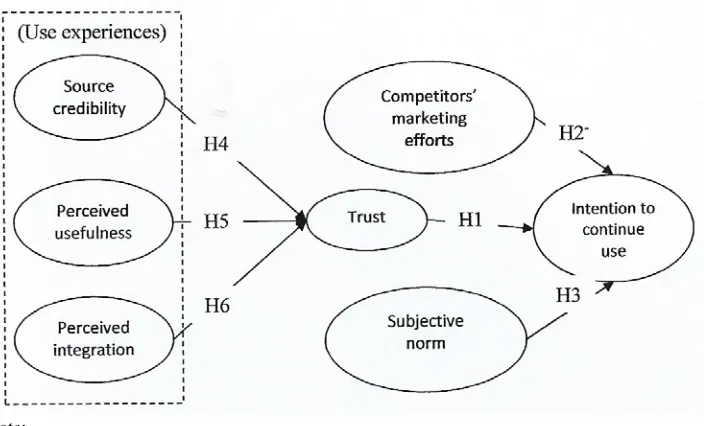
From the perspective of use experiences, this study proposes that source credibility, perceived usefulness, and perceived integration are internal factors that affect intention to continue use of a mobile payment provider through trust.
Besides use experiences, external effects from competitors and other people may also affect intention to continue use of a mobile payment provider. The marketing efforts of companies have an impact on consumers’ purchase behavior (Knox, 2006). The competition for consumers’ mobile wallets becomes even hotter (Nielsen, 2014). Effective marketing efforts by competitors may be attractive to customers, and these efforts may stop their intention to continue use of a mobile payment provider. The current study proposes, therefore, that competitors’ marketing efforts influence intention to continue use. Liao, Chen, and Yen (2007) found that customers’ behavioral intention to continue use of electronic services is affected by the subjective norm. Mobile payment is a kind of electronic service. Accordingly, the current study assumes that subjective norm influences intention to continue use.
Note:
Independent Variables: Source credibility, perceived usefulness, perceived integration, Competitors’ marketing efforts, subjective norm
Dependent Variable: Intention to continue use
Figure 1. Research Model for Current Study
2.2. Hypotheses
Trust is important in using mobile services (Wang, Shen, & Sun, 2013). Previous studies have confirmed that trust is an important antecedent of individuals’ continued use intention in the context of mobile payment. For example, Zhou (2014) demonstrated that consumers’ trust of mobile payment had a crucial effect on their intention to continue using the service. Hence, this study proposes the hypothesis that, when consumers trust a mobile payment service that they are already using, they will have intention to continue using the mobile payment provider:
H1: Trust positively affects intention to continue use of a mobile payment provider.
2008; Baidya & Maity, 2011). A company’s existing consumers may be attracted by the marketing efforts of its competitors. These consumers may reduce or even stop using the services of this company when the marketing efforts of other companies are attractive enough. Therefore, the present study proposes the hypothesis that competitors’ marketing efforts have negative impacts on intention to continue use of a mobile payment service:
H2: Competitors’ marketing efforts negatively affect intention to continue use of a mobile payment provider.
Subjective norm refers to consumers’ perceived pressure from family, friends, and society to do or not do something (Ajzen, 1991). Previous studies have demonstrated the significant positive influence of subjective norm on consumers’ behavioral intention in many fields (Madden, Ellen, & Ajzen, 1992; Richard & Meuli, 2013; Liao, Chen, & Yen, 2007). Mobile payment can help individuals handle some financial activities with acquaintances when they all use the same mobile payment service. Hence, consumers’ willingness to continue using a mobile payment provider may be affected by other people. Therefore, the present study proposes the hypothesis that subjective norm may have positive impacts on intention to continue use of a mobile payment provider.
H3: Subjective norm positively affects intention to continue use of a mobile payment provider.
According to the ELM, source credibility can affect persuasion as a peripheral cue (Petty & Cacioppo, 1983). Cosenza, Solomon, and Kwon (2015) found that the credibility of a blog is persuasive in influencing the trust of the blog readers. Similarly, the present study proposes that, as a peripheral cue, the credibility of a mobile payment service affects the trust that consumers have in that service. In addition, since trust is an important antecedent of intention to continue use (Belanche et al., 2014), the present study hypothesizes that trust plays an important mediating role in the relationship between source credibility and intention to continue use of a mobile payment provider:
H4: Source credibility positively affects consumers’ trust in a mobile payment provider that they are already using.
According to the ELM, people may also have a deep consideration based on the available information to form judgments about a target behavior in the central route (Petty & Cacioppo, 1983). In the context of mobile payment, perceived usefulness and perceived integration may be important central cues when consumers cognitively elaborate on the first-hand information that comes from their use experiences with a mobile payment service they are already using.
Perceived usefulness is the degree to which an individual perceives that using a specific system will improve his or her job/life performance (Davis, 1989). According to the ELM, information may affect individual attitude formation in a central route. In the context of mobile payment, consumers’ deep consideration about the usefulness of a mobile payment service they are already using may be a central route to form their trust in mobile payment. Lee and Jun (2007) found that consumers’ perceived usefulness is one of the crucial predictions of consumer trust in the mobile commerce environment. Amin, Rezaei, and Abolghasemi (2014) also found that users’ usefulness perception positively influenced their trust in a mobile website.
Therefore, the present study hypothesizes that perceived usefulness affects consumers’ trust in a mobile payment service that they are already using as a central cue. In addition, since trust is an important antecedent of intention to continue use (Belanche et al., 2014), the present study hypothesizes that trust plays an important mediating role in the relationship between perceived usefulness and intention to continue use of mobile payment:
H5: Perceived usefulness positively affects consumers’ trust in a mobile payment provider they are already using.
H5a: Trust is a mediator between perceived usefulness and intention to continue use of a mobile payment provider.
Perceived integration refers to the extent of data integration, information consistency, and overall coordination among different platforms of one service (Yang, Chen, & Wei, 2015). With the advent of the multi-screen world (Google, 2012), cross-platform electronic wallet use behavior is common. Low integration among different payment platforms may bring a bad experience to consumers with cross-platform electronic wallet use behavior. According to the ELM, attitude formation in a central route is a deliberate decision on the information (Haugtvedt & Petty, 1989).
their trust in the provider. Therefore, the present study hypothesizes that perceived integration affects consumers’ trust in a mobile payment provider they are already using as a central cue. In addition, since trust is an important antecedent of intention to continue use (Belanche et al., 2014), the present study hypothesizes that trust plays an important mediating role in the relationship between perceived integration and intention to continue use:
H6: Perceived integration positively affects consumers’ trust in a mobile payment provider that they are already using.
H6a: Trust is a mediator between perceived integration and intention to continue use of a mobile payment provider.
3. METHODOLOGY
This section discusses the constructs measured in the current study and describes the data collection process.
3.1. Measurement
The present study measured seven constructs: • Intention to continue use
• Trust
• Competitors’ marketing efforts • Subjective norm
• Source credibility • Perceived usefulness • Perceived integration
All scale items were measured using seven-point Likert scales anchored between ‘‘strongly disagree=1’’ and ‘‘strongly agree=7.’’
Intention to continue use refers to the willingness of a consumer to continue using a mobile payment provider. Measurements for this construct were adapted from the study by Zhu and Chang (2014). This construct includes three items.
Trust refers to the degree to which the consumer believes that a mobile payment provider is competent, honest, and benevolent. Measurements for trust were adapted from scales by Wang, Shen, and Sun (2013). This construct includes nine items.
for competitors’ marketing efforts were adapted from the study of Pauwels et al. (2011) and Baidya and Maity (2011). This portion included three items.
Subjective norm refers to consumers’ perception of the attitude of other people around them regarding use of a mobile payment provider. Measurements for subjective norms were adapted from the study by Chang and Zhu (2011) and Pookulangara, Hawley, and Xiao (2011). This construct includes three items.
Source credibility refers to the degree to which consumers believe that a mobile payment service is safe, reliable, and guaranteed. Measurements for source credibility were adapted from scales by Gurviez and Korchia (2003) and Zhou (2014). This construct includes three items.
Perceived usefulness refers to the degree to which consumers believe a mobile payment provider can improve their life/work performance. Measurements for perceived usefulness were adapted from the scales of Amin, Rezaei, and Abolghasemi (2014). This construct includes three items.
Perceived integration refers to the degree to which consumers think a mobile payment platform is integrated well with other relevant payment platforms. Measurements for perceived integration were adapted from scales by Yang, Wang, and Wei (2014). This construct includes three items.
3.2. Data Collection
A questionnaire in Chinese was used to collect data from the users of Alipay Wallet. Because the original scale items were in English, a back-translation procedure was used to guarantee the validity of translation. First, one researcher translated the English items into Chinese. Second, another researcher translated the Chinese version into English. Third, we compared the two versions of the English items to confirm the accuracy of the Chinese items. This comparison resulted in the first draft of the questionnaire.
Then, we consulted two marketing professors about the measurement items of the questionnaire. Finally, eight graduates majoring in marketing who had knowledge of mobile payment services were recruited to participate in a pilot test. Based on their feedback, we finalized the formal questionnaire. We uploaded the questionnaire to a professional online survey site and offered prizes for those providing data for our study. We used screening questions to exclude non-users of Alipay Wallet.
Gender
Male 60.31% (193)
Female 36.69 (127) Age
18-30 years 68.09% 31-45 27.81 45-60 4.10
In addition, 77.19% of the respondents had more than one year of experience using Table Alipay, and 48.75% had less than one year of experience in using Alipay Wallet.
4. RESULTS
This study used a structural equation modeling technique called partial least squares (PLS) to test the research model. This technique does well in predicting and interpreting the causal model of latent variables. In this study, we used the SmartPLS 2.0 M3 software developed by Ringle, Wende, & Will (2005). Following the two-step analytical procedure (Hair et al., 1998), the present study examined the measurement model first and then the structural model.
4.1. Measurement Model
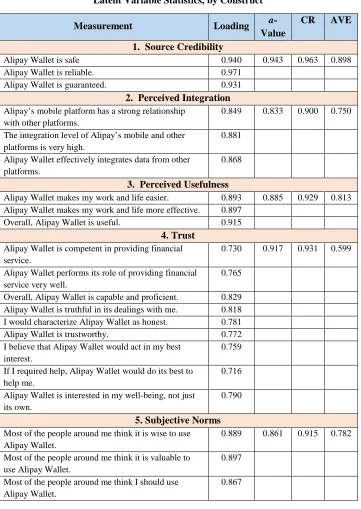
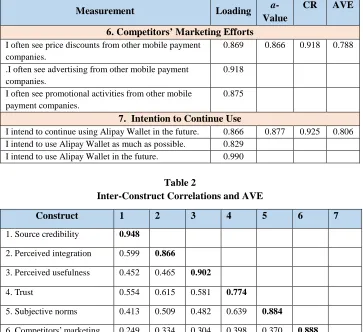
The measurement model was assessed mainly by reliability and validity tests. With regard to reliability, we tested the Cronbach’s α and composite reliability (CR) values. The results verified the internal consistency of the items. The Cronbach’s α values of all constructs were above 0.8 (Table 1), which meets the criterion suggested by Nunnally (1967). The CR values of all constructs were above 0.9 (Table 1), which meets the criterion of strong reliability (Chin & Gopal, 1995). The Cronbach’s α and CR values demonstrated the reliability of the measurement model.
Table 1
Latent Variable Statistics, by Construct
Measurement Loading
a-Value
CR AVE
1. Source Credibility
Alipay Wallet is safe 0.940 0.943 0.963 0.898
Alipay Wallet is reliable. 0.971
Alipay Wallet is guaranteed. 0.931
2. Perceived Integration
Alipay’s mobile platform has a strong relationship with other platforms.
0.849 0.833 0.900 0.750
The integration level of Alipay’s mobile and other platforms is very high.
0.881
Alipay Wallet effectively integrates data from other platforms.
0.868
3. Perceived Usefulness
Alipay Wallet makes my work and life easier. 0.893 0.885 0.929 0.813 Alipay Wallet makes my work and life more effective. 0.897
Overall, Alipay Wallet is useful. 0.915
4. Trust
Alipay Wallet is competent in providing financial service.
0.730 0.917 0.931 0.599
Alipay Wallet performs its role of providing financial service very well.
0.765
Overall, Alipay Wallet is capable and proficient. 0.829 Alipay Wallet is truthful in its dealings with me. 0.818 I would characterize Alipay Wallet as honest. 0.781 Alipay Wallet is trustworthy. 0.772 I believe that Alipay Wallet would act in my best
interest.
0.759
If I required help, Alipay Wallet would do its best to help me.
0.716
Alipay Wallet is interested in my well-being, not just its own.
0.790
5. Subjective Norms
Most of the people around me think it is wise to use Alipay Wallet.
0.889 0.861 0.915 0.782
Most of the people around me think it is valuable to use Alipay Wallet.
0.897
Most of the people around me think I should use Alipay Wallet.
0.867
Table 1(Cont’d)
Latent Variable Statistics, by Construct
Measurement Loading
a-Value
CR AVE
6. Competitors’ Marketing Efforts
I often see price discounts from other mobile payment companies.
0.869 0.866 0.918 0.788
.I often see advertising from other mobile payment companies.
0.918
I often see promotional activities from other mobile payment companies.
0.875
7. Intention to Continue Use
I intend to continue using Alipay Wallet in the future. 0.866 0.877 0.925 0.806 I intend to use Alipay Wallet as much as possible. 0.829
I intend to use Alipay Wallet in the future. 0.990
Table 2
Inter-Construct Correlations and AVE
Construct 1 2 3 4 5 6 7
1. Source credibility 0.948 2. Perceived integration 0.599 0.866
3. Perceived usefulness 0.452 0.465 0.902
4. Trust 0.554 0.615 0.581 0.774
5. Subjective norms 0.413 0.509 0.482 0.639 0.884 6. Competitors’ marketing
efforts
0.249 0.334 0.304 0.398 0.370 0.888
7. Intention to continue use 0.404 0.406 0.526 0.554 0.548 0.289 0.898
Note: The square root of AVE on the diagonal; correlations between constructs on the off-diagonal
4.2. Structural Model
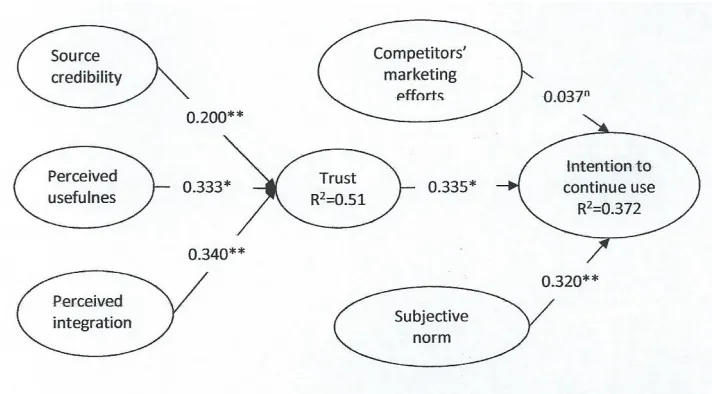
Note: **=p<0.01, n=not significant
Figure 2. The PLS Analysis of Research Model
Figure 2 shows that trust (β=0.335, p<0.01) is a strong predictor of intention to continue use. As we hypothesized that trust would positively affect intention to continue use, hypothesis H1 is supported. Competitors’ marketing efforts have no significant effect on intention to continue use (β=0.037, p>0.05), but subjective norm is a strong predictor of intention to continue use (β=0.320, p<0.01). As we hypothesized that competitors’ marketing efforts and subjective norm would positively affect intention to continue use, hypothesis H3 is supported, but hypothesis H2 is not. Source credibility (β=0.200, p<0.01), perceived usefulness (β=0.333, p<0.01), and perceived integration (β=0.340, p<0.01) are predictors of trust. As we hypothesized that source credibility, perceived usefulness, and perceived integration would positively affect trust, hypothesis H4, H5, and H6 are supported.
4.3. Mediation Analysis
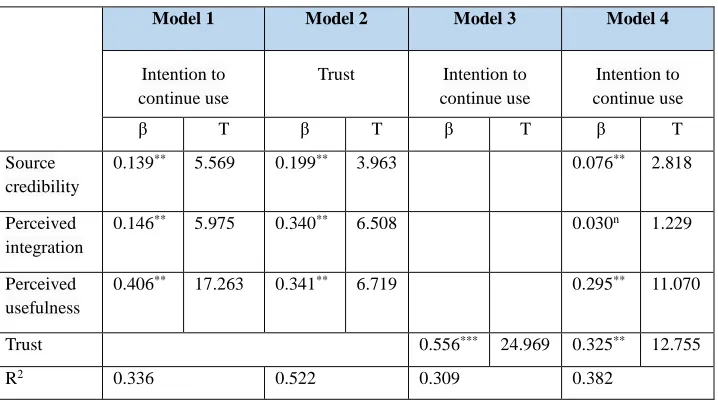
A mediation analysis was used to test the mediating role of trust in the relationships between the antecedents of source credibility, perceived usefulness, and perceived integration and the consequence of intention to continue use. The results presented in Table 3 for the four models indicate:
2. Source credibility, perceived usefulness, and perceived integration significantly affect trust.
3. The effect of trust on intention to continue use is statistically significant.
4. When the paths from source credibility, perceived usefulness, and perceived integration to trust and from trust to intention to continue use are controlled, a previously significant relationship from perceived integration to intention to continue use is no longer significant. Although the previously significant relationship between perceived usefulness and intention to continue use and between source credibility and intention to continue use are still significant, the coefficients reduce significantly.
These results indicate that trust is a full mediator in the relationship between perceived integration and intention to continue use (H5a); and it is a partial mediator in the relationship between source credibility and intention to continue use (H4a) and between perceived usefulness and intention to continue use (H6a). Hypotheses H4a, H5a, and H6a are supported.
Table 3 Mediation Analysis
Model 1 Model 2 Model 3 Model 4
Intention to continue use
Trust Intention to continue use
Intention to continue use
β T β T β T β T
Source credibility
0.139** 5.569 0.199** 3.963 0.076** 2.818
Perceived integration
0.146** 5.975 0.340** 6.508 0.030n 1.229
Perceived usefulness
0.406** 17.263 0.341** 6.719 0.295** 11.070
Trust 0.556*** 24.969 0.325** 12.755
R2 0.336 0.522 0.309 0.382
5. DISCUSSION
Trust has a significant positive impact on intention to continue use of a mobile payment provider. This result is consistent with the finding of Zhou (2014), who empirically proved that consumers’ trust in mobile payment significantly affected their intention to continue use. When consumers develop trust in a mobile payment company, they worry less about financial risks and enjoy the benefits from that mobile payment company; therefore, they remain in continuous use.
Subjective norm has a significant positive impact on intention to continue use of a mobile payment provider. Convenience is a major reason that consumers use mobile payment. Since mobile payment can increase convenience in helping individuals deal with some financial activities involving acquaintances, using a mobile payment company that is supported by these acquaintances is important. Hence, intention to continue use a mobile payment service is affected by the subjective norm.
The present study found that competitors’ marketing efforts have no significant influence on intention to continue use of a mobile payment service. This finding is inconsistent with our previous hypothesis. One possible reason is that competitors’ marketing efforts affect consumers’ behavior in the short term, but do not change their continuous use of a trusted mobile payment company. For example, consumers in China use different types of mobile apps at the same time, such as Alipay Wallet and WeChat. When WeChat uses a price discount to attract consumers, the consumers can enjoy the discount by simply using WeChat. They do not have to stop using Alipay Wallet. This reality may be one reason that competitors’ marketing efforts were found to be insignificant.
Source credibility has a significant positive impact on the trust of consumers toward a mobile payment service that they are already using. Trust is a full mediator between source credibility and intention to continue use. When consumers believe that a mobile payment provider is safe, reliable, and guaranteed with less cognitive effort, they intuitively believe that the mobile payment company is trustworthy and therefore have the intention to continue use.
Perceived integration has a significant positive impact on the trust of consumers toward a mobile payment company that they are already using. Trust is a full mediator between perceived integration and intention to continue use. With the intensification of market competition, there are too many types of mobile payment techniques. Consumers may be confused and may worry about the safety of these techniques. High data integration, information consistency, and overall coordination of the mobile payment platform with other relevant payment platforms provide proof of the mobile platform’s ability. In addition, high integration can give customers a good experience with cross-platform electronic wallet use behavior. Hence, when consumers find that the integration of a mobile payment platform is based on a deep consideration of prior use experiences, they develop trust in that platform, and then have intention to continue use.
6. CONCLUSIONS, IMPLICATIONS, AND LIMITATIONS
A large number of enterprises are involved in the competition for consumers’ mobile wallets (Nielsen, 2014). From the perspective of use experiences, competitors, and other people, this study develops a theoretical model to understand the effect of internal and external factors on intention to continue use of a mobile payment service. The findings of this study have important implications for both theoretical and practical research.
The theoretical research implications can be summarized as follows:
1. In the field of consumers’ use of mobile payments, most previous studies focused on pre-adoption. The research on post-adoption is still insufficient (Shaikh & Karjaluoto, 2015). The current study explored the antecedents of intention to continue use from the perspective of use experiences, subjective norm, and competitors’ marketing efforts, which provides additional knowledge about the antecedents of intention to continue use of a mobile payment service.
provides additional insights into the ELM in the context of intention to continue use a mobile payment provider.
3. Although previous studies have confirmed that trust is an important predictor of intention to continue use a mobile payment service, no study has further justified the mediating role of trust. The present study found that trust is a mediator between the independent variables of source credibility, perceived usefulness, and perceived integration and the dependent variable of intention to continue use of a mobile payment company. The findings reveal the psychological process of the formation of consumers’ intention to continue use of the mobile payment provider.
With regard to practical implications, the key points can be summarized as follows:
1. The current study found that trust is an important mediator between source credibility, perceived usefulness, and perceived integration and the intention to continue use of a mobile payment provider. Therefore, mobile payment providers should focus on winning the trust of consumers with regard to credibility, usefulness, and integration. By building a strict system to guarantee the safety of users’ personal financial information and by maintaining high standards of customer service, mobile payment providers may be perceived as credible by consumers.
2. In order to improve the integration, mobile payment providers should work hard to make information easily accessible and available and to avoid potential conflicts across diverse platforms.
3. Mobile payment providers should focus on offering more convenient payment services for consumers, such as expanding use scenarios, simplifying operational processes, and reducing response time. The current study found that subjective norm significantly affects intention to continue use of a mobile payment provider. The results suggest that mobile payment providers can take measures to encourage high-quality consumers to influence other users through word of mouth.
Although this study has meaningful implications, it also has three significant limitations that should be addressed in future research:
second-order factors of trust can be tested in future research to make clearer the psychological process of consumers.
2. This study uses source credibility as the peripheral cue. Other cues such as brand image and source likeability can be considered in future research.
3. Since it was founded, the main business of Alipay is to provide third-party online payment services. The origin of many emerging mobile payment services is different from that of Alipay Wallet. For example, WeChat is a kind of communications tool. It created WeChat Payment, which is the main competitor of Alipay Wallet in China. Apple, which leads the world in electronics innovation, created Apple Pay. This study focused on the users of Alipay Wallet in China. Future studies could focus on other kinds of mobile payment services outside China.
REFERENCES
Ajzen, I. (1991). The theory of planned behavior, Organizational Behavior and Human Decision Processes 50(2), 179-211. DOI: 10.1016/0749-5978(91)90020-T
Amin, M.; Rezaei, S.; and Abolghasemi, M. (2014). User satisfaction with mobile websites: The impact of perceived usefulness (PU), perceived ease of use (PEOU) and trust, Nankai Business Review International5(3), 258-274.
DOI: 10.1108/NBRI-01-2014-0005
Ansari, A.; Mela, C.F.; & Neslin, S. A. (2008). Customer channel migration, Journal of Marketing Research 45(1), 60-76. DOI: 10.1509/jmkr.45.1.60
Baidya, M., and Maity, B. (2011). Relationship between marketing efforts and sales of consumer brands: An empirical study in India, International Journal of Management 28(1), 387-393.
Belanche, D.; Casaló, L.V.; Flavián, C.; and Schepers, J. (2014). Trust transfer in the continued usage of public e-services, Information & Management 51(6), 627-640. DOI:10.1016/j.im.2014.05.016
Chang, A. (2015). Google Wallet and Apple Pay race for second place. Retrieved from: http://www.cnbc.com/2015/02/24/google-wallet-and-apple-pay-race-for-second-place.html.
Chin, W.W., and Gopal, A. (1995). Adoption intention in GSS: Relative importance of beliefs, ACM SIGMIS Database 26(2-3), 42-64. DOI: 10.1145/217278.217285 China Telecom. (2014). Alipay overtakes PayPal in the mobile payments market, China
Telecom 21(2), 9-9.
Cosenza, T.R.; Solomon, M.R.; and Kwon, W.S. (2015). Credibility in the blogosphere: A study of measurement and influence of wine blogs as an information source, Journal of Consumer Behaviour14(2), 71-91. DOI: 10.1002/cb.1496
Dahlberg, T.; Guo, J.; and Ondrus, J. (2015). A critical review of mobile payment research,
Electronic Commerce Research and Applications14(5), 265-284. DOI: 10.1016/j.elerap.2015.07.006
Dahlberg, T., Mallat, N., Ondrus, J., and Zmijewska, A. (2008). Past, present and future of mobile payments research: A literature review, Electronic Commerce Research and Applications7(2), 165-181. DOI: 10.1016/j.elerap.2007.02.001
Davis, F. D. (1989). Perceived usefulness, perceived ease of use, and user acceptance of information technology, MIS Quarterly13(3), 319-40. DOI: 10.2307/249008 Fornell, C., and Larcker, D.F. (1981). Evaluating structural equation models with
unobservable variables and measurement errors, Journal of Marketing Research,
18(1), 39-50. DOI: 10.2307/3151312
Google. (2012). The New Multi-Screen World: Understanding Cross-Platform Consumer Behavior. Retrieved from https://think.withgoogle.com/databoard/media/pdfs/the-new-multi-screen-world-study_research-studies.pdf
Gurviez, P., and Korchia, M. (2003). Proposal for a multidimensional brand trust scale. In M. Saren & A. Wilson (eds.),Marketing, Responsible and Relevant?Proceedings of the32nd EMAC Conference, Glasgow.University of Strathclyde, Scotland.
Hair, J.F.; Anderson, R.E.; Tatham, R.L.; and Black, W.C. (1998). Multivariate Data Analysis. Upper Saddle River, NJ: Prentice-Hall.
Haugtvedt, C.P., and Petty, R.E. (1989). Need for cognition and attitude persistence,
Advances in Consumer Research16, 33-36.
iResearch. (2016). Q3 2015 China Third-Party Mobile Payment Players Face Fierce Competition. Retrieved from:
http://www.iresearchchina.com/content/details7_19560.html.
Kapoor, K.K.; Dwivedi, Y.K.; and Williams, M.D. (2015). Examining the role of three sets of innovation attributes for determining adoption of the interbank mobile payment service, Information Systems Frontiers17(5), 1039-1056.
Karahanna, E.; Straub, D.W.; and Chervany, N.L. (1999). Information technology adoption across time: A cross-sectional comparison of pre-adoption and post-adoption beliefs,
MIS Quarterly23(2), 183-213. DOI: 10.2307/249751
Knox, G.A.H. (2006). Modelling and Managing Customers in a Multichannel Setting. (dissertation). Retrieved from:
http://repository.upenn.edu/dissertations/AAI3225484.
Lee, T., and Jun, J. (2007). Contextual perceived value? Investigating the role of contextual marketing for customer relationship management in a mobile commerce context,
Business Process Management Journal 13(6), 798-814. DOI: 10.1108/14637150710834569
Li, C.Y. (2013). Persuasive messages on information system acceptance: A theoretical extension of elaboration likelihood model and social influence theory. Computers in Human Behavior, 29(1), 264-275. DOI: 10.1016/j.chb.2012.09.003
Liao, C.; Chen, J.L.; and Yen, D.C. (2007). Theory of planning behavior (TPB) and customer satisfaction in the continued use of e-service: An integrated model,
Computers in Human Behavior 23(6), 2804-2822. DOI: 10.1016/j.chb.2006.05.006 Madden, T.J.; Ellen, P S.; and Ajzen, I. (1992). A comparison of the theory of planned
behavior and the theory of reasoned action. Personality and Social Psychology Bulletin18(1), 3-9. DOI: 10.1177/0146167292181001
Nielsen. (2014). Global Payment Gateways of the Future report. Retrieved from: http://www.nielsen.com/content/dam/corporate/us/en/reportsdownloads/2014%20R
eports/gobal-payment-gateways-of-the-future.pdf
Nunnally, J.C. (1967). Psychometric Theory. New York: McGraw-Hill.
Pauwels, K.; Leeflang, P.S.; Teerling, M.L.; and Huizingh, K.E. (2011). Does online information drive offline revenues? Only for specific products and consumer segments! Journal of Retailing87(1), 1-17. DOI: 10.1016/j.jretai.2010.10.001 Petty, R.E., and Cacioppo, J.T. (1983). Central and peripheral routes to persuasion:
Application to advertising. In L. Percy, and A.G. Woodside (eds.), Advertising and Consumer Psychology (pp. 3-23), Lexington, MA: D.C. Heath and Company. Petty, R.E.; Cacioppo, J.T.; and Schumann, D. (1983). Central and peripheral routes to
advertising effectiveness: The moderating role of involvement, Journal of Consumer Research 10, 135-146. DOI: 10.1086/208954
Petty, R. E.; Kasmer, J. A.; Haugtvedt, C. P.; & Cacioppo, J. T. (1987). Source and message factors in persuasion: A reply to stiff’s critique of the elaboration likelihood model,
Pookulangara, S.; Hawley, J.; and Xiao, G. (2011). Explaining multi-channel consumer’s channel-migration intention using theory of reasoned action, International Journal of Retail & Distribution Management39(3), 183-202.
DOI: 10.1108/09590551111115024
Pornpitakpan, C. (2004). The persuasiveness of source credibility: A critical review of five decades’ evidence, Journal of Applied Social Psychology 34(2), 243-281.
DOI: 10.1111/j.1559-1816.2004.tb02547.x
Pornsakulvanich, V., and Dumrongsiri, N. (2013). Internal and external influences on social networking site usage in Thailand, Computers in Human Behavior29(6), 2788-2795. DOI: 10.1016/j.chb.2013.07.016
Purnawirawan, N.; De Pelsmacker, P.; and Dens, N. (2012). Balance and sequence in online reviews: How perceived usefulness affects attitudes and intentions, Journal of Interactive Marketing26(4), 244-255. DOI: 10.1016/j.intmar.2012.04.002
Richard, J. E., and Meuli, P. G. (2013). Exploring and modelling digital natives' intention to use permission-based location-aware mobile advertising, Journal of Marketing Management29(5-6), 698-719. DOI: 10.1080/0267257X.2013.770051
Ringle, C.M; Wende, S.; and Will, A. (2005). SmartPLS 2. Hamburg: SmartPLS. Retrieved from: http://www.smartpls.com.
Schefter, P., and Reichheld, F. (2000). E-loyalty: Your secret weapon on the Web, Harvard Business Review 78(4), 105-113. DOI: 10.1007/PL00012187
Schumann, D W.; Kotowski, M.R.; Ahn, H.-Y.; and Haugtvedt, C. (2012). The elaboration likelihood model: A 30-year review. In S. Rodgers & E. Thorson (eds.), Advertising Theory (pp. 51-68), New York: Routledge.
Shaikh, A.A., and Karjaluoto, H. (2015). Making the most of information technology and systems usage: A literature review, framework and future research agenda, Computers in Human Behavior49, 541-566. DOI: 10.1016/j.chb.2015.03.059
Sparks, J. R., and Areni, C S. (2002). The effects of sales presentation quality and initial perceptions on persuasion: A multiple-role perspective, Journal of Business Research 55, 517-528. DOI: 10.1016/S0148-2963(00)00173-9
Wang, N.; Shen, X. L.; and Sun, Y. (2013). Transition of electronic word-of-mouth services from web to mobile context: A trust transfer perspective, Decision Support Systems54(3), 1394-1403. DOI: 10.1016/j.dss.2012.12.015
Zhou, T. (2013). An empirical examination of continuance intention of mobile payment services, Decision Support Systems54(2), 1085-1091.
DOI: 10.1016/j.dss.2012.10.034
Zhou, T. (2014). Understanding the determinants of mobile payment continuance usage,
Industrial Management & Data Systems114(6), 936-948. DOI: 10.1108/IMDS-02-2014-0068
Zhu, D.H., and Chang, Y.P. (2014). Understanding motivations for continuance intention of online communities in China: A comparison of active users of social networking sites and virtual communities, Information Development30(2), 172-180. DOI: 10.1177/0266666913482597
ACKNOWLEDGMENTS
This work was supported by the Fundamental Research Funds for the Central Universities of China (2016AC034).
ABOUT THE AUTHORS
Dong Hong Zhu is an associate professor at the School of Management, Huazhong
University of Science & Technology, PR China. Her research interests include customer behavior and network marketing. Her work has been published in a variety of journals including Computers in Human Behavior, Journal of Business Ethics, Internet Research, Journal of Electronic Ecommerce Research, and
Telematics and Informatics. Contact: School of Management, Huazhong University of Science & Technology, 1037 Luoyu Road, Wuhan, China. Email: [email protected]
Li Ying Lan is a graduate student at the School of Management, Huazhong University of
Science & Technology, PR China. Her research interests include customer behavior and network marketing. Contact: School of Management, Huazhong University of Science & Technology, 1037 Luoyu Road, Wuhan, China. Email: [email protected]
Ya Ping Chang is a professor at the School of Management, Huazhong University of