Vol. 3, Issue 2 (Feb. 2013), ||V1|| PP 37-42
A COMPARATIVE STUDY FOR PREDICTING STUDENT’S
ACADEMIC PERFORMANCE USING BAYESIAN NETWORK
CLASSIFIERS
P.V.Praveen Sundar
Research Scholar Hindusthan College of Arts & Science Coimbatore
Abstract: The main objective of educational institutions is to provide high quality of education. Providing a high quality of education depends on predicting the unmotivated students before they entering in to final examination. In this paper, we compare the Bayesian network classifiers for predicting the student's academic performance and generates a Model. This model helps earlier in identifying the drop outs and students who need special attention and allow the teacher to provide appropriate counselling / Advising. In Addition to this, Accurately predicting student performance is useful in many different contexts. For example, identifying exceptional students for scholarships is an essential part of the admissions process and identifying weak students who are likely to fail is also important for allocating limited tutoring resources.
Keywords: Bayesian Networks Classifiers,Classification, Educational Data Mining(EDM), Prediction
I. INTRODUCTION
Knowledge Discovery and Data Mining (KDD) is an interdisciplinary area focusing upon methodologies for extracting useful knowledge from data. The ongoing rapid growth of online data due to the Internet and the widespread use of databases have created an immense need for KDD methodologies. The challenge of extracting knowledge from data draws upon research in statistics, databases, pattern recognition, machine learning, data visualization, optimization, and high-performance computing, to deliver advanced business intelligence and web discovery solutions. In addition to this, recently there are increasing research interests in Educational Data Mining (EDM). EDM is a field that exploits statistical, machine-learning, and data-mining algorithms over the different types of educational data. Its main objective is to analyze these types of data in order to resolve educational research issues. EDM is concerned with developing methods to explore the unique types of data in educational settings and, using these methods, to better understand students and the settings in which they learn[1]. Whether educational data is taken from students' use of interactive learning environments, computer-supported collaborative learning, or administrative data from schools and universities, it often has multiple levels of meaningful hierarchy, which often need to be determined by properties in the data itself, rather than in advance. Issues of time, sequence, and context also play important roles in the study of educational data.
The main objective of educational institutes is to provide quality education to its students and to improve the quality of managerial decisions. One way to achieve highest level of quality in higher education system is by discovering knowledge from educational data to study the main attributes that may affect the students performance. The discovered knowledge can be used to offer a helpful and constructive recommendations to the academic planners in higher education institutes to enhance their decision making process, to improve students‟ academic performance and trim down failure rate, to better understand students‟ behavior, to assist instructors, to improve teaching and many other benefits[2],[4].
Educational Data mining can be implemented in many techniques such as decision trees, neural networks, k-nearest Neighbor, Naive Bayes, support vector machines and many others. using these methods many kind of knowledge can be discovered such as association rules, clasification, clustering, pruning the data.
The main objective of this paper is to predict the student academic performace and make a comparative study on bayesian network classifers, through that we compute which classifier predicts more students when compared to other classifiers. In this paper, student's information like Previous Semester Performance, Attendance, Seminar , Assignment marks,Internal marks, and whether the student has attend any Co-curricular Activities are collected from students to predict the performance at the end of the semester examination.
II. RELATED WORKS
mining to identify and then enhance educational process in higher educational system which can improve their decision making process. [8] applied the classification of data mining technique to evaluate student performance, they used decision tree method for classification. the goal of their study is to predict the final grade of the students.the outcome of their results indicated that Decision tree model had better prediction than other models.
[9] applied the classification as data mining technique to evaluate student‟ performance, they used decision tree method for classification. This study helps earlier in identifying the dropouts and students who need special attention and allow the teacher to provide appropriate advising.[10]applied the classification as data mining technique to evaluate student‟performance, they used decision tree method for classification. This study allows the University management to prepare necessary resources for the new enrolled students and indicates at an early stage which type of students will potentially be enrolled and what areas to concentrate upon in higher education systems for support.[11] applied the association rule mining analysis based on students‟ failed courses to identifies students‟ failure patterns. The goal of their study is to identify hidden relationship between the failed courses and suggests relevant causes of the failure to improve the low capacity students‟ performances.
[12]used k-means clustering algorithm to predict student's learning activities. the information generated after the implementation of data mining technique may be helpful for instructor as well as students.[13]used Bayesian Classification Method as a data mining technique and concluded that students grade in senior secondary exam, living location, medium of teaching, mother's qualification,students other habits, family annual income and students family status were highly correlated with the student academic performance.[14] used simple linear regression analysis and it was found that the factors like mother‟s education and student‟s family income were highly correlated with the student academic performance. [15]conducted study on the student performance using association rule technique and they find the interestingness of student in opting class teaching language.
III. DATA MINING PROCESS
Current Education System in India, a student's Performance is determined by their performance based on Internal marks and semester marks. The internal marks is carried out by the teacher based upon students performance in educational activities such as seminars taken, assignments, co-curicullar activities and performance in Internal exams. The end semester examination is one that is scored by the student in semester examination. each student has to get minimum marks to pass a semester in internal as well as end semester examination.
3.1. Data Preparations
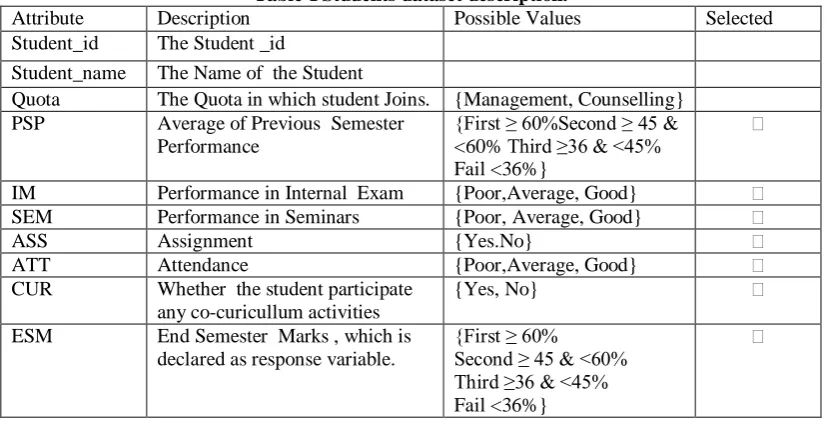
Table-I Students dataset description.
Attribute Description Possible Values Selected
Student_id The Student _id
Student_name The Name of the Student
Quota The Quota in which student Joins. {Management, Counselling} PSP Average of Previous Semester
Performance
{First ≥ 60%Second ≥ 45 & <60% Third ≥36 & <45% Fail <36%}
√
IM Performance in Internal Exam {Poor,Average, Good} √
SEM Performance in Seminars {Poor, Average, Good} √
ASS Assignment {Yes.No} √
ATT Attendance {Poor,Average, Good} √
CUR Whether the student participate any co-curicullum activities
{Yes, No} √
ESM End Semester Marks , which is declared as response variable.
{First ≥ 60%
Second ≥ 45 & <60% Third ≥36 & <45% Fail <36%}
√
software, irrevelant attributes should be removed. The attributes selected as seen in Table-I are processed via the Weka software to apply the data mining methods on them. The attributes such as the Student_Name or Student_ID,Quota are preprocessed using unsupervising filter “remove” and they are not selected to be part of the mining process; this is because they do not provide any knowledge for the data set processing and they present personal information of the students, also they have very large variances or duplicates information which make them irrelevant for data mining.
3.2.Model Construction
For our comparative Process, we use WEKA tool[17]. The WEKA Tool is a Open Source software which is fully implemented in the Java programming language and runs on any modern computing platform. it contains a comprehensive collection of data pre-processing and modelling techniques. Weka supports several standard data mining tasks like data clustering, classification, regression, pre-processing, visualization and feature selection. These techniques are predicated on the assumption that the data is available as a single flat file or relation.
After Preprossing the data using Weka, Student_data.arff is created. This file was loaded into WEKA explorer. The classify panel enables the user to apply classification and regression algorithms to the resulting dataset, to estimate the accuracy of the resulting predictive model, and to visualize erroneous predictions, or the model itself. There are 13 algorithms under bayes classifiers like AODE, AODEsr, BayesNet,HNB, etc., which is implemented in WEKA. The algorithms used for our proposed work is AODEsr, WAODE, HNB, Naivebayes Updateable. Under the "Test options", the 10-fold cross-validation is selected as our evaluation approach. Since there is no separate evaluation data set, this is necessary to get a reasonable idea of accuracy of the generated model.
3.3. Performance Metrics
Once Predictive model is created, it is necessary to check how accurate it is, The Accuracy of the predictive model is calculated based on the precision, recall values of classification matrix.
PRECISION is the fraction of retrieved instances that are relevant. It is calculated as total number of true positivies divided by total number of true positivies + total number of false positivies.
Precision = True positives
True positives + False positives
RECALL is fraction of relevant instances that are retrieved.It is usually expressed as a percentage. It is calculated as total number of true positivies divided by total number of true positivies + total number of false negativies.
Recall = True positives
True positives + False negativies
ACCURACY is the overall correctness of the model and is calculated as the sum of correct classifications divided by the total number of classifications.
IV. EXPERIMENTAL RESULTS
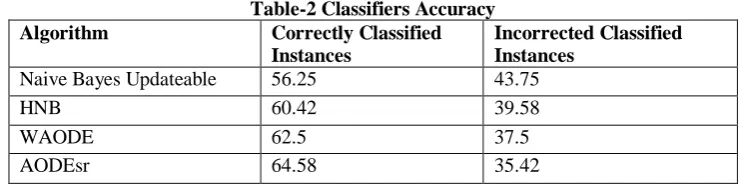
The Table-II shows the accuracy of Naive bayes Updateable, HNB, WAODE,AODEsr algorithms for classification applied on the above data sets using 10-fold cross validation as follows:
Table-2 Classifiers Accuracy Algorithm Correctly Classified
Instances
Incorrected Classified Instances
Naive Bayes Updateable 56.25 43.75
HNB 60.42 39.58
WAODE 62.5 37.5
AODEsr 64.58 35.42
Table –II shows that AODEsr algorithm has highest accuracy of 64.58 compared to other methods. Naive bayes Updateable, HNB, WAODE also showed an acceptable level of accuracy.
Fig 1. Comparision of Classifiers
The Classification matrix has been presented in Table-III,IV,V,VI, which compared the actual and predicted classifications.
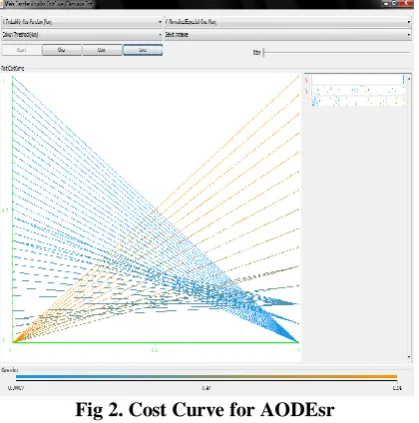
Fig 2. Cost Curve for AODEsr
Table-III
Classification matrix – Naive Bayes Updateable
ESM
Predicted
Precision (%)
First Second Third Fail
Actual
First 8 4 2 0 100
Second 0 10 4 0 55.56
Third 0 4 5 4 35.71
Fail 0 0 3 4 50
Recall(%) 57.14 71.43 38.46 57.14
0 10 20 30 40 50 60 70
NB Updateable
HNB WAODE AODEsr
Correctly Classified Instances
Table-IV
Classification matrix – Hidden Naive Bayes
ESM
Predicted Precision
(%)
First Second Third Fail
Actual
First 10 3 0 1 90.91
Second 1 10 3 0 55.56
Third 0 5 6 2 46.15
Fail 0 0 4 3 50
Recall(%) 71.43 71.43 46.15 42.86
Table-V
Classification matrix – WAODE
ESM
Predicted Precision
(%)
First Second Third Fail
Actual
First 10 2 1 1 90.91
Second 1 10 3 0 62.5
Third 0 4 7 2 46.67
Fail 0 0 4 3 50
Recall(%) 71.43 71.43 53.85 42.86
Table-VI
Classification matrix – AODEsr
ESM
Predicted Precision
(%)
First Second Third Fail
Actual
First 11 2 1 0 91.67
Second 1 10 3 0 62.5
Third 0 4 7 2 46.67
Fail 0 0 4 3 60
Recall(%) 78.57 71.43 53.85 42.86
Table-VII
Overall Accuracy of Classifiers
Algorithm Overall Accuracy Kappa Measure
Naive Bayes Updateable 56.3% 0.408
Hidden Naive Bayes 60.4% 0.459
WAODE 62.50% 0.49
AODEsr 64.6% 0.51
The Table-VII shows that AODEsr algorithm has provides high overall accuracy rate than other algorithms. .
V. CONCLUSION
In this paper, the classification task is used on student database to predict the students academic performance. As there are many approaches that are used for data classification, we use Bayesian Network Classifiers. Informations like Previous semester marks,Internal Marks,Performance on Seminars,Assignment,Attendance, Co-Curricular Activities were collected from the student‟ s database, to predict the performance of the end semester marks.
REFERENCES
[1] www.educationaldatamining.org.
[2] Mohammed M.Abu Tair,Alaa M.El-Hales,” Mining Educational Data to Improve Student‟s Performance: A Case study”, International Journal of Information and Communication Technology Research(ICT Jounal), 2012.
[3] Heikki, Mannila, “Data mining: machine learning, statistics, and databases”, IEEE, 1996.
[4] Surjeet Kumar Yadav, Brijesh Bharadwaj,Saurabh Pal, “Data Mining Applications:A Comparative
study for Predicting Students Performance,” International Journal of Innoviative Technology & Creative Engineering, 2011.
[5] Alaa el-Halees, “Mining students data to analyze e-Learning behavior: A Case Study”, 2009.
[6] Merceron, A. and Yacef, K.,"Educational Data Mining: a Case Study" In Proceedings of the 12th International Conference on Artificial Intelligence in Education AIED 2005, Amsterdam, The Netherlands, IOS Press. 2005.
[7] Galit.et.al, “Examining online learning processes based on log files analysis: a case study”. Research,
Reflection and Innovations in Integrating ICT in Education 2007.
[8] Beikzadeh,M. and Delavari, N., "A New Analysis Model for Data Mining Processes in Higher Educational Systems". On the proceedings of the 6th Information Technology Based Higher Education and Training 7-9 July 2005.
[9] Al-Radaideh, Q., Al-Shawakfa, E. and Al-Najjar, M. (2006) „Mining Student Data Using Decision Trees‟, The 2006 International Arab Conference on Information Technology (ACIT'2006) – Conference Proceedings.
[10] Baradwaj, B. and Pal, S. (2011) „Mining Educational Data to Analyze Student s‟ Performance‟, International Journal of Advanced Computer Science and Applications, vol. 2, no. 6, pp. 63-69. [11] Shannaq, B. , Rafael, Y. and Alexandro, V. (2010) „Student Relationship in Higher Education Using
Data Mining Techniques‟, Global Journal of Computer Science and Technology, vol. 10, no. 11, pp. 54-59.
[12] Chandra, E. and Nandhini, K. (2010) „Knowledge Mining from Student Data‟, European Journal of Scientific Research, vol. 47, no. 1, pp. 156-163.
[13] Shaeela Ayesha, Tasleem Mustafa, Ahsan Raza Sattar, M. Inayat Khan, “Data mining model for higher
education system”, Europen Journal of Scientific Research, Vol.43, No.1, pp.24-29, 2010.
[14] B.K. Bharadwaj and S. Pal. “Data Mining: A prediction for performance improvement using classification”, International Journal of Computer Science and Information Security (IJCSIS), Vol. 9, No. 4, pp. 136-140, 2011.
[15] S. T. Hijazi, and R. S. M. M. Naqvi, “Factors affecting student’s performance: A Case of Private
Colleges”, Bangladesh e-Journal of Sociology, Vol. 3, No. 1, 2006.
[16] U. K. Pandey, and S. Pal, “A Data mining view on class room teaching language”, (IJCSI) International Journal of Computer Science Issue, Vol. 8, Issue 2, pp. 277-282, ISSN: 1694-0814, 2011.
[17] http://www.dicom.uninsubria.it/~marco.vanetti/cfmatrix/