INTRODUCTION
Plastics are a material used all over the world in many branches of industry. They have gained popularity thanks to such features as: strength, durability, flexibility, and resistance to environ-mental factors. However, the growing use of plas-tics in industry is associated with the emergence of increasing amounts of waste. The beneficial and sought-after characteristics of plastics consti-tute a serious problem when they become waste. Therefore, an increasing emphasis is being placed on raising the amount of materials recycled and on reducing the amount of packaging used by consumers [Act of 13 June 2013, Jacobsen et al. 2018, Wróblewska-Krepsztul et al. 2018]. The way to reduce the amount of durable (thus re-sistant to decomposition processes) waste from
conventional plastics may be the use in the pro-duction of biodegradable and oxo-biodegradable polymers [Bahramian et al. 2016, Spierling et al. 2018]. Biodegradable materials should decom-pose under the influence of macro- and microor-ganisms. The oxo-degradable plastics are also de-composed with the participation of living organ-isms, but the initiation of the process requires an additional factor (thermal energy, UV radiation). According to the assumptions of the creators [bi-odeg.org, epi-global.com, okcompost.be], these polymers are to meet the requirements of plastics, that is, they are to be durable and flexible, and at the same time when they are no longer usable, they should be biodegradable in the environment, i.e., in bedding, in landfill, in compost or soil.
One of the products made of biodegradable and oxo-biodegradable polymers are the bags
Accepted: 2018.09.15 Available online: 2018.11.01 Volume 20, Issue 1, January 2019, pages 228–237
https://doi.org/10.12911/22998993/94585
Biodegradable Package – Innovative Purpose or Source of
the Problem
Florentyna Markowicz
1*, Grzegorz Król
2, Agata Szymańska-Pulikowska
11 Institute of Environmental Engineering, Wroclaw University of Environmental and Life Sciences,
50-363 Wroclaw, Grunwaldzki Square 24, Poland
2 Waste Treatment Plant Sp. z o.o. in Jarocin, 63-200 Jarocin, Witaszyczki 1A, Poland
* Corresponding author’s e-mail: [email protected]
ABSTRACT
Neutralization of the amount of plastic packaging waste from year to year is becoming an increasingly serious
problem. Replacing some of them with the products made of biodegradable and oxo-biodegradable polymers,
which may be broken down in the environment in a shorter time seems to be one solution. Polymers are used both for the production of bags for biodegradable waste, as well as shopping bags, labeled by the producers as “compostable”, “biodegradable”, etc. Therefore, they are often used to collect bio-waste, with which they go to the installations intended for their processing, e.g. composting plant. However, contrary to the information on the package, not all are decomposed under the conditions prevailing in composting plants. The aim of this study was
to assess the degree of decomposition of selected package from biodegradable and oxo-biodegradable polymers
under the actual conditions of an industrial composting plants and the possibility of contamination of the product (compost) with components originating from, among others from the additives that improve the properties of plastics and dyes. The conducted research has shown that many bags and sacks available in retail chains, contrary to the information provided, are not completely degraded in industrial composting plants, and may also become a source of heavy metal pollution.
for organic waste or shopping bags. Some of these products have the certificates confirming their compliance with European standards [EN 13432:2000, Wróblewska-Krepsztul et al. 2018], according to which, sacks (bags) should be 90% biodegradable within six months. Such products are marked as “compostable”. On the other hand, sacks (bags) that were made using additives that ensure accelerated degradation in the environ-ment (such as d2w® or TDPA®) are labelled by
the producers as oxo-biodegradable.
The shopping bags made of oxo and bio-degradable polymers, due to their different com-position and properties, should not be recycled together with non-biodegradable plastics. They should be subjected to biodegradation under aer-obic or anaeraer-obic conditions [Álvarez-Chávez et al. 2012]. Therefore, they are often used to col-lect bio-waste with which they can be processed. They encourage, among others things, from the information provided on them, suggesting that the bags should decompose. Their users are con-vinced that they support environmental protection by reusing waste. Together with bio-waste, the bags are transferred to the biological treatment plant (e.g. composting plant), in which, contrary to the information provided by the producers, not all decompose, and they are not always success-fully separated from the mass of waste during tearing and separation process. The substances included in the plastics, along with compost, can infiltrate into the soil environment and then wa-ter, causing pollution. Therefore, the permissible levels of impurities (chromium, cadmium, nickel, lead, and mercury) in fertilisers, also in composts made from wastes (classified as organic fertilis-ers) were defined [Regulation … 2008].
The research on various types of plastics has indicated the presence of, among others, phthal-ates, chlorine, phosphorus, heavy metals (zinc, cadmium, lead, nickel, copper, chromium, co-balt, iron, manganese) [Lithner et al. 2011, Roch-man et al. 2013, Tang et al. 2015, Pivnenko et al. 2016]. Among the additives used to manufacture plastics, there are: dyes, fillers, antioxidants, sta-bilizers, softeners, which can be a source of heavy metals. The agents used to dye materials are solu-ble dyes and insolusolu-ble pigments. They are dis-tinguished by a high ability to selectively absorb light and can permanently colour other objects. The metallic pigments made of aluminium, cop-per, zinc and their alloys are commonly used for printing on foils. Stabilisers prevent degradation
of the polymer under the influence of oxidation, UV radiation or elevated temperature. Soot, lead compounds and organic metal salts are used for this purpose [Hummel 2002, Hahladakis 2018].
Due to the wide use of compounds of various metals for the production and colouring of mate-rials made of biodegradable and oxo-biodegrada-ble polymers, an attempt was made to assess the possibility of environmental pollution with met-als released during their decomposition [Ohidul et al. 2018a]. The results of analysis pertaining to the content of selected metals in waste sacks and shopping bags are presented in this work. The research was conducted on new and composted packaging. The aim of the research was to deter-mine the possibilities of:
• decomposition of selected sacks and shopping bags along with biowaste collected in them, • pollutants entering the produced compost.
MATERIALS AND METHODS
Preparation of samples
Table 1 presents the characteristics of select-ed waste sacks and shopping bags, which were subject to decomposition under the actual condi-tions of an industrial composting plant. The sacks and bags commonly used in the trade were used. According to the manufacturers’ information, all of them were made of compostable, oxo-biode-gradable or biodeoxo-biode-gradable raw materials, which should be decomposed under the influence of microorganisms. The samples of about 500 cm2
were cut out from the sacks and bags.
According to the manufacturers’ instructions, in order for an oxo-biodegradable sample to de-compose, it must be exposed to UV radiation and thermal energy. In industrial composting plants, such conditions can only be obtained when col-lecting waste in hopper bunkers. This is impossi-ble later on, because the reactors in which the first stage of composting is carried out are in sealed equipment, with no UV radiation. Therefore, af-ter excision, all samples were exposed to a 36W UV lamp in 20- and 50-hour cycles, which cor-responded to the storage of waste in the bunker for 2 to 5 days.
re-sistant to the temperatures occurring during com-posting. All samples prepared in this way were placed in bioreactor in industrial composting plant (inside a waste heap) [Adamcova, Vaverko-va 2014]. In total, four samples were prepared for each tested sack (bag):
a) new packaging,
b) packaging composted without irradiation, c) packaging composted after irradiation for
20 hours,
d) packaging composted after irradiation for 50 hours.
Due to the limited amount of biodegradable waste, delivered to the reactor at one time, the tested set of samples consisted of: 10 samples of new packaging, 10 samples irradiated before composting over a period of 20 hours and 10 samples irradiated before composting over a pe-riod of 50 hours. Each set consisted of 30 samples placed under similar conditions. Subsequent sets
of samples were placed in the reactors, along with successive batches of waste, the composting of which was completed at a later time. The paper presents the results of testing the set of samples placed in the reactor on July 24, 2017.
After the completion of the composting pro-cess, the samples were removed from the com-post heap, thoroughly washed and dried. Tap water was used for cleaning, and at the end, the samples were thoroughly rinsed with distilled wa-ter. Drying took place at room temperature. The samples that were washed out of the net, were considered completely decomposed, due to the fact that under real conditions (without the nets) it would be impossible to separate them from the composted waste.
The washed and dried samples were removed from the nets and subjected to a visual assessment, which was a supplement to the photographic doc-umentation. Visual assessment allows to identify Table 1. Characteristics of selected samples [own study based on information from producers]
Sample
num-ber
Type of raw material/
polymer Manufacturer’s information
Characteristics of the polymer
form colour use type
1.
Compostable in
indus-trial conditions, 2 certifi -cates in accordance with norm EN 13432
There is no need to re-move from the stream of bio-waste at the compost-ing industry
foil, elastic, soft milky, translu-cent, imprinted gradable wastebags for biode- biodegradable, compostable
2.
Compostable at home
conditions, 2 certificates
in accordance with norm EN 13432
It is degraded in compost-ing conditions in a period of approximately 45 days
foil, elastic, soft, thin,
rub-ber
milky, green,
translucent gradable wastebags for biode- biodegradable, compostable
3. Compostable, certificate in accordance with norm EN 13432
Made on the basis of corn and potato starch, decom-posed by bacteria from 6 weeks to one year
foil, elastic, soft, starch coating green, opaque, matt, imprinted packaging of products, including food-stuffs biodegradable, compostable
4. Oxo-biodegradable, HDPE and d2w additive
It is decomposed under
the influence of oxygen,
UV and heat, use within 18 months foil, elastic, soft, matt milky, white, translucent, imprinted packaging of products, including food-stuffs oxo-biodegrad-able
5. Oxo-biodegradable, PE and TDPA additive It is subject to accelerated decomposition slippery to the foil, elastic, touch
orange, imprinted, opaque, glossy
packaging of
products oxo-biodegrad-able
6. Biodegradable, LDPE and sugar cane Sugar cane content above 85%, renewable raw mate-rial, 100% recyclable
foil, elastic, slippery to the
touch white, opaque, glossy, im-printed packaging of products, including food-stuffs biodegradable
7. Oxo-biodegradable, PE and d2w additive Thanks to the addition of d2w, the bag is 100% bio-degradable
foil, elastic, slippery to the
touch white, opaque, glossy packaging of products, including food-stuffs oxo-biodegrad-able
8. Oxo-biodegradable, HDPE The bag is oxo-biodegra-dated 100% soft, slippery to foil, elastic, the touch milky, white, imprinted, opaque packaging of products, including food-stuffs oxo-biodegrad-able
9. Oxo-biodegradable, HDPE and d2w additive It has the Oxo-biodegrad-able Plastics Association mark
foil, rigid, slip-pery to the
touch milky, white, translucent, matt packaging of products, including food-stuffs oxo-biodegrad-able
the changes in the appearance and structure of the samples (discolouration, surface roughness), which indicate the beginning of the decomposi-tion process but do not affect the chemical com-position of the samples yet. Then, the samples were prepared for the procedure of determining the content of selected metals.
COMPOSTING
The research on the decomposition of se-lected sacks for waste and shopping bags was conducted in a composting plant located in Ja-rocin (Waste Treatment Plant in JaJa-rocin, Greater Poland Voivodeship, Poland). The composting plant uses the biodome technology, with a closed and actively aerated reactor, equipped with a flue gas cleaning installation. In this technology, solar radiation and process heat are used to maintain the appropriate temperature level inside the reac-tor, thanks to which one may reduce the electric-ity consumption. The composting process takes place in two stages – the first stage occurs in the reactor, the second in the prism square. The temperature measurement in the reactor is auto-matic. The processing capacity of the compost-ing plant is 5200 m3/year. The composting plant
processes a selectively collected organic fraction of municipal waste (leaves, grass, kitchen waste, fragmented branches, etc.). The selective collec-tion of this waste in the area served by the com-posting plant in Jarocin has been conducted for a short time, therefore, at one time, relatively small amounts of waste are placed in the reactor, in which a limited number of plastic samples can be placed. The composting process takes about 5 months. The first stage (composting in the re-actor) lasts two months, the second stage (mat-uration of compost) takes place in the compost
heap area and lasts about 3 months, depending on the weather conditions1.
Figure 1 shows the temperature curve during the composting of the analysed samples in the reactor of the composting plant in Jarocin. The process lasted two months, from July 24, 2017 to September 26, 2017. The course of the process was monitored and controlled. High tempera-ture ensures hygienisation of the waste and the development of microorganisms responsible for their decomposition. Aeration of the reactor takes place automatically. After the reactor was emp-tied, the pre-composted material matured in com-post heaps for 3 months.
Composting is the process of converting the biodegradable materials into a humus-like sub-stance, called compost. It is a controlled process, consisting of mesophilic and thermophilic phas-es, and the final product is a stabilised organic matter [Shah et al. 2008]. The finished product, i.e.compost, can be used, for example, in agricul-ture as a fertilizer. It is important to note that it does not contain harmful substances that can ac-cumulate in the soil. The plastic bags brought for composting plant should disintegrate during com-posting so that the remaining fragments would be difficult to identify in the finished compost [Javi-erre et al. 2015], and should not cause deteriora-tion of its properties.
CHEMICAL ANALYSIS
In the selected samples, the content of constit-uents that could pose a threat to the environment in the event of penetration from the material into the compost, was determined.
The content of the selected components was determined in new plastic samples, in the samples subjected to composting without irradiation and
in the samples subjected to irradiation for 20 and 50 hours. Laboratory analyses were conducted after dissolution (mineralisation) in a mixture of concentrated acids: nitric (V) – HNO3, chlorine (VII) – HClO4 and sulphuric (VI) – H2SO4, pre-pared in the ratios of 10: 4: 1 [Baranowska 2015]. The contents of sodium, potassium, calcium, magnesium, iron, manganese, zinc, copper, chro-mium, lead, nickel, and cadmium in dissolved samples were determined by means of Atomic Absorption Spectrometry (AAS), which uses the phenomenon of radiation absorption at a specific wavelength by atoms of the element [Yang et al. 2010, Żernicki 2010, Samadi et al. 2015].
The results of the research on the plastics composition were subjected to the statistical analysis using the Statistica 13.1 software pack-age (StatSoft Poland, StatSoft, Inc. USA). Due to the possibility of one-time composting of a lim-ited number of samples, the performed statistical
analyses were divided into: new samples (marked on the charts by letter A), composted samples not subjected to irradiation (B), compressed samples irradiated with UV rays over a period of 20 hours (C) and composited samples irradiated with UV rays over a period of 50 hours (D). Too small number of observations did not enable to analyse the changes in the composition of plastics differ-entiating them between biodegradable and oxo-biodegradable, nor individual samples.
RESULTS
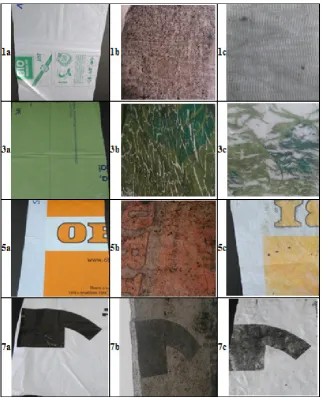
During the composting process of samples made of biodegradable and oxo-biodegradable polymers, all samples No. 1 and 2 (without irra-diation and after irrairra-diation) were followed by a complete decomposition. Figure 2 shows the ap-pearance of selected samples before composting
(a), after the composting process (b) and after rinsing and removal from the net – in the case of sample No. 1 the net was empty.
Sample No. 3 disintegrated into distinct frag-ments. In the structure of the remaining samples, no such significant changes were observed. Some were slightly discoloured, became duller and roughened, but there were also the samples (Nos. 6 and 10) that retained a distinct colour and elastic-ity. Flexibility was also evident in samples 7 and 8. Oxo-biodegradable samples, containing TDPA® or d2w® supplements exposed to
irradia-tion (both 20- and 50-hour) showed greater struc-tural changes than those that were not. Such ob-servations were also made by Corti [Corti et al. 2010], among others, who showed that thanks to exposure to solar radiation and subsequent bio-degradation of vaccinated mushrooms, the deg-radation process took place over a shorter period. Other authors indicated that the composted materials with the addition of TDPA® (crushed
and mixed with waste) will decompose within 1–4 months [Raninger et al. 2002]. The research conducted in the composting plant in Jarocin
did not indicate such clear changes (e.g., sample No. 5), however the trials were not fragmented.
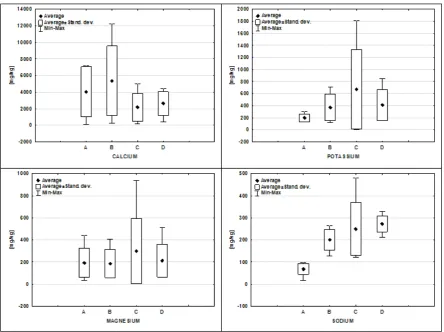
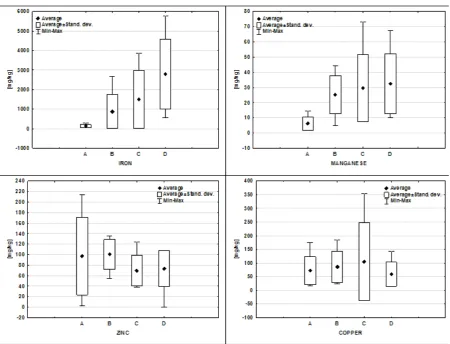
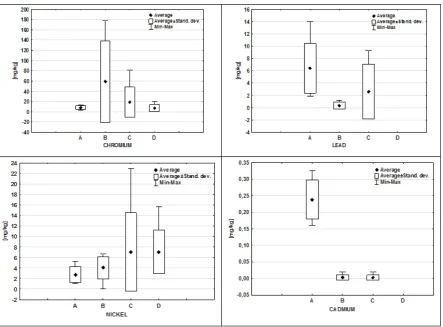
Figures 3–5 present the results pertaining to the analyses of selected metals (sodium, potassi-um, calcipotassi-um, magnesipotassi-um, iron, manganese, zinc, copper, chromium, lead, nickel, and cadmium). The contents were determined in new plastic samples (marked with the letter A), in the sam-ples subjected to composting without irradiation (B) and in samples subjected to irradiation for 20 (C) and 50 (D) hours.
The analysis of the content of the selected twelve metals in new samples of materials from biodegradable and oxo-biodegradable polymers indicated the highest calcium content (4044.91 mg Ca/kg on average) and potassium (196.19 mg K/kg on average). High levels of magnesium (191.86 mg Mg/kg on average), iron (135.5 mg Fe/kg on average) and zinc (97.36 mg Zn/kg on average) were also found in the materials. Nickel (2.72 mg Ni/kg on average) and cadmium (0.24 mg Cd/kg on average) were found in the smallest quantities. The knowledge on the con-tent of the analysed components is important, as
those are the maximum amounts that can enter the environment during the composting process (as in all variants of samples 1 and 2, which have been completely decomposed) [Ohidul et al. 2018a].
In the composted samples of non-irradiated packaging, calcium (5326 mg Ca/kg on aver-age) and iron (877.06 mg Fe/kg on averaver-age) were present in the largest quantities. The plastics also contained high amounts of potassium (372.25 mg K/kg on average), sodium (201.57 mg Na/kg on average), and magnesium (185.86 mg Mg/kg on average), while lead (0.34 mg Pb/kg on average) and cadmium (0.0028 mg Cd/kg on average) were found in the smallest quantities. The changes in the content may have been caused by two mecha-nisms – the release of some components into the environment (causing a decrease in the content in the samples after composting – like in the case of sodium, potassium, calcium, iron, manganese and chromium contents) and the concentration of the remaining components (visible as an in-crease in the content in trials after composting, e.g. magnesium, lead, cadmium).
The samples irradiated with UV rays for 20 hours, after composting contained the most calcium (2175.57 mg Ca/kg on average). Iron (1492.57 mg Fe/kg on average) and potassium were found in smaller quantities (671.86 mg K/kg on average). High magnesium (297.37 mg Mg/kg on average) and copper (105.12 mg Cu/kg on average) content was also found in the sam-ples, while lead (2.62 mg Pb/kg on average) and cadmium (0.0028 mg Cd/kg on average) were found in the smallest quantities. For new samples, the increase in the content was observed in the case of sodium, potassium, magnesium and iron, whereas calcium, zinc, lead and cadmium were characterized by a decreased content.
The samples irradiated with UV rays for 50 hours, after composting exhibited mostly iron (2795.68 mg Fe/kg on average), and calcium (2623.88 mg Ca/kg on average) content. Potas-sium (408.28 mg K/kg on average) and sodium (273.0 mg Na/kg on average) were also found in large quantities, while nickel (7.08 mg Ni/kg on average) and chromium (7.21 mg Cr/kg on aver-Fig. 4. Characteristic values (average, standard deviation, minimum, maximum) of iron, manganese, zinc and
age) were found in the least amount. The pres-ence of lead and cadmium was not detected in any of the samples. Compared to new samples, the contents of iron, potassium, sodium, manga-nese and nickel increased after composting, while the content of calcium, zinc, copper, chromium and nickel decreased.
The conducted research on the content of se-lected metals in the samples of materials from biodegradable and oxo-biodegradable polymers indicated a large variation in the obtained re-sults. The macronutrients such as: calcium, iron, magnesium, sodium, and potassium were found in the largest amounts. Although these are the elements naturally present in the environment in large quantities, supplying them to the soil together with compost from waste can lead to exceeding safe levels for the environment (e.g., in the case of trial No. 3). An example may be magnesium, the excess of which may limit the uptake of other elements, e.g., potassium. How-ever, the excess of calcium may be manifested by the dying of plants and the higher pH disturbs the water and other components [Jaishankar et al. 2014, Warne 2014].
The analysis of the heavy metals content (zinc, copper, chromium, lead, nickel, and cadmi-um) indicated their presence in all tested plastic samples. Most of these pollutants were in sam-ples no. 6, 8, 9, and 10, although trial no. 6 was described by the manufacturer as made at least 85% from natural raw materials, and trials 8, 9, and 10 are oxo-biodegradable. The source of met-als in the studied materimet-als could be used for the production of additives, such as dyes, fillers, an-tioxidants, stabilizers or softeners. In the tested samples of oxobiodegradable and biodegradable plastics, the content of chromium and manganese was higher than that of traditional plastics (PE, HDPE, LDPE, PVC). The contents of lead, zinc and copper were similar. The cadmium contents in the tested materials were significantly lower [Ohidul et al. 2018b]. Taking into account the fact that heavy metals are able to accumulate in the environment, supplying them with compost made from waste can lead to contamination of the soil on which the compost will be used. Even if the content of heavy metals in the studied materials were not too high, the spread of their use for bio-waste collection resulting in an increased share in Fig. 5. Characteristic values (average, standard deviation, minimum, maximum) of chromium, lead, nickel and
the composted mass, may lead to a deterioration of the quality of the soil or water environment.
CONCLUSIONS
1. Biodegradable and oxo-biodegradable sacks (or shopping bags) are readily used by consum-ers to collect waste for composting. However, the additives used for their production (dyes, fillers, antioxidants, stabilisers, softeners), contain heavy metals compounds (zinc, cad-mium, lead, nickel, copper, chrocad-mium, cobalt, iron, manganese), which can infiltrate into the environment during biodegradation.
2. The research results presented in the work in-dicated that many sacks (bags) made of biode-gradable and oxo-biodebiode-gradable plastics were not degraded in conditions of industrial com-posting. Only two of the ten analysed samples were completely degraded during compost-ing. The third was clearly fragmented. Among those remaining, some indicated slight changes in colour or structure, but there were also the samples which did not differ significantly after composting from the new ones.
3. The results of the analysis of the content of selected metals (sodium, potassium, calcium, magnesium, iron, manganese, zinc, copper, chromium, lead, nickel and cadmium) showed wide variation, both in new plastics and after their composting. Changes in the content may have been caused by two mechanisms – the re-lease of some components into the environment (causing a decrease in the content in the samples after composting) and the concentration of the remaining components (visible as an increase in the content in trials after composting).
4. The conducted analyses also showed the var-ied nature of changes in the composition of plastics, depending on the UV irradiation con-ducted. Some of the metals tested (chromium, lead, nickel) occurred in smaller quantities in the samples subjected to irradiation in the long term. This was particularly evident in the case of cadmium and lead, which were not found in the majority of the analysed samples (4–10) ex-posed to UV radiation over a period of 50 hours. 5. The research results presented in the paper in-dicated that the biodegradable and oxo-biode-gradable plastic waste can be a source of pol-lution, released into the environment. Due to
the varied nature of the changes identified, it is advisable to continue the research, which will enable to determine the desired method of their recovery or disposal.
Acknowledgements
The research was carried out as part of a tar-geted subsidy for research and development of young scientists and PhD students at the Faculty of Environmental Engineering and Geodesy of the Wrocław University of Environmental and Life Sciences – contract no. B030/0101/17.
REFERENCES
1. Act of 13 June 2013 on the management of
packag-ing and packagpackag-ing waste. (the unified text) Journal
of Laws 2018, item 150 [in Polish].
2. Adamcová D., Vaverková M. 2014. Biodegradation of Degradable/Biodegradable Plastic Material in Controlled Composting Environment. Polish Jour-nal of Environmental Studies, 23(5), 1465–1474. 3. Álvarez-Chávez C.R., Edwards S., Moure-Eraso
R., Geiser K. 2012. Sustainability of bio-based plastics: general comparative analysis and recom-mendations for improvement. Journal of Cleaner Production, 23, 47–56.
4. Bahramian B., Fathi A., Dehghani F. 2016. A re-newable and compostable polymer for reducing consumption of non-degradable plastics. Polymer Degradation and Stability, 133, 174–181.
5. Baranowska I. (ed.) 2015. Handbook of trace analysis. Fundamentals and applications. Springer Cham Heidelberg New York Dordrecht London. 6. biodeg.org (13.02.2018)
7. Bunsell A. R. (ed.) 2009. Handbook of Tensile
Properties of Textile and Technical Fibres. Wood -head Publishing Limited, Abington Hall.
8. Corti A., Muniyasamy S., Vitali M., Imam S. H.,
Chiellini E. 2010. Oxidation and biodegradation of polyethylene films containing pro-oxidant ad
-ditives: Synergistic effects of sunlight exposure,
thermal aging and fungal biodegradation. Polymer Degradation and Stability, 95(6), 1106–1114. 9. EN 13432:2000 Packaging – Requirements for
packaging recoverable through composting and biodegradation – Test scheme and evaluation
crite-ria for the final acceptance of packaging.
10. epi-global.com/en/about-tdpa.php (13.02.2018) 11. Hahladakis J.N., Velis C.A., Weber R., Iacovidou
12. Hummel D.O. 2002. Atlas of Plastic Additives. Analysis by Spectrometric Methods. Springer-Ver-lag Berlin Heidelberg New York.
13. Jacobsen R., Willeghems G., Gellynck X., Buysse J. 2018. Increasing the quantity of separated post-consumer plastics for reducing combustible house-hold waste: The case of rigid plastics in Flanders. Waste Management, 78, 708–716.
14. Jaishankar M., Tseten T., Anbalagan N., Blessy B.
M., Beeregowda K.N. 2014. Toxicity, mechanism and health effects of some heavy metals. Interdis
-ciplinary Toxicology, 7(2), 60–72.
15. Javierre C., Sarasa J., Claveria I., Fernandez A. 2015. Study of the Biodisintegration on a Painted Bioplastic Material Waste. MATERIALE PLAS-TICE, 52(1), 116–121.
16. Lithner D., Larsson A., Dave G. 2011. Environ-mental and health hazard ranking and assessment of plastic polymers based on chemical composi-tion. Science of The Total Environment, 409(18), 3309–3324.
17. Ohidul A., Mukaddis B., Ding Y. 2018a. Charac-teristics of plastic bags and their potential environ-mental hazards. Resources, Conservation & Recy-cling, 132, 121–129.
18. Ohidul A., Sijia W., Wentao L. 2018b. Heavy met-als dispersion during thermal treatment of plastic bags and its recovery. Journal of Environmental Management, 212, 367–374.
19. okcompost.be (23.02.2018).
20. Pivnenko K., Eriksen M.K., Martín-Fernández J.A., Eriksson E., Astrup T.F. 2016. Recycling of plastic waste: Presence of phthalates in plastics from house-holds and industry. Waste Management, 54, 44–52. 21. Raninger B., Steiner G., Wiles D.M., Hare C.W.J.
2002. Tests on composting of degradable polyeth-ylene in respect to the quality of the end product compost. In: Insam H., Riddech N., Klammer S. (eds) Microbiology of Composting. Springer, Ber-lin, Heidelberg, 299–308.
22. Regulation of the Minister of Agriculture and Ru-ral Development of 18 June 2008 on the implemen-tation of certain provisions of the Act on fertilizers and fertilization (Journal of Laws of 2008, No. 119,
item 765), [in Polish].
23. Rochman C.M., Browne M.A, Halpern B.S., Hentschel B.T., Hoh E., Karapanagioti H.K., Rios-Mendoza L.M., Takada H., The S., Thompson R.C. 2013. Classify plastic waste as hazardous. Nature, 494, 169–171.
24. Samadi N., Hasanzadeh R., Rasad M. 2015. Ad-sorption isotherms, kinetic, and deAd-sorption studies
on removal of toxic metal ions from aqueous solu -tions by polymeric adsorbent. Journal of Applied Polymer Science, 132(11), 41642.
25. Shah A.A., Hasan F., Hameed A., Safia A. 2008. Bi -ological degradation of plastics: A comprehensive review. Biotechnology Advances, 26, 246–265. 26. Spierling S., Knüpffer E., Behnsen H., Muders
-bach M., Krieg H., Springer S., Albrecht S., Her-rmann C., Endres H-J. 2018. Bio-based plastics – A review of environmental, social and economic im-pact assessments. Journal of Cleaner Production, 185, 476–491.
27. Tang Z., Zhang L., Huang Q., Yang Y., Nie Z., Cheng J., Yang J., Wang Y., Chai M. 2015. Con-tamination and risk of heavy metals in soils and sediments from a typical plastic waste recycling
area in North China. Ecotoxicology and Environ -mental Safety, 122, 2015, 343–351.
28. Warne R.W. 2014. The micro and macro of nutri-ents across biological scales. Integrative and Com-parative Biology, 54(5), 864–872.
29. Wróblewska-Krepsztul J., Rydzkowski T., Borowski
G., Szczypiński M.M., Klepka T., Thakur V.K.,
2018. Recent progress in biodegradable polymers and nanocomposite-based packaging materials for sustainable environment. International Journal of Polymer Analysis and Characterization, 23(4), 383–395.
30. Yang L., Li Y., Wang L., Zhang Y., Ma X., Ye Z. 2010. Preparation and adsorption performance of a novel bipolar PS-EDTA resin in aqueous phase. Journal of Hazardous Materials, 180(1–3), 98–105. 31. Żernicki W., Borkowska-Burnecka J., Bulska E.,
![Table 1. Characteristics of selected samples [own study based on information from producers]](https://thumb-us.123doks.com/thumbv2/123dok_us/8362608.1672062/3.595.72.524.82.480/table-characteristics-selected-samples-study-based-information-producers.webp)