Original Research Article
Socio demographic profile of clients visiting the ICTC at a teaching
hospital in Guntur district of Andhra Pradesh
Prabhakar Akurathi*, Samson Sanjeeva Rao, T. S. R. Sai
INTRODUCTION
HIV counseling and testing service is a key entry point to prevention of HIV infection and to treatment and care of people who are infected with HIV. When availing counseling and testing services, people can access accurate information about HIV prevention and care and undergo HIV test in a supportive and confidential environment.1
Even though India is considered to be a country with low HIV prevalence, due to the large population size, India has the third largest HIV epidemic in the world with 2.1
million people living with HIV. Initially the epidemic was concentrated among high-risk populations, that is female sex workers, men having sex with men (MSM) and intravenous drug users (IDU). There is a need to study the socio-demographic and clinical profile of HIV/AIDS patients for planning services. Moreover, it is important to understand the presentation of HIV disease in the local context and culture.
HIV antibody testing or screening has two broad but distinct objectives: case-finding and public health surveillance. In case-finding, the primary objective is to ascertain the HIV-infection status of a specific person for
ABSTRACT
Background: The challenge is to make all HIV-infected people aware of their status so that they may prevent the transmission of HIV to others. Only 25–30% of the people who are HIV positive in India are aware of their HIV status. Guntur district has a high epidemic potential with established transmission among the general population. The objective of the study was to study the socio demographic profile and HIV positivity rates among clients visiting an Integrated Counselling and Testing Centre (ICTC).
Methods: This descriptive study is based on secondary data from the records of the ICTC. The data is entered and analysed with MS Office Excel and EPI Info statistical package. Important findings were tested for statistical significance at 5% level of significance.
Results: Of the 6940 clients attending the ICTC, 43.34% are antenatal women (HIV positivity of 0.27%). Of the rest, provider initiated clients are 94.02% (HIV positivity 4.38%) and client initiated 5.9% (HIV positivity 20%). The difference of HIV positivity is highly significant (p<0.000001). 61.1% of the clients were found to be between the ages 25 to 49 years. Among the client initiated, more women (7.4%) were seen to be attending the ICTC (p<0.05). High risk professions identified were hotel workers (7.3% HIV positive), local transport workers (6.01%) and petty business (6.22%). Housewives were found to have 3.2% HIV positivity.
Conclusions: Self-referral to ICTC is still very poor. The epidemic is shifting to the general populations. HIV/AIDs education efforts aimed at the population in general must be increased.
Keywords: HIV, ICTC, Provider initiated, Client initiated, RNTCP
Department ofCommunity Medicine, NRI Medical College, Chinakakani, Guntur, Andhra Pradesh, India
Received: 13 December 2018
Accepted: 15 January 2019
*Correspondence:
Dr. Prabhakar Akurathi,
E-mail: [email protected]
Copyright: © the author(s), publisher and licensee Medip Academy. This is an open-access article distributed under the terms of the Creative Commons Attribution Non-Commercial License, which permits unrestricted non-commercial use, distribution, and reproduction in any medium, provided the original work is properly cited.
appropriate medical treatment or public health follow-up and action. For public health surveillance, in contrast, the objective is to determine the prevalence, distribution, and trends of HIV infection in a group or population.2
The challenge is to make all HIV-infected people aware of their status so that they adopt healthy lifestyles and prevent the transmission of HIV to others. Only 25–30% of the people who are HIV positive in India are aware of their HIV status. Guntur district has a high epidemic potential with established transmission among the general population.3
Integrated Counseling and Testing Centre (ICTC) is an entry point to care and support services, which provides people with an opportunity to learn and accept their HIV sero status in a confidential environment.4
A person is counseled and tested for HIV at an ICTC either of his own freewill (client initiated) or as advised by a medical provider (provider initiated). Fixed stand alone ICTCs are located within existing healthcare facilities like medical college hospitals where a full time counselor and lab technician provide counseling and testing services.5
The India HIV Estimation 2017 Report shows that the total number of people living with HIV (PLHIV) in India is estimated at 21.40 lakhs. The National adult (15–49 years) HIV prevalence in India is 0.22% in 2017 (males 0.25% and females 0.19%). Andhra Pradesh has an adult HIV prevalence of0.63%, (2017). The total number of people living with HIV (PLHIV) in Andhra Pradesh is estimated at 2.70 Lakh.6
HIV prevalence among ANC attendees is a known proxy indicator for HIV prevalence among the general population. It has shown a steady decline between 2005 and 2015. HIV Prevalence among ANC in Guntur district 2007-15 at Sentinel Site Guntur Medical College is 0.75%.
The National AIDS Control Programme (NACP) is committed towards the goal of ‘Ending the AIDS epidemic as a public health threat by 2030’. The commitment has been articulated in the National Health Policy 2017.7
Objectives
To study the socio demographic profile of people attending an ICTC.
To study the utilization patterns of the ICTC center and HIV positivity rates.
METHODS
This descriptive study was based on secondary data, taken from the records of the ICTC at NRI Medical College General Hospital from January to December
2014. A total of 6940 people had registered during the period of study (43.3% ANC, 53.3% Provider initiated and 3.4% Client initiated). The data was entered in MS Office Excel and analysed using Epi Info statistical package. Important findings were tested for statistical significance at 5% level of significance.
RESULTS
Antenatal testing for HIV
Among the total clients attending the ICTC, 43.34% are antenatal women with a HIV positivity of 0.27%.
Provider initiated versus client initiated testing
Provider initiated clients make up 53.27% of the ICTC clients with about 4.38% of them showing positive status. Client initiated were 3.39% with a HIV positivity of 20%. This difference of HIV positivity between provider initiated and client initiated is statistically highly significant (Chi Square 107.08 p<0.000001). 61.1% of the clients were found to be between the ages 25 to 49 years. HIV positivity in the Age group 35-49 yrs was 10.7% [chi square 70.15 p<0.000001 RR 2.9 (2.2-3.8)].
Gender and age
Among the client initiated, more women (7.4%) were seen to be attending the ICTC for testing compared to males (5.6%) (p<0.05). Among provider initiated, in age group of 35-49 yrs, HIV percentage of positivity is significantly high in males (14.2%) when compared to females (5%) [p=0.000002 RR 2.8 (1.8-4.5)]
Referrals
Of the 556 (14.14%) clients referred from TB & CD Department of the hospital, 27 (4.8%) were positive which is comparable with national figures. Referrals from Skin and VD were 3.5% (137) and of these 5.8% were positive for HIV. 54.32% were referred from all the other depts. and HIV positivity was 1.17%. Referrals from other private hospitals were 20% with 11% HIV positivity.
High risk professions
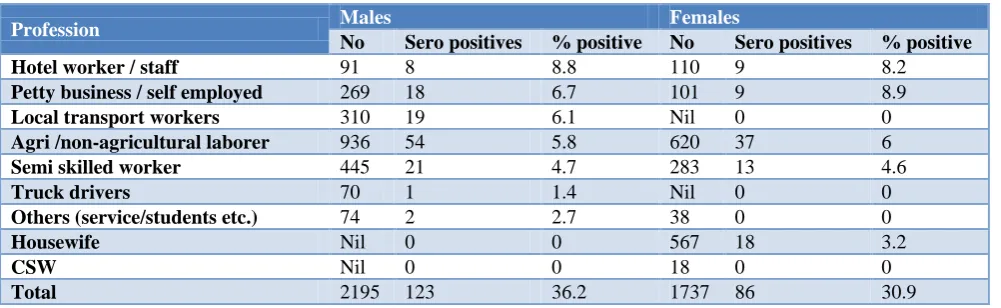
In this study, high risk professions seen were hotel workers (7.3% HIV positive), local transport workers (6.01%), and petty business (6.22%). HIV positivity among laborers, both agricultural and non-agricultural was 4.9%. Housewives were also at risk with 3.2% HIV positivity. Interestingly, the HIV positivity among HRGs (CSWs and truck drivers) in this ICTC was very low.
Spouse testing
Table 1: Age distribution in client initiated ICTC attendees (n=235).
Age in years Male Female
No. (%) Sero positives % positive No. (%) Sero positives % positive
<14 NIL 0 0 NIL 0 0
15-24 27 (23.3) 0 0 24 (20.2) 4 16.7
25-34 51 (44.0) 6 11.8 52 (43.7) 7 13.5
35-49 29 (25.0) 12 41.4 36 (30.3) 13 36.1
>50 9 (7.8) 3 33.3 7 (5.9) 2 28.6
Total 116 21 18.1 119 26 21.9
Table 2: Age distribution in provider initiated ICTS attendees (n=235).
Age in years Male Female
No. (%) Sero positives % positive No. (%) Sero positives % positive
<14 120 (5.8) 3 2.5 127 (7.8) 1 0.8
15-24 334 (16.1) 6 1.8 208 (12.9) 4 1.9
25-34 957 (46.0) 24 2.5 407 (25.2) 18 4.4
35-49 338 (16.3) 48 14.2 520 (32.1) 26 5
>50 330 (15.9) 21 6.4 356 (22.0) 11 3.1
Total 2079 102 4.9 1618 60 3.7
Table 3: Distribution of sero positivity among referrals to ICTC.
S.No. Source of referral No. of cases Sero positives (%)
1 RNTCP Clinic 558 27 (4.8)
2 STI Clinic 139 8 (5.8)
3 Spouses of Ante Natal Women 1224 8 (0.7)
4 Other Clinical depts. 1740 119 (6.8)
5 NGOs (commercial sex workers) 18 0 (0)
Total 3679 162 (4.4)
Table 4: Distribution of ICTC attendees by profession and gender for sero-positivity.
Profession Males Females
No Sero positives % positive No Sero positives % positive
Hotel worker / staff 91 8 8.8 110 9 8.2
Petty business / self employed 269 18 6.7 101 9 8.9
Local transport workers 310 19 6.1 Nil 0 0
Agri /non-agricultural laborer 936 54 5.8 620 37 6
Semi skilled worker 445 21 4.7 283 13 4.6
Truck drivers 70 1 1.4 Nil 0 0
Others (service/students etc.) 74 2 2.7 38 0 0
Housewife Nil 0 0 567 18 3.2
CSW Nil 0 0 18 0 0
Total 2195 123 36.2 1737 86 30.9
DISCUSSION
Antenatal testing
Among the antenatal women here tested in the ICTC, HIV sero positivity as seen in 0.3%. The AP state prevalence is 0.7%, and the national prevalence of HIV positivity in antenatal women is 0.3%.
The number of client initiated attending the ICTC are much lesser (3.4%) compared to the provider initiated. However, the HIV sero positive rate among this group is 20.0% which is very high (p<0.000001). Looking at age distribution it is seen overall that the 35-49 yrs had a 10.7% positivity (p<0.000001 RR 2.9 (2.2-3.8).
(14.2%) when compared to females (5%) [(p=0.000002 RR 2.8(1.8-4.5)]
High risk occupations
Occupation wise it is seen that the high risk are Hotel staff, petty business/self-employed and Local transport workers. In a study done in Northern Vietnam, people who were self-employed were more likely to have sexual intercourse with casual partners/sex workers (OR=2.1).8 Caballero-Hoyos et al suggest that being self-employed was a risk factor for sexual promiscuity. Self-employment was associated with an increased likelihood of having sexual intercourses with casual partners/sex workers. Perhaps individuals who are self-employed have a wider social network, which can facilitate more casual sexual events.9
Housewives
Among housewives attending this ICTC the sero positivity is 3.2%. Despite reduction in HIV prevalence among the population, the percentage of Indian women contracting the disease seems to have increased. The social implications are also different in females. Payana et al found in their study that, among male patients who did not know the HIV status of spouse the majority had not revealed their HIV status to the wife or had never asked the wife to get tested for HIV.10
Provider initiated
Among RNTCP referrals, 4.8% were found to be positive. The National average for the same is -5%. Among the STI referrals it is 5.8% (AP state-9.2%, National -1.3%). Here it seen that a good number of HIV positives were found among those referred from the TBCD department. Achanta et al found that HIV testing of TB suspects aged 25–54 years demonstrated higher yield for a given effort. Implementation of Provider Initiated HIV testing and counseling’(PITC) among TB suspects is feasible and effective, detecting a large number of new HIV cases with minimal additional workload on staff of HIV testing centre and should be considered by policy makers at least in settings with high HIV prevalence.11
Dermatological problems occur in more than 90% of patients with human immunodeficiency virus (HIV) infection. Distinctive skin lesions occur at various WHO clinical stages of HIV infection.12
Singh et al in their study showed high prevalence of dermatological manifestations in HIV-infected subjects, and they occur more frequently with progression of HIV and decline in immune functions.13
In the high risk groups, sero-positivity as found to be very low; commercial sex workers: zero (0/18) and truck
drivers: 1/70 (1.4%) Earlier in the Indian HIV epidemic, the majority of infections were in the age group of 15–49 years and over-all 39% of the total were women. Infections in the early days were mostly in female sex workers and truck drivers but soon spread to housewives and the general population.
The sexual behavior of trucking populations has been associated with the transmission of sexually transmitted infections (STI) and HIV in India and elsewhere in the world. Thakur A et al in their study found that 49% of the long distance truck drivers had CSW exposure in last 6 months. The prevalence of STI symptoms was found to be 21.51% among the long distance truck drivers. The Truck Driver who had exposure with CSW more than five times in the last 6 months were found to be more careless regarding using condoms while having intercourse with the CSW’s.14,15
Interestingly, the HIV positivity among HRGs in this ICTC was very low. In southern India where interventions like Avahan (the India AIDS Initiative of the Bill & Melinda Gates Foundation), have been implemented earlier, the HIV prevalence among Female sex workers has decreased considerably.16
Spouse testing
The overall goal of partner services programs is to prevent HIV/STD disease transmission and progression via partner notification and the provision of screening and referrals for treatment for identified partners. CDC, The Partner Services Evaluation Field Guide (PSEFG) 2010. Provider-assisted methods of partner notification increase testing and counseling among sexual partners of patients diagnosed with HIV, however they are resource-intensive. Brown LB et al suggest that all partners are at high risk for HIV infection and contact with a provider greatly increases the probability of partners receiving testing.17
Couples HIV counseling and testing is essential for combination HIV prevention, but its uptake remains very low. Couples’ voluntary HIV counseling and testing (CVCT) is estimated to reduce HIV transmission in discordant couples by two-thirds The uptake of couples HIV counseling was associated with women having been accompanied by their partner to ANC in India. Implementing biomedical interventions aiming at preventing HIV acquisition and transmission within couples requires a first critical step, i.e. HIV status awareness within couples. Couple members who get tested together and mutually disclose their HIV status are more likely to adopt HIV prevention behaviors, both in HIV concordant or discordant relationships.18
when they test HIV-positive than those who are counseled individually.
HIV partner notification strategies need to address issues like availability of effective treatments and prevention of vertical transmission, as well as potential harmful effects, such as domestic violence.19
Risk profile
The incidence in HRG is going down and the HIV epidemic is gradually shifting from High risk groups and bridge population to the general population. There is a need to identify appropriate risk groups in the current scenario of HIV. This study attempted to identify a risk profile of ICTC attendees who are most likely to be positive for HIV so that keen attention may be given in diagnosis. In this study, risk profile was identified as follows: Male aged 35-49 yrs working as Hotel worker, Petty business/self-employed or as local transport workers (auto drivers etc.).
Singh et al in a similar study concluded that majority of patients belonged to low socioeconomic status and productive age group with heterosexual contact being commonest mode of transmission. Females were usually infected secondarily and were diagnosed after the diagnosis of their husband.20
There were more positive among males, 20–49 years of age group, those living singly, unmarried, divorcee, widow(er) and separated. Similarly positives were more amongst illiterates, less educated and those engaged in unskilled and semi-skilled jobs. Adolescent students (>14 years) accounted for one-fifth of the total positives. Direct walk in clients were more positive compared to those referred by doctors.
Overall sero positivity was 4.8%; high in males, 30–49 years age, unmarried and divorcee etc. Sero prevalence decreased with improvement in education and also with improvement in job nature. It was also high in those living alone compared to those staying with their family. Such study shall in evaluating the performance of ICTC and designing the information, education, and communication (IEC) to increase the client uptake in terms of quality and quantity.21
Clients in the age group of 35 to 49 years, married, not much educated, agricultural works and those engaged in heterosexual risk behavior had a significantly higher risk of being positive. They should be counseled for behavioral change and linked to care and support program immediately.22
CONCLUSION
The findings suggest that the HIV epidemic is shifting from the high risk groups to various other groups in the
general population. HIV/AIDs education efforts aimed at the population in general must be increased. Self-referral to ICTC is still very poor. Certain occupation groups are more at risk in both sexes. HIV sero positivity among housewives is also found to be high. While HIV programs are very successful in bringing down transmission among High Risk Groups, the epidemic is shifting to the bridge and general populations.
Recommendations
HIV/Aids Education Efforts Aimed at the General Population must be increased. Special Attention must be given to Risk Populations Identified by Age, Gender and Occupation.
ACKNOWLEDGEMENTS
The authors are grateful to the staff of the ICTC of NRI General Hospital and the Management for giving us permission to do this study.
Funding: No funding sources Conflict of interest: None declared
Ethical approval: The study was approved by the Institutional Ethics Committee
REFERENCES
1. NACO, National HIV Counseling and Testing Services (HCTS) Guideline, December 2016. Available at: http:naco.gov.in/integrated-counselling-and-testing-centre. Accessed on 4 February 2019.
2. Chin J, Public health surveillance of AIDS and HIV infections, Bulletin of the World Health Organization, 1990;66(5):529-36.
3. Avert - HIV AND AIDS IN INDIA, Global information and education on HIV and AIDS.
Available at:
https://www.avert.org/professionals/hiv-around-world/asia-pacific/india Accessed on 4 February 2019.
4. Dutt R, Choudhuri S, Goswami S. Profile of HIV positive clients: an ICTC record based retrospective study. Int J Community Med Public Health. 2017;4(8):3018-21
5. Park K. Textbook of Preventive and Social Medicine, 24th edition. AIDS Epidemiology of communicable diseases. M/S Banarasi Das Bhanot, Jabalpur; 2017: 453.
6. NACO HIV facts and figures. Available at: http://naco.gov.in/hiv-facts-figures. Accessed on 4 February 2019.
ult/files/Western%20Region%20-%20Vol% 202%20revised.pdf. Accessed on 4 February 2019. 8. Vu TMT, Boggiano VL, Tran BX, Nguyen LH,
Tran TT, Latkin CA, et al. Sexual Risk Behaviors of Patients with HIV/AIDS over the Course of Antiretroviral Treatment in Northern Vietnam. Int J Environ Res Public Health. 2018;15(6):1106. 9. Caballero-Hoyos R, Villasenor-Sierra A,
Millan-Guerrero R, Trujillo-Hernandez B, Monarrez-Espino J. Sexual risk behavior and type of sexual partners in transnational indigenous migrant workers. AIDS Behav. 2013;17:1895–905.
10. Padyana M, Bhat RV, Dinesha, Nawaz A. HIV in Females: A Clinico-epidemiological Study.J Family Med Prim Care. 2013;2(2):149-52.
11. Achanta S, Kumar AMV, Nagaraja SB, Jaju J, Shamrao SRM, Uppaluri R, et al. Feasibility and Effectiveness of Provider Initiated HIV Testing and Counseling of TB Suspects in Vizianagaram District, South India. PLoS One. 2012;7(7):e41378. 12. Halder S, Banerjee S, Halder A, Pal PR. Skin diseases in HIV-infected patients: Impact of immune status and histological correlation. Indian J Sex Transm Dis AIDS. 2012;33(1):65-7.
13. Singh H, Singh P, Tiwari P, Dey V, Dulhani N, Singh A. Dermatological manifestations in HIV-infected patients at a tertiary care hospital in a tribal (Bastar) region of Chhattisgarh, India. Indian J Dermatol. 2009;54:338-41.
14. Thakur A, Toppo M, Lodha R. Study on sexual risk behaviors of long-distance truck drivers in central India, International Journal of Research in Medical Sciences. Int J Res Med Sci. 2015;3(7):1769-74. 15. Paranjape RS, Challacombe SJ. HIV/AIDS in India:
an overview of the Indian epidemic. Oral Diseases. 2016;22 (1):10–4.
16. Alary M, Banandur P, Rajaram SP, Thamattoor UK, Mainkar MK, Paranjape R, et al. Increased HIV
prevention program coverage and decline in HIV prevalence among female sex workers in south India. Sex Transm Dis. 2014;41(6):380-7.
17. Brown LB, Miller WC, Kamanga G, Kaufman JS, Pettifor A, Dominik RC, et al. Predicting partner HIV testing and counseling following a partner notification intervention. AIDS Behav. 2012;16(5):1148-55.
18. Tiendrebeogo T, Plazy M, Darak S, Miric M, Perez-Then E, Butsashvili M, et al. Couples HIV counselling and couple relationships in India, Georgia and the Dominican Republic. BMC Public Health. 2017;17:901.
19. Mathews C, Coetzee N, Zwarenstein M, Lombard C, Guttmacher S, Oxman A, et al. Systematic review of strategies for partner notification for sexually transmitted diseases, including HIV/AIDS Int J STD AIDS. 2002;13:285-300.
20. Singh A, Mahajan S, Singh T, Deepti SS, Socio-demographic and clinical profile of HIV/AIDS patients attending the ART centre of Amritsar, Punjab, Int J Community Med Public Health. 2018;5(5):2059-65.
21. Sharma R. Profile of attendee for voluntary counseling and testing in the ICTC at Kesar SAL Medical College, Ahmedabad. Indian J Sex Transm Dis. 2009;30:1-6.
22. Chougale RA, Sawant VD. Socio-demorgraphic profile of clients enrolled at the ICTC of a teaching Institute in Kolhapur, India. Online Int Interdiscipl Res J. 2013;3:343-61.