A REVIEW OF APPROACHES AND TOOLS FOR COLLABORATIVE
NETWORKS SIMULATION
Beatriz Andresa; Raul Polera
a Polytechnic University of Valencia (UPV) - Valencia, VC, Spain
ABEPRO
DOI: 10.14488/BJOPM.2016.v13.n3.a1
Collaborative networks (CN) are characterised by being complex systems, highlighting the need of considering simulation approaches to support the resolution of CN models. Simulation approaches are seen as a supporting tool to analyse the formal model of a supply network. Three relevant simulation approaches are identified for its application in the context of CN models: Discrete Events Simulation, System Dynamics and Agent Based Simulation. Each simulation approach is briefly described and compared with each other, according to a group of relevant features, with the main aim of aiding the modellers in the task of selecting the most appropriate simulation approach to address the modelling process in the context of CN. Besides, a group of commercial and academic tools are listed for each simulation approach.
1. INTRODUCTION
The study of complex systems has its origin in the study of Systems Theory. The number of applications of systems theory to organizations is very wide, and a high variety of system models have been developed. The first models were proposed by Barnard 1938, and were based on the notion of “balance”. These models evolved towards the
Sociological Systems Theory, defined by Selznick 1948, which introduced the analogy between the organisms and organizations. Subsequently, the General Systems Theory
was presented, whose roots were found in the biology study area Bertalanffy 1950, which considered that the organisms are complex systems with rigorous operation of open systems. Bertalanffy 1968 as a biologist defined the systems as a set of interactive elements, and considered them as complex systems (i.e. multicellular organisms, ant colonies, ecosystems, economies, societies, enterprises, supply networks...) those characterized by having a structure composed of several levels. Afterwards, the Contingency Theory Kast and Rosenzweig 1981 and the Theory of Socio-technical Systems Trist and Bamforth 1951 appeared. The Contingency Theory studies the organizations as sets of interdependent subsystems, each one carrying out its own functions to perform within the context of the organization. Due to the importance of the survival of any organization, each subsystem must be viable and effective and must be consistent with each other and with the environment into which it is embedded.
Complex systems are characterised by (i) its decentralized nature, in which the system behaviour arises from the self-organization of its components without these being controlled by any extrinsic entity to the system, (ii) the presence of loops of causality and nonlinear feedback, and (iii) the fact that it contains several self-contained units that can interact, evolve and adapt their behaviour to changes in the environment Vicsek 2002. Collaborative networks (CN) consist of a wide range of decentralised and heterogeneous entities each one carrying out different processes and activities to provide goods or services to final customers Camarinha-Matos and Afsarmanesh 2008. Furthermore, each organisation defines its own objectives and formulates its own strategies. This heterogeneity makes CN complex systems, involving that in most cases it would be very difficult to adequately model and solve them mathematically Izquierdo et al., 2008). Consequently, CN require the use of ad-hoc methodologies, models and tools to tackle problems and succeed in identifying proper and optimal solutions Castilla and Longo 2010. It is at this point where simulation approaches come into play.
In the light of this, this paper is organized as follows: Section 2 highlights the importance of relying on simulation approaches to solve complex systems. Three simulation
approaches are described focusing on its application in CN: Discrete Event Simulation (DES), System Dynamics (SD) and Agent Based Simulation (ABS). These approaches are jointly compared in Section 3. In Section 4 an overview of the tools identified in each simulation approach is presented. Finally, the conclusions derived from the review are proposed in Section 5.
2. COLLABORATIVE NETWORKS SIMULATION
APPROACHES
Concerning the supply network application area, simulation deals with (i) managing the complexity associated (as supply networks are considered complex systems), (ii) supporting the decision making process, and (iii) assessing the key factors (relevant performance measures) for the supply network, such as profits, customers’ service or competitiveness. The construction of “WHAT-IF” scenarios, in supply network simulation approaches, will allow decision makers to obtain optimised solutions with less costs and time. Some examples can be found in terms of developing strategic plans based on market trends, company goals and competitors’ strategies; creating adaptive operational management strategies that respond to internal and external dynamics such as demand fluctuations, change of suppliers, competitors’ activities; or generating holistic plans considering strategic planning, marketing, and HR issues.
According to Shannon (1975), the construction of simulation-based models for supply networks are useful when:
• The supply network model to be simulated cannot
be formulated in a mathematical notation.
• The supply network model can be mathematically
formulated but there is no resolution method to solve the model.
• The supply network model can be expressed in a
mathematical notation and there exist methods for its resolution, but these are costly, tedious and time consuming.
• The objective is to build experiments for compar -ing different scenarios of the supply network, and these experiments cannot be carried out in a real supply network.
higher levels of abstraction and causal dependencies, ABS and DES considers higher levels of detail in the representation of individual entities/agents Tako et Robinson (2012). Figure 1 provides a graphical comparison of the three simulation approaches, which are analysed in this chapter with the main aim of dealing with supply network simulation-based models.
In the next subsections a brief definition is given for each simulation approach, previously identified.
2.1. Discrete Events Simulation
DES simulation approach has its origin in the evolution of the General Purpose Simulation System (GPSS)
(originally Gordon’s Programmable Simulation System)
proposed by Gordon (1961). DES simulation approach considers individual entities , each one with specific attributes, which determine their behaviour along the simulation process Tako et Robinson (2012). DES is based on the concept of entities (seen as passive objects representing people, machines, messages, tasks, etc.), resources and block flow charts, through which the entities pass and stay in queues, are delayed or are processed Borshchev et Filippov (2004). This means that entities enter the system, visit some of the states and move between different states as time passes, after that the entities leave the system Siebers
et al., 2010. DES plays a significant role in modelling supply networks, especially at the tactical level. As DES does not represent systems from an aggregate perspective, it is not appropriate for strategic modelling. Works worth to mention in the context of supply networks are those developed by Lee et al., (2002) and Kleijnen et Wan (2007).
One characteristic of DES is that it includes stochastic elements through the use of statistical distributions, when randomness is generated, Kleijnen, 2005. DES state changes occur at irregular discrete points of time, such as network of queues.
The drawbacks associated to DES simulation paradigm in the context of supply networks are the (i) lack of representation of continuous processes, and (ii) the higher complexity obtained due to DES represent high detailed models Lee et al., 2002.
During the seventies DES was solely used in the research field. It was changed in the nineties when software applications were developed for simulating the complex queuing theory and resource allocation problems. The acceptance of DES as a management tool was triggered by the development of well know software tools, such as Kelton, Sadowski, et Sturrock (2003).
2.2. System Dynamics
Forrester is considered the precursor of System Dynamics (SD), which has its starting point in the Industrial Dynamics Forrester (1961). The Industrial Dynamics has its origins in a study carried out in a company of electronic components,
Sprague Electric, as a new approach to address industrial problems. The main trouble found in this company was the appearance of oscillations in the order process. These oscillations were considered unusual due to the nature of the market in which Sprague Electric was embedded. That is, a market consisting of a few strong customers, from which it would expect that the orders’ flow would be
maintained regular. Unlike, in the mid 50’s, it was observed that the orders generated were characterised by suffering oscillations.
According to this, Forrester, who was teaching at the newly formed M.I.T. Sloan School of Management, started to study this phenomenon. In the study, Forrester identified as key issue, in the operation of process, the feedback presented in the information structures. This finding involved an intelligent application of the theory of feedback systems; allowing representing the elements of the system, and their relations, by identifying the feedbacks to justify the appearance of oscillations. This representation enabled to identify and take the necessary measures to correct the existent oscillations in Sprague Electric. In the late fifties, and from the results of the performed work, Forrester formalized his ideas and methodology, resulting in the Industrial Dynamics methodology. Industrial Dynamics included structural aspects such as feedback control, and represented a new approach to address industrial problems, based on the analysis of the internal structure of the systems rather than the impact of exogenous factors affecting it.
Once the Industrial Dynamics method reached an acceptable level of maturity, the same concept was extended to social systems. Urban Dynamics was created in Forrester, (1969) as a result from his collaboration with John Collins, the former mayor of Boston and visiting professor of Urban Affairs at Massachusetts Institute of Technology (M.I.T.).
In 1970, Forrester was invited by the Club of Rome to apply his methodology in the study of the world, considering it as a dynamic system. The result was the Model of the World
Forrester (1971). The application of industrial dynamics at urban and worldwide context triggered to rename the Industrial Dynamics methodology into a broader term, currently known as System Dynamics Forrester (1968).
The SD is based on the feedback control theory, decision-making processes, experimental approaches and computational developments Campuzano et Mula, (2011).
Forrester developed the SD method as a set of tools and an approach to simulate complex systems, such as the supply network. Through SD it was possible to understand the structure of a system and identify how the intrinsic control policies operate. The supporting tools associated to SD enabled to improve the system assessment by simulating its behaviour.
Since its appearance, SD has been widely studied and disseminated in multiple research areas. Its application in case studies can be seen in areas such as defence Cooper, ( 1980)social sciences Richardson (1991), medical science Homer (1987), ecology Sterman, Richardson, et Davidsen, (1998), ecosystem Wang et Eltahir (2000), natural resources management, project management Lyneis et Ford (2007), social Lane et Husemann, 2008, socioeconomic systems
and transportation Liu, Triantis, et Sarangi, 2010, civil construction Lee et Peña-Mora (2007), strategy management Weil (2007) Gary, Kunc, et Morecroft, 2009, management Roberts (1978), knowledge sharing Luna-Reyes et al., 2008, resource allocation Lee, Ford, et Joglekar, 2007, disruptions (Williams, Ackermann, et Eden, 2003 or supply networks Ashayeri, Keij, et Bröker (1998) Campuzano, Mula, et Peidro (2010).
SD allows building (i) models based on previous situations faced by decision makers in the supply network, by considering their experience; (ii) dynamic models appearing on reality that are able to self-regulate their activities through feedback loops, applying the feedback systems theory; (iii) models using the computer as a supporting tool, allowing to compute models through simulating different scenarios in a short time and at low cost.
SD dissemination is done through the publication of papers in journals such as System Dynamics Review and other journals in management, operations research and social sciences. Besides, different groups worldwide, employing system dynamics, are also spreading the SD method, one referent group is the System Dynamics Group at MIT.
2.3. Agent Based Simulation
ABS approach was developed in the nineties as a novel tool to deal with problems that were not completely satisfactorily solved through using DES and SD. For example, in the operation research area, high complex management process and global and dynamic environments, in which enterprises are embedded, makes that traditional simulation approaches, such as DE, present limitations as a supporting tool to model and simulate complex systems North et Macal (2007). It is, therefore, recognised the high potential application linked to ABS for modelling and simulating complex systems Siebers et al., 2010performing a new step in the progress of simulation methods, and in the enhancement of simulation applications.
independent agents, each one with their own objectives, and are generally capable to interact with each other and with their environment. Therefore, interactions established between the individual agents and the environment are also modelled. Each agent has the capacity to evolve over the time and adapt to new environmental conditions or objectives. One of the fundamental points of agent-based simulation is the concept of emergence. The agents’ behaviour is modelled at the individual level, and the global behaviour emerges as a result of the interactions with many individuals, each one following its own behaviours and rules. Neither the expert nor the modeller imposes conditions on the overall behaviour of the system directly, due to it emerges as a result of the conditions imposed on the basic system components and their interactions. That is why ABS modelling is also called bottom-up modelling, corresponding to the macroscopic patterns that emerge from the decentralised interactions of simpler individual components Holland (1998). This bottom-up approach allows capturing the complexity and dynamicity of the modelled system. In ABS interactions between the basic components of the system are studied, therefore the system can be modelled even in the absence of the knowledge about the global interdependencies Izquierdo et al., 2008)).
ABS approach is a powerful technique for modelling complex systems, such as social systems Gilbert (2007), health Brailsford et al., 1992 traffic and transportation, financial markets, energy usage North et Macal, 2007 or supply networks Hernández et al., 2009. Generally, ABS allows analysing the behaviours of real systems that consist of autonomous entities.
It is well known that depending on the type of modelled problem and its characteristics, the simulation approaches used to model and solve them will differ. In some situations, ABS will fit better the modelling requirements due to its flexibility and robustness; nevertheless for some other approaches DES and SD will be useful. In accordance to Siebers et al., 2010 ABS are recommended when:
• The problem to be modelled has a natural repre -sentation as agents
• The goal is to model the behaviours of individuals in a diverse population
• Agents are related each other (social networks) • Individual agents have associated movements in
the space
• Agents to be modelled in the population have to
learn or adapt
• Agents anticipate other agents’ reactions when making decisions
• Represent collaborative behaviours
• The past is not used as a predictor of the future
• It is important to extend models in the future • The emergence feature is a key issue in the prob
-lem modelled
3. SIMULATION APPROACHES COMPARISON
In order to select one or another simulation approach for modelling complex systems (supply networks), the literature brings some works making pairwise comparisons. The characteristics of DES approaches are mostly compared with the SD ones Maidstone (2012) Tako et Robinson (2012). Some authors focus on contrasting the usability and application between SD and ABS Borshchev and Filippov
(2004), Izquierdo et al., 2008, Macal (2010), Maidstone
(2012). While others analyse DES paradigm versus ABS
approaches Borshchev et Filippov (2004) Siebers et al.,
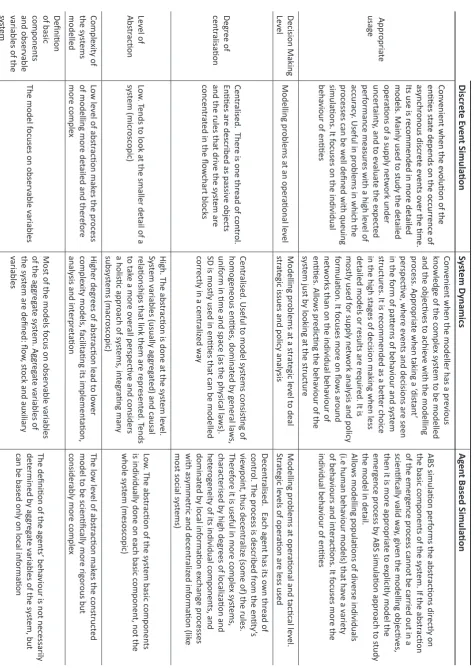
2010 Maidstone (2012). The work presented in Sumari et al.,(2013) proposes a initial work comparing the three simulation approaches DES, SD and ABS but by only considering the disadvantages, the advantages and the tools (focusing in Promodel, Vensim, and AnyLogic) that can be used in each simulation method. In this area a more comprehensive research is needed to jointly compare the three simulation approaches by considering more features such as the appropriate usage, the decision making level in which there can be applied, the degree of centralisation the level of abstraction, the complexity, components used, the entities behaviour, the modelling approach, the mathematical approximation, the evolution over the time, the data requirement, the validation requirements and the application into the SC context .
In the light of this, Table 1 intends to give an overall comparison of the same features for the three simulation approaches, DES, SD and ABS. Derived from the comparative work it can be concluded that the differences among the compared approaches are sometimes not so clear-cut. In this regard, Macal (2010) states that most of the models build in SD have an equivalent formulation in ABS approaches.
As a general recommendation, the choice of one or the other simulation approach depends on the perspective from which the modeller views the problem and the features that characterises the system, which, in fact, define the requirements of the modelled complex system. Besides, the modellers’ familiarity with the software used must be considered in the selection of the simulation approach.
Table 1 Simula tion appr oaches c omparison: DE S v
s. SD v
s. ABS Discr ete E ven t Simula tion Sys tem Dynamics Ag en
t Based Simula
tion Appr op ria te usag e Con venien
t when the
e volu tion of the en tities s tat e de pends on the occurr ence of as ynchr on ou s dis cr ete e ve nts o
ver the time.
Its use is
re comme nded in mor e de tailed mod els . Main ly use d t o s
tudy the de
tailed
op
er
ation
s of
a supply ne
tw ork unde r uncert ain ty
, and t
o e valu ate the e xpe ct ed pe rformance me asur
es with a high le
ve l of accur acy . Use ful in pr ob lems in which the pr ocesse s c
an be w
ell
de
fine
d with queuin
g
simula
tion
s. It f
ocuse s on the in divid ual be ha viou r of en tities Con venien
t when the
mod
elle
r has a pr
eviou s kno wledg e of the comple x s yst em t o be mod elle d
and the ob
jectiv
es t
o achie
ve with the
mod ellin g pr ocess. Appr op ria te whe n t ak in
g a ‘
dis tan t’ pe rspe ctiv e, wher e e ve
nts and de
cis ion s ar e se en in the f orm of pa tterns of be ha viou
r and s
yst
em
structur
es. It is
rec
ommende
d as a be
tter choic
e
in
the high s
tag es of de cis ion makin g whe n less de taile d mod els or r esults ar e r equir
ed. It is
mos
tly used f
or supply ne
tw ork analy sis and polic y formula tion
. It f
ocuses mor e on flo ws ar ou nd ne tw ork
s than on
the in divid ual beha viou r of en tities. Allo ws pr edicting the be ha viou r of the sys tem ju st b y look in g a t the structur e ABS simula tion pe rforms the ab str action s dir ectly on
the basic c
ompon
en
ts of
the s
yst
em. If the
ab str action of the e me rge nce pr ocess c annot be carried ou t in a scien tific ally valid w ay, giv
en the mod
ellin
g ob
jectiv
es,
then it is
mor e appr op ria te t o e xplic itly mod el the eme rgence pr ocess by AB S simula tion appr oach to study the mod el in de tail. Allo ws mod ellin g pop ula tion s of div erse in divid uals (i.
e human be
ha viou r mod els ) tha t ha
ve a v
arie ty of be ha viou
rs and in
ter
action
s. It f
ocuses mor e the in divid ual be ha viou r of en tities Decis ion Makin g Le ve l Mod ellin g pr ob lems a
t an op
era tion al le ve l Mod ellin g pr ob lems a
t a s
tra
tegic le
ve
l to deal
str
ategic is
sues and polic
y analy sis Mod ellin g pr ob lems a t op er ation
al and t
actic al le vel. Str ategic le vels of op era tion ar
e less use
d Degr ee of ce ntr alis ation Cen tralis
ed. The
re is on e thr ead of con trol. En titie s ar e de scrib
ed as passiv
e ob
jects
and the rules tha
t driv
e the s
yst em ar e con cen tra ted in the flo wchart bloc ks Cen tralis ed. Use fu l t o mod el s yst ems c on sis ting of homog ene ou s en titie s, domin ated b y g ene ral la ws, unif orm in
time and space
(as the ph ysic al law s). SD is mos tly use d in en titie s tha t c
an be mod
elled corr ectly in a cen traliz ed w ay Decen tralis
ed. E
ach ag
en
t has its o
wn thr ead of con trol. The pr oce ss is de scrib ed fr
om the e
ntity
’s
vie
wpoin
t, thus de
ce
ntr
aliz
e (some of
) the
rules.
Ther
efor
e it is
use fu l in mor e c omple x s yst ems, char act eris ed b
y high degr
ee s of loc aliz ation and he ter og ene ity of its in divid ual compon en ts, and domin ate d b y loc al in forma tion ex chang e pr oce sse s with as ymme
tric and dece
ntr aliz ed in forma tion (lik e mos t social sys tems) Le ve l of Ab str action Lo w. T ends t o look at the smalle r de tail of a sys tem (micr osc op ic)
High. The ab
str action is don e a t the sy stem le vel. Sys tem v ariables (usually ag gr eg
ated) and c
ausal rela tion ship s tha t lin k the m ar e r epr esen ted. T ends to t ak
e a mor
e o ver all pe rspe ctiv
e and c
on sid er s a holis tic appr oach of sys tems, in tegr ating man y sub sys tems (macr osc op ic) Lo
w. The ab
str
action
of
the
sy
stem basic c
ompon en ts is in divid ually don e on
each basic c
ompon
en
t, not the
whole s yst em (mesosc op ic) Comple xity of the s yst ems mod elle d Lo w le vel of ab str action mak es the pr ocess of mod ellin g mor e de taile
d and ther
efor e mor e c omple x Higher de gr ee s of ab str action lead t o lo we r comple xity mod els , facilit
ating its impleme
nta tion , analy sis and in terpr eta tion The lo w le vel of ab str action mak es the con struct ed mod el t o be scien tific ally mor e rig or ou s but con sid erably mor e c omple x De finiti on of basic compon en ts and ob ser vable variables of the syste m The mod el f ocuse s on ob ser vable v ariables Mos t of the mod els focus on ob ser vable v ariables of the ag gr eg ate sy ste m. Ag gr eg ate variables of the s yst em ar e de fine d: flo w, s tock and auxilia ry variables The de finiti on of the ag en ts’ beha viou r is not ne ce ssarily de termin ed b y ag gr ega te v ariables of the s yst em, but
can be based on
Discr et e E ven t Simula tion Sy st em Dynamics Ag en
t Based Simula
tion En titie s be ha viou r t o tak e decis ion s Passiv e. The beha viou r of the en titie s in the mod el is de te rmin ed b
y the s
ys
te
m. P
assiv
e
en
tities implies tha
t some thin g is don e t o the e
ntities while the
y mo ve tr ou gh the sy stem; in te llig ence (i. e., decis ion makin g) is mod elle
d as part of
the s ys te m Passiv e. Individ ual en titie s ar
e not spe
cifi
cally
mod
elle
d, but in
stead, the y ar e r epr esen
ted as a
con tinuou s quan tity in st ock . F eedback loop s ar e used t o r epr esen
t the e
ffects of polic y decis ion s. A dynamic vie w of the
cause and e
ffe ct r ela tion ship s is r epr esen te d alon g the sy ste m eleme nts Ac tiv e. In ternal to the e ntities. Ac tiv e en tities, or ag en ts, can t ak e themselv es the in iti ativ e t o pe rform the de cis ion -makin g. Specifi c a ttrib ut es ar
e assigned t
o
each ag
en
t, which de
termin
e wha
t happens t
o them
thr
ou
ghou
t the simula
tion
. Decis
ion s eme rg e fr om the micr o de cis ion s of the in divid ual ag en ts. Aut on omou s (self -dir ect ed) ag en ts f ollo
w a series of
pr ede fine d rules t o achie ve the ir ob jectiv es whils t in ter acting with each othe
r, as w
ell
as with the
en vir on me nt. Ther ef or e, in tellig ence is repr ese nt ed in each in divid ual ag en t (ob jects, e nt erpris es, peop le) Mod ellin g appr oach Pr ocess orien ted. T op -do wn mod ellin g appr oach f ocused on mod ellin g the sy stem in de tail Pr ocess orien ted. T op -do wn mod ellin g appr oach focuse d on mod ellin
g the s
ys
te
m fr
om a glob
al
pe
rspe
ctiv
e and high le
vel of
ab
str
action
Individ
ual based. Bott
om-up mod ellin g appr oach focuse d on mod ellin
g the en
titie
s and in
te raction s be tw ee n them Ma the ma tic al appr oxima tion Ge ner ally st ochas tic in na tur e, wher e randomne ss is gene ra te d thr ou
gh the use
of sta tis tic al dis trib ution s. Be in g s tochas tic in na tur e, it pr ovides diff er en t r esults on diff er en
t runs. Can use
in put dis trib ution s t o mod el random beha viou r Ge ner ally de te rmin
istic and v
ariables usually re pr esen t a ver ag e v alu es. Be in g de te rmin istic in na tur e, it pr ovid es the same r
esults run a
fter run, so on ly ne eds t o be run on ce Ge ner ally st ochas tic f ea tur
e. Can use
in put dis trib ution s to mod el random beha viou r Ev olu tion o ver the time The s ys tem is mod
elled as a ne
tw
ork of
que
ues and activities whe
re st at e chang es occur a t dis cr et e poin ts of time . St at e chang
es occur a
t irr egular dis cr et e time ste ps The s ys tem is repr ese nt
ed as a se
t of
stock
s and
flo
ws wher
e the s
ta
te chang
es occur c
on tinuou sly ov er time . St at e chang es ar e c on tinuou s, appr oxima te d b y small dis cr et e s tep s of equal leng th The s ys tem is mod elled c on sid erin g tha t s ta te chang es occur a t dis cr et e poin ts of time . St at e chang
es occur in
a de fined s te ps of dis cr et e time Da ta Re quir emen ts Re quir es g atherin g mor e de tailed da ta. Input dis trib ution s ar e oft en base d on colle cting /measurin g (ob jectiv e) da ta Min imal da ta r equir emen ts t o build a mod el. Input dis trib ution s ar e oft en base d on theories or subjectiv e da ta Re quir es g atherin g mor e de tailed da ta t o mod el the ag en ts’ beha viou
r. Input dis
trib ution s ar e oft en base d on the
ories or subjectiv
e da ta Valid ation Es tablis he
d rules f
or v alid ation Es tablis he
d rules f
or v alid ation Valid ation rules c
annot be dir
ectly tr ans ferr ed Applic ation s in SC c on te xt Supply ne tw ork s tructur e Re plenis hmen t c on trol polic ies Supply ne tw ork op timis ation Dis trib ution and tr ansport ation plannin g SC in te gr ation In forma tion sharin g In ven tor y plannin g manag emen t Plannin
g and f
or ec as ting demand Pr od uction plannin
g and sche
dulin g Logis tics In ven tor y plannin g Mark et e volu tion Bullw hip e ffe ct Dis rup tion s SC in te gr ation In forma tion sharin g In ven tor y plannin g manag eme nt Plannin
g and f
or ec as ting demand Pr od uction plannin
g and sche
dulin g Pr od uction plannin
g and sche
dulin g In forma tion flo w Ris k manag emen t SC c oor din ation In ven tor y, Pr od uction , T ransport ation Bullw hip e ffe ct SC c on figur ation s Sour
ce: The author
s o
a combination of at least two different simulation approaches representing and modelling a unique system. The types of combinations are about:
• Combination of SD and ABS. Development of mod
-els in which a group of agents individually and ex -plicitly represented interact in an environment in which certain variables evolve following a dynamic approach. The combination of both simulation ap -proaches, SD and ABS will allow to enhance the ABS model, capturing more sophisticated dynam -ics Borshchev et Filippov (2004).
• Combination of SD and DES. In the context of rep
-resenting the system of an integrated enterprise DES can be used to model local production plan
-ning or sequencing activities while SD can capture the long term effects caused by the disruptions or delays in production planning Rabelo et al., 2005 • Combination of DES and ABS. The process flow is
modelled from a DES perspective and autonomous
active entities in ABS approach (replacing passive entities modelled in DE), with the main aim of dis -playing proactive behaviours Siebers et al., 2010.
4. SIMULATION TOOLS
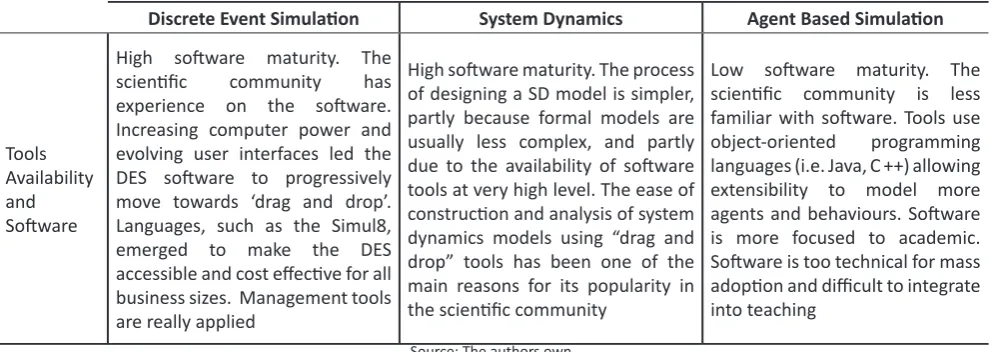
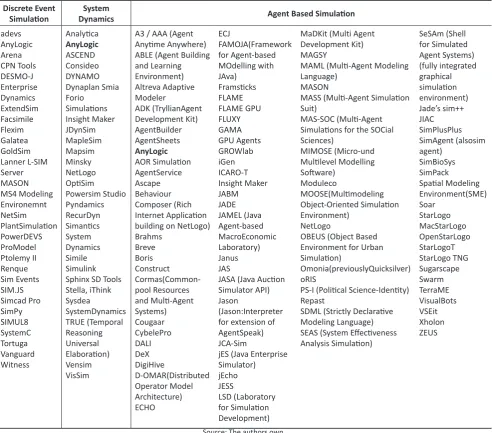
This section gives a brief overview of the tools, and its characteristics, identified in each simulation approach (Table 2). In Table 3, a list of tools – alphabetically ordered – is depicted for each simulation approach.
Most of the tools are characterised its specific use in a particular simulation approach. Nevertheless, AnyLogic (AnyLogic, 2015) commercial tool is characterised by offering a multi-method approach in which the three simulation paradigms can be represented in the same visual environment. It allows modelling different parts of an only model with different simulation approaches. The main disadvantage that modellers have to overcome using AnyLogic is related to their familiarity to work in Java environments.
Discrete Event Simulation System Dynamics Agent Based Simulation
Tools Availability and Software
High software maturity. The
scientific community has
experience on the software. Increasing computer power and evolving user interfaces led the DES software to progressively move towards ‘drag and drop’. Languages, such as the Simul8, emerged to make the DES accessible and cost effective for all business sizes. Management tools are really applied
High software maturity. The process of designing a SD model is simpler, partly because formal models are usually less complex, and partly due to the availability of software tools at very high level. The ease of construction and analysis of system dynamics models using “drag and drop” tools has been one of the main reasons for its popularity in the scientific community
Low software maturity. The scientific community is less familiar with software. Tools use object-oriented programming languages (i.e. Java, C ++) allowing extensibility to model more agents and behaviours. Software is more focused to academic. Software is too technical for mass adoption and difficult to integrate into teaching
Source: The authors own.
Table 3. Simulation Approaches Tools Discrete Event
Simulation DynamicsSystem Agent Based Simulation
adevs AnyLogic
Arena
CPN Tools
DESMO-J
Enterprise Dynamics ExtendSim Facsimile Flexim Galatea GoldSim Lanner L-SIM
Server
MASON MS4 Modeling Environemnt NetSim PlantSimulation PowerDEVS ProModel Ptolemy II Renque Sim Events
SIM.JS
Simcad Pro SimPy SIMUL8 SystemC Tortuga Vanguard Witness
Analytica
AnyLogic
ASCEND Consideo DYNAMO Dynaplan Smia Forio Simulations Insight Maker JDynSim MapleSim Mapsim Minsky NetLogo OptiSim Powersim Studio Pyndamics RecurDyn Simantics System Dynamics Simile Simulink Sphinx SD Tools Stella, iThink Sysdea
SystemDynamics TRUE (Temporal Reasoning Universal Elaboration) Vensim VisSim
A3 / AAA (Agent Anytime Anywhere) ABLE (Agent Building and Learning Environment) Altreva Adaptive Modeler
ADK (TryllianAgent Development Kit) AgentBuilder AgentSheets
AnyLogic
AOR Simulation AgentService Ascape Behaviour Composer (Rich Internet Application building on NetLogo) Brahms
Breve
Boris Construct Cormas(Common-pool Resources and Multi-Agent Systems) Cougaar CybelePro DALI
DeX
DigiHive
D-OMAR(Distributed Operator Model Architecture) ECHO
ECJ
FAMOJA(Framework for Agent-based MOdelling with
JAva)
Framsticks FLAME FLAME GPU FLUXY
GAMA
GPU Agents GROWlab
iGen
ICARO-T Insight Maker
JABM JADE
JAMEL (Java Agent-based MacroEconomic Laboratory) Janus
JAS
JASA (Java Auction Simulator API) Jason
(Jason:Interpreter for extension of AgentSpeak) JCA-Sim
jES (Java Enterprise Simulator) jEcho
JESS
LSD (Laboratory for Simulation Development)
MaDKit (Multi Agent Development Kit)
MAGSY
MAML (Multi-Agent Modeling Language)
MASON
MASS (Multi-Agent Simulation Suit)
MAS-SOC (Multi-Agent Simulations for the SOCial Sciences)
MIMOSE (Micro-und Multilevel Modelling Software)
Moduleco
MOOSE(Multimodeling Object-Oriented Simulation Environment)
NetLogo
OBEUS (Object Based Environment for Urban Simulation)
Omonia(previouslyQuicksilver)
oRIS
PS-I (Political Science-Identity) Repast
SDML (Strictly Declarative Modeling Language) SEAS (System Effectiveness Analysis Simulation)
SeSAm (Shell for Simulated Agent Systems) (fully integrated graphical simulation environment) Jade’s sim++
JIAC
SimPlusPlus SimAgent (alsosim agent)
SimBioSys SimPack Spatial Modeling Environment(SME)
Soar
StarLogo MacStarLogo OpenStarLogo StarLogoT StarLogo TNG Sugarscape Swarm TerraME VisualBots VSEit Xholon
ZEUS
Source: The authors own.
5. CONCLUSIONS
The aim of this paper is to discuss the use of different simulation approaches to support the modelling and resolution process of complex systems, such as the CN. Three simulation approaches are considered as relevant to the scope of our purpose: DES, SD and ABS each one with its advantages and disadvantages for modelling the CN. It has been considered that depending on the characteristics of problem/process to be modelled and the availability of the tools in which the simulation approach is supported, one approach or another will be selected. Moreover, the modellers’ familiarity with the used software must be considered.
To sum up, DES is recommended to be used for the study of supply network process characterised by being under
uncertainty conditions, or collaborative process that can be modelled with queuing simulations, in which the state of the model elements evolves according to discrete events behaviour. SD can be usefully applied in complex systems in which models are represented with less detail in order to predict the behaviour, given certain initial conditions. In SD the processes can be represented from a continuous perspective. Finally, ABS has its application in systems in which the elements that take part are sufficient autonomous to perform themselves the decision-making process.
REFERENCES
AnyLogic (2015), “AnyLogic.” Retrieved (http://www.any -logic.com/).
Ashayeri, J., R. Keij, and A. Bröker (1998), “Global Busi -ness Process Re-Engineering: A System Dynamics-Based Ap -proach.” International Journal of Operations & Production Management 18(9/19):817–31.
Balaban, M., and P. Hester (2013), “Exploration of Pur -pose for Multi-Method Simulation in the Context of Social Phenomena Representation.” Pp. 1661–72 in Proceedings of the 2013 Winter Simulation Conference, edited by R Pasupa -thy, S.-H. Kim, A Tolk, R Hill, and M E Kuhl.
Barnard, C. (1938), The Functions of the Executive. Hard -vard University Press, Cambridge.
Bertalanffy, L. (1950), The Theory of Open Systems in Physics and Biology. Systems thinking.
Bertalanffy, L. (1968), General System Theory. New York: George Braziller.
Borshchev, A., and A. Filippov (2004), “From System Dy -namics and Discrete Event to Practical Agent Based Model -ing: Reasons, Techniques, Tools.” in The 22nd International Conference of the System Dynamics Society. July 25 - 29, 2004, Oxford, England.
Brailsford, S. C., A. K. Shahani, R. Basu, and S. Sivapalan (1992), “Simulation Modelling for HIV Infection and AIDS.” International Journal of BioMedical Computing 31(2):73–88.
Camarinha-Matos, L. M., and H. Afsarmanesh (2008), Col-laborative Networks: Reference Modelling. Springer Interna -tional Publishing.
Campuzano, F., and J. Mula (2011), Supply Chain Simu-lation. A System Dynamics Approach for Improving Perfor -mance. Springer London Dordrecht Heidelberg New York.
Campuzano, F., J. Mula, and D. Peidro (2010), “Fuzzy Esti -mations and System Dynamics for Improving Supply Chains.”
Fuzzy Sets and Systems 161(11):1530–42. Retrieved (http:// linkinghub.elsevier.com/retrieve/pii/S0165011409005296).
Castilla, I., and F. Longo (2010), “Modelling and Simula -tion Methodologies, Techniques and Applica-tions: A State of the Art Overview.” International Journal of Simulation & Process Modelling 6(1):1–6.
Cooper, K. G. (1980), “Naval Ship Production: A Claim Set -tled and a Framework Built.” Interfaces 10(6):20–36.
Edmonds, B. (2002), “The Use of Models - Making MABS More Informative.” Pp. 15–32 in Multi-Agent-Based Simula -tion. Lecture Notes in Computer Science. Berlin: Springer-Verlag.
Forrester, J. W. (1961), Industrial Dynamics. Cambridge, MA: MIT press.
Forrester, J. W. (1968), Principles of Systems. Wright-Allen Press.
Forrester, J. W. (1969), Urban Dynamics. Pegasus Commu -nications.
Forrester, J. W. (1971), World Dynamics. Wright-Allen Press.
Gary, M. S., M. Kunc, and D. W. Morecroft. (2009), “Sys -tem Dynamics and Strategy.” System Dynamics Review
24(4):407–29.
Gilbert, N. (2007), Agent-Based Models. Quantitative Ap -plications in the Social Sciences. London: SAGE Publications. Gordon, G. (1961), “A General Purpose Systems Simula -tion Program.” Pp. 87–104 in Proceedings of EJCC, edited by McMillan NY. Washington D.C.
Hernández, J. E., M. M. E. Alemany, F. C. Lario, and R. Poler (2009), “SCAMM - CPA : A Supply Chain Agent - Based Modelling Methodology That Supports a Collaborative Plan -ning Process.” Innovar 19(34):99–120.
Homer, J. B. (1987), “A Diffusion Model with Application to Evolving Medical Technologies. ,.” Technological Forecast-ing and Social Change 31(3):197–218.
Izquierdo, L. R., J. M. Galán, J. I. Santos, and R. Olmo (2008), “Modelado de Sistemas Complejos Mediante Simu -lación Basada En Agentes Y Mediante Dinámica de Sistemas.”
Revista de Metodologia de Ciencias Sociales 16(16):85–112. Retrieved (http://e-spacio.uned.es/revistasuned/index. php/empiria/article/view/1391).
Kast, F. E., and J. E. Rosenzweig (1981), Organization and Management: A System and Constingency Approach. Mc-Graw Hill.
Kelton, W. D., R. P. Sadowski, and D. T. Sturrock (2003), Simulation with Arena. McGraw-Hill: New York.
Kleijnen, J. P. C. (2005), “Supply Chain Simulation Tools and Techniques: A Survey.” International Journal of Simula -tion and Process Modelling 1(1-2):82–89.
Kleijnen, J. P. C., and J. Wan (2007), “Optimization of Simu -lated Systems: OptQuest and Alternatives.” Simulation Mod -elling Practice and Theory 15(3):354–62. Retrieved (http:// linkinghub.elsevier.com/retrieve/pii/S1569190X06000931).
Lane, D. C., and E. Husemann (2008), “Steering without Circe: Attending to Reinforcing Loops in Social Systems.” Sys-tem Dynamics Review 24(2):37–61.
System Dynamics Review 23(1):35–60. Retrieved (http://doi. wiley.com/10.1002/sdr.359).
Lee, Y. H., M. K. Cho, S. J. Kim, and Y. B. Kim (2002), “Supply Chain Simulation with Discrete–continuous Combined Mod -eling.” Computers & Industrial Engineering 43(1-2):375–92. Retrieved (http://linkinghub.elsevier.com/retrieve/pii/ S0360835202000803).
Lee, Z. W., D. N. Ford, and N. Joglekar (2007), “Effects of Resource Allocation Policies for Reducing Project Durations : A Systems Modelling Approach.” Systems Research and Be-havioral Science 566(October 2006):551–66.
Liu, S., K. P. Triantis, and S. Sarangi (2010), “A Framework for Evaluating the Dynamic Impacts of a Congestion Pricing Policy for a Transportation Socioeconomic System.” Trans-portation Research Part A: Policy and Practice 44(8):596– 608.
Luna-Reyes, L. F., L. J. Black, A. M. Cresswell, and T. A. Pardo (20080, “Knowledge Sharing and Trust in Collab -orative Requirements Analysis.” System Dynamics Review
23(3):265–97.
Lyneis, J. M., and D. N. Ford (2007), “System Dynamics Applied to Project Management: A Survey, Assessment, and Directions for Future Research.” System Dynamics Review
23(2-3):157–89. Retrieved (http://doi.wiley.com/10.1002/ sdr.377).
Macal, C. M. (2010), “To Agent-Based Simulation from System Dynamics.” Pp. 371–82 in Proceedings of the 2010 Winter Simulation Conference, edited by B Johansson, S Jain, J Montoya-Torres, J Hugan, and E Yücesan.
Maidstone, R. (2012), “Discrete Event Simulation , Sys -tem Dynamics and Agent Based Simulation : Discussion and Comparison.” System 1–6.
North, M. J., and C. M. Macal (2007), Managing Business Complexity: Discovering Strategic Solutions with Agent-Based Modeling and Simulation. Oxford University Press: New York.
Rabelo, L., M. Helal, A. Jones, and H. S. Min (2005), “Enterprise Simulation: A Hybrid System Approach.” Inter-national Journal of Computer Integrated Manufacturing 18(6):498–508. Retrieved (http://www.tandfonline.com/ doi/abs/10.1080/09511920400030138).
Richardson, G. (1991), Feedback Thought in Social Science and Systems Theory. Philadelphia: University of Pennsylva -nia Press.
Roberts, E. (1978), Managerial Applications of System Dy -naimcs. Cambridge, MA: Productivity Press.
Selznick, P. (1948), Foundations of Th Theory of Organiza -tions’. ASR.
Shannon, R. E. (1975), Systems Simulation: The Art and Science. PrenticeHall, Englewood.
Siebers, P. O., C. M. Macal, J. Garnett, D. Buxton, and M. Pidd (2010), “Discrete-Event Simulation Is Dead, Long Live Agent-Based Simulation!” Journal of Simulation 4(3):204– 10. Retrieved (http://www.palgrave-journals.com/doifind -er/10.1057/jos.2010.14).
Sterman, J., G. Richardson, and P. Davidsen (1998), “Mod -elling the Estimation of Petroleum Resources in the Unit -ed States.” Technological Forecasting and Social Change. 33(3):219–49.
Sumari, S., R. Ibrahim, N. H. Zakaria, and A. H. A. Hamid (2013), “Comparing Three Simulation Model Using Taxono -my: System Dynamic Simulation, Discrete Event Simulation and Agent Based Simulation.” International Journal of Man -agement Excellence 1(3):54–59. Retrieved (http://ijmeon -line.com/index.php/ijme/article/view/1300000009).
Tako, A., and S. Robinson (2012), “The Application of Dis -crete Event Simulation and System Dynamics in the Logis -tics and Supply Chain Context.” Decision Support Systems
52(4):802–15. Retrieved (http://linkinghub.elsevier.com/ retrieve/pii/S0167923611002211).
Trist, E. L., and K. W. Bamforth (1951), Some Social and Psicological Consequences of the Long Wall Method of Coal-Getting. edited by Human Relations.
Vicsek, T. (2002) “Complexity: The Bigger Picture.” Nature 418(6894):131.
Wang, G., and E. a. B. Eltahir (2000), “Ecosystem Dynamics and the Sahel Drought.” Geophysical Re-search Letters 27(6):795–98. Retrieved (http://doi.wiley. com/10.1029/1999GL011089).
Weil, H. (2007), “Application of System Dynamics to Cor -porate Strategy: An Evolution of Issues and Frameworks.”
System Dynamics Review 23:137–56.