Northwest Journal of Teacher Education
Northwest Journal of Teacher Education
Volume 9
Issue 2 Northwest Passage: Journal of
Educational Practices Article 10
September 2011
A Model for Professional Development in Elementary
A Model for Professional Development in Elementary
Science
Science
David Davison
Montana State University, Billings
Kenneth Miller
Montana State University, Billings
Michael Scarlet
Montana State University, Billings
Follow this and additional works at: https://pdxscholar.library.pdx.edu/nwjte
Part of the Education Commons
Let us know how access to this document benefits you.
Recommended Citation Recommended Citation
Davison, David; Miller, Kenneth; and Scarlet, Michael (2011) "A Model for Professional Development in Elementary Science," Northwest Journal of Teacher Education: Vol. 9 : Iss. 2 , Article 10.
DOI: 10.15760/nwjte.2012.9.2.10
Available at: https://pdxscholar.library.pdx.edu/nwjte/vol9/iss2/10
This Article is brought to you for free and open access. It has been accepted for inclusion in Northwest Journal of Teacher Education by an authorized administrator of PDXScholar. For more information, please contact
A Model for Professional Development in Elementary Science
David Davison, Kenneth Miller, and Michael Scarlett Montana State University Billings
Abstract
Statements of outcomes for 21st century learners typically include inquiry-based learning as a major goal. In the PRISM Project, 62 elementary teachers in Montana were selected to receive professional development using inquiry science instruction in their classrooms. Participants attended workshops designed to model inquiry lessons, participated in online discussions to help them make their lessons more inquiry-based, and prepared Scoop notebooks containing three lessons demonstrating how they were implementing inquiry in their classrooms. Based on analysis of these data, participants were judged to have met the goal of the project to increase their use of inquiry in the science classroom.
In recent years much has been written on the need for bringing education into the twenty-first century. Educational reformers such as Ken Kay, president of the Partnership for 21st
Century Skills, claim that students need a curriculum that reflects an emphasis on twenty-first century skills such as higher order thinking skills, relationship building, and the use of
technology, in particular. These items have been a significant part of educational discussion for many years, but there is now substantial discussion on changing the culture of schools from test-driven reception learning to one of more autonomous student learning. For this to happen,
teachers must be equipped to respond to this change. At present, teacher education programs may have such change as a goal, but the emerging emphasis in these programs is for greater attention to clinical experiences to prepare teacher candidates more effectively for the workplace
(NCATE, 2010). Emerging changes in teacher education appear to be focusing on making teachers more ready to enter existing classrooms rather than preparing them for twenty-first century classrooms. Therefore, if school cultures are to be changed, it means that current teachers who have mastered school routine need to be equipped to change their view of how students can learn most effectively.
One area in which such change is needed is in the teaching of elementary science. If we examine the typical science textbook of the last 20 years we observe that the memorization of a body of science information is emphasized. Science education reformers of the twentieth century such as Joseph Schwab (1962) and Robert Karplus (1967) believed that the appropriate way for students to learn science was through active engagement in the process of inquiry, building on prior knowledge. Their thinking underpinned the science education reforms of that period. Why has classroom teaching of science not reflected these changes? One reason is that changing the culture of the classroom is a very slow process. While substantial resources have been devoted to professional development for teachers over the decades, little change has been observed.
Changes of the type proposed by Karplus and Schwab are endorsed by the science education professional community. The National Academy of Sciences (National Research Council 1996, 2000) is clear that science in the elementary school means pursuing the goals of studying science: that students are to function as young scientists. This position is endorsed by Bell, Smetana, and Binns (2005) who point out that most students need substantial scaffolding before they are ready to develop scientific questions and design effective data collection. They
indicate that the inquiry scale should be seen as a continuum, whereby students would progress gradually from lower to higher levels during a year. Unfortunately, this need for scaffolding is also evidenced by many elementary school science teachers, especially those who teach in small rural schools. It is essential, therefore, to provide these teachers with professional development opportunities to help them move across the inquiry continuum.
To accomplish this change, teachers will need to change the culture of their classrooms from one of reception learning to one of active learner engagement. The substantial body of literature on inquiry science indicates that the science education community has been focused on this issue. It is also clear that many elementary science teachers would like to incorporate inquiry instruction into their teaching but lack the means to do it effectively.
The purpose of this investigation was to explore methods whereby elementary teachers can become more effective in providing a climate of inquiry science for their students.
Literature Review: Inquiry-based Instruction
In a synthesis of teaching science though inquiry, Haury (1993) recognizes the differing conceptions of inquiry presented by science educators, but we suggest that many of these differences can be addressed by adherence to the inquiry continuum. While advocacy for
inquiry-based instruction is generally conceptual in its support, researchers look for evidence that students learn more science when inquiry methods are used. Mattheis and Nakayama (1988) found that inquiry-based programs in the middle grades enhanced student performance, especially with regard to laboratory skills and graphing and data interpretation skills. Glasson (1989) found students scored higher on tests of procedural knowledge, while Lloyd and Contreras (1985) found increases in vocabulary knowledge and conceptual understanding. However, these are isolated studies and broad generalizations should not be made.
Cobern, Schuster, Adams, Applegate, Skjold, Undreiu, Loving, and Gobert (2010)
undertook a carefully controlled experimental study comparing the efficacy of carefully designed inquiry instruction and equally carefully designed direct instruction in realistic science classroom situations at the middle school grades. They found that inquiry and direct methods led to
comparable science conceptual understanding in equal instructional times. Given that many of the intended benefits of inquiry instruction are not reflected in such tests, they argued that the expected benefits of direct instruction were not evident. Thus they support well-designed, active engagement lessons which are well taught.
On the other hand, Minner, Levy, and Century (2010) synthesized research on inquiry-based science instruction over an 18 year period and concluded that the evidence of effects of inquiry-based instruction was not overwhelmingly positive. They did find that hands-on experiences with scientific or natural phenomena were found to be associated with increased conceptual learning. However, they did not find that high levels of inquiry were associated with more positive learning outcomes for students.
While these findings offer only mild support for the use of inquiry-based methods in the science classroom, it can be argued that typical assessment methods place inquiry methods at a disadvantage. Therefore, we can argue that in the spirit of the National Science Education
Standards (NRC, 1996, 2000) teachers should continue to be encouraged to use inquiry methods, where appropriate, in their classroom instruction in science.
The PRISM Project
The Partnership to Reform Inquiry Science in Montana (PRISM) was designed to prepare rural elementary teachers to improve student science achievement in Montana schools. It is a research-based state Math and Science Partnership project sponsored through the Montana Office of Public Instruction. For three years this project worked with 52 teachers in a large region in the southeast portion of Montana. The specific partner Local Education Associations were chosen based upon high need, availability and project guidelines. No school chosen was under 30% free and reduced lunch, a common indicator of schools of low SES status.
The professional development focused on increasing the science subject matter knowledge of teachers, increasing teacher understanding and use of effective, research-based instructional strategies (specifically, inquiry-based instruction), and increasing teacher competency in the use of educational technology.
Accomplishing the Goals of the PRISM Project
A variety of activities were used to accomplish the project goals. The National Science Teachers‘ Association (NSTA) SciPacks were selected to measure teachers‘ knowledge of content appropriate to elementary school science. Not only do these SciPacks present content that elementary teachers should master, but the presentation of the content is interactive and supports an inquiry approach to science instruction. Over the course of the project, participants completed six SciPacks. Teachers were encouraged to adapt SciPack lessons in their own teaching.
An emphasis on inquiry instruction was a priority of this project. The Inquiry Continuum (see categories in Tables 2 and 3) served as the standard against which progress towards the goals of inquiry would be measured. Workshop sessions focused attention on the modeling of inquiry lessons. These lessons were led primarily by science educators, but some participants also shared successes from their classrooms. In online discussions, participants addressed
strategies they were using to make their instruction more inquiry based, including the adapting of regular text-based science lessons to a more inquiry focus. The primary evidence for the
teachers‘ use of inquiry was supplied by the use of Scoop notebooks (Borko, Stecher, & Kuffner, 2007). Teachers were asked to compile a notebook of evidences from their classroom over a period of three months during their second year in the project. These classroom samples were self-assessed for the level of inquiry reached and were also assessed by a project evaluator.
Findings from the Project
Use of inquiry in the classroom. Anecdotal and survey information from workshop evaluations indicated that the participants learned a great deal from the modeling of how to use inquiry in instruction. In their survey question responses to each workshop they requested more modeling of inquiry-based science lessons, and more experience working with the inquiry continuum. They were very positive about their desire to change the culture of their classrooms.
In a follow-up workshop teachers continued to see the transition to a more inquiry-based approach to science instruction as a high priority. They had been thinking about it for a whole year, but it was evident from their responses that they still needed more modeling of ways to integrate it successfully into their classrooms. They were clearly still on a learning curve with
regard to how to make their instruction more inquiry-based. A surprising result was the number
of teachers who were not accustomed to the 5E‘s lesson planning model.
Participants were introduced to the Scoop notebook and the process involved in
collecting data. They were also introduced to the use of Desire to Learn (D2L) as a strategy for Blended Learning (mixed live/online). A common participant reaction was that they would have liked more time to feel comfortable with working with D2L before being responsible for it on their own.
Online discussions which addressed ways of making science lessons more inquiry-based reflected such a change in culture.
Analysis of participants’ written comments. At each workshop participant satisfaction responses have been uniformly positive. (See Table 1.)
Participants enjoyed the activities, and the more reflective of them welcomed having essential features of inquiry science modeled for them through these activities. One comment that has been oft repeated is that a number of the participants are looking for a repertoire of inquiry-based activities to take away with them from the workshop. This is not a surprising finding–we have encountered this type of response in a wide range of professional development activities for teachers. It does make good sense for teachers to go away from a workshop with a lot of ready-made ideas to put into practice. The danger is when we cross the line providing teachers with access to valuable resources to ―spoon-feeding‖ them. What is disturbing to us is that one goal of inquiry-based learning is to have teachers become more reflective in their selection of learning materials. Some of the D2L learning assignments set out to do just that, especially in terms of having participants convert a textbook based activity into an inquiry-based activity, and some of the responses suggested that this was too time-consuming. As we
interviewed many of these teachers, typically outside of regular school hours, we noted that their school commitments engaged them for many hours and left them little time for reflection or for finding new resources. In that sense, if the goals of the project are to be attained in a sustainable manner, teachers need to learn to share access to valuable resources. We judge that this is one reason why these workshops have been so well appreciated. But they are also a costly portion of the project and, in a region as large as that embraced by this project, distance
learning/conferencing becomes the only cost-effective way of promoting such collegiality. The area of participant responses that was not always so positive dealt with their views towards online interaction (D2L). Perhaps the staff and the participants should have met to discuss together what should be expected using D2L. From our personal interactions with the participants, as well as our reading of their workshop comments, we judge that the participants do want to use D2L effectively, but they want its use to be smooth. Clearly, in a region such as that embraced by this project, professional development must include an online component if it is to be economically viable. We would recommend that preparatory training is distance learning be prerequisite to any professional development program.
Notwithstanding the mildly positive/neutral comments about D2L, participants continued to be quite satisfied with the workshops. Now that the project is completed, attention must be directed to finding ways of continuing to accomplish the goals of the project in a cost-effective manner.
Scoop notebooks. In order to understand the degree to which the goals and objectives of
Table 1
Analysis of Participant Feedback (Workshop Evaluation April 23-24, 2010)
Analysis of Ratings
1. I am making substantial use of the knowledge gained from the SciPacks in my teaching of science.
The median response was Strongly Agree.
2. The Inquiry Continuum is improving my ability to teach using the methods of inquiry science.
The median response was Agree. This result is again very positive, but we might have expected that it would have been stronger, especially because the teachers had had two years to become accustomed to using the continuum.
3. The teacher workshops are improving my ability to teach using the methods of inquiry science.
The median response was Agree (leaning towards Strongly Agree). This positive response supports the written comments the participants made about the workshops.
4. The teacher workshops have increased my knowledge of content needed to teach science in my classroom.
The median response was Agree. While one might initially expect the rating to be closer to Strongly Agree, we must remember that the workshops have focused on instructional strategies, not content. Of course, participant content knowledge would have been strengthened by the science activities in which they were engaged. The surprising rating is the teacher who was ambivalent about responding to this and the previous statement. (From personal interviews with each teacher, the evaluator was unaware of any such ambivalence.)
5. My school‘s administration has supported my involvement in the PRISM Project. The median response was Agree. Sometimes the response to a question of this type may be a matter of perception, but it is disconcerting to note that administrative endorsement was a precondition of participation in the project. At least one respondent validated this dissonance in the narrative comments. We note that administrative interest in the workshops has been modest at best, in spite of their receiving invitations to attend. This must raise questions about the capacity of the goals of the project to be spread to other teachers who might potentially be impacted by project teachers. It will be interesting to note the effectiveness of those teachers from the Cohort who will engage in Year 3 of the project, essentially to mentor their colleagues in inquiry science.
6. The PRISM Project Staff has supported my involvement in the PRISM Project
The median response was Strongly Agree. It is pleasing that the participants are satisfied with their contacts with project staff.
7. The D2L online course has been effective in improving my ability to teach using the methods of inquiry science.
The median response was Neutral. This response is not surprising in view of the extensive comments about D2L in the participants‘ additional comments. Some of the issues were technical in nature, but others raised questions about using the online instruction more effectively.
8. The pedagogical discussions have been successful in improving my ability to teach using the methods of inquiry science.
The median response was Neutral. It is not unexpected that this item‘s ratings should be consistent with those of Item 7.
9. The pedagogical discussions have been successful in increasing my knowledge of content needed to teach science in my classroom.
The median response was Neutral. This response is consistent with those of the two previous items and the remarks made earlier are valid here.
10. The content discussions have been successful in increasing my knowledge of content needed to teach science in my classroom.
The median response was Neutral. Again, the responses to all of the items dealing with D2L remain consistent and point to the need to address how D2L is implemented.
11. The content discussions have been successful in improving my ability to teach using the methods of inquiry science.
The median response was Neutral. Again, the responses to all of the items dealing with D2L remain consistent and point to the need to address how D2L is implemented. It needs to be remembered that one goal of this project is to make inquiry science accessible to remote area teachers, and online learning and discussions are integral to achieving this goal. It is critical, therefore, that problems (real or perceived) in making D2L effective need to be addressed.
12. Creating a Scoop Notebook has been successful in improving my ability to teach using the methods of inquiry science.
The median rating was Agree, indicating that the teachers view it positively. More discussion of this issue will be found in the analysis of the SCOOP notebooks. These ratings taken as a whole support the participants‘ overall satisfaction with the project. The one issue that caused concern deals with the implementation of D2L. These ratings results are all consistent with the written comments that the participants made at the same time.
the PRISM Project were reflected in teachers‘ practices, participants collected artifacts from three of their science lessons to create a ―Scoop‖ Notebook (a procedure developed at the National Center for Research on Evaluation, Standards, and Student Testing (CRESST), 2007). Teachers collected artifacts of classroom practice and made observations in the forms of pre and post-reflections similar to the way a scientist might take a sample from nature to analyze back in
a laboratory. For each scooped lesson teachers were instructed to include a lesson plan, instructional materials (handouts, worksheets), examples of student work (high, medium, and low quality), tests, quizzes, rubrics, and pictures of the classroom set-up, including instructions on the whiteboard, and instructional tools/materials.
Scoop Notebooks were evaluated using rating scales that included the five Essential Features of Classroom Inquiry (Montana K-12 Content Standards and Performance Descriptors for Science-Inquiry Continuum, 2008. Office of Public Instruction.) Teachers were also asked to rate their own lessons using the five Essential Features of Classroom Inquiry. Although the teachers evaluated each individual ―scooped‖ lesson, the evaluator gave a rating based on an overall evaluation of the Scoop Notebook. A total of 16 Scoop Notebooks were collected from the first cohort, a turn-in rate of 64%. Forty-eight science lessons total were included in the Scoop Notebooks.
Overall, it was clear from the Scoop Notebooks that teachers were using inquiry-based science instruction in their classrooms and the Scoop Notebook was a useful tool for
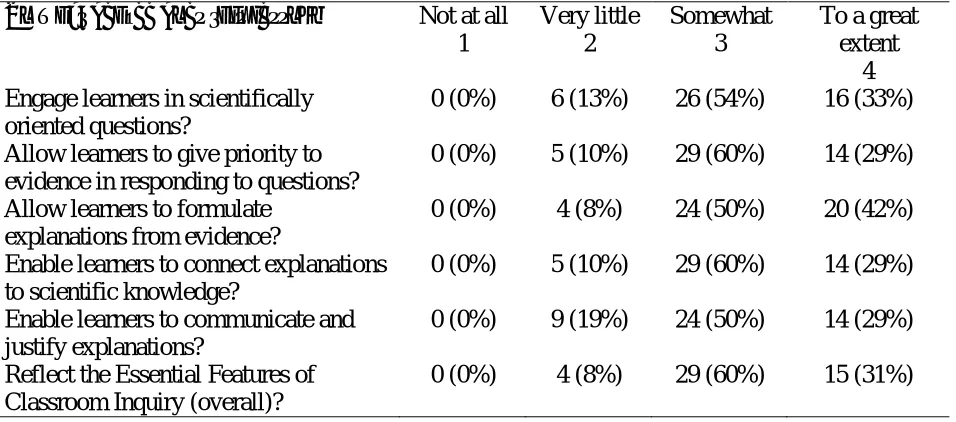
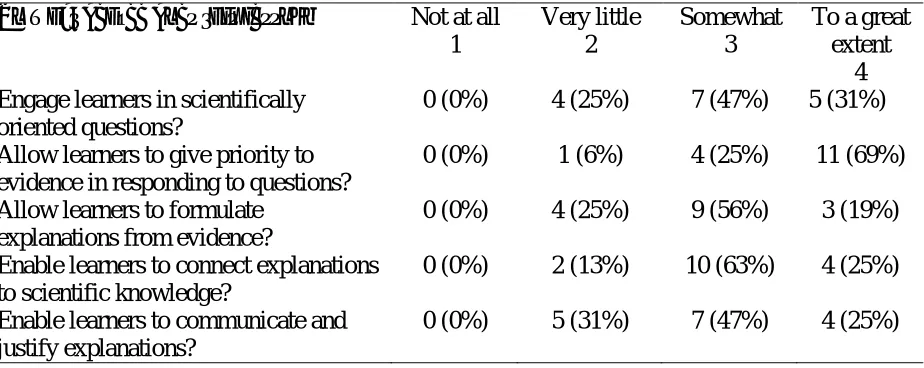
understanding what science instruction looks like in teachers‘ classrooms. The majority of the lessons incorporated elements of inquiry-based instruction either somewhat or to a great extent, according to both teachers and the evaluator (See Tables 2, 3).
Table 2
Teachers‘ Rating of Inquiry in Scoop Lessons (N=48 lessons)
To what degree does this lesson… Not at all 1
Very little 2
Somewhat 3
To a great extent
4 Engage learners in scientifically
oriented questions?
0 (0%) 6 (13%) 26 (54%) 16 (33%)
Allow learners to give priority to evidence in responding to questions?
0 (0%) 5 (10%) 29 (60%) 14 (29%)
Allow learners to formulate explanations from evidence?
0 (0%) 4 (8%) 24 (50%) 20 (42%)
Enable learners to connect explanations to scientific knowledge?
0 (0%) 5 (10%) 29 (60%) 14 (29%)
Enable learners to communicate and justify explanations?
0 (0%) 9 (19%) 24 (50%) 14 (29%)
Reflect the Essential Features of Classroom Inquiry (overall)?
Table 3
Evaluator‘s Rating of Inquiry in Scoop Notebooks (N=16)
To what degree does this lesson… Not at all 1
Very little 2
Somewhat 3
To a great extent
4 Engage learners in scientifically
oriented questions?
0 (0%) 4 (25%) 7 (47%) 5 (31%)
Allow learners to give priority to evidence in responding to questions?
0 (0%) 1 (6%) 4 (25%) 11 (69%)
Allow learners to formulate explanations from evidence?
0 (0%) 4 (25%) 9 (56%) 3 (19%)
Enable learners to connect explanations to scientific knowledge?
0 (0%) 2 (13%) 10 (63%) 4 (25%)
Enable learners to communicate and justify explanations?
0 (0%) 5 (31%) 7 (47%) 4 (25%)
Interestingly, one area in which there was disagreement between the teachers‘ rating and the evaluator‘s rating was the degree to which the lesson allowed learners to formulate
explanations from evidence. This may be due to the difference between how the lesson was actually taught and the evidence that was provided in the Scoop Notebook.
Conclusion
In a project which set out to increase the ability of a cadre of rural elementary teachers to use science inquiry, positive results have been obtained. However, these findings are tempered by the conditions existing in many rural schools. As a result of the professional development, participants certainly met the expectations of the project, but could this progress be expected to continue without grant support. Would teachers continue to collaborate with colleagues at a distance without some significant incentive? We believe we have demonstrated that we can help teachers make a transition to more inquiry-based instruction, but we are not so clear that this transition can be maintained without external impetus. It is true that these teachers have increased their use of inquiry in science teaching during the timeline of the project, but further growth is unlikely unless the teachers have strong encouragement to do so. If we are committed to incorporating twenty-first century instructional strategies into our educational system, then resources need to be made available for this to happen.
References
Bell, R. L., Smetana, L., & Binns, I. (2005, October). Simplifying inquiry instruction. The Science Teacher, 30 – 33.
Borko, H., Stecher, B., & Kuffner, K. (2007). Using artifacts to characterize reform-oriented instruction: The Scoop Notebook and rating guide. National Center for Research on Evaluation Technical Report 707.
Cobern, W. W., Schuster, D., Adams, B., Applegate, B., Skjold, B., Undreiu, A., Loving, C. C., & Gobert, J. D. (2010). Experimental comparison of inquiry and direct instruction in science. Research in Science & Technological Education, 28 (1), 81 – 96.
Glasson, G. E. (1989). The effects of hands-on and teacher demonstration laboratory methods on science achievement in relation to reasoning ability and prior knowledge. Journal of Research in Science Teaching, 26(2), 121 – 131.
Haury, D. L. (1993). Teaching science through inquiry. ERIC/CSMEE Digest. ED 359048. Karplus, R., & Their, H. D. (1967). A new look at elementary school science. Chicago: Rand
McNally and Co.
Lloyd, C. V., & Contreras, N. J. (1987). What research says: Science inside-out. Science and Children, 25(2), 30 – 31.
Mattheis, F. E., & Nakayama, G. (1988). Effects of a laboratory-centered inquiry program on laboratory skills, science process skills, and understanding of science knowledge in middle grades students. ED 307148.
Minner, D. D., Levy, A. J., & Century, J. (2010). Inquiry-based science instruction—what is it and does it matter? Results from a research synthesis years 1984 to 2002. Journal of Research in Science Teaching, 47(4), 474 – 496.
National Council for Accreditation of Teacher Education. (2010, November). Transforming teacher education through clinical practice: A national Strategy to prepare effective teachers. Washington, DC: NCATE.
National Research Council. (1996). National science education standards. Washington, DC: National Academy Press.
National Research Council. (2000). Inquiry and the national science education standards. Washington, DC: National Academy Press.
Schwab, J. J. (1962). The teaching of science as inquiry. In J. J. Schwab & P. T. Brandwein (Eds.), The teaching of science (pp. 3-103). Cambridge, MA: Harvard University Press.