(DOI: 10.24874/jsscm.2018.12.01.05)
Flexural Analysis of Composite Laminated Beams Subjected to
Thermo-Mechanical Loads
S. K. Kulkarni1*, Y. M. Ghugal2
1 Department of Civil Engineering, D Y Patil School of Engineering and Technology, Pune
-412105, Maharashtra State, India e-mail: [email protected]
2 Department of Applied Mechanics, Government Engineering College, Karad - 415124,
Maharashtra State, India e-mail: [email protected] *corresponding author
Abstract
The present work is concerned with the flexural analysis of single layer orthotropic, two-layer antisymmetric and three-layer symmetric laminated beams subjected to uniformly distributed thermo-mechanical loads. The thermal load is varying linearly across the thickness of laminated beams. A combination of uniformly distributed thermal load with uniformly distributed transverse mechanical load is taken into consideration for the flexural analysis of laminated beams. A sinusoidal shear deformation theory is used. The displacement field of theory consists of sinusoidal function in terms of thickness co-ordinate to include the shear deformation effect. Governing equations and boundary conditions of theory are obtained by using the principal of virtual work. The theory obviates the need of shear correction factor and satisfies the shear stress free conditions at the top and bottom of the beam. Stresses and displacements in orthotropic, antisymmetric and symmetric cross ply laminated beams are obtained by using sinusoidal shear deformation theory. The results obtained by present theory are compared with Timoshenko beam theory, classical beam theory and also with the results which are available in the literature wherever possible.
Keywords: Cross ply laminated beams, sinusoidal shear deformation theory, thermal stress, thermo-mechanical loads, equivalent single layer theory
1. Introduction
direction resulting high inter-laminar stresses at the interfaces. Therefore, there is a need to predict the inter-laminar transverse shear stresses accurately.
Several theories exist in literature for the flexural analysis of composites structures. They have been extended to thermoelastic problems as well. Classical laminate beam theory (CBT) presented by (Tanigawa et al. 1989) is based on the Euler-Bernoulli hypothesis and leading to inaccurate results for moderately thick beams, because transverse shear strains are neglected. The first order shear deformation theory of (Mindlin, 1951) when applied to beams is known as Timoshenko beam theory (TBT). The transverse shear strains are assumed to be constant along the thickness of laminates; hence transverse shear stresses remain constant along the thickness of laminates and stress-free boundary conditions are not satisfied at the top and bottom of the laminates. Further, it requires a shear correction factor to obtain the correct stresses and displacements. In the present work, a shear correction factor of 5/6 has been used.
A higher order shear deformation theory takes into account transverse shear strains and obviates the need of shear correction factor. A non-constant polynomial expression for the out of plane displacement is considered by (Kant et al. 1997) with a higher order theory. An exponential function has also been used by (Soldatos et al. 1997) with higher order theory. All these studies have a displacement-based approach. On the basis of mixed formulations, other approaches are formulated and presented by (Carrera, 2000b). A finite element model is also applied to beams by using higher order shear deformation theory and presented by (Kant et al. 1988). A thermoelastic solution of linear uncoupled thermo-elasticity has been presented for certain problems of flexure of composite laminates by (Bhaskar et al. 1996). Both mechanical and thermo-mechanical tests for thin and thick beams are presented by (Philippe et al. 2009) in order to evaluate the capacity of newly developed three node beam finite elements including transverse and normal effects in the analysis of laminated beams. This work focuses on the necessity to take into account the transverse normal stress, especially for thick beams. Within the framework of thermal problems, different approaches have been developed; including mixed formulations presented by Tessler et al. (2001) and displacement based developed by Ali et al. (1999).
The higher order shear deformation theories with sinusoidal functions in terms of thickness coordinates to include thickness effect are termed as trigonometric or sinusoidal shear deformation theories. Trigonometric shear deformation theory has been developed by Touratier (1991). Various problems of plates have been investigated including bidirectional bending when acted upon by mechanical and thermal load. Thermal stresses and displacements for orthotropic, antisymmetric and symmetric laminates subjected to nonlinear thermal load using trigonometric shear deformation theory have been presented by Ghugal et al. (2013). This paper includes bidirectional bending of plates. A closed form solution to assess multilayered plate theories for various thermal stress problems is presented by (Carrera et al. 2004). This work is the further development of two-dimensional modelling in thermal stress analysis of multilayered composite plates. Various equivalent single layer and layerwise theories for laminated plates subjected to mechanical load are critically discussed by Ghugal et al. (2002). An assessment of mixed and classical theories for the thermal stress analysis of orthotropic multilayered plates has been presented by Carrera, (2000a).
However, it has been observed from the literature review that the trigonometric shear deformation theory is not fully explored for the one-dimensional analysis of laminated composite beams subjected to combined thermal and mechanical loadings. Hence, a sinusoidal shear deformation theory (SSDT) is applied for the flexural analysis of laminated composite beams subjected to combined uniformly distributed thermo-mechanical loadings and the results are presented for the first time in the literature.
composite beams subjected to combined thermal and mechanical loadings. This is an equivalent single layer theory for the evaluation of displacements and inter-laminar stresses in composite laminated beams. The necessity to consider the transverse shear stress especially for thick beam in thermal conditions has been studied in this work.
The results of displacement and stresses obtained by sinusoidal shear deformation theory (SSDT) are compared with those of classical beam theory (CBT), Timoshenko beam theory (TBT), and other refined theories. The results of pure thermal load are compared with exact elasticity solutions.
2. Mathematical formulation
The mathematical formulation of present sinusoidal shear deformation theory for laminate composite beam is based on certain kinematical and physical assumptions. The governing equations and boundary conditions are obtained by using principal of virtual work. The Navier solution has been employed to develop the analytical solution for the simply supported boundary conditions.
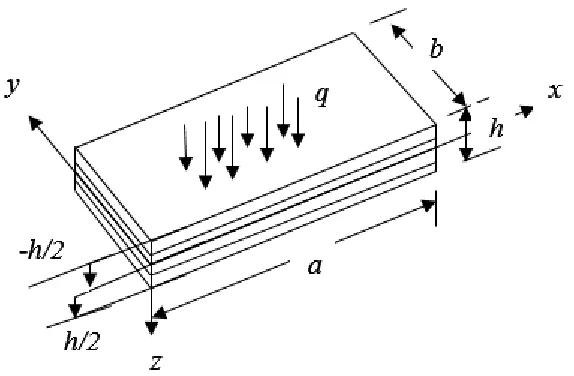
2.1 A laminated beam under consideration: The geometry of beam is as shown below.
Fig. 1. Geometry of a laminated beam.
Let us consider a beam occupying the domain in Cartesian coordinate
Ox y z, ,
.0 , 0 ,
2 2
h h
x a y b z
(1)
surface of laminated beam
z h 2
is subjected to thermal loadT x z
, and transverse mechanical load
q .2.2 Assumptions made in mathematical formulation
The present sinusoidal shear deformation theory is based on following assumptions:
1.It is assumed that, the width of the beam b along y axis is very small as compared to length a along x axis while it is simply supported at its edges x0 and xa.
2.The displacement component u is the inplane displacement along x axis and w is the transverse displacement in
z
direction.3.Since the theory has been applied to laminated beam, the displacement along y direction (v ) is assumed to be zero.
4.Since, ab we can state, 0 y
and
d
x x
.
5.The axial displacement u in x direction has three components namely extension, bending and shear.
0
u u u u b s
(2)
a) u0 is the middle surface displacement in xdirection known as extension component. b) The bending component ub is assumed to be analogous to the displacement given by classical laminate theory.
w xu z
b x
(3)
c)The shear component is assumed to be sinusoidal in nature with respect to thickness coordinate, so that maximum shear stress occurs at neutral plane and zero at top and bottom surfaces of the beam.
sin
h z
u x
s h (4)
6.The transverse displacement win
z
direction is assumed to be a function of xcoordinate only.
ww x (5)
7.The laminated beams are subjected to pure thermal load as well as a combination of uniformly distributed thermal and mechanical load.
3. Kinematics of sinusoidal shear deformation theory
Based on the before mentioned assumptions the kinematics of sinusoidal shear deformation theory (SSDT) for beam is expressed as follows:
,
sin
0
w h z
u x z u x z x
x h
(6)
,
w x z w x (7)
Here, u x z
, is the axial displacement in x direction and w x
is the transverse displacement in thez
direction. u0
x is the centre line displacement and is the function of x only. The shear slope is also a function of x only. The trigonometric function in thickness coordinate considers the shear deformation effects and the displacement field of the theory represents a better kinematics. The kinematics of the theory enforces to satisfy shear stress free boundary conditions on top and bottom surfaces of the beam with realistic variation across the thickness.3.1 Strain-displacement relationship
Within the framework of linear theory of elasticity, the normal and shear strains are obtained as follows.
u x x
(8)
u w zx z x
(9)
3.2 Constitutive relations
The thermo-elastic stress-strain relationships for laminated beam can be written as;
0 11 0
55
T Q
x x x
Q
zx k k zx k
(10)
where, Q( )k
ij are the reduced stiffness coefficients as given below.
( )( ) 1 , ( ) ( )
11 55 13
1
12 21 k E
k k k
Q Q G
k k
(11)
where,
E
is Young’s modulus, G is shear modulus, ij are Poisson’s ratios and
x
is the coefficient of thermal expansion in x direction.3.3 Temperature distribution
2
,
0 T x z zT x
h
(12)
In the above equation,
T
is the temperature change from a reference state which is a function of x andz
. The thermal load T0 is linearly varying across the thickness of laminated beam and is a function of x. The temperature distribution through the thickness of laminated beam is as shown in figure 2.Fig. 2. Temperature distribution through the thickness of laminated beam.
4. Governing equations and boundary conditions
The governing equations and boundary conditions are derived by using principle of virtual work. The principal of virtual work states that of all possible displacements that satisfy the given conditions of constraints, that system which is associated with equilibrium makes the value of sum of potential energy of the prescribed external forces and the potential strain energy of the internal stresses maximum and in the case of stable equilibrium a minimum. The principle of virtual work when applied to the laminated beam leads to:
2
0
0 0
2 h
a a
dx dz q wdx
x x zx zx
h
(13)
The governing equations of equilibrium can be derived from the above equation (13) by integrating the displacements gradients in i by parts and setting the coefficients of u0,w and to zero separately. The symbol denotes variational operator and collecting the coefficients of u0,w and one can obtain the governing equations as follows.
-1.00 -0.50 0.00 0.50 1.00
-0.50 -0.25 0.00 0.25 0.50
z/h
2 3 2
0 0
: 0
0 11 2 11 3 11 2 11
u w T
u A B SB TB
x
x x x
(14)
3 2
4 3
0 0
:
11 4 11 3 11 3 11 2
u T
w
w D B S TD q
x x x x
(15)
2
3 2
0 0
: 0
11 3 11 2 55 11 2 11
u T
w
S SS C SB TS
x
x x x
(16)
The associated boundary conditions are as follows: Along edges x0 and xa
2 3 2
0 0 or is prescribed.
11 2 11 3 11 2
u w
B D S w
x x x
(17)
2
0 0 or is prescribed.
11 11 2 11 11 0
u w dw
B D S TD T
x x x dx
(18)
2
0 0 or is prescribed.
11 11 2 11 11 0
u w
SB S SS TS T
x x x
(19)
2
0 0 or is prescribed.
11 11 2 11 11 0 0
u w
A B SB TB T u
x x x
(20)
where the stiffness coefficients A ,B ,....
ij ij etc are defined as follows:
1
2
, , 1, ,
11 11 11 11
1 z
N k k
A B D Q z z dz
k z
k
(21)
1
, , sin 1, , sin
11 11 11 11
1 z
N k k h z h z
SB S SS Q z dz
h h k z k
(22)
1
2, , , , sin
11 11 11 11
1 z
N k k h z
TB TD TS Q z z dz
x h k z k
(23)
1 2 cos 55 55 1 zN k k z
C Q dz
h k z k
(24)
For orthotropic and three-layer symmetric laminated beam , , 0 and 0
11 11 11 0
5. Application of theory
To assess the performance of the sinusoidal shear deformation theory when applied to laminated beams subjected to thermal load and combined thermo-mechanical load, a simply supported orthotropic (00), antisymmetric (00/900) and symmetric (00/900/00) cross ply laminated beams are
considered. The material properties of high modulus Graphite-Epoxy orthotropic layer are taken from Philippe et al. (2009) and Bhaskar et al. (1996). The material properties are as follows:
172.4 GPa, 6.895 GPa, 3.448 GPa, 1.379 GPa, 0.25, 1125
12
E E G
L T LT
G
TT T L
(25)
where
L
refers to the fiber direction, andT
refers to the transverse direction. Land T are the thermal expansion coefficients in the fiber and normal direction.To assess the effectiveness of the present theory, numerical investigations have been carried out for following examples with different configurations and the material properties as mentioned above.
Example 1: A single layer orthotropic beam (00) subjected to sinusoidal and uniformly
distributed pure thermal load is considered for thermal bending analysis (Table 1).
Example 2: A two-layer antisymmetric laminated beam (00/900) subjected to sinusoidal and
uniformly distributed pure thermal load is taken in to consideration for thermal analysis (Table 2).
Example 3: A three-layer symmetric laminated beam (00/900/00) subjected to sinusoidal and
uniformly distributed pure thermal load is considered for thermal flexural analysis (Table 3). Example 4: An orthotropic beam (00) subjected to uniformly distributed thermal load in
combination with uniformly distributed transverse mechanical load is taken in to consideration for thermo-mechanical bending analysis (Table 4).
Example 5: A two-layer antisymmetric laminated beam (00/900) subjected to uniformly
distributed thermal load in combination with uniformly distributed transverse mechanical load is taken into consideration for thermo-mechanical flexural analysis (Table 5).
Example 6: A three-layer symmetric laminated beam (00/900/00) subjected to uniformly
distributed thermal load in combination with uniformly distributed transverse mechanical load is taken into consideration for thermo-mechanical flexural analysis (Table 6).
6. Navier solution
Following are the boundary conditions used for simply supported laminated composite beam along the edgesx0 and xa.
0, 0, 0, s 0
w M N M
x x x
Navier’s solution procedure is adopted to compute displacement variables. The following is the solution forms for u0
x w x, and
x that satisfies the boundary conditions exactly.
cos0
1.3.5
m x
u x u
m a
m
sin 1.3.5m x
w x w
m a m
(27)
cos1,3,5 m x x m a m
(28)
where, u ,w and
m m
m are the unknown coefficients to be determined. The thermal andtransverse mechanical loads are expanded in single Fourier sine series as given below.
sin 0 0 1 sin 1 m xT x T
m a
m
m x
q x q
m a m (29)
where mis the positive integer and T0m and qm are the coefficients of Fourier series expansions, respectively for thermal and transverse mechanical loads as follows:
for sinusoidal thermal load, 1 0
4
0 0 for uniform thermal load, 1,3,5.... 4
0 for uniformly distributed load, 1,3,5...
T m
T m T
m m q q m m m (30)
In which T0 and q0 are the intensities of thermal and mechanical load respectively. Substitution of equations (26), (27), (28) and (29) in to governing equations (14), (15) and (16) leads to the set of algebraic equations which can be written in matrix form as follows.
2 2 3 3 2 2
2
11 2 11 3 11 2 0 11
0
3 3 4 4 3 3 2 2 2
11 3 11 4 11 3 0 11 2
2 2 3 3 2 2 2
0 11
11 2 11 3 11 2 55
m m m m
A B SB T TB
m
a a a u ha
m
m m m m
B D S w T TD q
m m m
a a a ha
m m
m m m T TS
SB S SS C m ha
a a a
(31)
Solving the above set of algebraic equations, the values of u0m,wm and
m can be obtained. Having obtained the values of u0m,wmand
m one can then calculate all the thermal displacements and stresses within the beam by using equations (6), (7), (8), (9) and (10).Transverse shear stresses are obtained by integrating equilibrium equations
EE zx
1 2
z k
EE x dz C
zx x
h
The constant of integration can be obtained from appropriate boundary conditions. It is expected that this relation will produce accurate transverse shear stresses.
6.1 Numerical results
In this paper, displacements and stresses are obtained for single layer orthotropic beam (00),
two-layer antisymmetric beam (00/900) and three-layer symmetric laminated beam (00/900/00) with
simply supported boundary conditions and subjected to pure thermal load as well as combined thermo-mechanical loads for various aspect ratios
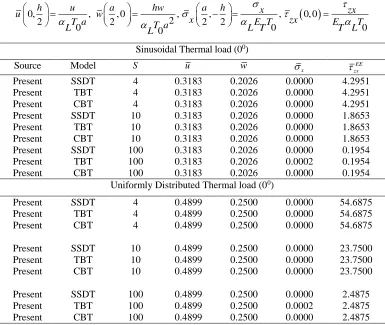
S . The numerical results for single layer orthotropic beam (00) subjected to pure thermal load are presented in following normalized formsfor the purpose of discussion (Table 1).
0, , , 0 , , , 0, 0
2
2 2 2 2
0 0 0 0
h u a hw a h x zx
u w
x zx
T a T a E T E T
L L L T T L
Sinusoidal Thermal load (00)
Source Model S u w x EE
zx Present SSDT 4 0.3183 0.2026 0.0000 4.2951
Present TBT 4 0.3183 0.2026 0.0000 4.2951
Present CBT 4 0.3183 0.2026 0.0000 4.2951
Present SSDT 10 0.3183 0.2026 0.0000 1.8653 Present TBT 10 0.3183 0.2026 0.0000 1.8653 Present CBT 10 0.3183 0.2026 0.0000 1.8653 Present SSDT 100 0.3183 0.2026 0.0000 0.1954 Present TBT 100 0.3183 0.2026 0.0002 0.1954 Present CBT 100 0.3183 0.2026 0.0000 0.1954
Uniformly Distributed Thermal load (00)
Present SSDT 4 0.4899 0.2500 0.0000 54.6875 Present TBT 4 0.4899 0.2500 0.0000 54.6875 Present CBT 4 0.4899 0.2500 0.0000 54.6875 Present SSDT 10 0.4899 0.2500 0.0000 23.7500 Present TBT 10 0.4899 0.2500 0.0000 23.7500 Present CBT 10 0.4899 0.2500 0.0000 23.7500 Present SSDT 100 0.4899 0.2500 0.0000 2.4875 Present TBT 100 0.4899 0.2500 0.0002 2.4875 Present CBT 100 0.4899 0.2500 0.0000 2.4875 Table 1. Normalized displacements and stresses in single layer orthotropic beam (00) subjected
The numerical results for two-layer antisymmetric laminated beam (00/900) subjected to pure
thermal load are presented in following normalized forms for the purpose of comparison and discussion (Table 2).
0, , , 0 , , , 0, 0
2
2 2 2 2
0 0 0 0
h u a hw a h x zx
u w
x zx
T a T a E T E T
L L L T T L
Sinusoidal Thermal load (0/90)
Source Model S u w
x
EE
zx Present SSDT 4 101.3046 38.1550 2123.2790 134.8439 Present TBT 4 101.4938 41.2759 2188.1140 135.6736 Present CBT 4 101.4844 41.2721 2188.1140 135.6737 Philippe et al.
(2009)
SinRef-7p
4 155.1000 42.6520 2044.1000 - Philippe et al.
(2009)
SinRef-6p
4 156.6000 41.3020 2075.4000 - Philippe et al.
(2009)
SinRef-c 4 153.3900 45.8820 1774.5000 - Philippe et al.
(2009)
exact 4 155.3600 42.8890 1994.7000 -
Present SSDT 10 101.4551 40.7663 2177.5280 54.2153 Present TBT 10 101.4939 41.2759 2188.1160 54.2695 Present CBT 10 101.4845 41.2721 2188.1150 54.2695 Philippe et al.
(2009)
SinRef-7p
10 114.2200 43.2850 2142.4000 - Philippe et al.
(2009)
SinRef-6p
10 114.3500 43.0230 2150.1000 - Philippe et al.
(2009)
SinRef-c 10 111.8800 42.1910 2115.3000 - Philippe et al.
(2009)
exact 10 114.1800 43.2930 2129.0000 -
Present SSDT 100 101.4841 41.2708 2188.0100 5.4269 Present TBT 100 101.4928 41.2754 2188.0830 5.4270 Present CBT 100 101.4845 41.2721 2188.1150 5.4270 (Philippe et al.
2009)
SinRef-7p
100 104.1800 43.1520 2181.1000 - (Philippe et al.
2009)
SinRef-6p
100 104.1800 43.1490 2181.2000 - (Philippe et al.
2009)
SinRef-c 100 101.6000 41.2860 2199.8000 - (Philippe et al.
2009)
exact 100 104.1900 43.1550 2171.7000 - Uniformly Distributed Thermal load (0/90)
Present TBT 10 156.1983 50.9189 2118.6390 690.9801 Present CBT 10 156.1838 50.9142 2118.6370 690.9805 Present SSDT 100 156.1800 50.9140 2119.9720 69.0068 Present TBT 100 156.1968 50.9183 2118.6020 69.0981 Present CBT 100 156.1838 50.9142 2118.6390 69.0981 Table 2. Normalized displacements and stresses in antisymmetric laminated cross ply beam
subjected sinusoidal and uniformly distributed thermal load (Example 2)
The numerical results for three-layer symmetric laminated beam (00/900/00) subjected to pure
thermal load are presented in following normalized forms for the purpose of discussion (Table 3).
0, , , 0 , , , 0,
2
2 2 2 2 6
0 0 0 0
h u a hw a h x h zx
u w
x zx
T a T a E T E T
L L L T T L
Sinusoidal Thermal load (0/90/0)
Source Model S u w
x
EE
zx Present SSDT 4 0.7606 0.1499 34.7579 7.8886 Present TBT 4 0.8679 0.5525 43.1644 7.6074 Present CBT 4 0.8679 0.5525 43.1644 7.6074 (Philippe et al. 2009) SinRef-c 4 0.2608 0.2332 4.46270 - (Philippe et al. 2009) exact 4 7.4696 3.6156 281.110 -
Present SSDT 10 0.8499 0.4850 41.7541 3.0618 Present TBT 10 0.8679 0.5525 43.1644 3.0430 Present CBT 10 0.8679 0.5525 43.1644 3.0430 (Philippe et al. 2009) SinRef-c 10 0.7346 0.3762 32.9600 - (Philippe et al. 2009) exact 10 5.0095 1.8934 87.4100 -
Present SSDT 100 0.8677 0.5518 43.1501 0.3043 Present TBT 100 0.8679 0.5525 43.1640 0.3043 Present CBT 100 0.8679 0.5525 43.1644 0.3043 (Philippe et al. 2009) SinRef-c 100 0.8665 0.5506 43.3780 - (Philippe et al. 2009) exact 100 4.4494 2.8197 43.3100 -
Uniformly Distributed Thermal load (0/90/0)
Present SSDT 4 0.9268 0.2572 45.9882 143.4607 Present TBT 4 1.3357 0.6816 41.7938 96.8608 Present CBT 4 1.3357 0.6816 41.7938 96.8608 Present SSDT 10 1.2048 0.6139 45.6244 50.0257 Present TBT 10 1.3357 0.6816 41.7938 38.7443 Present CBT 10 1.3357 0.6816 41.7938 38.7443 Present SSDT 100 1.3334 0.6809 41.9686 3.9060 Present TBT 100 1.3357 0.6816 41.7933 3.8744 Present CBT 100 1.3357 0.6816 41.7938 3.8744 Table 3. Normalized displacements and stresses in symmetric laminated cross ply beam
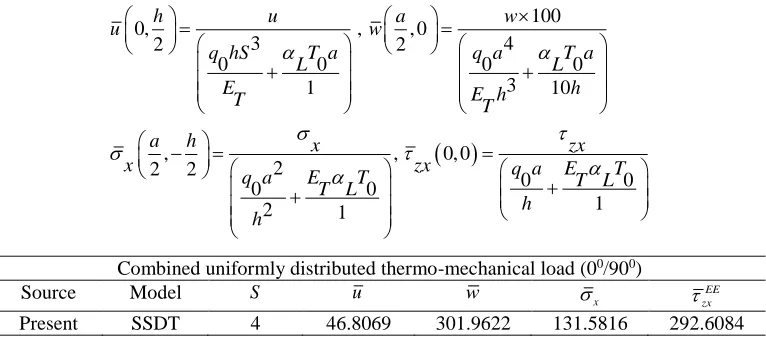
The numerical results for single layer orthotropic beam (00) subjected to uniformly distributed
combined thermo-mechanical load are presented in following normalized form for the purpose of discussion (Table 4).
100
0, , , 0
3 4
2 2
0 0 0 0
3
1 10
, , 0, 0
2 2 2 0 0 0 0 1 2 1
h u a w
u w
q hS T a q a T a
L L
E E h h
T T
a h x zx
x q a E T zx q a E T
T L T L h h
Combined uniformly distributed thermo-mechanical load (00)
Source Model S u w
x
EE
zx Present SSDT 4 0.0382 2.1801 0.7071 11.5881 Present TBT 4 0.0382 4.0378 0.7058 11.5884 Present CBT 4 0.0382 2.1738 0.7058 11.5884 Present SSDT 10 0.0148 0.8804 0.7438 2.8984 Present TBT 10 0.0148 1.1739 0.7425 2.8988 Present CBT 10 0.0148 0.8741 0.7425 2.8988 Present SSDT 100 0.0101 0.6296 0.7503 0.8301 Present TBT 100 0.0100 0.6305 0.7499 0.8302 Present CBT 100 0.0100 0.6275 0.7499 0.8302 Table 4. Normalized displacements and stresses in orthotropic beam (00) subjected to uniformly
distributed thermal load in combination with uniformly distributed transverse mechanical load (Example 4)
The numerical results for two-layer antisymmetric laminated beam (00/900) subjected to
uniformly distributed combined thermo-mechanical load are presented in following normalized form for the purpose of discussion (Table 5).
100
0, , , 0
3 4
2 2
0 0 0 0
3
1 10
, , 0, 0
2 2 2 0 0 0 0 1 2 1
h u a w
u w
q hS T a q a T a
L L
E E h h
T T
a h x zx
x q a E T zx q a E T
T L T L h h
Combined uniformly distributed thermo-mechanical load (00/900)
Source Model S u w
x
EE
Present TBT 4 47.0903 322.2385 126.6506 345.2234 Present CBT 4 47.0903 319.5756 126.6507 345.2236 Present SSDT 10 10.1300 54.0477 23.6874 57.9713 Present TBT 10 10.1471 54.6229 23.1068 62.5132 Present CBT 10 10.1471 54.1946 23.1068 62.5133 Present SSDT 100 0.1854 3.8426 2.3639 0.3532 Present TBT 100 0.1854 3.8433 2.3631 0.3540 Present CBT 100 0.1854 3.8391 2.3631 0.3540 Table 5. Normalized displacements and stresses in antisymmetric laminated beam (00/900)
subjected to uniformly distributed thermal load in combination with uniformly distributed transverse mechanical load (Example 5)
The numerical results for three-layer symmetric laminated beam (00/900/00) subjected to
uniformly distributed combined thermo-mechanical load are presented in following normalized form for the purpose of discussion (Table 6).
100
0, , , 0
3 4
2 2
0 0 0 0
3
1 10
, , 0,
2
2 2 6
0 0
0 0
1
2 1
h u a w
u w
q hS T a q a T a
L L
E E h h
T T
a h x h zx
x zx q a E T
q a ET LT T L
h h
Combined uniformly distributed thermo-mechanical load (00/900/00)
Source Model S u w x EE
zx Present SSDT 4 0.0721 4.9820 3.8974 29.1846 Present TBT 4 0.0883 7.2160 3.1903 19.9780 Present CBT 4 0.0883 4.8776 3.1903 19.9780 Present SSDT 10 0.0236 1.7184 1.2989 5.2092 Present TBT 10 0.0235 1.7044 1.1837 4.2106 Present CBT 10 0.0235 1.3283 1.1837 4.2106 Present SSDT 100 0.0105 0.6579 0.7825 0.7881 Present TBT 100 0.0105 0.6586 0.7817 0.7881 Present CBT 100 0.0105 0.6549 0.7817 0.7881 Table 6. Normalized displacements and stresses in symmetric laminated beam (00/900/00)
Fig. 3. Normalized axial displacement
u through the thickness of orthotropic beam (00)subjected to uniformly distributed thermal load aspect ratio 4
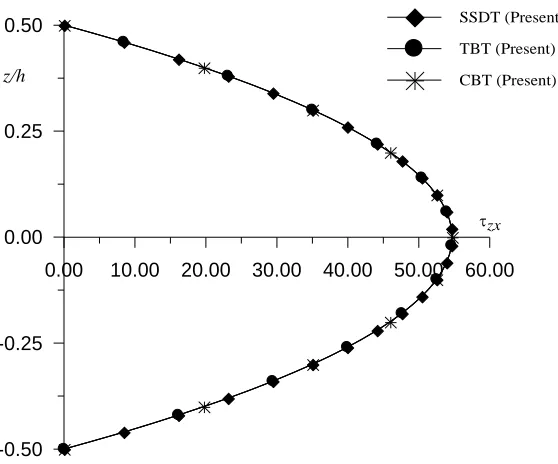
Fig. 4. Normalized transverse shear stress
zx through the thickness of orthotropic beam (00)subjected to uniformly distributed thermal load and obtained by equilibrium equation for aspect ratio 4
-0.50 -0.25 0.00 0.25 0.50
-0.50 -0.25 0.00 0.25 0.50
z/h
u
SSDT (Present) TBT (Present) CBT (Present)
0.00 10.00 20.00 30.00 40.00 50.00 60.00
-0.50 -0.25 0.00 0.25 0.50
z/h
zx
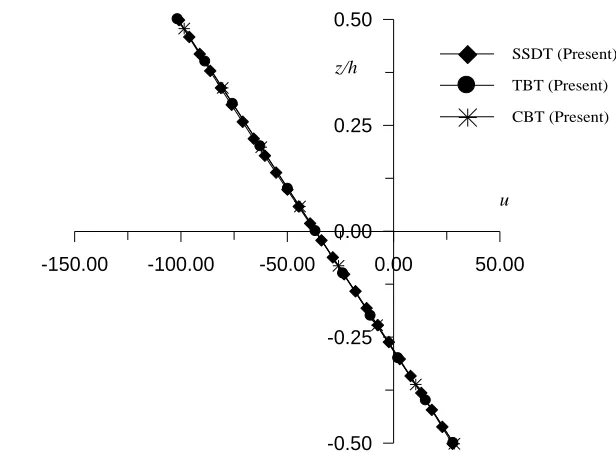
Fig. 5. Normalized axial displacement
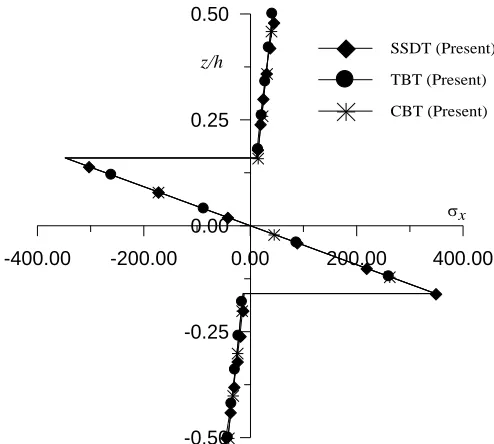
u through the thickness of two layer laminated beam for aspect ratio 4 under sinusoidal thermal load.Fig. 6. Normalized normal stress
x through the thickness of two-layer laminated beam for aspect ratio 4 under sinusoidal thermal load-150.00 -100.00 -50.00 0.00 50.00
-0.50 -0.25 0.00 0.25 0.50
u
z/h SSDT (Present)
TBT (Present) CBT (Present)
-1000.00 0.00 1000.00 2000.00 3000.00
-0.50 -0.25 0.00 0.25 0.50
SSDT (Present) TBT (Present) CPT (Present)
z/h
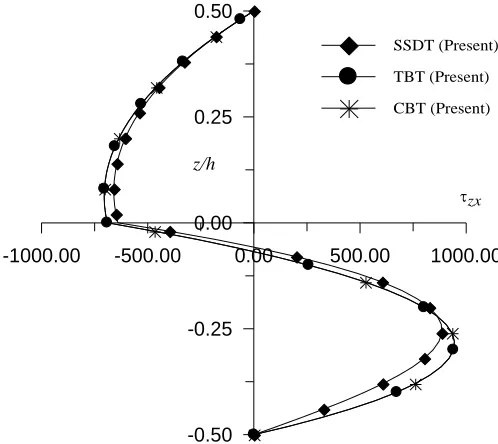
Fig. 7. Normalized transverse shear stress
zx through the thickness of two-layer laminated beam subjected to sinusoidal thermal load and obtained by equilibrium equation for aspect ratio4 under sinusoidal thermal load.
Fig. 8. Normalized transverse shear stress
zx through the thickness of two-layer laminated beam subjected to uniformly distributed thermal load and obtained by equilibrium equation foraspect ratio 10
-200.00 -100.00 0.00 100.00 200.00
-0.50 -0.25 0.00 0.25 0.50
SSDT (Present) TBT (Present) CBT (Present)
zx z/h
-1000.00 -500.00 0.00 500.00 1000.00
-0.50 -0.25 0.00 0.25 0.50
z/h
SSDT (Present) TBT (Present) CBT (Present)
Fig. 9. Normalized axial displacement
u through the thickness of three-layer laminated beam (0/90/0) subjected to uniformly distributed thermal load for aspect ratio 4Fig. 10. Normalized normal stress
x through the thickness of three-layer laminated beam (0/90/0) subjected to uniformly distributed thermal load aspect ratio 4-2.00 -1.00 0.00 1.00 2.00
-0.50 -0.25 0.00 0.25 0.50
z/h
u
SSDT (Present) TBT (Present) CBT (Present)
-400.00 -200.00 0.00 200.00 400.00
-0.50 -0.25 0.00 0.25 0.50
z/h
x
Fig. 11. Normalized transverse shear stress
zx through the thickness of three-layer laminated beam (0/90/0) subjected to uniformly distributed thermal load and obtained by equilibriumequation for aspect ratio 10
Fig. 12. Normalized axial displacement
u through the thickness of orthotropic beam (00)subjected to combined uniformly distributed thermo-mechanical load for aspect ratio 4
-20.00 0.00 20.00 40.00 60.00
-0.50 -0.25 0.00 0.25 0.50
z/h
zx
SSDT (Present) TBT (Present) CBT (Present)
-0.04 -0.02 0.00 0.02 0.04
-0.50 -0.25 0.00 0.25 0.50
z/h
u
Fig. 13. Normalized normal stress
x through the thickness of orthotropic beam (00)subjected to combined uniformly distributed thermo-mechanical load for aspect ratio 4
Fig. 14. Normalized transverse shear stress
zx through the thickness of orthotropic beam (00)subjected to combined uniformly distributed thermo-mechanical load for aspect ratio 4
-1.00 -0.50 0.00 0.50 1.00
-0.50 -0.25 0.00 0.25 0.50
z/h
x
SSDT (Present) TBT (Present) CBT (Present)
0.00 2.00 4.00 6.00 8.00 10.00 12.00
-0.50 -0.25 0.00 0.25 0.50
z/h
Fig. 15. Normalized axial displacement
u through the thickness of two-layer laminated beam (0/90) subjected to combined uniformly distributed thermo-mechanical load for aspect ratio 4Fig. 16. Normalized axial stress
x through the thickness of two-layer laminated beam (0/90) subjected to combined uniformly distributed thermo-mechanical load for aspect ratio 4-60.00 -40.00 -20.00 0.00 20.00
-0.50 -0.25 0.00 0.25 0.50
z/h
u
SSDT (Present) TBT (Present) CBT (Present)
-200.00 -100.00 0.00 100.00 200.00
-0.50 -0.25 0.00 0.25 0.50
z/h
x
Fig. 17. Normalized transverse shear stress
zx through the thickness of two-layer laminated beam (0/90) subjected to uniformly distributed thermal load in combination with uniformlydistributed transverse mechanical load for aspect ratio 4
Fig. 18. Dimensionless axial displacement
u through the thickness of three-layer laminated beam (0/90/0) subjected to uniformly distributed thermal load in combination with uniformlydistributed transverse mechanical load for aspect ratio 4.
-400.00 -200.00 0.00 200.00 400.00 600.00
-0.50 -0.25 0.00 0.25 0.50
z/h
zx
SSDT (Present) TBT (Present) CBT (Present)
-0.10 -0.05 0.00 0.05 0.10
-0.50 -0.25 0.00 0.25 0.50
z/h
u
Fig. 19. Normalized normal stress
x through the thickness of three-layer laminated beam (0/90/0) subjected to uniformly distributed thermal load in combination with uniformlydistributed transverse mechanical load for aspect ratio 10
Fig. 20. Normalized transverse shear stress
zx through the thickness of three-layer laminated beam (0/90/0) subjected to uniformly distributed thermal load in combination with uniformly distributed transverse mechanical load and obtained by equilibrium equation for aspect ratio 10-4.00 -2.00 0.00 2.00 4.00
-0.50 -0.25 0.00 0.25 0.50
z/h
x
SSDT (Present) TBT (Present) CBT (Present)
-10.00 -5.00 0.00 5.00 10.00
-0.50 -0.25 0.00 0.25 0.50
z/h
zx
7. Discussion of results
Axial displacement
u :Single layer orthotropic beam, 00:
It has been observed that, the axial displacements obtained by sinusoidal shear deformation theory, Timoshenko beam theory and classical beam theory are identical irrespective of the aspect ratios in case of pure thermal load. The through thickness variation of axial displacement for single layer orthotropic beam under pure thermal load is shown in Fig. 3 for aspect ratio 4. The combined thermo-mechanical loads found to yield different values of this displacement with different aspect ratios as shown in Table 4. The through thickness variation of axial displacements under combined thermo-mechanical loads is shown in Fig. 12 for aspect ratio 4.
Two-layer 00/900 beam:
The results of axial displacement along x axis obtained by sinusoidal shear deformation theory (SSDT) are in good agreement with the results obtained by Timoshenko beam theory (TBT) and classical beam theory (CBT) for aspect ratios 4, 10 and 100 (Table 2). The percentage error when compared with exact elasticity solution reduces as aspect ratio changes from 4 to 10 and found to be 11.14 % for aspect ratio 10. Further, this percentage error reduces to 2.59 % for aspect ratio 100. The through thickness variation of axial displacement under sinusoidal thermal load is as shown in Fig. 5 for aspect ratio 4. The results of axial displacement obtained by sinusoidal shear deformation theory (SSDT) for aspect ratio 4 under uniformly distributed thermal load increases slightly when aspect ratio changes from 4 to 10, whereas the results obtained by TBT and CBT are independent of aspect ratio. The shear deformation effect has been observed in the result shown by SSDT. The results of axial displacement obtained by SSDT, TBT and CBT for aspect ratio 100 are in good agreement with each other. The effect of shear deformation has been observed when acted upon by combined thermo-mechanical loads as shown in Table 5. The through thickness variation of axial displacement under combined thermo-mechanical loads is shown in Fig. 15 for aspect ratio 4 which shows slight deviation of SSDT as compared to TBT and CBT.
Three-layer 00/900/00 beam:
The results of axial displacement in three-layer laminated beam subjected to sinusoidal, uniformly distributed pure thermal load and combined thermo-mechanical loads are shown in Table 3 and Table 6, respectively. It has been observed that axial displacements obtained by Timoshenko beam theory and classical beam theory have identical values and are independent of aspect ratios, whereas the results of axial displacements obtained by sinusoidal shear deformation theory (SSDT) changes as aspect ratio changes from 4 to 100. The through thickness variation of axial displacements under pure thermal load and combined thermo-mechanical load is shown Figs. 9 and 18 respectively. These figures show the realistic variation obtained by sinusoidal shear deformation theory (SSDT) indicating the shear deformation effect under pure thermal load and combined thermo-mechanical loads.
Transverse displacement
w : Single layer orthotropic beam, 00:load, the considerable difference has been observed in the results obtained by sinusoidal shear deformation theory and Timoshenko beam theory for aspect ratio 4 and 10.
Two-layer 0/90 beam:
The results of transverse displacement for two-layer antisymmetric laminated beam under pure thermal load are shown in Table 2. Transverse displacement along
z
direction obtained by sinusoidal shear deformation theory (SSDT) for aspect ratio 4 shows the effect of shear deformation, whereas the results of transverse displacement obtained by Timoshenko beam theory (TBT) and classical beam theory (CBT) do not show any change in the result even though aspect ratio changes from 4 to 10. The results of transverse displacement obtained by sinusoidal shear deformation theory (SSDT) are found to increase with increase in aspect ratio from 4 to 10 and 10 to 100. The percentage error when the results obtained by SSDT are compared with exact solution of elasticity reduces from 11.03 % to 5.8 % when aspect ratio changes from 4 to 10. Further, for aspect ratio 100, transverse displacement obtained by SSDT, TBT and CBT are in good agreement with each other and percentage error reduces to 4.3 % when results obtained by SSDT are compared with exact solution of elasticity. The results of transverse displacement under combined thermo-mechanical loads are presented in the Table 5. The effect of transverse mechanical load on this displacement has been observed for aspect ratio 4 when obtained by sinusoidal shear deformation theory.Three-layer symmetric laminated beam 0/90/0:
The results of transverse displacements for three-layer symmetric laminated beam under pure thermal load are shown in Table 3. It is observed that the results obtained by Timoshenko beam theory (TBT) and classical beam theory (CBT) have identical values for all aspect ratios whereas the transverse displacement obtained by present theory increases as aspect ratio increases from 4 to 100, this shows the effect of shear deformation. The results of transverse displacement under combined thermo-mechanical loads are presented in Table 6. A considerable difference has been observed in the results of SSDT and TBT for aspect ratio 4 under combined thermo-mechanical load. This effect is due to additional mechanical load.
Axial normal stress
x :Single layer orthotropic beam, 00:
The results of axial normal stress for orthotropic beam when subjected to pure thermal load are presented in Table 1. It has been noted that the results obtained by present theory, Timoshenko beam theory and classical beam theory under pure thermal load are zero. That is no bending stresses are developed due to pure thermal load. It means the effect of pure thermal load on bending of orthotropic beam is negligible. The effect of mechanical load has been observed when an orthotropic beam is acted upon by combined thermo-mechanical load as shown in Table 4. The through thickness variation of these stresses under combined thermo-mechanical load is shown in Fig. 13 for aspect ratio 4 indicating the effect of mechanical load alone.
Two-layer 0/90 beam:
thermal load and decrease in this stress is observed in case of uniformly distributed thermal load with increase in aspect ratio from 4 to 100. The percentage error between sinusoidal shear deformation theory (SSDT) and exact elasticity solution for aspect ratio 10 is found to be 2.2 % which further decreases to 0.75 % for aspect ratio 100. The through thickness variation of normal stress across the thickness of laminated beam is as shown in Fig. 6 for aspect ratio 4 under sinusoidal thermal load with change in direction. These stresses under combined thermo-mechanical load are presented in Table 5. The results of axial normal stress obtained by present theory show considerable difference when compared with the results of Timoshenko beam theory and classical beam theory for aspect ratio 4 under uniformly distributed combined mechanical load. The through thickness variation of these stresses under combined thermo-mechanical load is shown in Fig. 16 for aspect ratio 4. The variation of this stress shows the notable deviation from classical beam theory.
Three-layer symmetric laminated 0/90/0 beam:
The results of axial normal stress for three-layer symmetric laminated beams subjected to pure thermal load and combined thermo-mechanical load are presented in Tables 3 and 6 respectively. It is noted that the results obtained by Timoshenko beam theory and classical beam theory have identical values for all aspect ratios whereas axial normal stress obtained by sinusoidal shear deformation theory (SSDT) decreases as aspect ratio increases. The through thickness variation of theses stresses under pure thermal load and combined thermo-mechanical load are shown in Figs. 10 and 19 respectively. The effect of additional mechanical load has been observed in figure 19.
Transverse shear stress
zxEE : Single layer orthotropic beam, 00:The results of transverse shear stress for orthotropic beam subjected to pure thermal load and combined thermo-mechanical loads are shown in Tables 1 and 4 respectively. Transverse shear stresses obtained by sinusoidal shear deformation theory, Timoshenko beam theory and classical beam theory have identical values for aspect ratios 4, 10 and 100. Through thickness variations of these stresses under pure thermal load and combined thermo-mechanical load are shown in Figs. 4 and 14, respectively.
Two-layer 0/90 beam:
Three-layer symmetric laminated 0/90/0 beam:
The results of transverse shear stress for three-layer symmetric laminated beam subjected to pure thermal load are shown in Table 3. A considerable difference has been noted in the results obtained by SSDT, TBT and CBT for aspect ratios 4 and 10. The effect of shear deformation has been observed in the result obtained by SSDT for thick beam under pure thermal load. The shear stress free boundary conditions are observed. In case of combined thermo-mechanical loads, the effect of additional mechanical load has been observed and shown in Table 6 for various aspect ratios. The through thickness variation of theses stresses under pure thermal load and combined mechanical loads are shown in Figs. 11 and 20, respectively. In case of thermo-mechanical load shear stress distribution deviates considerably with change in sign as compared to the distribution in case of pure thermal load.
8. Conclusions
In this article, a numerical model of sinusoidal shear deformation theory has been presented to investigate the thermal and thermo-mechanical response of single layer orthotropic, two-layer antisymmetric and three-layer symmetric cross ply laminated beams subjected to pure thermal load and combined thermo-mechanical loads for different aspect ratios. Special attention is pointed towards the transverse shear stresses, which plays an important role in thick beams. This study shows the necessity of taking in to account the transverse shear effect which cannot be neglected, particularly in thermal problems of laminated beams. It has been observed that the Timoshenko beam theory and classical beam theory underpredicts the transverse shear stress and overpredicts the transverse displacement for thick beam. The effect of shear deformation has been observed in the results of axial stress obtained by sinusoidal shear deformation theory for thick beam. Timoshenko beam theory and classical beam theory are observed to be suitable for thin laminated beams whereas sinusoidal shear deformation theory is suitable for thin as well as moderately thick laminated beam under pure thermal load and combined thermo-mechanical loads. Further, sinusoidal shear deformation theory obviates the need of shear correction factor and yields realistic displacements and stresses. Hence, the equivalent single layer sinusoidal shear deformation theory is strongly suitable for thick laminated beams under thermal environment.
References
Ali JSM, Bhaskar K, Vardan TK (1999). A new theory for accurate thermal/mechanical flexural analysis of symmetric laminated plates, Composite Structures, 45, 227-232.
Bhaskar K, Vardan TK, Ali JSM (1996). Thermoelastic solutions for orthotropic and anisotropic composite laminate, Composites: Part B, 27B, 415-420.
Carrera E (2000a). An assessment of mixed and classical theories for the thermal stress analysis of orthotropic multilayered plates, Journal of Thermal Stresses, 23, 797-831.
Carrera E (2000b). A priori vs. a posteriori evaluation of transverse stresses in multilayered orthotropic plates, Composite Structures, 48, 245-260.
Carrera E, Ciuffreda A (2004). Closed form solutions to assess multilayered plate theories for various thermal for various thermal stress problems, Journal of Thermal Stresses, 27, 1001-1031.
Ghugal YM, Kulkarni SK (2013). Thermal flexural analysis of cross ply laminated plates using trigonometric shear deformation theory, Latin American Journal of Solids and Structures, 10, 1001-1023.
Ghugal YM, Shimpi RP (2002). A review of refined shear deformation theories of isotropic and anisotropic laminated plates, Journal of Reinforced Plastics and Composites, 21, 775-813. Kant T, Gupta A (1988). A finite element model for a higher order shear-deformable beam theory,
Journal of Sound and Vibration, 125, 193-202.
Kant T, Marur S, Rao G (1997). Analytical solution to the dynamic analysis of laminated beams using higher order refined theory, Composite Structures, 40, 1-9.
Mindlin R (1951). Influence of rotatory inertia and shear on flexural motions of isotropic, elastic plates, Journal of Applied Mechanics, 18, 31-38.
Philippe V, Olivier P, (2009). A refined sine-based finite element with transverse normal deformation for the analysis of laminated beams under thermo-mechanical loads, Journal of Mechanics of Materials and Structures, 4, 1127-1155.
Soldatos KP, Watson (1997) A general theory for the accurate stress analysis of homogeneous and laminated composite beams, International journal of solids and structures, 34, 2857-2885. Tanigawa Y, Murakami H, Ootao Y (1989). Transient thermal stress analysis of a laminated
composite beam, Journal of Thermal Stresses, 12, 25-39.
Tessler A, Annett M, Gendron G (2001). A {1,2}-order plate theory accounting for three-dimensional thermoelastic deformations in thick composite and sandwich laminates, Composite Structures, 52, 67-84.