ORIGINAL ARTICLE
IJPHY
ABSTRACT
Background: Dynamic balance is an ability to move two or more body parts under control. The split and squat jump ex-ercise primarily strengthen gluteus, hamstring muscles, quadriceps, and calves muscles, as well as provide cardiovascu-lar benefits. The objectives of the study were to find the effect of split jump and squat jump exercise on dynamic balance and to compare the effect of exercise on the dynamic balance among female netball players in KPJ University College.
Methods: An experimental design with total 80 female subjects were selected and divided equally to 40 subjects in each group. The Star Excursion Balance Test was used to measure the outcome of dynamic balance before and after the in-tervention. Group A received split jump exercise whereas Group B received squat jump exercise. The intervention was given for six weeks with three sessions for each week. After six weeks of intervention, the researcher checked dynamic balance for both groups.
Results: The result showed that there is a significant difference between the groups with P-values 0.0043, 0.0001, 0.0471, 0.0001 for anterior, lateral, posterior and medial respectively.
Conclusion: The study concluded that both exercises could improve dynamic balance. However, the squat jump exer-cise is more effective to improve dynamic balance among netball players.
Keywords: dynamic balance, star excursion balance test, split jump, squat jump.
Received 18th August 2017, revised23rd Januray 2018, accepted 12th February 2018
www.ijphy.org
10.15621/ijphy/2018/v5i2/170742
CORRESPONDING AUTHOR
Int J Physiother. Vol 5(2), 57-62, April (2018) ISSN: 2348 - 8336
COMPARATIVE EFFECT OF SQUAT JUMP AND SPLIT JUMP
EXERCISE ON DYNAMIC BALANCE AMONG FEMALE NETBALL
PLAYERS
*1Jibi Paul
²Sharmilaa Kumar
*1Dr. Jibi Paul, MPT, Ph.D.
Professor in Faculty of Physiotherapy,
Dr. M.G.R. Educational and Research Institute, Chennai, India.
Mail Id: [email protected] ²BPT Graduate, Department of Physiotherapy,
School of Health Sciences, KPJ Healthcare University College, Nilai, Malaysia.
INTRODUCTION
Netball is a sport enjoyed by a large number of participants. To achieve a successful netball shot, there are few move-ments which should be performed correctly for the best outcome. The squat jump is a type of plyometric exercise essential for leg strength improvement. It helps in work-ing on the core muscles and in muscle stabilization which brings better balance and greater stability. The split jump is a plyometric type of exercise which effective on muscle lengthening and shortening quickly with rapid force [1-3].
Dynamic balance is more challenging than static balance as it required more muscle energy to maintain equilibrium in positional change. Sensory feedback includes proprio-ception, vision and vestibular are important to maintain static and dynamic balance. Many studies reported that proprioception and visual feedback have a great role to maintain good balance ability among players [4-8].
The SEBT (Star Excursion Balance Test) is a tool used to as-sess dynamic balance. This test should be performed with the participants standing on one limb at the center point of a grid marked on the floor, with 8 or 4 lines (120cm) ex-tending at 45° increments from the center point of the grid and the distance they reached will be recorded in centime-ter. SEBT tool on 4 directions are [Anterior (A), Medial (M), Posterior (P), Lateral (L)]. The benefit of these four lines is it takes less time to complete the task [9].
The objective of the study was to find out the comparative effect of squat jump and split jump exercise on the dynamic balance among female netball players in KPJUC. Specific objectives of the study were to evaluate the effects of squat jump and split jump exercises on the dynamic balance among female netball players in KPJUC and also to investi-gate the difference in dynamic balance between squat jump and split jump exercise group.
METHODOLOGY
Research Design: it’s a Pre and post comparative exper-imental study design. The population selected from KP-JUC students, who were netball players with a minimum of one-year experience. This study has been conducted at KPJUC campus at Kota Seriemas, Nilai. The simple ran-dom sampling method was used to allocate the samples for Group A and Group B, and they were divided equally with 40 female subjects in each group. The randomization method used in this study was Lottery method to select 40 females in each group.
Sample selection criteria: This was to select the subjects who are eligible based on the requirement for this study. The study included female netball players with minimum one year of experience with age group between 18 – 25 years, height ranged between 150cm -170cm and weight ranged between 50kg-70kg. The study excluded subjects with the patellofemoral syndrome, lower limb fracture within one year and chronic ankle instability.
Sample size calculation: Eighty female subjects were select-ed including 10 percent of dropout sample for this study and randomly divided into two groups with forty subjects
in each group. Sample size calculated by using the standard formula for a comparison of two samples means Panics G. et al. 2008 [28].
Sample allocation: Eighty samples were selected for the study on base of selection criteria and randomly divided into two groups by lottery method. Group A and Group B have been allocated with 40 subjects. Group A was received split jump exercise, and Group B was received squat jump exercise.
Study instruments
Study Materials: A questionnaire with ten questions re-garding the study. The subjects need to tick each of the small boxes according to the question. Evaluation form includes name, age, and programme to be filled up by the subjects. The intervention (group) has two boxes; this is for the researcher to tick either split jump or squat jump. Consequently, there are two boxes below for the pre-test and post-test. Bottom of the form on the right side, there are three lines for the subject’s signature, name, and date. Apart from that measurement tape are used to measure be-fore pasting the cloth tape on the floor. Marker pen was used to draw the lines for SEBT. Cloth tape is also used to create a proper SEBT line according to the measurements. Measurement tool: The Dynamic balance was measured using Star Excursion Balance Test (SEBT) in 4 directions (anterior, lateral, posterior, medial). There was 90° differ-ence in between each direction and 12cm length for each. Procedures:Informed consent received from each partici-pant before starting the study. It is important that the re-searcher seeks the informed consent of the subjects who participate in this study. This was done in writing. The researcher explained about the exercises and duration of the study to the participants. Subjects were encouraged to ask any questions regarding the exercise program. The re-searcher assured to the subjects that this informed consent would be kept confidentially.
Pre-test evaluation: The test (SEBT) was demonstrated by the researcher to create better understanding to all par-ticipants for accurate evaluation of dynamic balance. The participants were examined for three trials of dynamic bal-ance in anterior, posterior, lateral and medial directions. The participants were instructed to hold their both hand on pelvis till completed three practice trials in each direc-tion with the dominant leg. The participants were asked to reach the non-dominant leg maximum and place the foot on the line or side of the line to measure the distance from the center of the intersection of four lines. After completing the practice trials, researchers proceed to test trial. Each participant was given a 1-minute break between the tests for the dominant leg. The mean value of the three reading was taken and documented.
asked to jump using primarily leg straight up into the air. Group B was given squat jump exercise. The subjects were asked to stand erect with hands clasped behind and feet kept apart to hip width. Before jump up, the subjects re-quired to squat down by keeping the thighs parallel to the ground followed by a jump up maximum and land on both feet by keeping the knee flexed with pushing hip back. The intervention was given for six weeks, three sessions for a week, the intensity and repetitions were included for first three weeks as two sets of an exercise with five repetitions and for the following three weeks one set of exercise with ten repetitions for each group.
Post-test evaluation: After six weeks of intervention, the researcher was assessed the dynamic balance using SEBT tool. Reach distances were measured in centimeter (cm) from the center intersection point of four lines to the point of maximum reach, this was observed and noted by the re-searcher on the evaluation form. Total three reading was noted for each direction (3 times) for the dominant leg. The mean value of the three reading was taken and docu-mented in the evaluation form. Finally, the researcher an-alyzed the effect of split jump and squat jump exercise on the dynamic balance among female netball players. The re-searcher also compared the significant difference in effects on a dynamic balance between the two groups.
Statistical Analysis: The normality test for the data of this study was performed using Kolmogorov-Smirnov test. All set of data were reported normally distributed in Kolm-ogorov-Smirnov test showed non-significant results with p> 0.05. Hence parametric test was used in this study to analyze the data.
Descriptive Data Analysis was used for demographic data of the samples. Dependent t-test used to find the effect of dynamic balance within squat jump and split jump exer-cise group. ANOVA was used to compare the effects of dy-namic balance between squat jump and split jump exercise. The study was considered as significant with P < 0.05.
RESULT
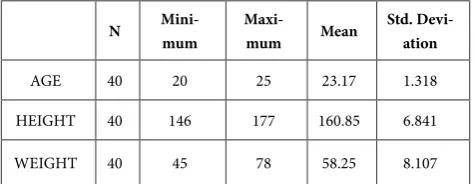
Forty subjects were involved in this Group A. The subjects ranged from 18-25 years of age, with a mean age of (23.17 SD=1.318). Mean height of the subjects were (160.85 SD=6.841) ranged between 150cm-170cm.The mean of the subject’s weight is (58.25 SD=8.107) which ranged between
50kg-70kg (Table 1).
Forty subjects were involved in Group B. The subjects ranged from 18-25 years of age, with a mean age of (23.05 SD=1.395). Mean height of the subjects were (158.95 SD=6.598) ranged between 150cm -170cm.The mean of the subject’s weight is (55.85 SD=5.868) which ranged be-tween 50kg-70kg (Table 2).
Dependant T’ Test of SEBT for Group A
A dependent t-test of group A are presented as mean, standard deviation, standard error mean, 95% Confidence Interval of the difference (upper and lower), t, df and sig-nificance (2 tailed). Pre and post anterior direction (mean -4.000, SD=5.043, p=0.000). Pre and post of lateral
direc-tion (mean -3.025, SD=8.018, p=0.022). Pre and post of posterior direction (mean -4.450, SD=10.273, p=0.009). Pre and post of medial direction (mean -3.425, SD=5.926, p=0.001). All the mean values of pre-post Group B are sig-nificant because of p <0.05 (Table 3).
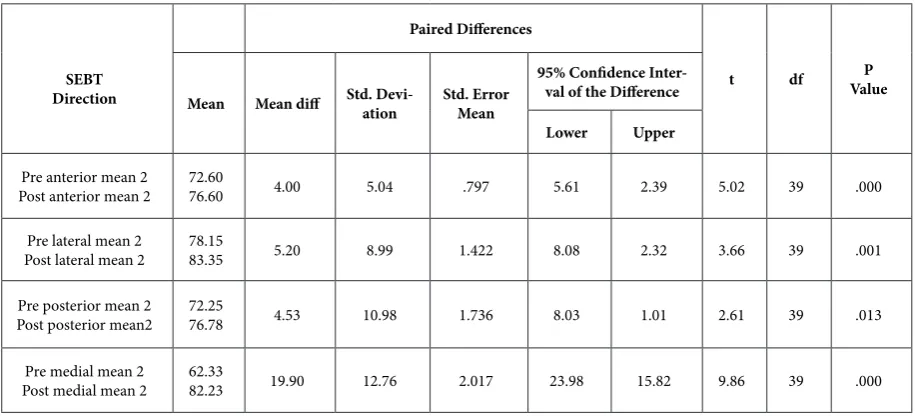
Dependant T-Test of SEBT for Group B
A dependent t-test of group B are presented as mean, stan-dard deviation, stanstan-dard error mean, 95% Confidence Interval of the difference (upper and lower), t, df and sig (2 tailed). Pre and post anterior direction (mean -2.825, SD=4.766, Sig 2 tailed=0.0001). Pre and post of lateral di-rection (mean -5.200, SD=8.993, Sid 2 tailed=0.001). Pre and post of posterior direction (mean -4.525, SD=10.982, Sid 2 tailed=0.013). Pre and post of medial direction (mean -19.90, SD=12.760, Sid 2 tailed=0.000). From this result, all the mean values of pre-post group B can conclude that all are significant p<0.05 shown in Table 4.
Analysis of Variance (ANOVA)
The ANOVA data consist of SEBT direction, groups, the sum of square, mean squares f and significance. The SEBT anterior direction between group A and B (f=4.55, p=0.0043). The SEBT lateral direction between group A and B (f= 9.311, p=0.0001). The SEBT posterior direction between group A and B (f=2.709, p=0.0471).The SEBT me-dial direction between group A and B (f=65.21, p=0.0001). There is a significant difference between two group (A and B). The squat jump group showed improvement because the pre-post mean difference of anterior, lateral, posterior and medial (Mean values 2.83, 5.20, 4.53, 10.90) respec-tively (Table 5).
N Mini-mum Maxi-mum Mean Std. Devi-ation
AGE 40 20 25 23.17 1.318
HEIGHT 40 146 177 160.85 6.841
WEIGHT 40 45 78 58.25 8.107
Table 1: Demographic Data of Group A
N Mini-mum Maxi-mum Mean Std. Devia-tion
AGE_2 40 20 25 23.05 1.395
HEIGHT_2 40 150 170 158.95 6.598
WEIGHT_2 40 43 70 55.85 5.868
Direction of SEBT
Paired Differences
t df ValueP Mean Mean diff SD Std. Error Mean
95% Confidence Interval of the Difference
Lower Upper
Pre anterior mean
Post anterior mean 75.4078.23 2.83 4.77 .75 4.35 1.30 3.75 39 .001
Pre lateral mean
Post lateral mean 73.6576.67 3.03 8.02 1.27 5.59 .46 2.39 39 .002
Pre posterior mean Post posterior mean
72.30
76.75 4.45 10.27 1.62 7.74 1.17 2.74 39 .009
Pre medial mean
Post medial mean 59.0562.48 3.43 5.93 .94 5.32 1.53 3.66 39 .001
Table 3: Star Excursion Balance Test for Pre - Post data of Group A
SEBT Direction
Paired Differences
t df ValueP Mean Mean diff Std. Devi-ation Std. Error Mean
95% Confidence Inter-val of the Difference
Lower Upper
Pre anterior mean 2
Post anterior mean 2 72.6076.60 4.00 5.04 .797 5.61 2.39 5.02 39 .000
Pre lateral mean 2
Post lateral mean 2 78.1583.35 5.20 8.99 1.422 8.08 2.32 3.66 39 .001
Pre posterior mean 2
Post posterior mean2 72.2576.78 4.53 10.98 1.736 8.03 1.01 2.61 39 .013
Pre medial mean 2
Post medial mean 2 62.3382.23 19.90 12.76 2.017 23.98 15.82 9.86 39 .000
Table 4: Star Excursion Balance Test for Pre - Post data of Group B
SEBT Direction Group A & B Sum of Squares df Mean Square F P value
Anterior Between groups 675.4 3 225.1 4.557 0.0043
Lateral Between groups 1973 3 657.5 9.311 0.0001
Posterior Between groups 805.6 3 268.5 2.709 0.0471
Medial Between groups 13456 3 4485 65.21 0.0001
Statistical test ANOVA, significant P - value <0.05
DISCUSSION
Mc Guine T A et al., 2000, has reported proprioceptive and balance exercises are effective on dynamic postural control and prevent sports injuries among athletes [10-14]. Tsai, Y.H. 2009, has reported the effect of jumping exercise on children who suffer from blurred vision have improved their balance. Furthermore, the impact of jumping exer-cise on children reported a significant improvement in their balance. The results have proven that jumping is not only fun but also reduces the risk of obesity, diabetes, and depression and improves balance [15-16].
Plyometric training is effective on improvement of athlete’s coordination and landing technique; it has influenced on the reduction of certain sports injuries among athletes [17-20]. Postural sway and functional balance have compared to balance trained, and untrained control participants found more effective on trained participants. Plyometric or strength training include Jumping performance can im-prove agility; strength and neuromuscular control were re-ported in sprint performance of athletes [21-23].
Duthie GM, 2002, reported the effect of jumping exer-cise for six weeks’ balance training among hockey players found improved their balance immediately after the train-ing sessions [24]. Myer, G. D., et al. 2006, balance ability for college students with balance training found more effective on outcome compared with a control group [25]. Soccer players have analyzed for postural control and dynamic stabilization after neuromuscular training found signifi-cant improvement in outcome.
Granacher U, Gollhofer A, et al. 2010, studied the effect of jumping exercise on postural sway in a four-week train-ing program among adolescents with twenty high school students; the study reported significant improvement in postural control [26]. Kent et al., 1992, conducted a study to compare the effectiveness of squat, plyometric and squat-plyometric with the control group on vertical jump among forty subjects. The study concluded that squat-plyo-metric training was more effective in improving the height of vertical jump with p < 0.0001 [27].
The current research study was undertaken to determine if jumping exercise programme would lead to a significant improvement (p<0.05) in dynamic postural control in two group of netball players with two different type of jumping exercise in each group. Eighty female KPJ university net-ball players selected to participate in this study. A paired t-test showed that there is a significant difference within the group A and B. The outcome on ANOVA showed that dynamic postural control measured with SEBT demon-strated a statistically significant difference in improvement (p<0.05) across four directions (anterior, lateral, posteri-or and medial) between the two group of netball players. Mean difference in improvement on dynamic balance found more on group A (squat jump) compared to group B (split jump). The study proposes that squat jumping exer-cise could be more beneficial for improving dynamic pos-tural control in netball players.
Limitation of the study: Intervention of the participants was not fully supervised. The samples of this study were selected only from KPJUC students. The participants se-lected for this study were only female students. Also, the researcher was not able to observe activities of the partic-ipants other than specified exercise program during the study period.
Recommendation: The results of present study suggest the use of jumping exercise in a rehabilitation programme for netball players with poor dynamic postural control. This study support to implement the program for athletes to im-prove their dynamic balance and postural control.
Conflict of interest: This study has no conflict of interest on its outcome, and it was not influenced by any of its ben-efits.
Ethical Clearance: This study was conducted with eth-ical approval, reference number: KPJUC/SOHS (PHY)/ ECR/07/37, dated 28/03/2016 from Research and Develop-ment Committee, School of Health Sciences, KPJ Health-care University College, Nilai, Malaysia.
CONCLUSION
The study concluded that there is a significant effect on dy-namic balance with split jump and squat jump exercises in anterior, lateral, posterior and medial directions respec-tively. The comparative study showed that there is a sig-nificant difference between split jump and squat jump on dynamic balance. Squat jump exercise showed more pre-post-test mean difference when compared with split jump exercise in improving dynamic balance. This might be due to the effect of squat Jump exercise on leg muscle strength and core muscle stabilization, which brings better balance and greater stability.
Acknowledgment
The investigators are grateful to the management, research, and development committee, School of Health Sciences, KPJ Healthcare University College, for all the facilities and support extended to them during this study. The research-ers are thankful to all the participants for their cooperation to complete this study successfully.
REFERENCES
[1] Alptekin, A., Kilic, O., & Mavis, M. The effect of an 8-week plyometric training program on sprint and jumping performance. Serbian Journal of Sports Sci-ences.2013; 7(2): 45-50.
[2] Mulcahy, R.L., & Crowther, R.G. The effects of an 8 week supplemented plyometric exercise training pro-gram on leg power, agility and speed in adolescent net-ball players. Journal of Australian Strength and Condi-tioning. 2013; 21(3): 31-6.
[3] Alam, S., Pahlavani, H. A., & Mehdipou, A. The effect of plyometric circuit exercises on the physical prepa-ration indices of elite handball player. Facta universi-tatis-series. Physical Education and Sport. 2012;10(2): 89-98.
balance training on dynamic stability. PhysTher Sport. 2007; 8(4):177–184.
[5] Schubert M, Beck S, et al. Balance training and bal-listic strength training are associated with task-spe-cific corticospinal adaptations. Eur J Neurosci. 2008; 27(8):2007–2018.
[6] Gioftsidou, A., et al. The effects of soccer training and timing of balance training on balance ability. European Journal of Applied Physiology. 2006; 96: 659-664.
[7] Sannicandro, I. et al. Balance training exercises de-crease lower-limb strength asymmetry in young tennis players. Journal of Sports Science and Medicine. 2014; 13(2):397-402.
[8] Holm, I., Fosdahl, M. A., et al. Effect of neuromuscular training on proprioception, balance, muscle strength, and lower limb function in female team handball play-ers. Clinical Journal of Sports Medicine. 2004; 14(2): 88-94.
[9] Olmsted, L. C., et al. Efficacy of the star excursion bal-ance tests in detecting reach deficits in subjects with chronic ankle instability. Journal of Athletic Training, 2002, 37, 501-506.
[10] McGuine TA, et al. Balance as a predictor of ankle
in-juries in high school basketball players. Clin J Sport Med. 2000; 10(4):239–244.
[11] McGuine, T. A., & Keene, J. S. The effect of balance
training program on the risk of ankle sprains in high school athletes. American Journal of Sports Medicine. 2006; 34(7): 1103-1111.
[12] Hrysomallis, C. Relationship between balance ability,
training and sports injury risk. Sports Medicine. 2007; 37(6): 547-556.
[13] Hrysomallis, C., McLaughlin, P., & Goodman, C.
Bal-ance and injury in elite Australian footballers. Inter-national Journal of Sports Medicine. 2007; 28: 844-847.
[14] Ferreira, Spamer, et al. Biomechanical, anthropomet-rical and physical profile of elite university netball players and the relationship to musculoskeletal in-juries. South African Journal for Research in Sport, Physical Education and Recreation. 2010; 32(1):57-67.
[15] Tsai, Y.H. Effect of rope jumping training on the health related physical fitness of students with ambly-opia. Unpublished Master’s Thesis. Taipei: National Taiwan Normal University; 2009.
[16] Yeh, H.C. The role of vision in rope skipping training for balance development in the mental retardation.
Unpublished Master’s Thesis. Taipei: National Taiwan Normal University; 2007.
[17] Sannicandro, I., Cofano, G., Rosa RA., &Piccino, A. Balance training exercises decrease lower-limb strength asymmetry in young tennis players. Journal of Sports Science and Medicine. 2014; 13(2): 397-402.
[18] Jibi Paul, Pradeep Balakrishnan, MohdIzham.
Com-parative effect of vision deprived balance training over free vision balance training in stroke subjects. Int J Physiother. 2014; 1(2): 46-53.
[19] Jibi Paul, MS Nagarajan. Comparison of dynamic bal-ance in lower limbs among knee injured male profes-sional footballers.IRJBS.2014;3(5): 80-84.
[20] Jibi Paul, E Mythili. Comparative study on the effi-cacy of strategy training program over conventional balance program for restoration of balance in patients with Parkinson’s disease.IJMHR;2013; 1(5): 219-26.
[21] Mulcahy, R.L. & Crowther, R.G .The effects of an 8 week supplemented plyometric exercise training pro-gram on leg power, agility and speed in adolescent netball players. J. Aust. Strength Cond. 2013; 21(3) 28-33.
[22] Astrid Zech, et al. Balance Training for Neuromuscu-lar Control and Performance Enhancement: A Sys-tematic Review. J Athl Train. 2010; 45 (4):392-403.
[23] Adams K, O’Shea JP, O’Shea KL et al. The effect of six weeks of squat, plyometric and squat-PT on pow-er production. Journal of Applied Sport Science Re-search. 1992; 6(1):36–41.
[24] Duthie GM, Young WB, Aitken DA. The acute effects of heavy loads on jump squat performance: An eval-uation of the complex and contrast methods of power development. Journal of Strength and Conditioning Research. 2002; 16(4):530–538.
[25] Myer, G. D., K. R. Ford, et al. The effects of plyomet-ric vs. dynamic stabilization and balance training on power, balance, and landing force in female athletes. J Strength Cond Res. 2006; 20(2): 345-53.
[26] Granacher U, Gollhofer A, et al. Effects of balance training on postural sway, leg extensor strength, and jumping height in adolescents. Res Q Exerc Sport. 2010; 81(3):245-51.
[27] Kent, et al. The Effect of Six Weeks of Squat, Plyomet-ric and Squat-PlyometPlyomet-ric Training on Power Produc-tion. Journal of Strength & Conditioning Research. 1992; 6(1):36-41.
[28] Panics G., et al. Effect of proprioception training on knee joint position sense in female team handball players. Br J Sports Med. 2008;42(6) :472-6.
Citation