A Practical Attack Against the Use of RC4 in the HIVE
Hidden Volume Encryption System
?Kenneth G. Paterson1 and Mario Strefler2
1Information Security Group, Royal Holloway, University of London
2
Karlsruhe Institute of Technology [email protected]
Abstract. The HIVE hidden volume encryption system was proposed by Blass et al. at ACM-CCS 2014. Even though HIVE has a security proof, this paper demonstrates an attack on its implementation that breaks the main security property claimed for the system by its authors, namely plausible hiding against arbitrary-access adversaries. Our attack is possible because of the HIVE implementation’s reliance on the RC4 stream cipher to fill unused blocks with pseudorandom data. While the attack can be easily eliminated by using a better pseudorandom generator, it serves as an example of why RC4 should be avoided in all new applications and a reminder that one has to be careful when instantiating primitives.
1 Introduction
At ACM CCS 2014, Blass et al. [2] presented a novel “hidden volume encryption” system called HIVE. Their system splits an encrypted disk into several volumes. The intention of HIVE is to hide the existence of some of these volumes, and to hide the pattern of read and write accesses to the volumes from observers.
To hide the access patterns, reading and writing has to be indistinguishable. This is accomplished by overwriting an empty block with pseudorandom data during a read operation to simulate an encryption. The HIVE implementation makes use of the RC4 algorithm to overwrite blocks with pseudorandom data and AES in CBC mode to per-form encryption. This approach can be proved secure if both the ciphertexts produced by the symmetric encryption scheme and the output of the pseudorandom generator are indistinguishable from random. We stress that RC4 is not used to encrypt any data in the scheme, but only to fill unused disk space with pseudorandom bytes. According to [2], RC4 was selected for performance reasons.
We show that RC4 is a poor choice for this task: we demonstrate that its use enables us to break the main security property claimed for HIVE in [2], namely “plausible hiding against arbitrary-access adversaries”. In fact, we will break the even weaker notion of plausible hiding againstone-time adversaries. Our attack does not extract plaintext, but we are able to detect the supposedly hidden volumes by only examining the disk twice.
?
The supposed infeasability of this kind of attack is the main advantage claimed for HIVE over conventional disk encryption systems and was used to justify its storage overhead [2].
Our attack exploits biases in RC4 keystreams. While it is well-known that RC4 keystreams are biased, and therefore not indistinguishable from random byte streams [5,3,4,1,6], it is not immediately obvious that these existing results can be applied to break any claimed security property of HIVE. This is because previous distinguishers [3,4] require access to either a very large amount of consecutive keystream bytes, or to a corresponding amount of truly random bytes, whereas HIVE acts in a blockwise fashion (with the typical block size being 4096 bytes), presenting a distinguisher with amix of short RC4 blocks and AES-CBC blocks.
Our adversary makes use of the Mantin biases in RC4 key-streams [4] to build a weak blockwise distinguisher for short blocks; in contrast to previous work identifying RC4 biases [3,4] we explicitly present an efficient and near-optimal statistical test that can be used to implement the distinguisher. Our blockwise distinguisher is then applied repeatedly over many blocks to estimate how many blocks on the disk are filled with RC4 and how many are filled with AES-CBC ciphertexts; this approach seems to be novel and not previously exploited in the literature. Finally, the estimate can be used to decide what sequence of read and/or write accesses was performed on the disk by the HIVE system.
Our adversary is efficient, and it needs access only to a moderate number of read/write queries on blocks. For example, it has success rate 0.997 in an attack involving 223.7 read/write queries on a disk containing a total of 224.7 blocks and 104 GB of data.
Our approach does not involve the derivation of any new properties of RC4. However it does illustrate that RC4 is not only unfit for use as a general purpose pseudorandom generator (PRG), but also that it can result in systems that can be practically attacked in scenarios where RC4’s weaknesses are not obviously problematic.
We informed the authors of [2] about our attack at a conceptual level, and, while they updated their FAQ for the HIVE system1, they did not initially take the opportunity to revise their source code to use a better PRG or amend their research paper describing the system. They instead argued that RC4 is only an exchangeable building block that can easily be replaced. We note that RC4 was the default, and it is unlikely that users would replace it with their own implementation of a secure PRG, leaving them at risk. Given that the authors released HIVE to the public and still claimed that it “provides more security than all existing schemes”,2 we therefore decided to prepare this paper to alert potential users of the HIVE implementation to the shortcomings of the system. We are happy to note that after publication of a pre-print of this paper, RC4 was replaced by AES-CTR in the HIVE implementation.
We again emphasise that we attack only the specific implementation of HIVE that instantiates the PRG with RC4, and do not claim that the HIVE scheme is insecure if
1
http://hive.ccs.neu.edu/FAQ, date of access 26/10/2014
instantiated with a different PRG. Indeed we consider HIVE to be a very interesting proposal that is worthy of further (crypt)analysis.
1.1 Paper Organisation
In the next section, we provide more details on HIVE and its use of RC4. We build an RC4 distinguisher for short blocks in Section 3. Section 4 describes how we use this distinguisher to attack the HIVE scheme.
2 Description of the HIVE Scheme
HIVE [2] is a hidden volume encryption scheme that works on a storage device divided into blocks. The user chooses a value l and can then configure up to l logical volumes
Vi, where each volume is encrypted with a key derived from a password Pi. Without
knowledge of the corresponding password, a volume should be undetectable. The goal is that “a user can plausibly deny the existence of a hidden volume even if the adversary has been able to take several snapshots of their disk and knows the password for the main volume.”3 This makes it necessary to hide the pattern of accesses that a user makes to the disk, which is achieved by building on a write-only oblivious RAM (ORAM) scheme. The original paper presents several different security notions and two different schemes; to fix the attack target, we choose a weak security notion and one scheme, which we de-scribe below. For simplicity, we assume that all ORAMs have the same size, 1/l times the size of the hard disk.
2.1 ORAM
The stash-optimized, write-only ORAM scheme from [2] is a logical overlay of an en-crypted disk over a physical disk at least twice the size of the enen-crypted disk. It makes use of a pseudo-random generator (PRG) and a symmetric encryption scheme with the property that without the key, ciphertexts are indistinguishable from random strings of the same length. The security goal for ORAM is to hide access patterns to the encrypted disk.
The ORAM maintains a map of logical blocks to physical blocks. Initially, all logical blocks are mapped to⊥. At each ORAM.Write(logical block, data block) operation, the ORAM picks K physical blocks at random (independently of the logical address) and tries to decrypt each of them. Some may already contain data, while others may be empty. The new data block to be written and any data blocks that were already stored in the selected K blocks are written to memory. Specifically, they are added to a stash, which acts as a buffer to store blocks yet to be written to disk. Then as many of the data blocks in the stash as possible are encrypted and written back to the selected K
blocks. Because the physical disk is much larger than the logical disk, there is a good chance that one or more of the K selected blocks were still free, so that all the blocks
currently in the stash can be written to the disk. Any remaining free blocks from the
K selected blocks are overwritten with random data (generated by the PRG). The map from logical to physical blocks is updated accordingly.
If not enough of the selected blocks were free, then some data blocks will remain in the stash, to be written during a later write operation, when free blocks are found. In general, the parameters of the scheme are selected so that there is a good probability that one or more blocks will be free, so that with high probability the stash size remains small throughout. For example, forK = 3, the probability of having more than 50 items in the stash is bounded by 2−64.
The security argument is that since for each operation, K randomly selected blocks are overwritten with a pseudo-random string, the operation does not leak any information about the logical address, the data to be written, or the state of the disk (i.e. which blocks are free).
2.2 HIVE
The security target for HIVE is that it should hide the existence of encrypted disk volumes for which the key is not known. This is accomplished by executing a real ORAM.Read and a dummy ORAM.Write for each Read, and a dummy ORAM.Read and a real ORAM.Write for each Write.
It is claimed in [2] that HIVE achieves the notion of plausible hiding against arbitrary-access adversaries. We will break the even weaker notion of plausible hiding against one-time adversaries, which is given in Definition 1 immediately below.
Definition 1 (Plausible hiding against one-time adversaries). The experiment
ExpplA-,Σot-b(k) for a bit b is run between an adversary A and a challenger emulating the scheme Σ and consists of the following phases.
1. In the setup phase, A sends l to the challenger, who chooses l passwords P1, . . . , Pl. The challenger initializesΣ0 withlvolumes and passwords, andΣ1withl−1volumes
and passwords P1, . . . , Pl−1 and sends P1, . . . , Pl−1 and a snapshot D0 of Σb to A. 2. In roundi,Asends two accessesoi,0andoi,1to the challenger; the challenger executes
oi,b onΣb.
3. Finally, the adversary requests a snapshotDf of the disk, and outputs a bit b0, which is the output of the experiment.
An access o is of the form o= (op, b, V, d). If op=w, then data d is written to block b
on volume V. If op=r, then blockb from volume V is read into d. Since the adversary knows the passwordsP1, . . . , Pl−1, if one of the operations in roundiis a write to one of
the volumes V1, . . . , Vl−1, then both operations must be identical. Intuitively, this means
that any access to Vl can be passed off as an access to another volume. We define the advantage of the adversary as
If we used an asymptotic definition, we would say that Σ is secure if for all PPT A,
AdvplA-,Σot(k) is a negligible function. Since we want to attack a concrete instance, we use a concrete security definition. We fix a concrete security parameter kand let
AdvplΣ,k-ot(τ, q) = max A {Adv
pl-ot
A,Σ(k)},
where the maximum is taken over all adversaries running4 in at most τ steps and mak-ing at most q access queries (that is, there are at most q rounds in the game, each round involving either writing to or reading from a single block). We then say that for a concrete parameter k, Σ is (ε, τ, q)-plausible hiding against one-time adversaries, if
AdvplΣ,k-ot(τ, q)≤ε.
2.3 HIVE Instantiation
In HIVE, the symmetric encryption scheme is instantiated with AES-CBC using 256-bit, password-derived keys and a fresh IV at each call. The number of blocks written to for each operation,K (kin the original paper), is set to 3 in the implementation.5 This low value of K necessitates the use of a stash of unwritten blocks to handle the situation where, whenKrandom blocks are selected, all are already in use. From the HIVE source code it appears that a volume is not initially overwritten with random data. This will help our adversary, since it means it will need to consider less additional data, but is not necessary for the attack to work.
The implementation follows the good practice of using a PRG seeded once with true randomness obtained from the OS to generate all the randomness consumed by the cryptographic operations involved in HIVE. Specifically, the output of the PRG is used to:
1. produce a fresh, random 16-byte IV (for use with each call to AES-CBC); 2. fill a 4096-byte sector with random bytes;
3. fill a 32-byte metadata block with random bytes. A metadata block consists of two 8-byte values and a 16-byte IV.
4. select a random sector to write to. This requires a random 8-byte value for the sector id.
The PRG, while being properly seeded, is instantiated with RC4-drop256. According to [2] this is for performance reasons. More specifically, RC4 is keyed using 256 bytes of randomness obtained from the OS, the first 256 bytes of RC4 output are dropped to avoid well-known strong biases (see for example [1] for a complete exposition of these), some further bytes of output are used for other purposes, and thenB consecutive bytes of output are used to fill a block with “random” bytes. The HIVE implementation uses
B = 4096 (so it has 4 KB blocks), though the choiceB= 256 is also discussed in [2]. Note that we do not (and do not need to) know from precisely where in the RC4 keystream the bytes are selected, but only that they are consecutive.
4
for an appropriate definition of running time, a problem we do not consider in this paper
3 Blockwise Distinguisher for RC4
In this section, we develop and evaluate a distinguisherD for short RC4 keystreams as used in HIVE. This will be used in the next section as a component in building an attack against HIVE.
3.1 RC4 Biases
We first recall the main results on biases in RC4 outputs from [4] that we will use. Other biases, notably those in [3] are available, but not so convenient to use in the setting of interest to us. This is because they are position-dependent, and we do not wish to make any assumptions about exactly which positions in the RC4 keystreams the bytes we are targeting are selected from (since this is not readily apparent from the description of HIVE in [2] and the corresponding source code).
The following result is a restatement of Theorem 1 in [4], concerning the probability of occurrence of byte strings of the form ABSAB in RC4 outputs, where A and B
represent bytes andS denotes an arbitrary byte string of a particular length G.
Result 1 Let G ≥0 be a small integer. Under the assumption that the RC4 state is a random permutation at stepr, then
Pr (Zr=Zr+G+2∧Zr+1 =Zr+G+3) = 2−16 1 +
e(−4−8G)/256
256
!
.
Note that for a truly random byte string Zr, . . . , Zr+G3, the probability that Zr =
Zr+G+2 and Zr+1 = Zr+G+3 is equal to 2−16. The relative bias is therefore equal to
e(−4−8G)/256/256.
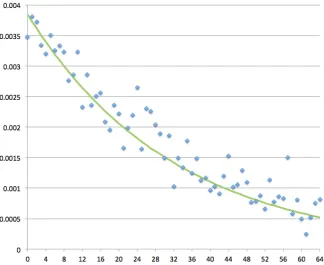
The above result was experimentally confirmed in [4] for values ofGup to 64, though with quite a small sample size, and not focused on early bytes in RC4 output. We have confirmed that the result holds to a reasonable approximation in the situation in which we are interested, for positions 256 onwards. See Figure 1.
3.2 Discrimination and Statistical Hypothesis Testing
Given two probability distributionspand q on some setS, we define thediscrimination
betweenpandq, denotedL(p, q), to beP
s∈Sp(s) logp(s)/q(s). Note that discrimination is additive: if p1, p2,q1, q2 are distributions on S, and if p1p2,q1q2 denote the product distributions onS × S, thenL(p1p2, q1q2) =L(p1, q1) +L(p2, q2). This equality extends in the obvious way to larger products of distributions.
Next consider the distributions p andq arising from a simple “bias presence” test T
Fig. 1. Experimental validation of Mantin biases based on 228 random 256-byte keys, 4096 bytes of RC4 output per key. The x-axis depicts the value of G, the y-axis scaled biases (γ values). Blue points denote experimentally measured values; green line denotes theoretical values computed according to Result 1.
r,r+ 1,r+ 2,r+ 3 in the string and check whether the quartet of byte values are of the form “ABAB” or not, an event which should happen with slightly larger than expected probability if the input string comes from RC4 output rather than being truly random. Letpbe the output probability distribution ofT if the input string comes from RC4 output andqthe output probability distribution ofT if the input string is truly random. Thenp(0) = 1−ρ(1 +γ),p(1) =ρ(1 +γ) andq(0) = 1−ρ,q(1) =ρ whereρ= 2−16and
γ > 0 is the relative bias under consideration (so γ = e(−4−8G)/256/256 for some small integerG).
Then, as shown in Lemma 3 of [4] (using different notation),L(p, q)≈ργ2.
The presence of different types of biases in different positions motivates us to consider product distributions p1· · ·pt and q· · ·q, where each component in the two products
corresponds to a different test Ti based on a specific bias. Here the second distribution
is always a fixed one, q, as defined above (since all the bias presence tests behave the same way in case the input string is truly random), while the first one pi describes the
distribution of the test’s {0,1}-valued outcomeOi. We assume we have ttests in total,
different types of test being conducted, despite many of the tests involving overlapping bytes. The same assumption was made in [3,4] when developing distinguishers for RC4. This assumption enables us to write:
L(p1· · ·pt, q· · ·q) = t X
i=1
L(pi, q)≈ρ t X
i=1
γi2
whereγi is the appropriate value for thei-th test performed.
Now letDdenote any distinguisher based on an input that is the concatenation of the outputsOi of the tindividual bias presence tests, and that predicts whether or not the
particular string ofB bytes used in the tests was generated by RC4 or is truly random. We assume thatD outputs 1 (indicating RC4) with probability 1−β when its input is from RC4, and thatDoutputs 0 (indicating truly random) with probability 1−α when its input is truly random. In other words, α is the false positive rate for Dand β is the false negative rate forD. Then, following [3], we have that:
L(p1· · ·pt, q· · ·q)≥βlog2
β
1−α + (1−β) log2
1−β α .
Moreover equality is achieved by any optimal statistical test, such as a Neyman-Pearson likelihood ratio test.
We next evaluateL(p1· · ·pt, q· · ·q)≈ρPti=1γi2 for the set of tests corresponding to
all the possible Mantin biases arising in aB-byte block of consecutive keystream bytes. From the above equation, this will then allow us to establish bounds on (α, β) for optimal distinguishersD. We then provide an efficient and approximately optimal statistical test based on these biases, and compute the parameters of the test in such a way as to maximise the quantity 1−α−β, which is the usual advantage of the distinguisher D.
3.3 Computation for the Mantin Biases
In aB-byte block, we can performB−(G+3) bias presence tests withγ =e(−4−8G)/256/256 for each value ofG≥0. In practice, since the biases decrease in size with increasingG, we work with valuesGsatisfying 0≤G≤Gmax for some valueGmax. In our experiments, we takeGmax = 64.
Combining all of these bias presence tests, we obtaint=PGmax
G=0 B−(G+3)≈Gmax·B tests such that
L(p1· · ·pt, q· · ·q) =ρ X
G≥0
(B−(G+ 3))·e(−4−8G)/128/216).
Direct calculation gives L(p1· · ·pt, q· · ·q) ≈ 8.7276 ≈ ×10−7 for B = 256 and
3.4 An Efficient Statistical Test
We start with a likelihood ratio test and develop from this an efficient test which is approximately optimal.
In the likelihood ratio test, the test statistic is computed as a ratioΛ(O) :=L(θ0|O)/L(θ1|O) where θ0 denotes the distribution arising from the hypothesis H0, θ1 denotes the dis-tribution arising from the alternative hypothesis H1,O denotes the observed data, and
L(θi|O) := Pr(O|θi) denotes a likelihood. In the test, the hypothesisH0 is rejected (and our distinguisher outputs 1 indicating that its input is believed to be RC4) if the ratio of likelihoods Λ(O) is less than or equal some value η; otherwise, H0 is accepted (and our distinguisher outputs 0 indicating that its input is believed to be truly random). In principal η can be calculated from α, the false positive rate for the test. Specifically, η
is determined as the value such that Pr(Λ(O)≤η|H0) =α.
In our situation,O is a vector composed of the outcomes Oi of the individual tests
Ti with parameters γi. Hypothesis H0 is that the input sequence of B bytes is random and H1 is the hypothesis that it is an output of RC4. Keeping in mind that γi >0 for
all i, we can then write
L(θ0|O) =
Y
i:Oi=1
ρ Y
i:Oi=0 1−ρ
and
L(θ1|O) =
Y
i:Oi=1
ρ(1 +γi) Y
i:Oi=0
1−ρ(1 +γi).
Then, taking logs, using the fact thatρ and all theγi are small, manipulating the above
expressions using standard log approximations, and simplifying, we finally obtain:
logΛ(O)≈ − X
i:Oi=1
γi+ X
i:Oi=0
ργi.
Let us denote the above quantity by L. Thus a suitable, approximately optimal test is to reject the hypothesisH0 (that the input string is a truly random string) and output “1” if L ≤logη, and to output “0” otherwise. Note that the test statistic L is efficient to compute: it requires on the order of Gmax ·B floating point operations and byte comparisons.
It remains to compute appropriate values ofηfor a given targetα. This requires us to know the distribution of the test statisticLwhenO comes from distributionθ0. Now, in this case, the outcomeOi is Bernoulli distributed with parameterρ, i.e. Pr(Oi = 1) =ρ.
Moreover, we can group the tests intoGmax + 1 groups, each group corresponding to a set of tests having the same value forγi. Since the number of tests in each group is large,
3.5 Optimal Choice of Parameters
For reasons that will become clear in the next section, we wish to maximise the value of the quantity δ := 1−α−β over the choice of distinguisher D acting on B bytes of input. Let us denote this value byδB. (As temporary motivation note thatδis the usual
cryptographic definition of the advantage of the distinguisher.) Since we are interested in optimal distinguishers, our choice of parameters (α, β) is subject to the constraint that
LB = βlog2
β
1−α + (1−β) log2 1−β
α where the quantity LB was computed for different
values ofBin Section 3.3. Direct maximisation using Wolfram alpha6yieldsδB = 0.00055
for B = 256 (at (α, β) = (0.499459,0.499991)) and δB = 0.002273 for B = 4096 (at
(α, β) = (0.498343,0.499384)).
3.6 Implementation
We implemented the above statistical test to ensure that its practical performance is in line with the theoretical analysis. As noted above the parameter η could be set by calculating the distribution of the test statistic L when O comes from distribution θ0. Another approach would be to generate many samples of the test statistic to estimate the distribution of Land setη by computing theα-percentile of the sampled values.
In our experiments, we simply set η = 0, ran the test on random inputs and on RC4 inputs, and computed the corresponding values ofα, β, δ. This gives us sub-optimal values forδ, but is sufficient to validate that the test works and gives us a distinguisher having performance that is reasonably close to that which is theoretically obtainable. ForB= 4096 and based on 225samples (224 for each of random input and RC4 inputs), settingη = 0, we obtainedα= 0.453706,β = 0.544646 andδ = 0.001648. Here the value ofδcompares favourably to the theoretical maximum of 0.002273. We are confident that a closer match would be obtained by adjustingη. In our evaluation of our attack on HIVE to follow, we present attack costs for both the ideal value of δ and our experimentally obtained value.
4 An Attack on HIVE Based on a Blockwise RC4 Distinguisher
We describe a family of adversaries{AB,S,T}, parameterized by the block lengthB and
two other parametersS and T which are defined below. Our adversaries have access to the distinguisherDacting onB bytes from Section 3. Recall thatDoutputs a single bit
b; ifD’s input is uniformly random bytes, DB outputs 1 with probability α; ifD’s input
consists of B consecutive bytes of RC4 output, D outputs 1 with probability 1−β. For a fixed block lengthB,AB,S,T is a one-time adversary against plausible hiding for
two volumes, as in Definition 1. In this simple case, there are two encrypted volumesV1,
V2 protected by passwordsP1,P2, and a user wants to be able to deny the existence ofV2 to an adversary who knowsP1. We consider two volumes for simplicity and because two
volumes are used in the implementation; the attack generalizes directly to any number of volumes. We assume that each volume consists ofS blocks ofB bytes, so the disk has 4SB bytes in total (because it needs to be twice the size of all the volumes combined).
We overload the notation for the access operations in Definition 1 to allow reading and writing of multiple blocks of data in a single query. In what follows, 0SB denotes an all-zero string ofSB bytes, equating toS blocks ofB bytes each.
Our adversaryAB,S,T then proceeds in five steps:
1. AB,S,T sends l = 2 to the challenger and receives the password P1 and a snapshot
D0 of the disk.
2. AB,S,T sends o1,0 =o1,1 = (w,0, V1,0SB).
3. AB,S,T sends o2,0 = (w,1, V2,0SB),o2,1 = (r,0, V1, d, SB).
4. AB,S,T requests a snapshot Df, containing 4S blocks. AB,S,T disregards the blocks
that are the same as in D0, runs D successively on each of the remaining E used blocks ofDf and concatenates the output bits ofD to form a string R∈ {0,1}E.
5. Finally,AB,S,T outputs 1 ifW, the Hamming weight ofR, is at mostT; otherwise it
outputs 0.
The following theorem is immediate (noting that reading or writingB bytes counts as making 1 query in the security model given previously, so AB,S,T makes 2S queries
in total):
Theorem 2. LetτB,S,T denote the running time ofAB,S,T andAdvB,S,T its advantage. Then HIVE is not (AdvB,S,T, τB,S,T, 2S)-plausible hiding against one-time adversaries.
Now let us determine values forS,B andT for which the theorem gives a meaningful attack. We consider what informationAB,S,T has access to in its attack when b= 0 and
b= 1 in the security experiment. Whenb= 0, the disk is initialised withV1 and V2, and
o1,0 and o2,0 are executed. When b= 1, the disk is initialised only with V1, and o1,1 and
o2,1 are executed.
The adversary gets an initial snapshot of the disk before any operations are executed, so identifying unused blocks is trivial;Edenotes the number of blocks that differ between
D0 andDf. All blocks that are written to certainly differ, so we have 2S ≤E≤4S. We
callEB the effective disk size, since the other blocks are irrelevant to the attack. Note that the expected value ofE is approximately 3.1075S. (There are 4S blocks on the disk, and in the 2S read and write operations in our attack, HIVE will choose K·2S = 6S
blocks at random to write to. This means that we expect that, out of the total of 4S
blocks available, 4S· 1− 1 4S
6S
blocks are not written to.7 Using (1−1/n)m ≈e−m/n, we getE[E]≈(1−e−1.5)4S ≈3.1075S.)
LetWb denote the Hamming weight of the vectorR constructed by AdvB,S,T in case
b. We have:
7 In reality, because of the way the stash operates, slightly fewer than S or 2S blocks of data might be
– When b = 0, 2S blocks of data are written to the disk, so it contains 2S blocks of AES output andE−2Sblocks of RC4 output. Since AES output is indistinguishable from random (otherwise, we would have an attack on AES), the expected value for
W0 is α·2S+ (1−β)·(E−2S).
– When b= 1, only S blocks of data are written to the disk, so it containsS blocks of AES output and E −S blocks of RC4 output. The expected value for W1 is
α·S+ (1−β)·(E−S).
The difference in the expected values of the Hamming weight of R in the two cases is therefore (1−α−β)S = δS, which corresponds to the S blocks of additional data written to the disk in case 0.
Note that the output ofDon eachB-byte block is an independent Bernoulli random variable with one of two possible distributions, depending on whether the block contains output from RC4 or AES (and where we assume the latter is indistinguishable from truly random bytes). Specifically, when a block contains RC4 output,D’s output equals 1 with probability 1−β, while, when it contains AES output,D’s output equals 1 with probabilityα. Thus, whenb= 0, the distribution ofW is a Poisson binomial distribution with parameters p1 = . . . = p2S = α, p2S+1 = . . . = pE = 1−β (since the trials are
independent, the order does not matter). Similarly, whenb= 1, the distribution ofW is a Poisson binomial distribution with parametersp1 =. . .=pS =α,pS+1=. . .=pE =
1−β.
By standard results for the Poisson binomial distribution, the variance ofW0 is equal to 2Sα(1−α) + (E−2S)β(1−β), while the variance ofW1 is equal toSα(1−α) + (E−
S)β(1−β). Sinceα(1−α), β(1−β)≤1/4 andE ≤4S, it follows that the two variances are bounded byS. We define σ2:=S.
Now, given that W0 and W1 are obtained as sums of large numbers of independent Bernoulli random variables, we can consider them to be Normally distributed to a good approximation (here, we assume E is large, as indeed it will need to be to obtain rea-sonable success rates for our adversary). We already established that their variances are bounded byS, while their means are separated by δS. Note that
AdvplA-ot
B,S,T,Σ(k) =|Pr[1←Exp
pl-ot-0
AB,S,T,Σ(k)]−Pr[1←Exp
pl-ot-1
AB,S,T,Σ(k)]| =|Pr[W0≤T]−Pr[W1≤T]|
where W0 and W1 are Normally distributed by assumption. We set T to be half-way between the means; vizT =E−1.5S−1.5Sα−(E−1.5S)β. This finally brings us to a position where we can apply standard tail bounds for Normal distributions in order to estimate the advantage ofAB,S,T.
Suppose that we insist that the means of W0, W1 are 2nσ apart for some parameter
n; then by our choice ofT and under our assumption of Normality (and since σ2 is an upper bound on the variances ofW0, W1) we get an advantage for our adversary which is at least
1−erf
n
√
2
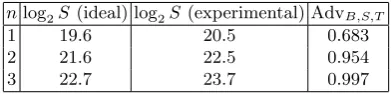
nlog2S(ideal) log2S (experimental) AdvB,S,T
1 19.6 20.5 0.683
2 21.6 22.5 0.954
3 22.7 23.7 0.997
Table 1. Number of blocks S required to achieve a given advantage AdvB,S,T forB =
4096.
where erf(·) is the standard error function for the Normal distribution:
erf(x) = √1
π
Z x
−x
e−t2dt.
Hence, under the condition thatδS= 2nσ= 2nS1/2, the advantage AdvB,S,T of our
adversary AB,S,T will be at least the claimed value, namely 1−erf(n/
√
2). Solving for
S, we see that we require
S= 4n 2
δ2 to achieve the claimed advantage.
4.1 Concrete Numbers
To launch a concrete attack, we setB= 4096, as in [2]. Then, from the results of Section 3 we can take δ = 0.002273 as the optimal setting. Setting n= 1 in the above analysis and solving for S, we get S = 219.6 for an advantage of 0.683. Continuing for other values of n, we obtain the second column in Table 1. Thus we see that an adversary with advantage very close to 1 can be achieved by setting S = 222.7, i.e. for an attack involving 2S = 223.7 read/write queries on a disk containing a total of 4S = 224.7 blocks and 4BS = 236.7 bytes of data (i.e. roughly 104 GB of data).
The third column in Table 1 contains estimates forS based on settingδ = 0.001648, the value experimentally observed when settingη = 0 in the statistical test developed in Section 3.6. The higher numbers in this column reflect the sub-optimal performance of the blockwise distinguisher for this setting ofη.
The main computational cost of implementing the attack is that of running the blockwise distinguisher E times; since E ≤ 4S, the total cost of the attack is on the order ofGmax·B·S floating point operations. In our implementation, the running time for a single execution of the blockwise distinguisher for Gmax = 64, B = 4096 was 0.000719s (on a Macbook Air with a 1.3 GHz Intel Core i5 processor and 8GB of RAM); the running time of the whole attack withE= 4SandS = 223.7would then be about 11 hours. This running time could be improved by optimising the choice ofη(thus allowing a reduced value of S).
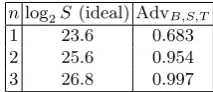
nlog2S(ideal) AdvB,S,T
1 23.6 0.683
2 25.6 0.954
3 26.8 0.997
Table 2. Number of blocksS required to achieve a given advantage AdvB,S,T for B =
256.
hand, the total disk size is only moderately increased and the running time of the dis-tinguisher is further reduced (because of the reduced block size).
5 Conclusions
We have shown that the current instantiation of HIVE using RC4 is insecure. Specifically, there is an efficient attack involving 223.7read/write queries onB = 4096 byte blocks for which we can construct an adversary having advantage 0.997 in the security model for plausible hiding against one-time adversaries. This violates the main security property claimed for HIVE.
Our work illustrates that if a provably secure scheme is instantiated with an insecure primitive, then all security guarantees may be lost.
HIVE can be repaired by replacing RC4 with a stronger PRG. For example, AES in counter mode (CTR) could be used instead; as well as being more secure, the performance will be better than that of the current RC4-based system on platforms with hardware support for AES. More options, optimized for performance in hard- or software, are offered by the eSTREAM project.8
We gave the authors of HIVE the opportunity to make changes to their code and to their paper after notifying them of our initial concerns about their scheme’s reliance on RC4. They did not avail themselves of this opportunity. In view of the fact that HIVE had been released to the public and was promoted as “not rely[ing] on heuristics or obfus-cation techniques, but rather strong cryptographic primitives which can be mathematically proven” and as being able to “provide very strong security in practice”9, we decided to refine and publish our attack to provide a clear demonstration of the shortcomings of instantiating the system with RC4.
Shortly after publication of a pre-print version of this paper, RC4 was replaced by AES-CTR as the default PRG in the HIVE implementation. According to the HIVE developers, I/O performance remains unaffected.10
References
1. N. J. AlFardan, D. J. Bernstein, K. G. Paterson, B. Poettering, and J. C. N. Schuldt. On the security of RC4 in TLS. InUSENIX Security. USENIX Association, 2013. https://www.usenix. org/conference/usenixsecurity13/security-rc4-tls.
8 http://www.ecrypt.eu.org/stream/ 9
Both quotes fromhttp://hive.ccs.neu.edu/, date of access 26/10/2014
2. E.-O. Blass, T. Mayberry, G. Noubir, and K. Onarlioglu. Toward robust hidden volumes using write-only oblivious RAM. InCCS ’14, pages 203–214. ACM, 2014. Full version athttps://eprint.iacr. org/2014/344.
3. S. R. Fluhrer and D. A. McGrew. Statistical analysis of the alleged RC4 keystream generator. In
FSE 2000, volume 1978 ofLecture Notes in Computer Science, pages 19–30. Springer, 2001. 4. I. Mantin. Predicting and distinguishing attacks on RC4 keystream generator. In EUROCRYPT
2005, volume 3494 ofLecture Notes in Computer Science, pages 491–506. Springer, 2005.
5. I. Mantin and A. Shamir. A practical attack on broadcast RC4. InFSE 2001, volume 2355 ofLecture Notes in Computer Science, pages 152–164. Springer, 2002.