Study of Fresh State Properties & Durability of Self Compacting
Concrete with Weathered Crystalline Rock Sand as Fine Aggregate
Jyothis Mary C.J
1, Ranjan Abraham
2 1M.Tech student, M.G. University, Kerala,India2Professor, Department of Civil Engineering, Ilahia College of Engineering and Technology,Kerala,India
Abstract — Concrete is a composite construction material composed mainly of cement, fine aggregate, coarse aggregate and water. Self compacting concrete (SCC) is an innovative concrete that does not require vibration for placing and compaction. Aggregate occupy 70-75% of the total volume of concrete. From earlier days onwards river sand is used as fine aggregate. Nowadays, M-sand, pit sand etc. are also used. Since pit sand is available only at certain regions and due to the scarcity of river sand and M-sand, it has become necessary to find an alternative material, as fine aggregate. The alternative material selected here is sand from Weathered Crystalline Rock. And this type of rock is abundantly available at low cost in tropical areas. This paper discusses the fresh properties and durability of self compacting concrete using weathered crystalline rock sand as fine aggregate
Keywords — Self compacting concrete, Fine aggregate, Weathered crystalline rock sand, M-Sand.
I. INTRODUCTION
Cement concrete is a widely used construction material around the world, and its properties have been undergoing changes through technological advancement. So far, numerous types of Concrete have been developed such as High strength concrete, High performance concrete, Air entrained concrete, Light weight concrete, Self Compacting Concrete (SCC) etc. SCC is an advanced type of concrete that can flow through congested geometrical configurations under its own mass without vibration or segregation. It was developed in the middle of the 1980’s in Japan. It is well established that SCC can increase the construction productivity, job site safety and hardenened properties of concrete. However the material cost for SCC is higher than that of conventionally placed concrete. Proper selection and proportion of constituents can achieve economical production of SCC. In the present scenario the scarcity of river sand and increasing cost of M- sand are causing the impediment in construction activity. Hence an alternative construction material which can fully or partially replace the fine aggregate without affecting the property of self compacting concrete would be desirable. Weathered crystalline rocks are abundantly seen in Kerala. Hence, this is an earnest attempt to examine the suitability of weathered crystalline rock sand (WCRS) as fine aggregate for SCC.
A. Self compacting concrete
In places where compaction and placing are difficult, such as jacketing of structural elements for fire protection, and back filling near retaining structures, self compacting concrete (SCC) is a better choice than conventional concrete. In plastic state, SCC fills the form work under its own weight. The
hardened concrete is dense, homogenous, has better engineering properties and is more durable than traditional vibrated concrete.
B.Weathered crystalline rock
Weathered Crystalline Rocks are metamorphic rocks seen in the tropical areas like Kerala. They are formed by the weathering action on the rocks. Weathered crystalline rock is the outer layer of the underlying hard rock. Hence excessive mining is not required to obtain these types of rocks. In Kerala, weathered crystalline rock is used for the construction of small compound walls instead of random rubble and Laterite bricks. Generally, weathered crystalline rock sand is used for plastering works.
Chemical combination of the weathered crystalline rock is almost similar to the chemical combination of naturally occurring rocks. Silica is the major constituent in natural sand and weathered crystalline rock. Other constituents like oxides of Manganese, Magnesium, Iron, Aluminium etc. are in the safe limits. Other trace elements are in the range of ppm those are not at all affects the chemical activity of fine aggregate [1].
C.Scope of the study
Scope of this study is to
Determine fresh state properties and durability of self compacting concrete of M20 grade with weathered crystalline rock sand as fine aggregate.
Compare durability of SCC with WCRS as fine aggregate of M20 grade with SCC with M-sand as fine aggregate of M20 grade.
The scarcity of river sand causes much impediment in production of concrete. Replacement with alternate materials for fine aggregate is of priority and has been proved. SCC is becoming popular since valuable vibrating machinery can be avoided and can be used in complicated narrow, curved, structural shapes of machine parts and foundations where sharp corners and bends are involved. Also in this concrete fine aggregate is used in a dominant proportion.
D.Objective of the study
This study is focussing on replacement of fine aggregate fully with weathered crystalline rock sand. It is intended to tests on M 20 SCC mix.
• To study the fresh state properties of SCC of M20 grade with weathered crystalline rock sand as fine aggregate
• To study the durability of SCC M20 grade with weathered crystalline rock sand as fine aggregate. • To compare the durability of M20 grade SCC with
E.Methodology
The methodology adopted for the present experimental investigation is as follows:
Collection of raw materials Material characterisation
Select suitable grade of concrete –here M 20 Design a mix using fly ash as additive by suitable method for M-Sand and weathered crystalline rock sand.
Laboratory tests of fresh SCC
Prepare cubes using this mix and subject them to chloride attack and sulphate attack by standard procedures for durability studies. To compare the durability of M20 grade SCC with WCRS and SCC of M20 grade with M-sand as fine aggregate.
II. MIX DESIGN
The mixture proportioning is one of the important steps in the production of SCC. So far the proper mix design procedure to get the proportion of all the ingredients in the SCC is not standardised.
In 1993 Okamura [2] proposed a mix design method for SCC. His main idea was to conduct first the test on paste and mortar in order to examine the properties and compatibility of super plasticizer, cement, fine aggregate and Pozzolanic materials, and then followed by trial mix of SCC. The major advantage of this method is that it avoids having to repeat the same kind of quality control test on concrete, which consumes both time and labour. However, the drawbacks of Okamura’s method is that it requires quality control of paste and mortar prior to SCC mixing, while many ready- mixed concrete producers do not have the necessary facilities for conducting such tests and the mix design method and the procedures are too complicated for practical implementation. No method specifies the grade of concrete in SCC except the Nan Su method [3]. The limitation of Nan-Su method is, that it gives required mix proportions for the grades which are more than 50N/mm2 . The self –compacting laterized mix design method developed by Mathews and George, [4] is used as the basis of mix design used in this study.
A. Mix design for SCC with M-Sand as fine aggregate
A.1 Calculation of cement content
Where, = Weight of cement for 1 m3 of concrete in kg. Modification factor,
= Characteristic cube compressive strength of concrete = 20N/mm2
A.2 Calculation of Fly Ash Additions
Where, Weight of fly ash for 1m3 of concrete in kg, Fly ash factor,
Specific gravity of fly ash = 2.127
Specific gravity of cement = 3.1 The fly ash factor can be calculated using the relation
357.604 kg
A.3 Calculation of Water Powder Ratio
Total powder Water content , W =
= 696.039 243.614 l
A.4 Calculation of Aggregate content
Where, = Air content in % = 1
Aw = Weight of total aggregate in kg. =
Sa = Specific gravity of aggregate W = Weight of water in kg.
From this two-third weight of total aggregate is taken as coarse aggregate and one- third is taken as fine aggregate. Weight of coarse aggregate = 854.442 kg
Weight of fine aggregate = 427.221 kg
A.5 Calculation of Super Plasticizer (SP) dosage
Adding an optimum amount of SP will improve the flow ability.
Target mean strength =
B. Mix design for SCC with WCRS as fine aggregate
B.1 Calculation of cement content
Modification factor,
= Characteristic cube compressive strength of concrete
B.2 Calculation of Fly Ash Additions
Where, Weight of fly ash for 1m3 of concrete in kg,
Fly ash factor,
Specific gravity of fly ash = 2.127 Specific gravity of cement = 3.1
The fly ash factor can be calculated using the relation
B.3 Calculation of Water Powder Ratio
Total powder
Water content =
B.4 Calculation of Aggregate content
Where, = Air content in % = 1
Aw = Weight of total aggregate in kg. =
Sa = Specific gravity of aggregate
W = Weight of water in kg.
From this two-third weight of total aggregate is taken as coarse aggregate and one- third is taken as fine aggregate. Weight of coarse aggregate = 859.85 kg
Weight of fine aggregate = 429.923 kg
B.5 Calculation of Super Plasticizer (SPO) dosage
Adding an optimum amount of SP will improve the flow ability.
Target mean strength =
III..RESULT AND DISCUSSION ON FRESH CONCRETE
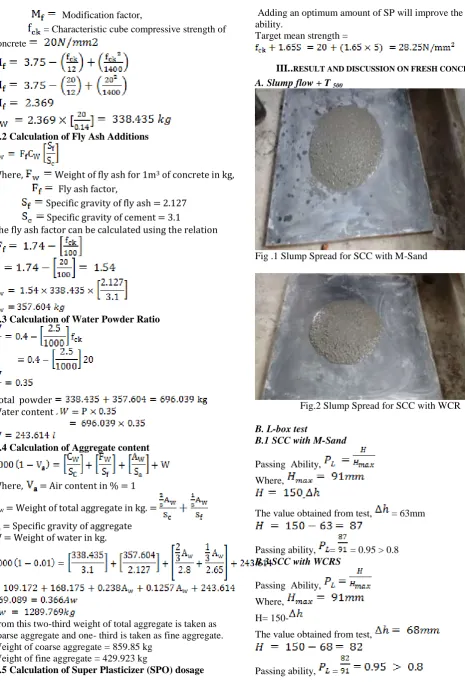
A. Slump flow + T 500
Fig .1 Slump Spread for SCC with M-Sand
Fig.2 Slump Spread for SCC with WCR
B. L-box test
B.1 SCC with M-Sand
Passing Ability,
Where,
-The value obtained from test, = 63mm
Passing ability, = = 0.95 > 0.8
B.3 SCC with WCRS
Passing Ability,
Where,
H=
150-The value obtained from test,
The results on fresh properties of concretes are tabulated in Table 7.1.
TABLE.1FRESH PROPERTIES OF CONCRETE
Type of SCC Slump
(mm) T 500 (s)
Passing Ratio
V-funnel (s)
SCC with
M-Sand 670 2 0.95 22
SCC with
WCRS 670 2.9 0.9 24
According to “European guideline for SCC”[15] if the value of slump flow between 660-750 mm then the concrete can be used for normal application like walls, columns etc. The above values obtained come under the range of SCC. Therefore this concrete can be used as a self compacting concrete. If the value of T500 is more than 2s then the V-funnel time to be obtained was 22s for SCC with M-Sand and 24s for SCC with WCRS, which come under VS2/VF2 class. The passing abilities obtained were greater than 0.8, so this comes under class-2 (PA2). Therefore this concrete can be used where confinement reinforcement gap are present. The above values obtained were come in the range of SCC. Therefore these concretes can be used as a self-compacting concrete.
IV.TESTONHARDENEDCONCRETE
A. Strength study
A.1 Compressive Strength
Compression test is the most common test conducted on hardened concrete. The compressive test is carried out on specimens cubical in shape. The cube specimen is of size 15 x15 x 15 cm. The compression tests were conducted after 7days, 14 days, 28 days, 56 days. The test was conducted according to IS specifications [14].
A.2 Durability Study
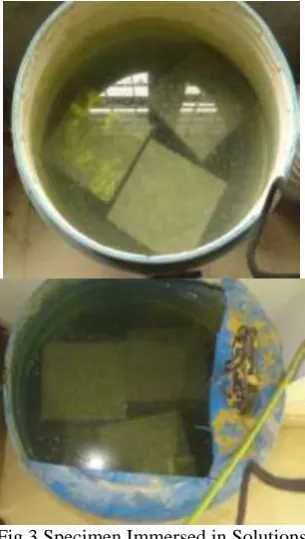
Durability is the ability to resist weathering action, chemical attack, abrasion or any other process of deterioration. In order to study the durability characteristics, that is, the sulphate attack and chloride attack the SCC cubes were immersed in sodium chloride and Magnesium sulphate solutions. The cubes were demoulded and dipped in the respective solutions. Then the cubes were taken from the solutions after 7, 14, 28, 56 days and their corresponding compressive strengths were noted. Sodium chloride solution of three different strengths was used. Salt content of soil is 0.25 and 0.5 was used. Similarly Magnesium sulphate solution was also of two different strengths. They were 4% and 5%. The specimen immersed in solutions was shown in Fig 3.
Fig.3 Specimen Immersed in Solutions
V. RESULTSANDDISCUSSIONSONHARDENED CONCRETE
A. Specimen Exposed to Sodium chloride Solution
Fig.5 Weight Loss (%) of Cube Immersed in Sodium Chloride Solution
From Fig 4, it can be seen that as molarity increases, the compressive strength of SCC slightly decreases as exposure day increases for both SCC and also, it can be seen that the increasing strength of SCC gradually decreases as compared with water curing cube strength as the days of exposure increases. This was due to deterioration of concrete. From Fig. 8.5, the reduction in compressive strength for SCC with M-Sand exposed to 0.25 M NaCl were 5.07%, 2.80% and 6.68%.For 0.5 M, reduction of compressive strength was 8.12%,7.07% and 15.14% . The reduction in compressive strength for SCC with WCRS exposed to 0.25 M NaCl were 1.34%, 0.198%, 4.539%. For 0.5 M, reduction in compressive strength was 17.7%,6.035% and 8.373%. The percentage of compressive strength reduction is higher for SCC with WCRS. It can be seen that the strength reduction is slightly reduced for 14 days in both SCC it is due to strength development of concrete is in faster rate compared to reaction with salt content.
B. Specimen Exposed to Magnesium Sulphate Solution
Fig.6 Variation of SCC Cube Compressive Strength Immersed in MgSO4 solution with Respect to Curing Days
Fig. 7 Weight Loss (%) of Cube Immersed in Magnesium Sulphate Solution
From Fig. 6, it can be seen that as strength of solution increases, the compressive strength of SCC slightly decreases as exposure day increases for both SCC. It can also be seen that the increasing strength of SCC gradually decreases as compared with water curing cube strength as the days of exposure increases. This was due to deterioration of concrete. From Fig.8.10, the reduction in compressive strength for SCC with M-Sand exposed to 4% MgSO4 were 2.54%, 7.07% and 8.811%.For 5%, reduction
in compressive strength is 7.36%, 8.96% and 10.57%. The reduction in compressive strength for SCC with WCRS exposed to 4% MgSO4 were 19.02%, 8.45% and 5.57%. For 5%, reduction in compressive strength is 38.057%, 19.056% and 16.73%. The strength development of SCC with WCRS in sulphate solution is at lesser rate compared to SCC with M-Sand. The deterioration of concrete is higher for SCC with WCRS. But, the compressive strength of SCC with WCRS is higher than that of SCC with M-Sand because, M-M-Sand contains more fines than that of WCRS.
From Figures 5 and 7, it can be seen that as strength of solution increases the weight loss also increases. This is due to the deterioration of concrete. Weight loss is more in sulphate solution than the chloride solution. Weight loss of SCC with M-Sand in chloride solution is more than that of SCC with WCRS. But in sulphate solution it is vice versa. Sulphate resistance of WCRS is poor compared to M-Sand.
VI.CONCLUSIONS
Based on the study the following conclusions
were drawn;
1.
Slump flow +T
500, filling ability, passing
ability etc are tested in lab and it meet the
European standard of SCC.
2.
Use of SCC developed using WCRS is
recommended according to the European
guidelines.
3.
Compressive strength of cubes of both SCC
immersed in sodium chloride solution
decreased as the strength of solution
increased.
4.
Compressive strength of cubes of both SCC
immersed in magnesium sulphate solution
decreased as the strength of solution
increased.
5.
The rate of development of strength of SCC
prepared with WCRS is less in both
solutions compared to SCC prepared with
M-Sand.
6.
Weight loss of the specimen immersed in
sulphate solution and chloride solution
increased as exposure day increased, which
was due to deterioration of concrete.
7.
Weight loss of the specimen prepared with
WCRS when immersed in sulphate solution
is high compared to SCC prepared with
M-Sand.
ACKNOWLEDGMENT
First of all I would like to thank God for divine grace bestowed on me to complete this project successfully on time. The main motivation and driving force behind this project is guide Prof. RANJAN ABRAHAM (Assistant Professor, Department of Civil Engineering, Ilahia College of Engineering & Technology). His enterprising attitude, timely suggestions and support made my project successful. I would also like to express my sincere thanks to Prof. SHAJI M. JAMAL (Head of department, Civil Engineering, Ilahia College of Engineering & Technology ). I would like to thank all technical staff of Ilahia College of Engineering & Technology, Mulavoor for their assistance in carrying out the experimental work.
I am deeply indebted to my parents and all my friends for their constant encouragement. They were instrumental in keeping my spirit high and their association with me will be always remembered.
REFERENCES
[1] Eldhose M Mathew, Shaji M Jamal, Ranjan Abraham “Weathered crystalline rock :Suitability as fine aggregate in concrete –A comparative study”, International Journal of Innovative Research in Science, Engineering and Technology(IJIRSET), Vol.2(4),April 2013, pp. 960-969.
[2] H Okamura, “Self Compacting High Performance Concrete”, Construction Research Communication Limited, pp. 365- 383 [3] Nan Su, Kung-Chung Hsu and Hi-Wan Chai, “A simple mix design
method for selfcompacting concrete”, Cement and Concrete Research,Vol.31, 2001, pp. 1799–1807
[4] George Mathew and Mathews M. Paul, “Study about Mix design methodology for laterized self compacting concrete and its behavior at elevated temperature,” Construction and Building Materials vol.36,2012, pp.104–108
[5] EFNARC: Specification and Guidelines for Self-Compacting Concrete. Farnham, February 2002
[6] Timo Wustholz “Fresh properties of self-compacting concrete (scc)”, Otto-Graf-Journal Vol. 14, 2003, pp. 180-188.
[7] N. Ganesan, Bharati Raj. J and A.P. Shashikala Nuran Deveci Aksoy,
“Strength and durability studies of self compacting rubberised concrete,” The Indian Concrete Journal,September 2012,pp.15-24. [8] Kiran K. Shetty, Gopinatha Nayak, Rahul Shetty K,” Study on the Self
compacting concrete using red mud and used foundry sand”, International Journal of Research in Engineering and Technology (IJRET),Vol. 03 Special Issue: 03, May-2014,pp.708-711.
[9] Dhiyaneshwaran S, Ramanathan, P., Baskar, I.and Venkatasubramani, R” Study on durability characteristics of self-compacting concrete with fly ash,” Jordan Journal of Civil Engineering, Vol. 07(3), 2013 [10] Oladipupo S. Olafusi ,Adekunle P. Adewuyi, Abiodun I. Otunla,
Adewale O. Babalola“Evaluation of Fresh and Hardened Properties of Self-Compacting Concrete,”Open Journal of Civil Engineering, Vol. 5, 2015, pp.1-7
[11] Anju K. Govind, Eldhose M Manjummekudy, Shibi Varghese,” Comparative study on the effect of concrete using Eco sand , Weathered crystalline rock sand and GBS as fine aggregate replacement,” International Journal of Engineering Research & Technology (IJERT), Vol. 3, Issue 10, October- 2014
[12] IS 12269-1989, “Specification for Ordinary Portland cement 53 grade”,Bureau of Indian Standards, New Delhi
[13] IS: 383-1970, “Specification for Coarse and Fine Aggregate from natural sources for Concrete”, Bureau of Indian Standards, New Delhi [14] IS.2386:1963, “Methods of test for Aggregate of concrete part 1, 2, 3
and 4, Bureau of Indian Standards”, New Delhi.