ISSN(Online): 2319-8753 ISSN (Print): 2347-6710
I
nternational
J
ournal of
I
nnovative
R
esearch in
S
cience,
E
ngineering and
T
echnology
(An ISO 3297: 2007 Certified Organization)
Website: www.ijirset.com
Vol. 6, Issue 6, June 2017
Improvement in Broadcasting Technique for
Path Establishment
Arshdeep Kaur 1, Shilpa Sharma 2
Mtech Student, Department of CSE, Lovely Professional University, Phagwara, Punjab, India1 Assistant Professor, Department of CSE, Lovely Professional University, Phagwara, Punjab, India2
ABSTRACT: The Mobile Ad hoc Network is the self configuring type of network in which no central controller is
present. The vehicular Ad hoc network is the type of Ad hoc network in which vehicles move freely and communicate with each other. In vehicular ad hoc networks two type of communication is possible, that is; vehicle to vehicle and vehicle to infrastructure communication. As vehicle nodes have higher mobility due which some prediction based technique are proposed in previous times for path establishment. Among proposed prediction based techniques, location audit routing is proposed which is based location is estimated and routing can be done in the network. In this work, improvement will be proposed in LAR technique for efficient path establishment between source to destination. This will leads to reduce delay and improve network throughput
KEYWORDS: Delay, mobility, root nodes, throughput, VANET
I. INTRODUCTION
The VANETs areone of the most prominently researched areas of today’s technology which help in determining the communication of vehicles and the road-side units with each other [1]. There is a proper connection provided to the all the nodes present in the network amongst each other and also the elements of roadside network. There is no need to determine the base or foundation of the creation of the network [2]. The important data is sent and received throughout the network. There are warnings given to the required vehicles regarding any kind of situations. There is a growth in utilization of the Wi-Fi IEEE 802.11 technology which helps in the deployment of the VANETs [3]. There are two standards basically involved here which are the 802.11b or 802.11g. There are different behaviours and characteristic properties of VANETs which help them be different from the other networks. The unique features of VANETs are described below:
Unlimited transmission power: The main aspect in the ad hoc devices is the power issue [4]. In the VANETs however, continuous power is supplied to the computing and communication devices.
Computational capacity very high: The sensing capabilities, communication, as well as the computing can be affordable by the operating vehicles on their own [5].
Predictable mobility: The prediction of the vehicle mobility is very difficult in the case of mobile ad hoc networks.
High mobility: The configurations of VANETs are different and they are highly dynamic in nature.
Partitioned network: There will be much frequent partitions in the vehicular ad hoc network [6]. The traffic could be of dynamic nature which might result in the huge inter-vehicular gaps in areas which are less populated in various isolated clusters of the nodes.
II. LOCATION AIDED ROUTING
ISSN(Online): 2319-8753 ISSN (Print): 2347-6710
I
nternational
J
ournal of
I
nnovative
R
esearch in
S
cience,
E
ngineering and
T
echnology
(An ISO 3297: 2007 Certified Organization)
Website: www.ijirset.com
Vol. 6, Issue 6, June 2017
rectangle which holds the location of the sender and the expected zone is known as the request zone. The request zone is mentioned by the LAR in the route request message. The request zone however does not hold the information about the node which receives the request message [8]. This results in discarding the packet. The propagation of the route request message is given restricted boundaries due to this which is named as a LAR1 method.
III. LITERATURE REVIEW
Young-Bae Ko and Nitin H. Vaidya [1] proposed in this paper, that a mobile ad hoc network consists of wireless hosts that may move often. This paper suggests an approach to utilize location information (for instance, obtained using the global positioning system) to improve performance of routing protocols for ad hoc networks. By using location information, the proposed Location-Aided Routing (LAR) protocols limit the search for a new route to a smaller “request zone” of the ad hoc network. This results in a significant reduction in the number of routing messages. Two algorithms are presented to determine the request zone, and also suggest potential optimizations to our algorithms.
Mohammad A. Mikki [2] introduced in this paper, an Energy Efficient Location Aided Routing (EELAR) Protocol for MANETs that is based on the Location Aided Routing (LAR). EELAR makes significant reduction in the energy consumption of the mobile nodes batteries by limiting the area of discovering a new route to a smaller zone. Thus, control packet overhead is significantly reduced. To show the efficiency of the proposed protocol they present simulations using NS-2. Simulation results show that EELAR protocol makes an improvement in control packet overhead and delivery ratio compared to AODV, LAR, and DSR protocols.
Shetali Zeadally, Ray Hunt [3] represents a paper, on recent advances in hardware, software and communication technologies are enabling the design and implementation of a whole range of different type of networks that are being deployed in various environment. In this paper simulation of VANET brief define the some benefits and limitations. Finally outline some of VANET research challenges that still need to be addressed to enable the deployment and widespread adoption of scalable, reliable, robust and secure VANET architecture, protocols, technologies and services.
Cristina Rico Garcia, Andreas Lehner [4] represents a paper, on efficient design and reliable broadcast MAC layers for wireless mobile ad-hoc networks (MANET) especially high user speeds are allowed is a current challenge. In this paper design the MAC layer protocol designed for broadcast MANETs called COMB cell based orientation- aware MANET Broadcast. In the technique of COMB allow the realization of collision free transmission, high speed is supported and no handshake is required. COMB is based on the localization aware cross layer dimensioned CDMA cell and it uses the SOTDMA protocol as intra cell scheme.
Jonathan Ledy, Herve Boeglen [5] represents a paper, on V-AODV a version of AODV (Ad-hoc On demand Distance Vector) especially created for vehicular ad-hoc networks (VANETs). In the V-AODV is designed for complex cross layered metric based on delay from node to node and bit error rate coming from the physical layer. This paper implemented on the ns2 simulator taking in account a realistic environment tool called communication ray tracer. In the results of this papers shows that basic propagation models not suitable in ns2 because it not more suitable for VANET. This paper show that using the routing metric based on delay and BER the first parameter is more relevant in terms of QoS.
ISSN(Online): 2319-8753 ISSN (Print): 2347-6710
I
nternational
J
ournal of
I
nnovative
R
esearch in
S
cience,
E
ngineering and
T
echnology
(An ISO 3297: 2007 Certified Organization)
Website: www.ijirset.com
Vol. 6, Issue 6, June 2017
IV. RESEARCH METHODOLOGY
In the vehicular ad hoc network, vehicle to vehicle and vehicle to infrastructure communication is available for communication. To vehicle to vehicle communication is available to exchange important information between vehicles. To establish path between various vehicles various routing protocols had been proposed which are of reactive and proactive type. The reactive routing protocols had remarkable performance in VANETS which use the broadcasting technique for path establishment. The broadcasting technique will increase delay in the network and network resource consumption increase at steady rate. To reduce delay in the network, the technique of multicasting had been proposed. The following are various assumptions of the proposed technique.
1. The network will be deployed with the fixed number of nodes and roads structure already defined.
2. Every node is responsible to maintain the table of its adjacent nodes.
3. Some nodes in the network are predefined as root nodes for multicasting nodes.
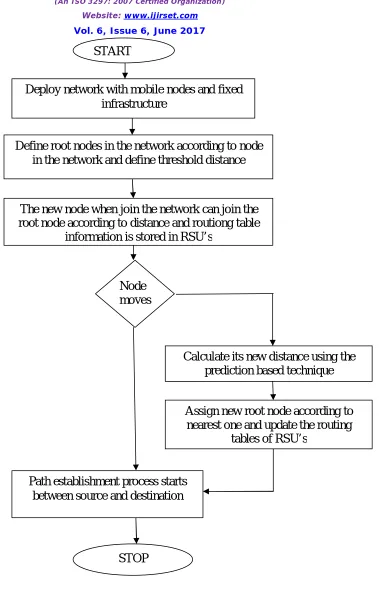
In the proposed technique, in the whole network we define some nodes which are root nodes, under these root nodes we will defines the leaf nodes. The leaf node comes under which root that will be decided by prediction based technique for multicasting.
4.1 Algorithm: R-optimal path algorithm
Set M Mobile Node’s Set S sender and R receiver Node Routing = AODV Set Route
{ If (route from S to R found) { Check number of route;
If (route => 1) //means alternative route exist in network {
Search nearest neighbouring nodes Establish path through root nodes
Send route acknowledge of route establishment through root node} } Else {root unreachable}
} {; New root node formation; {
Source node start sending data to destination through root node { Increment-Q;
Store incoming data; } Receiver receives data from I node;
ISSN(Online): 2319-8753 ISSN (Print): 2347-6710
I
nternational
J
ournal of
I
nnovative
R
esearch in
S
cience,
E
ngineering and
T
echnology
(An ISO 3297: 2007 Certified Organization)
Website: www.ijirset.com
Vol. 6, Issue 6, June 2017
Figure 1 : Flowchart of Proposed Work
START
Define root nodes in the network according to node
in the network and define threshold distance
The new node when join the network can join the
root node according to distance and routiong table
information is stored in RSU’s
Deploy network with mobile nodes and fixed
infrastructure
Node
moves
Calculate its new distance using the
prediction based technique
Assign new root node according to
nearest one and update the routing
tables of RSU’s
Path establishment process starts
between source and destination
ISSN(Online): 2319-8753 ISSN (Print): 2347-6710
I
nternational
J
ournal of
I
nnovative
R
esearch in
S
cience,
E
ngineering and
T
echnology
(An ISO 3297: 2007 Certified Organization)
Website: www.ijirset.com
Vol. 6, Issue 6, June 2017
V. EXPERIMENTAL RESULTS
The proposed algorithm has been implemented in NS-2 and the results are analyzed in terms of packet loss, delay and throughput
.
Figure 2: Packet loss
As shown in the figure 2, packet loss criteria are used to compare the old as well as the new proposed technique. The packet loss is found to be less in the new proposed technique than the already existing technique.
Figure 3: Delay
As shown in fig. 3, the delay criteria are used for comparing the proposed and the already existing techniques. There is a reduction in the delay in the new proposed technique when compared to already existing technique. This is due to the use of multicasting approach which is used for path establishment.
0 20 40
2 4 6 8
No of Packets
T
im
e
in
S
e
co
n
d
s
Packetloss
Comparision
E-AODV
AODV
0 100 200
2 4 6 8
No Of packets
Ti
m
e
in
S
e
co
n
d
s
Delay Comparision
E-AODV
ISSN(Online): 2319-8753 ISSN (Print): 2347-6710
I
nternational
J
ournal of
I
nnovative
R
esearch in
S
cience,
E
ngineering and
T
echnology
(An ISO 3297: 2007 Certified Organization)
Website: www.ijirset.com
Vol. 6, Issue 6, June 2017
Figure 4: Throughput
As shown in figure 4, for the purpose of establishing a path the broadcasting technique is used. Also the multicasting technique is applied by the proposed algorithm in the network. Due to this reason, the throughput of the network is increased
.
V. CONCLUSION
In this work, it has been concluded that vehicle Ad hoc network is self configuring type of network in which network topology change at very steady rate. The secure and shortest path will be established from source to destination using prediction based analysis technique. In the prediction based technique, source node flood route request packets in the network and adjacent nodes of the destination will respond back with the route reply packets. The source select best path on the basis of hop count and sequence number. Due to higher node mobility in the network, the time required for path establishment. In this work, improvement will be proposed in LAR algorithm for predicting locations of the nodes which can make path to destination. This research leads to improve network throughput and reduce network delay
.
REFERENCES
[1] Young-Bae Ko and Nitin H. Vaidya, “Location-Aided Routing (LAR) in mobile ad hoc networks”, Department of Computer Science, Texas A&M University, College State,2000.
[2] Mohammad A. Mikki , “Energy Efficient Location Aided Routing Protocol for Wireless MANETs”, (IJCSIS) International Journal of Computer Science and Information Security Vol. 4, No. 1 & 2,2009.
[3] Sherali Zeadally, Ray Hunt, Yuh-Shyan Chen ,” Vehicular ad hoc networks (VANETS): status, results, and challenges”, Angela Irwin, Aamir Hassan,2010.
[4] Cristina Rico Garcia, Andreas Lehner, Thomas Strang German Aerospace , “A Reliable MAC Protocol for Broadcast VANETs”, Center Institute of Communications and Navigation 82234 Wessling Germany, p1-8,2006
[5] Jonathan LEDY, Hervé BOEGLEN, Benoît HILT Abdelhafid ABOUAISSA, Rodolphe VAUZELLE ,” An Enhanced AODV Protocol for VANETs with Realistic Radio Propagation Model Validation”, IEEE ,2009.
[6] Jason J. Haas and Yih-Chun Hu , “Real-World VANET Security Protocol Performance”, University of Illinois at Urbana-Champaign Urbana, Illinois, U.S.A p1-7,2007.
0 20 40 60 80
2 4 6 8
No of Packets
Ti
m
e
in
S
e
co
n
d
s
Throughput Comparision
E-AODV
ISSN(Online): 2319-8753 ISSN (Print): 2347-6710
I
nternational
J
ournal of
I
nnovative
R
esearch in
S
cience,
E
ngineering and
T
echnology
(An ISO 3297: 2007 Certified Organization)
Website: www.ijirset.com
Vol. 6, Issue 6, June 2017
[7] Muddassar Farooq and Gianni A. Di Caro, “Routing Protocols for Next Generation Networks Inspired by Collective Behaviors of Insect Societies: An Overview”, Next Generation Intelligent Networks Research Center National University of Computer and Emerging Sciences (NUCES) Islamabad, Pakistan p1-60,2008.