INTERNATIONAL JOURNAL OF PHARMACEUTICAL, CHEMICAL AND BIOLOGICAL SCIENCES
Available online at
www.ijpcbs.com
SYNTHESIS OF Co(II), Ni(II), Cu(II), Fe(III), VO
2+AND UO
2
2+COMPLEXES DERIVED FROM A NEW BIS(PYRIDYLUREA)
LIGAND. SPECTROSCOPIC CHARACTERIZATION, THERMAL,
MAGNETIC AND 3D MOLECULAR MODELING STUDIES
MA. El-ghamry
*
, AA. Saleh, SME. Khalil and AA. Mohammed
Department of Chemistry. Faculty of Education. Ain Shams University. Roxy. Cairo. Egypt.
INTRODUCTION
Amide bonds [—CONH—] are ubiquitous in biochemistry, because they provide the linkages that held together two of the most important types of biopolymers, nucleic acids and proteins. The interest in the study of amide complexes derived from their ability to model active sites present in some metallo-proteins,1, 2 to act as effective catalysts for important organic transformations3 and the search for better understanding of the physicochemical properties of such complexes, especially to modulate the structural, stereochemical and electronic properties of transition metal centers.4-6 Pyridine urea ligands are a class of good candidates in the design and construction of supramolecular architectures because the effectively incorporate the urea groups for hydrogen bond formation and the pyridine moiety for coordination with metal ions.7 Such ligands have been extensively used to construct various structures and functions through
cooperative binding of transition metals and anions.8, 9 The coordination chemistry of pyridyl ureas and pyridinecarboxamides is extremely rich. Coordination via the pyridine nitrogen atoms, the carbonyl oxygen atoms and the amide nitrogen atoms of the ligands in a non-, mono- and bis-deprotonated form are known. Pyridinecarboxamides act as multidentate ligands towards transition metals10, 11 and have also been employed in catalysis.12, 13 Many derivatives of pyridine amide show anti-flammatory, antipyretic and analgesic activities and they are useful in the treatment of atherosclerosis.14 Some Pt (II)
complexes with amide compounds demonstrated notable antitumour and anticancer activity.15, 16 In the present work, a new ethylene-1,2-bis(3-pyridin-2-ylurea) ligand, EBPU and its metal complexes with vanadyl(II), iron(III), cobalt(II), nickel(II), copper(II) and uranyl(II) ions were synthesized. The structures of the ligand and
Research Article
ABSTRACT
Bis(pyridylurea) ligand, EBPU and its Co(II), Ni(II), Cu(II), Fe(III), VO2+, UO2 2+
solid complexes were synthesized. Reaction of the ligand, EBPU with Co(II), Ni(II), Cu(II) and Fe(III) ions in presence of 8- hydroxyquinoline (8-HQ) afforded new mixed ligand complexes. The ligand and its metal complexes were characterized by elemental and thermal analyses, IR, 1H NMR, electronic and mass spectra as well as conductance and magnetic susceptibility measurements. The spectroscopic data showed that the ligand, EBPU acts as bi- and tetradentate toward the metal ions, coordination via the pyridine -N, the carbonyl -O and/or the amidic -N atoms in a non, mono- and bis-deprotonated form. The metal complexes exhibited tetrahedral, octahedral and square pyramidal geometrical arrangements. Kinetic and thermodynamic parameters for the different thermal decomposition steps of some complexes were calculated using Coats–Redfern equation. 3D molecular modeling of the ligand, EBPU and a representative complex were studied.
Keywords: Bis(pyridylurea) ligand; metal complexes; Spectroscopic; Thermal studies.
its metal complexes were characterized by elemental and thermal analyses, IR, 1H NMR, electronic, ESR and mass spectra as well as conductivity and magnetic susceptibility measurements at room temperature. Also, new mixed ligand complexes of the ligand, EBPU and 8-hydroxyquinoline (8-HQ) with Co2+, Ni2+, Cu2+ and Fe3+ ions were synthesized and characterized. In addition, the kinetic and thermodynamic characteristics of the decomposition steps of some complexes have been studied employing Coats–Redfern equation. Finally, 3D molecular modeling of the ligand, EBPU and a representative complex were studied.
MATERIALS AND METHODS Materials
Ethylchloroformate, 2-aminopyridine, ethylenediamine, anhydrous sodium acetate, EDTA, Cu(NO3)2.3H2O, Ni(NO3)2.6H2O, Fe(NO3)3.9H2O, Co(NO3)2.6H2O, VOSO4.H2O, UO2(CH3COO)2.2H2O, hydrochloric, nitric and sulphuric acids were either Aldrich, BDH or Merck products. The organic solvents used, ethanol, DMF and diethylether, were spectroscopically pure and used without further purification.
Analytical and physical measurements
FT-IR spectra were recorded on a Perkin–Elmer 293 spectrometer (4000–400 cm-1) in KBr pellets. Electronic spectra were recorded at room temperature on a Shimadzu model UV-1601 PC spectrophotometer (200–800 nm) as solutions in DMF. The 1HNMR spectrum of the ligand as a solution in DMSO-d6, were recorded on a Varian (FT-290), 90 MHz spectrometer at room temperature using TMS as an internal standard. Mass spectra were recorded at 300 oC and 70 ev on a shimadzu QP spectrometer model MS-5988. Magnetic susceptibilities of the complexes were measured by the Gouy method at room temperature using a Johnson Matthey, Alfa products, Model MKI magnetic susceptibility balance. The effective magnetic moments were calculated from the expression µeff = 2.828 (XMT)1/2 B.M., where XM is the molar susceptibility corrected using Pascal’s constants for the diamagnetism of all atoms in the compounds.17 The conductivities of complexes were measured as a solution in DMF (10-3 M) using WTWD-812 Weilheium-conductivity meter model LBR, fitted with a cell model LTA100. Microanalyses of carbon, hydrogen and nitrogen were carried out at the microanalytical center, Cairo University, Giza, Egypt. Analyses of the metals followed the dissolution of the solid complex in concentrated HNO3 and titrating the
metal solutions complexometrically using 0.001 M EDTA solution.18 ESR spectra of the complexes were recorded on a Bruker, E500, X-band spectrometer. TGA measurements were carried out on a shimadzu-50 thermal analyzer. Melting points of the compounds were determined using a Stuart melting points instrument.
Synthesis of the ligand, EBPU
The ligand, EBPU was prepared in two steps,19 scheme 1.
Synthesis of ethylpyridine-2-carbamate (EPC)
Ethylchloroformate (1.09 g, 10 mmol) was added dropwise to 2-aminopyridine (0.94 g, 10 mmol) with one drop of piperidine, the reaction mixture was allowed to stand in ice-bath few minutes due to the exothermic behavior of the reaction, after that the reaction mixture was fused on a hot plate under reflux for 6 h. The product was allowed to cool till room temperature, solidified by ethanol and diethylether, filtered off and recrystallized from ethanol then dried under vaccum to give buff crystals, yield 44 %, m.p. 180 ˚C.
Synthesis of ethylene-1,2-bis(3-pyridine-2-ylurea), the ligand, EBPU
A mixture of EPC (3.32 g, 20 mmol ) and ethylenediamine (0.59 g, 10 mmol) in DMF (20 ml) was refluxed on a hot plate for 4 h. The reaction mixture was allowed to cool till room temperature, poured on crushed ice, filtered off and recrystallized from ethanol then dried under vacuum to give white crystals, yield 55%, m.p. 248 oC. The molecular formula of the ligand (C14H16N6O2, M.Wt = 300 g/mol) is in good agreement with the stoichiometry concluded from analytical data and mass spectra.
Synthesis of the metal complexes
Ethanolic solutions of the ligand, EBPU and the metal salt, Cu(NO3)2.3H2O, Ni(NO3)2.6H2O, Co(NO3)2.6H2O, Fe(NO3)3.9H2O, VOSO4.H2O or UO2(CH3COO)2. 2H2O were mixed in a 1:1 and 1:2 (L:M) molar ratio. The resulting solutions were stirred for about 1 h then refluxed on a hot plate from 6 to 8 h. The solid complexes which separated out on hot were filtered off, washed with hot ethanol and diethylether and finally dried in vaccum desiccator over anhydrous CaCl2.
Synthesis of mixed ligand complexes
molar ratio 1:2 (L:M). The resulting solutions were stirred for 0.5 h, then an ethanolic solution of 8- hydroxyquinoline (8-HQ) was added to the previous solution in the molar ratio 2:2 (8-HQ:M). The solutions were continuously stirred for 2 h then refuxed on a hot plate from 6 to 8 h. The solid complexes which separated out on hot were filtered off, washed with hot ethanol then diethylether and finally dried in vacuum desiccator over anhydrous CaCl2.
3D molecular modeling studies
The 3D molecular modeling of the ligand, EBPU and a representative complex, [Cu2(EBPU)2(NO3)3(H2O)]NO3.H2O was carried out on a Hyperchem 7.5 program.20 It is an interactive graphics program that allows rapid structure building, geometry optimization with minimum energy and molecular display. It has ability to handle transition metal compounds.
RESULTS AND DISCUSSION
Characterization of the ligand, EBPU
The structure of the ligand, EBPU was investigated by elemental analyses, IR, 1H NMR, UV–Vis and mass spectra. Anal. Calcd.%: C, 56.00; H, 5.33; N, 28.00. Found%: C, 55.59; H, 5.04; N, 27.70. The IR spectrum (cm-1) of the ligand, table 2, showed bands at 3219 and 3090 that may be assigned to ν(NH), strong band at 1682 characteristic of ν(C=O) amide. The IR spectrum of the ligand showed bands at t 1584 and 1479 that may be due to the stretching frequencies of the pyridine ring.21, 22 1H NMR spectral data (δ ppm) of the ligand relative to TMS in DMSO-d6 without and with D2O give further support of the suggested structure of the ligand. The aromatic proton signals of pyridine rings were observed in the range 6.84-8.05, the signals observed at 8.46 and 9.20 may be assigned to the protons of NH groups and completely disappeared on adding D2O. The electronic spectral data of the ligand (10-3 M in DMF), Table 3, max (nm) showed three bands at 244, 291 and 430 which may be assigned to –* transitions within the aromatic rings, –
*transitions within C=O and an intramolecular charge transfer (CT) transition within the whole molecule, respectively. The mass spectrum of the ligand, (figure 1), showed the molecular ion peak at m/e = 300 amu, confirming its formula weight (F. W. = 300 g/mol). The mass fragmentation mode of the ligand, EBPU occured through two main pathways, scheme 2, and supported the suggested structure of the ligand. The optimized structure of the ligand was given in (figure. 2) and structural parameters were evaluated by means of a semi-empirical molecular orbital calculations at the PM3 level
provided by Hyperchem 7.5 program. These data are found to be, surface area (Ao2) = 498.80, volume (Ao3) = 1001.22, HOMO energy (ev) = -9.334, LUMO energy (ev) = -0.360, heat of formation (Kcal/mol) = 13.13, electronic energy (ev) = -668960.38, dipole moment µ (Debye) = 7.297 and bonds length C=O (C8-O21 and C13-O22) = 1.217 Ao.
Characterization of the metal complexes
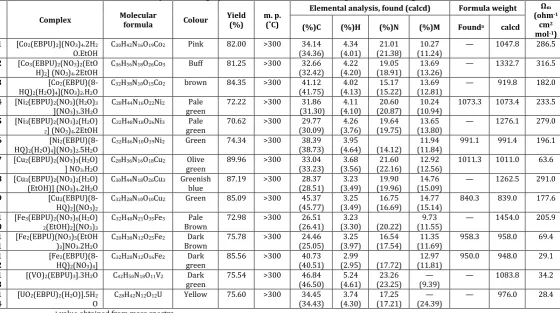
Reactions of the ligand, EBPU with Co(II), Ni(II), Cu(II), Fe(III), VO2+ and UO22+ ions, in the molar ratio 1:1 or 1:2 (L:M), yielded mononuclear, binuclear or trinuclear complexes. All of the complexes prepared were stable at room temperature, non-hygroscopic, insoluble in common organic solvents except DMF. The elemental analyses of the metal complexes of the ligand, EBPU were agreed well with the proposed formulae, table 1.
The molar conductance values of the complexes in DMF (10-3 M solutions) were measured at room temperature and the results were listed in Table 1. The complexes 12 , 13 and 14 have molar conductance values in the range 29.1 - 34.2 ohm-1 cm2 mol-1. The values show that these complexes have non-electrolytic nature. The molar conductance values of the complexes
7 and 11 were 63.6 and 69.4 ohm-1 cm2 mol-1, respectively, suggesting 1:1 electrolytic nature. The complexes 3, 6 and 9 have molar conductance values in the range 177.6 - 196.1 ohm-1 cm2 mol-1, suggesting 1:2 electrolytic nature. The molar conductance values of the complexes 4 and 10 were 233.5 and 205.9 ohm-1 cm2 mol-1, respectively, suggesting 1:3 electrolytic nature. The complexes 1, 2, 5 and 8
have molar conductance values in the range 279.0 - 316.5 ohm-1 cm2 mol-1, suggesting 1:4 electrolytic nature.23
IR spectra and mode of bonding
coordinated ligand is doubled, one band being nearly coincident with the corresponding one of free ligand at 1682 cm-1 and the other occurring at a lower frequency by 60-66 cm-1. This result has been interpreted in terms of the presence of both coordinated and noncoordinated (C=O) groups in the same ligand molecule.25 This is confirmed by the existence of new bands at 529-514 cm−1, which could be assigned to υ(M―O) bands.26 One of the ν(NH) bands of the coordinated ligand being nearly coincident with corresponding one of free ligand and the other shows slightly shift to a higher frequency and the intensity of this band has decreased suggesting coordination of the ligand with deprotonating of the amidic hydrogen's. For complexes 13 and 14, the ν(C=O) band of the coordinated ligand being nearly coincident with the corresponding one of the free ligand confirming that C=O group is not involved in complex formation and the intensity of one NH (amidic) bands of the coordinated ligand has decreased showing coordination of the ligand with deprotonating of the amidic hydrogen's. This is supported by the existence of new bands at 428-408 cm−1 which could be assigned to υ(M―N) bands.27 The results reveal that the ligand, EBPU acts as bi- or tetradentate towards the metal ions via the pyridine – N, the carbonyl – O and / or the amide – N atoms in a non, mono- and bis- deprotonated form. The nitrate vibrations in complexes 2, 4, 5, 7, 8, 10, 11 and
12 at 1411-1354, 1332-1281 and 1235-1224 cm-1 are indicative of the presence of monodentate nitrato groups28, 29 since the separation of the two highest frequency bands (under C2V symmetry) is small (<160 cm-1). The Presence of ionic NO3¯ ions in complexes 1 - 11 confirming by the appearance of the stretching vibration mode of ionic nitrate at 1443-1379 cm-1.30 The VO2+ complex 13 displayed a strong band at 985 cm-1, assignable to υ(V=O) moiety.31 The UO22+ complex 14 complex showed a new band at 926 cm-1, which may be assigned to the υ3(O=U=O), suggesting that the uranyl ion is linear.32 The IR spectrum of the free 8-hydroxyquinoline (8-HQ) shows a strong band at 1586 cm-1 due to the stretching vibration of the C=N group.33 This bandis shifted to a higher wavenumber on coordination for complexes 3, 6, 9 and 12 suggesting that the lone pair on nitrogen is involved in the formation of a bond with the metal ion. Moreover, the broad stretching vibration at 3242 cm-1 due to O―H band of the free 8-HQ ligand.34 was found to be absent in the latter complexes, suggesting the formation of a M―O bond with hydroxyquinolinate. Thus
8-hydroxyquinoline in all mixed ligand complexes
3, 6, 9 and 12 is a bidentate chelating ligand.
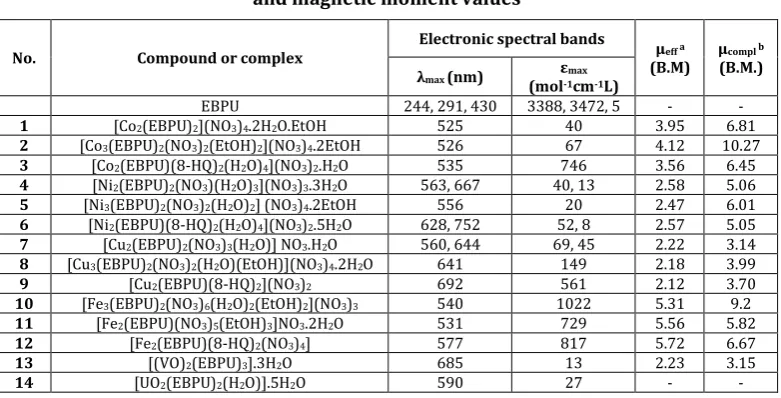
Electronic spectra and magnetic moment measurements
complex 5 showed a band at 556 nm, which can be assigned to 3T1 → 3T1 (P) transitions indicating tetrahedral geometry around Ni(II) ions, the shift of band to lower wavelength may be explained by the coordination of DMF solvent with Ni(II) ions in the complex and formation of octahedral structure. In case of the Ni(II) complexes 4 and 6 the electronic spectra display two bands at 563 and 667 , 628 and 752 nm, respectively, which can be assigned to 3A2g → 3T1g (P) and 3A2g → 3T1g (F) transitions in an octahedral geometries. The electronic spectra of the Fe(III) complexes 10, 11 and 12 showed one band in the range 531–577 nm corresponding to the 6A1g → 4T2g (G) transition, within the range reported for octahedral complexes.45 The values of magnetic moments of the complexes 10, 11
and 12 were 5.31; 5.56 and 5.76 B. M., respectively. These values reveal the presence of five unpaired electrons in the d-orbital per Fe(III) ion in a high spin octahedral geometry.46 The lower values than expected magnetic moment (which is around 5.92 B. M.), perhaps due to antiferromagnetic interactions between Fe(III) ions in the complexes. The electronic spectrum of the VO2+ complex 13 showed an absorption band at 685 nm, that can be assigned to 2B2→ 2E(υ1) or 2B2 → 2B1 (υ2) transition in square-pyramidal geometry.47 The magnetic moment value of the VO2+ complex 13 is 2.23 B.M. which is higher than the expected value for d1-system, suggesting an orbital contribution.48 The electronic spectrum of the UO2(II) complex 14 showed a band at 590 nm which is attributed to an electronic transition from the apical oxygen atoms to f-orbital of the uranium(VI) ion or due to charge transfer transition from the ligand to uranium(VI) ion.49 The uranyl complex 14 is diamagnetic as expected.
ESR spectra
To obtain further information about the stereochemistry of the Cu(II) complexes, ESR spectra of the Cu(II) complexes (7, 8 and 9) were recorded in the solid state at room temperature as shown in (figure 3) The X-band ESR spectrum of the Cu(II) complex 7 exhibits two signals at g = 2.072 and g׀׀= 2.261, gav =
1/3 (g׀׀+ 2 g) = 2.135. The shape of the ESR
signals is consistent with the octahedral geometry around the Cu(II) ions in this complex.50, 51 From the observed g - values, it is clear that g ׀׀ > g which indicates that the
unpaired electron is predominantly in the dx2-y2 orbital52-54 giving 2B1g as the ground state. The complexes 8 and 9 exhibited sharp signals at g
= 2.073 and 2.079, g׀׀= 2.271 and 2.254, gav =
2.139 and 2.137, respectively. The shape of signals and the g - values indicate tetrahedral
geometry around Cu2+ ions in these complexes. The g value is an important function for indicating covalent character of M-L bonds,55 for ionic character, g׀ ׀< 2.0023 and for covalent
character, g׀׀> 2.0023. In the present complexes
7, 8 and 9, the g is more than 2.0023 indicating appreciable covalent character for the Cu-L bond.55 In addition, the g-values are related by the expression, [G = (g׀׀ – 2.0023) / (g –
2.0023)], which measures the exchange interaction between copper centers in the solid state. According to Hathaway,56, 57 if the value of G is greater than four, the exchange interaction between a copper(II) centers in the solid state is negligible, whereas when G is lower than 4, a considerable exchange interaction is indicated in the solid complex. The calculated G-value of Cu(II) complexes 7, 8 and 9 were 3.712, 3.801 and 3.282, respectively, which lower than 4, suggesting that there are copper–copper exchange interactions.58
Mass spectra
The mass spectra for most of the complexes were performed to confirm the proposed formulae. The molecular ion peaks are coincident with the formula weights of the complexes, table 1. The mass spectra of the complexes, [Ni2(EBPU)2(NO3)(H2O)3] (NO3)3.3H2O (4); [Cu2(EBPU)2(NO3)3(H2O)]NO3.H2O (7) and [Fe2(EBPU) (8-HQ)2(NO3)4] (12), as representative examples, are depicted in (figure 4) The mass spectra of the complexes 4, 7 and
12 showed the molecular ion peaks at m/e 1073.3, 1011.3 and 950.0, respectively, which agree with the formula weights of these complexes.
Thermal studies
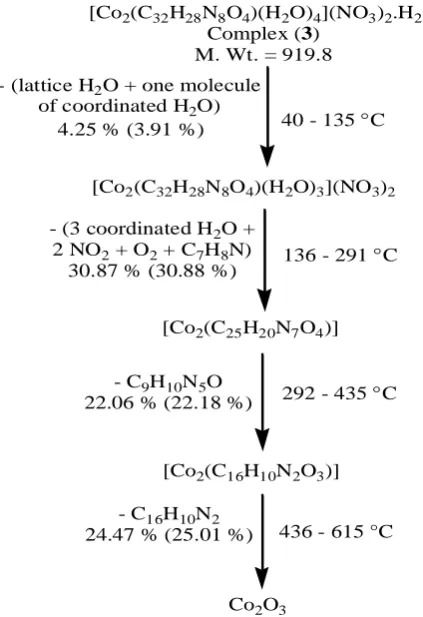
Thermogravimetric analysis (TGA) was mainly used to proof the associated water or solvent molecules to be in the inner or outer coordination sphere of the central metal ion.59 Complexes 1, 3, 4, 7, 11 and 13 were taken as representative examples for thermal analysis. The results of TGA of these complexes were recorded in table 4. The following detailed description of the TG thermogram of the complex 3 is given as an example and the TG thermograms of other complexes were obtained similarly.
TGA of complex 3 [Co2
(EBPU)(8-HQ)2(H2O)4](NO3)2.H2O
ranges 40 – 135, 136 – 291, 292 – 435 and 436 – 615 ºC, scheme 3. The first step showed removal of the non-coordinated water molecule in addition to one coordinated water molecule (weight loss: found%, 4.25; calcd.%, 3.91). The second step showed loss of three coordinated water molecules in addition to two ionisable nitrate groups and a fragment part (C7H8N) of the ligand (weight loss: found%, 30.87 ; calcd.%, 30.88). The third step showed removal of another fragment part (C9H10N5O) of the ligand (weight loss: found%, 22.06 ; calcd.%, 22.18). In the last step, the complex undergoes decomposition of the final part (C16H10N2) of the ligand within the temperature range up to 615 ºC (weight loss: found%, 24.47 ; calcd.%, 25.01) leading to the formation of Co2O3 (found 18.46 ; calcd.%, 18.03 %) as a final residue.
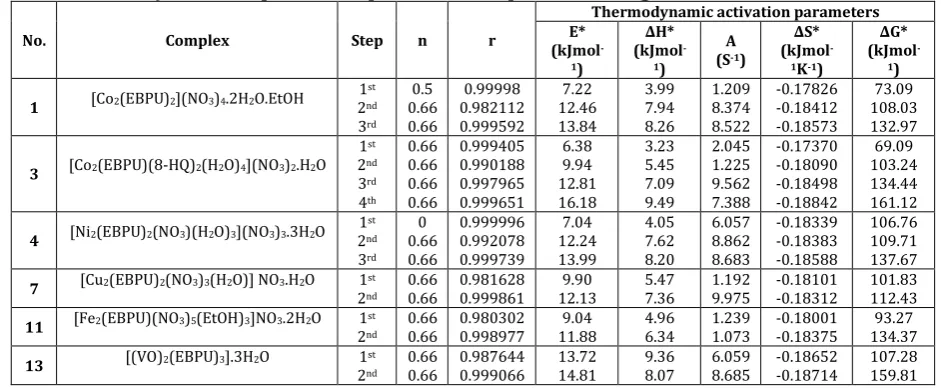
The thermodynamic and kinetic parameters for the different thermal decomposition steps in the complexes 1, 3, 4, 7, 11 and 13 were evaluated graphically by employing the Coats–Redfern equation.60 The results of the order (n), the activation energy (E*), the activation enthalpy (∆H* = E* – RT ), the activation entropy (∆S* = R [ln (Ah / KBT) – 1]) and the free energy of activation (∆G* = ∆H* – T∆S*) of the decomposition steps for the chosen complexes are listed in table 5, where A is a pre-exponential factor, K is Boltzmann’s constant and h is Plank’s constant, respectively. The ∆S* values were found to be negative which indicated that the activated complex is more ordered than the reactant and/or the thermal decomposition reaction is slower than normal.61 The positive sign of ∆G* revealed that the
decomposition steps are non-spontaneous processes. ∆G* values increase with increasing the order of the decomposition stages which indicates that at high temperatures the ligand decomposes and requires more energy for its rearrangement in the activated state62 this may be attributed to the structural rigidity of the remaining complex after the expulsion of one and more ligands, as compared with the precedent complex, which required more energy for its rearrangement before undergoing any compositional change. The positive values of ∆H* means that the decomposition processes are endothermic.
3D Molecular modeling study
The molecular modeling of a representative complex, [Cu2(EBPU)2(NO3)3(H2O)] NO3 .H2O (7) is shown in (figure 5) The C=O bonds (C12-O14 and C28-O30) are longer by 0.024 A° than that in the free ligand, which indicate that the coordination take place through carbonyl groups with two O, N-donors of the ligand, EBPU at the equatorial positions in trans-arrangement to each other, is based on its octahedral structure.
from the interpretation of elemental and thermal analyses together with results of spectral data (infrared, electronic, mass and ESR) as well as magnetic susceptibility measurements at room temperature and conductivity measurements, it is possible to draw up the tentative structures of the metal complexes. The proposed structures of the metal complexes under study can be represented as follows:
z NO3. n H2O. mEtOH
N H
N O
NH
H
N HN
O N
N
N H N H
O
O N H
NH N
M
M X Y
X X
M X Y z n m
(15) Co(II) 4 2 1 (21) Cu(II) NO3 H2O 1 1 0
M X Y z n m
(1) Co(II) - - 4 2 1 (7) Cu(II) NO3- H2O 1 1 0
N NH
NH O
HN
NH O
N
N NH
NH O
NH
NH O
N
M M
O3N
O3N
M X EtOH
(NO3)4. 2 Z
M X Z
(2) Co EtOH EtOH (8) Cu H2O H2O
The proposed structures of the trinuclear complexes (2) and (8)
N H N
NH
O HN HN
O N
M
M
X
X
X
X
N O
N O
nNO3.ZH2O
M X n Z
(
17
) Co(II) H
2O 2 1
(
23
) Cu(II)
(
26
) Fe(III) NO
3
0 0
M X n z
(3) Co(II) H2O 2 1
(9) Cu(II) - 2 0 (12) Fe(III) NO3- 0 0
The proposed structures of the mixed ligand complexes (3), (9) and (12)
(NO3)3. 3H2O N
H N
NH O
H N
N H
N O
N
N H O NH
N H N
O N
H Ni
Ni OH
2
O3N OH2 H
2O
N NH
NH O
HN
N NH
NH O
NH Ni
Ni H2O
H2O
Ni NO3
NO3
HN
O N
HN O
N
(NO3)4. 2 EtOH
The proposed structure of the trinuclear Ni(II) complex (5)
N H N
NH
H
N HN
N O O
Ni
Ni
OH
2H
2O
OH
2H
2O
N O
N O
(NO3)2. 5H2O
The proposed structure of the mixed ligand complex (6)
N NH
NH O
HN
O HN
N
N NH
NH O
HN O
HN N Fe
Fe NO3
NO3 O3N H2O
EtOH
EtOH
Fe NO3
NO3
OH2
O3N (NO3)3
N
NH
NH O
HN HN
O
N
Fe
Fe
NO
3NO
3O
3N
O
3N
O
3N
EtOH
EtOH
E
tO
H
(NO
3). 2H
2O
The proposed structure of the binuclear Fe(III) complex (11)
N NH
NH O
N
N H
O N
N NH
N
N
HN O
N O
V O
N NH N
O HN
HN O N
V O
. 3H2O
The proposed structure of the binuclear VO2+ complex (13)
N H
N NH
O
N H N O
N
H N N
N
H O
N HN
O N
U O
O
H2O
5 H2O
The proposed structure of the mononuclear UO22+ complex (14)
CONCLUSION
A new ethylene-1,2-bis(3-pyridin-2-ylurea) ligand, EBPU and its metal complexes with vanadyl(II), iron(III), cobalt(II), nickel(II), copper(II) and uranyl(II) ions were synthesized
complexes exhibited tetrahedral, octahedral and square pyramidal geometrical arrangements. The thermodynamic and kinetic parameters for the different thermal decomposition steps in some of the complexes were evaluated graphically by employing the Coats–Redfern
equation. 3D molecular modeling of the ligand and a representative Cu(II) complex indicate that the coordination take place through carbonyl groups with two O, N-donor of the ligand.
N NH2
drop of piperidine fussion
+
(6 h)
Cl OC2H5
O
N N
H OC2H5 O
(EPC)
N N
H O
OC2H5 H2N NH2
N N H O N H N H O N H N + 2 DMF
reflux (4 h)
Ligand, EBPU
Scheme. 1: Synthesis of the ligand, EBPU
N
H N HN
O
H N HN
O N
M m/z 300 (21.02 %)+
(M+1) m/z 301 (24.75 %)+
(M+2) m/z 302 (21.02 %) (M+3) m/z 303 (26.78 %)
+ + (1) (2) N
-C6H5N2O
+H
+
H N HN
O
NH2 +
m/z 180 (6.10 %)
N H N HN
O CH2
m/z 150 (27.80 %)
H2NCH2CH2NHCONH2
m/z 103 (17.63 %)
+
H2NCH2CH2NHCOH
m/z 88 (22.03 %)
+
CH2NHCHO
m/z 58 (30.51 %)
+ N H N NH O N H N NH N H +
m/z 136 (21.02 %) m/z 108 (3.73 %)
m/z 78 (9.49 %)
+ + N H N O N H NH
O
N
+
N H NH
O N + H N N H N N NH2 N N + + N H + + (D) (C) -NH2 +H
-CH2NH2 (D) (C) -NH 2 +H (2) (1)
m/z 285 (23.73 %)
m/z 229 (23.05 %)
-C3H5O
+H (B) (A) (B) (B) -C2H5N2
+H -CH 3N 2O (A) -CO -NH 2NH +H
-C5H4N
+H
-NH2
m/z 94 (53.90 %)
m/z 171 (24.07 %) -HCN
-NH2
m/z 67 (100 %) (base Peak)
m/z 51 (67.80 %)
Scheme 14. Mass fragmentation pattern of EBPU (H2L2) ligand
+H -C
2H4N
CH2 NH2
[Co2(C32H28N8O4)(H2O)4](NO3)2.H2O Complex (3)
M. Wt. = 919.8
40 - 135 C - (lattice H2O + one molecule
of coordinated H2O) 4.25 % (3.91 %)
[Co2(C32H28N8O4)(H2O)3](NO3)2
136 - 291 C - (3 coordinated H2O +
2 NO2 + O2 + C7H8N) 30.87 % (30.88 %)
Residue, 18.46 % (18.03 %) [Co2(C25H20N7O4)]
292 - 435 C - C9H10N5O
22.06 % (22.18 %)
[Co2(C16H10N2O3)]
- C16H10N2
24.47 % (25.01 %) 436 - 615 °C
Co2O3
Scheme. 3:Proposed thermal decomposition pattern of the complex 3
Fig. 2: The optimized structure of the ligand EBPU
Fig. 3: X-band ESR spectra of Cu (II) complexes [Cu2(EBPU)2(NO3)3(H2O)] NO3.H2O (7),
[Cu3(EBPU)2(NO3)2(H2O)(EtOH)] (NO3)4.2H2O (8) and [Cu2(EBPU)(8-HQ)2](NO3)2 (9)
Fig. 4: Mass spectra of the [Ni2(EBPU)2(NO3)(H2O)3](NO3)3.3H2O(4),
[Cu2(EBPU)2(NO3)3(H2O)]NO3.H2O(7) and [Fe2(EBPU) (8-HQ)2(NO3)4] (12) complexes
Table 1: Analytical and physical data of the metal complexes of the ligand EBPU
Complex Molecularformula Colour Yield(%) m. p.(˚C)
Elemental analysis, found (calcd) Formula weight Ωm
(ohm-1
cm2
mol-1)
(%)C (%)H (%)N (%)M Founda calcd
1 [Co2(EBPU)2](NO3)4.2H2
O.EtOH C30H42N16O19Co2 Pink 82.00 >300 (34.36)34.14 (4.01)4.34 (21.38)21.01 (11.24)10.27 — 1047.8 286.5
2 [Co3(EBPU)2(NO3)2(EtO
H)2] (NO3)4.2EtOH
C36H56N18O26Co3 Buff 81.25 >300 32.66
(32.42) (4.20)4.22 (18.91)19.05 (13.26)13.69 — 1332.7 316.5
3 [Co2
(EBPU)(8-HQ)2(H2O)4](NO3)2.H2O
C32H38N10O15Co2 brown 84.35 >300 41.12
(41.75) (4.13)4.02 (15.22)15.17 (12.81)13.69 — 919.8 182.0
4 [Ni2(EBPU)2(NO3)(H2O)3
](NO3)3.3H2O
C28H44N16O22Ni2 Pale
green 72.22 >300 (31.30)31.86 (4.10)4.11 (20.87)20.60 (10.94)10.24 1073.3 1073.4 233.5
5 [Ni3(EBPU)2(NO3)2(H2O) 2] (NO3)4.2EtOH
C32H48N18O26Ni3 Pale
green 70.62 >300 (30.09)29.77 (3.76)4.26 (19.75)19.64 (13.80)13.65 — 1276.1 279.0
6 [Ni2
(EBPU)(8-HQ)2(H2O)4](NO3)2.5H2O
C32H46N10O19Ni2 Green 74.34 >300 38.39
(38.73) (4.64)3.95 (14.12) (11.84)11.94 991.1 991.4 196.1
7 [Cu2(EBPU)2(NO3)3(H2O)
] NO3.H2O
C28H36N16O18Cu2 Olive
green 89.96 >300 (33.23)33.04 (3.56)3.68 (22.16)21.60 (12.56)12.92 1011.3 1011.0 63.6
8 [Cu3(EBPU)2(NO3)2(H2O)
(EtOH)] (NO3)4.2H2O
C30H44N18O26Cu3 Greenish
blue 87.19 >300 (28.51)28.37 (3.49)3.23 (19.96)19.90 (15.09)14.76 — 1262.5 291.0
9 [Cu2
(EBPU)(8-HQ)2](NO3)2
C32H28N10O10Cu2 Green 85.09 >300 45.37
(45.77) (3.49)3.25 (16.69)16.75 (15.14)14.77 840.3 839.0 177.6
1
0 [Fe3(EBPU)2(EtOH)2(NO32)](NO6(H2O)3)3
C32H48N21O35Fe3 Pale
Brown 72.98 >300 (26.41)26.51 (3.30)3.23 (20.22) (11.55)9.73 — 1454.0 205.9
1
1 [Fe2(EBPU)(NO)3]NO3)53(EtOH.2H2O
C20H38N12O25Fe2 Dark
Brown 75.78 >300 (25.05)24.46 (3.97)3.25 (17.54)16.54 (11.69)11.35 958.3 958.0 69.4
1
2 [FeHQ)2(EBPU)(8-2(NO3)4]
C32H28N12O16Fe2 Dark
green 85.56 >300 (40.51)40.73 (2.95)2.99 (17.72) (11.81)12.97 950.0 948.0 29.1
1
3 [(VO)2(EBPU)3].3H2O C42H50N18O11V2 greenDark 75.54 >300 (46.50)46.84 (4.61)5.24 (23.25)23.26 (9.39)— — 1083.8 34.2
1 4
[UO2(EBPU)2(H2O)].5H2
O
C28H42N12O12U Yellow 75.60 >300 34.45
(34.43)
3.74 (4.30)
17.25 (17.21)
— (24.39)
— 976.0 28.4
a value obtained from mass spectra.
Table 2: Important IR spectral data and their assignment for the ligand EBPU and its metal complexes
No. Compound or complex
IR spectral bands (cm-1)
υ(OH) (H2O/EtO
H) υ(NH) υ(C=O)
Pyridine stretching vibrations
υ(M—
O) υ(M—N) Other bands
EBPU (H2L2) — 3219, 3090 1682 1584, 1479 — — —
1 [Co2(EBPU)2](NO3)4.2H2O.EtOH 3462 3289, 3093 1679, 1618 1583, 1486 519 423 υ(NO13843¯)ionic
2 [Co3(EBPU)2(NO3)2(EtOH)2]
(NO3)4.2EtOH 3462
3288,
3093 1678, 1617 1581, 1484 519 423
υ(NO3¯)ionic,
υ(NO3¯)monodentate
1433 1400, 1329, 1234
3 [Co2
(EBPU)(8-HQ)2(H2O)4](NO3)2.H2O 3461
3290,
3093 1678, 1617 1579, 1485 517 414 υ(NO13843¯)ionic
4 [Ni2(EBPU)2(NO3)(H2O)3](NO3)3.3H2
O 3462 3290, 3093 1682, 1622 1583, 1486 519 427
υ(NO3¯)ionic,
υ(NO3¯)monodentate
1435 1384, 1332, 1233
5 [Ni3(EBPU)2(NO3)2(H2O)2]
(NO3)4.2EtOH
3465 3290,
3092 1682, 1621 1581, 1485 519 427
υ(NO3¯)ionic,
υ(NO3¯)monodentate
1437 1394, 1330, 1231
6 [Ni2
(EBPU)(8-HQ)2(H2O)4](NO3)2.5H2O 3462
3292 ,
3093 1682, 1622 1581, 1485 517 418 υ(NO13843¯)ionic
7 [Cu2(EBPU)2(NO3)3(H2O)] NO3.H2O 3375 3281, 3091 1679, 1617 1565, 1483 520 428
υ(NO3¯)ionic,
υ(NO3¯)monodentate
1432 1383, 1282, 1232
8 [Cu3(EBPU)2(NO3)2(H2O)(EtOH)]
(NO3)4.2H2O 3543
3282,
3091 1681, 1617 1565, 1483 519 428
υ(NO3¯)ionic,
υ(NO3¯)monodentate
1431 1354, 1281, 1232,
9 [Cu2(EBPU)(8-HQ)2](NO3)2 — 3230, 3092 1680, 1616 1572, 1496 523 417 υ(NO13793¯)ionic
O3)3 3093 1616 υ(NO3¯)monodentate
1443 1384, 1284, 1235
11 [Fe2(EBPU)(NO3)5(EtOH)3]NO3.2H2O 3390 3252, 3092 1678, 1616 1581, 1482 514 423
υ(NO3¯)ionic,
υ(NO3¯)monodentate
1437 1411, 1310, 1224
12 [Fe2(EBPU)(8-HQ)2(NO3)4] ― 3283, 3092 1678, 1620 1576, 1500 514 417 υ(NO1384, 1292, 12333¯) monodentate
13 [(VO)2(EBPU)3].3H2O 3356 3269, 3090 1686, 1647 1577, 1484 518 408 υ(V=O)985
14 [UO2(EBPU)2(H2O)].5H2O 3356 3268, 3091 1686, 1647 1577, 1486 518 408 υ(O=U=O)926
Table 3: Electronic absorption spectral data (in DMF solution)
and magnetic moment values
a μeff (B.M.) of one cationic species in the complex; b μeff (B.M.) the
total magnetic moments of all cations in the complex.
No. Compound or complex Electronic spectral bands μeff a
(B.M) μ(B.M.)compl b λmax (nm) (molε-1maxcm-1L)
EBPU 244, 291, 430 3388, 3472, 5 -
-1 [Co2(EBPU)2](NO3)4.2H2O.EtOH 525 40 3.95 6.81
2 [Co3(EBPU)2(NO3)2(EtOH)2](NO3)4.2EtOH 526 67 4.12 10.27
3 [Co2(EBPU)(8-HQ)2(H2O)4](NO3)2.H2O 535 746 3.56 6.45
4 [Ni2(EBPU)2(NO3)(H2O)3](NO3)3.3H2O 563, 667 40, 13 2.58 5.06
5 [Ni3(EBPU)2(NO3)2(H2O)2] (NO3)4.2EtOH 556 20 2.47 6.01
6 [Ni2(EBPU)(8-HQ)2(H2O)4](NO3)2.5H2O 628, 752 52, 8 2.57 5.05
7 [Cu2(EBPU)2(NO3)3(H2O)] NO3.H2O 560, 644 69, 45 2.22 3.14
8 [Cu3(EBPU)2(NO3)2(H2O)(EtOH)](NO3)4.2H2O 641 149 2.18 3.99
9 [Cu2(EBPU)(8-HQ)2](NO3)2 692 561 2.12 3.70
10 [Fe3(EBPU)2(NO3)6(H2O)2(EtOH)2](NO3)3 540 1022 5.31 9.2
11 [Fe2(EBPU)(NO3)5(EtOH)3]NO3.2H2O 531 729 5.56 5.82
12 [Fe2(EBPU)(8-HQ)2(NO3)4] 577 817 5.72 6.67
13 [(VO)2(EBPU)3].3H2O 685 13 2.23 3.15
-Table 4: Results of thermogravimetric analysis (TGA) of some complexes of the ligand EBPU
Complex
No. Molecular formula of the complex(M. Wt.) TemperatureRange (˚C) Found % (calcd %)Wt loss % Decomposed product lost
1 [Co2(EBPU)2](NO3)4.2H2O.EtOH
(1047.8)
73 - 163 164 - 303 304 - 521
6.09 (6.11) 45.79 (45.62) 27.40 (27.39) 20.92 (20.88)
lattice EtOH + one molecule of
lattice H2O
lattice H2O + 4
NO2 + 2 O2 +
C10H8N2 + 2 C2H4
C12H13N7O2
Residue, Co2(C2H3N3O2)
3 HQ)2[Co(H22O)(EBPU)(8-4](NO3)2.H2O
(919.8)
40 - 135 136 - 291 292 - 435 436 - 615
4.25 (3.91) 30.87 (30.88) 22.06 (22.18) 24.47 (25.01) 18.46 (18.03)
lattice H2O +
one molecule of coordinated H2O
3 coordinated H2O + 2 NO2 + O2
+ C7H8N
C9H10N5O
C16H10N2
Residue, Co2O3
4 [Ni2(EBPU)2(NO3)(H2O)3](NO3)3.3H2O
(1073.4)
43 - 161 162 - 354 355 - 585
5.14 (5.03) 43.31 (42.67) 21.37 (21.15) 30.18 (31.15)
3 lattice H2O
3 coordinated H2O + 4 NO2 + 2
O2 + C10H8N2
C14H17N3
Residue, Ni2(C4H7N7O4)
7 [Cu2(EBPU)2(NO3)3(H2O)] NO3.H2O
(1011.0) 288 - 64664 - 287
44.42 (43.52) 24.37 (23.94) 32.01 (32.54)
lattice H2O +
coordinated H2O
+ 4 NO2 + 2 O2 +
C10H8N2
C14H18N4
Residue, Cu2(C2H3N3O2)2
11 [Fe2(EBPU)(NO3)5(EtOH)3]NO3.2H2O
(958.0)
29 - 274
275 - 531 54.16 (53.65)9.85 (9.81) 36.02 (36.53)
2 lattice H2O + 3
coordinated EtOH + 6 NO2 +
2 O2
C5H6N2
Residue, Fe2(C9H10N4O4)
13 [(VO)2(EBPU)3].3H2O
(1083.8)
108 - 426
427 - 674 71.58 (71.23)9.11 (8.49) 19.55 (20.28)
3 lattice H2O +
C35H38N14O4
C5H4N2
Table 5: The order (n), temperature of decomposition and activation parameters (E*, ∆H*, ∆S*, ∆G*) for decomposition steps of some complexes of the ligand EBPU
Thermodynamic activation parameters r n Step Complex No. ∆G* (kJmol -1) ∆S* (kJmol
-1K-1)
A (S-1)
∆H* (kJmol -1) E* (kJmol -1) 73.09 108.03 132.97 -0.17826 -0.18412 -0.18573 1.209 8.374 8.522 3.99 7.94 8.26 7.22 12.46 13.84 0.99998 0.982112 0.999592 0.5 0.66 0.66 1st 2nd 3rd
[Co2(EBPU)2](NO3)4.2H2O.EtOH
1 69.09 103.24 134.44 161.12 -0.17370 -0.18090 -0.18498 -0.18842 2.045 1.225 9.562 7.388 3.23 5.45 7.09 9.49 6.38 9.94 12.81 16.18 0.999405 0.990188 0.997965 0.999651 0.66 0.66 0.66 0.66 1st 2nd 3rd 4th
[Co2(EBPU)(8-HQ)2(H2O)4](NO3)2.H2O
3 106.76 109.71 137.67 -0.18339 -0.18383 -0.18588 6.057 8.862 8.683 4.05 7.62 8.20 7.04 12.24 13.99 0.999996 0.992078 0.999739 0 0.66 0.66 1st 2nd 3rd
[Ni2(EBPU)2(NO3)(H2O)3](NO3)3.3H2O
4 101.83 112.43 -0.18101 -0.18312 1.192 9.975 5.47 7.36 9.90 12.13 0.981628 0.999861 0.66 0.66 1st 2nd
[Cu2(EBPU)2(NO3)3(H2O)] NO3.H2O
7 93.27 134.37 -0.18001 -0.18375 1.239 1.073 4.96 6.34 9.04 11.88 0.980302 0.998977 0.66 0.66 1st 2nd
[Fe2(EBPU)(NO3)5(EtOH)3]NO3.2H2O
11 107.28 159.81 -0.18652 -0.18714 6.059 8.685 9.36 8.07 13.72 14.81 0.987644 0.999066 0.66 0.66 1st 2nd
[(VO)2(EBPU)3].3H2O
13
REFERENCES
1. Belda O and Moberg C. Bispyridylamides—coordination chemistry and applications in catalytic reactions. Coord. Chem. Rev.2005;249:727–740.
2. Kovacs JA. Synthetic Analogues of Cysteinate-Ligated Non-Heme Iron and Non- Corrinoid Cobalt Enzymes. Chem. Rev. 2004;104(2):825-848.
3. Mishra A, Ali A, Upreti S and Gupta R. Cobalt Coordination Induced Functionalized Molecular Clefts: Isolation of {CoIII−ZnII} Heterometallic Complexes and Their Applications in Beckmann Rearrangement Reactions. Inorg. Chem. 2008; 47(1):154-161. 4. Ghosh K, Eroy-Reveles AA, Olmstead
MM and Mascharak PK. Reductive Nitrosylation and Proton-Assisted Bridge Splitting of a (μ-Oxo)dimanganese(III) Complex Derived from a Polypyridine Ligand with One Carboxamide Group.Inorg. Chem. 2005;44(23):8469-8475.
5. Amiri A, Amirnasr M, Meghdadi S, Mereiter K, Ghodsi V and Gholami A. Structural effects on electrochemical properties of the carboxamide complexes [NiII(Mebpb)] and [NiII(Mebqb)]. Inorg. Chim. Acta. 2009;362(11):3934-3940.
6. Korendovych IV, Kryatova OP, Reiff WM and Rybak-Akimova EV. Iron(II) Complexes with Amide-Containing Macrocycles as Non-Heme Porphyrin
Analogues. Inorg. Chem. 2007;46(10):4197–4211.
7. Pratt MD and Beer PD. Anion recognition and sensing by mono- and bis-urea substituted ferrocene receptors. Polyhedron. 2003;22:649– 653.
8. Bondy CR, Gale PA and Loeb SJ. Metal−Organic Anion Receptors: Arranging Urea Hydrogen-Bond Donors to Encapsulate Sulfate Ions. J. Am. Chem. Soc. 2004; 126(16):5030-5031. 9. Turner DR, Smith B, Goeta AE, Evans IR,
Tocher DA, Howard JAK and Steed JW. The R21(6) hydrogen-bonded synthon in neutral urea and metal-bound halide systems. Cryst. Eng. Comm. 2004;6:633-641.
10. Redmore SM, Rickard CEF, Webb SJ and James Wright L. Ruthenium Complexes of a Simple Tridentate Ligand Bearing Two “Distal” Pyridine Base. Inorg. Chem. 1997;36(21):4743–4748.
11. Kawamoto T, Hammes BS, Ostrander R, Rheingold AL and Borovik AS. Synthesis and Structures of Nickel(II) and Copper(II) Complexes of 2,6-Bis[(2-acetylphenyl)carbamoyl]pyridine: Effects of Molecular Structure on Crystal Lattice Architecture. Inorg. Chem. 1998;37(13):3424-3427.
13. Trost BM and Hachiya I. Asymmetric Molybdenum-Catalyzed Alkylations. J. Am. Chem. Soc. 1998;120(5):1104– 1105.
14. Singha NC and Sathyanarayana DN. 1H and 13C NMR investigations of N,N′-bis(2- and 3-pyridinyl)-2,6-pyridine dicarboxamides. J. Mol. Struct. 1997;403:123–135.
15. Van Beusichem M and Farrell N. Activation of the trans geometry in platinum antitumor complexes. Synthesis, characterization, and biological activity of complexes with the planar ligands pyridine, N-methylimidazole, thiazole, and quinoline. Crystal and molecular structure of trans-dichlorobis(thiazole) platinum(II). Inorg. Chem. 1992;3(4);634–639
16. Bierbach U, Qu y, Hambley TW, Peroutka J, Ngayen HL, Doedee M and Farrell N. Synthesis, Structure, Biological Activity, and DNA Binding of Platinum(II) Complexes of the Type trans-[PtCl2(NH3)L] (L = Planar Nitrogen Base). Effect of L and Cis/Trans Isomerism on Sequence Specificity and Unwinding Properties Observed in Globally Platinated DNA. Inorg. Chem.1999;38(15): 3535–3542. 17. Selwood PW. Magnetochemistry.
Interscience, New York. 1956; 78–91. 18. Vogel AI. A Textbook of Quantitative
Inorganic Analysis. Longman,London. 1987;4th Edn.
19. El-ghamry MA, Saleh AA, Khalil SME and Mohammed AA. Mono, bi- and trinuclear metal complexes derived from new benzene-1,4-bis(3-pyridin-2-ylurea) ligand. Spectral, magnetic, thermal and 3D molecular modeling studies. Spectrochim. Acta Part A. 2013;110:205-216.
20. Chandra S, Saleem H, Sebastian S and Sundaraganesan N. The spectroscopic (FT-IR, FT-Raman), NCA, first order hyperpolarizability, NBO analysis, HOMO and LUMO analysis of l-cysteine by ab inito HF and density functional method
Spectrochim. Acta Part A. 2011;78:1515-1524.
21. Condorelli G, Seminara A and Musumeci A. Lanthanide complexes with picolinamide. J. Inorg. Nucl. Chem. 1974;36:3763-3766. 22. Sun W, Zhang W, Gao T, Tang X, chen L,
Li Y and Jin X. Synthesis and
characterization of N-(2-pyridyl)benzamide-based nickel complexes and their activity for ethylene oligomerization. J. Organomet. Chem. 2004;689:917-929.
23. Geary WJ. The use of conductivity measurements in organic solvents for the characterisation of coordination compounds. Coord. Chem. Rev. 1971; 81–122.
24. Gudasi K, Vadavi R, Shenoy R, Patil M, Patil SA and Nethaji M. Transition metal complexes of a tridentate ligand bearing two pendant pyridine bases: The X-ray crystal structure of pentacoordinate copper(II) complex. Inorg. Chim. Acta. 2005;358: 3799-3806.
25. Zafiropoulos ThF, Plakatouras JC and perlepes SP. Preparation and properties of complexes of lanthanide(III) salts with n-(2-pyridyl) pyridine-2′-carboxamide. Polyhedron. 1991;10:2405-2415.
26. Chandra S, Pipil P and Sharma SD. Synthesis, EPR, and electronic spectral studies on Cr(III) and Mn(II) complexes of some oximes. Synth. React. Inorg. Met-Org. Chem. 2001;3:779-794. 27. Saleh AA. Synthesis and spectroscopic
studies of novel mononuclear complexes of cyclic and acyclic Schiff-base derivatives of tridentate and tetradentate coordination with some bivalent transition metal ions.J. Coord. Chem. 2005;58 (3):255-270.
28. Nakamoto K. Infrared and raman spectra of Inorganic and Coordination Compounds. Wiley Interscience, New York.1986;4th Edn:258.
29. Casellato U, Vigato pA and Vidali M. Actinide nitrate complexes. Cood. Chem. Rev. 1981;36:183–265.
30. Kleywegt GJ, Wiesmeijer WR, Van Driel GJ, Driessen WL and Reedijk J. Unidentate versus symmetrically and unsymmetrically bidentate nitrate co-ordination in pyrazole-containing chelates. The crystal and molecular structures of (nitrato-O)[tris(3,5-
dimethylpyrazol-1-ylmethyl)amine]copper(II) nitrate, (nitrato-O,O′)[tris(3,5-dimethylpyrazol-1-ylmethyl)amine]nickel(II) nitrate, and (nitrato-O)(nitrato-O,O′)[tris(3,5-
31. Bailar JC, Emeleus H, Nyholm JR, Dickenson AFT. Comprehensive Inorganic Chemistry. Pergamon Press, Oxford, New York.1995;1st Edn:517. 32. Nakamoto K. Infrared and raman
spectra of Inorganic and Coordination Compounds. Wiley Interscience, New York.1997;5th Edn:267.
33. Sonsale AY, Gopinathan S and Gopinathan C. Indian J. Chem. 1976;14A:408.
34. Dhammani A, Bohra R and Mehrotra RC. Synthesis and characterization of some unique heterocyclic derivatives containing aluminium(III) atoms in different coordination states—4. Reaction of bis(β-diketonato) aluminium(III)-di-μ-isopropoxo-di-isopropoxo aluminium(III) with 8-hydroxyquinoline Polyhedron. 1998;17(1):163-171.
35. Shankera K, Rohinia R, Ravindera V, Reddyb PM and Hob YP. Ru(II) complexes of N4 and N2O2 macrocyclic Schiff base ligands: Their antibacterial and antifungal studies. Spectrochim. Acta Part A. 2009;73(1):205-21.
36. Saleh AA, El-ghamry MA, Namasha KS and Abu El-Wafa SM. Synthesis, spectroscopic and biological characterization of Cr(III), Mn(II), Co(II), Ni(II) and Cu(II) complexes with new macrocyclic tetradentate [N4] Schiff base ligands. Egypt. J. Chem. 2010;53:821.
37. Karaoglu K, Baran T, Serbest K and Degirmencioglu MEI. Two novel macroacyclic schiff bases containing bis-N2O2 donor set and their binuclear complexes: synthesis, spectroscopic and magnetic properties. J. Mol. Struct. 2009;922(1):39-45.
38. Cotton FA and Wilkinson G. Advanced inorganic chemistry. John Willey, New York. 1972; 3rd Edn:541.
39. Khan TA, Rather MA, Jahan N, Vankey SP and Shakir M. Synthesis and Characterization of bis(Macrocyclic) Complexes Based on the 13-Membered Pentaaza Unit. Synth. React. Inorg.Met.-Org. Chem. 1997; 27:843-854.
40. Sone K and Fukuda Y. Inorganic Thermochromism. Springer, Heidelberg. 1987;1st Edn.
41. Lever ABA. Inorganic electronic spectra. Elsevier, Amsterdam. 1968.
42. Ismail TMA, Saleh AA and El-ghamry MA. Tetra- and hexadentate Schiff base ligands and their Ni(II), Cu(II) and
Zn(II) complexes. Synthesis, spectral, magnetic and thermal studies. Spectrochim. Acta Part A. 2012; 86:276-288.
43. Swamy SJ and Pola S Spectroscopic studies on Co(II), Ni(II), Cu(II) and Zn(II) complexes with a N4-macrocylic ligands. Spectrochim. Acta Part A. 2008;70(4):929-933.
44. Sreedarana S, Bharathia KS, Rahimana AK, Suresha R, Jegadeeshb R, Raamanb N and Narayanana V. Electrochemical, catalytic and antimicrobial activities of N-functionalized cyclam based unsymmetrical dicompartmental binuclear nickel(II) complexes. Spectrochim. Acta Part A. 2009;74(4):849-854.
45. Cotton FA, Wilkinson G. Advanced Inorganic Chemistry. Interscience Publishers, London.1974.
46. Griffith WP and Mostafa SI. Complexes of 3-hydroxypyridin-2-one and 1,2-dimethyl-3-hydroxypyridin-4-one with second and third row elements of groups 6, 7 and 8. Polyhedron. 1992;11(23):2997-3005.
47. Petrovic AF, Oeovac VM and Ribar B. Synthesis, structural and spectral investigations of new types of dioxovanadium(V) complexes with S-methylthiosemicarbazones derived from salicyl and 2,4-dihydroxybenzaldehydes. X-ray
structure of
ammonium(salicylaldehydeS-methylthiosemicarbazonato)
dioxovanadate(V) monohydrate.Trans. Met. Chem. 1986;1, 207-213.
48. Khalil SME, El-Shafiy HFO. Vo(IV), Fe(III), Co(II) and Cd(II) Complexes of Asymmetric Schiff Base Ligands (N2O3). Synthesis and Spectroscopic Studies. Synth. React. Inorg. Met.-Org. Chem. 2000;30:1817-1833.
49. Khalil SME. Synthesis, Spectroscopic and Magnetic Studies on Metal Complexes of 5-Methyl-3-(2-Hydroxyphenyl)Pyrazole. J. Coord. Chem. 2003;56: 1013-1024.
50. Kasumov T, Tas E, kartal I, Ucun F, Koksal F and Cukuroval A. complexation of metal ions with 3,5-di-tert-butyl-1,2-benzoquinone-1-monooxime, ESR studies of radical intermediates. J. Coord. Chem. 2001;52:207-227.
52. Dhara PK, Pramanik S, Lu T, Drew MGB and Challopadhyay P. Copper(II) complexes of new tetradentate NSNO pyridylthioazophenol ligands: synthesis, spectral characterization and crystal structure. Polyhedron. 2004;23(16):2457-2464.
53. Sebastian M, Arun V, Robinson PP, Varghese AA, Abraham R, Suresh E and Yusuff KKM. Synthesis, structural characterization and catalytic activity study of Mn(II), Fe(III), Ni(II), Cu(II) and Zn(II) complexes of quinoxaline-2-carboxalidine-2-amino-5-methylphenol: Crystal structure of the nickel(II) complex. Polyhedron. 2010;29(15):3014-3020.
54. Rapheal PF, Manoj E and Kurup MRP. Copper(II) complexes of N(4)-substituted thiosemicarbazones derived from pyridine-2-carbaldehyde: Crystal structure of a binuclear complex. Polyhedron. 2007;26:818–828.
55. Jasinski JP, Bianchani JR, Cuva J, El-Said FA, El-Asmy AA and West DX. Hexanedione Bis(3-azacyclothiosemicarbazones). Z. Anorg. Allg. Chem. 2003;629: 202-206.
56. Hathaway BJ. Complex Chemistry. Struct. Bond. 1984;57: 55-118.
57. Hathaway BJ, Billing DE. The electronic properties and stereochemistry of mono-nuclear complexes of the copper(II) ion. Coord. Chem. Rev. 1970; 5:143–207.
58. El-Ayaan U and Gabr IM. Thermal, spectroscopic, and solvent influence studies on mixed-ligand copper(II) complexes containing the bulky ligand: Bis[N-(p-tolyl)imino]acenaphthene. Spectrochim. Acta A. 2007;67(1):263-272.
59. Shebl M, El-ghamry MA, Khalil SME and Kishk MAA. Mono- and binuclear copper(II) complexes of new hydrazone ligands derived from 4,6-diacetylresorcinol: Synthesis, spectral studies and antimicrobial activity. Spectrochim. Acta Part A. 2014;126:232-241.
60. Coats AW and Redfern JP. Kinetic Parameters from Thermogravimetric Data. Nature. 1964;20:68-69.
61. Tawfik AM, El-ghamry MA, Abu-El-Wafa SM and Ahmed NM. A new bioactive Schiff base ligands derived from
propylazo-N-pyrimidin-2-yl-benzenesulfonamides Mn(II) and Cu(II) complexes: Synthesis, thermal and spectroscopic characterization biological studies and 3D modeling structures. Spectrochim. Acta Part A. 2012;97:1172-1180.
![Fig. 3: X-band ESR spectra of Cu (II) complexes [Cu2(EBPU)2(NO3)3(H2O)] NO3.H2O (7), [Cu(EBPU)(NO)(HO)(EtOH)] (NO).2HO (8) and [Cu(EBPU)(8-HQ)](NO) (9)](https://thumb-us.123doks.com/thumbv2/123dok_us/8578498.1718354/13.595.173.424.72.460/fig-band-spectra-complexes-ebpu-ebpu-etoh-ebpu.webp)
3.3H2O(4), 2(NO3)3(H2O)]NO3.H2O(7) and [Fe2(EBPU) (8-HQ)2(NO3)4] (12) complexes](https://thumb-us.123doks.com/thumbv2/123dok_us/8578498.1718354/14.595.92.522.417.672/fig-mass-spectra-ebpu-ebpu-no-ebpu-complexes.webp)