Image Blur Removal By Adaptive Filtering
Abdussalam Alhadi Addeeb, Ahmed Abdullah Aburas
Al-Mergib Univ., ECE Dept. Khoms – Libya
Al-Mergib Univ., ECE Dept. Khoms – Libya
Abstract: Digital image processing (DIP) has many significant advantages over analog image processing. DIP allows a much wider range of algorithms to treat the impairment effects such as the build-up of blurred and noisy signal distortion during the diverse image processes. This paper is to assess couple of adaptive filters in estimating an image out of blur distortion. The image is distorted with Motion blur and Gaussian blur separately. The utilized restoration techniques are Lucy Richardson (LR) Algorithm filter and Wiener filter (WF). The proposed filters are tested against the color image. Different performance measures are employed, including, Mean Square Error (MSE), Performance Index (PI), and Peak Signal-to-Noise Ratio (PSNR). Repeatedly, these measures show that LR filter demonstrates a much higher performance than its counterpart. In fact, this filter outcome shows a decent match between subjective and objective assessments of the images.
Keywords: Adaptive filter, Performance measures, and Motion & Gaussian blur.
I.
I
NTRODUCTIONImages are acquired and processed to be intelligent information signals. Due to defects in the related image processes, however, the recorded image invariably represents a degraded version of the original scene. The degradation results in image blur, affecting identification and extraction of the valuable information in the images. This type of blurring can be due to relative motion between the camera and the original scene. This is also because of any out-of-focus of optical system and atmospheric turbulences and deviations in the optical system[1][2][4]. The blur distortion of the acquired images can cause vital outcomes in safety and financial loss. Therefore, recovering the distorted images is a critical task in order to expand practical application of the images. Usually, there are two types of restoration methods in use. One is non-blind restoration in which a prior knowledge of the system function h(x, y) is required. Three filters are commonly utilized in this case[4]. Among which are Wiener and Lucy filters, which are discussed in section III. The other one is Blind Retrieving filtering in which there is no need for any prior knowledge of h(x, y) [4]. The image restoration model used in this study is shown in figure 1. It consists of taking a non-blurred image f(x, y), applying it to a known blurring function h(x, y), where the output will be a blurred image or a degraded image g(x, y). The output may be further corrupted with additive Gaussian noise (for example) if needed. The additive noise is excluded in this paper, since it is only concerned with blur distortion. Finally, this degraded image is passed through a restoration filter R(x, y) to get the restored image fˆ(x, y)
the LR and WF adaptive filters. An adaptive filter is capable of adapting its behavior depending on the characteristics of the image area being filtered by using a specific window. The performance of the LR algorithm is compared with Wiener filter in section I. Blur types in section II. The LR (Algorithm) filter and WF are presented in Section III. Simulation and results take place in section IV. The paper is concluded by Section V.
II.
B
LUR TYPESBlur is an image area that is not sharp caused by camera or body movement as well as by inaccurate focus in or the use of an aperture that gives shallow depth of field. The Blur effects are caused by filters, that smoothen transitions and weaken edge sharpness that leads to contrast decrease. This is due to averaging the pixels next to hard edges of defined lines and areas, where there are significant color and gray-level transition of fine image details.
A.Gaussian Blur
The Gaussian Blur effect is a filter functioning that smoothens a specific number of pixels incrementally, following a bell-shaped curve. The blurring is dense in the center and feathers at the edge. Gaussian Blur can be applied to an image when more control over the blur effect is desired for some applications[2].
B.Motion Blur
The Motion Blur effect is a filter functioning that makes the image appear to be moving by adding a blur in a specific direction. The motion can be controlled by angle or direction (0 to 360 degrees or –90 to +90) and/or by distance or intensity in pixels as desired[9].
C.Average Blur
are discussed. It is assumed that the characteristics of the
degrading system to be known as a priori.
A.Wiener Filter
Wiener filter is an efficient technique for removing blur from an blurred image because it minimizes the Mean Square Error (MSE) between the estimated random process and the desired process. Referring to figure 1, the problem statement can be introduces as follows. For the model, given g(x, y), some knowledge about h(x, y), n(x, y) f(x, y), an estimate f^(x, y) of the original image f(x, y) can be optimized. This requires that MSE between them is minimal, where MSE = E{(f- f^)2} or E is a mean value operator. The expression in the frequency domain can be formulated so that the solution, R(u, v) is computed as in equation (1) [2].
(1)
Since noise is not included in this study, i.e., Sn = 0. Hence, R(u, v) = 1/ H(u, v).
B.LR Algorithm Filter
Most of the image recovery methods are linear. They are straightforward, in the meaning that once the restoration filter is assigned, the solution is attained accordingly. During the previous two decades, non-liner iterative methods have been performing better than linear techniques. This is because of the global problem sense that the nonlinear techniques take into consideration versus linear techniques. Indeed, they are accepted due to their superior outcomes. The LR technique is an iterative nonlinear restoration method. It is a technique that gets up from maximum likelihood method in which image is modeled with poison statistics. Maximizing the likelihood function of the model yields a formula that can be satisfied whenever the following iteration converges:
(2)
When the above equation is applied, an obvious question of where to stop in iteration is raised. It is difficult to claim any specific value for the number of iterations; An optimum solution depends on the size and complexity of the matrix system of point spread function (PSF). With a small PSF, a very few iterations are needed. On the other hand, increasing the system size will cause the number of iterations to increase and this slows down the computational process[6][7].
IV.
F
ULL-R
EFERENCEQ
UALITYM
ETRICSFull-reference algorithms compare the input image against a clean reference image with no distortion. These algorithms include the following items[11].
A.Mean square error (MSE)
N M j i j i Y
MSE i j
* )) , ( ) , ( ( 2 1
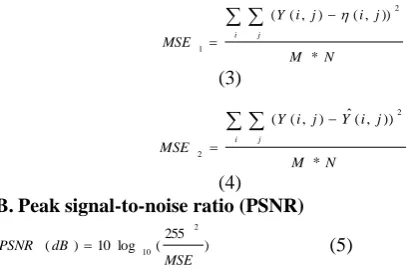
(3) N M j i Y j i YMSE i j
* )) , ( ˆ ) , ( ( 2 2
(4)B.Peak signal-to-noise ratio (PSNR)
) 255 ( log 10 ) ( 2 10 MSE dB
PSNR (5)
In equations (3) and (4), Y represents the original image, Ŷ denotes the de-noised image, and represents the noisy image. M * N is the size of the image[1][2].
C.Performance index (PI)
(6)
The PI is to show the relative amount of error increase or decrease in the restored image. The percentage performance index can be calculated by multiplying PI by 100. Also, the PI is multiplied by a conventional negative (-) sign to show the negative PI value as a distortion decrease in the output image, while the positive PI value as a distortion increase in the output image.
V.
RESULTS
The proposed filters: Wiener & LR (with static number of iterations 15) are tested using 255X255, standard color image such as board. The performance of the proposed filters are examined for various levels of Blurs (Motion and Gaussian) corruption and compared them to each other. Each time the test image is corrupted by (motion and Gaussian) blur of different density ranging from Len=theta=5,5 to 30,30. In addition to the visual observation, the performance of the proposed filters is evaluated by the following parameters discussed previously: MSE, PI, PSNR and all the filters and related processes are computed by MATLAB 13. The results of different forms can presented as follows.
TABLE I. MSE AND PI FOR MOTION BLUR AT
Fig. 2. Shows the MSE2 performance vs Motion blur
values.
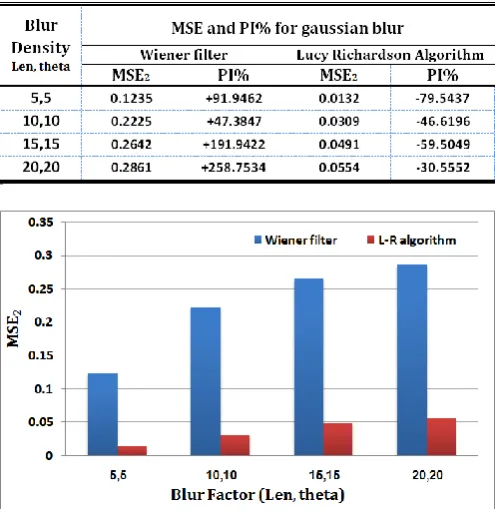
TABLE I. MSEANDPIFORGAUSSIANBLURAT
DIFFERENTBLURDENSITIES
Fig. 3. Shows the MSE2 versus values of Gaussian blur.
TABLE II. PSNRFOR MOTIONBLUR AT VARIOUS
BLURDENSITIES
Fig. 4. Shows the PSNR performance vs Motion blur
values.
TABLE III. PSNRFORGAUSSIANBLURAT
DIFFERENTBLURDENSITIES
Fig. 7. Shows blurred & restored images for motion blur
density (5,5).
Fig. 8. Shows blurred & restored images for motion blur
density (10,10).
Fig. 9. Shows blurred & restored images for motion blur
density (20,20).
Fig. 10. Shows blurred & restored images for motion
blur density (30,30).
Fig. 11. Shows blurred & restored images for Gaussian
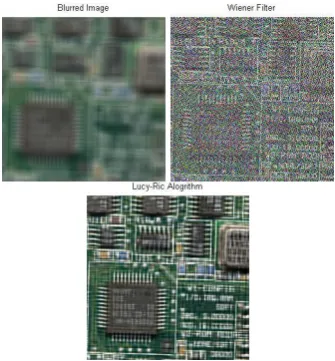
blur density (5,5).
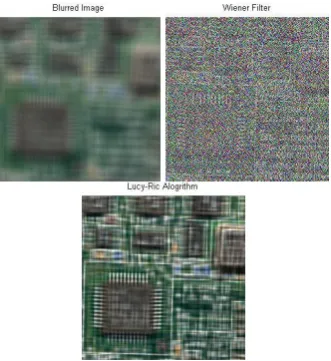
Fig. 12. Shows blurred & restored images for Gaussian
Fig. 13. Shows blurred & restored images for Gaussian
blur density (15,15).
Fig. 14. Shows blurred & restored images for Gaussian
blur density (20,20).
The filters are investigated at low, medium and high blur values. PSNR, MSE, and PI are utilized to examine the performance measurements for the two filtering techniques. Tables I, II, III, IV and Figures 1, 2, 3 and 4 represent the MSE, PI and PSNR of the two filters versus the blur density as indicated on the corresponding results. As mentioned previously, the two types of investigated blur are Motion blur and Gaussian blur. The LR algorithm has the superior performance over all range of the blur density spectrum. Wiener filter however is of lower performance than that of LR algorithm at all blur density values. The LR algorithm has higher value of PSNR than Wiener filter in the presence of both Gaussian blur as well as Motion blur. Furthermore, the LR algorithm has lower value of mean square error than WF in the presence of both Gaussian blur as well as Motion blur. The LR algorithm has double processing time (0.7s) compared with Wiener filter (0.37s) for a number of iterations (15). Table I and Table III show the results of estimation of board images for Motion blur. They represent MSE/PI and PSNR outcomes respectively. LR algorithm produces larger value of PSNR than WF. LR has a PSNR value of
Table II and Table IV show the results for Gaussian blur. LR algorithm produces the largest value of PSNR compared with WF. LR has a PSNR value of 18.809 and WF has a value of 9.175. As for the MSE values, LR performance is again proved to be better than that of WF as it has the least MSE of 0.0132 while WF has the highest MSE of 0.125. These results are at same blur density (5,5).
VI.
CONCLUSION
As an application of adaptive filtering, this paper is crafted to assess couple of filters in estimating an image out of blur distortion. The study declares the LR algorithm superiority over Wiener filter in treating blurred images. The LR algorithm demonstrates higher values of PSNR than those of Wiener filter in the presence of both Gaussian blur as well as Motion blur. Furthermore, the LR algorithm shows lower values of MSE than those of WF in the presence of both types of blur. Subjectively, LR algorithm restores an intelligent image with much higher performance than that of WF. In fact, both filters' performances are confirmed when compared utilizing visual evaluation of the images and the mathematical assessment measures. Increasing the number of iterations in LR algorithm introduces better results. On the other hand, raising the number of iterations slows down the computational process and increases the processing time gradually. It is concluded that the advantages of LR algorithm entail accurate results and easy implementation (no non-linear optimization is needed). However, its disadvantages are slow of convergence in the absence of noise and slight instability in the presence of noise. The feasibility of all three performance measures (MSE, PI, PSNR) utilized to asses filters shows high degree of correctness when contrasted versus each other as well as with the subjective assessment of the images. All filters' responses are confirmed when compared with the subjective evaluation of the restored images. Finally, this practice can be more investigated when blurred and noisy image is considered.
VII.
R
EFERENCES[1] Rafael C. Gonzalez, Richard E. Woods and Steven L. Eddins, “Digital Image Processing Using MATLAB”, Pearson Prentice Hall, 2003.
[2] Rafael C. Gonzalez and Richard E. Woods, “Digital Image Processing”, Prentice Hall, 2008 I. S. Jacobs and C. P. Bean,.
[3] J. M. Parmar and S. A. Patil, ”Performance Evaluation and Comparison of Modified De-noising Method and the Local Adaptive Wavelet Image De-noising Method,” International Conference on Intelligent Systems and Signal Processing, pp. 101-105, March 2013.
[5]
https://www.slideshare.net/NaseemAshraf/image-degradation-and-noise-by-mdnaseem-ashraf, slice #3. [6] Arijit Dutta, Aurindam Dhar, Kaustav Nandy, Project
report on “Image De-convolution By Richardson Lucy Algorithm”, Indian Statistical Institute, November, 2010.
[7] M. Bertero and P. Boccacci, “A simple method for the reduction of boundary effects in the Richardson-Lucy approach to image de-convolution,” Astronomy and Astrophysics, Vol. 437,pp. 369-374, July 2005. [8] G. Li, Y. Ito, et. Al., “A discrete wavelet transform
based recoverable image processing for privacy protection,” IEEE International Conference on Image Processing, pp. 1372-1375, October 2008.
[9] M. Ben-Ezra and S.K. Nayar, “Motion-based motion de-blurring,” IEEE Transactions on Pattern Analysis and Machine Intelligence, Vol. 26, No. 6, pp. 689-698, June 2004.
[10] G. Suseela, S. Ahmed Basha. Woods and Steven L. Eddins, “Image Restoration Using Lucy Richardson Algorithm For X-Ray Images”, IJISET - International Journal of Innovative Science, Engineering & Technology, Vol. 3 Issue 2, February 2016.
![Fig. 1. Image restoration process model [5]](https://thumb-us.123doks.com/thumbv2/123dok_us/8589452.1720722/1.595.51.295.662.731/fig-image-restoration-process-model.webp)