DOI: 10.14738/abr.77.6877.
Jalil, M., Ujianto., & Nugroho, R. (2019). The Effect of Culture Orientation and Social Support on Work Behavior, Work Value and Performance of Family Waste Management In Tegal Regency. Archives of Business Research, 7(7), 360-369.
The Effect of Culture Orientation and Social Support on Work
Behavior, Work Value and Performance of Family Waste
Management In Tegal Regency
Mahben Jalil
Candidat Doctor University, August 17, 1945, Surabaya, Indonesia
Ujianto
University lecturer,
August 17, 1945, Surabaya, Indonesia
Riyadi Nugroho
University lecturer,
August 17, 1945, Surabaya, Indonesia
ABSTRACT
The problem of family waste is a fairly complicated problem for most cities in Indonesia. Waste is a problem that needs special attention. Because if family waste is not managed properly it will have a large negative effect on health. The Tegal Regency Government has a special agency that is responsible for family waste management in Tegal Regency, namely the Department of Environment for Spatial Planning, Landscaping and Hygiene and is carried out by the Waste and Waste Management Section. Waste management for the Traditional Market area is also carried out by the local Market Service and for the kelurahan or village level to RW the hygiene management is the responsibility of the local community. This research aims to examine and analyze the effect of culture orientation and social support on work behavior, work value and performance of family waste management In Tegal Regency. The population in this study were 402 people managing household waste in Tegal Regency. The sample selection method uses purposive sampling method. The number of samples in this study were 200 people managing household waste in Tegal Regency. This study uses data analysis Descriptive Statistics, Test Assumptions, Structural Equation Modeling Analysis. Technique of data analysis using SEM with SPSS version 23 and AMOS 20. Based on the results of the research analysis it can be proven that Cultural orientation has no significant effect on work values, Social support has a significant effect on work values, Cultural orientation has a significant effect on work behavior, Social support has a significant effect on work behavior, Cultural orientation has no significant effect on performance, Social support has a significant effect on performance, Work values has no significant effect on performance, and Work behavior has no significant effect on performance.
Keywords: Cultural orientation, social support, work value, work behavior, performance
INTRODUCTION
waste by the Tegal Regency Environmental Service, waste handling for the Traditional Market area is also carried out by the local Market Service and at the kelurahan or village level up to RW management.
The problem of family waste is a problem that needs special attention. Because if family waste is not managed properly it will have a large negative effect on health. These negative influences can be directly or indirectly. Direct effects can be caused by direct contact between humans and family waste and indirect effects are generally caused by creatures that carry germs that develop in family waste to humans. So that it takes a family waste management officer who has high morale and work values.
The value of work by family waste management officers in Tegal Regency is important because it will affect organizational behavior as a whole, as well as productivity and organizational commitment. The factors that influence the value of work are cultural orientation. Malinowski (2012 9) culture is the whole of human life which consists of various equipment and consumer goods, various regulations for people's lives, ideas and human works, human beliefs and habits. Culture as a comprehensive complex combination consisting of knowledge, beliefs, art, morals, laws, customs and various other capabilities and whatever habits are obtained by a human being as part of a society. Kluckhohn (1994) cultural values is a bear concept of the broad scope of life in the mind of most citizens of a society about what is most valuable in life.
In addition to cultural orientation, work values are also influenced by social support. Social support is information and feedback from others that shows that someone is loved and cared for, valued, respected, and involved in communication networks and reciprocal obligations (King, 2010:226). Kuo-Hsiung Chen (2011) concluded that is 1) The higher the level of social support, the better the adjustment for living abroad; 2) The higher the level of social support, the better individual work performance; 3) Better foreign adjustments lead to an increase in foreign workforce performance; 4) Relationship to foreign adjustment with social support and work performance has a partial mediating effect.
Work values can also affect work behavior. Behavior is whatever someone does (Suprihanto, 2003). Robbins (2002:35-39) Work behavior that is where people in the work environment can actualize themselves through attitude in work. To understand how individuals behave in organizations, a manager must know why there are differences in behavior among workers. The opinions expressed by experts about individual behavior still have contradictions. Some argue that a person's behavior is more determined by heredity or inheritance, and some say that the behavior is more influenced by environmental variables.
Performance
Dessler (2008:87) worker performance is the actual performance of workers or the level of achievement of results for the implementation of certain tasks. The performance of the family waste manager is the level of achievement of results in order to realize the goals of the family waste manager. Performance management is the whole activity carried out to improve the performance of the family or organization's waste management, including the performance of each individual and working group in the family's waste management. Wibowo (2007:7) performance is the result of work that has a strong relationship with the objectives of organizational strategy, customer satisfaction, and contributes to the economy.
Bacal (2010:115) performance in carrying out its functions does not stand alone, but is related to satisfaction and reward levels, influenced by skills, abilities and individual traits, as means that our performance is determined by individual factors, such as ability and effort, but also by factors outside of our direct control, decisions taken by other people, available resources, the system in which we work and so on. Gomes (2005:78) says job performance is a record of results or outcomes that are produced from a particular job function or specific activity in a certain period of time.
Performance is a form of business activity or program initiated and carried out by the head of the organization or the manager of the family's waste to direct and control the performance of workers. hence a continuous process of communication is needed, carried out within the framework of cooperation between a worker and his immediate supervisor, which involves establishing expectations and understanding of the most basic work function of the worker, how work workers contribute to organizational goals, meaning in concrete terms to do a good job, how work performance will be measured, obstacles that interfere with performance and ways to minimize or eliminate.
Work Value
The concept of value is the basis of understanding individual attitudes and motivations. Individuals who enter an organization with preconceived opinions about what should and what should not happen. This in turn has implications for certain behaviors and outcomes that are preferred over others, in other words values cover objectivity and rationality (Robbins, 2007:148). Values are the basic beliefs of individuals in behaving inside and outside the organization that influence the perception of work, and the right things or things that are desired (Rivai, Mulyadi, 2010; Robbin, 2006; Ucanok, 2009).
Values can be interpreted as useful, capable of being, empowered, valid, beneficial and most correct according to the beliefs of a person or group of people (Adisusilo, 2012:56). The concept of value reflects three important characteristics (1) as cognitions about what is desired, (2) It is affective, with related emotions, and (3) has a behavioral component that leads to action when activated. The value of work according to Daryanto (2013), is the orientation and attitude towards his work in the family waste manager, loyalty to the waste management of the family and organization, and to personal relationships with members of the family waste management.
activity preferences by workers to keep themselves active and busy in their work. (2) Extrinsic is measured by using the following two indicators a) Attitude toward earnings the value of an individual individual place to seek profit in work. b) Social status of jobs jobs have an effect on themselves and coworkers and relatives, in their own eyes or in the eyes of others. (3) Mixed character that can be measured based on Upward striving indicators, namely the desire to achieve and find work that is higher and better than living standards.
Work Behavior
Behavior is whatever someone does (Suprihanto, 2003). Talking to superiors, typing letters, storing records, serving customers and so on shows a person's behavior. Prawirosentono (2009:35), behavior is an important characteristic of the person to carry out activities. Behavior is a composite result of various psychological factors. These psychological factors are the result of a combination of physical, biological, and social conditions that affect one's life environment.
The main elements of the manager's behavior are several types of activities, whether physical or mental. Management behavior as a series of activities. While the activity is always oriented to the goals or objectives. Therefore they must be fostered and given a motivation (Komarudin, 2003:66).
Motivation involves a chain reaction, which starts from the perceived needs, then arises the desires or goals to be achieved, then causes efforts to achieve the goal, which ends with satisfaction. Motivation problems are very complex, because the reality of motivating people is different, both to the individual and the situation. Desired needs due to behavior, but needs may also be a result of behavior. Success in various areas of life turns out to be determined by human behavior, especially work behavior. Indicator of work behavior according to Anthony Jansen (1984 41) According to Anthony Jansen there are indicators that really affect work behavior, namely Getting along (hospitality), Doing the job (doing work, examples of the quality of work) and success in various areas of life turned out to be determined by human behavior, especially work behavior. Some people refer to this work behavior as motivation, habit and work culture.
Cultural Orientation
Culture is a complex whole, customs, and other abilities, as well as habits acquired by humans as those which contain science, belief, art, morality, law, members of society (Ranjabar, 2006:26). alinowski (2012:9) culture is the whole of human life which consists of various equipment and consumer goods, various regulations for people's lives, ideas and human work, human beliefs and habits. Koentjaraningrat (1987:85) defines culture as the whole system of ideas, actions and results of human work in the framework of people's lives that are made human by learning.
Kluckhohn in Pelly (2004) argues that cultural values are a broad-scope bear concept that lives in the minds of most citizens of a society, about what is most valuable in life. The series of concepts are mutually related and constitute a system of cultural values. Functionally this value system encourages individuals to behave as determined. Cultural Value Oriented according to Kluckhohn (1994) suggests that cultural values are a broad concept of bear life that lives in the minds of most citizens of a society about what is most valuable in life. The series of concepts are interrelated and are a system of cultural values.
concepts are interrelated and are a system of cultural values. There are five main problems of human life in every culture that can be found universally. Kluckhohn in Pelly (1994) the five main problems are (1) the problem of the nature of life, (2) the nature of work or human work, (3) the nature of human position in space and time, (4) the nature of human relations with the environment, and (5) the nature of human relations with human beings;
Social Support
Dimatteo (1991), social support is support or assistance that comes from other people such as friends, family, neighbors, coworkers and others. Baron Byrne (2000) defines social support as the physical and psychological comfort provided by friends and family members. Social support is a reciprocal interpersonal relationship where someone gives assistance to others. Social support is needed by anyone in dealing with others in order to live in the midst of society because humans are created as social beings. The term \"social support\" is generally used to refer to the acceptance of security, care, appreciation or assistance that someone receives from another person or group.
Social support is information and feedback from others that shows that someone is loved and cared for, valued, respected, and involved in communication networks and reciprocal obligations (King, 2010:226). Sarafino (2002) social support is a form of comfort, attention, appreciation, or assistance that is received by individuals from people, meaning both individually and in groups. With indicators of emotional support, award support, instrumental support and information support.
From some of the opinions above, it can be concluded that social support is positive assistance or support given by certain people to individuals in their lives and in certain social environments so that individuals who receive feel cared for, valued, respected, loved. Individuals who receive social support will be more confident and competent in carrying out their activities.
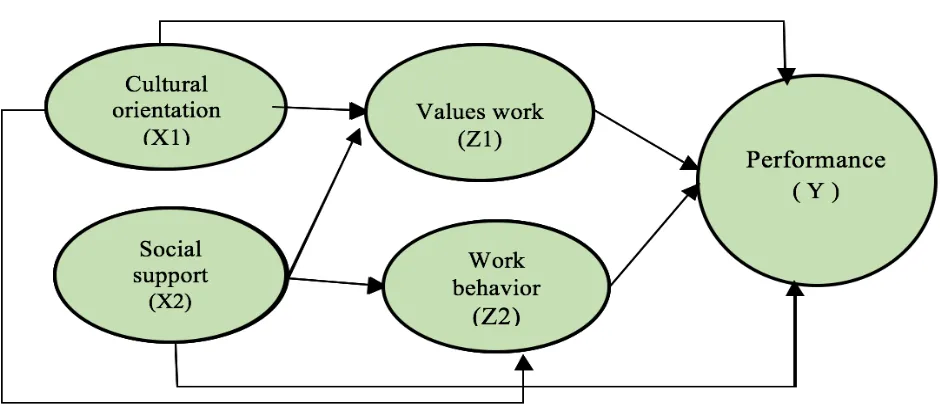
Conceptual Framework
Figure 1 Conceptual Framework
Research Hypothesis
1. Cultural orientation has a significant effect on work values 2. Social support has a significant effect on work values
3. Cultural orientation has a significant effect on work behavior 4. Social support has a significant effect on work behavior 5. Cultural orientation has a significant effect on performance. 6. Social support has a significant effect on performance 7. Work values has a significant effect on performance 8. Work behavior has a significant effect on performance.
RESEARCH METHODS
Data analysis techniques based on the conceptual framework and the design of the research, then this study uses the SEM analysis techniques (Structural Equation Modeling) with the program SPSS version 23 and AMOS 20. Structural Equation Modeling is statistical techniques, allowing to test a series of relatively complicated relationships and simultaneous. Ferdinand (2006) SEM requires a minimum sample in SEM is between 100 to 200 samples so that a sample of research above meets the requirements of both the sample and the minimum requirements to use the techniques of analysis of the complicated relationship of SEM. It can be built from one or several variables bound and free variables or multiple. The population in this study were 402 people managing household waste in Tegal Regency. The sample selection method uses purposive sampling method. The number of samples in this study were 200 people managing household waste in Tegal Regency.
DISCUSSION
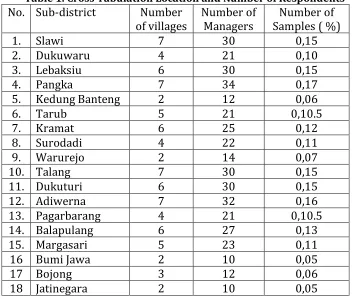
Based on the results of data collection in the field, through gathering interviews obtained from respondents, an illustration of the condition of the object from the study was obtained as follows
Table 1. Cross Tabulation Location and Number of Respondents
No. Sub-district Number
of villages Number of Managers Samples ( %) Number of
1. Slawi 7 30 0,15
2. Dukuwaru 4 21 0,10
3. Lebaksiu 6 30 0,15
4. Pangka 7 34 0,17
5. Kedung Banteng 2 12 0,06
6. Tarub 5 21 0,10.5
7. Kramat 6 25 0,12
8. Surodadi 4 22 0,11
9. Warurejo 2 14 0,07
10. Talang 7 30 0,15
11. Dukuturi 6 30 0,15
12. Adiwerna 7 32 0,16
13. Pagarbarang 4 21 0,10.5
14. Balapulang 6 27 0,13
15. Margasari 5 23 0,11
16 Bumi Jawa 2 10 0,05
17 Bojong 3 12 0,06
The Results of the Tests of Goodness of Fit
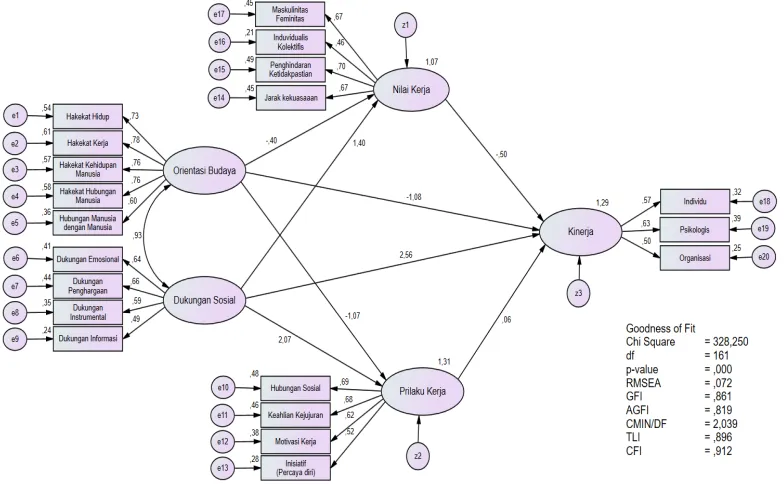
A model is said to be good if the hypothetical development conceptually and theoretically supported by empirical data, structural equation model test results are shown on the following picture:
Figure 1. Structural Equation Model
In the table below is a table of the results of tests of Goodness of Fit of the model taken from the last modified or the results of the development model of the best mods. SEM analysis of the results of the model of the complete test results can be some Goodness of Fit long-sleeved Model can be seen in the table below:
Table 2.Goodness of Fit dan Cut off ValueModification Model
Goodness of Fit Measure Index Cut off Description
Chi-square of estimate model 76,487 No fit model
Probability Level 0,001 > 0,05 No fit model
Goodness of Index (GFI) 0,938 > 0,9 Fit model
Adjusted Goodness of Index (AGFI) 0,900 > 0,9 Fit model
RMSEA 0,066 < 0,08 Fit model
Relative x² (CMIN/DF) 1,866 ≤ 2,00 Fit model
Tucker-Lewis Index (TLI) 0,948 > 0,9 No fit model
Comparative Fit Index (CFI) 0,961 > 0,9 Fit model
Hypothesis Testing
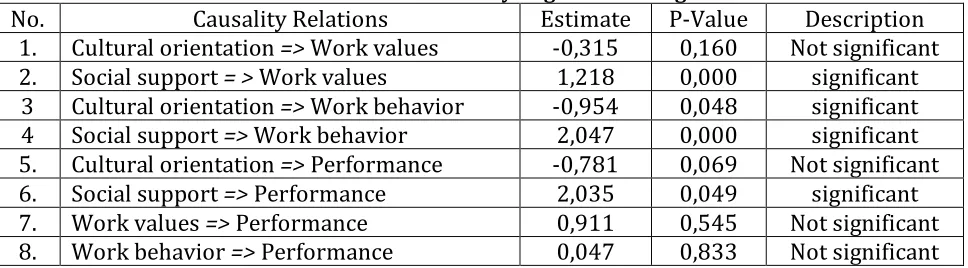
Models that already ascertained fit then the next step is to test the hypothesis that test the relationship causal, i.e. testing whether endogenous or exogenous variables between effect on endogenous variables appropriate reference in the hypothesis. At the stage of testing this hypothesis can also note the value of the coefficient of the respective relationships between variables. The value of the coefficient of relationship is to know the direction of the relationship is positive or negative and big changes in endogenous variables exogenous variables if the change or changes in the endogenous variable (the dependent) if endogenous variables (intervening) changed. Following are the results of the calculation the relationship between direct influence variable:
Table 3. Test Causality Regression Weight
No. Causality Relations Estimate P-Value Description
1. Cultural orientation => Work values -0,315 0,160 Not significant 2. Social support = > Work values 1,218 0,000 significant
3 Cultural orientation => Work behavior -0,954 0,048 significant 4 Social support => Work behavior 2,047 0,000 significant 5. Cultural orientation => Performance -0,781 0,069 Not significant 6. Social support => Performance 2,035 0,049 significant 7. Work values => Performance 0,911 0,545 Not significant 8. Work behavior => Performance 0,047 0,833 Not significant
Hypothesis 1. Cultural orientation significant effect on work values of family waste managers in Tegal Regency
From the findings in this study it was shown that cultural orientation did not significantly influence the work value of family waste managers in Tegal Regency. This is indicated by the estimated parameter value of the relations between the two variables obtained at -0.315. Tests show insignificant results with CR = -1.404 which do not meet the requirements > 1.96 with probability = 0.160 which has not met the test probability requirements above 0.05. Thus hypothesis 1 which states that " Cultural orientation significant effect on work values of family waste managers in Tegal Regency" has not been proven to be true
Hypothesis 2. Social support significant effect on work values of family waste managers in Tegal Regency
The findings of this study show that social support has a significant effect on work value. This is indicated by the estimated parameter value of the relations between the two variables obtained at 1,218. The test shows a significant result with a CR value of 4,806 that meets the requirements <1.96 with a probability below 0,000 (***) that meets the requirements for the probability of testing below 0.05. Thus hypothesis 2 which states that "Social support significant effect on work values of family waste managers in Tegal Regency" proved the truth.
Hypothesis 3. Cultural orientation significant effect on work behavior of family waste managers in Tegal Regency
Hypothesis 4. Social support has a significant effect on work behavior of family waste managers in Tegal Regency
From the findings in this study it was shown that social support had a significant effect on the work behavior of family waste managers in Tegal Regency. This is indicated by the estimation parameter value of the relations between the two variables obtained at 2,047. Tests show significant results with CR = 3.851 that meets the requirements < 1.96 with probabilities below 0,000 (***) that meet the requirements for testing probabilities below 0.05. Thus hypothesis 4 which states that "Social support has a significant effect on work behavior of family waste managers in Tegal Regency" proved the truth.
Hypothesis 5. Cultural orientation significant effect on performance of family waste managers in Tegal Regency
The findings of this study indicate that cultural orientation has no significant effect on the performance of family waste managers in Tegal Regency. This is indicated by the estimated parameter value of the relations between the two variables obtained at -0.781. Tests show insignificant results with CR = -1,817 that do not meet the requirements >1.96 with a probability = 0.069 that has not met the test probability requirements above 0.05. Thus hypothesis 5 which states that "Cultural orientation significant effect on performance of family waste managers in Tegal Regency" has not been proven true.
Hypothesis 6. Social support significant effect on performance of family waste managers in Tegal Regency
The findings of this study show that social support has a significant effect on the performance of family waste managers in Tegal Regency. This is indicated by the estimated parameter value of the relationship between the two variables which is 2.035. The test shows significant results with CR = 1,965 that meets the requirements < 1.96 with a probability = 0.049 that meets the requirements for the probability of testing below 0.05. Thus hypothesis 6 which states that "Social support significant effect on performance of family waste managers in Tegal Regency" proved the truth.
Hypothesis 7. Work values significant effect on performance of family waste managers in Tegal Regency
Work values has no significant effect on performance
From the findings in this study it was shown that the value of work did not significantly influence the performance of family waste managers in Tegal Regency. This is indicated by the estimated parameter values of the relations between the two variables at -0.458. The test shows the results that are not significant with the value of CR = -0.605 that does not meet the requirements > 1.96 with a probability = 0.545 that has not met the test probability requirements above 0.05. Thus the hypothesis 7 which states that "Work values significant effect on performance of family waste managers in Tegal Regency" has not been proven correct.
Hypothesis 8. Work behavior significant effect on performance of family waste managers in Tegal Regency
effect on performance of family waste managers in Tegal Regency" has not been proven to be true.
CONCLUSIONS AND SUGGESTIONS
Based on the analysis and discussion of it can be made a summary as follows: 1. Cultural orientation has no significant effect on work values
2. Social support has a significant effect on work values
3. Cultural orientation has a significant effect on work behavior 4. Social support has a significant effect on work behavior 5. Cultural orientation has no significant effect on performance. 6. Social support has a significant effect on performance
7. Work values has no significant effect on performance 8. Work behavior has no significant effect on performance.
SUGGESTIONS FOR OTHER RESEARCHERS
Based on the results of the analysis of the research that has been done, for the benefit of the Department of Environment in the Field of Spatial Planning, Landscaping and Hygiene, as well as subsequent knowledge, it is conveyed to include some of the following suggestions:
1. To the Office of Environment in the Field of Spatial Planning, Landscaping and Cleaning of Tegal District. There needs to be good cooperation and coordination between related agencies in the family waste management officer.
2. To the development of research
The findings obtained by researchers can be input and considerations for developing further research so that the development of science, especially the science of human resource management in general and organizational behavior in particular grows to develop in accordance with the development of time and time.
BIBLIOGRAPHY
Bacal, Robert. 2016. Performance Management. Jakarta: PT. Gramedia Pustaka Utama. Daryanto. 2013. Implementation of Character Education in Schools. Bandung: Gava Media Dessler, Gary, 2008. Personnel Management. Jakarta: Erlangga.
Ferdinand, A. 2006. Structural Education Modelling dalam Penelitian Manajemen. Edisi pertama. Semarang: Universitas Diponegoro.
Gomes, Faustino Cardoso, 2005. Human Resource Management, Yogyakarta: Andi Offset.
Hsiung Chen, Kuo. et al. 2011. Social Support, Overseas Adjustments And Work Performance Of Foreign Labors In Taiwan. African Journal of Business ManagementVol. 5(22).
King, Laura. 2010. General Psychology. Jakarta : Salemba Humanika Koentjaraningrat. 1987. Community Research Methods. Jakarta: Gramedia. Komarudin, 1994. Management Encyclopedia. Jakarta: Bina Aksara
Ranjabar, 2006. An Introduction to the Indonesian Socio-Cultural System. Bandung: Ghalia Indonesia Robbins, S.P. 2006, Organization Theory Structyure, Design and Applications. Singapore: Prentice-Hall International Inc.
Rivai, Veithzal., Mulyadi, Deddy. 2010. Leadership and Organizational Behavior. Jakarta:Raja Grafindo Persada. Simamora, Henry, 2004. Human Resource Management. Yogyakarta: STIE YKPN.
Soeprihanto, John, 2003. Worker Performance and Development Assessment. Yogyakarta: BPFE UGM. Susilo,A. Sutarjo. 2012. Character Value Learning. Jakarta: Rajawali Pers