Training Needs Assessment Of The Gender Focal
Point System: Basis For A Capability Building
Program
Maria Theresa H. Arellano-Hernandez
Batangas State University, College of Arts and Sciences Rizal Avenue, Batangas City, Philippines 4200
Abstract: The primary focus of this training need assessment is to determine the familiarity of Batangas State University Gender Focal Point System (GFPS) members on Gender and Development (GAD) concepts, policies and mandates, and tools. Through this assessment, the Gender and Development Office will be able to develop more relevant training design for GFPS members. The study used a descriptive method of research which utilized the Training Needs Assessment Questionnaire of the Philippine Commission on Women. Respondents included members of BatStateU’s GFPS at the university and per campus levels. Statistical tools utilized were frequency, percentage, weighted mean, T-test, and ANOVA. Findings revealed diversity of the GFPS members in terms of their profile variables, namely; sex, age, position, campus, and length of service. Results showed the areas in which training among GFPS members was needed. It was found out that they know little about gender mainstreaming and GAD planning and budgeting. Further, there are still policies and mandates which need to be the focus of future seminars and trainings. In terms of GAD tools, respondents had little information about these. Results further presented no significant difference on familiarity to GAD concepts in terms of sex, age, campus and length of service. There was also no significant difference on familiarity to GAD policies and mandates, and tools with respect to profile variables. The survey clearly points out the need for GFPS members to undergo trainings to further the University’s GAD advocacy. The University’s annual GAD plan and budget should consistently include capacity building to enable them to effectively perform their tasks as GFPS members.
Keywords: GAD concepts, GAD policies and mandates, GAD tools, Gender Focal Point System, training needs assessment
1.
Introduction
In the Philippines, Republic Act No. 9710 otherwise known as Magna Carta of Women was signed into law on August 14, 2009 to affirm the role of women in nation building and ensure the substantive equality between women and men [1]. The law aims to uphold and recognize the role of women in nation building and their rights as human rights. It has considered gender mainstreaming as a strategy for implementation. With this approach, it envisions to promote women’s human rights and eliminate gender discrimination in the systems, structures, policies, procedures, and programs of all government agencies. As such, it provides for mechanisms such as GAD Planning and Budgeting, creation and/strengthening of GAD Focal Point System (GFPS), and generation and maintenance of GAD database, among others. Section 36 of Republic Act No. 9710, otherwise known as the Magna Carta of Women (MCW), mandates all government departments, including their attached agencies, offices, bureaus, state universities and colleges, government-owned and –controlled corporations, local government units and all other government instrumentalities to adopt gender mainstreaming as a strategy to promote women’s human rights and eliminate gender discrimination in their systems, structures, policies, programs, processes and procedures. It is further provided in Section 37-C of the Implementing Rules and Regulations that a Gender Focal Point System (GFPS) or a similar GAD mechanism shall be established and strengthened to catalyze and accelerate gender mainstreaming within the agency [2]. The GFPS is then tasked to ensure and advocate for, coordinate and monitor the development, implementation, review of GAD plans and GAD-related programs, activities and projects. Batangas State University is a higher education institution which advocates gender equality and equity. In doing so, it has reconstituted the Gender Focal Point System and its local
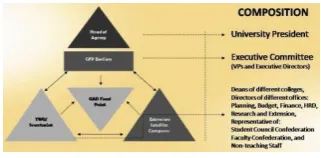
counterpart in the main and extension campuses. The GFPS members are tasked to pursue gender mainstreaming in the University. In addition, plans and projects are in place to support continuing gender education and capacity development. Nevertheless, to effectively implement these programs, activities and projects, it requires individuals to be responsive, receptive and perceptive to the needs, issues and concerns of people of all genders. In order for them to perform this task, there is a need for them to be aware of GAD concepts, policies and tools. It was in 2014 that the University’s Gender Focal Point System was organized through Memorandum Order No. 334, series 2014. It was reorganized annually due to changes in the designations of administrative officials and representatives. The following figure shows the GFPS structure of the University:
Figure 1: GFPS Structure for SUCs
University’s Gender Focal Point System members. Results of
this assessment will be the basis for developing a capability building program for GFPS members.
This study aimed to:
1. Determine the profile of Gender Focal Point System members in terms of:
1.1.Sex 1.2.Age 1.3.Position 1.4.Campus
1.5.Length of service
2. Assess the familiarity of the GFPS members on the following:
2.1.GAD concepts 2.2.GAD policies 2.3.GAD tools
3. Test the hypothesis that the familiarity of GFPS members on the abovementioned variables do not significantly differ when they are grouped according to profile variables
4. Develop a capability building training program for GFPS members
2.
Methodology
The study used a descriptive type of research. A survey questionnaire was used to determine the familiarity of GFPS members on GAD concepts, legal mandates, and GAD tools. The questionnaire was based on the Training Needs Assessment Questionnaire of the Philippine Commission on Women. Out of 135 instruments which were administered to members of the GFPS, 98 of these were retrieved. The TNA was administered on July 2015. Statistical tools used were frequency, percentage, weighted mean, T-test, and ANOVA. The following scale was used to determine the familiarity of the respondents to GAD concepts, legal mandates and tools:
Scale Range Verbal Interpretation
1 – 1.49 No Idea
1.5 – 2.49 Know little about it
2.5 – 3.49 Familiar with it
3.5 – 4.49 Confident to talk about it
4.5 - 5 Can apply it to the work/output
3.
Results and Discussions
3.1 Profile of the GFPS Members
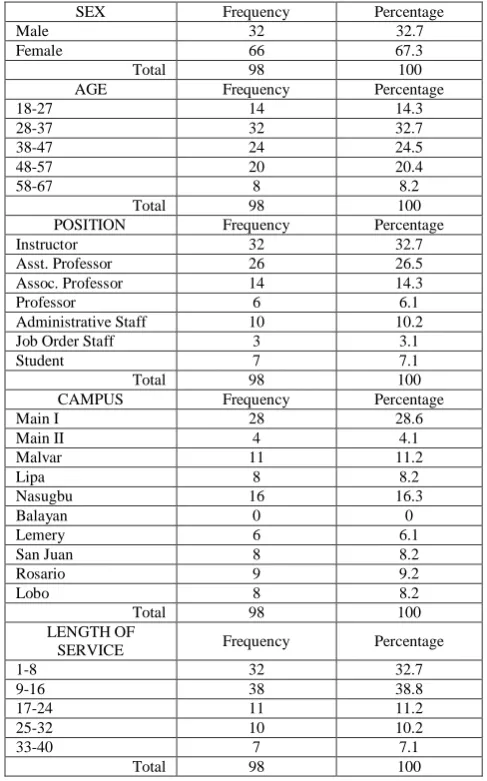
Table 1 presents the distribution of GFPS members according to profile variables such as sex, age, position, campus and length of service. It can be noted from the table that majority of the GFPS members were female, with a frequency of 66 or 67.3 percent. Male members were only 32, with 32.7 percent. This result reflects the fact that majority of the University’s administrative officials are female. In addition, it signifies recognition of women’s contribution to the development of the University.
Table 1: Distribution of GFPS Members according to Profile Variables
SEX Frequency Percentage
Male 32 32.7
Female 66 67.3
Total 98 100
AGE Frequency Percentage
18-27 14 14.3
28-37 32 32.7
38-47 24 24.5
48-57 20 20.4
58-67 8 8.2
Total 98 100
POSITION Frequency Percentage
Instructor 32 32.7
Asst. Professor 26 26.5
Assoc. Professor 14 14.3
Professor 6 6.1
Administrative Staff 10 10.2
Job Order Staff 3 3.1
Student 7 7.1
Total 98 100
CAMPUS Frequency Percentage
Main I 28 28.6
Main II 4 4.1
Malvar 11 11.2
Lipa 8 8.2
Nasugbu 16 16.3
Balayan 0 0
Lemery 6 6.1
San Juan 8 8.2
Rosario 9 9.2
Lobo 8 8.2
Total 98 100
LENGTH OF
SERVICE Frequency Percentage
1-8 32 32.7
9-16 38 38.8
17-24 11 11.2
25-32 10 10.2
33-40 7 7.1
Total 98 100
members each, or 8.2 percent. The least number of GFPS
members were from Lemery and Main 2 campuses, with six (6) and four (4) respondents, respectively. Of the 98 GFPS members, 38 of them (38.8 percent) had been in service for nine (9) to 16 years. There were 32 GFPS members (32.7 percent) with a length of service of one (1) to eight (8) years. Eleven (11) of them or 11.2 percent had been with the University for 17-24 years. Ten (10) of them (10.2 percent) had been in service for 25-32 years. The least was 33-40 years of service for seven (7) members or 7.1 percent. Results suggest the relative status of the GFPS members in terms of length of service. This could mean that with respect to the GAD advocacy of the University, they will still need to participate in GAD seminars and trainings. Findings revealed the diversity of the GFPS members in terms of their profile variables. As can be noted in the GFPS structure of the University, it is composed of varied members of the administrative council. The said structure is also replicated in the campuses of the University. They are tasked to catalyze and accelerate gender mainstreaming. It is a mechanism established to ensure and advocate for, guide, coordinate, and monitor the development, implementation, review and updating of GAD plans and GAD-related programs, activities and project (PAPs).
3.2 Familiarity on GAD Concepts, Legal Mandates, and
GAD Tools
The tables that follow present a summary of the results on the familiarity of GFPS members to GAD concepts, legal mandates, and tools.
3.2.1 GAD Concepts
Table 2 presents the familiarity of GFPS members to GAD concepts. The concepts included in the survey are those which the respondents needed to have a deeper understanding to enable them to respond to gender issues effectively. It can be noted from Table 2 that GFPS members are confident to talk about sex and gender concepts. Knowledge of these concepts will enable them to provide a distinction between sex and gender and other concepts associated with it such as gender identity and sexual orientation. Results also showed that GFPS members are familiar with most of the GAD concepts. However, it was found that they know little about gender mainstreaming and GAD planning and budgeting.
Table 2: Familiarity of GFPS Members on GAD Concepts
The familiarity of GFPS members with some of the GAD concepts could be due to the orientation seminars and other activities conducted by the University’s Gender and Development Office. They are encouraged to participate in these seminars for them to gain awareness of the concepts needed to advance gender mainstreaming. The composite mean of 2.94 indicates that the GFPS members are generally familiar with GAD concepts. It is important for GFPS members to be familiar with the basic GAD concepts for them to be able to understand how they will be able to do gender mainstreaming. As an approach to achieving gender equality, gender mainstreaming was a strategy formulated in the Fourth World Conference for Women in Beijing in 1995. Through this approach, gender perspective, issues and concerns will be mainstreamed in the agency’s development planning. GAD planning and budgeting, on the other hand, is of technical nature which will enable GFPS members to formulate the annual GAD plan and budget of the University. The GAD Plan and Budget is formulated within the context of the agency’s mandates to mainstream gender perspectives in the policies, programs, and projects. Hence, knowledge of how to formulate this will ensure that appropriate interventions will be done to address gender issues of the University’s clients and/or stakeholders.
3.2.2 GAD Policies and Mandates
Table 3 shows familiarity of the GFPS members on legal mandates relative to GAD. These include international and national mandates which provide general policies on gender equality and gender mainstreaming strategies to implement international and local policies.
Table 3: Familiarity of GFPS Members on GAD Policies and Mandates
GAD Concepts Mean Verbal Interpretation
Sex and Gender 3.55 Confident to talk about it
Gender and Development 3.19 Familiar with it
Gender Stereotypes 2.86 Familiar with it
Gender Discrimination 3.17 Familiar with it
Gender Analysis 2.72 Familiar with it
Gender Mainstreaming 2.48 Know little about it
GAD Planning and Budgeting 2.35 Know little about it
Gender Equality 3.28 Familiar with it
Gender Equity 2.93 Familiar with it
Gender Perspective 2.83 Familiar with it
Composite Mean 2.94 Familiar with it
GAD Policies and Mandates Mean Verbal
Interpretation UN Convention on the Elimination of
Discrimination Against Women 2.17 Know little about it
Beijing Platform for Action 1.61 No Idea
Millenium Development Goals 2.06 Know little about it
Philippine Plan for Gender-Responsive
Development 1.8 Know little about it
GAD in the General Appropriations Act 1.87 Know little about it
RA 7192 (Women in Nation Building
Act) 2.06 Know little about it
RA 7877 (Anti-Sexual Harassment Act) 2.55 Familiar with it
RA 8353 and 8505 (Anti-Rape Law of 1997 and Rape Victims Assistance and Protection Act of 1998)
2.47 Know little about it
RA 9262 (Anti-Violence against
Women and their Children Act of 2004) 2.71 Familiar with it
RA 9710 (Magna Carta of Women) 2.63 Familiar with it
RA 10354 (Responsible Parenthood and
Reproductive Health Act of 2012) 2.7 Familiar with it
RA 10364 (Expanded Anti-Trafficking
in Persons Act of 2012) 2.31 Know little about it
RA 10398 (Anti-VAW Consciousness
Day of 2012) 2.24 Know little about it
GAD Code 1.99 Know little about it
MC 2011-01 Guidelines for the Creation, Strengthening and Institutionalization of GFPS
2.03 Know little about it
JMC 2012-01 Guidelines on the Preparation of Annual GPB and AR to implement MCW
1.86 Know little about it
JMC 2013-01 Guidelines on the
Localization of MCW 1.83 Know little about it
It was presented in Table 3 that respondents were familiar
with RA 7877 (Anti-Sexual Harassment Act), RA 9262 (Anti-Violence against Women and their Children Act of 2004), RA 9710 (Magna Carta of Women), and RA 10354 (Responsible Parenthood and Reproductive Health Act of 2012). This result could mean that they gained sufficient knowledge of these laws from several seminars conducted within the University in the previous years. They know little about other laws, such as UN Convention on the Elimination of Discrimination Against Women, Millennium Development Goals, Philippine Plan for Gender-Responsive Development, GAD in the General Appropriations Act, RA 7192 (Women in Nation Building Act), RA 8353 and 8505 (Anti-Rape Law of 1997 and Rape Victims Assistance and Protection Act of 1998), RA 10364 (Expanded Anti-Trafficking in Persons Act of 2012), RA 10398 (Anti-VAW Consciousness Day of 2012), GAD Code, MC 2011-01 Guidelines for the Creation, Strengthening and Institutionalization of GFPS, JC 2012-01 Guidelines on the Preparation of Annual GPB and AR to implement MCW, and JMC 2013-01 Guidelines on the Localization of MCW. Results also showed that they had no idea about the Beijing Platform for Action. The results in this part of the survey showed that the composite mean of 2.17 indicates that GFPS members in general know little about GAD policies and mandates. There are still policies and mandates which need to be the focus of seminars and trainings that the Gender and Development Office would conduct in the future. Gaining knowledge of these laws would enable the GFPS members to effectively perform their tasks and address gender issues and concerns.
3.2.3 GAD Tools
Table 4 shows the familiarity of GFPS members on GAD Tools. These are the tools that can be utilized for gender analysis.
Table 4: Familiarity of GFPS Members on GAD Tools
As shown in the table, respondents have little knowledge of the 24-hour activity profile, gender gap analysis tool at the community level, Harmonized GAD Guidelines, and Gender Mainstreaming Evaluation Framework. Meanwhile, they expressed no knowledge or familiarity on GerLkaBa Tool and Participatory Gender Audit. The composite mean of 1.53 indicates that GFPS members in general know little about GAD tools. The GAD tools identified in the survey are used by agencies in gender analysis. These tools are for different levels of analysis which include household and community level, project or program, and organization or institution. Data that can be generated from these tools can guide planners on what programs, projects and activities will be implemented to address gender issues and concerns. The
tools included in the survey were based on varied Gender Analysis Frameworks. In addition, results showed that there is a need to conduct training workshops to enable GFPS members to gain knowledge of and capability on using these tools. GFPS members who will be trained on gender analysis will be able to select the tool which is most appropriate to the needs. An overview of gender analysis approaches will be useful in building this level of capacity among the University’s GFPS members. It will be an advantage for them to know which frameworks will be most likely to support gender mainstreaming provided the socio-economic context and program priorities. In particular, this will also be useful in developing extension programs, projects and activities which are most appropriate interventions to address gender needs of the community.
3.3 Significant Difference on the Familiarity of GFPS
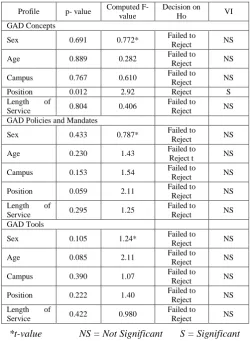
Members to GAD Concepts, Policies and Mandates, and Tools when Grouped According to Profile Variables This training needs assessment examined differences on the familiarity of GFPS members to GAD concepts, policies and mandates, and tools with respect to their profile variables. Results of this assessment are shown in Table 5. Data on Table 5 showed that the F-value of 2.92 with the p-value of 0.012 which is less than 0.05 indicates that the null hypothesis is rejected. This means that the familiarity of GFPS members on GAD concepts differed relative to position. GFPS members with faculty rank are more likely to be familiar on GAD concepts than those in the administrative or non-academic position and students. This is also due to the structure of the GFPS which includes faculty coordinators. They attend training since they needed to be knowledgeable about basic concepts which are needed in their tasks of designing and implementing gender responsive projects and activities. Results further presented no significant difference on familiarity of GFPS members to GAD concepts when grouped according to sex, age, campus and length of service. There was also no significant difference on familiarity of GFPS members to GAD policies and mandates, and GAD tools when they are grouped according to their profile variables, namely; sex, age, campus, position, and length of service. This could be due to the opportunities provided to all members of the GFPS to participate in basic GAD trainings. The basic GAD trainings provided to them include gender sensitivity training or basic GAD orientation and training on gender analysis tools. It can be inferred from the results that familiarity to GAD concepts among GFPS members varied in terms of their position. This is a relevant input to the capability training program in order to develop training designs suited to the needs of the GFPS members.
GAD Tools Mean Verbal Interpretation
24-hour Activity Profile 1.55 Know little about it
Gender Gap Analysis Tool at
the Community Level 1.55 Know little about it
Harmonized Gender and
Development Guidelines 1.61 Know little about it
Gender Mainstreaming
Evaluation Framework 1.56 Know little about it
GerlKa Ba Tool 1.47 No Idea
Participatory Gender Audit 1.46 No Idea
Table 5 : Significant Difference on the Familiarity of GFPS Members to GAD Concepts, Policies and Mandates, and
Tools when Grouped According to Profile Variables
*t-value NS = Not Significant S = Significant
3.4 Capability Building Training Program for GFPS
Members
Results of this study served as inputs to the University’s GAD Plan and Budget for 2017, particularly the organization-focused activities. Specific activities which will address the need for GFPS members to gain technical competence in advancing the University’s gender mainstreaming initiatives are incorporated in the GPB. These include gender sensitivity trainings, seminars on GAD policies and mandates, and trainings on the use of gender analysis tools. In addition, participation of GFPS members to trainings/seminars conducted by other agencies is made part of the plan. Considering that the Magna Carta of Women mandates agencies to allocate five percent of its annual budget (GAA) to gender PAPs, the activities in the capability training of GFPS members will be provided with sufficient budget allocation.
4.
Conclusions
The following conclusions were based on the findings generated in the study:
1. Most of the Gender Focal Point System members are female, 28 to 37 years old, instructor, from Main Campus 1, and had been in service for nine to 16 years. 2. GFPS members are confident to talk about sex and
gender concepts, but know little about gender mainstreaming and GAD planning and budgeting. They are familiar with Anti-VAWC Act, Magna Carta of Women, and Responsible Parenthood and Reproductive Health Act. However, they have no idea about the
Beijing Platform for Action. They know little about some of the GAD tools, but have no idea about Gerl Ka Ba Tool and participatory gender audit.
3. Familiarity of GFPS members on GAD concepts significantly differ when they are grouped according to position.
4. The capability building program for GFPS members, which intends to address the need for GFPS members to gain technical competence in advancing the University’s gender mainstreaming initiatives, is incorporated in the University’s Annual GAD Plan and Budget (2017).
5.
Recommendations
The survey clearly points out the need for GFPS members to undergo trainings to advance the GAD advocacy of the University. The annual GAD plan and budget of the University should consistently include capacity building for the GFPS members to enable them to effectively perform their tasks. It is recommended that capability building activities focus on gender sensitivity, gender mainstreaming, gender analysis, and legal mandates. An annual orientation seminar and training workshop on these areas should be conducted. In addition to the basic concepts and mandates, deepening sessions should likewise be undertaken in order for GFPS members to gain confidence in discussing and applying these to their work. They can also be trained to serve as technical advisers/consultants to the University’s stakeholders and other communities and agencies. In addition, GFPS members should be encouraged to participate in GAD capability building trainings or seminars sponsored or organized by other agencies.
References
[1] Republic Act No. 9710 (Magna Carta of Women)
[Online]. Available:
https://www.pcw.gov.ph/sites/default/files/documents/la ws/republic_act_9710.pdf. Accessed: August 14, 2015].
[2] Implementing Rules and Regulations of Magna Carta of
Women [Online]. Available:
https://www.pcw.gov.ph/sites/default/files/documents/la ws/republic_act_9710.pdf. Accessed: August 14, 2015].
[3] MC 2011-01 Guidelines for the Creation, Strengthening and Institutionalization of GFPS [Online]. Available: https://www.pcw.gov.ph/law/pcw-memorandum-circular-no-2011-01. Accessed: July 1, 2015].
Author Profile
Maria Theresa H. Arellano-Hernandez received the
Bachelor of Arts in Political Science degree from Universiy of Batangas, Batangas City, Philippines in 1998. She is a graduate of Master in Public Administration from Batangas State University, Philippines, in 2004, and currently undertaking her Doctor of Public Administration in the same university. She is now connected with Batangas State University teaching public administration and social science both in the undergraduate and graduate levels.
Profile p- value Computed F-
value
Decision on
Ho VI
GAD Concepts
Sex 0.691 0.772* Failed to
Reject NS
Age 0.889 0.282 Failed to
Reject NS
Campus 0.767 0.610 Failed to
Reject NS
Position 0.012 2.92 Reject S
Length of
Service 0.804 0.406
Failed to
Reject NS
GAD Policies and Mandates
Sex 0.433 0.787* Failed to
Reject NS
Age 0.230 1.43 Failed to Reject t NS
Campus 0.153 1.54 Failed to
Reject NS
Position 0.059 2.11 Failed to
Reject NS
Length of
Service 0.295 1.25
Failed to
Reject NS
GAD Tools
Sex 0.105 1.24* Failed to
Reject NS
Age 0.085 2.11 Failed to
Reject NS
Campus 0.390 1.07 Failed to
Reject NS
Position 0.222 1.40 Failed to Reject NS
Length of
Service 0.422 0.980
Failed to