http://www.sciencepublishinggroup.com/j/jenr doi: 10.11648/j.jenr.20190802.13
ISSN: 2330-7366 (Print); ISSN: 2330-7404 (Online)
The Value of a Land Use Project’s Ecosystem Services
Yongxiong Liu
1, Mingzhi Li
2, Jiacheng Zhao
11School of Information Engineering, Chang’an University, Xi’an, China 2School of Construction Mechinery, Chang’an University, Xi’an, China
Email address:
To cite this article:
Yongxiong Liu, Mingzhi Li, Jiacheng Zhao. The Value of a Land Use Project’s Ecosystem Services. Journal of Energy and Natural Resources. Vol. 8, No. 2, 2019, pp. 60-65. doi: 10.11648/j.jenr.20190802.13
Received: April 21, 2019; Accepted: May 20, 2019; Published: May 23, 2019
Abstract:
The evaluation of ecosystem service value is a focus issue in the construction of ecological civilization in China. With the progress of human civilization, various types of land use projects are increasing day by day, which not only bring huge economic benefits, but also profoundly affect the regional land use pattern and ecological process, and have many influences on ecosystem services. In order to understand the real economic cost of land use projects, it is urgent to evaluate the ecosystem service cost of specific land use projects. In this paper, an ecological service evaluation model for comprehensive evaluation of land use project ecological service value is established. In this model, the emerging theory, virtual disposal cost method and market price method are applied to quantify the ecosystem service cost of land use project from four aspects of water, land, gas and biology. Using our model, we can estimate the ecological cost of a land use project more quickly and obtain the real economic cost of the project. Taking a thermal power plant as an example, the annual cost of the system service is calculated based on the ecosystem evaluation model and the existing model. By comparing the results of the two models, the feasibility and validity of the model are revealed.Keywords:
Ecosystem, Ecosystem Services Valuation, Land Use Project1. Introduction
Since the 1970s, the ecosystem service function has become a scientific term and a branch of ecology and ecological economics. The connotation of ecosystem services mainly includes the generation and maintenance of biodiversity, the renewal and maintenance of soil fertility, environmental purification and many other aspects.
Since the 21st century, with the progress of human civilization, the ecological environment has been continuously destroyed and the human living environment has gradually deteriorated. It is very important to measure the damage of ecological environment accurately to improve ecological environment. The existing quantitative models of “ecosystem services” [1] can be divided into three categories. The first is to apply the aggregate analysis of multiple policy changes to explore whether these changes can have a positive impact on improving the environment. [2] The second is to analyze the ways to control pollution from the national factors such as industrial structure, international trade and so on. [3, 4]
indirectly from the perspective of cost quantification. However, the above models are used to assess the overall environmental costs of a country and a region from a macro perspective, and it is difficult to measure the costs of environmental degradation caused by a project from a micro perspective.
2. The Ecological Services Valuation
Model
2.1. Literature Review
to the environment.
Figure 1. Ecosystem Services Valuation index.
2.2. Water
Water resources within the ecosystem system and all kinds
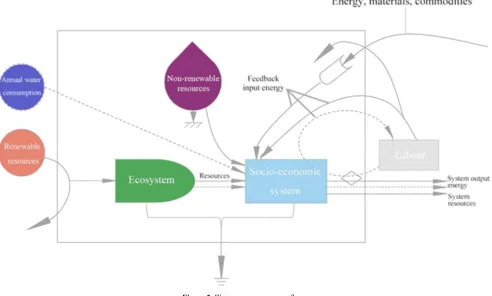
of ecosystem systems play a very important function, in the process of forming and maintaining the human survival environment. The ecosystem services value of water resources is the degree to which water satisfies the demand for the normal operation of the ecosystem. Considering the indirect water service is hard to calculate, we use the method of emergy evaluation analysis of the water ecosystem services costs.
According to the emergy theory [5], emergy refers to the amount of another kind of energy contained in the energy flowing or stored, which can be used as a benchmark to measure the energy value of various energies. The basic idea of emergy analysis is to use emergy as a benchmark to unify the energy in the ecosystem on the emergy scale to quantitatively analyze the functions of the system.
Figure 2. Water resource emergy flow.
The conversion relationship between emergy and matter is as follows:
mW
E =
τ
B (1)Where is the emergy of water (sej).
Bis the amount of water ( 3
m ). It should be noted that here indicates how much water is used. In land use project, besides using waterB1, sewageB2will also be removed. When calculating the ecosystem cost of sewage, we can borrow the alternative equivalent analysis method: add purified waterB2 to sewageB3to meet discharge standards. At this time B is as follows:
1 3
B=B +B (2)
τ
is emergy transformity, That is, the amount of solar energy per unit of matter or energy(sej/m ). According to Buenfil's calculations [6], the conversion rates of solar energy in mineral water and purified water are 1.43 10 sej/and 1.56 10 / .
We use the emergy/money ratio to convert emergy to money flow:
(3)
is Emergy Divide Ratio(sej/dollar)
is the total energy value used throughout the year by the regional economic system(sej)
!"# is the corresponding region's current gross national product (dollar)
Finally, the formula for calculating the water ecosystem services by using the emergy theory is as follows:
water mW
M =EDR E× (4)
2.3. Land
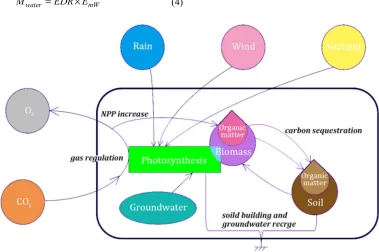
As most land use projects expands, land are occupied and plants are being cut to obtain construction materials, fuelwood for cultivation. Considering the direct and indirect services of vegetation, we divide the value of the areas of the ecosystem into four parts: net primary production, carbon sequestration, soil building and groundwater recharge, gas regulation.
Figure 3. The ecosystem services provided by land.
2.3.1. NPP Increase
Net primary production (NPP) is the difference between the fixed energy consumed by photosynthesis and the energy consumed by plant respiration.
The formula of increase is:
1( ) 2( )
mNPP
E = ×
ε
f T ×fβ
×PER FPER× −R (5)Where is the amount of the emergy required by NPP increase in study area, $ is maximum light utilization, % &'( and %)&*( is the effects of temperature and soil moisture on $, # is photosynthetic effective radiation reaching the surface. +# is proportion of photosynthetic effective radiation absorbed by vegetation. is geopotential and chemical potential energy.
2.3.2. Carbon Sequestration
Plants can convert atmospheric carbon dioxide into carbohydrates and fix it in the form of organic carbon.
The formula of carbon sequestration is:
1 2
mCS bio
E = × ∆ × ×B S UEV (6)
mNPP E
UEV = (7)
Where ,-is the emergy producted by photosynthesis of plants (sej); ∆ annual increase in biomass per unit area of local ecosystem (g/hr/year); 0 is the area of ecosystem occupied by projects. Considering that carbon sequestration amount in plants is about a half of the biomass, the right hand-side of the equation has to be multiplied by 0.5. 1 2345 is the transformity of biomass (sej/g); "## is the NPP mass per unit area per year (g/ha/year).
2.3.3. Soil Building and Groundwater Recharge
The existence of vegetation can increase the recharge of groundwater and build the soil. The formula of soil building and groundwater recharge is:
mGR GR
E = × × × ×L S
ρ
k UEV (8)Where 6 is the emergy producted by groundwater recharge(sej); L is the precipitation in the local ecosystem (mm/year); 0 is the area of ecosystem occupied by projects;
ρ is the density of groundwater 3
( /g m ) ; k is the
coefficient by which a plant absorbs water(%); 1 26 is the specific emergy of groundwater(sej/g).
2.3.4. Gas Regulation
formed, 1.62g of 78) would be required and 1.2g of 8) would be released at the same time. Using Sweden's carbon tax rate of $0.15/kg and virtual disposal cost approach [12], we can translate it into a tax on the absorption of 78). The formula of gas regulation is:
2 2 2 2
gas co co o o
M =n ×m +n ×m (9)
Where 9:5; is the amount of 78) absorbed by the vegetation in the area; 95; is the amount of 8) absorbed by the vegetation in the area. :5; is the tax rate of 78)calculated according to the Swedish carbon tax rate, the value is $4.094 × 10=/>? [13]; the unit mass value of
5;is calculated according to the industrial 8) production price, the value is $488/g.
2.3.5. Land Service Valuation
To quantifying the cost of land services occupied by a project, we apply the emergy evaluation method and the market price method in three parts: net primary production, carbon sequestration, the soil building and groundwater recharge. Since the value of ecosystem services created by vegetation in this area is not easy to be directly reflected, EDR is introduced to quantify its environmental costs by emergy method. When it comes to gas regulation, the value of carbon dioxide and oxygen can be reflected by market value, thus, we use market price method to evaluate its ecosystem cost.
Above all, the formula of land service valuation is:
@ABC= × & + ,-+ 6( + EAF (10)
Considering the landforms and the types of vegetation is different in different areas, the four functions that affect the environment are also different. For example, the ecosystem services valuation of forest landforms is higher than that of grasslands. Based on this, we need to consider the landform of the occupied land before calculate the cost of services valuation.
2.4. Air
In the process of construction and operation, land use projects will inevitably emit toxic and harmful gases. Air pollution refers to the environmental pollution caused by the discharge of air pollutants into the atmosphere, which mostly produced by enterprises and sudden air pollution accidents. Market price method and emergy evaluation method can not evaluate the atmospheric environmental damage very precisely. According to the above reason, we choose the virtual governance cost method [6] to evaluate it. The idea is that the cost of virtual governance is calculated by the cost method of governance, that is, the cost of governance that is used to prevent the degradation of environmental functions is equal to the assumed cost of pollution control and the harm caused by pollution emissions. the formula of air is:
2 2
ave
C
2
X X
so so NO NO
C ×K +C ×K
= (11)
Where 7AGHis the average cost per unit of air pollutant
reference material treatment (dollar/t). 7F5; and 7 IJ are the land use project on 08) and "8K governance costs. L-I;
and L IJ are the weight of overhead expenses, which is the proportion of 08) and "8K dioxide pollutants in total pollutants in the land use project(%).
i ave ave C C D D
= × (12)
Where C is the unit treatment cost of air pollutant (dollar/t). Di is the amount of atmospheric pollutants. Dave
is the amount of the reference substance.
A4M= 7 × 9 (13)
Where A4M is the air service valuation, nis the pollution exhaust gas emitted by the project.
2.5. Biology
Ecosystem services in biology mainly include indirect services and existence services. We value biology services in the perspectives of biodiversity, tourism and recreational value by emergy theory.
2.5.1. Biodiversity
Ecosystem can maintain biodiversity and the formula of biodiversity is as follows:
(
)
1
0
bc
N S GEB T
E
N
× × ×
= (14)
Where Ebc is the emergy required by biodiversity
conservation (sej); N1is the species density in the areas (N/ha); S is the area of ecosystem (ha); GEB is the geobiosphrere emergy baseline(sej/year); T is the average turnover time of species(year); N0is the number of global species.
2.5.2. Tourism and Recreational Value
Each ecosystem has a natural landscape, which can generates tourism income for local residents. Both tourism and recreational value can be measured by annual tourism value Mtou.
2.5.3. Biology Service Valuation
Above all, the formula of land service valuation is:
bio bc tou
M =EDR E× +M (15)
2.6. Ecosystem Services Valuation
Based on the service valuation discussed above, the service valuation of the local areas can be calculated as follows:
total water land air bio
M =M +M +M +M (16)
3. Case Study and Model Effectiveness Evaluation
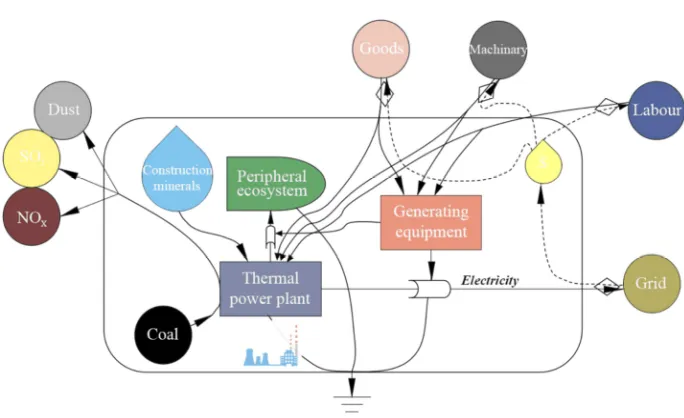
Figure 4. The ecosystem services related to thermal.
We selected a thermal power plant as a regional project. The quantitative method of ecosystem services is demonstrated concretely, and the effectiveness of our model is verified.
We found the power generation, air pollution [7], water resource utilization [8] and land use [9], of the thermal power plant in the network and literature.
The annual ecosystem services cost of the project was calculated by our ecosystem model and compared with that of
Robert Costanza model [10]. The difference percentager ε is calculated:
2 1
1
100%
M M
M
−
= ×
ε (17)
The calculation results are shown as follows:
Table 1. Results contrast.
Index
ecosystem index Amount Cost PQ ((((dollars)))) Robert Costanza’s index Cost PR((((dollars)))) Ε ((((%))))
Water 1.11 10S
( ) 1.72 10T
water regulation 1.13 10T
53.7%
water supply 1.51 10T
Land 3.50 (hm) 2.65 10=
Disturbance regulation 1.26 10
20.8%
Erosion consrol 6.18 10
Soil formation 2.52 10
Nutrient cycling 2.33 10=
Waste treatment 2.20 10
Air 1.20 10U(kg) 2.02 10V
Gas regulation 4.50 10T
-66.3
Climate regulation 2.30 10T
Biology 32200 (number) 4.47 10T Biological control 3.86 10T 12.1%
Habitat/refugia 1.15 10T
Total 2.64 10V Total 1.45 10V 45.1%
4. Conclusion
The existing methods of ecosystem services valuation is complex and uncertain, which makes ecological conservation and restoration difficult to be effectively put into practice.In order to make the data easier to access, easier to change over time. This paper establishes an ecological services valuation model to value the ecosystem services of a land use project comprehensively. In this model, emergy theory, virtual disposal cost approach, market price method are applied to quantify the ecosystem services costs of a land use project in four aspects (water, land, air and biology).
ecosystem services valuation accounting methods, and estimate the ecological cost of a land use project more quickly.
References
[1] Richmond A, Kaufmann RK, Myneni RB. Valuing ecosystem services: A shadow price for net primary production [J]. Ecological Economics, 2007, 64 (2): 454-462.
[2] Dasgupta S, Laplante B, Hua W, et al. Confronting the Environmental Kuznets Curve [J]. Journal of Economic Perspectives, 2002, 16 (1): 147-168.
[4] Hettige H, Mani M, Wheeler D. ‘Industrial Pollution in Economic Development: The Environmental Kuznets Curve Revisited’ [J]. Journal of Development Economics, 2004, 62 (2): 445-476.
[5] Bing XUE, Xing Peng CHEN, Yong GENG, et al. Emergy-based study on eco-economic system of arid and semi-aridregion: a case of Gansu province, China [J]. Journal of Arid Land, 2010, 2 (3): 207-213.
[6] Yang Q, Liu G, Casazza M. Development of a new framework for non-monetary accounting on ecosystem services valuation [J]. Ecosystem Services, 2018, 34.
[7] Roseiro LM, Neto MA, Amaro A, et al. External fixator
configurations in tibia fractures: 1D optimization and 3D analysis comparison [J]. Computer Methods & Programs in Biomedicine, 2014, 113 (1): 360-370.
[8] Mingzhong S, Mailiang H. Environmental Pollution and Water Resources Utilization in Coal-fired Power Industry [J]. CHINA ENVIRONMENTAL PROTECTION INDUSTRY, 2011, (01): 43-48.
[9] Datang huayin zhuzhou power generation company in 2011 unit utilization hours ranked first in hunan province [C], 2012: 1.