INTRODUCTION
The development of spray drying equipment and techniques evolved over a period of several decades from the 1870s through the early 1900s. Spray drying comes of age during World War II, with the sudden need to reduce the transport weight of foods and other materials. This technique enables the transformation of feed from a fluid state into dried particulate form by spraying the feed into a hot drying medium. It is a continuous particle processing drying operation. The feed can be a solution, suspension, dispersion or emulsion. The dried product can be in the form of powders, granules or agglomerates depending upon the physical and chemical properties of the feed, the dryer design and final powder properties desired (Michael, 1993).
Spray drying process mainly involves five steps
i. Concentration: feedstock is normally concentrated prior to introduction into the spray dryer.
ii. Atomization: the atomization stage creates the optimum condition for evaporation to a dried product having the desired characteristics.
iii. Droplet-air contact: in the chamber, atomized liquid is brought into contact with hot gas, resulting in the evaporation of 95%+ of the water contained in the droplets in a matter of a few seconds. iv. Droplet drying: moisture evaporation
takes place in two stages-
1. During the first stage, there is sufficient moisture in the drop to replace the liquid evaporated at the surface and evaporation takes place at a relatively constant rate (Keey & Pham, 1976), and
2. The second stage begins when there is no longer enough moisture to maintain saturated conditions at the droplet surface, causing a dried shell to form at the surface. Evaporation then depends on the diffusion of moisture through the shell, which is increasing in thickness.
v. Separation: cyclones, bag filters, and electrostatic precipitators may be used for the final separation stage. Wet Scrubbers are often used to purify and cool the air so that it can be released to atmosphere.
ABSTRACT
Spray drying is an important unit operation in manufacturing process for powders. It is also a challenging one involving a complex balance between production costs and product quality. Common areas for improvement include enhancement of drying capacity, minimizing of fouling and reduction of downtime for cleaning. This systemic review covers the design and critical elements of spray drying, types of spray drier, critical parameters of spray drying, innovations in spray drying, and its applications in pharmaceutical field.
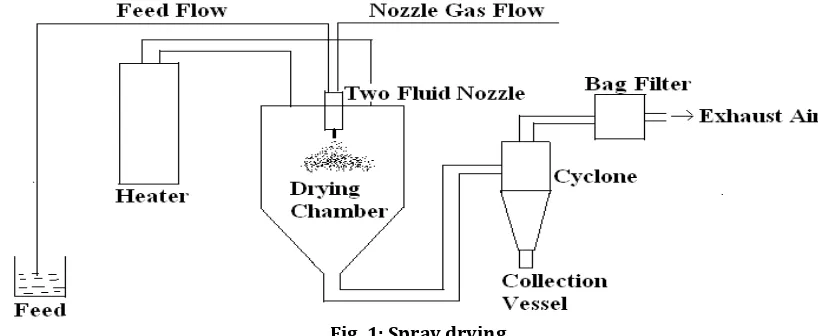
Fig. 1: Spray drying
Spray drying process (Fig.1) have advantages that can be designed to virtually any capacity required. Feed rates range from a few pounds per hour to over 100 tons per hour. Operation is continuous and adaptable to full automatic control (Gharsallaoui et al., 2007). It can be used with both heat-resistant and heat sensitive products. Nearly spherical particles can be produced. There are some limitation that includes limited versatility in producing particles or structures with the complex morphologies, and rapid drug release rates often exhibiting a burst effect (Katta & Gauvin, 1976).
Design and critical elements of spray drying Atomizers
The "heart" of any spray dryer is the atomizer, small in size, big in importance, installing the right atomizer is essential to spray drying success. The atomizer must fulfill several important functions which are summarized below:
i. It must disperse the feed material into small droplets, which should be well distributed within the dryer and mixed thoroughly with the hot gas.
ii. The droplets produced must not be so large that they are incompletely dried, nor so small that product recovery is difficult. Small particles may also overheat and become scorched.
iii. The atomizer must also act as a metering device, controlling the rate at which the material is fed into the dryer:
a) Air atomization or two fluid nozzles, b) Airless atomization nozzles,
Air flow
a. Co-current flow: in a co-current dryer, the spray is directed into the hot air entering the dryer and both pass through the chamber in the same direction.
b. Counter-current flow: in this dryer design, the spray and the air are introduced at opposite ends of the dryer, with the atomizer positioned at the top and the air entering at the bottom.
c. Mixed flow: dryers of this type combine both cocurrent and counter current flow. In a mixed flow dryer, the air enters at the top and the atomizer is located at the bottom.
Spray drying chamber
Air within the chamber maintains a flow pattern, preventing deposition of partially dried product on the wall or atomizer (Ronald, 1997). Air movement and temperature of inlet air influence the type of final product.
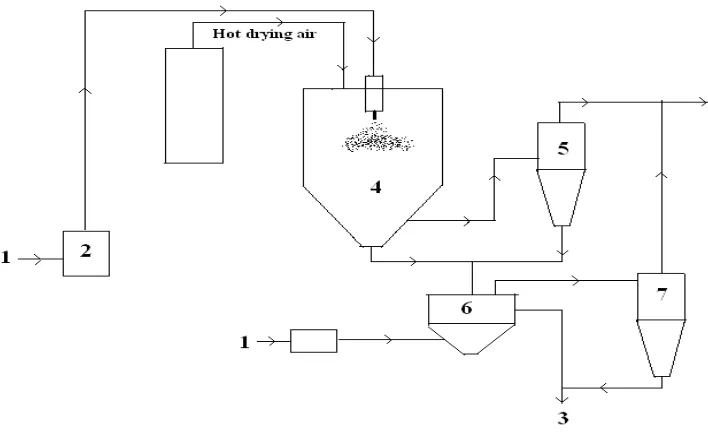
Types of spray drier Two stage dryer
Two stage dryers allow the use of lower temperatures in the dryer, making the design a good choice for products that are particularly heat sensitive (Katta & Gauvin, 1976) (1-air; 2-feedstock; 3-dried product; 4-drying chamber; 5-cyclone; 6-stationary fluid bed; 7-fluid bed cyclone) .
Horizontal dryer
3-Fig. 2: (1-Feedstock; 2-drying chamber; 3-dried product; 4- cyclone; 5-wet scrubber; 6-bag filter)
Fig. 4: Horizontal dryer
Fig. 5: Fluidized spray drier
Multi stage drier
The process produces non-dusty, free flowing agglomerated powders with high flavor retention. It operates with low outlet-temperatures, achieving high thermal efficiency. This design concept is successful for drying high fats, hygroscopic, and sticky products that are
difficult to handle in more conventional designs.
Compact Spray Dryer
thermal efficiencies and cooler conditions for powder handling.
Integrated filter drier
Integrated Filter Dryer - Combines an integrated fluid bed and filter arrangement. It is an adaptable and flexible spray dryer for the food ingredients, food, dairy, chemical, and pharmaceutical industries.
b) Outlet temperature of air: it govern the sizing of powder recovery equipments, higher is the outlet air temperature larger will be the size of powder recovery equipment and conveying ducts and plenums (Maury et al., 2005). Outlet air temperatures control final moisture content of powder.
c) Viscosity: high viscosity hinders correct drop formation. As the viscosity is lowered, less energy or pressure is required to form a particular spray pattern.
d) Solid content: care must be taken with high solid loadings (above 30%) to maintain proper atomization to ensure correct droplet formation.
e) Surface tension: addition of a small amount of surfactant can significantly lower the surface tension. This can result in a wider spray pattern, smaller droplet size, and higher drop velocity.
f) Feed temperature: as the temperature of a solution to be sprayed is increased, the solution may easily dry as it brings more energy to the system.
g) Volatility of solvent: a high volatility is
desirable in any drying process.
Unfortunately, choices are limited today. In many cases, these restrict the solvent choice to water.
h) Nozzle material: most pharmaceutical applications use stainless steel inserts. However, tungsten carbide nozzles are often available and have excellent resistance to abrasion and good corrosion resistance for most feedstock.
Innovations in spray drying
Sterile spray drying for stable injectable liquid formulation
Soluble glass microspheres forming a
monodisperse suspension in anhydrous
Spray drying for the production of crystalline products
Spray drying is known to produce predominately amorphous material due to the almost instantaneous transition between liquid and solid phases. However, spray drying can also be used to obtain crystalline products (Shoyele & Cawthorne, 2006). To achieve such a goal, the product is fed in a crystalline suspension, instead of a solution, to the drying chamber. Feeding the crystals in the right form allows spray drying to fine tune crystal size distribution and final content of residual solvents (Jorge & Felipe, 2004).
Applications of spray drying in pharmaceutical field
Effect of spray drying on powder properties
Many spray drying operations produce spherical particles while others result in non-spherical particles. Particles may be hollow or solid. Pressure spray nozzles can produce particles ranging in size from 20 to 600 microns. Two-fluid nozzles generally produce particles with sizes in the range from 10 to 200 microns and larger (Katta & Gauvin, 1976; Sommerfeld & Blei, 2001). Rotary atomizers produce more uniform particle sizes compared to pressure atomizers. Co-current dryers produce powders with lower bulk densities than counter-current dryers.
Granulation
greatly improving the dissolution rate of many drug substances, including tolbutamide, indomethacin and ibuprofen (Gonnissen et al., 2008). Complexes of paracetamol and diazepam have been prepared with pcyclodextrin.
Encapsulation
With a cocurrent drier, heat exposure is minimized. The product is usually recovered about 15°C below the outlet temperature (Wan et al., 1992). This has been applied to microencapsulation of products such as antibiotics, vaccines, peptides and proteins. Inhalation highly specialized spray drying nozzles that give increased particle engineering capabilities, even on largescale- making it possible to accurately manipulate aerodynamic particle size and properties. Spray drying technologies make it easier than ever to efficiently produce therapies in the form of free-flowing particles that are ideally suited for inhalation (Seville et al., 2007).
Control release products
Creating a shell-like structure around the granular allows spray drying to be used for the manufacture of controlled-release products. Future impacts Spray drying is presently one of the most exciting technologies for the pharmaceutical industry, being an ideal process where the end-product must comply with precise quality standards regarding particle size distribution, residual moisture content, bulk density and morphology. The production of particles from the process of spraying has gained much attention in recent years. Multistage
processes, new spray techniques, and
temperature-gradient systems hold promise for future pharmaceutical application (Masters, 1991). Classic equipment designs are being used more and more in the United States as a means for preparing pharmaceutical products of various types. Their versatile output capacity, continuous operation and controllability are desirable features.
REFERENCES
1. Keey RB and Pham QT. Behavior of spray driers with nozzle atomizers. Chem Engg. 1976;311:516-521.
2. Masters K. Spray drying handbook, John
a laboratory spraydryer. Eur J Pharma & Biopharma. 2005;59:565–573.
4. Michael JK. Spray drying and spray congealing of pharmaceuticals. In:
Encyclopedia of pharmaceutical
technology. Marcel Dekker INC, NY. 1993;14:207-221.
5. Ronald CD. Spray drying innovative use of an old process. Design Elements. 1997;7:97–113.
6. Roser B. Sterile spray drying for stable liquid 21st century pharmaceuticals. In:
Innovations in pharmaceutical
technology. 2005:50-54.
7. Seville PC, Li Hy and Learoyd TP. Spray dried powders for pulmonary drug delivery. Crit Rev Ther Drug Carrier Syst. 2007;24(4):307-360.
8. Shoyele SA and Cawthorne S. Particle engineering techniques for inhaled biopharmaceuticals. Adv Drug Delivery Rev. 2006;58:1009–1029.
9. Sommerfeld M and Blei S. Lagrangian modeling of agglomeration during spray drying processes. Encyclopedia of Pharma Technol. 1992;6:171-173.
10. Vehring R. Pharmaceutical particle engineering via spray drying. Pharm Res. 2008;25(5):999–1022.
11. Wan LS, Heng PW, Chia CG and Cececilia GH. Spray drying as a process for encapsulation and the effect of different coating polymers. Drug Dev Ind Pharm. 1992;18(9):997-1011.
12. Armstrong NA and Haines-Nutt RF. Elastic recovery and surface area changes in compacted powder systems. Powder Technol. 1974;9:287–290.
13. Broadhead J, Edmond Rouan SK and Rhodes CT. The spray drying of pharmaceuticals. Drug Dev Ind Pharm. 1992;18:1169–1206.
14. Di Martino P, Guyot-Hermann AM, Conflant P, Drache M and Guyot JC. A new pure paracetamol for direct compression: the orthorhombic form. Int J Pharm. 1996;128:1–8.
relationships in powder compaction. Trans. Metall. Soc. AIME. 1961;221:661– 675.
20. Huttenrauch R, Friecke S and Zielke P. Mechanical activation of pharmaceutical systems. Pharm Res. 1985;6:302– 306. 21. Joiris E, Di Martino P, Berneron C,
Guyot-Hermann AM and Guyot JC. Compression behaviour of orthorhombic paracetamol. Pharm Res. 1998;15:1122–1130.
22. Juslin MJ and Paronen TP. On the accuracy
of displacement measurements by
instrumented single-punch machine. J Pharm Pharmacol. 1980;32:796–798. 23. Lefebvre C, Guillaume F, Bouche R,
Buoaziz R and Guyot JC.Etude de diffe´rentes formes polymorphes du meprobamate. In: Fifth International
Conference on Pharmaceutical
Technology. 1989;I:211–211.
24. Martindale, The Exrta Pharmacopoeia, 31st ed. Royal Pharmaceutical Society, London. 1996:811–813.
25. Sebhatu T, Ahlneck C and Alderborn G. The effect of moisture content and bond-formation properties of amorphous
The effect of spray drying feed
temperature and subsequent
crystallization conditions on the physical form of lactose. AAPS Pharm Sci Tech. 2002;3(4):17.
30. Gharsallaoui A, Roudaut G, Chambin O, Voilley A and Saurel R. Applications of spray-drying in microencapsulation of food ingredients: an overview. Food Res Intl. 2007;40:1107–1121.
31. Gonnissen Y, Verhoeven E, Peeters E, Remon JP and Vervaet C. Coprocessing via spray drying as a formulation platform to improve the compactability of various drugs. Eur J Pharmac & Biopharma. 2008;69:320–334.
32. Hanrahan FP and Webb BH. USDA develops foam-spray drying. Food eng. 1961;33(8):37.
33. Jorge MCP and Filipe G. Spray drying technology for better API crystals. Process development. 2004:38-39.
34. Katta S and Gauvin W. Basic concepts of
spray dryer design. AICHE J.