Study of Optimum Eccentricity Angle of a
Horizontal Eccentric Annulus
M .G. Mousa, Mustafa. A. El-Bouz, Mahmoud A. Elazab
Mechanical Engineering Department, Faculty of Engineering, Mansoura University, Mansoura, Egypt
Abstract
A numerical study of mixed convection and flow inside an eccentric horizontal annulus is presented. The inner and outer cylinders rotate to generate the forced convection effect. The numerical work was carried out using ANSYS FLUENT 16. The numerical study is conducted for laminar flow mixed convection. Different eccentricity angle were studied to get the best position of eccentricity at which the best heat transfer occurs. The effect of eccentricity angle on the average Nusselt number at constant radius ratio of 2 and constant eccentricity of 0.5 is conducted. All results were performed with constant heat flux=400 W/m2 at the inner cylinder and constant inlet velocity. isotherms was investigated.
Key Words
:
Mixed convection, Eccentricity angle, Eccentric annulus, Rotating cylinder.1- Introduction
The heat transfer in an annulus between two horizontal concentric cylinders have attracted considerable attention because of their wide engineering applications. The study of heat transfer in an annulus has direct industrial
applications such as heat exchangers, heat transfer in turbo machineries, indoor climate, double glazed windows, cooling of electrical and electronic components, underground electric transmission cables using pressurized gas and others.
Numerical simulation of natural convection in concentric and eccentric circular cylinder has been reported in the literatures [1-4]. Wael et al [5] studied mixed convection in an eccentric annulus filled by nanofluid. The inner and outer cylinders are kept at constant temperatures as Th and Tc, respectively. The inner cylinder rotates to generate the forced convection effect.
Omer et al [6] studied natural convection heat transfer in horizontal concentric annulus between outer cylinder and inner flat tube using nanofluid. Natural convection heat transfer in two-dimensional region Omer et al [6] studied natural convection heat transfer in horizontal concentric annulus between outer cylinder and inner flat tube using nanofluid. Natural convection heat transfer in two-dimensional region formed by constant heat flux horizontal flat tube concentrically located in cooled horizontal cylinder was studied numerically by using nanofluid.
Natural convection of nanofluid in a concentric annulus considering variable viscosity and variable thermal conductivity has been investigated by Abu-Nada [7] and Abu-Nada et al. [8]. Matin and Pop [9] studied numerically natural convection flow and heat transfer of Copper (Cu)–water nanofluid inside an eccentric horizontal annulus. Laminar mixed convection Al2O3-Water nanofluid flow in elliptic ducts with constant heat flux boundary condition has been simulated employing two phase mixture model by Shariat et al. [10]. Results showed that in a given Reynolds number and Richardson number, increasing solid nanoparticles volume fraction increases the Nusselt number while the skin friction factor decreases. Increasing aspect ratio in elliptic tubes reduces the local skin friction factor whereas it does not have any specified effect on the local Nusselt number. Mirmasoumi and Behzadmehr [11] studied numerically laminar mixed convection of a nanofluid consisting of water and Al2O3 in a horizontal
nanofluid flow inside a wide rectangular microchannel heat sink. Decent investigation in the same way of the present study was performed by Matin and Pop [14]; they introduced a numerical study of mixed convection flow and heat transfer of Al2O3-water nanofluid inside an eccentric horizontal annulus with rotation on the inner cylinder.
Hamed et al.[15]. An experimental investigation has been conducted to determine the effects of the rotation, heat flux, eccentricity, and Radius ratio on the convective heat transfer of air between horizontal concentric and eccentric rotating cylinders. An experimental apparatus is designed and constructed to achieve this investigation. The measured data are presented in form of Nusselt number, Rotation Reynolds number, Rayleigh number, eccentricity and Radius ratio.
A numerical study of mixed convection and flow inside an eccentric horizontal annulus is presented at Mousa et al. [16]. The inner and outer cylinders rotate to generate the forced convection effect. The numerical work was carried out using ANSYS FLUENT 16. Different scenarios are explored to explain the effects of different parameters on the studied problem. These parameters are rotation ratio, eccentricity ratio, raduis ratio and rotation direction. The range of the Richardson number Ri, eccentricity ratio ε, radii ratio Rr and rotation ratio ωR, are 0.1 ≤ Ri ≤ 1 (mixed convection), 0 ≤ ε ≤ 0.9, 1.5 ≤ Rr ≤ 3.5 and 0 ≤ ωR ≤ 1.5 respectively. All results were performed with constant heat flux=400 W/m2 at the inner cylinder and constant inlet velocity. The effects of eccentricity, rotation ratio, radii ratio and rotation direction on the average Nusselt number, and isotherms were investigated. Results are discussed, and are found to be in good agreement with previous works. It is also found that, the eccentricity, rotation ratio, radii ratio and rotation direction has a positive remarkable effect on the average Nusselt number. The best value of eccentricity is about 0.65 to .75.
The aim of the present work
This paper is an extension of Mousa et al. [16] but at constant radius ratio of 2 and constant eccentricity of 0.5 at different angle of eccentricity to study the best position at which the best Nusselt number occurs.
2-The Mathematical Model 2-1 Physical Model
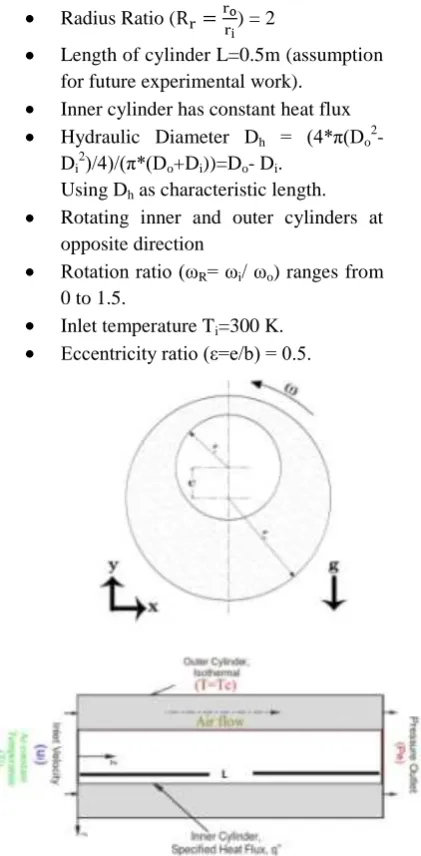
The physical model, which describes the problem under investigation, is illustrated on Figure (1).
The problem and boundary conditions can be described as followed:
Radius Ratio ( ) = 2
Length of cylinder L=0.5m (assumption for future experimental work).
Inner cylinder has constant heat flux Hydraulic Diameter Dh = (4*π(Do2 -Di
2)/4)/(π*(D
o+Di))=Do- Di. Using Dh as characteristic length. Rotating inner and outer cylinders at opposite direction
Rotation ratio (ωR= ωi/ ωo) ranges from 0 to 1.5.
Inlet temperature Ti=300 K. Eccentricity ratio (ε=e/b) = 0.5.
Figure (1) Physical Modeling
2-2 Governing Equations Continuity equation:
θ-direction
Z-direction
Energy equations:
3-Mesh independence and Validation
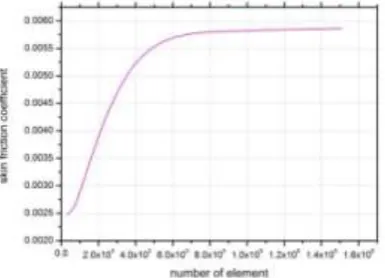
To insure the independence of mesh, a various number of elements is used to know the most accurate range of number of elements.
Nusselt number, and skin friction coefficient are presented on Figure (2) to investigate the effect of variation of no of elements at Radius ratio=2, Eccentricity Ratio (e/b) =0.5, and ReΩ=0.
Figure (2) effect of number of elements on Nusselt number and skin friction coefficient
Figure (2) shows that the numerical results were independent of the grid when the number of cells are larger
than 1,100,000. Based on this result, a 1,100,000 grid system was used in the present numerical analysis
Figure (3) Effect of variation of averageNusselt number (Nu) on Rayleigh number (Ra)
Figure (4) shows the Effect of variation of Rayleigh number Ra on average Nusselt number Nu for Radius ratio=2.84, eccentricity ratio =0.46,Pr=0.7 and ReΩ=0.
Figure (4) Effect of variation of average Nusselt number (Nu) on Rayleigh number (Ra)
4-Results and discussions
The angle of eccentricity is calculated from the positive direction of x-axis as shown in Figure (5).
Figure (5) angle of eccentricity
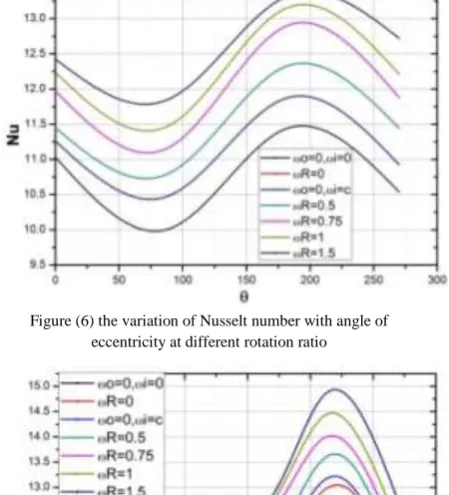
The effect of eccentricity angle on the average Nusselt number at constant radius ratio of 2 and constant eccentricity of 0.5 is shown in Fig. (6).The variation is almost sinusoidal and similar behavior is noticed at angle of 0o (right) an 180o (left) with maximum value occurring at angle between 180o and 270o. Calculating other two angles between 180o and 270o to determine the maximum angle at which the higher Nusselt number exists, this is shown in Figure (7).
Figure (6) the variation of Nusselt number with angle of eccentricity at different rotation ratio
Figure (7) the variation of Nusselt number with angle of eccentricity at different rotation ratio
ε=0.5
right
ε=0.5
down
ε=0.5
left
ε=0.5
up
ωi=0,ωo=0
ωi=c,ωo=0
ωR=0
ωR=-0.5
ωR=-0.75
ωR=-1
Figure (8) Effect of eccentricity angle on the isotherms
Isotherms of the two angles between 180o and 270o is illustrated in Figure (9). It is observed that as the angle increases the temperature decreases, indicating that more cooling for the cylinder
θ=180 θ=210 θ=240 θ=270
ωi=0,ωo=0
ωi=c,ωo=0
ωR=0
ωR=-0.5
ωR=-0.75
ωR=-1.5
Figure (9) Effect of eccentricity angle on the isotherms
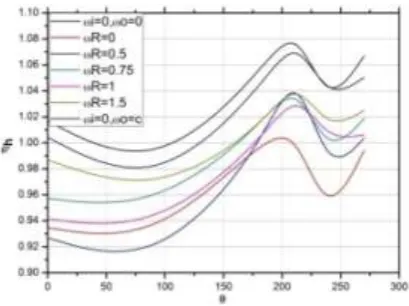
The calculated thermal hydraulic performance versus angle of eccentricity for different rotational ratios at opposite direction is shown in Figure (10). The figure shows that the best value of angle of eccentricity shown by the figure is about 215o and the worst value is about 65o.
Figure (10) Thermal hydraulic performance versus angle of eccentricity for different rotational ratios
5- Conclusions
The maximum value is at an angle around 215o and minimum value at an angle around 100o and what it looks like at the Fourth quarter. The average Nusselt number increases with the increase in the Rotation Reynolds number for all angles.
Nomenclature
b Annulus gab width(ro-ri) Dh Hydraulic diameter e Eccentricity
h Heat Transfer Coefficient ((w/m2k) kf Thermal conductivity of fluid L Length of cylinder
q Wall heat flux per unit area (w/m2) ro Outer Raduis (m)
ri Inner Raduis (m) Rr Radius Ratio(ro/ri) T Temperature
x,y,z Cartesian coordinates
r,θ,z Cylindrical coordinates
Greek symbols
ω Angular velocity [rad/S] ωR Rotation ratio (ωi/ ωo) ε Eccentricity Ratio (e/b) θ Angle of eccentricity α Thermal diffusivity µ Dynamic viscosity
β coefficient of thermal expansion β ν kinematic viscosity
Dimensionless numbers
Nu Nusselt number (h*Dh/kf) Ri Richardson number (Gr/(Reω2)) Pr Prandtl number
References
[1] Deng, Q.,Fluid flow and heat transfer characteristics
of natural convection in square cavities due to discrete source sink pairs, Int. J. Heat Mass Transfer, 51 (2008) pp. 5949–5957 .
[2] Zhou Y. ,Zhang R., Staroselsky I. and Chen H.,
Numerical simulation of laminar and turbulent buoyancy-driven flows using a lattice Boltzmann based algorithm, Int. J. Heat Mass Transfer, 47 (2004) PP.4869–4879 .
[3] Seyyedi S.M., Dayyan M., SoheilSoleimani and
Ghasemi E. , Natural convection heat transfer under
constant heat flux wall in a nanofluid filled annulus enclosure, Ain Shams Engineering Journal (2015) 6,PP. 267–280 .
[4] Colombo L.P.M. and Lucchini A. ,Fully developed
laminar mixed convection in uniformly heated horizontal annular ducts, International Journal of Thermal Sciences ,Volume 94, August 2015, PP. 204–220.
[5] Wael El., Abo.Mohamed, Ali S. and El. Yehia,
Mixed convection in an eccentric annulus filled by nanofluid , Thermal Science 2014 OnLine-First Issue 00, PP. 128-128.
[6] Omer A. Alawia, Nor
AzwadiCheSidika andDawoodbH.K., Natural
convection heat transfer in horizontal concentric annulus between outer cylinder and inner flat tube using nanofluid
, International Communications in Heat and Mass Transfer, Volume 57, October 2014, PP. 65–71.
[7] Abu-Nada. E., Effects of variable viscosity and
thermal conductivity of CuO– water nanofluid on heat transfer enhancement in natural convection, mathematical model and simulation, ASME J. Heat Transfer, 132 (2010) PP. 1–9.
[8] Abu-Nada. E., Masoud. Z. and Hijazi. A.,Natural
convection heat transfer enhancement in horizontal concentric annuli using nanofluids, Int. Commun. Heat Mass Transfer, 35 (2008) PP. 657–665.
[9] HabibiMatin. M. and Pop, I., Natural convection
[10] Shariat, M., Akbarinia, A., Nezhad, A.,
Behzadmehr, A. and Laur, R., Numerical study of two
phase laminar mixed convection nanofluid in elliptic ducts, Applied Thermal Engineering, 31 (2011) PP. 2348-2359. [11] Mirmasoumi, S. and Behzadmehr, A.,Numerical study of laminar mixed convection of a nanofluid in a horizontal tube using two-phase mixture model, Applied Thermal Engineering, 28 (2008) PP.717–727.
[12] Akbarinia, A. and Behzadmehr, A., Numerical study of laminar mixed convection of a nanofluid in horizontal curved tubes, Applied Thermal Engineering, 27 (2007) PP. 1327–1337.
[13] Kalteh, M., Abbassi, A., Saffar-Awal, M., Frijns,
A., Darhuber A. and Harting J., Experimental and
numerical investigation of nanofluid forced convection inside a wide microchannel heat sink, Applied Thermal Engineering, 36 (2012) PP. 260-268.
[14] HabibiMatin, M. and Pop, I.,Numerical Study of Mixed Convection Heat Transfer of a Nanofluid in an Eccentric Annulus, Numerical Heat Transfer, Part A: 65 (2014) PP. 84–105.
[15] Hamed R. Elthan,Reda I. El-Ghnam, M.G.Mousa, Eed A. Abdel-Hadi, Sherief H. Taher, Analysis of Heat Transfer in an Annulus Between Two Horizontal Rotating Cylinders, Seventh International Engineering Conference , Mansoura university , January 2009, pp.21-33.
[16] M .G. Mousa, Mustafa. A. El-Bouz, and Mahmoud A. Elazab , " Mixed convection in an eccentric annulus",