Submittedin:December2012 Acceptedin:May2013 Publishedin:January2014
Recommended citation
Abstract
Thisarticlepresentsatechno-pedagogicallecturertrainingmodelthatwasvalidatedinanintensive hybrid-modeworkshop/courseforlecturers. Theaimofthecoursewastotrainlecturershowtouse theMoodlevirtuallearningenvironment(VLE)asadidacticsupportintheirclassrooms. A research
-actionmethodwasappliedtothestudy, andtheinstrumentsusedwereinterviews, questionnaires,
blogsandopinionsurveys, togetherwiththeplanninganddevelopmentofanonlinecourseby
eachparticipantastheend-product. Thecoursewasthenanalysedtoseehoweachofthe16par
-ticipantshadgraduallyappropriatedthetechnology, withoutoverlookingthepedagogicalaspects.
Someprogressedfrombeginnertointermediatelevel, andothersfromintermediatetoadvanced
level, whilethosealreadyatadvancedleveldevelopedsophisticatedcoursesandsoughtwaysof
improvingthemontheirown. Inaddition, theresearchersfoundthattheroleoftheuniversityinsti
-tutionhadbeenfundamentaltotheproperrunningofthecourse, andthatconstantcommunication
betweenthefacilitatorandthelecturers/learnershadbeenimportant.
Keywords
highereducation, lecturertraining, educationaltechnology, technologyappropriation, hybridmode,
virtuallearningenvironments
Aplicación y validación de un modelo tecnopedagógico
de formación docente mediante una plataforma educativa virtual
Resumen
El artículo presenta un modelo de formación docente tecnopedagógico, validado dentro de un curso-taller intensivo en la modalidad híbrida, dirigido a docentes de educación superior. Este curso tiene como obje-tivo capacitar en el uso de la plataforma Moodle como apoyo didáctico en sus clases. El método utilizado en la investigación es de investigación-acción, los instrumentos usados fueron la entrevista, cuestionarios, bitácoras y sondeos de opinión, conjuntamente con la planeación y desarrollo de un curso en línea ela-borado por cada uno de los participantes como producto final. El curso fue analizado después, para ver cómo cada uno de los dieciséis participantes se apropiaba gradualmente de la tecnología, sin descuidar el referente pedagógico. Algunos de ellos pasaron de ser principiantes a intermedios y algunos de estos a avanzados, mientras que los avanzados desarrollaron cursos más sofisticados y buscaron la forma de mejorarlos por sí solos. Además, los investigadores se percataron de que la institución universitaria des-empeña un papel primordial para el buen desarrollo del curso, así como la importancia de una constante comunicación entre el facilitador con los docentes-aprendientes.
Palabras clave
1. Introduction
The world’s educational systems are currently faced with the challenge of using information
and communication technologies(ICTs)to provide theirstudents withthe necessary tools and
knowledge for the21st century. Consequently, thelearning processis undergoinga numberof
substantialchanges, themostimportantonebeingtherolethatteachersplay(Álvarez, 2006). Various
researchers(Castellano, 2010;Cebrián, 2003)havefoundthatICT useintheteaching-learningprocess
isadvantageousand, whentrainingteacherstouseICTs, thatitispossibletogetthemtousethemas
asupportbothinsideandoutsidetheirclassrooms.
Previous studies have underscored the problem of training university lecturers to use ICTs.
DespitethefactthatICTsareusedineducation, thereareconcernsto findoutwhy, ifthereareso
manytechnologicalresourcesavailabletosupporttheeducationalprocess, notalllecturersareusing
them. A lackofknowinghowtoincorporatethemintotheclassroomisapossibleexplanation, and
anotheristhescarceornon-existenttrainingthatinstitutionsoffertheirlecturersinthepedagogical
useofthesetechnologies.
TheintegrationofICTsintheclassroomdependsontheteachers’abilitytoscaffoldthelearning
environmentby usingeffectiveICT-based pedagogies (Shawki etal., 2008). However, numerous
researchreportshaveindicatedalackoftechnicalandpedagogicaltrainingamongteachers, which
preventsthem fromsetting criteriawithregardtowhenandhowtostartusingthis technology
(Kaput, 1992;García, Martínez, & Miraño, 2000; Adell, 2002;Veen, 1993;Jones, Cox, & Scrimshaw, 2004,
citedinBECTA, 2004;Bautista, Borges, & Forés, 2012). Itisforthesereasonsthatinstitutionsshouldtrain
theirlecturersnotonlytousetechnology, butalsotomakethemunderstandwhyusingtechnology
isimportantand, aboveall, toensurethattheyunderstandthedifferentrolesthattechnologyplays
intheteaching-learningprocess(Bates, 1997).
With the support of the Educational Development and Research Institute (IIDE) at the
AutonomousUniversityofBajaCalifornia(UABC), Mexico, thestudywasconductedatXochicalco
University, Mexico.1 A techno-pedagogicallecturertrainingmodelwasdevelopedtomeettheneeds
oftraininglecturerstouseICTswithpedagogicalsupportandtogetthemtoimplementitintheir
ownclassrooms.
Theaimofthisarticleistopresentatechno-pedagogicallecturertrainingmodelanditsvalidation
throughtheparticipationoflecturersfromaprivateMexicanuniversity. Combiningpedagogywith
technologyisquiteunusualandoftennon-existentinlecturertraining. Theresultsobtainedfromthe
research-actionprocessusedtodevelopandvalidatethemodelaredescribedbelow.
2. Method
The research-action method served to guide most of the intervention, as the task implied a
simultaneousneedto findthingsoutandintervene, aswellastheparticipationofthoseinvolved
(lecturersandresearchers). Everyaspectwasguidedbythespiralformoftheresearch-actionprocess,
thatistosay, takingpracticeasthebasistodetect, clarifyanddiagnosetheproblem, toformulate
aplantosolvetheproblemorintroducechange, toimplementtheplanandevaluatetheresults,
andtogivefeedback, whichthenleadstoanewdiagnosisandanewspiralofreflectionandaction
(Sandín, 2003). Inthisrespect, thestudywasconductedinthefourstagesdescribedbelow.
The firststage was fieldwork, which involved developing the techno-pedagogical model. In
ordertodothat, theopinionsoftheuniversity’slecturersanddirectorswerecollectedbymeansofa
questionnaireforlecturersandthreeinterviewswithlecturers. Inaddition, areviewoftheliterature
onexistingmodelswasperformed;alltheinformationwasanalysedandamodelwascreated.
Thesecondstageinvolvedexpressingthemodelasadidacticplanforface-to-faceandonline
sessions in the Moodle virtual learning environment (VLE). In order to document the learning
process, didacticmaterialwascreated, aswereinstrumentssuchasquestionnaires, readingrecords,
diagnostictests, self-evaluationtestsandblogstofosterreflection.
Thethirdstageinvolvedrunningthesix-weekcourseinSeptember-October2012attheuniversity.
Therewere16lecturers/learnersleftattheendofthecourse.
The finalstage involvedanalysingallthedata collectedfromtheactivitiesundertakenbythe
participantsthroughoutthetrainingcourse, suchasexercises, questionnaires, commentsinforums
andchats, blogs, e-mailsandevaluationsofthecourseandthefacilitator.
3. Results
Model
Thecreationofthetechno-pedagogicalmodelwasbasedonastudybyMurilloetal. (2006)that
examinedsevenLatin-AmericanandEuropeaninstitutionalteachertrainingmodelsandidentified five
generalfeatures:innovativeculture, contextualisation, innovativepedagogicalproposal, theoretical
frameworkandbottom-upapproach. Inaddition, thestudydescribedinnovativecontributionsto
teachertraining:competencydevelopment, theory-practiceinterrelation, researchasakeyfactor,
universitiesaslearningorganisations, andopenofferingsbasedonIT use(Murilloetal., 2006).
Likewise, recommendations containedin studieson thetopic wereanalysed. Someofthese
were:teacher trainingshouldbesupervisedand consideredas lifelonglearning;theadvantages
of ICT use shouldbe madeexplicit (Coxet al., 1999, cited in BECTA, 2004); both technical and
pedagogicalaspectsshouldbeincluded(Veen, 1993, citedinBECTA, 2004);itshouldexplicitlymeet
theteachers’needs(Levy, 2000, citedinBECTA, 2003);anditshouldprovideteacherswithinnovation
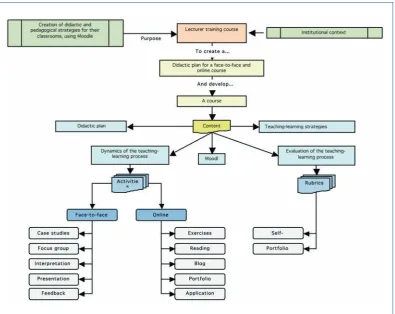
Thetechno-pedagogicallecturertrainingmodelisshowninFigure1below:
Figure 1.Techno-pedagogical lecturer training model
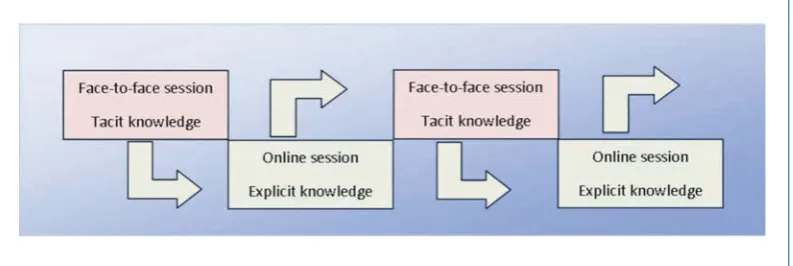
The hybrid mode, which combines face-to-facewithonline sessions(Figure 2) was selected
because ofthe qualityof communication, bothface-to-face andindirect, using communication
mediainthecaseofthelatter(Lavigneetal., 2009). Anotheradvantageofthehybridmodeisthatit
convergeswiththeclassificationofexplicitknowledgeandtacitknowledge;explicitknowledgecan
beaddedataspecificlocation, storingobjectiveforms, andbeappropriatedwithouttheparticipation
oftheknowledgeablesubject;tacitknowledgeiscontextualandpersonal, andcannotbeadded
easily–takingfulladvantageofitrequirestheinvolvementandcooperationoftheknowledgeable
subject(Nonaka & Takeuchi, 1995). Takingintoaccountthetrainingobjective, convergencewarranted
theuseofthehybridmode. Inadditiontothehybridmode, the ‘Castle Top’modelproposedbyFink
Workshop/course
Theuniversitywasaskedforsupporttorunthetechno-pedagogicallecturertrainingcourseforthose
teachingonvariousundergraduateandgraduateprogrammes. Itshouldbenotedthatinstitutional
support(Salinas, 2004)isanimportantfactorthatenables teacherstohavetherighttraining, the
necessaryinfrastructure, andtechnicalandhumansupport(Murilloetal., 2006).
Thecoursewasdesignedwiththeideaofcombiningpedagogywithtechnology. Tothatend,
shortlectures, tasksandsimpleexerciseswerepreparedontheonehand, andontheother, examples
weregivenofhowthelecturerscouldincorporateMoodleintotheirowncoursesinlinewiththe
strategyoflearning-by-doing, theparticipationofexpertsinthetopicarea, andtheuseofvarious
media such as chats, forums and e-mail toensure aconstant flowof communication withthe
lecturers/learners. Feedbackwasalsogivenoneachcommentmade.
Thirteensessionswereheld;sevenface-to-faceandsixonline, usingMoodleforthelatter. Theactivities
thathadtobedoneforeachsession, includingtheface-to-facesessions, wereputonMoodle. There
wasaselectionoffundamentalandpracticalcontentforthedevelopmentofthelecturers’teachingand
technologicalskills:didacticplanning, teachingandlearningstrategies, Moodleuse, andevaluation.
At the start of the course, a questionnaire was applied to ascertain the lecturers’levels of
pedagogicaland technologicalknowledge, whichwas dividedintothree sections: generaldata,
Moodleuse, andteachingandlearningstrategies. Therewere14questions, sixmultiplechoiceand
eightopen. Someoftheresultsaredetailedbelow.
Moodle use
Participatinginthe firstsessionwere19lecturers, 53%ofwhomtaughtintheSchoolofMedicineand
32%inotherschoolsorworkareas.
Ofthelecturers, 53%saidthattheyhadusedMoodlealready, but, asshowninFigures3and4, the
usewasnotverywidespreadordiverse. Regardingtheactivities/modulesthatMoodleoffers, allthe
lecturerssaidthattheyalwaysusedonlinetext, while33%useduploadasingle file, offlineactivity, lesson,
questionnaireanddialogue. AsshowninFigure3, veryfeweverusedanyoftheotheractivities/modules.
Databasc Dialogue Questionnaire Survey Forum Glossary Lesson SCORM Onlinetext Uploadasingle file Offlineactivity Wiki 6.7% 33% 33% 13% 27% 20% 33% 6.7% 53% 33% 33% 6.7% 13% 27% 20% 13% 20% 13% 13% 6.7% 47% 33% 60% 53% 53% 53% 87% 33% 47% 53% 87% 20% 60% Always Sometimes Never
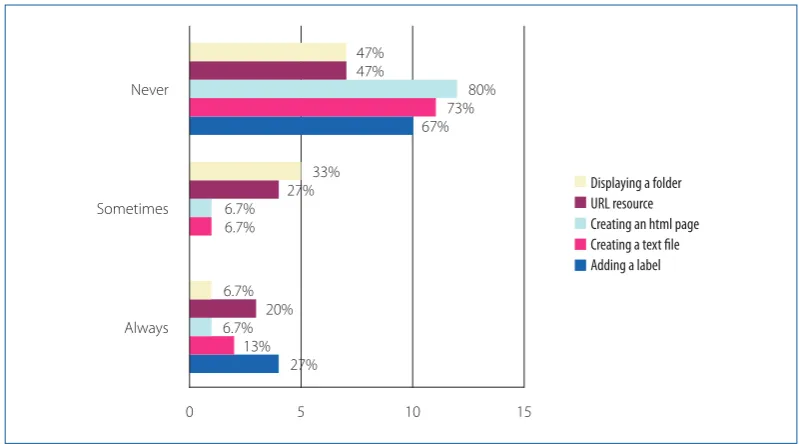
RegardingtheresourcesthatMoodleoffers, Figure4showsthat27%ofthelecturersusedadding
alabel, while27%sometimesusedURLresourceandveryfeweverusedanyoftheotherresources.
Inthecourse, thelecturerssaidthattheyhadbeenunawareofthem.
Figure 3.Moodle activities/modules that lecturers used in their courses
Figure 4.Moodle resources that lecturers used in their courses
Displaying a folder URL resource Creating an html page Creating a text file Adding a label
Always Sometimes Never 27% 67% 13% 6.7%
73%
6.7% 6.7%
80%
20% 27%
47%
6.7%
33% 47%
0 5 10 15
It isimportanttopointoutthatwhile 53%ofthe lecturerssaidthat theyhadusedMoodle,
theadvantagesanddisadvantagesofusingMoodle, theysaidthattheadvantageswereaccessto
information24/7andaclassroomcomplement, andthedisadvantageswerenotknowinghowto
useit, whichhighlightedthelecturers’lackofpreparationanddedication.
Teaching and learning strategies
Inordertodeterminetheparticipants’learningstyles, theywereaskedtodescribeadayinthelifeof
aclass. Theyrepliedasfollows:
Table 1. Description of a day in the life of a class.
Lecturer 1: Presenting a case/problem, assigning roles to the members and giving team answers to the different questions posed by the case/problem.
Lecturer 2: The topic is broached by performing a diagnosis of prior reading, I explain the topic to the students, and exercises are done.
Lecturer 3: I give a visual presentation of the topic and explain the issues that will be addressed, I encourage dialogue and reasoning among the students.
Lecturer 4: I present the idea, pose the problem, group solution, feedback.
Lecturer 5: I ask the students to do prior reading, a concept map of the topic is created, it is reviewed in PowerPoint, a summary is made.
Lecturer 6: 20% is theory coming from me; 60% teamwork, practicals, fieldwork; 20% questionnaires.
Lecturer 7: We can start with a presentation by the students, or a question that arouses their interest, or even a topic that introduces the importance of the issue to be addressed.
Lecturer 8: Lecture, slides, presentations, questions.
Itshouldbenotedthat, whenaskedduringthesession, mostofthemsaidthatthetechnique
theymostcommonlyusedwasexpository;thiscanbeconsideredatraditionalteachingpractice. In
addition, theywereaskedtogivetheirowndefinitionsofteachingstrategies. Someexamplesoftheir
answersareshownbelow.
Table 2. Definitions of teaching strategies
The various procedures available to make the teaching and learning process more active.
The forms and ways that lecturers select to enable their students to gain competencies.
The various ways of effectively transmitting information to students, which facilitate understanding and learning.
Means that enable lecturers to provide students with knowledge.
Proven tools for conveying information to students and getting them to learn.
Strategies that facilitators can use to support the teaching process.
Tools that facilitate the transfer of knowledge to students.
Tools that enable learning-to-learn, or classes that are innovative, creative and interesting to students.
Theywereaskedtogivetheirowndefinitionsoflearningstrategies. Asshownin Table3, some
ofthelecturersdidnothaveaclearideaofwhattheywere, andthatiswhyexamplesofthemwere
givenonthecourse.
Table 3. Definitions of learning strategies
Methods that the students use to learn.
The conceptualisation of the issue.
For me, it is a teaching and learning strategy.
Means that enable students to construct concepts, skills and attitudes.
Tools that help us lecturers get students to learn.
Various strategies that anyone doing learning activities can use.
Behaviours that students adopt in order to learn.
What I am going to use to ensure that what I teach is learnt.
Mechanisms to fix knowledge in the students’ minds.
Necessary tools that facilitate the acquisition of knowledge.
Tools that are used in accordance with the students’ learning styles, though any tools that students are lacking can be acquired.
The specific way of how to guide students in order to strengthen their learning.
Aftergoingovertheanswerstothequestionnaire, thesessionswererestructured, thetaskswere
simplified, the teaching-learning strategies werereviewed and exercises weredone on Moodle
followingthespiralstructureoftheresearch-actionprocess.
Level of progress in technology use and appropriation
Thissectionemergedfromthedatacollectedinthe fieldworkandfrom thetheory proposedby
HooperandRieber(1995), whopresentedamodelofthephasesoftechnologyappropriation(or
‘adoption’intheirwords):familiarisation, utilisation, integration, reorientationandevolution. Thus, by
compilingandanalysingtheblogs, questionnaires, eachoftheparticipants’courses, observations,
sessionquestionsande-mailssenttothefacilitator, differenttypesoflecturer/learnerwereidentified.
Thesewereclassifiedintothreegroups:beginnerlevel(7), intermediatelevel(6)andadvancedlevel
(3).
Beginner level
Beginner-levellecturerswerethosethathadneverusedMoodleandthosethat, bythethirdsession,
hadnotmanagedtogetabasicgraspofMoodle.
Forthisgroup, thefamiliarisationphaseofthemodelby HooperandRieber(1995)wasconsidered.
Theseauthorsdefineditasaphaseconcernedwithateacher’s “initialexposuretoandexperience
Twobeginner-levelparticipants’commentsaregivenbelow:
R I still don’t think I understand how and when the activities are done.
R For me, using the resources is always a challenge.
Itshouldbenotedthatoneofthebeginner-levellecturersaskedforsupporttounderstandhow
Moodleworkedandwasgivenindividualadvice. Thislecturerwasalittleafraidofpressingabutton,
thoughthiswassomethingthattendedtoeaseoff asMoodlewasexplained:
R Today I tried to use Moodle, but I’m at a loss as to what we have to do, or rather how we are supposed to do it.
Intermediate level
Intermediate-levellecturers weredefined bythe levelofVLE-use knowledge andby taking into
consideration the utilisation phase proposed by Hooper and Rieber (1995). According tothese
authors, thisphase “occurswhentheteachertriesoutthetechnologyorinnovationintheclassroom,”
although “theattitudeof ‘AtleastIgaveitatry’willlikelyinterferewithanyenduringandlong-term
appropriationofthetechnology. Teacherswhoprogressonlytothisphasewillprobablydiscardthe
technologyatthe firstsignoftrouble […]”
Intermediate-levellecturers werethosethathadusedsome typeofVLE, whetherMoodleor
another (Blackboard, for example). Three intermediate-level participants’ comments are given
below:
R I felt comfortable, in an environment that fostered learning about new aspects of Moodle that I hadn’t used.
R The first time I used Moodle was a terrifying experience, as it was the first time I’d ever used it.
R I felt very good because I’d already used a similar program: Blackboard.
Manyoftheintermediate-levellecturersmanagedtoovercomesomeofthedifficulties. Indeed,
theycommentedonthisintheblogspecificallycreatedforproblemsarisingintheonlinesessions:
R As far as the online session is concerned, I’m going to ask for more advice.
R The only difficulty was finding the functions, but in general I think it gets easier as you become more familiar with the VLE.
Advanced level
Advanced-levellecturerswerethosethatalreadyhadoneormorecoursesonMoodle. According
to Hooper andRieber (1995), the integrationphase “occurs whena teacherconsciously decides
removed or is unavailable, the teacher cannot proceed with the instruction as planned.” Many
lecturerswould findithardtogivealecturewithoutaprojector, forexample. HooperandRieber
(1995) wenton tosaythat “Forsome teachers, theIntegration phase marksthebeginning of a
professional ‘metamorphosis’ […]”
Fourexamplesofadvanced-levellecturersandtheircommentsintheblogsaregivenbelow:
R I’ve learnt a lot from the online course, but I’ve learnt a lot more from putting it into practice, even though I may have made some mistakes and spent a lot of time correcting things.
R I’ve gained more knowledge about the benefits of the VLE, I’m now more interested in working with it.
R I feel very confident, and am looking forward to learning about a few of the techniques that I need to perfect.
R I think the course is a good example in its own right of how to use it in practice.
Oncompletionofthecourse, theirgradualprogressinrelationtotechnologicalskillswasobserved
(see Table4). Thiswas thecase for five ofthelecturers/learnersbelonging tothe beginner-level
group, whohadmoveduptotheintermediate-levelgroup;twooftheintermediate-levellecturers/
learnershadmadeenoughprogresstojointheadvanced-levelgroup. Threelecturersalreadyinthe
advanced-levelgroupusedMoodletoolsthattheyhadnotusedpreviously, theylearnttosearchfor
helpontheInternetandviavideotutorials, andtolookforwaysofimprovingthemontheirown.
Inaddition, oncompletionofthetrainingcourse, 12outofthe16lecturers/learnershadtheirown
coursesonMoodle.
Table 4. Number of lecturers by level of technological knowledge
Training Beginner level Intermediate level Advanced level
At the start 7 6 3
On completion 2 9 5
4. Discussion
OverdijkandDiggelen(2006)definedtechnologyappropriationas “aprocessofsocialconstruction
inwhichtheactionsandthoughtsoftheuserareshapedbythetechnology, whilethemeaningand
effectsofthetechnologyareshapedthroughtheusers’actions.”
McAnally-Salas, Navarro, andRodríguez(2006)definedtechnologyappropriationasthechanges
occurringinlecturersasaconsequenceoftechnologyuseintheircourses;inthisrespect, teaching
turnsintosomethingdifferentwhentechnologyisincorporatedintoit, eithervoluntarilyorforcibly,
because new knowledge and skills are integrated that become apparent in alecturer’s levelof
Asthe authors havealready mentioned, itwas possible toobservechanges inthe lecturers’
attitudestowardstechnology, aswellasthegradualdevelopmentoftheirskills. Someexamplesof
theirviewsaregivenbelow:
R I need to keep practising, though I have gained more knowledge.
R All this stuff about learning with technology is never ending; there’s always something else to learn.
R […] there’s a lot to learn. I suggest a second part; we’re hooked, so let’s carry on!
Duringthesessions, itwasfoundthattheadvanced-levellecturershadcontinuedtouseMoodle
asareplicaofwhattheywouldusuallyhavedone intheface-to-faceclasses(usingMoodleas a
blackboard). The beginnerand intermediate-level lecturers/learnershad alsodone the same. As
theydiscoveredMoodletools, theyrealisedthebenefitsthatthisVLEcouldofferthemintermsof
simplifyingtheirclasses, suchasgrades, questionnairesanddialogues.
R Questionnaires make the lecturer’s job much easier.
Manyofthelecturerspreferredtousee-mailtosendassignmentinstructionsortokeepintouch
withtheirstudents, buttheyvaluedthefactthattheycoulddoallofthatinoneplace.
HooperandRieber(1995)proposedanothertwophases. Oneisreorientation, which, according
totheseauthors, “requiresthateducatorsreconsiderandreconceptualizethepurposeandfunction
oftheclassroom. […] Thefocusoftheclassroomisnowcenteredonastudent’slearning […] the
teacher’sroleistoestablishalearningenvironmentthatsupportsandfacilitatesstudentsasthey
constructandshapetheirownknowledge […] [teachers] areopentotechnologies […] [and] include
technologyintheirclassrooms.”
HooperandRieber(1995)alsostatedthattheevolutionphase “servesas areminderthatthe
educational systemmust continueto evolve and adaptto remaineffective. […] The classroom
learningenvironmentshouldconstantlychangetomeetthechallengeandpotentialprovidedby
newunderstandingsofhowpeoplelearn.” Inthecaseoflecturersobservedinthestudypresentedin
thisarticle, onlyonereachedthisphase.
5. Conclusions and study limitations
Fromtheresultsobtained, itwasfoundthat trainingthelecturerstouseICTsandguidingthem
todeveloptheirowncoursesmadethemmorelikelytoacquiretechnologicalskills. Thelecturers
managed to incorporate technology into their classrooms, and they gradually appropriated it,
withoutoverlookingthepedagogicalaspects.
Theirgradualprogress inrelationtotechnologicalskills wassupervised. Thiswasthecasefor
five ofthe lecturers/learnersbelonging tothebeginner-levelgroup, whohad movedup tothe
whohadmoveduptotheadvanced-levelgroup. Intheadvanced-levelgroup, thelecturers/learners
learnttolookforwaysofimprovingtheircoursesontheirownLikewise, 12outofthe16participants
had theirown onlinecourses as aclassroom support. Thismeant that this techno-pedagogical
lecturertrainingmodelwasvalidatedbecauseitworked.
Regardingthelimitationsofthisstudy, itshouldbenotedthatseverallecturersdroppedoutof
thecourse. Outofthe24lecturersenrolledonit, only16completedit. Thus, ifparticipationhadbeen
greater, betterresultscouldhavebeenobtained. Moreover, itwouldhavebeeninterestingtohave
establishedwhytheydroppedout.
Otherimportantissuesnotaddressedinthestudywere(a)gettingtheopinionsofthestudents
ofthelecturers/learnersonthecourseand(b)analysingtheonlineactivitylogstoascertainusage
timeandparticipationineachactivity.
It shouldbeunderscored thatconstant communicationwiththe lecturers isvery important.
Indeed, followingcompletionofthecourse, someofthelecturerscontinuedtoaskforadviceabout
revisingtheircourses. Thisprovidedconfirmationoftheimportanceofinstitutionalsupport.
References
Álvarez, M. (2006). Delimitaciones previas a la formación para el uso de las TIC en la enseñanza univer-sitaria: funciones y competencias del docente en entornos virtuales [Delimitationspriortotraining forICT useinuniversityteaching:functionsandcompetenciesofthelecturerinvirtuallearning
environments]. 4º CongresoInternacionalDocenciaUniversitariaeInnovación(CIDUI). Barcelona,
Spain:UniversitatObertadeCatalunya. Retrievedfromhttp://openaccess.uoc.edu/webapps/o2/
bitstream/10609/1666/1/alvarez_Guasch_Espasa_CIDUI_06_paper.pdf.
Bates, A. W. (1997). Restructuring the University for Technological Change. TheCarnegieFoundation forthe Advancementof Teaching. London, England. Retrievedfromhttp://cclp.mior.ca/Referen
-ce%20Shelf/PDF_OISE/Bates_Restructuring%20University.pdf
Bautista, G., Borges, F., & Forés, A. (2012). Didáctica universitaria en entornos virtuales [Universitytea
-chinginvirtuallearningenvironments] (3rded.). Madrid, Spain:EdicionesNarcea.
BritishEducationalCommunicationsand Technology Agency(BECTA)(2004). A review of the research literature on barriers to the uptake of ICT by teachers. Retrievedfromhttp://dera.ioe.ac.uk/1603/1/ becta_2004_barrierstouptake_litrev.pdf.
British Educational Communications and Technology Agency (BECTA) (2003). What the research
says about interactive whiteboards. Retrieved from http://webarchive.nationalarchives.gov.
uk/20130401151715/https://www.education.gov.uk/publications/standard/publicationDetail/
Page1/15007.
Castellano, H. (2010). Integración de la tecnología educativa en el aula: Enseñando con las TIC [Integra
-tionofeducationaltechnologyintheclassroom]. Buenos Aires, Argentina:CenageLearning.
Celaya, R. R., Lozano, M. F., & Ramírez, M. M. S. (2010). Apropiacióntecnológica enprofesoresque
incorporanrecursoseducativosabiertos eneducaciónsuperior [Technologyappropriationby
lecturers who incoporate openeducational resourcesinto highereducation]. Revista
Mexica-na de Investigación Educativa, 15(45), 487-513. Retrievedfrom http://www.redalyc.org/articulo.
oa?id=14012507007.
Epper, R., & Bates, A. W. (2004). Enseñar al profesorado cómo utilizar la tecnología [Teachingfacultyhow tousetechnology]. Barcelona, Spain:UniversitatObertadeCatalunya.
Fink, D. (2003). Creating Significant Learning Experiences: An Integrated Approach to Designing College Courses. SanFrancisco, CA:Jossey-Bass.
Hooper, S., & Rieber, L. P. (1995). Teachingwithtechnology. In A. C. Ornstein(Ed.). Teaching: Theory into practice(pp. 154-170). Needham Heights, MA: AllynandBacon. Retrievedfromhttp://www.
nowhereroad.com/twt/.
Lavigne, G., Organista, S. J., & Backhoff, E. E. (2009). Lahibridacióndigitaldelprocesoeducativo [Digital
hybridisationoftheeducationprocess]. InJ. ValesGarcía(Ed.). Nuevas tecnologías para el aprendi-zaje [Newtechnologiesforlearning](pp. 43-60). Mexico, DF:Pearson/Prentice Hall.
McAnally-Salas, L., Navarro, H. M., & Rodríguez, L. J. J. (2006). Laintegraciónde latecnologíaedu
-cativacomoalternativaparaampliarlacoberturaenlaeducaciónsuperior [Theintegrationof
educationaltechnology asanalternativemeansofexpandingcoverage inhighereducation].
Revista Mexicana de Investigación Educativa, 11(28), 11-30. Retrievedfromhttp://www.redalyc.org/ articulo.oa?id=14002803.
Murillo, T. F. J. (ed.). (2006). Modelos innovadores en la formación inicial docente [Innovativemodels ininitialteachertraining].Santiago, Chile:UNESCO. Retrievedfromhttp://www.oei.es/docentes/
publicaciones/docentes/modelos_innovadores_formacion_inicial_docente.pdf
Nonaka, I., & Takeuchi, H. (1995). The Knowledge-creating company: How Japanese companies create the dynamics of innovation. New York, NY:OxfordUniversityPress.
Overdijk, M., & DiggelenVan, W. (2006). Technology Appropriation in Face-to-Face Collaborative Learning.
UtrechtUniversity:ResearchCentreLearninginInteraction. Retrievedfromhttp://igitur-archive.
library.uu.nl/fss/2007-1213-200540/OverdijkVanDiggelen%20ECTEL%202006.pdf.
Salinas, J. (2004). Innovacióndocenteyusodelas TICenlaenseñanzauniversitaria [Teachinginnova
-tionandtheuseofICT inuniversityeducation]. RUSC. Universities and Knowledge Society Journal, 1(1). Retrievedfromhttp://www.uoc.edu/rusc/dt/esp/salinas1104.pdf
Sandín, M. P. (2003). Investigación cualitativa en educación: fundamentos y tradiciones [Qualiativere
-searchineducation:foundationandtraditions].Madrid, Spain:McGraw Hill.
Shawki, T. (ed.)(2008). Estándares de competencia en TIC para docentes [ICT competencystandardsfor teachers]. Paris, France:UNESCO. Retrievedfromhttp://www.eduteka.org/pdfdir/UNESCOEstan