ePrints Soton
Copyright © and Moral Rights for this thesis are retained by the author and/or other copyright owners. A copy can be downloaded for personal non-commercial
research or study, without prior permission or charge. This thesis cannot be
reproduced or quoted extensively from without first obtaining permission in writing from the copyright holder/s. The content must not be changed in any way or sold commercially in any format or medium without the formal permission of the
copyright holders.
When referring to this work, full bibliographic details including the author, title, awarding institution and date of the thesis must be given e.g.
AUTHOR (year of submission) "Full thesis title", University of Southampton, name of the University School or Department, PhD Thesis, pagination
USING A VIRTUAL LEARNING ENVIRONMENT TO INCREASE THE USE OF INFORMATION AND COMMUNICATION TECHNOLOGY
BY UNIVERSITY TEACHERS AT JAZAN UNIVERSITY, SAUDI ARABIA
by
Mohammed Ageel
A thesis submitted for the degree of Doctor of Philosophy
Southampton Education School University of Southampton
United Kingdom
UNIVERSITY OF SOUTHAMPTON ABSTRACT
FACULTY OF LAW, ARTS AND SOCIAL SCIENCES SCHOOL OF EDUCATION
Doctor of Philosophy
USING A VIRTUAL LEARNING ENVIRONMENT TO INCREASE THE USE OF INFORMATION AND COMMUNICATION TECHNOLOGY
BY UNIVERSITY TEACHERS AT JAZAN UNIVERSITY, SAUDI ARABIA by Mohammed N. Ageel
This thesis is primarily instigated and directed by the researcher’s previous small-scale studies. These revealed Saudi teachers’ low usage and negative perceptions about technology in teaching in schools and higher educational institutions.
For further our understanding, this study investigates the use of technology by a Saudi university’s teachers in their instruction and attempts to explore the viability of training within a Virtual Learning Environment (VLE) for their professional
development. The study engages a mixed-method approach where a VLE training programme is facilitated among 40 teachers of Jazan University. It observes changes in their perceptions about technology and the level of use of Information and
Communication Technology (ICT) tools in teaching. Interviews and questionnaires are used to collect data in two phases, before and after the VLE training, on their use of a range of ICT tools.
The research data shows a significant improvement in the teachers’ usage of a number of ICT teaching tools after they received VLE training. Additionally, it points to positive change in the attitudes, knowledge and skills of these teachers and promises an active role in the teachers’ professional development for these aspects. Moreover, a
ii
to the use of technology are identified, necessitating a Continuous Professional Development (CPD) scheme.
By analysing the research findings it is recognised that a CPD scheme delivered via a VLE can positively change university teachers’ knowledge, attitude, and skills about technology, and consequently increase the use of ICT tools in teaching and learning. However, the study also reveals a number of difficulties and concerns among the teachers regarding VLEs and CPD, and provides recommendations to overcome these. Additionally, the research proposes some directions on possible future studies based on this research work.
Table of Contents
List of Figures ... ix List of Tables ... xi Acknowledgements ... xiii Abbreviations ... xv Chapter 1 Introduction... 1 1.1 Introduction ... 11.2 Rationale for the Study ... 1
1.3 The Focus of the Study ... 2
1.4 The Focus of the Study ... 2
1.5 Research Questions ... 3
1.6 Study Outline ... 3
1.7 Expectations of the Study ... 4
1.8 The Structure of the Study ... 4
Chapter 2 ICT in Higher Education in Saudi Arabia ... 7
2.1 Introduction ... 7
2.2 Saudi Higher Education System – Historical Overview ... 9
2.3 ICT and E-learning in Saudi Higher Education Institutions ... 12
2.4 ICT Usage in Saudi Higher Education Institutions... 14
2.5 Difficulties in Implementation ICT in Higher Education Institutions ... 16
2.6 Plans to Increase ICT Usage in Higher Education... 18
2.7 Summary ... 19
Chapter 3 Literature Review ... 21
3.1 Introduction ... 21
3.2 Teacher, Teaching, and the Use of Technology ... 22
3.2.1 Expectations from Teachers ... 22
3.2.2 New Teaching and Learning Approaches ... 23
3.2.3 Technology in Educational Perspective ... 24
3.3 Information and Communication Technology (ICT) ... 26
3.3.1 What is Information and Communication Technology (ICT)? ... 26
3.3.2 The Nature of ICT in Education ... 27
3.3.3 The Benefits of ICT in Education ... 28
iv
3.3.5 ICT in Higher Education... 36
3.3.6 Why should university teachers use ICT in their teaching? ... 38
3.3.7 University Teacher’s Knowledge, Attitudes, Skills and Usage of ICT 40 3.3.8 Conclusion ... 48
3.4 Continuing Professional Development (CPD) ... 49
3.4.1 What is CPD? ... 50
3.4.2 The Importance of CPD for Teachers ... 50
3.4.3 CPD in Teaching ... 51
3.4.4 CPD in Higher Education Institutions ... 52
3.4.5 CPD in Teaching in Saudi Arabia ... 53
3.4.6 Online CPD: Nature of Learning and Requirements ... 58
3.4.7 Conclusion ... 62
3.5 Virtual Learning Environment (VLE) ... 63
3.5.1 What is a Virtual Learning Environment (VLE)? ... 63
3.5.2 Examples of Types of Virtual Learning Environment... 64
3.5.3 The Efficacy of the VLE ... 68
3.5.4 The Use of the VLE in Saudi Arabian Education ... 70
3.5.5 The Impact of the VLE in Teaching and Training to Adults ... 72
3.5.6 The Use of the VLE in Training (CPD) to Support ICT ... 73
3.5.7 Conclusion ... 75
3.6 Literature Review Summary ... 76
Chapter 4 Study Framework ... 79
4.1 Introduction ... 79
4.2 The Conceptual Framework ... 80
4.3 Information and Communications Technology (ICT) ... 81
4.4 The Virtual Learning Environment (VLE) ... 83
4.4.1 Training in Presentation ... 83
4.4.2 Electronic Mail (e-mail), Chat Rooms and Blogs ... 83
4.4.3 Video-Audio-Image ... 83
4.4.4 The Provision of the ‘E-test’, ‘quiz’ and ‘survey’ ... 84
4.4.5 Management ... 84
4.4.6 Spreadsheet Training ... 84
4.5 Continuing Professional Development (CPD) ... 85
4.5.2 Increased Staff Communication ... 86
4.5.3 Improved Competence ... 86
4.5.4 More Efficient Administration ... 86
4.5.5 More Cost Effective Assessment Procedures ... 87
4.5.6 Better Understanding of ICT ... 87
4.6 The Use of ICT ... 87
4.7 The Study Framework... 89
Chapter 5 Research Design ... 91
5.1 Introduction ... 91 5.2 Research Methodology ... 92 5.2.1 Qualitative Research ... 93 5.2.2 Quantitative Research ... 94 5.2.3 Mixed-method Research ... 95 5.2.4 Practitioner Research ... 96
5.3 Justification for Mixed-Method Practitioner Research ... 98
5.3.1 Triangulation ... 99
5.4 Research Methods ... 99
5.4.1 Interview ... 100
5.4.2 Questionnaire... 101
5.4.3 The Virtual Learning Environment (VLE) and Moodle ... 104
5.5 Pilot Study ... 107
5.5.1 Piloting the Questionnaire ... 107
5.5.2 Piloting the Interview ... 109
5.6 Sample Group ... 110
5.6.1 Criteria for Sample Selection ... 110
5.7 Organisation of Data Collection ... 111
5.8 Procedures of Data Analysis ... 112
5.8.1 Interview Data from the University Teachers ... 112
5.8.2 Data from Questionnaires ... 113
5.9 Reliability and Validity ... 113
5.9.1 Reliability and Validity of Questionnaires ... 114
5.9.2 Reliability and Validity of Interviews ... 115
5.10 Ethical Considerations ... 116
vi
Chapter 6 Results ... 119
6.1 Introduction ... 119
6.2 Usage: Findings by Interviews ... 122
6.2.1 Interviews: The Before Stage ... 123
6.2.2 Interviews: The After Stage ... 130
6.2.3 Usage: Findings by Pre- and Post-tests ... 135
6.2.4 Pre- and Post-test Stages: A Comparison ... 141
6.2.5 Summary of the Usage Results ... 142
6.3 Attitudes: Findings by Interviews ... 143
6.3.1 Interviews: The Before Stage ... 144
6.3.2 Interviews: The After Stage ... 148
6.3.3 Attitude: Findings by Pre- and Post-tests... 154
6.3.4 Pre- and Post-test Stages: A Comparison ... 157
6.3.5 Summary of the Attitudes Results ... 158
6.4 Knowledge: Findings by Interviews ... 159
6.4.1 Interviews: The Before Stage ... 160
6.4.2 Interviews: The After Stage ... 161
6.4.3 Knowledge: Findings by Pre- and Post-tests ... 166
6.4.4 Pre- and Post-test Stages: a Comparison ... 169
6.4.5 Summary of the Knowledge Results... 171
6.5 Skills: Findings by Interviews ... 171
6.5.1 Interviews: Before Stage ... 171
6.5.2 Interviews: The After Stage ... 174
6.5.3 Skills: Findings by Pre- and Post-tests ... 177
6.5.4 Pre- and Post-test Stages: A Comparison ... 179
6.5.5 Summary of the Skills Results ... 181
6.6 Findings: based on gender and schools ... 181
6.7 Overall Summary ... 182
Chapter 7 Discussion... 187
7.1 Introduction ... 187
7.2 Earlier assumptions and research findings ... 187
7.3 The impact of VLE intervention ... 188
7.3.1 Findings through interviews ... 189
7.4 Responding to research questions ... 191
7.4.1 Research Question 1: ... 191
7.4.2 Research Question 2: ... 193
7.4.3 Research Question 3: ... 194
7.4.4 Research Question 4: ... 197
7.5 The integration of ICT through VLE in CPD ... 199
Chapter 8 Conclusion and Recommendations ... 203
8.1 Conclusion and Recommendations ... 203
8.2 Concluding Remarks and Future Direction of the Research ... 209
References ... 211
Appendices ... 237
Appendix 1: Ethical Approval ... 237
Appendix 2: Letter for Data Collection ... 238
Appendix 3: Letter to Request Permission for Data Collection ... 239
Appendix 4: Permission for Data Collection from Jazan University ... 240
Appendix 5: Confirmation of Data Collection from Jazan University ... 241
Appendix 6: Consent Form ... 242
Appendix 7: Consent Form in Arabic ... 243
Appendix 8: Participant Information Sheet ... 244
Appendix 9: Participant Information Sheet in Arabic ... 245
Appendix 10: The Interview Questions (in English) ... 246
Appendix 11: The Interview Schedule (in Arabic) ... 249
Appendix 12: The Questionaire (in English) ... 252
Appendix 13: The Questionare (in Arabic) ... 257
Appendix 14: Sample of the Questionnaire ... 262
Appendix 15: Sample of the Interviews Data Analysis (with coding) ... 267
Appendix 16: Sample of the Interviews Data Analysis (in categories) ... 271
Appendix 17: Quantitative Data Analysis ... 273
Appendix 18: The Implemented VLE (Moodle) ... 280
List of Figures
Figure 2-1: Jazan University on the Map ... 8
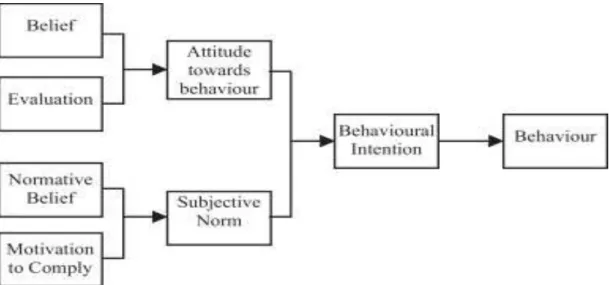
Figure 3-1: Theory of Reasoned Action (Ajzen and Fishbein, 1980) ... 44
Figure 3-2: Technology Acceptance Model (Davis, 1989) ... 45
Figure 4-1: TRA and TAM based Theoretical Framework ... 80
Figure 4-2: The three important elements in Developing ICT use in teaching ... 80
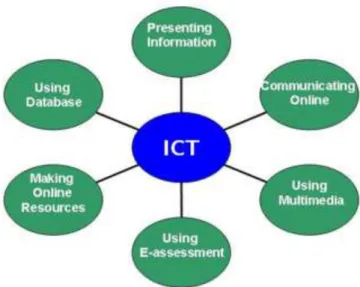
Figure 4-3: Important ICT Teaching Functions ... 81
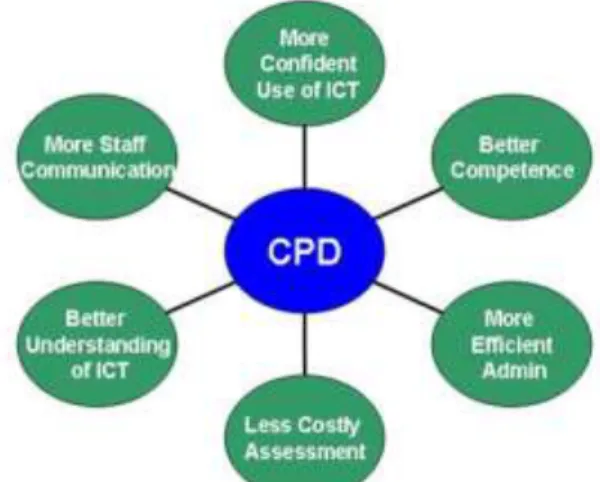
Figure 4-4: Continuing Professional Development Outcomes ... 85
Figure 4-5: Curriculum Content of ICT Functions Transferred into a VLE ... 88
Figure 4-6: A VLE within CPD to Enable University Teachers to Achieve Associated Outcomes ... 88
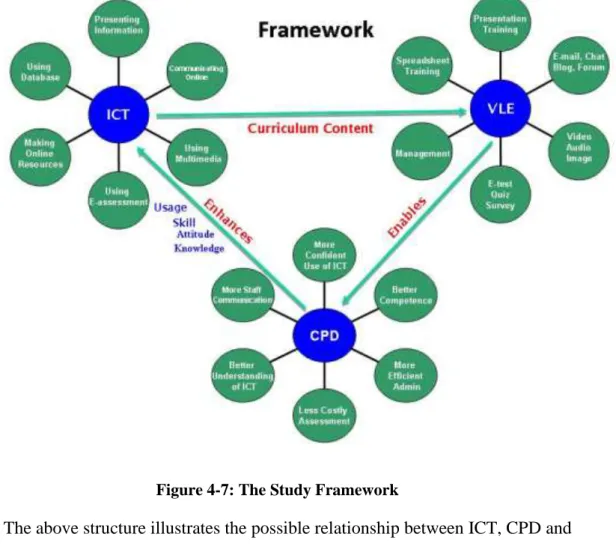
Figure 4-7: The Study Framework ... 89
Figure 6-1: Theme-based Data Presentation Chart ... 120
Figure 6-2: Usage of Information and Communication Technology ... 123
Figure 6-3: Main Areas of Lack of ICT Usage ... 123
Figure 6-4: Main Obstacles in ICT Usage ... 125
Figure 6-5: Main Areas of Hesitation in Using ICT ... 127
Figure 6-6:MainAreasof‘Dispensewith’inICTUsage ... 128
Figure 6-7: Main Areas of Weakness in Using ICT ... 129
Figure 6-8: Main Areas of Improved Usage of ICT... 131
Figure 6-9: Main Areas for Motivation for Using ICT ... 132
Figure 6-10: Main Areas for the Merge of Using ICT ... 134
Figure 6-11: Main Areas for the Trust in Using ICT ... 135
Figure 6-12: Comparative picture of the usage of various ICT tools (1st part) .... 138
Figure 6-13: Comparative picture of the usage of various ICT tools (2nd part) ... 139
Figure 6-14: Attitudes towards ICT ... 144
Figure 6-15: Main Areas of Optimism for Using ICT ... 144
Figure 6-16: Main areas of acknowledgement about using ICT ... 145
Figure 6-17: Main Areas of Concern in Using ICT ... 146
Figure 6-18: Main Areas of Fear of ICT Usage ... 147
Figure 6-19: Main Areas of inspiration for Using ICT ... 149
x
Figure 6-21: Main Areas of Love for and Desire to Use ICT ... 151
Figure 6-22: Main Areas of Awareness for Using ICT ... 152
Figure 6-23: Main Areas of Preparedness for Using ICT ... 153
Figure 6-24: Knowledge of ICT ... 159
Figure 6-25: Main Areas for the Lack of ICT Knowledge ... 160
Figure 6-26: Main Areas Regarding the Need for ICT Knowledge ... 161
Figure 6-27: Main Areas of Improved Knowledge on ICT ... 162
Figure 6-28: Main Areas about the Need for ICT Knowledge ... 163
Figure 6-29: Main Areas about the Request for More ICT Knowledge ... 164
Figure 6-30: Main Areas of Improved Knowledge on ICT ... 164
Figure 6-31: Main Areas about the Need for ICT Knowledge ... 165
Figure 6-32: Main Areas about the Request for More ICT Knowledge ... 166
Figure 6-33: Skills of ICT ... 172
Figure 6-34: Main Areas of the Lack of ICT Skills ... 172
Figure 6-35: Main Areas for Requesting ICT training ... 173
Figure 6-36: Main Areas on Challenges of Gaining ICT Skills ... 174
Figure 6-37: Main Areas of Improved Skills by Practice ... 175
Figure 6-38: Main Areas of Approaching Perfection with ICT Skills ... 175
Figure 6-39: Main Areas for Requesting Training for Gaining ICT Skills ... 176
Figure 7-1: ICT Training Model ... 200
List of Tables
Table 2-1: Number of Students Enrolled in Universities in Saudi Arabia ... 10
Table 2-2: Private Universities in Saudi Arabia ... 12
Table 2-3: Online Courses and WebCT facilities at Six Universities ... 15
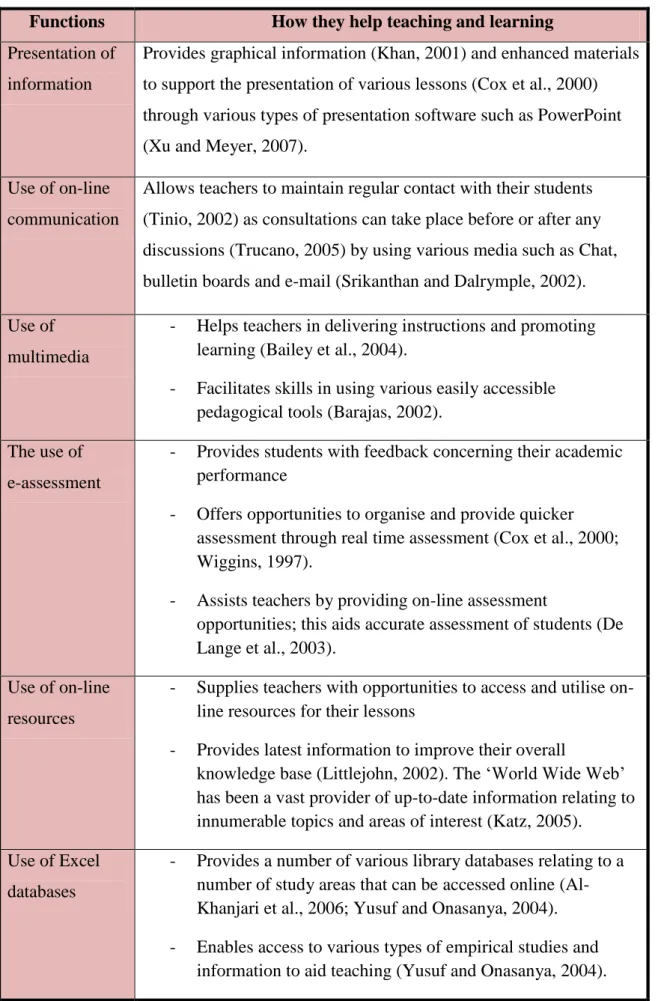
Table 4-1: ICT Functions ... 82
Table 5-1: Methods Used to Collect the Data for Each Research Question ... 100
Table 5-2: Experts Participating in the Pilot Study ... 108
Table 5-3: Number of Participants from Each School ... 111
Table 5-4:Reliability(Cronbach’sAlpha) ... 115
Table 6-1: Pre-test and Post-test for ICT Usage ... 137
Table 6-2: t-test results for ICT usage ... 142
Table 6-3: Pre-test and Post-test for the Attitude towards ICT ... 155
Table 6-4: t-test results for ICT attitudes ... 158
Table 6-5: Pre-test and Post-test for the Knowledge of ICT ... 167
Table 6-6: t-test results for ICT knowledge ... 170
Table 6-7: Pre-test and Post-test for the Skills of ICT ... 178
Table 6-8: t-test results for ICT skills ... 181
Table 6-9: Independent t-test for overall impact on two independent groups (male and female) ... 182
Table 6-10: Anova for school-based differences in mean responses on overall VLE impact ... 182
Acknowledgements
First, I would like to thank Allah, to whom I always pray to guide me along the right path. I am also very grateful to my supervisor, Dr John Woollard, for his support, motivation and all his invaluable advice and assistance throughout my studies.
I would also like to express my gratitude to my esteemed universities, Jazan University and University of Southampton, for providing me with the intellectual opportunities for my professional growth and experience in achieving many personal, professional and academic goals.
Finally, on a personal note, I would like to express my greatest appreciation to my family members in United Kingdom and Saudi Arabia, specially my grandmother, my mother, my father, my brothers and sisters, my wifes and my Three lovely children whose prayers, encouragement and emotional support always stay with me.
Abbreviations
ICT Information and Communication Technology. The term refers to any computer-based technology that supports learning and teaching through communication (access, presentation and analysis of information) using various technological tools.
VLE Virtual Learning Environment.
CPD Continuing Professional Development, in this thesis. It is also termed Continuous Professional Development in some countries. However, they both generally refer to the similar concepts and meanings in this paper.
University teachers Teachers who work at universities.
Before stage Time before receiving six-week VLE training. While stage During six-week VLE training.
After stage Time after receiving six-week VLE training.
Chapter 1
Introduction
1.1
Introduction
Most university teachers still engage in traditional methods of disseminating information to their students, and thus often follow traditional procedures when teaching (Bingimlas, 2009). As the use of ICT in educational activities has been found efficient and appropriate in utilising valuable resources and time, teachers of higher educational institutions are strongly recommended to adopt ICT in their educational activities (Paechter et al., 2010). Its use has also been found effective in facilitating research and development through computing systems, software and internal and external data networks (Concannon et al., 2005; Gonzalez, 2010). Additionally, it has been shown to improve the personal skills of teachers and may place them in
appropriate position to stay on a par with the advancing world in terms of ICT (Bingimlas, 2009).
However, recent research found that limited use of technology, particularly ICT tools, by the teachers at Jazan University in Saudi Arabia (Ageel, 2011). Based on this initial evidence, there is a need to formulate research to examine the feasibility of new methods for training university teachers that may enhance its use in their teaching.
This research is broadly a mixed-method practitioner research study that
investigates the impact of a VLE on increasing usage of ICT in teaching by the teachers of Jazan University, Saudi Arabia. The research seeks to determine the current use and reviews the teachers’ ICT skills, knowledge and attitudes when they attend a VLE course on a CPD programme. The research tests the effect of the VLE in improving these teachers’ knowledge, attitudes, skills and use of ICT. Additionally, it tries to help bring a better understanding of the use of ICT in teaching, and the viability of using VLE for CPD to support this.
1.2
Rationale for the Study
Prior first-hand knowledge of the contemporary importance of ICT in education and its poor utilisation by the teachers at Jazan University in Saudi Arabia suggested that the
ICT by these teachers was not possible because most offered their course materials through traditional methods; even the use of audio-visual materials in their teaching was severely limited (Ageel, 2011). Besides, measuring the quality and the quantity of ICT in their lectures seemed problematic as most lacked the necessary technological skills to use ICT (Ageel, 2011). Considering these reasons, the researcher felt the need to explore the viability of a VLE as a method of Continuing Professional Development (CPD) for the university teachers of Saudi Arabia, and for assessing the use of
Information and Communication Technology (ICT) tools in their teaching practices. This study takes the view that the application of ICT can ease the teaching, learning and research processes in an educational setting. Additionally, the developments in ICT usage can build-up institutional decision support systems which can assist the teachers as well as policy makers in considering and implementing educational and
administrative decisions. Moreover, through incorporating ICT tools in their teaching the university teachers can take up a convenient position from which to develop strategies to counter the difficulties in adopting technology in university education.
1.3
The Focus of the Study
This research seeks to provide a clear understanding of ICT usage by university teachers in their teaching and, in this connection, attempts to evaluate the viability of a VLE for their CPD. Although personal ICT use should encourage university teachers to adopt it in their teaching, a high percentage of Saudi Arabian teachers may not be able to do so due to their lack of knowledge and skills. This study therefore seeks to
determine the current usage of ICT of the teachers of a Saudi Arabian university and review their ICT knowledge, attitudes and skills. These factors are later explored by implementing a VLE course in a CPD programme for a number of university teachers. Finally, the research attempts to measure the impact of the VLE on their knowledge, attitudes, skills and usage.
1.4
The Focus of the Study
The aims of the study are to: Test the efficacy of a VLE in improving ICT usage by Jazan University teachers in a CPD programme.
Identify and explore the effects of VLE-based programmes on the university teachers’ existing knowledge of ICT.
Identify and explore the effects of the VLE on teachers’ skills and attitudes to ICT.
Bring about a better understanding of ICT issues at Jazan University. Review the concerns of the university teachers and make the necessary
recommendations for both university teachers and the policy makers, after acquiring a better understanding of the situation.
1.5
Research Questions
Both theoretical explanations and empirical evidence claim that a VLE can support teacher training successfully and enhance participating teachers’ use of ICT in their classes. However, there are no research findings that explain how teachers’ ICT knowledge, skills and attitudes interplay in this type of technology-supported professional training. Moreover, because of the unique educational and cultural
circumstances, it is necessary to explore whether, or to what extent, a VLE can change the use of ICT in the Saudi Arabian higher education context. Therefore, the research questions are:
1. Can a VLE affect the use of ICT in teaching by university teachers in Jazan University to support their teaching?
2. What is the effect of the VLE-based programme on university teachers’ knowledge of ICT at Jazan University?
3. What is the effect of the VLE-based programme on university teachers’ attitudes toward ICT usage at Jazan University?
4. What is the effect of the VLE-based programme on university teachers’ ICT skill at Jazan University?
1.6
Study Outline
This research is a mixed-method practitioner research study that tries to explore the status of ICT usage of the teachers of Jazan University, Saudi Arabia. It also examines
the impact of the VLE on their use of technology when teaching. The study uses a VLE design course (called a Moodle) as an ICT training programme to orient the university teachers to the benefits of implementing ICT through various teaching methods. The investigation deals with bounded and rich, but representative, sets of data. The approach can be categorised as a mixed-method practitioner research study for its applied nature and relevance to educational perspectives, and also for its consideration of both quantitative and qualitative data.
1.7
Expectations of the Study
The expectations of the study are to:a) Aid the understanding of the current situation with regard to the method, quality and extent of ICT usage by university teachers at Jazan University.
b) Reveal the university teachers’ knowledge, attitudes, skills and usage of ICT. c) Identify the imaginary and real concerns of university teachers over the use of
ICT at the institution.
d) Identify the appropriateness of implementing VLE courses in the CPD programme for teachers at Jazan University.
e) Make the necessary recommendations for both university teachers and policy makers after acquiring a better understanding of the situation.
1.8
The Structure of the Study
This Introduction provides the basis of the research by offering the rationale, focus and aims of the study, and also the research questions. In addition, it draws a brief outline including the expectations for the research.
There are seven further chapters. The content of these chapters is briefly mentioned below:
ICT in Higher Education in Saudi Arabia, the second chapter, gives the background of the higher education system along with ICT usage in higher educational institutions in Saudi Arabia. Additionally, it discusses the difficulties of implementing ICT in those educational institutions.
Chapter 3 is a Literature Review that discusses the concepts and relevant evidences of three focus areas: ICT, CPD, and VLE. In discussion, the aspects of higher education and the context of Saudi Arabia are specially emphasised.
Study Framework, the fourth chapter, proposes a conceptual framework for applying a number of information and communication tools within a VLE through a CPD programme. This also critically evaluates the possible impact of this type of teaching and learning on adult learners, particularly in the Saudi Arabian context.
Chapter 5 is entitled Research Design and outlines a research structure involving a mixed-method approach. It particularly explains the boundedness and richness of the case study approach and the use of interview and questionnaire methods for
investigation. This chapter explains the pilot study scheme and the data analysis procedures.
Chapter 6, Results, lists the research findings, providing both the qualitative and quantitative data collected through interviews and questionnaires.
The next chapter, Chapter 7, is Discussion and critically evaluates the research findings, analysing them according to the research questions of the thesis.
Chapter 8, Conclusion and Recommendations, summarises the overall study. It provides critical reflections on the main learning from the research, particularly on aspects of methods adopted, their shortcomings, potential bias, and scope for further improvements. Additionally, it lists a number of recommendations for ensuring the effective use of technology in teaching at higher educational institutions in Saudi Arabia, and also provides some possible future directions for similar kinds of research.
Chapter 2
ICT in Higher Education in
Saudi Arabia
2.1
Introduction
Higher education is the key to economic progress (Ramsden, 1992), and this is evident in the fact that most economic activities in the present business environment depend for success on people skills, innovation and technology (Arthur et al.,1999). At no time in human history has the welfare of nations been so closely linked to the quality and reach of their higher education systems and institutions (UNESCO, 2009). Saudi Arabia, too, has witnessed an increasing focus on its higher education over the past few years (Alromi et al., 2008; Al-Jarf, 2007). It is interesting to note that the Arab countries have experienced increased diversification in the number of higher education institutions across the region and a remarkable increase in educational opportunities (Education, 2006; Fergany, 2000).
During the past few decades, around the globe teaching and learning processes have undergone vast changes in terms of learning environments and the teaching aids used by teachers (Loveless and Ellis, 2001). As with all aspects of human
communication, technology has played an influential role in contemporary educational activities (Anderson, 2002; Cox, 2005; Gulbahar, 2008; James, 2002). The
conventional classroom has been replaced by computer-enabled learning environments facilitated by the use of internet and multimedia technology tools. The use of
information and communication technologies in the education sector has revolutionised the learning process (Kirkup and Kirkwood, 2007). It has opened up new possibilities for the scope of the application of technology, especially distance learning programmes dependent on computer-mediated communication technologies (Beller and Or, 2006; Franciscato, 2007; Hayes, 2007).
Concepts of space and time are changing, and how and with whom people can collaborate, discover communities, explore resources and ideas, and learn are being chellenged (Salmon, 2000). As a result, the revolution in ICT has had a profound effect on the teaching and learning process. The change is clearly visible in the development
of online learning communities. Most countries, even those with developing economies, stress the use of computers as an instructional medium. Advanced technology and communication tools greatly enhance the process of teaching and learning, provided that teachers are equipped to use them to their advantage to deliver effective learning systems. The integration of computer-mediated communication with multimedia courseware, electronic libraries and databases has led to the emergence of a whole new kind of educational experience, namely e-learning or networked learning (Rosenburg, 2001). The personalised learning environment offered by this medium has been found to have great potential to enhance the learning processes considerably. Colleges and universities are adopting this way of enhancing the learning efficiency of students.
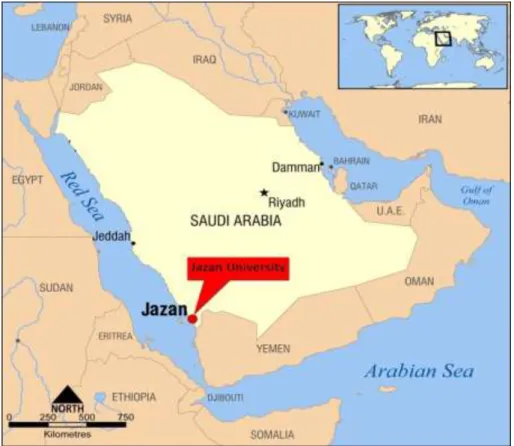
Based on the above advantages of technology in education, this research expects to contribute to the knowledge and understanding of ICT usage by teachers at Jazan University in Saudi Arabia (location of both country and university are marked on the following map). As the research focuses on how the integration of ICT in the teaching processes of the university teachers is influenced by a VLE-based training programme within a CPD framework, it tests the efficacy of VLE to enhance the teachers’ ICT-related knowledge, attitudes, skills and use.
This chapter provides an in-depth analysis of both ICT use in Saudi higher education and its impact on the educational system. For the purpose of improved understanding and knowledge, the chapter starts with a discussion of the development of the Saudi higher education system, and is followed by an exploration of the growth and emergence of ICT and e-learning in educational institutions. Additionally, the chapter highlights the practical difficulties in and limitations to the implementation of ICT in Saudi Arabia, and proposes plans to address these challenges.
2.2
Saudi Higher Education System – Historical Overview
The education system in Saudi Arabia can be broadly categorised into three distinct sectors – general, technical (or vocational), and the higher education (World Data on Education, 2011/12). The country’s higher education sector has evolved over the past few decades to incorporate widespread changes and developments in the way education is delivered to students (Robertson and Al-Zahrani, 2012). It is incontrovertible that higher education around the globe is witnessing overwhelming increases in innovation in educational practices and a growth spurt in educational distance learning systems (Ali, 2010). The changes are largely attributed to rapid advancements in technology and the shift of economies towards a knowledge-intensive workforce where the role of information and communication is considered inevitable (Saltari et al., 2012). As a result, many countries like Saudi Arabia focus their efforts on improving the quality of education to meet growing social, economic, and educational demands of the changing world.
However, the conventional Saudi Arabian higher education system and its
performances have not been found to be adequate to keep pace with changing times and educational demands (Al-Karni, 1999; Al-Hamidi et al., 1999). One of the reasons may be the complexity of the educational system at this higher stage and the resulting slow pace of upgrading facilities, in the face of the rapid globalisation (Fergany, 2000). Additionally, ‘the absence of coordination and cohesion between planners and teachers-researchers’ also hinders the transition (Alghafis, 1992: 49). Moreover, there is a gender issue, an inadequate number of higher education institutions, a lack of quality teachers, an unequal distribution of institutions across geographic locations, and low motivation or opportunities to pursue higher studies. The higher education system in Saudi Arabia is characterised by low female enrolment, and there is a wide gap
significant developments in this area. Technical institutes and institutions for postgraduate studies, offering various disciplines, have increased over the past few years and the number of students in higher education has increased from 2.3 million in 1998–1999 to 7.1 million in 2007–2008 (UNESCO – Arab Report, 2009). The
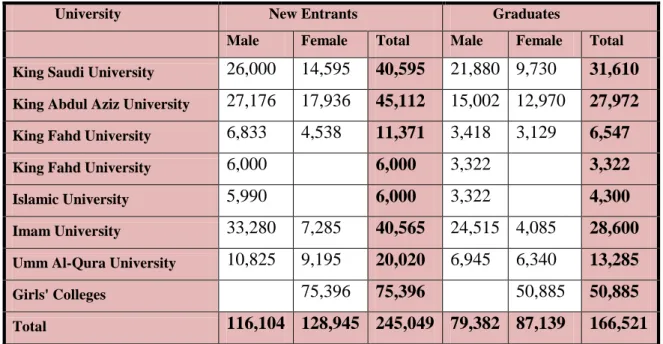
country’s focus on higher education was motivated by the need to provide skilled professionals to assist in the growth of the country’s ‘increasingly sophisticated economy’ (MOE, 2006). Table 2-1 provides information on the number of students enrolled in various universities in the country, 1995–1999.
Table 2-1: Number of Students Enrolled in Universities in Saudi Arabia
University New Entrants Graduates
Male Female Total Male Female Total
King Saudi University 26,000 14,595 40,595 21,880 9,730 31,610
King Abdul Aziz University 27,176 17,936 45,112 15,002 12,970 27,972
King Fahd University 6,833 4,538 11,371 3,418 3,129 6,547
King Fahd University 6,000 6,000 3,322 3,322
Islamic University 5,990 6,000 3,322 4,300
Imam University 33,280 7,285 40,565 24,515 4,085 28,600
Umm Al-Qura University 10,825 9,195 20,020 6,945 6,340 13,285
Girls' Colleges 75,396 75,396 50,885 50,885
Total 116,104 128,945 245,049 79,382 87,139 166,521
Source: adapted from Saudi-net
Historically, the development of higher education in Saudi Arabia started late in comparison to other countries across the globe. Until the 1950s Saudi Arabia was a country without many resources, with people living a simple lifestyle devoid not only of luxury but basic infrastructure. The region witnessed a growth spurt after the discovery of oil resources and economic development lead to changes in people’s lifestyles. Traditionally, Islamic society encouraged learning in mosques and informal study circles that transferred knowledge of religion, mathematics and other sciences from one generation to another. ‘Mulla’ was the term used to refer to the Islamic teachers responsible for educating the younger generation in worldly wisdom and knowledge related to various subject matters. A formal education system did not exist in the country until before 1925 (Alromi et al., 2008). Education in this period was limited to elementary schools and the region established its first university in 1957. The
first was King Saud University with just nine teaching staff and 21 students (Saleh, 1986). It should be noted that education in Saudi Arabia was mainly for male students (Alaugab, 2007), but this gender issue was not confined to the Muslim world as there was a similar trend in developed countries (World Bank, 2012).
The number of higher education institutions gradually increased to seven, and by 1982 there was a total of 63,563 students and 6,906 teachers (Saleh, 1986) in Saudi Arabia. Educational growth and development in the country was limited by various constraints; in the education sector the slow development was primarily due to lack of financial resources. Moreover, there were inadequate qualified teachers in the higher educational institutions (Alromi et al., 2008). The Ministry of Higher Education was formed in 1953 with the primary objective of encouraging student enrolment across all economic and social sectors of the population. Living accommodation for students in higher education was free and the government provided a grant of $250 per month. These steps resulted an increased student enrolment (Alromi et al., 2008). The country presently boasts 21 government universities, 78 colleges and a large number of other vocational training and education institutions, providing students with scope to pursue higher education in their field of interest (MOHE, 2010).
The Saudi education system is designed to eliminate illiteracy and to ensure the country’s religious, economic, and social needs are met (MOE, 2006). The literacy rate among males in the country rose to 98 per cent in 2003–2007 and the female literacy rate to 96 per cent (UNICEF, 2010). The development of the education system and infrastructure in the past few decades has been largely due to government initiatives and supportive policies to promote education for all. The total number of colleges and universities in Saudi has increased within the past ten years (UNESCO – Arab Report, 2009).
Admission to higher education institutions in Saudi Arabia is based on the grading of students at high school level. This system has been highly effective in securing admission for deserving candidates, but creates a gap in fulfilling admission conditions for international students or students from less developed regions with lower levels of educational infrastructure. Growing economic prosperity and global
influences have triggered changes in this policy to promote increased opportunities to students from these different regions and backgrounds (UNESCO – Arab Report, 2009). Efforts to increase student enrolment in higher education have also focused on increasing the percentage of female students through specialised education policies
focusing on improved social structures. Moreover, the country’s higher education system has evolved to provide students with greater choice of specialisation.
Private colleges have also had a significant impact on improving higher education facilities within the country. They receive extensive support from the Ministry of Higher Education, which endeavours to provide incentives directly to private
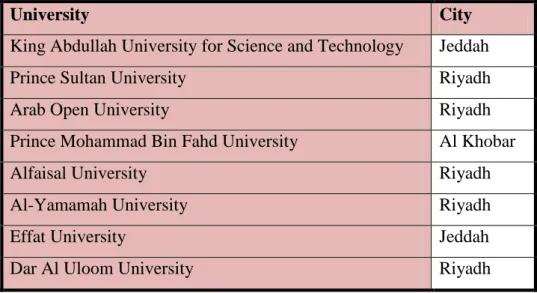
universities and colleges to serve the nation, as they provide the employment market with graduates of different specialities (MOHE, 2010). There are a total of eight different private universities in the country offering a wide range of subjects for specialisation in bachelor and master degree programmes. There is currently a total of 20 private colleges and eight private universities in the country. Table 2–2 provides a list of the private universities in Saudi Arabia.
Table 2-2: Private Universities in Saudi Arabia
University City
King Abdullah University for Science and Technology Jeddah
Prince Sultan University Riyadh
Arab Open University Riyadh
Prince Mohammad Bin Fahd University Al Khobar
Alfaisal University Riyadh
Al-Yamamah University Riyadh
Effat University Jeddah
Dar Al Uloom University Riyadh
(Source: Adapted from MOHE 2009)
2.3
ICT and E-learning in Saudi Higher Education Institutions
E-learning is commonly referred to as the international use of networked ICT in teaching and learning. It also refers to educational processes that use ICT to mediate asynchronous as well as synchronous learning and teaching activities (Naidu, 2006). Naidu claims that the growth of e-learning is directly related to increasing access to information and technology, as well as its decreasing cost. The capacity of ICT to support multimedia resource-based learning and teaching is also relevant to the growing interest in e-learning. Growing numbers of teachers are ICT to support their teaching. The introduction of ICT methods in higher education institutions in the late 1990s took place when university students and teachers adopted the internet to researchsubject matter. A recent study conducted by Al-Shawi and Al-Wabil (2008) on internet usage by faculties in Saudi higher education observes that, although some universities in the Kingdom had limited internet access before 1998, the achievement of wide-scale internet connectivity across local campuses in December of that year resulted in
heightened rates of internet usage by university teachers and students.
The information revolution has had a major impact on learning and education processes, and this is linked to the knowledge, economy, and globalisation of higher education. A concentrated effort on the part of the government of Saudi Arabia to implement ICT within the education sector is evident in the ICT goal outlined by the Ministry of Higher Education in its strategic plan: to develop the infrastructure of information and communication technology and its employment in education and learning (MOE, 2008). The Computer and Information Centre was established in the Ministry of Education in 1996 and since then it has achieved new heights in terms of infrastructural facilities, range of applications within the education and learning environment, and innovative applications advancing technology in distance learning and VLEs. This includes enabling video conferencing facilities in higher educational institutions and installing wide area networks connecting higher education institutions to the head office of the Ministry of Education in Riyadh, which facilitates students’ access to unrestricted and expanded information through its central database (MOE, 2008). The focus of the strategies of the Ministry of Education is on designing, developing and implementing an advanced e-learning infrastructure that enables increasing numbers of students to avail themselves of higher education facilities.
Saudi Arabia has organised various centres and institutions to support the growth and development of higher education institutions to meet the growing economic
demands for a specialised workforce and skilled labours. The global trend towards the application of ICT in the higher education sector has made a significant impact on initiatives to develop educational policies and infrastructures based on a similar framework. Educational organisations also reap extensive benefits in providing e-learning and distance e-learning courses to students based in remote locations.
A major achievement in the context of ICT implementation in higher education institutions in Saudi Arabia is the establishment of virtual universities in various regions within the past few years, with a number of centres offering distance learning courses using digital and advanced collaborative technologies. The ICT application in higher education institutions is visible in the form of Intranet facilities, portals,
e-libraries, scientific research databases, video conferencing tools, advanced
collaborative applications and improved networking infrastructural growth (UNESCO – Arab Report, 2009).
The growing needs of the business environment, coupled with rapidly advancing technology, have led to new methods of learning and increasing opportunities to access knowledge resources. The ICT goals of the Ministry of Higher Education in Saudi Arabia, affiliated with UNESCO, are framed according to these learning principles and objectives:
1. Boosting innovation, creativity and practical applications of ICT by capacity building and developing professional skills.
2. Enabling the design, preparation, production and distribution of knowledge products to achieve sustainable development goals.
3. Encouraging the creation and dissemination of Arab digital content.
4. Facilitating the gathering of resources, technical knowledge and private sector participation in applying ICT (UNESCO – Arab Report, 2009).
2.4
ICT Usage in Saudi Higher Education Institutions
The total number of educational institutions in Saudi Arabia offering e-learning courses was just six in 2007, but has been growing steadily. The students and teachers of the country are now finding increased scope for learning online (Al-Jarf, 2007). The number of online courses in various fields of study has multiplied over the past few years and contributed to growth in learning opportunities and exposed students and teachers to new modes of learning (Ageel, 2011; Al-Gahtani, 2005; Al-Khalifa, 2010).
The development of ICT for education has triggered changes and adaptations by higher education system to emerging trends. The number of institutions offering virtual learning modules, specialised training courses and professional courses online has grown significantly in Saudi Arabia (Drew et al., 2012). There are various means of ensuring that training needs are met through online programmes delivered over the internet or by providing customised online training courses to meet specific training requirements. Quality education, innovation, and development were the watchwords of the Arab Regional Conference on Higher Education (UNESCO, 2009). Educational institutions have started realising the significance of ICT tools in enhancing the
in the country still suffer from major infrastructural weaknesses that restrict the level of ICT usage for educational purposes.
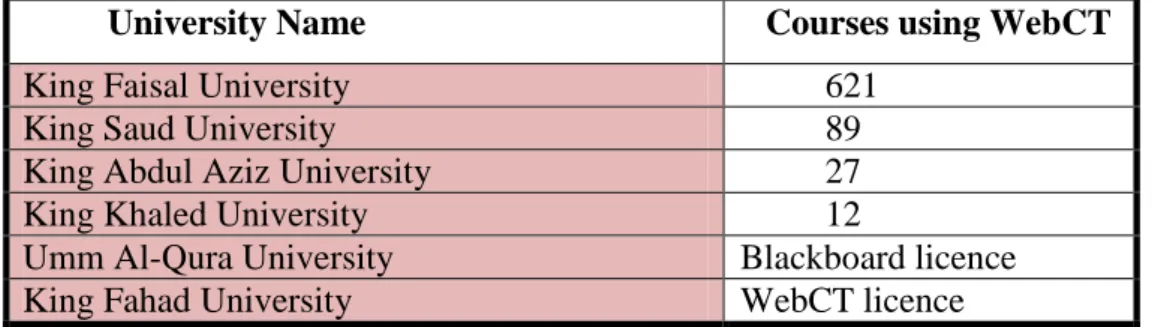
A research study undertaken by Al-Jarf (2007) on the e-integration challenges for rectors and deans in higher educational institutions in Saudi Arabia found that only six universities (43%) then offered online courses using WebCT or Blackboard. Moreover, the nature of online courses offered was not in proportion to the number of colleges, departments and faculties at those universities. It was observed during the course of the study that faculty members lacked the motivation, online teaching skills, training and awareness of blended learning or technology integration approaches, administrative support and infrastructural facilities to make effective use of ICT tools. Table 2-3
shows the number of online courses and WebCT facilities used by the six universities in Saudi Arabia that have adopted ICT tools.
Table 2-3: Online Courses and WebCT facilities at Six Universities
(Source: adapted from Al-Jarf 2007)
The figures relate to the number of online courses offered by these universities in various categories. Some of the universities, such as King Abdul-Aziz University, have adopted the learning management systems (LMS) to develop and offer online courses. King Umm Al-Qura University and King Fahad University have licences to use WebCT and Blackboard technologies but do not offer any online courses.
Al-Jarf (2007) has identified a number of factors influencing the level of ICT usage in higher education in Saudi Arabia. According to his report, the country’s education system is wholly controlled by the Ministry of Higher Education, which takes all the decisions on education practices. This administrative system may be termed centralised; any attempt to change the existing education culture, or to request funding to do so, must be passed by different stages in the administrative hierarchy. Introducing distance learning programmes has thus required Ministry approval and hence the level of usage is comparatively low. Another factor identified by the researcher is that the integration of technology tools with education has been a
University Name Courses using WebCT
King Faisal University 621
King Saud University 89
King Abdul Aziz University 27
King Khaled University 12
Umm Al-Qura University Blackboard licence King Fahad University WebCT licence
relatively a slow process. Faculty training remains a core issue as 50 per cent of the teaching staff in higher education institutions possess only basic computer skills such as online browsing and using email: just 5 per cent have in-depth knowledge of online courses and only 1 per cent claim to be expert users. Al-Jarf also found that the technology infrastructure in colleges and universities is inadequate for the number of staff and teachers. Internet connections are slow owing to limited bandwidth, and only King Abdul Aziz University is known to have an online learning centre.
However, Saudi Arabia has already adopted new strategic goals and plans to increase the effectiveness of the learning processes and enrolment of students in higher education. This development has been vastly enabled by the use of ICT tools and e-learning concepts, including computer-mediated communication tools such as web conferencing, audio, video and Chat. The Ministry has extended additional funding and support to facilitate increasing use of such tools and technologies to promote higher educational goals and greater learning effectiveness.
2.5
Difficulties in Implementation ICT in Higher Education
Institutions
There is no doubt that higher education services and infrastructure, as discussed in previous sections, have improved dramatically over the past few years and the percentage of students enrolling in higher education has also multiplied. However, there are still distinct challenges that require concerted effort if they are to be overcome. These include low enrolment rates in higher education, inequality of
educational opportunities across various segments of society, and the limited number of skilled faculty members. The UNESCO Arab Report (2009) observed that in Saudi Arabia the major obstacle for implementing ICT in teaching at higher educational institutions is the lack of quality teachers able to handle this new approach. This poor situation in fact proves the need to design suitable curricula and for research into standardised and high quality teaching modules, along with ensuring mandatory ICT training.
The research report by Al-Shawi and Al-Wabil (2008) identified two primary barriers to the adoption of ICT tools in higher education in Saudi Arabia – limited access to the internet and lack of computer skills. It is clear that an extensive
internet connectivity, would be required to implement ICT and e-learning programmes in higher educational institutions. Similarly, as online learning environments are highly dependent on technology, a number of non-conventional approaches are needed to be designed and followed. For example, a team of professionals would be required and a number of servers would need to be located in remote locations to manage the installed technology. Moreover, the type of network configuration and browser would have to be appropriate: limited bandwidth makes it difficult to upload and view large audio, video and image files. In recent years the government in Saudi Arabia has finally increased the budget for building infrastructural support for ICT usage, and as a result internet subscribers have significantly increased in number, from 0.3 million in 2002 to 1.17 million in 2008 (Al-Khalifa, 2010), which indicates a steady growth of ICT services and infrastructure in the region. However, a lack of skilled and qualified teachers has emerged as one of the chief obstacles to the implementation of ICT in higher education institutions.
Another barrier to the use of ICT in higher education is the integration of technology with the curriculum (Harris et al., 2009). For effective ICT use, the traditional curriculum needs to adapt to changet ing trends and developments in learning processes. It is important to acknowledge that training, especially for professionals, has shifted to more informal learning environments that encourage instant collaboration such as Intranets, internet searches, online meetings and an extended knowledge base. These provide additional knowledge on related areas and enhance individual skills and capabilities (Sandarst, 2012; Garcia-Penalvo et al., 2012). Reviewing the training needs of learners, setting the learning goals and establishing suitable strategies to address the training needs and objectives are of prime importance in the contemporary learning and teaching process. For this reason, training modules are now expected to feature specific delivery styles according to the subject matter. Logically, it is to be expected that some training modules are most effectively taught with the aid of audio-video presentations, whereas for other subjects text and audio presentation is enough.
Moreover, most of the e-learning content is in English and this poses a distinct challenge for Saudi Arabian teachers and students, for whom it is a foreign language. English as a second language has not gained prominence in the education curriculum and this has created a relative lack of skills in both spoken and written English
(Bacherman, 2007). Therefore, there is a need to design Arabic language VLEs and Web 2.0 technology for Saudi Arabian users.
2.6
Plans to Increase ICT Usage in Higher Education
ICT policy and strategy play a significant role in promoting the right kind of environment for the use and application of ICT in various sectors. Information and detailed insights relating to the trends and development in the ICT field is imperative in framing supportive policies that identify existing limitations, possible solutions and strategic implementation plans (ITU, 2007).
The Saudi Arabian Ministry of Higher Education plans to improve the levels of ICT implementation in higher education institutions by addressing these limitations. Its objective is to improve the quality of higher education through increased usage of advanced and innovative technology that promotes further course enrolment. The shortage of skilled trainers and qualified teachers can be addressed by increased cooperation with other Middle Eastern countries and global economies to recruit academic trainers conversant in e-learning technologies. Moreover, the consultancy approach can help to address the need for high quality teachers in higher education. Experts in their field of knowledge can be invited on a regular basis to deliver lectures, training programmes and online courses and teach through VLEs. This will provide institutions with expert guidance on building the knowledge base, the creation of well-structured content and improved collaboration in developing innovative ICT
applications to suit the needs of the learners.
Saudi higher education institutions are in the process of integrating technology in the teaching-learning process to keep up with the latest developments in educational technology and e-administration (Al-Jarf, 2007). The barriers limiting the extent of ICT usage in higher education institutions need to be addressed to enable Saudi Arabian universities to meet global standards in online education. The universities need to equip themselves with the necessary resources to meet the needs of the online learning
process. This includes integrating technology with educational objectives and future learning plans, setting up a centre for developing structured online learning courses, and devising a plan for introducing learning courses that meet global standards in terms of course delivery, feedback and evaluation. It is imperative to improve awareness of online learning techniques and blended learning approaches by providing training to teachers and instructors on the various aspects of technology used to boost the
effectiveness of learning. Overall, a complete understanding of the e-learning processes and scope of ICT tools used in higher education settings is mandatory. There must be education of society in general, and faculty and policy makers in particular, about online instruction (Alaugab, 2007).
A partnership between IT corporations and higher education institutions can have the desired impact on improving the effectiveness of ICT implementation in
universities. Al-Jarf (2007) recommends the ‘Arabizing’ of software and learning management systems to help instructors use the tools effectively. Additionally, this may help in overcoming the barrier posed by the fact that English is a second language in Saudi Arabia.
2.7
Summary
The chapter highlights some distinctive challenges faced by Saudi Arabia in the
implementation of ICT plans in its higher education sector. These challenges have been identified as a significant gap between instructional technologies and teachers’
background, formal training of university faculties in ICT tools and technologies, and lack of adequate e-learning content to guide an effective learning programme. The past few years have seen a rapid advancement in the area of reducing the gap between technology and teachers’ abilities, but there is still much to overcome.
The chapter also discusses that ICT tools and technologies can act as to propel various economic sectors to new heights. To achieve this, governments and educational institutions must make redoubled efforts to exploit the benefits of advanced technology through improved usage and applications. Saudi Arabia has come a long way in
establishing and developing new initiatives in the field of higher education and promoting enrolment of students through effective usage of enhanced ICT tools and applications. However, the country still lags behind other developing countries and faces distinctive challenges, as analysed in this chapter. The area has tremendous potential to develop its educational effectiveness by employing the new tools and technologies that are now rapidly emerging.
Chapter 3
Literature Review
3.1
Introduction
Technology has been used in one form or another since the beginning of civilisation (Schreyer, 2000). Over the years, simple yet beneficial tools and primitive machinery used by early man evolved to become digital tools in educational reform. As education needs to keep pace with the demands and advancements in society continually, the integration of ICT in education has become crucial to this contemporary world (Lowe and McAuley, 2000).
ICT in general is defined as a ‘diverse set of technological tools and resources used to communicate, create, disseminate, store, and manage information’ (Tinio, 2002: 4). It is widely observed that ICT in education plays an important role, not only in the development of the field of education, but as a tool to bring about change and enhance both students’ learning and teachers’ teaching (Lowe and McAuley, 2000). The focus of this thesis is the application of ICT in teaching and teachers’ attitudes towards its use in their work.
Additionally, this research aims to investigate ICT usage amongst teachers at Jazan University and, at the same time, to measure the change in their ICT knowledge, skills and attitudes through a VLE-enabled CPD programme. This research is expected to provide a better understanding of the feasibility of using VLE in CPD to increase the use of ICT to support teaching in the context of the higher education institutions of Saudi Arabia.
This literature review mainly covers recent literature on three salient elements: ICT, CPD, and VLE. Each is thoroughly discussed by providing various types of research evidence and relevant source materials expected to benefit from the
development of the research concepts, and also the formulation of a conclusion to the research findings with relevant recommendations.
3.2
Teacher, Teaching, and the Use of Technology
The importance of teaching in education cannot be ignored, as it tries to focus on learning contexts and learning outcomes, helps students develop cognitive and social skills (Biggs, 2003) and, ultimately, ‘makes learning possible’ (Ramsden, 2003: 115). However, because of the various limitations and difficulties, effective teaching does not happen all the time and teachers do not perform according to their expectations.
3.2.1 Expectations from Teachers
If we analyse the traditional view of teaching, we find there are many expected professional practices that teachers are required to perform. For example, teachers are likely to possess a certain amount of wisdom that they have had to acquire through self-knowledge, experience and practical performance (Schwen, 1998). Similarly, they need to be prepared for ‘effective enactment’, where they act to solve complex educational problems, both situational and pedagogical (Kim et al., 2012). Developing the self, both personally and professionally, is also vital for teachers’ effective teaching. According to Cranton (2001), teachers need to undergo both teaching and learning experiences and therefore effective teachers not only use their personal skills and knowledge for
teaching but achieve professional development through various learning processes. Darling-Hammond and Bransford (2005) mention the need for teachers to develop ‘adaptive expertise’. According to them, this type of expertise ensures the involvement of the two dimensions of efficiency dimension and innovation dimension. Firstly, efficiency dimension can equip teachers with ‘greater abilities to perform particular tasks without having to devote too many additional resources to achieve them’. The innovation dimension may facilitate them ‘moving beyond existing routines and often requires people to rethink key ideas, practices, and even values in order to change what they are doing’ (Darling-Hammond and Bransford, 2005: 361). In summary, the following ideal qualities of teachers listed by Davies et al. (2005: 186-187) are:
… enthusiasm, clarity, showing good management of student behaviour, demonstrating well developed interpersonal skills, being able to provide
intellectual stimulation, showing respect for students, being organised and having good presentation skills.
3.2.2 New Teaching and Learning Approaches
Teaching and learning objectives in the twenty-first century have extended and
diversified as students are increasingly exposed to extensive and intensive global ideas and events. One of the major responsibilities of present day teachers has therefore become assisting students to grow as internationalists, ‘able to understand and work with people from other countries and cultures [and also simultaneously can develop] values outcomes such as shared understandings, acceptance, openness,
interconnectivity, mutual respect, plurality and world peace’ (Sanderson, 2011: 66). However, teachers may find these expectations difficult to meet as the process requires many professional qualities.
In the past two decades the role of professional development for teachers in higher education has undergone rapid change and teaching approaches have
experienced extensive reform; for example, lecture-based teaching has begun to shift towards learner-centred instruction (Lindholm et al., 2005). Although lectures are economically viable and easy to administer, the rate of learning under this method is often unsatisfactory (Walkin, 2000). Besides, new educational concepts and practices such as collaborative learning, active learning, and learning in communities have been suggested to achieve higher learning outcomes (Cox et al., 2011). Tight (1996)
observed the present trend of learner-centred teaching approaches and reported that it is ‘no longer seen as imparting knowledge and doing things to the student, but is
redefined as facilitation of self-directed learning’ (p. 26). As a consequence of the decrease of the didactic teaching methods, new approaches of facilitation have emerged that have created a wider scope for the teachers to play different teaching roles through applying diverse teaching and learning techniques. Therefore, the relationship among teachers and students has become more flexible, and students are being encouraged to challenge and argue, even with their teachers (Freeth and Parker, 2003). It is believed that if the teachers are open and flexible, learners can themselves become more critical thinkers, problem solvers, and able to analyse concepts more intellectually (Haith-Cooper, 2003). However, in order to perform well the teachers have to evaluate their own teaching approaches and should bring about the necessary changes. It is important to acknowledge that the teaching profession is mainly reflection-based (Schon, 1983). Therefore, teachers are expected to be reflective thinkers (Hamilton, 2005; Williams and Burden, 1997) to reflective practitioners and share the citations with Ebtesam who
with due consideration to contextual variety (Kim and Hannafin, 2008). The adoption of technology in teaching can also be an effective measure of all the new concepts of teaching (Means et al., 2009).
3.2.3 Technology in Educational Perspective
In recent years the use of educational technology, particularly for classroom teaching, has increased dramatically in many countries (Livingstone, 2012). Haynes et al. (2004: 161) provided the following scenario of a typical technology supported classroom of a British university:
Staff have initially used IT to support their current working arrangements, such as the production of typed hand-outs and lecture presentations and are more confident using IT to reinforce existing working practices rather than embark on radical new learning practices … [which] has led to ...
implementation of IT in higher education with gradual application of IT to support current teaching, learning and administration.
According to Kim et al. (2012), technological exploitation in educational activities has now extended beyond the classroom, and has become extensively informal, collective, social and multi-modal in nature. They discuss how the use of technology in teaching and learning can supply teachers with both adaptable and transferable knowledge and skills to help deal with various teaching-related challenges such as lesson preparation, lesson delivery, learning monitoring and assessment. The use of technology has also been claimed to be efficient in addressing most sectors of education and its multi-faceted applications can provide easy and effective access to the world of learning (Selinger, 2011). The major impact of the greater interventions of technology has been observed to bring about two initial changes in education: firstly to influence the perceptions of learners on both academic and non-academic matters, and then to change the teacher-student relationship dramatically (Khan, 2012). Means et al. (2009) found in their research that learning through internet and multimedia is more advantageous than the face-to-face. The statement of Punie et al. (2006) also reinforces this claim; according to them, the various applications of modern technological tools are effective in managing complex educational demands through enhancing the users’ problem-solving and critical thinking abilities along with creativity and strategy-building skills.
Conversely, prevailing concerns over the use of technology in educational perspectives cannot be overlooked. First of all, its implementation is still at its beginning stage and the overall impact on teaching and learning is not significant enough to measure in most country contexts (Livingstone, 2012). Secondly, despite the rapid increase of the use of technology in higher education, the research findings do not support any widespread and sustainable impact of this new approach on teaching and learning (Zemsky and Massy, 2004 cited inKirkup and Kirkwood, 2005). Moreover, it has been observed in many cases that the focus has been on technology, not on the teaching or learning (Ofsted, 2009). However, it is extensively discussed that the effective exploitation of technology in teaching requires adequate teacher training, and designing and application of proper technological tools (Attewell et al. 2009).
Additionally, teachers have to go through an extended trial-and-error process of
practising the use of certain technological applications (Setter, 2008). In order to obtain the maximum benefit from using technology, teachers need to access facilities beyond their own premises. Koh and Divaharan (2011) studied a wide number of theoretical and empirical claims, and suggested three conditions for the effective utilisation of technology in teaching. Firstly, there is the need to ‘foster acceptance’ by teachers of the technological interventions in teaching through introducing them to the
instructional strategies of those tools. Next, teachers’ technological proficiency is required. This can be acquired through relevant training and practices. Finally, there should be the scope for pedagogical applications, which teachers can do by using technological tools in their teaching and personal learning. In fact, it is important to remember that the incorporation of technology for teaching should aim to modify ‘the natural environment to satisfy perceived human wants and needs’ (ITEEA 2007: 9) and therefore relevant technology skills are required successfully to connect content,
pedagogy, and technology if expected teaching and learning objectives are to be achieved (So and Kim, 2009). However, there should be proper consideration on various influencing factors, such as learning purpose and age (as indicated by
Livingstone, 2012), which can affect the application of technology in both teaching and learning processes.
As the use of technology in teaching and learning has increased dramatically, in contemporary educational discussions the term ‘Information and communications technology’ or ICT has become common. ICT is generally considered as a monolithic and homogenous term that represents most technological tools and approaches to