R E S E A R C H
Open Access
Towards model-driven CIM-based data
exchange for DSOs
Dominik Ascher
1*and Christoph Kondzialka
2FromThe 7th DACH+ Conference on Energy Informatics Oldenburg, Germany. 11-12 October 2018
*Correspondence:
1Technische Universität München,
Boltzmannstr. 3, 85748 Garching b. München, Germany
Full list of author information is available at the end of the article
Abstract
Smart energy systems (SES) promote the transformation of the distribution grid towards more sustainable operation and planning strategies, but also impose a set of considerable technological and political challenges. In this, distribution system operators (DSOs) are faced with the necessity of adapting their information system landscapes to enable the efficient utilization of information within their internal structures. In this work, we propose a model-based approach to derive an open middleware platform supporting the integration of existing system landscapes of DSOs. For this, we shortly describe a domain analysis on the DSO domain, which we use to derive the requirements of our platform. The platform is then implemented utilizing the Common Information Model (CIM) and open standards. Finally, we demonstrate the applicability of our approach within a small case study for a single use-case.
Keywords: Model-driven engineering, Domain analysis, Distribution system operation, Smart energy systems, Common Information Model (CIM)
Introduction
Smart energy systems (SES) promote the transformation of the distribution grid towards more sustainable operation and planning strategies, but also impose a set of complex challenges such as high numbers of decentralized and renewable energy sources (RES) as well as energy storages, high penetration of electric vehicles (EV) as well as changing load profiles as a result of self consumption. To address these emergent challenges, plan-ning and operation strategies have to accommodate changes and intermittency of loads occurring as a result of aforementioned challenges (Ramchurn et al.2012). For instance, this includes utilization of intelligent load management mechanisms (Palensky and Diet-rich 2011), predicting, scheduling and storing intermittent power loads from RES (Lei et al. 2009; Sharma et al. 2011; Barton and Infield 2004), accurately predicting power consumption (Zhao and Magoulès2012) as well as scheduling charging or discharging EVs efficiently (Kempton and Tomi´c2005). To enable these new applications and meth-ods, detailed knowledge about the current state of the low-voltage distribution grid is necessary. By utilizing the broad availability of data from modern sensing technology in electricity networks as well as using information encoded in heterogeneous DSO systems, more efficient operation and planning strategies can be achieved and costs for system
operation can be decreased. However, for this it is required that available data is made available to different systems and applications as well as can also be efficiently exchanged between them.
Because of this, standardization represents a key challenge towards enabling smart energy systems (Uslar et al.2010; Fan et al.2013; Kuzlu et al.2017), promoting seam-less data exchange between different applications from different vendors and avoiding vendor-specific solutions. The Common Information Model (CIM) represents a compre-hensive data model for the electric utility domain, and is described in the International Electrotechnical Commission (IEC) standard IEC 61970 (for energy management sys-tems (EMS)) and related standards IEC 61968 (for information exchanges between electrical distribution systems) and IEC 62325 (for energy market communications). Overall, the CIM is intended to support description of both distribution and transmis-sion energy systems in terms of a shared data model, which encodes a domain ontology of entities and their relationships. Thus, the CIM proposes a standardized vocabulary for data exchange between different information systems and data within electricity networks.
Problem statement
Previously, DSOs integrated new information systems into their infrastructure on behalf of respective departments, which then accessed systems through proprietary or application-specific interfaces, while using proprietary data models. As a result, information from these systems can often not be easily accessed by other systems or exchanged between different departments. As a result, often complex point-to-point integrations between systems are then performed, which lead to high follow-up costs and time expenditures, while impeding day-to-day operations. In addition, it is often difficult to replace one system from a given vendor within a system landscape as every connection to accessing systems must be updated. Furthermore, DSO software systems are often highly tailored to the specific requirements of a given DSO, making according DSO system landscapes highly susceptible to vendor lock-in.
Contribution
Structure
This paper is structured as follows. The “Approach” section elaborates on our approach for establishing a middleware platform, based on current challenges for DSOs and their system landscapes. The “Domain analysis” section then describes a conducted domain analysis to elicit and generalize information as well as requirements about the domain of distribution system operators. Based on this, the “Model-based adapters” section describes how parts of our middleware platform can be derived within a model-based approach. The “Middleware platform” section explores the platform architecture, which is supported by the model-based approach. The “Case study” section then elaborates on a case study demonstrating a single use-case of our platform. Then, in the “Related work” section, we explore related work. Finally, in the “Conclusion” section, we conclude.
Approach
To support migration of DSOs towards domain-wide standards, we propose a middleware platform for DSOs based on the Common Information Model, which is supported by a model-based approach. Initially, we conducted a domain analysis with two German DSOs, where information and requirements about the DSO domain was collected, analyzed and structured. Based on the information captured, a domain model was derived, which gen-eralizes domain knowledge of the DSO domain. Furthermore, we then identified relevant use-cases for our middleware platform.
Using the domain model, we then derive parts of the implementation of the middleware platform within a model-driven engineering approach. The approach is intended to sup-port efficient adaptation of parts of our platform to different distribution system operator system landscapes by utilizing the shared structure of data models and systems of DSOs and by employing model-to-model transformations.
Then, we present a modular software architecture that provides an efficient method to access interfaces of DSO data systems by utilizing lean micro-services and established web protocols. Here, based on a system landscape employed by a given DSO, we describe how single systems can be integrated into the middleware platform. The approach offers modularity with respect to offering step-by-step integration of different DSO systems, while not impeding ongoing business-relevant and day-to-day operations. Our concept aims at mapping non-CIM data to the standardized CIM data model for integrated sys-tems. We identified the latter to represent a major keystone ability for a comprehensive DSO data exchange platform.
Domain analysis
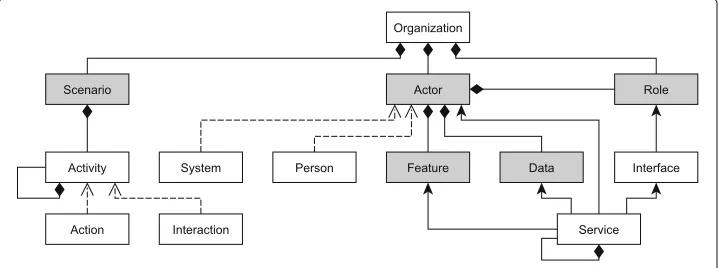
This section elaborates on a domain analysis for the distribution system operator domain. Here, to understand the domain and requirements of DSOs, a domain analysis was con-ducted with two German DSOs. Here, domain knowledge was captured in an interview process spanning multiple topic areas with different DSO departments intended to sup-port capturing DSO requirements. For the interview process, we focused on internal DSO departments concerned with planning and operative asset management, system operation and network control, strategic asset management and regulation management, metering point operations, network documentation, accounting and purchasing as well as IT infras-tructure management. For these topic areas, the domain analysis then specifically focused on eliciting requirements for DSOs with respect to challenges arising in the context of establishing smart energy systems. Based on the information elicited, we established a metamodel for capturing domain knowledge. The metamodel is visualized in Fig.1.
Subsequently, we describe the classes of the metamodel in detail:
• Organization. An organization refers to an entity, which represents an organizational unit in terms of its departments or sub-organizations. Here, an organization realizes a set ofscenarios, i.e. a set of activities which support the business processes of the DSO, and contains a set ofactors and roles.
• Scenario. Scenarios represent sequences of activities, i.e. granular actions or interactions, which support the business processes of an organization. Activities are generally performed by a set of actors such aspersons or systems.
• Actor. An actor refers to a system or person, which perform sequences of activities. Here, each activity is initiated and executed by at least one actor. Note that for this, an actor utilizesdata and features, i.e. predefined functionality achieving a particular goal. Actors are specialized as follows:
– Person. A person represents an actor, which performs an activity manually, i.e. without a software system supporting the activity.
– System. A system represents an actor, which performs an activity automatically or interactively (i.e. together with another actor).
• Interface. An interface defines a formal description for accessing specific data. Here, an interface can be utilized for interaction betweenservices. For this, an interface defines a set ofroles which are allowed to access it.
• Data. Data refers to domain-specific and business-specific structured information in terms of underlying data classes, types, attributes and the relationships between them. Note that data is managed by an accountable actor.
• Role. Roles refer to organizational units with a defined set of objectives such as internal departments or external business partners. Furthermore, we use roles to model access control, i.e. permissions on interfaces. Therefore, depending on the role, an interface can allow or deny access to specific resources.
• Activity. Activities represent tasks, which can be performed manually, automatically or as an interactive sequence.
– Action. If initiation and execution are performed by the same single actor, we refer to this activity as an action.
– Interaction. If initiation and execution are dependent on multiple different actors, we refer to this activity as an interaction.
• Feature. Features describe individual functionalities to transform data, which are realized by individual actors such as systems or persons, as well as the relationships between them.
• Service. A service represents a subset of the functionality, which can be performed by an actor. Here, a service can be responsible for data access, data transformation and validation and is accessed through a given interface.
Note that, based on the established metamodel, we then derive a general domain model for the domain of distribution system operators, which we described in detail in previous work (Ascher and Bytschkow2018). Here, a domain model represents a model about the relevant parts of an application domain (Broy2013). In this context, our domain model describes common domain elements about the distribution system operator domain, which are shared between different DSOs (e.g. common domain entities such as SCADA or GIS systems), but depending on the DSO, may occur in different representations such as SCADA systems from specific vendors or specific configurations. The goal of a domain model is to capture information about the problem domain itself, rather than the solution domain. In fact, requirements elicitation and design for a given solution can then be performed based on the domain model (See “Model-based adapters” and “Middleware platform” sections).
Model-based adapters
This section describes model-based generation of specific parts of the implementation of our overall platform. More specifically, we describe code generation of so-called adapters by automatically deriving implementation code from an implementation model as well as the domain model.
metamodel, the domain model (M2) describes more specific domain entities, which occur in DSOs, such as SCADA or GIS systems of a specific vendor or data models employed by a specific metering application. Finally, as instances of the domain model, instance mod-els (M1) describe concrete instantiations of the domain model for specific DSOs such as a specific SCADA system of a given vendor configured for a single DSO.
Based on the information encoded within the domain model (M2) and instance model (M1) levels, we are able to perform data transformations from data encoded within one system to another data model. More specifically, Model-to-Model (M2M) transforma-tions are defined to convert one data model to another, where the transformation of a source data model to a target data model utilizes a set of functional transformation rules. Thus, the transformation rules define the conversion from individual data enti-ties in the source model to data entienti-ties in the target model. Note that transformation rules are defined on the domain model (M2) level and are therefore independent of the specific instance data of a particular DSO. Then, based on the defined transformation rules, a transformation of specific instance data such as a specific network topology in an application-specific data model to another can be performed. In our approach, we employ M2M transformations to convert non-CIM data, which for example occurs in propri-etary, application-specific data models to standardized CIM data, based on the CIM data model, and vice versa.
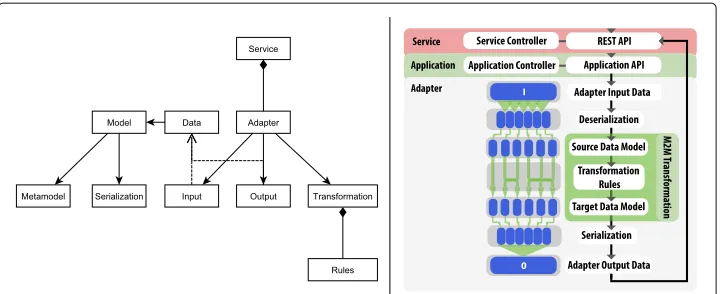
Conceptually, to then integrate these M2M transformation with a given system or appli-cation, we employadapters, which are part of our platform. The core idea of adapters is to enable software systems to remain independent, where each system integrated within our platform is wrapped with its own specialized adapters. More specifically, adapters represent components of the proposed platform, which read the data input of an applica-tion, deserialize this input, map it into to a given, known source data model (i.e. the data model of a given system or application), perform a M2M transformation to a target data model, and then write the resulting output data after serializing it. Note that, in order to read data inputs from an application, we assume that the application produces this data in response to a specific query and that this data is made available to the adapter, for example as a local file. In fact, hereservicesproduce the query to a given application and execute the workflow of an adapter. An extensive description of services is provided in “Middleware platform” section. The workflow of an adapter is visualized in the right part of Fig.2.
Technically, to implement an adapter within a given scenario (e.g. a sequence of activ-ities with a given system), we define a generic implementation model. Here, as required conceptually, the implementation model of an adapter encodes the information necessary to read an input, perform a transformation, and write a specific output. Based on the sys-tem an adapter is implemented for, input and output data models are referenced using the information encoded within the domain model, i.e. the proprietary data model for the given system as well as the standardized CIM data model, the transformation should be performed to or from. The implementation model of an adapter is visualized in the left part of Fig.2.
Fig. 2Left: Representation of implementation model of an adapter. Right: Workflow of an adapter
for the given DSO. Therefore, using the information encoded in the instance model, we adapt adapters dynamically to the specific system configuration of a DSO. Note that the approach is intended to support easy platform adaptation for heterogeneous DSOs by utilizing commonalities in data models and systems.
Middleware platform
The technical part of our platform was aligned along the requirements and use-cases, which were identified during the domain analysis of the participating DSOs (see “Domain analysis” section). Over 100 use-cases were determined and described during this analysis, for the reason to mark the communication patterns behind it. We consider patterns as a sequence of events such as versioning and merge, market processes such as offer/bid/dealclose and underlying distribution of data streams.
Afterwards, an architectural style viable for the requirements of DSOs were chosen, based on correlation between communication patterns and corresponding communi-cation methods (see Fig.3). As it fully covers the communication patterns identified, the Representational State Transfer (REST) architectural style (Medvidovic and Taylor 2010) was selected. REST denotes a architectural style for distributed systems in general and web services in particular, and defines a stateless client-server protocol. In addi-tion, is scalable with respect to queue-based methods, is suitable for integrating current safety requirements and technology as well as enables efficient system integration, con-trol and maintainability. Furthermore, REST offers lightweight applicability and flexibility in industrial IT environments. By utilizing established and open technologies within our approach, system operators can choose to combine open-source and closed-sourced sys-tems or components, which enables synergies between them. By means of integrating independent applications into the platform, a wide variety of different functionality can be accommodated. This includes the connection of simulation tools to grid calculation applications, the utilization and condition monitoring of the distribution grid, the predic-tion of energy consumppredic-tion and weather, and addipredic-tion of new energy systems as well as changing load profiles (Alberts et al.2014).
Fig. 3Identification of technical communication procedures by analyzing the communication patterns of use-cases
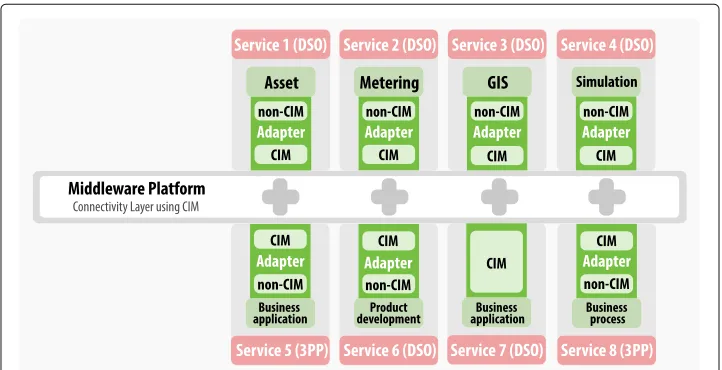
our platform. The bottom line shows a selection of further configurations when connect-ing new systems. Dependconnect-ing on the components involved, a wide variety of integration variants can be implemented.
Single use-cases are then realized usingservices. Two types of services are employed: use-case servicesandapplication services. Use-case services are responsible for the coor-dination of the interaction of individual components within the respective use-case, perform the control flow of involved data and provide a corresponding user interface. Instead, application services encapsulate either an existing specialized technical applica-tion or provide subject-specific funcapplica-tionality. Using this, applicaapplica-tion services only have to implemented once and can be reused by services of different use-cases. As shown in Fig.5, each service is consisted of aserver-moduleand acore-module. Core-modules include specialized control logic for accessing data or processing subject-specific data. Note that implementation code for integrating subject-specific applications and code for
Fig. 5Design patterns of the services
core-modules doesn’t comprise a REST interface. Implementation is performed in the given target language such as Python or Java. In addition, the complete control flow of the realized use-case is implemented in core-modules. Then, finally, adapters for the conversion from and to the CIM are integrated within core-modules.
The server-module contains the main-loop and converts REST to procedure calls. For parallel calls, the server provides separate threads as process environments. Like-wise, an exception forwarding mechanism is realized, where exceptions are translated by the server-module into a REST string and back into an exception by the calling proxy. Communication with other services is performed via the proxy-module, which converts service-internal function calls to REST for each service.
Case study
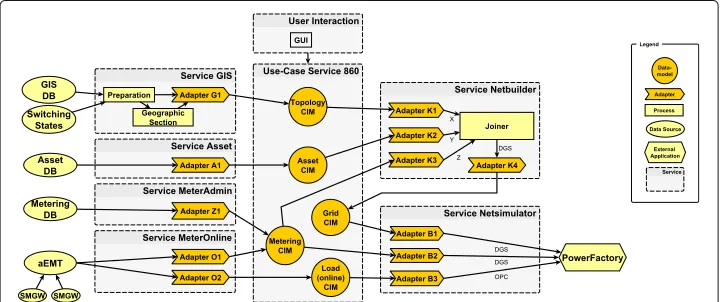
As part of the project, one scenario was selected from 100 different use cases identified as part of the performed domain analysis and was implemented within a case study. For this, the scenario "data acquisition for network calculation" was selected, which represents a vertical prototype covering all relevant features of the proposed platform. In Fig.6, the scenario is visualized conceptually.
In terms of data, the scenario covers a wide range of links between data sources of dif-ferent IT systems that are relevant to network calculations for DSOs. In terms of source systems, data from a GIS system, a metering system and an asset management system
is utilized. In this concrete scenario, the target system represents an application for net-work calculation. Additionally, a subject-specific service was employed between the data sources and target system. This service enriches the network data provided by the GIS system with asset and metering data in order to generate a low-voltage grid model that is consistent from medium voltage to every single low-voltage house connection. The goal of the prototype was to cover a scenario highly relevant for and benefiting to a participating DSO, while enabling application of the approach in a real-world setting.
Related work
The Common Information Model (CIM) has been recognized as a key element to con-nect different DSO systems and applications using a standardized data model and enable interoperability for smart grid applications (Hargreaves et al.2014; Ascher and Bytschkow 2018). In that, a substantial challenge consists in bridging the gap between application-specific data models and the application-independent CIM data model in order to make data accessible for applications requiring multiple data sources such as power system simulations. As a result, several approaches have focused on this challenge in the past.
The CIM2Matpower (CIM2Matpower) package supports transformation of a CIMv14 ENTSO-E profile transmission system network model to a Matpower case structure (Zimmerman et al.2011). However, currently, the tool is only intended to support trans-mission system operator data structures. Armendiariz et al. (2015) introduce a method to convert proprietary application data models to the MATLAB Matpower data model (Zimmerman et al.2011) by utilizing the CIM. The developed tool is intended to sup-port the conversion from utility data such as network topologies and equipment data into MATLAB Matpower to support simulation studies evaluating different technical options for future DSO operations. Gomez et al. (2017) propose an model-driven engineering approach which applies model-to-model transformations between CIM and the Model-ica system modeling language (Mattsson et al.1998). Here, the approach focuses on using M2M transformations to derive Modelica models for dynamic power system simulations only. In contrast, the scope of our approach aims to provide a holistic platform employ-ing adapters between heterogeneous DSO applications and the CIM. Finally, Bredillet et al. (Bredillet et al.2010) propose a smart grid service-oriented architecture, utilizing model-driven development and incorporating standards such as the Common Informa-tion Model (CIM) and the IEC 61850 standard. Goering et al. (2016) propose multi-layer service-oriented architecture utilizing the CIM. Finally, Haq et al. (2011) leverage the CIM to integrate systems from different application vendors within an Service Oriented Architecture.
Conclusion
entities in order to describe the DSO domain sufficiently complete, without requiring proprietary extensions. In fact, as CIM development continues, efforts to establish a stan-dardized CIM profile for DSOs (analogous to the CGMES profile of the ENTSO-E for transmission system operators which currently dominates application landscapes), which covers all requirements of the DSO domain, will be vital. Furthermore, currently, new CIM versions are provided without instructions for migrating models from one version to another, which complicates the maintenance of existing models. Here, future work has to investigate whether our model-based approach can support migration from different CIM versions.
Abbreviations
CIM: Common information model; DSO: Distribution system operator; EMS: Energy management systems; ENTSO-E: European network of transmission system operators for electricity; EV: Electric vehicles; GIS: Geographic information system; IEC: International electrotechnical commission; M2M: Model-to-model; RES: Renewable energy sources; REST: Representational state transfer; SES: Smart energy systems; SCADA: Supervisory control and data acquisition
Acknowledgements
We would like to sincerely thank our project partner, the software company SEKAS GmbH, for the cooperation. Furthermore, we would like to thank the participating municipal utilities of Stadtwerke Ulm/Neu-Ulm Netze GmbH and Stadtwerke Pfarrkirchen for the intensive cooperation.
Funding
Publication costs for this article were sponsored by the Smart Energy Showcases - Digital Agenda for the Energy Transition (SINTEG) programme. Furthermore, publication of this article was sponsored by the German Federal Ministry for Economic Affairs and Energy as part of the German federal research initiative Future-proof Power Grids within the research project ESOSEG (Grant 0325811A-C). The funding leading to the results presented in this article is gratefully acknowledged.
Availability of data and materials
The datasets generated during and/or analysed during the current study are not publicly available due to existing confidentiality agreements with third party partners but are available from the corresponding author on reasonable request and permission of partners.
About this supplement
This article has been published as part ofEnergy InformaticsVolume 1 Supplement 1, 2018: Proceedings of the 7th DACH+ Conference on Energy Informatics. The full contents of the supplement are available online athttps:// energyinformatics.springeropen.com/articles/supplements/volume-1-supplement-1.
Authors’ contributions
All authors participated in drafting and revising the final manuscript and contributed to this study. DA focused on domain analysis and the model-based approach in this manuscript. CK focused on the middleware platform and implementation of a practical field test scenario in this manuscript. Both of the authors have read and approved the final manuscript.
Competing interests
The authors declare that they have no competing interests.
Publisher’s Note
Springer Nature remains neutral with regard to jurisdictional claims in published maps and institutional affiliations.
Author details
1Technische Universität München, Boltzmannstr. 3, 85748 Garching b. München, Germany.2Hochschule Ulm,
Eberhard-Finckh-Str. 11, 89075 Ulm, Germany.
Published: 10 October 2018
References
Alberts I, Stauch V, Lee D, Hagedorn R (2014) Probabilistic weather information tailored to the needs of transmission system operators. In: AGU Fall Meeting Abstracts. American Geophysical Union, San Francisco
Armendariz M, Saleem A, Nordström L, Brugeron M (2015) Facilitating distribution grid network simulation through automated common information model data conversion. In: PowerTech, 2015 IEEE Eindhoven. IEEE, Eindhoven. pp 1–6
Ascher D, Bytschkow D (2018) Integrating distribution system operator system landscapes. Comput Sci Res Dev 33(1):169–175
Atkinson C, Kühne T (2003) Model-driven development: a metamodeling foundation. IEEE Softw 20(5):36–41 Barton JP, Infield DG (2004) Energy storage and its use with intermittent renewable energy. IEEE Trans Energy Convers
Bredillet P, Lambert E, Schultz E (2010) CIM, 61850, COSEM standards used in a model driven integration approach to build the smart grid service oriented architecture. In: Smart Grid Communications (SmartGridComm), 2010 First IEEE International Conference On. IEEE, Gaithersburg. pp 467–471
Broy M (2013) Domain modeling and domain engineering: Key tasks in requirements engineering. In: Perspectives on the Future of Software Engineering. Springer, Berlin Heidelberg. pp 15–30
CIM2Matpower.https://github.com/kkgerasimov/CIM2Matpower. Accessed 30 May 2018
Fan Z, Kulkarni P, Gormus S, Efthymiou C, Kalogridis G, Sooriyabandara M, Zhu Z, Lambotharan S, Chin WH (2013) Smart grid communications: Overview of research challenges, solutions, and standardization activities. IEEE Commun Surv Tutorials 15(1):21–38
Goering A, Meister J, Lehnhoff S, Jung M, Rohr M, Herdt P (2016) Architecture and quality standards for the joint development of modular open source software for power grid distribution management systems. In: 5th DA-CH+ Energy Informatics Conference in Conjunction with 7th Symposium on Communications for Energy Systems (ComForEn), Vol. 36. Österreichischer Verband für Elektrotechnik, Wien
Gómez F, Vanfretti L, Olsen SH (2017) CIM-Compliant Power System Dynamic Model-to-Model Transformation and Modelica Simulation. IEEE Trans Ind Inform 14(9):3989–3996
Haq E, Haller D, Rahman KA, Iverson B (2011) Use of common information model (cim) in electricity market at California ISO. In: Power and Energy Society General Meeting, 2011 IEEE. IEEE, Detroit. pp 1–6
Hargreaves N, Pantea SM, Taylor G (2014) Adopting the IEC Common Information Model to Enable Smart Grid Interoperability and Knowledge Representation Processes. Springer Singapore, Singapore. pp 439–462
Kempton W., Tomi´c J. (2005) Vehicle-to-grid power implementation: From stabilizing the grid to supporting large-scale renewable energy. J Power Sources 144(1):280–294
Kuzlu M, Pipattanasompom M, Rahman S (2017) A comprehensive review of smart grid related standards and protocols. In: Smart Grid and Cities Congress and Fair (ICSG), 2017 5th International Istanbul. IEEE, Istanbul. pp 12–16 Lei M, Shiyan L, Chuanwen J, Hongling L, Yan Z (2009) A review on the forecasting of wind speed and generated power.
Renew Sust Energ Rev 13(4):915–920
Mattsson SE, Elmqvist H, Otter M (1998) Physical system modeling with Modelica. Control Eng Pract 6(4):501–510 Medvidovic N, Taylor RN (2010) Software architecture: foundations, theory, and practice. In: Software Engineering, 2010
ACM/IEEE 32nd International Conference On. IEEE, Cape Town Vol. 2. pp 471–472
Palensky P, Dietrich D (2011) Demand side management: Demand response, intelligent energy systems, and smart loads. IEEE Trans Ind Inform 7(3):381–388
Ramchurn SD, Vytelingum P, Rogers A, Jennings NR (2012) Putting the ’smarts’ into the smart grid: a grand challenge for artificial intelligence. Commun ACM 55(4):86–97
Sharma N, Sharma P, Irwin D, Shenoy P (2011) Predicting solar generation from weather forecasts using machine learning. In: Smart Grid Communications (SmartGridComm), 2011 IEEE International Conference On. IEEE, Brussels. pp 528–533 Uslar M, Rohjans S, Bleiker R, González J, Specht M, Suding T, Weidelt T (2010) Survey of Smart Grid Standardization
Studies and Recommendations–Part 2. In: Smart grid communications (SmartGridComm), 2010 first IEEE international conference on. IEEE, Gothenberg
Zhao H-x, Magoulès F (2012) A review on the prediction of building energy consumption. Renew Sust Energ Rev 16(6):3586–3592
Zimmerman RD, Murillo-Sánchez CE, Thomas RJ (2011) MATPOWER: Steady-state operations, planning, and analysis tools for power systems research and education. IEEE Trans Power Syst 26(1):12–19
Submit your manuscript to a
journal and benefi t from:
7Convenient online submission
7Rigorous peer review
7Immediate publication on acceptance
7Open access: articles freely available online
7High visibility within the fi eld
7Retaining the copyright to your article