DRTRMRTIGlIN
'
March
Ampex's second-generation TM-2 uses design principles already proved the hard way -
in on-site computer
use.
And with these proved principles, it gives performance far exceeding any available industry
stand-ards: tape speed to 150 ips; closely controlled 2.0 ms start/lo5 ms stop times; up to 200 Kc net character
transfer rate (1" tape).
Ampex performance standards set the pace 7'n maximum system thru-put.
Ampex - the world's largest corporation devoted solely to magnetic tape technology - has sold over 3,500
digital tape transports. Experience encompassing design, development and production of virtually every
type of head and tape transport has evolved the present use-proved principles. Fifteen of the world's
leading computer manufacturers specify Ampex because Ampex systems reflect unmatched knowledge
and specialized experience, besides offering new industry performance standards and world-wide service.
User acceptance
is the true measure of A'mpex's contribution to maximum system thru-put.
For TM-2 details and specifications please write,' AMPEX COMPUTER PROOUCTS COMPANY
BOX 5000 • REDWOOD CITY, CALIFORNIA
IAMPEX]
(TM=2)
Qmax
$
WHERE (TM-2) = AMPEX TM-2 MAGNETIC MEMORY SYSTEM
Q
=
ACTUAL SYSTEM THRU-PUTS = MAGNETIC TAPE TRANSPORT INVESTMENT
CIRCLE 1 ON READER CARD
Mathematical computation:
vital element of Space Technology LeadershipThe rapid solution of ever-more complex problems is indispensable in converting physical concepts into specifications for
advanced space and ballistic missile systems_ Space Technology Laboratories employs the modern, high-speed digital computer
as an integral part of systems engineering. At STL's Computation and Data Reduction Center, computing specialists are daily
expanding the wide potential of modern computing devices, as well as solving problems arising in advanced space technology.
The Center, a modern, flexible facility, has a capability including two IBM 7090's and IBM 1401 auxiliary equipment. Continuing
expansion of STL's activities in this vital area now creates the need for additional specialists with B.S., M.S., or Ph.D. in
Mathe-matics, Engineering or the Physical Sciences, and related experience. Those capable of contributing within the environment of
Space Technology Laboratories are invited to contact Dr. R. C. Potter, Manager of Professional Placement and Development. Their
resumes and inquiries will receive meticulous attention.
SPACE TECHNOLOGY LABORATORIES, INC.
P.o. BOX 95005Y, LOS ANGELES 45, CALIFORNIAa subsidiary of Thompson Ramo Wooldridge Inc. •
EI Segundo • Santa Maria • Edwards Rocket Base • Canoga Park ~ Cape Canaveral • Manchester, England • Singapore • Hawaii
volume
7,
number3
Staff
Publisher FRANK D. THOMPSON
Vice President & General Mgr. GARDNER F. LANDON
Editor SANTO A. LANZAROTTA
Managing Ed. HAROLD BERGSTEIN
Assistant Ed. G. PATRICK ANDERSON
European Editor ETIENNE J. GUERIN
Contributing Ed. DR. HERB GROSCH
Technical Consultant DON B. PRELL
Production Mgr. & Art Director CLEVE BOUTELL
Circulation M gr. MARTHA KNOWLES
Editorial Advisers
DANIEL D. McCRACKEN C. L. W ANLASS
Sales Mgr. & Eastern District Mgr. RICHARD W. NIELSON
141 E. 44th St., New York 17, N. Y. MUrray Hill 7-5180
New England District Manager WARREN A. TIBBETTS
434 Webster St., Manchester 4, N. H. NAtional 5-9498
Cleveland District Manager ALBERT PUDV AN
3537 Lee Road, Shaker Heights 20, OhIo WAshington 1-9370
Midwest District Manager GILBERT THAYER
Midwest Representative ROBERT W. HEATH 201 N. Wells St., Chicago 6, III. Financial 6-1026
Western lJistrirt Manager HAMILTON S. STYRON
10373 W. Plco Blvd., Los Angeles 64, Cal. BRadshaw 2-2643
European IIfar/([~cr
E. J. GUERIN Box 824
Stockholm I, Sweden
EDITORIAL OFFICES
10373 W. PI CO BLVD., LOS ANGELES 64, CALIF.
the automatic handling of in formation
Articles
22 Optical Recognition - The Breakthrough Is Here
23 Farrington Has Optical Scanning Lead by Vin Wentworth
25 Newest Scanner - Letters, Symbols, Punctuation Read 26 Optical Scanning Of Customer Accounts by George W. Vogler
27 IB:M Optical Reader Provides Direct Entry 28 Optical Character Reading At NCR
33 The Sylvania View - More Comments On COBOL by Jean E. Sammet
35 Another Autonetics Entry, Recomp - From II to III,
by Richard F. Musson
36 Computer Characteristics Chart - A Supplement 38 Burroughs Announces The B5000
41 Computer Controlled Recorder Produces Mechanical Drawings 41 Users O.K. Affiliation \Vith ACM
50 vVJCC In 1961 Nlay Attract 3,000
54 Information, Decision Symposium Scheduled At Purdue
Departments
6 Letters To The Editor 14 18 21 43 47 48 52
56
5860
Datamation In Business and Science Important Dates In Datamation The Editor's Readout
Datamation News Briefs
People Moving Up In Datamation Datamation Abroad
New Products In Datamation Datamation Feature Index - 1960 New Datamation Literature Advertisers' Index
THIS ISSUE -
35,000 COPIES
DRTRMRTlmJN
March
o y
3
1 "; b 9
~
bB."s
'...a....cu:::L...c::::"'I
Y '0 2 )""
!
5 (::
8
Cover
". . . the production facilities of more than ten major electronics manufacturers will be re-quired to meet the optical scanning needs of American industry," a Farrington vice presi-dent states in this issue. Special treatment of an important input medium begins on page 22.
Circulation audited by Business Publications Audit
Member, National Business Publications
DATAMATION is circulated without charge by name and title to the manufacturers and users of automatic, information-handling equipment in all branthes of business, industry, government and military installations. Qualified individuals in the United States and Canada are invited to request this publication on their company letter-head, stating position and firm's business. Available to others by subscription at the rate of $10.00 annually; single issue, $1.00 when available. No subscription agency is authorized by us to solicit or take orders for subscriptions in the United States, Canada or overseas.
DATAMATION is published monthly on or about the tenth day of every month by F. D. Thompson Publications, Inc., Frank D. Thompson, president. Executive Circu· lation and Advertising offices, 141 East 44th St., New York 17, N.Y. (MUrray Hill 7-5180). Editorial offices, 10373 West Pico Blvd., Los Angeles 64, Calif. (BRadshaw 2·0817). Published at Chicago, Ill. Accepted as controlled circulation publication at Waseca, Minn. Copyright 1961, F. D. Thompson Publications, Inc.
OPERATION
binary
CATNAP?
duotric en
ary
19 l536 0032
FETCH
Rs
GUSP
8269
1;
~
SQRT(a,
1f2Lx:+%/e
l/z
x
---L
i
~ 2::{Ik+~,
*
EB}=EA(mty3LA
j-c
£
(l) ---
end
WHAT NEXT.
:"
.
~..
..
ADVANCED PROGRAMMING
$10,000-$20,000
and
YOUR
PROGRESS?
Our client, a top company in the data processing field, has immediate openings for creative minded
programmers-professionals who wish to participate in advancing the state of the art in a stimulating atmosphere. Permanent
assignments exist in prime locations - East, Los Angeles, Midwest.
ASSIGNMENTS IN:
Advanced Programming Techniques Applied Research
Analytical Techniques
Operational Programming Support to study groups
Indexing, Storage & Retrieval
QUALIFICATIONS:
CURRENT PROJECTS:
Intelligence
Command & Control Systems Administrative & Logistic Systems Space Systems
Air Traffic Control Anti-submarine Warfare Communications Systems Weapons Systems
Candidates must be strong technically, but primarily interested in systems applications, as the project areas involve a great deal more than just computers or hardware. Spe-cifically, applicants must possess college degrees plus a minimum of three years of sophisticated large scale programming experience with commercial or military systems orientation.
Please submit detailed resume including salary information
All inquiries will be answered promptly and treated confidentially
HALBRECHT ASSOCIATES, INC.
332 SOUTH MICHIGAN AVENUE
•
CHICAGO 4, ILLINOIS•
HArrison 7 -2876March 1961
576 Fifth Avenue New York 36, New York
11749% Wilshire Blvd. Los Angeles 25, California
Why struggle with up to
Visit UsIRE SHOW
Booth Nos. 3038 & "3039
19 bits straight binary readout
when you can have the convenience
of display directly in the units
of your own data system with
HERMES TRANSLATORS
6
~
Typical Problem: Readout of angular position of a radar encoder is in the form of 16 bits straight . binary. You want to convert the 16 bits readout.into decimal display expressed in degrees.
HERMES TRANSLATOR. MODEL 2060
Solution: Since the radar can track in a com· plete circle, each bit represents 3600
-+- 65,535 (16 bits binary = 21 " - 1
=
65,535 parts). There are, therefore, 0.005490per binary count. The Hermes Translator transforms straight bi· nary to decimal, manipulates the data arithmet· ically to multiply by 0.00549, and displays the required readout in degrees.
This same method may be applied to any data system where the original output is any number of straight binary bits and digital readout in the units of the measuring system is required.
Three basic types of conversion can be accom-modated by Hermes Translators for a wide variety of applications:
Code-Format Conversion in which the actual physi-cal characteristics of input data are transformed into the required output data form.
Code-to-Code Conversion in which only the lan-guage or code in which the information is rep-resented is transformed.
Scale Conversion in which data is manipulated arithmetically (as in the Typical Problem above) to display readout in decimal form and in the units of the measuring system being employed.
Write for Technical Bulletin Translators
DerIDes
ELECTRONICS CO.
75 CAMBRIDGE PARKWAY, CAMBRIDGE 42, MASS. [
Itek
1
A DIVISION OF
CIRCLE 5 ON READER CARD
to the
editor.
Dear Sir:
.
.
Graham Jones apparently had a bug in his arithmetic logic when he stated in "Trends in Computer
Hard-ware", DATAMATION, January,
1961, that today's fastest equipment
(e.g. IBM STRETCH or UNIVAC
LARC) could do eight years of UNI-VAC I work in twenty-four hours. This infers a speed-up factor of 2920 to 1.
A consideration of execution· time produces the following:
EXECUTION TIME
PER INSTRUCTION
MICRO-(excluding 110) SECONDS
1. UNIVAC I (average) 424
2. UNIVAC LARC
(quoted) 4
3. IBM STRETCH
(quoted) 1
When Input/Output effective
speeds are compared, the speed-up factor is significantly less. Programs dealing with the updating of low percentage activity files (e.g., Insur-ance Premium Master Files) could be only 5-10 times faster when the hardware of 1961 is compared to the hardware of 1952.
By no stretch of the imagination, even considering additional core memory sophisticated instruction codes, floating point hardware, in-dexing, multi-programming, multi-channels, etc., can one expect to ac-complish the work of a UNIVAC
I on today's equipment in 1/2920th of the elapsed time.
Maybe Tomorrow!
MARTIN A. GOETZ
APPLIED DATA RESEARCH, INC.
Dear Sir:
The January 1961 issue of "Data-mation" was, as usual, quite interest-inK However, I must ob;ect to the superior attitude assumed by Daniel
D. McCracken in his article "The
Human side of Computing." I agree that professional status should be given to "computer people," if by this unscientific expression he means sci-entists and technicians who work with computers.
But in his statement on page 10, that this professional status will be im-possible to obtain "as long as anyone with ten dollars can ;oin the ACM and proclaim himself a professional com-puter expert," is a slap in the face to myself and many others who have been members of the AC M for several years . ..
Long ago I became convinced that
Electronics were going to have an im-portant bearing on the Accounting profession and Business Administra-tion and, as you know, my assumpAdministra-tion has been proven correct.
Therefore, my reasons for joining the ACM and subscribing to several technical magazines are not "to pro-claim myself a professional computer expert," but to learn all I could about computers and other equipment which could and will be applied to business administration, including applications to small businesses and Public Ac-counting offices. So much for the un-warranted attack by D. D. McCracken on myself and probably many other members of the AC M.
There is one point I wish to bring to your attention, namely, the educa-tion in the computer field. I should have said; the lack of educational fa-cilities and on this point I agree with
D. D. McCracken when he says that "we must prepare for an intensive education effort." ...
I am sure that I am speaking for a large group of professional and bus-iness people, who would like to learn more about Automation in all its ap-plications. Computers, I.D.P., Sys-tems and Procedures, etc. but who do not know where to turn for this edu-cation . ..
H. C. VOORHOEVE
Accredited Public Accountant Proud Member of the AC M
North Vancouver, B. C.
Dear Sir:
Could you answer for me the ques-tion as to what in the eyes of industry constitutes a "qualified" programmer? What education, experience, etc. are considered to satisfy the "qualified" status.
My second question is: "if an in-dividual is not qualified unless he has four years of large machine program-ming experience, and industry will not hire a person with small machine ex-perience because he is not "qualified", then how does the small machine in-dividual ever enter the ranks of being "qualified"; how does he get the
quali-fying experience, if he cannot be· hired unless he already has it?
These two questions pose a real problem to the individual who seeks to jump into the large machine pro-gramming area from the status of small machine programming. They amount to self-generating roadblocks to the individual desirous of making the jump . ..
JOHN J. CALLAHAN, JR.
Reading, Mass.
March 1961
SHOWN 3 TIMES NORMAL SIZE
~,
RECORDING
HEAD
FERRITE
Kearfott's new CN-20 nickel-ferrite, specifically developed
for recording head applications, is a sintered material
which operates most efficiently in the 10 kc to 750 kc
fre-quency range. CN-20imparts superior magnetic and me ..
chanical properties, is insensitive to. mechanical stresses
of potting compound during curing, is magnetically stable
under temperature variation and has uniform magnetic
properties. CN-20 heads have
negligibledeviationsinin~ductance to temperatures as high.as160°F, using gaps
of .0010 or .0015 inches.
Production quantities of complex shapes are immediately
available. Dimensional tolerances of. 0.0001 inch and
finishes of 16 to 32 micro-inches are standard ...
electro-platedsurfaces for unusual wear resistance also available.
Initial Permeability at 100 kc 800 Saturation Magnetization
(DC) at 16 oersteds
TYPICAL
CHARACTERISTICS
Residual Magnetization Coercive Force
Temperature Coefficient af Initial Permeability (-20°C to +100°C)
3680 gauss 2565 gauss 0.19 oersteds
Write for complete data
Curie Temperature Resistivity
1.0% °C 150°C 104 ohm-em All magnetic properties are held within a tolerance of ±15%
KEARFO'TT DIVISION
GENERAL PRECISION. INC.
Little Falls, New Jersey
CIRCLE 6 ON READER CARD
Design changes double power of Honeywell
400
Internal speed increased
to
10,000
three-address operations
a
second; new independent
console,
FACT
business compiler, optional off-line printing,
more
optional tape drives.
Honeywell's EDP Division has greatly broadened the appli-cation of Honeywell 400 - and extended the benefits of electronic data processing to more companies - by incor-porating into this System a number of outstanding new features. These new developments, a result of Honeywell's continuous research, have further enhanced the pre-eminence of Honeywell 400 in its class. And, except for the new optional features, there has been no increase in cost.
Internal speed iumps -
The internal speed of the Hon-eywell 400 is now approximately 10,000 three-address opera-tions per second - the equivalent of 20,000 one-address operations. Multiplication is about twice as fast as before, and division about four times as fast. Multiply time for a six non-zero digit multiplier is 1.9 milliseconds. Division times range from 1.6 to 8.6 milliseconds.FACT business compiler available -
Now, in addition to the EASY assembly program, the FACT compiler is avail-able with Honeywell 400. FACT, a widely acclaimed, highly efficient automatic programming system, is unique in that it can be applied to all typical functions of business data proc-essing with ease and uniformity. This includes input editing, sorting, processing of variable-length records, and report writing.New independent console -
Included in the basic sys-tem price of $8,660 a month is a new independent console equipped with a keyboard, printer, and breakpoint switches. This new console enables Honeywell 400 operators to com-municate more easily with the System.Optional off-line printing -
Now organizations such as public utilities and insurance companies can print bills or premium notices in huge volume without attenuating the important processing work going on inside their Honey-well 400.An off-line printing configuration consisting of a printer, high-speed magnetic tape unit, and electronic control equip-ment is now available at a rental of $3,500 per month.
More tape drives may be connected -
The maximum number of magnetic tape units which may be used with the Honeywell 400 has been increased from six to eight. (Basic system includes four tape units.)Expansion now easy. economical -
By vastly increas-ing the processincreas-ing power without increasincreas-ing the price, and by making new optional equipment available, the new Honeywell 400 gives users power to spare for the years of growth ahead. It also makes easy and economical the possible future jump to Honeywel1 800, the most powerful of allcomputers in the Honeywell family.
The outstanding performance of Honeywell 400 in the areas of storage and high-speed manipulation of large vol-umes of data make it exceptionally efficient at sorting and file maintenance.
SUMMARY OF KEY FEATURES
Basic package:
Includes central processor, four speed magnetic tape units, console and console printer, high-speed printer and card reader.Price of basic package:
Monthly rental- $8,660 per month. Price - $390,000.Options:
Various input-output devices including off-line printing, up to four additional tape units, card punch ( 100 or 250 cards per minute), paper tape input and output units.EQUIPMENT SPECIFICATIONS CENTRAL PROCESSOR:
Speed 10,000 (approx.) 3-address operations per second. Memory 1,024 words of core memory (approx. 10,000
characters).
Checking Internal parity checking.
Features Simultaneous read-write, special automatic editing provisions, high-speed sorting ability.
Options Multiply-divide, print storage for simultaneity with
MAGNETIC TAPES: other operations, additional memory.
Speed 96,000 decimal digits per second. Features Identical to Honeywell 800 tape units.
PRINTER:
Speed Horizontal
span Features
CARD READER:
Speed Feature
CONSOLE:
Features
Orthotronic Control (automatic error detection and correction).
900 lines per minute. 120 columnar positions.
Up to 10 clean carbons, rugged construction, fully checked.
650 cards per minute. Fully checked.
Printer and keyboard for both input and output, breakpoint switches.
AUTOMATIC PROGRAMMING AIDS:
EASY Assembly Program. FACT Business Compiler.
If you have any questions about this new and more powerful Honeywell 400, just write Honeywell EDP, Wellesley Hills 81, Mass. Or Honeywell Controls Limited, Toronto 17, Ontario.
Honey~ell
II
e~
Do:a
p~~
CIRCLE 7 ON READER CARD8 DRTRMRTION
In Computer Applications, you need PRECISION
•
•
. and that's the word for ARNOLD BOBBIN CORES
For use in shift registers, coincident current matrix systems, pulse trans-formers, static magnetic memory ele-ments, harmonic generators and simi-lar equipment, Arnold Bobbin Cores meet the most exacting requirements. Quality and uniformity? You'll find them no problem-because, as a fully . integrated producer with highly
mod-ern facilities, we're able to maintain close control over every step.
Arnold Bobbin Cores are available in a wide range of sizes, tape thick-nesses, widths and number of wraps. Magnetic materials usually employed are Deltamax and Permalloy, in standard gauges of 1,
Yz,
;4 and Vamil, in widths from ~" through ;4".
Core properties include quite rec-tangular hysteresis loops, relatively
March 1961
low coercive values and high satu-ration densities, plus the ability to shift in a few micro-seconds from negative remanence to positive sat-uration, and vice versa, under con~
ditions of pulse excitation.
Let Arnold supply your require-ments for Bobbin Cores-or other tape-wound cores, powder cores, per-manent magnets, etc.-from the most complete line of magnetic materials in the industry . • Just address
The Arnold Engineering Company, Main Office and Plant, Marengo, Ill.
ASK FOR BULLETIN Te-IOBA
Includes essential data on applications and properties, fabrication and testing of Arnold Bobbin Cores; lists standard sizes, etc.
ADDRESS DEPT. D-3
CIRCLE 8 ON READER CARD
Ultra-thin tape for bobbin cores is rolled to high precision standards for thickness and finish on our own 20-high Sendzimir cold reducing mill, beta-ray controlled.
wsw 7420 A
BRANCH OFFICES and REPRESENTATIVES In PRINCIPAL OTiES
Find them FAST in the YfLLOW PAGES
Said Johann Kepler:
liThe planets move in elliptical orbits about the sun,' and the square of their
periods of revolution are proportional to the cube of their mean distances from the sun."
With interplanetary voyages fast becoming a reality, complete information regarding the velocity requirements for travel between planets is of vital importance. With these data available, it is possible to analyze propulsion requirements, plan ultimate system configurations, and conduct feasibility studies for any particular mission.
Lockheed Missiles and Space Division scientists have actually evolved a rapid-calculation method, utilizing a high-speed computer. This has produced literally thousands of orbits, velocity requirements, and elapsed time, for design studies of trips to and from both Mars and Venus-every tenth day from now until January, 1970.
More simple to analyze are many factors which make Lockheed Missiles and Space Division a wonderful place to live and work. Located in Sunnyvale and Palo Alto, California, on the beautiful San Francisco Peninsula, Lockheed is Systems Manager for such programs as the DISCOVERER and MIDAS satellites and the POLARIS FBM. These, together with research and development projects in all disciplines, make possible a wide diversity of positions for creative engineers and scientists in their chosen fields.
Why not investigate future possibilities at Lockheed? Write Research and Development Staff, Dept. M-14 B., 962 West EI Camino Real, Sunnyvale, Calif. U.S. citizenship or existing Department of Defense industrial security clearance required.
IIlt:kIJlllld
/
MISSILES AND SPACE DIVISION
Systems Manager for the Navy POLARIS FBM and the Air Force AGENA Satellite in the DISCOVERER and MIDAS Programs
SUNNYVALE. PALO ALTO. VAN NUVS. SANTACRUZ. SANTAMARIA. CALIFORNIA- CAPE CANAVERAL. FLORIDA- HAWAII
When responding, a mention of DATAMATION would be appreciated.
This
Card ...
This magnetic card is the heart of the National 315 Card Random Access Memory (CRAM) ... an un-equalled advance in economical magnetic file processing. In effect, a reel of magnetic tape-31;4 inches wide-has been cut into 256 strips forming ad-dressable magnetic cards. A single card is capable of storing 21,700 alpha-numeric characters. Each card contains seven recording tracks that can be addressed electronically by the central processor. The 256 cards (5,555,200 alpha-numeric charac-ters) are housed in a removable cartridge that can be changed in less time than it takes to change
a new concept in Computers
can revolutionize your data
processing procedures.
a reel of magnetic tape. Up to 16 CRAM files can be operated on-line with the National 315 ... providing 88,883,200 alpha-numeric characters . . . an
unprece-dented range of random accessible memory. This unique system combines all the advantages of ra.ndom and sequential processing ... elimi-nates rewind time ... requires fewer files ... speeds sorting, up-dating, and reporting routines. INVESTIGATE THE NATIONAL 315 for eco-nomical price performance • For unusual expansi-bility • For high-speed, balanced processing • For economy of programming • For ease of operation.
Learn why the National 315 is the most advanced electronic data processing system available today. Call your nearby National office, or write to Data Processing Systems and Sales, Dayton 9, Ohio.
THE NATIONAL CASH REGISTER COMPANY. Dayton 9, Ohio
1039 OFFICES IN 121 COUNTRIES .•. 77 Y EARS OF HELPING BUSINESS SAVE MONEY
CIRCLE 9 ON READER CARD
March 1961
EU(TIlONIC DATA PltGCESSfNG
ADDING IMACHINU.CASH.grGI$WU
ACCOUNTING MACHINES ~N~ PAP!t
160,000,000 digit impressions without failure
Rugged, Trouble-Free-Digit-Matics are specially built to stand the strain of continuous operation. In a durability test, over 160 million digit impressions were made without breakdown or need of adjust-ment. The machine tested operated continuously, eight hours per day until 160 million digit impres-sions were made. During this period only normal lubrication and cleaning were performed.
Parallel or Serial Entry - Automatic and un-attended, solenoid-activated Digit-Matics print out alpha-numeric data from remote equipment. High speed parallel entry models accept up to 10 digits at a time, print up to 4 lines per second. Serial entry models accept 1 digit at a time, up to 11 per line.
Two-Color Printing - Positive values in black, negative values in red. Ideal for H accept-reject"
se-quences, testing applications, accumulating data from two sources on one Digit-Matic, and many other uses. Adaptable to Your Specific Needs - Line in-cludes listers, accumulators and calculators. Versa-tile units can handle degrees, minutes, seconds, fractions. Other modifications: superimposed key-board for manual use, time readings, counters, etc. Immediate Field Service - 70 factory service branches and service representatives in over 600 cities assure uninterrupted operation. Victor offers 30-day delivery on most Digit-Matics. Mail coupon now for product data and application information.
r---~
VICTOR
I
Victor Adding Machine Co. 0-3 III
Chicago 18, IllinoisI
Send full information on Victor Digit-Matics.I
I
I
I
My application isI
12
ELECTRONICS DIVISION
Victor Adding Machine Co., Chicago 18, Illinois Victor Adding Machine Co., (Canada) Ltd., Galt, OntoManufacturers of Digit-M atic Printers, Scanning Printers, Electrical Keyboards, and Digit-Matic Data Punches
I
Name TitleI
I
CompanyI
I
AddressI
I
City StateI
~---~
CIRCLE 10 ON READER CARD
CIRCLE 71 ON READER CARD
+
1'1' ! 'ii ,If:
:;"
~ n
TRMRTION
in business and science
i
I!ji Ir.i ~
, IBM, RCA, GE
MOVE TOWARD CONTROL FIELD
GEN. DYNAMICS
FORMS NEW ELECTRONICS DIV.
14
SDC'S 2000
WILL BE ON AIR MAY 9TH
Three of the information processing industry's
lead-ing firms seem to have decided that the grass in the
control field is green enough for cutting and are
moving up their big mowers with hopeful hearts. IBM,
RCA and GE say they have plans and will travel.
General Electric announced formation of an
indus-trial process control computer business to be part of
the Industrial Control
De~t.GE control computers
had been manufactured and marketed by the Computer
Dept. but the company undoubtedly feels the growth
potential is great enough in both the IP and control
fields to warrant the spin-off. R. C. Berendsen has
been named general manager of the process computer
activity. The Computer Dept. and the new operation
will continue to function in Phoenix.
RCA says demands for their control computers and
devices have outstripped estimates. "The industrial
computer control business is expanding," says an
of-ficial, "and we are taking the necessary steps to
grow with it." Initially, the "steps" include an
ad-ditional 10,000 sq. ft. to double manufacturing and
testing space at Natick, Mass. RCA's Industrial
Com-puter Systems Dept. is currently producing the 110
computer, the 130 information transmission link and
other equipment.
IBM has announced transfer of the process control
systems program to the General Products Division
Development Laboratory in San Jose, Calif. from
Peekskill, N. Y. The San Jose installation will
de-velop and manufacture "systems (which) provide the
direct physical connection between systems hardware
and a customer's process," a release reads.
Mean-while, IBM and Du Pont have, for some time been
in-volved in a joint research program to investigate
ad-vanced concepts of computer control systems.
The above information is undoubtedly not news to
firms already producing general and special purpose
process control machines and the whole picture adds
up to a hot, competitive computer race in the plants,
refineries and factories.
General Dynamics/Electronics is a new division in the
parent corporation which will provide a means of
con-solidating electronic activities formerly spread
among many divisions. Stromberg-Carlson, San Diego,
will now be known as Information Technology Division
of General Dynamics/Electronics.
The Philco 2000 which System Development Corp. is
purchasing will probably be delivered before May 1
and will be installed and on the air in time for
the Western Joint Computer Conference beginning May
9. The machine, which will be used primarily by SDC's
Systems Simulation Research Laboratory, will be fully
operational by September. An SDC-developed realtime
input/output transducer, the RL-I01, will be available
with the system.
CRTRMRTICN
·l~":."
;.~..
t
•
Now ... IBM Control Panels
DELIVERED
IMMEDIATELY
.. from your local IBM office
NOW ••• IBM CONTROL PANELS
are available at all of our 192 branch offices. A phone call ... and your panel literally comes off the shelf to meet your emergency need.
Call With Confidence ... because IBM alone carries the complete line of control panels .
Behind The Panel ... is IBM's liberal trade-in policy. In addition, IBM control panels may be returned for credit if obsoleted by the installation of a more advanced IBM system.
With The Panel ... you get IBM quality and engineering know-how ... and, most important, IBM service. This service is provided by men with an intimate knowledge of your IBM equipment and systems ... so they can be genuinely helpful on panel problems.
So ... next time you need a control panel, call your IBM office and get immediate
del ivery ... at new lower prices ... from the company that designed and built your data processing system.
DATA PROCESSING
CIRCLE 13 ON READER CARD 17
18
Senior Methods Analysts, Scientific Applications
Specialists, and Sales Representatives
GIVE YOUR CAPABILITIES
FULL EXPRESSION -
AT A
LOCATION OF YOUR CHOICE
-'\NITH RCA'S EDP DIVISION
There's an atmosphere of achievement at RCA. You
become associated with other highly capable people
working on important projects. You are stimulated
to contribute your best ... and your
accomplish-ments are recognized and rewarded.
You're a vital member of a company whose
equip-ment is universally accepted and respected ... a
com-pany that's growing . . . expanding its EDP 'offices
and facilities throughout the country. Because of
this, you're able to choose your own location.
The qualifications required: for Senior Methods
Analysts,
an extensive background in EDP systems
analysis and a knowledge of programming methods
and planning. For Scientific Applications Specialists,
a minimum of three years' experience in scientific
computations on EDP tape equipment, plus
sys-tems experience.
For Sales Representatives, a background that includes
at least one year of on-quota EDP sales experience
with either government or commercial clients, and
a thorough EDP systems knowledge.
Call or send your resume to the nearest RCA
Electronic Data Processing Dim'sion office for
confidential consideration of your qualifications:
Mr. R. W. Baumann, Pers. Mgr., Northeastern Reg.
45 Wall Street New York,S, New York HAnover 2-1811
Mr. R. C. Mercer, Pers. Mgr., Cent. & Southeastern Reg. RCA Cherry Hill, Bldg. 204-1 Camden, 8, New Jersey WOodlawn 3-8000,
Ext. PY 5444
Mr. R. W. Stephens, Pers. Mgr., Western Reg.
11819 W. Olympic Blvd. Los Angeles, 64, Calif. BRadshaw 2-8842 Mr. M. G. Young, Pers. Mgr.,
Fed. Gov't Sales 1725 K Street, N.W. Washington, 6, D.C. FEderal 7-8500
e
The Most Trusted Name in Electronics
® RADIO CORPORATION OF AMERICA
CIRCLE 72 ON READER CARD
1 961
IMPORTANT
D AT E 5
• The IRE National Convention will be held at the New York Coliseum and the Waldorf-Astoria Hotel, New York City, March 20-23, 1961.
.- The annual meeting of POOL, the LGP-30 and RPC-4000 computer users group, will be held on March 27-30, at the Jung Hotel, New Or-leans.
• The annual meeting and Conven-tion of the NaConven-tional Microfilm Asso-ciation will be held April 4-6, 1961 at the Hotel Sherman in Chicago, Ill. • The 7th meeting of CO-OP, the 1604 user's organization will be held at the Shoreham Hotel, Washington D.C., on April 12-13.
• The Cincinnati Section of the IRE and the Southern Ohio Section of the ARS will hold its 15th Annual Spring Technical Conference April 12-13 at the Hotel Alms in Cincinnati. For in-formation contact R. P. Schlemmer, Engineering Specialties, 8115 Cam-argo Rd., Madeira. Cincinnati 42. O. • The UNIVAC users association Spring Conference is scheduled for the Statler Hilton Hotel, Los An-geles, April 13-14. For information contact Donald Houghton, Secretary, UNIVAC Users Association, Westing-house Electric Corp., 3 Gateway Cen-7ter 15-West, Pittsburgh 22, Penna.
I/./::~
• The USE Meeting will be held in EI Paso, Texas, April 18-21, 1961. For information contact James W. Nickitas, 315 Park Ave., N.Y.C. • The 5th CUE Meeting will be held in April, 1961 in Chicago, Ill.
• TRANSAC Users Group Meeting No.8 will be held in Hartford Conn., in May 1961.
• The Western Joint Computer Con-ference is scheduled for Los Angeles' Ambassador Hotel, May 9-11, 1961. For information contact Dr. W. F. Bauer, Ramo-Wooldridge Co, 8433 Fallbrook Ave., Canoga Park, Calif.
Automatic
drafting
like this
from your
computer
in less than
1 second!
The S-C 4020
March 1961
Actual drawings produced by the S-C 4020 High-Speed Microfilm Recorder
T
I
1
~~
, 7'8"J ....
I
1
- - - ' - - - 11/1 - - - 1 1
1114 1114
L
" I~tl
_
1~~-~---~L-~~--~--~~
Z 114 ---I~iV____~
1/81
Instantaneous mechanical drawing is now a reality, with the Stromberg-Carlson S-C 4020 High-Speed Microfilm Recorder. Auto-matic drafting can cut weeks from design time, saving invaluable engineering man-hours. Here's how it works:
A computer is programmed with the contours and specifications of the part to be designed, using APT (Automatically Programmed Tool) language. The computer operates the S-C 4020 Recorder which makes multi-view mechanical drawings of the part in a fraction of a second. After the drawings have been checked, output of the com-puter can be used to operate a numerical control tool and produce the part. Capabilities of the S-C 4020 include recording data on microfilm -at 17,500 points per second, plotting graphs on microfilm at 12,500 points per second, recording complex logic circuit draw-ings, tabular printing and forms projection. Write for more details to Stromberg-Carlson-San Diego, Dept. B-20, P. O. Box 2449, San Diego 12, California.
STROMBERG-CARLSON-SAN DIEGO
A DIVISION OF GENERAL DVNAMICS CORPORATION
20
AN INVITATION
TO DELEGATES ATTENDING THE IRE CONVENTION
IN NEW YORK CITY
The tremendous expansion now in progress at Philco has created a number
of immediate openings within our marketing
organization~This growth is the result of the widespread acceptance of the Philco 2000.
It
offers experienced computer personnel with strong backgrounds unique
opportunities to build rewarding careers with the country's leading computer
manufacturer.
Openings are currently available in:
Sales
Field Engineering
Programming
Technical Writing
Customer Service
Educational Specialists
Systems Analysis
Successful candidates will be assigned to our headquarters staff or to one
of our strategically located branch offices throughout the United States.
There is opportunity for men with management potential and interest to
advance to supervisory responsibility. Proven marketing procedures and
policies assure permanency and superior earnings.
You are invited to investigate these opportunities and
also openings in our engineering departments in
com-plete confidence while you are in New York City at the
convention. Contact Mr. John Felos, Professional
Em-ployment Manager at
PLaza 3-0806
or write to Philco, Computer Division, Willow Grove,
Pennsylvania.
CIRCLE 73 ON READER CARD DRTRMRTION
,
the automatic handling of in formation march
March 1961
COBOL'S LOT -
BOTTLENECKS
&
BRICKBATS
A discussion of COBOL is hardly ever a casual thing. It would he difficult to think of another topic in the field of information processing which can evoke as much controversy and wrath. (ALGOL debaters operate on a sci-entifically high level.) Rarely is such a discussion an organized thing. The COBOL picture changes faster than you can turn a kaleidoscope.
DATAJ\!IATION has long since abandoned the thought of taking a firm COBOL stand because, frankly, we wonder if anyone really knows what, if anything, is wrong and what can be done about it.
We have therefore decided to restrict ourselves hereto asking a few loosely connected questions and volunteering a few limited observations ... all of which will undoubtedly stimulate an enthusiastically unfavorable response from both pro- and anti- COBOL groups.
Could the whole effort have been better organized from the start? After reviewing the short but stormy CODASYL record, one is forced to answer in the affirmative. But who except the DOD came forward? Where were the professional societies? The manufacturers' groups? The user groups? Where was the National Joint Computer Committee?
Has CODASYL handled things well? Perhaps as well as could he ex-pected. But why were deadlines set and hardly ever met? \Vhy were some manufacturers so closely identified with the CODASYL executive commit-tee so early in the game? vVhy were so many reasonable ideas summarily rejected? And why were the manufacturers allowed to use COBOL in ad-vertising and press releases almost before it even existed and certainly be-fore there was any sign that it could ever become a truly common business language?
On the other hand, we can ask if all opposition to COBOL has been reasonable and if all opponents have the best interests of the industry at heart. For whatever else might be said, CODASYL is trying to come up with a business language which will allow easy communication between computers of different make.
Are manufacturers who oppose COBOL attempting to protect their own . compilers developed after a tremendous investment in money and man years? Do users opposing COBOL see it as some kind of a threat to their secure and highly specialized PDsitions? And could it be possihle that there are some manufacturers who are somewhat less than enthusiastic ahout see-ing a Great Equalizer, in the form of a common language, enter thE com-petitive scene?
What lies ahead for COBOL is also in question. The fact that the lan-guage's chief architects still make a "Required COBOL" and an "Elective COBOL" distinction sits none too well with prospective llsers. For to some this still means "Adopt what you like and whal is best for your machine and reject the rest."
In the midst of this rippled picture, a group has proposed that the Data Processing Group of OEMI sponsor the COBOL effort as a full time assign-ment. Even should CODASYL agree, when one considers the loaded po-litical factors, the still-hot controversy, the rumors of legal action by some manufacturers against CODASYL and, generally, the quantity of water over the dam, we can expect an extremely careful decision.
OPTICAL RECOGNITION
J}i
N AMERICAN STANDARD for optical character rec-ognition covering numeric font and printing specifications is being developed. Progress on this project was reported bv Brian \IV. Pollard, chairman of the American Stand-a;·ds Association Subcommittee on Character Recognition Standards (X3-1). The Subcommittee's schedule for com-pletion of its work is the end of 1961 and it will submit a recommendation for an American standard to the ASA in carly 1962.The Character Recognition Standards Subcommittee is concerned with developing printed character sets - a nu-meric or alpha-nunu-meric font - that can be read or recog-nized by the average person without special knowledge or prior instructon. The character sets also must be capable of being recognized, identified, and utilized by data proc-essing systems.
In developing methods of reading such a font by ma-chine, the Subcommittee is concentrating on the "optical method." In this method, a character is scanned by a beam of light and th~ reflected light, whose intensity varies, is detected by a light-sensitive device and converted into electrical wave shapes. These waveforms, in turn, are an-alyzed and converted into signals appropriate to the data processor.
In exploring optical character recognition, Subcommittee 'X3-1 has three task groups in action to determine: a
suit-able font or fonts; printing requirements and printer capbilities; format and applications. A total of 48 represent
a-tives from 18 companies are active in this work.
The data processing industry - because of its youth and its amazing rate of growth - probably has one of the most difficult standardization problems of any of the technologi-cal industries. There is no firmly established hard core of practice and experience from which standards may be de-rived. Standards, therefore, must evolve concurrently with the development of techniques and with the determination, by practical experience, of what the user of data processing equipment desires.
As in many areas of data processing, the principal prob-lem in character recognition is not the technical "how" but the economic "how." To determine the economic "how," it is essential not only to explore the best techniques for today but to develop techniques which will lead to the best methods in the future. In attempting to determine standards, great care must be taken not to burden one part of the total system so heavily that it becomes uneconomic. For example, it would be possible to specify type standards so loosely that virtually every known printing mechanism could achieve these standards, but the cost of a reliable reader would almost certainly be impractically high. On the other hand, type standards could be set so high that it would not be difficult to design a low-price reader. In such a case, however, very precise and expensive printing mechanisms would be required. To evolve a satisfactory standard, detailed analyses must be made so that the re-sulting standard will permit adequate performance -
reli-li
NDIVIDUALS INVOLVED in the X3-1 work are listed below. Names of the chairmen and secretaries of the subcommittee and the three task groups and the scope of each of these bodies are included.X3-1 CHARACTER RECOGNITION
Chairman: Mr. Brian Pollard Burroughs Corporation Secretary: Mr. George L. Fischer, Jr.,
Farrington Electronics, Inc.
Scope: Input and output media to data processing systems for interchange of infor-mation between data proc-essing and associated equipment.
Briggs Associates, Inc.; Brooks Lyman, Pitney-Bowes, Inc; G. M. Miller, General Electric Com-pany; W. L. Poland, Rem-ington Rand Univac; Ber-nard Radack, Department of Defense; F. J. Rex, United Shoe Machinery Corp.; A. A. Sargent, Moore Business Forms, Inc.; I. M. Sheaffer, Jr., Burroughs Corporation; H. F. Sherwood, Touche, Ross, Bailey & Smart; \lVilliam Smith, UARCO, Inc.; R. A. Wallace, Ra-dio Corp. of America.
X3-1 TASK GRP. 2, PRINTING
Chairman: Mr. A. M. Angel, National Cash Reg. Co. Secretary: Mr. A. A. Sargent,
Moore Business Forms Scope: Tabulation of printer data,
determination of means of copying samples for eval-uation and discussion, es-tablishment of printing ca-pabilities and parameters of applicable printing de-vices in conjunction with transfer media and ma-chine techniques.
X3-1 TASK GROUP 3
APPLICATIONS AND FORMAT
Chairman: . Mr. H. Sherwood, Touche, Members: C. \V. Allen, IBM
Corpo-ration; A. M. Angel, Na-tional Cash Register Co.; C. T. Deere, Addresso-graph-Multigraph; R. W. Green, Standard Register Company; C. C. Heasly, Jr., Farrington Electronics, Inc.; G. A. Hedden, Jr.,
22
X3-1 TASK GROUP 1 FONT DEVELOPMENT
Chairman: Mr. I. M. Sheaffer, Jr., Burroughs' Corporation Secretary: Mr. F. C. Schiller,
National Cash Register Company
Scope: Font Development, meas-urements, specifications and terminology.
Ross, Bailey & Smart Secretary: Mr. Frederick
J.
Rex,United Shoe Machinery Corporation
Scope: Statement of retail re-quirements and priorities; evaluation of other appli-cations for similarity and differences; identifications of various types of format.
CI=ITI=IMRTION
'.
•
TYPE FONTS FOR
OPTICAL CHARACTER RECOGNITION
123Y-Sb7890
1234567890
12a~5b~890
1231;567890
L2345b1890
.L23 .lr56 78CJO
123l;5b789D
123'tSblSgO
In working toward standardizing on a single type font, Farrington, IBM, NCR, RCA, Remington Rand, Burroughs and General Electric have submitted the existing and pro-posed fonts shown above. Each font is presented in its actual size.
ability, general appropriateness of characteristics, speed-at minimum cost.
Studies being made by Subcommittee X3-1 will result in basic concepts which will permit the development of over-all Optical Character Recognition systems which are well-balanced; that is, they will not demand excessive standards of performance from anyone unit in the system.
criteria established
Criteria for beginning design on a numeric-symbol font were established at an X3-1 meeting held in San Francisco on February 14 and 15. Application areas have been ex-panded from two (retail and government) to nine. The seven added are B.nance, transportation, utilities, manufac-turing, insurance, petroleum, and communications. A de-cision has been made to use the following criteria in the design of character shapes:
(a) Characters will be constructed on a 5 by 9 grid . (b) Characters will have uniform width.
(c) Characters will have strong right edges.
(d) Characters will contain a minimum of serifs and non-critical radii. .
(e) They will be usable with 10 per inch printing. (f) They will be restricted to two sizes and in proportion.' (g) Abstract symbols will be unaltered by 1800
rotation and will not resemble alphabetical characters. (h) Strokes of each character will be uniform and critical
horizontal and vertical strokes will not occur in adjacent matrix rows or columns.
Discussing the full implication of standardization in the field of character recognition, Subcommittee Chairman PoL lard explained, "By developing standards, the data process-ing industry will have a base from which to develop the wide range of equipment needed to meet the requirements of the users. At a time of critical technical manpower shortage, the industry will avoid unnecessary duplication of effort in the determination of basic parameters and con-cepts. By standardization, it will be possible for equipment manufactured . by the various companies to communicate with one' another. Technical' progress will be speeded up and there will be less likelihood of equipment being made obsolete by major changes in basic concepts. Thus, by ade-quate industry-wide planning for accepted standards, we could look to a steady and economic evolution of the requi-site data processing systems."
The American Standards Association data processing standardization programs are sponsored by the Data Proc-essing Group (DPG) of the Office Equipment Manufactur-ers Institute. Actively engaged in industry standardization activities, the Data' Processing Group - composed of 22 member companies in tlie data processing industry - de-votes itself to the dissemination of non-competitive informa-tion on new or improved methods and equipment.
March 1961
the big onel
c;£\flflD~@u©~ C=~£\£)
OPTICAL SCANNING
[L~l~\[Q)
by VIN WENTWORTH,
Farrington Electronics, Inc.
p
~ Y THE END of 1961 electronic character recog-nition will have become a key tool in the accounting pro-cedures of many major utility companies.
The experience of Atlantic City Electric Company, Ari-zona Public Service Company, New York Telephone Com-pany and Ohio Bell Telephone ComCom-pany, first to adopt scanning as an integral part of their data processing ma-chinery, has led five more large utility companies to order the installation of Farrington Optical Scanners this year. The new lessees are: Detroit Edison, Commonwealth Edison of Chicago, Cleveland Electric Company, Southern California Edison and Consumer Power Company of Jack-son, Michigan.
Another major market to be breached in the coming months is the insurance industry. To speed the handling of premium stubs in much the same manner as utility bill stubs are processed, Mutual Benefit Life Insurance Com-pany, Newark, New Jersey, St. Paul Fire and Marine In-surance Company, Northwestern Mutual Life InIn-surance Company, Milwaukee, Wisconsin., Mutual Life Insurance Company of New York and the Franklin Life Insurance Company, Chicago, Illinois, will receive early delivery of the Farrington equipment.
Some of these firms will obtain advanced models able to read agents' identifications, commission rates, due rates and other statistical information codes in addition to policy numbers and amounts due.
This impressve roster, however, represents only a scratch-ing of the surface. It is my firm belief that in the foresee-able future the production facilities of morc than ten major electronics manufacturers will be requircd to meet the op-tical scanning needs of American industry.
The state of the art of character sensing has progressed to the point where we can safely decIa)"(~ that the automa-tion loop can now be closed. Optical scanning is a practi-cal reality.
So much has been written and said on the subject of theoretical optical character recognition that it is important to emphasize that the techniques used in Farrington Optical
[
1 r" ,r" ~ .""'\ .• ,,.., ". r~ I~ ~~,"j ... r "7 ~
'( .1. L L C LI [ ~ C "~ L. l;.: (..J •... J ~.l
Scanners were first tried out in the secure confines of the laboratory before being put to the test in field installations. Field experience has enabled us to improve some aspects of these tcchniques and forced us to discard others. How-ever, it has been conclusively proved that the basic tech-niques wc started with ten years ago were sound. They have stood up under the wear and tear of daily use.
how does optical scanning work?
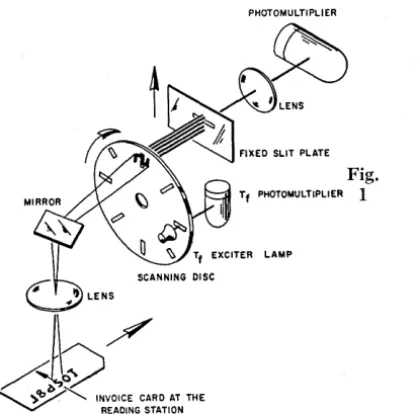
vVhcn a document is presented to the scanner (see fig. 1) the image of a numeric or alphabetic character on the document is illuminated. The optical system picks up the image and projects it upon a disc, which is rotating at a speed of 10,000 RPM.
PHOTOMULTIPLIER
Fig.
Tf PHOTOMULTIPLIER 1
LAMP
/jb/
"
~<o~"" INVOICE CARD AT THE~ . READING STATION
The radial slits in the disc allow .only a portion of the character to get through to the fixed plate at anyone time. This fixed plate, in turn, can contain one or more slits which allow only a segment of the image, or light energy, to bom-bard the photoelectric cell which converts the light seg-ments into electronic pulses.
The motion of the document or the sweep of the optics and the rotation of the disc gives us two directions in order to scan the entire character, the entire word, and the length of the line of information.
The problem of character recognition is not merely the problem of character shape identification. Were this true, many of the character recognition schemes advanced in the past might have been practical.
Shape recognition is only part of the problem. It must be taken into account that typewriters, adding machines, cash registers, bookkeeping machines, etc., are not notably precise in their rendition of intended character shapes. Highspeed printers often sacrifice legibility for rate of out-put.
All computers users - in any industry - are trying to minimize their input problem, either by using input de-vices which produce input media as close to the point of ori-gin as possible (i.e. gasoline station credit card imprinters) or by creating output documents which may later be used in the input process - so-called "turnaround" documents, pre-pared by highspeed business machines.
The common oil company card features an embossed ac-count number. When a credit purchase is made, the service station attendant places the card in his imprinter. The stiff top copy which he sends to company headquarters,
24
because of the arrangement of the carbon paper, bears the account number impression on the reverse side as well as on its face. It is found that this reverse impression is far more legible than the other, and the optical scanners in the oil industry are adjusted to read from a mirror reflection, to compensate for the characters being turned around. The scanners accept the invoice as a punch card, and make the holes which render the document ready for sorting into the file of the customer whose account number it bears.
improvement coming
We plan soon to make a vast improvement in this process by placing in . the hands of the service station operators a new-type imprinter; one which will register the amount of the sale as well as customer identification, making the entire billing process fully automatic.
National Biscuit Company compiles its daily sales re-ports on 450 regionally-dispersed adding machines. In its effort to achieve automated accounting, Nabisco first con-sidered outfitting each of these adding machines with ac-cessory "add-punch" devices. The individual machines, it was planned, would produce punched tape, to be rushed to the computer system in .New. York for consolidation.
There was one substantial obstacle: cost. It would have meant an outlay of $1,500 per adding machine, or $675,000 in all, to activate this program.
Instead, a Farrington scanner reads the original adding machine sales report for a small fraction of this amount, at the New York office.
The "turnaround" application is especially appropriate to the utility companies. Though each installation may vary in some small respect, in substance bill stubs are scanned and the amount and customer identification con-verted into punch card or punched tape form. The term "turnaround" characterizes the process in which the original bill - or at least the stub - which goes out for payment and returns to the company for data processing.
Selfchek numeric type is widely employed in connection with optical scanning, and a special alphabetic type font has been designed for use with the new page reading equip-ment now coming on the market (see companion piece, "Letters, Symbols, Punction Read.")
Selfchek is a Farrington development aimed at over-coming the problems engendered by the poor quality of much business machine printing. Selfchek type font was not designed to make scanning possible.
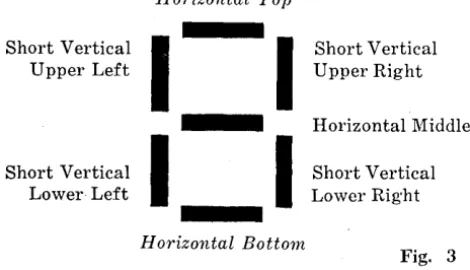
Selfchek type face has the ability to do two things. First, to improve the readability of characters over a wide range of variation and, secondly, to take care of the borderline cases in which a character is unrecognizable. Without proper safeguard in this 'second instance the possibility ex-ists that the scanning equipment could mistake one character for another.
Thus this special type font, economically installable in existing business machinery, is designed so that at least two of the strokes making up a particular character must change before it can become another character. (See fig. 2)
[image:26.620.64.273.217.424.2]