DOI 10.1007/s13173-012-0075-5 O R I G I N A L PA P E R
Clus-DTI: improving decision-tree classification
with a clustering-based decision-tree induction algorithm
Rodrigo C. Barros·Márcio P. Basgalupp· André C.P.L.F. de Carvalho·Marcos G. Quiles
Received: 10 October 2011 / Accepted: 10 April 2012 / Published online: 27 April 2012 © The Brazilian Computer Society 2012
Abstract Decision-tree induction is a well-known tech-nique for assigning objects to categories in a white-box fash-ion. Most decision-tree induction algorithms rely on a sub-optimal greedy top-down recursive strategy for growing the tree. Even though such a strategy has been quite success-ful in many problems, it presents several deficiencies. For instance, there are cases in which the hyper-rectangular sur-faces generated by these algorithms can only fit the input space after several sequential partitions, which results in a large and incomprehensible tree. In this paper, we propose a new decision-tree induction algorithm based on clustering named Clus-DTI. Our intention is to investigate how clus-tering data as a part of the induction process affects the ac-curacy and complexity of the generated models. Our perfor-mance analysis is not based solely on the straightforward comparison of our proposed algorithm to baseline classi-fiers. We also perform a data-dependency analysis in order to identify scenarios in which Clus-DTI is a more suitable option for inducing decision trees.
A previous version of this paper appeared at ENIA 2011, the Brazilian Meeting on Artificial Intelligence.
R.C. Barros (
)·A.C.P.L.F. de CarvalhoUniversity of São Paulo—ICMC-USP, São Paulo, Brazil e-mail:[email protected]
A.C.P.L.F. de Carvalho e-mail:[email protected] M.P. Basgalupp·M.G. Quiles
Universidade Federal de São Paulo, São Paulo, Brazil M.P. Basgalupp
e-mail:[email protected] M.G. Quiles
e-mail:[email protected]
Keywords Decision trees·Clustering·Hybrid intelligent systems·Data-dependency analysis·Machine learning
1 Introduction
Classification is the problem of identifying the category to which observations belong, given that the identity of the category is unknown a priori. A classification algorithm is required to place these observations (objects) into groups based on quantitative or qualitative information collected from characteristics (attributes) of each object. A great deal of algorithms have been proposed by researchers in machine learning and statistics in the last decades for classifying data in a variety of domains.
Decision-tree induction is a classification method that represents the induced knowledge through a hierarchical tree. Such a representation is intuitive and easy to assimilate by humans, which has motivated a large number of studies that make use of this strategy. Some well-known algorithms for decision-tree induction are C4.5 [1] and CART [2].
Another strategy that has been increasingly employed is the induction of decision trees through evolutionary algo-rithms (EAs) [5,6]. The main benefit of evolving decision trees is due to the EAs’ capability of escaping local optima. EAs perform a robust global search in the space of candi-date solutions, and thus they are less susceptible to local optima convergence. In addition, as a result of this global search, EAs tend to cope better with attribute interactions than greedy methods [7]. The main disadvantages of evolu-tionary induction of decision trees are related to time and space constraints. EAs are a solid but computational expen-sive heuristic. Another disadvantage lies on the large num-ber of parameters that need to be set (and tuned) in order to optimally run the EA for decision-tree induction [8].
There are advantages and disadvantages in using one strategy or another for decision-tree induction, and the same can be said for every machine learning algorithm developed to date. Algorithms that excel in a certain dataset may per-form poorly in others (i.e., the no free-lunch theorem [9]). Whereas there are many studies that propose new classifica-tion algorithms every year, most of them neglect the fact that the performance of the induced classifiers is heavily data de-pendent. Moreover, these studies usually fail to point out the cases in which the proposed classifier may present signifi-cant gain over well-established classifiers.
In this paper, we attempt to improve the accuracy of typi-cal decision-tree induction algorithms, and at the same time we try to preserve the comprehensibility of the model gen-erated. For that, we propose a new classification algorithm based on clustering, named Clus-DTI (Clustering for im-proving Decision-Tree Induction). The key assumption that is exploited in this paper is that a difficult problem can be de-composed into simpler sub-problems. Our main hypothesis is that we can make use of clustering for improving classi-fication with the premise that, instead of directly solving a difficult problem, solving its sub-problems may lead to im-proved performance.
We investigate the performance of Clus-DTI regarding the data it is being applied to. Our contributions are twofold: (i) we propose a new classification algorithm whose objec-tive is to improve decision tree classification through the use of clustering, and we empirically analyze its perfor-mance in public datasets; (ii) we investigate scenarios in which the proposed algorithm is a better option than a tradi-tional decision-tree induction algorithm. This investigation is based on data-dependency analyses. For such, it takes into account how the underlying data structure affects the perfor-mance of Clus-DTI. Note that this work is an extended ver-sion of a previous conference paper [10], in which we signif-icantly increase the number of experiments, and also largely improve on the original Clus-DTI methodological aspects.
In Sect.2we detail the proposed algorithm, which com-bines clustering and decision trees. In Sect.3 we conduct
a straightforward comparison among Clus-DTI and a well-known decision-tree induction algorithm, C4.5 [1] (more specifically, its Java version, J48). Section4presents a data-dependency analysis, where we suggest some scenarios in which Clus-DTI can be a better option than J48. Section5
presents related work, and we discuss our main conclusions in Sect.6.
2 Clus-DTI
We have developed a new algorithm, named Clus-DTI (Clustering for improving decision-tree induction), whose goal is to cluster the classification data aiming at improv-ing decision-tree induction. It works based on the followimprov-ing premise: some classification problems are quite difficult to solve; thus, instead of growing a single tree to solve a poten-tially difficult classification problem, clustering the dataset into smaller sub-problems and growing several trees may ease the complexity of solving the original problem. For-mally speaking, our algorithm approximates the target func-tion in specific regions of the input space, instead of making use of the full input space. These specific regions are not randomly chosen, but defined through a well-known cluster-ing strategy. It is reasonable to assume that objects drawn from the same class distribution can be grouped together in order to make the classification problem simpler. We do not assume, however, that we can achieve a perfect cluster-to-class mapping (and we do not mean to).
Our hypothesis is that solving sub-problems indepen-dently from each other, instead of directly trying to solve the larger problem, may provide better classification results overall. This assumption is not new and has motivated sev-eral strategies in computer science (e.g., the divide-and-conquer strategy).
Clus-DTI works as follows. Given a classification train-ing set X, Clus-DTI clustersXink non-overlapping sub-sets ofX, i.e.,P = {C1, . . . ,Ck}, such thatCj∩Ci= ∅for j=iandC1∪ · · · ∪Ck=X. In this step, Clus-DTI uses ei-therk-means [11] or Expectation Maximization (EM) [12], two very well-known clustering algorithms. The choice of clustering algorithm is specified by the user, according to its own knowledge of the data. Note that Clus-DTI ignores the target attribute when clustering the training set. In addition, note that Clus-DTI scales all numeric values to the interval [0,1], and that nominal values withwcategories are trans-formed inwbinary attributes.
In order to decide the “optimal” value of k, Clus-DTI employs different strategies according to the clustering al-gorithm employed. If the user has selectedk-means as the clustering algorithm, Clus-DTI employs the Ordered Mul-tiple Runs ofk-means(OMRk) algorithm [13] for deciding the “optimal” value ofk. OMRkexecutesk-means repeat-edly for an increasing number of clusters. For each value ofk, a number of partitions obtained byk-Means (from dif-ferent initializations) are assessed by using a relative valid-ity index [14], in order to determine the best estimated value fork. Algorithm1depicts this rationale, wherekmaxis the largest value ofk tested,k∗ is the number of clusters esti-mated by the method,V is the value of the validity criterion after a single run ofk-means,V∗is the value of the validity criterion for the best partition found andpis the number of different partitions generated for each numberk≤kmaxof clusters. We assume thatV should be maximized.
Algorithm 1: OMRkalgorithm
input : Training datasetX, number of executionsp, maximum number of clusterskmax
output: The optimal number of clustersk∗and the resulting partitionP
begin
V∗← −∞
fork=2tokmaxdo fori=1topdo
Generate a random partition withkclusters Runk-means until convergence
ComputeVfor the resulting partition ifV > V∗then
V∗←V k∗←k
Hold the resulting partition asP∗
returnk∗, P∗
end
We define the required parameters of OMRkas follows. The value ofkmaxis set to√|X|, where|X|is the number of objects to be clustered. This value is a commonly used rule of thumb [15]. The number of executions,p, is set to 10, to generate different partitions ofk-means by varying the seed of its random initialization. Recalling that the estimated time complexity ofk-means is of the order ofO(k·N·n), where N is the number of objects,nthe number of attributes andk the number of clusters, then the estimated time complexity of OMRkcan be calculated as
Op·N·2+3+ · · · +kmax·n
→Op·N·kmax2·n (1)
Since we have definedpas a small constant, and that usually Nn, thenNandkmaxare the potentially critical variables of this problem.
Regarding the validity criterion to evaluate the partitions, we have chosen the Simplified Silhouette Width Criterion (SSWC) [14]. It is a simplified version of the well-known silhouette width criterion for cluster validity [16]. In order to define this criterion, let us consider that theith object of the dataset,xi, belongs to a given clustert∈ {1, . . . , k}. Let the average distance of this object to the centroid of clus-tertbe denoted byat,i. In addition, let the average distance of this object to the centroid of another clusterq,q=t, be calleddq,i. Finally, letbt,i be the minimumdq,i computed overq∈ {1, . . . , k},q=t, which represents the distance of objectxi to its closest neighboring cluster. Then, the simpli-fied silhouette of the individual objectxi is defined as Sxi=
bt,i−at,i max[at,i, bt,i]
(2) where the denominator is a normalization term. The higher the value ofSxi, the better the assignment ofxi to clustert. The SSWC is given by the average ofSxi, 1≤i≤N, i.e.:
SWC= 1
N N
i=1
Sxi (3)
and the higher the SWC value, the better the performance of the clustering algorithm, since maximizing SSWC means minimizing the intra-cluster distanceat,iwhile maximizing the inter-cluster distancebti.
We have chosen SSWC since it has scored among the best validity criteria in a recent comparative study [14]. Fur-thermore, its time complexity is estimated as O(n·N ), which is considerably better than the original silhouette width criterion—O(n·N2).
The other strategy for selecting the “optimal” value ofk, i.e., if the user has chosen the EM algorithm for clustering in Clus-DTI, is based on a 10-fold cross-validation (CV) pro-cedure, as follows:
1. The number of clusters is set to 1.
2. The training set is split randomly into 10 folds.
3. EM is performed 10 times using the 10 folds the usual CV way.
4. The resulting loglikelihood is averaged over all 10 re-sults.
5. If the loglikelihood has increased, the number of clusters is increased by 1 and the program continues at step 2. Else, the estimated number of clustersk∗is returned, and the optimal partitionP∗is generated with the full (train-ing) dataset.
for every object in test setZ. The assignment of a test in-stance to a cluster is performed according to the algorithm being employed. If the algorithm of choice isk-means, the test instance is assigned to the closest cluster according to the Euclidean distance between test instance and clusters’ centroids. Similarly, if the EM algorithm is being employed, the joint densities are calculated so the test instance is as-signed to its most probable cluster.
Algorithm 2 depicts the previously mentioned steps of Clus-DTI. Note that we do not necessarily expect a full ad-herence of clusters to classes. While clustering the training data may sometimes gather examples from the same class in their own cluster, we do not believe that would be the case for most real-world classification problems. Our inten-tion on designing Clus-DTI was to provide subsets of data in which the classification problem is easier than the one of the original set. In other words, we want to identify situa-tions in which the sum of the performance of decision trees in subsets results in better overall performance than the one of a single decision tree in the original set.
Even though this concept may be similar to the one of an ensemble of trees, we do not make use of any voting scheme for combining predictions. In that sense, Clus-DTI could be seen as a particular case of the well-knownmixture of ex-pertsstrategy [17], in which we have multiple experts (in our case, decision trees) and a “gating network” that stochasti-cally decides which expert to use on each test instance. In the particular case of Clus-DTI, the “gating network” role is performed by the cluster analysis step. The absence of a vot-ing scheme results in an important advantage of Clus-DTI over traditional ensembles: it can track which decision tree was used to achieve the prediction of a particular object, in-stead of relying on averaged results provided by inconsistent models.
Algorithm 2: Clus-DTI
input : Training datasetX, test datasetZ output: Set of decision treesD, test accuracyacc
begin
Execute OMRkor 10-fold cross-validation to discover optimal partitionP∗
foreachclusterCi∈P∗do
Generate decision treeDTifor data∈Ci AddDTito the setDof decision trees
numCorrect←0 foreachobject obj∈Zdo
Assignobjto closest/most probable clusterC∗ ClassifyobjwithDT∗built onC∗
if objwas correctly classifiedthen
numCorrect←numCorrect+1
acc←numCorrect÷ |Z|
returnD,acc
end
3 Baseline comparison
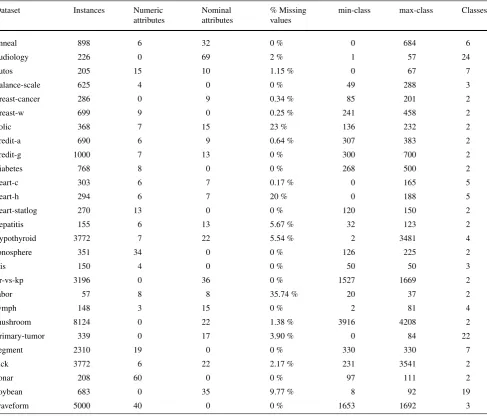
We tested the performance of Clus-DTI into 27 public UCI datasets [18] and compared it to the performance of J48 (java implementation of C4.5, available at the Weka Toolkit [19]). The datasets selected are: anneal, audiology, autos, balance-scale, breast-cancer, breast-w, colic, credit-a, credit-g, diabetes, glass, heart-c, heart-h, heart-statlog, hepatitis, ionosphere, iris, kr-vs-kp, labor, lymph, mush-room, primary-tumor, segment, sick, sonar, soybean and waveform-5000 (see Table 1 for details). Those datasets withkclasses,k >2, were transformed intokdatasets with two classes (one class versus all other classes), so every clas-sification problem in this paper is binary. The restriction of dealing only with binary classification problems is due to the fact that the geometrical complexity measures [20,21] used in this study for data-dependency analyses can deal with only two classes in most cases. With the transformations, the 27 datasets became 129 datasets, which were divided in 70 % for training and 30 % for test.
We tested both versions of Clus-DTI, i.e., by using either k-means or EM to cluster objects. Henceforth, we refer to Cluskas the Clus-DTI version withk-means and to ClusEM as the Clus-DTI version with EM. Table2presents the re-sults obtained in this comparison among ClusEM, Cluskand J48.# Winsindicates the number of datasets in which each method has outperformed the other two regarding either test accuracy (Acc) or tree size (TS). Note that ties were omitted. We noticed that the three methods had a similar number of wins considering test accuracy, with a small advantage to J48. Regarding tree size, both Clus-DTI versions provided smaller trees (tree size is averaged over all trees generated for a single dataset), which was expected since we are gener-ating trees for smaller training sets (clusters). One can argue that interpreting several small trees is as difficult as inter-preting a big tree. However, we highlight the fact that, for each test instance, only one tree is selected to perform the instance classification, and thus the user has to interpret only a single tree at a time.
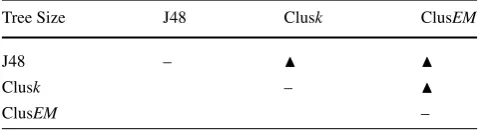
We executed the non-parametric Wilcoxon Signed Rank Test [22] for assessing the statistical significance of both test accuracy and tree size. The results are presented in Ta-bles 3 and4, indicating that both Clus-DTI methods out-perform J48 with statistical significance regarding tree size. Moreover, ClusEMprovides significantly smaller trees than Clusk. The pairwise comparisons amongst the versions of Clus-DTI and J48 did not reveal any significant difference in terms of test accuracy. All differences were measured with a 95 % confidence level.
Table 1 Data sets specification. Columns “min-class” and “max-class” refer to, respectively, the number of instances of the less-frequent class and the number of instances of the most-frequent class
Dataset Instances Numeric
attributes
Nominal attributes
% Missing values
min-class max-class Classes
anneal 898 6 32 0 % 0 684 6
audiology 226 0 69 2 % 1 57 24
autos 205 15 10 1.15 % 0 67 7
balance-scale 625 4 0 0 % 49 288 3
breast-cancer 286 0 9 0.34 % 85 201 2
breast-w 699 9 0 0.25 % 241 458 2
colic 368 7 15 23 % 136 232 2
credit-a 690 6 9 0.64 % 307 383 2
credit-g 1000 7 13 0 % 300 700 2
diabetes 768 8 0 0 % 268 500 2
heart-c 303 6 7 0.17 % 0 165 5
heart-h 294 6 7 20 % 0 188 5
heart-statlog 270 13 0 0 % 120 150 2
hepatitis 155 6 13 5.67 % 32 123 2
hypothyroid 3772 7 22 5.54 % 2 3481 4
ionosphere 351 34 0 0 % 126 225 2
iris 150 4 0 0 % 50 50 3
kr-vs-kp 3196 0 36 0 % 1527 1669 2
labor 57 8 8 35.74 % 20 37 2
lymph 148 3 15 0 % 2 81 4
mushroom 8124 0 22 1.38 % 3916 4208 2
primary-tumor 339 0 17 3.90 % 0 84 22
segment 2310 19 0 0 % 330 330 7
sick 3772 6 22 2.17 % 231 3541 2
sonar 208 60 0 0 % 97 111 2
soybean 683 0 35 9.77 % 8 92 19
waveform 5000 40 0 0 % 1653 1692 3
Table 2 Comparison among the methods J48, Cluskand ClusEM
Wins Acc Wins TS Margin Acc Wins (vs. J48) Margin TS Wins (vs. J48) Margin Acc Loss (vs. J48) Margin TS Loss (vs. J48)
J48 14 2 – – – –
Clusk 13 63 4.40 % 23.4 4.30 % 1.75
ClusEM 10 18 4.20 % 28.2 4.40 % 0.91
Wins Acc—number of times each method has outperformed the other two regarding accuracy Wins TS—number of times each method has outperformed the other two regarding tree size
Table 3 Wilcoxon two-sided signed rank test for test accuracy
Accuracy J48 Clusk ClusEM
J48 –
Clusk –
ClusEM –
The algorithm in the column outperforms the one in the row with statistical significance at a 95 % confidence level
Table 4 Wilcoxon two-sided signed rank test for tree size
Tree Size J48 Clusk ClusEM
J48 –
Clusk –
ClusEM –
The algorithm in the column outperforms the one in the row with statistical significance at a 95 % confidence level
for any future problems. Hence, our goal is to investigate in which situations each algorithm is preferred and try to relate these scenarios to meta-data and measures of geometrical complexity of datasets. This discussion is presented in the next section.
4 Data-dependency analysis
It is often said that the performance of a classifier is data dependent [23]. Notwithstanding, work that proposes new classifiers usually neglects data-dependency when analyz-ing their performance. The strategy usually employed is to provide a few cases in which the proposed classifier outper-forms baseline classifiers according to some performance measure. Similarly, theoretical studies that analyze the be-havior of classifiers also tend to neglect data-dependency. They end up evaluating the performance of a classifier in a wide range of problems, resulting in weak performance bounds.
Recent efforts have tried to link data characteristics to the performance of different classifiers in order to build rec-ommendation systems [23]. Meta-learning is an attempt to understand data a priori of executing a learning algorithm. Data that describe the characteristics of datasets and learn-ing algorithms are called meta-data. A learnlearn-ing algorithm is employed to interpret these meta-data and suggest a particu-lar learner (or ranking a few learners) in order to better solve the problem at hand.
Meta-learners for algorithm selection usually rely on data measures limited to statistical or information-theoretic de-scriptions. Whereas these descriptions can be sufficient for recommending algorithms, they do not explain the geometri-cal characteristics of the class distributions, i.e., the manner
in which classes are separated or interleaved, a critical fac-tor for determining classification accuracy. Hence, geomet-rical measures are proposed in [20, 21] for characterizing the geometrical complexity of classification problems. The study of these measures is a first effort to better understand classifiers’ data-dependency. Moreover, by establishing the difficulty of a classification problem quantitatively, several studies in classification can be carried out, such as algorithm recommendation, guided data pre-processing and design of problem-aware classification algorithms.
Next, we present a summary of the meta-data and geo-metrical measures we use to assess classification difficulty. For the latter, the reader should notice that they actually measure the apparent geometrical complexity of datasets, since the amount of training data is limited and the true prob-ability distribution of each class is unknown.
4.1 Meta-data
The first attempt to characterize datasets for evaluating the performance of learning algorithms was made by Rendell et al. [24]. Their approach intended to predict the execution time of classification algorithms through very simple meta-attributes such as number of meta-attributes and number of exam-ples.
A significant improvement of such an approach was project STATLOG [25] which investigated the performance of several learning algorithms over more than twenty data-sets. Approaches that followed deepened the analysis of the same set of meta-attributes for data characterization [26, 27]. This set of meta-attributes was divided in three categories: (i) simple; (ii) statistical; and (iii) information theory-based. An improved set of meta-attributes is further discussed in [28], and we make use of the following mea-sures presented in there:
1. Number of examples (N) 2. Number of attributes (n)
3. Number of continuous attributes (con) 4. Number of nominal attributes (nom) 5. Number of binary attributes (bin) 6. Number of classes (cl)
7. Percentage of missing values (%mv) 8. Class entropy (H (Y ))
9. Mean attribute entropy (MAE) 10. Mean attribute Gini (MAG)
11. Mean mutual information of class and attributes (MMI) 12. Uncertainty coefficient (UC)
Measures 1–7 can be extracted in a straightforward way from data. Measures 8–12 are information-theory based. Class entropy,H (Y )is calculated as follows:
H (Y )= − cl
j
p(Y=yj)log2p(Y=yj) (4)
wherep(Y=yj)is the probability the class attributeY will take valueyj. Entropy is a measure of randomness or dis-persion of a given discrete attribute. Thus, the class entropy indicates the dispersion of the class attribute. The more uni-form the distribution of the class attribute, the higher the value of entropy; the less uniform, the lower the value.
Mean attribute entropy is the average entropy of all dis-crete (nominal) attributes. It is given by
MAE=
nom
i=1H (Xi)
nom (5)
Similarly, the mean attribute Gini is the average Gini in-dex of all nominal attributes. The Gini inin-dex is given by Gini(X)=1−
j
p(X=xj)
2
(6)
MAG=
nom
i=1Gini(Xi)
nom (7)
The mean mutual information of class and attributes measures the average of the information each attribute X conveys about class attribute Y. The mutual information MI(Y, X) (also known as information gain in the machine learning community) describes the reduction in the uncer-tainty ofY due to the knowledge ofX, and it is defined as MI(Y, X)=H (Y )−H (Y|X) (8) H (Y|X)=
i
p(X=xi)H (Y|X=xi) (9)
for attributeXwithicategories and class attributeY withj categories. Note thatH (Y|X=xi)is the entropy of class at-tributeY considering only those examples in whichX=xi. SinceMI(Y, X)is defined, the mean mutual information of class and attributes is given by
MMI=
nom
i=1MI(Y, Xi)
nom (10)
The last measure to be defined is the uncertainty coeffi-cient, which is theMInormalized by the entropy of the class attribute,MI(Y, X)/H (Y ), which is analogous to the well-known gain ratio measure, though the gain ratio normalizes theMIby the entropy of the predictive attribute and not the class attribute.
In addition to the measures presented in [28], we have also make use of the ratio of the number of examples of the less-frequent class to the most-frequent class. For bi-nary classification problems, such a measure indicates the balancing level of the dataset. Higher values (closer to one)
indicate a balanced dataset whereas lower values indicate an imbalanced-class problem.
Next we present measures that seek to explain how the data is structured geometrically in order to assess the diffi-culty of a classification problem.
4.2 Geometrical complexity measures
In [20] a set of measures is presented to characterize datasets with regard to their geometrical structure. These measures can highlight the manner in which classes are separated or interleaved, which is a critical factor for classification accu-racy. Indeed, the geometry of classes is crucial for determin-ing the difficulty of classifydetermin-ing a dataset [21].
These measures are divided in three categories: (i) mea-sures of overlaps in the attribute space; (ii) meamea-sures of class separability; and (iii) measures of geometry, topology, and density of manifolds.
4.2.1 Measures of overlaps in the attribute space
The following measures estimate different complexities re-lated to the discriminative power of the attributes.
The maximum Fisher discriminant ratio (F1) This mea-sure computes the 2-class Fisher criterion, given by
F1=[d T(μ
1−μ2)]2
dTΣ¯d (11)
whered= ¯Σ−1Δis the directional vector on which data are projected,Δ=μ1−μ2,Σ¯−1 is the pseudo-inverse ofΣ,¯ μi is the mean vector for class i, Σ¯ =aΣ1+(1−a)Σ2, 0≤a≤1,Σiis the scatter matrix of instances for classci.
A high value of the Fisher discriminant ratio indicates that there exists a vector that can separate examples belong-ing to different classes after these instances are projected on it.
The overlap of the per-class bounding boxes (F2) This measure computes the overlap of the tails of distributions defined by the instances of each class. For each attribute, it computes the ratio of the width of the overlap interval (i.e., the interval that has instances of both classes) to the width of the entire interval. Then, the measure returns the product of the ratios calculated for each attribute:
F2= n
i=1
MINMAXi−MAXMINi MAXMAXi−MINMINi
(12)
classes, and max(fi, ci)and min(fi, ci) are, respectively, the maximum and minimum values of the attribute fi for class ci. Nominal values are mapped to integer values to compute this measure. A low value of this metric means that the attributes can discriminate the instances of different classes.
The maximum (individual) attribute efficiency (F3) This measure computes the discriminative power of individual attributes and returns the value of the attribute that can dis-criminate the largest number of training instances. For this purpose, the following heuristic is employed. For each at-tribute, we consider the overlapping region (i.e., the region where there are instances of both classes) and return the ra-tio of the number of instances that are not in this overlapping region to the total number of instances. Then, the maximum discriminative ratio is taken as measure F3. Note that a prob-lem is easy if there exists one attribute for which the ranges of the values spanned by each class do not overlap (in this case, this would be a linearly separable problem).
The collective attribute efficiency (F4) This measure fol-lows the same idea presented by F3, but now it considers the discriminative power of all the attributes (therefore, the col-lective attribute efficiency). To compute the colcol-lective dis-criminative power, we apply the following procedure. First, we select the most discriminative attribute, that is, the at-tribute that can separate a major number of instances of one class. Then, all the instances that can be discriminated are removed from the dataset, and the following most discrim-inative attribute (regarding the remaining examples) is se-lected. This procedure is repeated until all the examples are discriminated or all the attributes in the attribute space are analyzed. Finally, the measure returns the proportion of in-stances that have been discriminated. Thus, it gives us an idea of the fraction of instances whose class could be cor-rectly predicted by building separating hyperplanes that are parallel to one of the axis in the attribute space. Note that the measure described herein slightly differs from the max-imum attribute efficiency. F3 only considers the number of examples discriminated by the most discriminative attribute, instead of all the attributes. Thence, F4 provides more in-formation by taking into account all the attributes since we want to highlight the collective discriminative power of all the attributes.
4.2.2 Measures of class separability
In this section, we describe five measures that examine the shape of the class boundary to estimate the complexity of separating instances of different classes.
The fraction of points on the class boundary (N1) This measure provides an estimate of the length of the class boundary. For this purpose, it builds a minimum spanning tree over the entire dataset and returns the ratio of the num-ber nodes of the spanning tree that are connected and be-long to different classes to the total number of examples in the dataset. If a nodeni is connected with nodes of differ-ent classes,ni is counted only one time. High values of this measure indicate that the majority of the points lay closely to the class boundary, and therefore, that it may be more dif-ficult for the learner to define this class boundary accurately.
The ratio of average intra/inter-class nearest neighbor dis-tance (N2) This measure compares the within-class spread with the distances to the nearest neighbors of other classes. That is, for each input instance xi, we calculate the dis-tance to its nearest neighbor within the class (intraDist(xi)) and the distance to its nearest neighbor of any other class (interDist(xi)). Then, the result is the ratio of the sum of the intra-class distances to the sum of the inter-class distances for each input example:
N2=
N
i=1intraDist(xi)
N
i=1interDist(xi)
(13)
whereN is the total number of instances in the dataset. Low values of this measure suggest that the examples of the same class lay closely in the attribute space. High values indicate that the examples of the same class are disperse.
The leave-one-out error rate of the one-nearest neighbor classifier (N3) The measure denotes how close the exam-ples of different classes are. It returns the leave-one-out er-ror rate of the one-nearest neighbor (the kNN classifier with k=1) learner. Low values of this metric indicate that there is a large gap in the class boundary.
The minimized sum of the error distance of a linear classi-fier (L1) This measure evaluates to what extent the training data is linearly separable. For this purpose, it returns the sum of the difference between the prediction of a linear classifier and the actual class value. We use a support vector machine (SVM) [29] with a linear kernel, which is trained with the sequential minimal optimization (SMO) algorithm to build the linear classifier. The SMO algorithm provides an effi-cient training method, and the result is a linear classifier that separates the instances of two classes by means of a hyper-plane. A zero value of this metric indicates that the problem is linearly separable.
4.2.3 Measures of geometry, topology, and density of manifolds
The following four metrics indirectly characterize the class separability by assuming that a class is made up of single and multiple manifolds that form the support of the distribu-tion of the class.
The nonlinearity of a linear classifier (L3) This metric im-plements a measure of nonlinearity proposed in [30]. Given the training dataset, the method creates a test set by linear interpolation with random coefficients between pairs of ran-domly selected instances of the same class. Then, the mea-sure returns the test error rate of the linear classifier (the support vector machine with linear kernel) trained with the original training set. The metric is sensitive to the smooth-ness of the classifier boundary and the overlap on the con-vex hull of the classes. This metric is implemented only for 2-class datasets.
The nonlinearity of the one-nearest neighbor classifier (N4) This measure creates a test set as proposed by L3 and returns the test error of the 1NN classifier.
The fraction of maximum covering spheres (T1) This mea-sure was originated in the work of Lebourgeois and Emp-toz [31], which described the shapes of class manifolds with the notion of adherence subset. In summon, an adherence subset is a sphere centered on an example of the dataset which is grown as much as possible before touching any ex-ample of another class. Therefore, an adherence subset con-tains a set of examples of the same class and cannot grow more without including examples of other classes. The met-ric considers only the biggest adherence subsets or spheres, removing all those that are included in others. Then, the met-ric returns the number of spheres normalized by the total number of points.
The average number of points per dimension (T2) This measure returns the ratio of the number of examples in the dataset to the number of attributes. It is a rough indicator of sparseness of the dataset.
4.3 Results of the data-dependency analysis
We have calculated the 13 complexity measures and the 13 meta-attributes for the 129 datasets, and we have built a training set in which each example corresponds to a dataset and each attribute is one of the 26 measures. In addition, we have included which method was better for each dataset regarding test accuracy (ClusEM, Clusk or J48) as our class attribute. Thus, we have a training set of 129 exam-ples and 27 attributes.
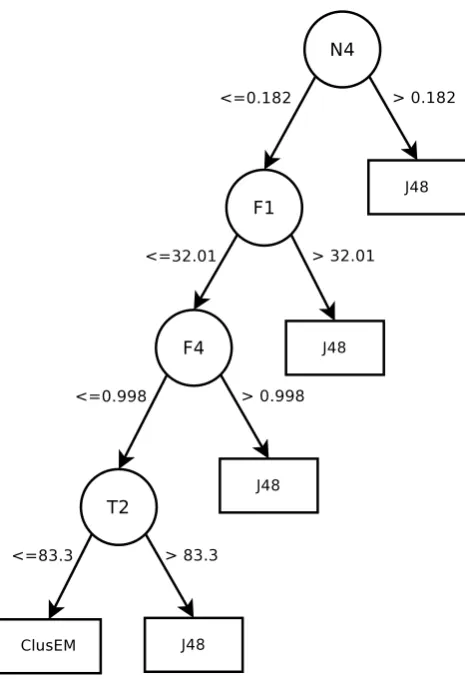
Fig. 1 Decision tree that describes the relationship between the measures and the most suitable algorithm to be used between ClusEM×J48
Our intention with this training set is to perform a de-scriptive analysis in order to understand which aspects of the data have a higher influence in determining the performance of the algorithms. In particular, we search for evidence that may help the user to choose a priori the most suitable method for classification. First, we have built a decision tree for each pairwise comparison (Clusk×J48 and ClusEM× J48) over the previously described training set. The idea is that the rules extracted from this decision tree may offer an insight on the reasons one algorithm outperforms the other. In other words, we are using a decision tree as a descrip-tive tool instead of using it as a predicdescrip-tive tool. This is not unusual, since the classification model provided by the deci-sion tree can serve as an explanatory tool to distinguish be-tween objects of different classes [32]. Figures1and2show these descriptive decision trees, which explain the behavior of roughly 90 % of the data.
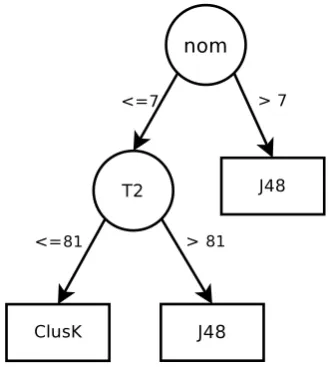
Fig. 2 Decision tree that describes the relationship between the mea-sures and the most suitable algorithm to be used between Clusk×J48
the higher its value, the more complex is the decision bound-ary between classes. The decision tree indicates that above a given threshold of N4 (N4>0.182), clustering provides no advantage for classifying objects. For the remaining cases, the decision tree shows that those problems deemed to be simpler by the attribute overlapping measures (F1 and F4) are better handled by J48. Specifically regarding F4, notice that the descriptive decision tree recommends employing J48 for problems in which 100 % of the instances can be correctly predicted by building separating hyperplanes that are parallel to one of the attribute axis (F4>0.998). Thus, for simpler problems in which axis-parallel hyperplanes can separate the classes, J48 is an effective option. This conclu-sion is intuitive considering that J48 will have no particular difficulty in generating axis-parallel hyperplanes to correctly separate the training instances in easier problems. However, in more complex problems in which there are a few in-stances whose classes cannot be separated by axis-parallel hyperplanes, it is possible that a clustering procedure that simplifies the input space in sub-spaces can be more effec-tive in solving the problem.
The decision tree in Fig.1also recommends employing J48 for problems whose sparsity (measured by T2) is below a given threshold (the higher the value of T2, the denser the dataset). This implies that for sparser problems, in which J48 alone has problems in generating appropriate separating hyperplanes, clustering the training set may be a more effec-tive option for classification. Though the dataset sparsity is not affected by clustering, one can assume that the generated sub-spaces are simpler to classify than the full sparse input space.
Next, we analyze the decision tree that recommends em-ploying either Clusk or J48. The decision tree in Fig. 2
shows that for datasets whose number of nominal attributes surpass a given threshold (nom>7), J48 is the
recom-mended algorithm. This can be intuitively explained by the difficulty that most clustering algorithms have of dealing with nominal values. For the remaining cases, measure of sparsity T2 is tested to decide between Cluskand J48. No-tice that, similarly to the previous decision tree, clustering the dataset is recommended for sparser datasets, alleviating the difficulty on finding axis-parallel hyperplanes for class separation in sparse problems.
Our last recommendation is for users for whom inter-pretability is a strong need: if none of the scenarios high-lighted before suggested that Clus-DTI is a better option than J48, it may be still worthwhile using it due to the re-duced size of the trees it generates. It should be noticed that even though Clus-DTI may generate several decision trees for the same dataset, only one tree is used to classify each test instance, and hence only one tree needs to be interpreted at a time. We can think of the clustering step as a hidden (or latent) attribute that divides the data in subtrees, which are interpreted independently from each other. It is up to the final user to decide whether he or she is willing to waste some extra computational resources in order to analyze (po-tentially) more comprehensible trees.
5 Related work
There is much work that combines clustering and deci-sion trees for descriptive/predictive purposes. For instance, Thomassey and Fiordaliso [33] propose employing clus-tering to generate sales profiles in the Textile-Apparel-Distribution industry, and then using these profiles as classes to be predicted by a decision-tree induction algorithm. Other example is the work of Samoilenko and Osei-Bryson [34], which proposes applying a methodology that combines both clustering and decision trees in data envelopment analysis (DEA) of transition economies. The cluster analysis step is responsible for detecting subsets in decision making units (DMU), whereas a later decision-tree step is employed to investigate the subset-specific nature of the DMUs used in the study.
a combining scheme that checks for an agreement between k-means and ID3 labeling.
Whereas Clus-DTI shares a fair amount of similarities to the work of Gaddam et al. [35], we highlight the main differ-ences as follows: (i) Clus-DTI makes use of a more robust tree inducer, C4.5, and also allows the choice of a more so-phisticated clustering algorithm, EM; (ii) Clus-DTI does not have a combining scheme for labeling test examples, which means our approach keeps its comprehensibility since we can directly track the rules responsible for labeling exam-ples (which is not the case of the work in [35] and any other work that uses combining/voting schemes); (iii) Clus-DTI is not limited to anomaly detection applications; (iv) Clus-DTI automatically chooses the “ideal” number of clusters; (v) Clus-DTI is conceptually simpler and easier to imple-ment thank-means+ID3, even though it makes use of more robust algorithms (C4.5 instead of ID3, and eventually EM overk-means).
6 Conclusions and future work
In this work, we have presented a new classification sys-tem which is based on the idea that clustering datasets may improve decision tree classification. Our algorithm, named Clus-DTI, makes use of well-known machine learning al-gorithms, namelyk-means [11], Expectation Maximization [12] and C4.5 [1].
We have tested Clus-DTI using 27 public UCI datasets [18], which were transformed to binary class problems re-sulting in 129 distinct datasets. Experimental results indi-cated that Clus-DTI provided significantly smaller trees than J48, with no significant loss in accuracy. A deeper analysis was made in an attempt to relate the underlying structure of the datasets with the performance of Clus-DTI. A total of 26 different measures were calculated to assess the complex-ity of each dataset. Some of these measures were also used in classical meta-learning studies [26,27]. Other measures were suggested in more recent works [20,21] in an attempt to assess data geometrical complexity. Through these mea-sures, we were able to generate decision trees for supporting a descriptive analysis whose goal was to point out scenarios in which Clus-DTI is a better option than J48 for data clas-sification.
This work is a first effort in the study of the potential ben-efits of clustering on classification. It presents a new classifi-cation algorithm that can also be seen as a framework that is more elegant than simply pre-processing data through clus-tering. It has opened several venues for future work, as fol-lows. We intend to implement alternative methods of choos-ing the best value ofk, such as employing the GAP statis-tic [37], a measure that evaluates the difference (gap) be-tween the within-cluster sum of squares of a given partition
with its expectation under a null reference distribution. The number of clusters defined by the partition with greater GAP is thus selected as “optimal”. Other alternatives for estimat-ing the value ofkinclude calculating the accuracy of Clus-DTI over a validation dataset and choosing the value ofk that provides the best accuracy in that validation set.
We also intend to test different decision-tree induction al-gorithms in our framework, in order to evaluate whether our conclusions are generalizable for other algorithms. Finally, we intend to test Clus-DTI in artificial datasets so we can guarantee its effectiveness in a variety of distinct scenarios, such as linearly separable data, non-linearly separable data, imbalanced datasets, high-dimensional data, sparse data and other interesting problems.
Acknowledgements Our thanks to Fundação de Amparo à Pesquisa do Estado de São Paulo (FAPESP) and Conselho Nacional de Desen-volvimento Científico e Tecnológico (CNPq) for supporting this re-search. Also, we would like to thank Dr. Alex A. Freitas for his valu-able comments, which helped improving this paper.
References
1. Quinlan JR (1993) C4.5: programs for machine learning. Morgan Kaufmann, San Francisco
2. Breiman L, Friedman JH, Olshen RA, Stone CJ (1984) Classifica-tion and regression trees. Wadsworth, Belmont
3. Rokach L, Maimon O (2005) Top-down induction of decision trees classifiers—a survey. IEEE Trans Syst Man Cybern, Part C, Appl Rev 35(4):476–487
4. Freitas AA, Wieser DC, Apweiler R (2010) On the importance of comprehensible classification models for protein function predic-tion. IEEE/ACM Trans Comput Biol Bioinform 7(1):172–182 5. Basgalupp M, de Carvalho A, Barros RC, Ruiz D, Freitas A (2009)
Lexicographic multi-objective evolutionary induction of decision trees. Int J Bio-Inspir Comput 1(1/2):105–117
6. Barros RC, Ruiz D, Basgalupp MP (2011) Evolutionary model trees for handling continuous classes in machine learning. Inf Sci 181:954–971
7. Freitas AA (2008) A review of evolutionary algorithms for data mining. In: Soft computing for knowledge discovery and data min-ing. Springer, New York, pp 79–111
8. Barros RC, Basgalupp M, de Carvalho A, Freitas AA (2011) A survey of evolutionary algorithms for decision-tree induction. IEEE Trans Syst Man Cyber, Part C, Appl Rev (in press) 9. Wolpert DH, Macready WG (1997) No free lunch theorems for
optimization. IEEE Trans Evol Comput 1(1):67–82
10. Barros RC, Basgalupp M, de Carvalho A (2011) Um algoritmo de indução de árvore de decisão baseado em agrupamento. In: IX Encontro nacional de inteligência artificial, pp 1–12
11. Lloyd S (1982) Least squares quantization in pcm. IEEE Trans Inf Theory 28(2):129–137
12. Dempster AP, Laird NM, Rubin DB (1977) Maximum likelihood from incomplete data via the EM algorithm. J R Stat Soc 39(1):1– 38
15. Campello R, Hruschka E, Alves V (2009) On the efficiency of evolutionary fuzzy clustering. J Heuristics 15:43–75
16. Rousseeuw P (1987) Silhouettes: a graphical aid to the interpre-tation and validation of cluster analysis. J Comput Appl Math 20:53–65
17. Jacobs RA, Jordan MI, Nowlan SJ, Hinton GE (1991) Adaptive mixtures of local experts. Neural Comput 3(1):79–87
18. Frank A, Asuncion A (2010) UCI machine learning repository. [Online]. Available:http://archive.ics.uci.edu/ml
19. Witten IH, Frank E (1999) Data mining: practical machine learn-ing tools and techniques with java implementations. Morgan Kauf-mann, San Mateo
20. Ho TK, Basu M (2002) Complexity measures of supervised classification problems. IEEE Trans Pattern Anal Mach Intell 24(3):289–300
21. Ho T, Basu M, Law M (2006) Measures of geometrical complexity in classification problems. In: Data complexity in pattern recogni-tion. Springer, London, pp 1–23
22. Wilcoxon F (1945) Individual comparisons by ranking methods. Biometrics 1:80–83
23. Smith-Miles KA (2009) Cross-disciplinary perspectives on meta-learning for algorithm selection. ACM Comput Surv 41:6:1–6:25 24. Rendell L, Sheshu R, Tcheng D (1987) Layered concept-learning and dynamically variable bias management. In: 10th International joint conference on artificial intelligence, pp 308–314
25. Michie D, Spiegelhalter DJ, Taylor CC, Campbell J (1994) Ma-chine learning, neural and statistical classification. Ellis Horwood, Chichester
26. Brazdil P, Gama Ja, Henery B (1994) Characterizing the appli-cability of classification algorithms using meta-level learning. In: European conference on machine learning, Secaucus, NJ, USA, pp 83–102
27. Gama J, Brazdil P (1995) Characterization of classification al-gorithms. In: 7th Portuguese conference on artificial intelligence, London, UK, pp 189–200
28. Kalousis A (2002) Algorithm selection via meta-learning. PhD dissertation, Université de Genève, Centre Universitaire d’Informatique
29. Vapnik VN (1995) The nature of statistical learning theory. Springer, New York
30. Hoekstra A, Duin RP (1996) On the nonlinearity of pattern classi-fiers. In: Proceedings of the 13th ICPR, pp 271–275
31. Lebourgeois F, Emptoz H (1996) Pretopological approach for su-pervised learning. In: International conference on pattern recogni-tion, Washington, DC, USA, pp 256–260
32. Tan P-N, Steinbach M, Kumar V (2005) Introduction to data min-ing, 1st edn. Addison-Wesley, Longman, Boston
33. Thomassey S, Fiordaliso A (2006) A hybrid sales forecasting sys-tem based on clustering and decision trees. Decis Support Syst 42(1):408–421
34. Samoilenko S, Osei-Bryson K (2008) Increasing the discrimina-tory power of DEA in the presence of the sample heterogene-ity with cluster analysis and decision trees. Expert Syst Appl 34(2):1568–1581
35. Gaddam SR, Phoha VV, Balagani KS (2007) K-means+id3: a novel method for supervised anomaly detection by cascading
k-means clustering and id3 decision tree learning methods. IEEE Trans Knowl Data Eng 19:345–354
36. Quinlan JR (1986) Induction of decision trees. Mach Learn 1(1):81–106