A preliminary review of implementing Enterprise
Mobile Application in ERP environment
Dr. Adnan Al Bar
Project Sponsor KAU-ERP Project King Abdulaziz University
Jeddah, K.S.A [email protected]
Essam Mohamed
Project Manager KAU-ERP Project King Abdulaziz University
Jeddah, K. S. A [email protected]
Mohd. Khursheed Akhtar
Deputy Project Manager KAU-ERP Project King Abdulaziz University
Jeddah, K.S.A [email protected]
Faris Abuhashish
Assistant to PM KAU-ERP Project King Abdulaziz University
Jeddah, K.S.A [email protected]
Abstract—This paper focuses on groundwork assessment of Enterprise Mobile Application (EMA) in Enterprise Resource Planning (ERP) environment which presents implementation challenges to mobile application development framework. Generally, there are five layers of taxonomies of enterprise mobile application such as mobile broadcast, mobile information, mobile transaction, mobile operation and mobile collaboration. But, we need one more layer as a mobile administration to control and monitor users and mobile devices which remotely monitored and controlled by administrators.
Index Term-- enterprise; resource; planning; framework; taxonomies.
I. INTRODUCTION
In recent years higher learning institute has been strongly influenced by global trends, especially as a result of the call by governments for universities worldwide to improve their performance and efficiency. Rising stakeholders’ expectations (particularly students and governments), quality and performance requirements, and competitive education environments, along with decreasing governmental support, have pressured universities worldwide to adopt new strategies in order to improve their performance [1]. As a result, the higher learning institute has curved to Enterprise Resource Planning (ERP) systems in supporting them to deal with the changing [2]. Existing management and administration computer systems have been replaced by ERP in these institutions [1], to achieve more efficiency and accessibility for all members and improve end users performance by providing better managerial tools [3].
ERP is basically the integration process for all business functions and processes in the organization – different business modules: HR, FI, Students affair, Inventory, Warehousing, etc… - to achieve numerous benefits by reengineering the organization work flow to achieve the centralization of information, decision-making, and control leads in order of increasing the efficiencies of operations and productivity, as well as coordination between all departments and divisions, this nature of sharing the database provides business managers
in the organization with accurate and up-to-date information to make well-informed business decisions.
Using EMA in this field plays main role in achieving much more benefits. EMA has the capability to provide a best solution that needs to make the business available twenty four hours seven days, regarding achieving business richness, remote business and enhance productivity, this leads to have high quality business that enables decision makers making their decision based on real time data deliver to their mobile devices at once anywhere. Nevertheless, we shouldn’t neglect the security issue regarding stakeholder permissions, in order to accomplish secure phase of communication.
II. ENTERPRISE RESOURCE PLANNING
A. Introduction to ERP
"Enterprise resource planning (ERP) systems are widely used by large corporations around the world. Recently, universities have turned to ERP as a means of replacing existing management and administration computer systems."[13]
ERP applications are most commonly deployed in a distributed and often widely dispersed manner. While the servers may be centralized, the clients are usually spread to multiple locations throughout the enterprise.
B. Two-tier Implementations
In typical two-tier architecture, the server handles both application and database duties. The clients are responsible for presenting the data and passing user input back to the server. While there may be multiple servers and the clients may be distributed across several types of local and wide area links, this distribution of processing responsibilities remains the same.
C. Three-tier Client/Server Implementations
In three-tier architectures, the database and application functions are separated. This is very typical of large production ERP deployments. In this scenario, satisfying client requests requires two or more network connections. Initially, the client establishes communications with the application server. The application server then creates a second connection to the database server.
Fig. 1. Information Flow in an ERP Architeture
III. MOBILE ERPARCHITECTURE
A. Introduction to Mobile ERP
Mobile ERP is a web-based mobile cloud computing business solution, leveraging the Internet infrastructure to deliver software as a service to business. It consists of a collection of online interactive business applications. It is made viable by the popularity of Mobile Broadband. For data transfer, cellular networks with GPRS and UMTS are connected to the Internet via Media Gateways. Mobile Enterprise depend HSDPA and HSUPA technology. Like mobile messaging technologies, such as SMS and E-mail, mobile enterprise supports enterprise mobility.
Business modules, functions and operations executed using Mobile Enterprise in Enterprise resource planning (ERP) including sales order, sourcing, tender, request for quotation, purchase order, shipment, receiving, warehousing, inventory control, delivery order, invoicing, customer service order, production monitoring and control, work order, as well as basic
utilities such as corporate calendar, corporate address book, corporate bulletin board, notes and internal messaging.
With the Mobile enterprise platform in place, entire businesses can be moved onto the internet. Enterprise databases can be remotely accessed and updated from anywhere in the world, at anytime, with any device equipped with a Web Browser and by anyone with permission to access the service. Mobile Enterprise is economical to implement and easy to use.
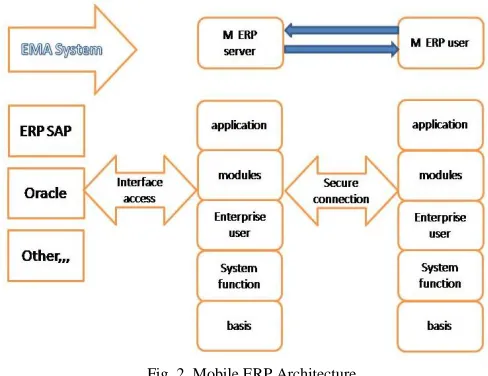
The architecture of mobile ERP provides flexibility and scalability through a multi-stage layer model (Figure 1). Via the template and modular design approach, the existing solution can be easily extended or modified to quickly provide additional functionality and flexibility when adapting business processes to changing market conditions. [4]
Fig. 2. Mobile ERP Architecture
Regarding our moving from using computers e-mails and local network in organization to new technology of business intelligence, choosing applications to be used in organization in secure various transactions will be considered. “EMA increasingly rely on Smartphone's to improve employee productivity "[1]. In order to achieve the best choice of mobile application, the organization must focuses on the following substantial issues to have accurate decision when studying mobile application extension to end user:
a) Devices -- which device is most appropriate is not always an easy choice.
b) Connections -- the types of connectivity that are required by the end users can be complex.
c) Application platform capability -- companies must evaluate whether the application platform in use within the company can be easily extended to the mobile workforce without substantial add-ons and/or re-engineering.
e) Support/management -- the majority of companies looking at mobile deployments fail to consider the needs of mobile management and support. "[2].
"Mobile applications are defined as internet applications that fit very well in the mobile computing environment. The mobile computing can be viewed as an extension of distributed computing types adding mobility to host computers "[3].
In this place we should not forget that Mobile Enterprise Applications Platform that offers three valuable primary applications for enterprise customers
Easy-to-use mobile application running on any device. Have a Benefits should include:
Improved business processes
Increased escalation and follow up productivity
Improved employees, student and management retention
Improved visibility and overall reporting accuracy (pipeline and forecast)
The Support application empowers IT support technicians with real-time access anywhere to time-sensitive, actionable incident and problem management information. Benefits include:
Increased field support team productivity
Reduced operational costs by improving first-call fix rates
Improved customer visibility of service status
Significant ROI, based on capital expense reduction The Service application provides field service workers
with bi-directional access to real-time customer, inventory, and other job-related information. Benefits include all those for the support application, plus enhanced parts usage information, which helps reduce inventory costs.
B. Additional reasons to use Mobile Enterprise Applications Platform:
Provides devices, wireless data plans, middleware applications, hosting, management, and professional services for a comprehensive, end-to-end solution
Runs on the largest voice and data network Is hosted in dual redundant data centers
Features superior middleware applications based on industry technology
Is end-to-end tested and certified on the broad device portfolio available
Uses priority testing and certification for new device launches and updates
24/7, enterprise-grade support
IV. THE IMPORTANCE OF MOBILE APPLICATION IN SUPPORTING ERP
"With this foundation in place, mobile applications have become more prevalent across a number of vertical organizations. The drivers and patterns of mobile application adoption vary across industries, but a common framework has begun to take shape that explains these activities. Put simply, organizations have started to apply mobile technology to those processes where the integration of real-time information can drastically improve process quality. Although the definition of process quality varies by industry, some general characteristics include the following:
a) Better decisions. To many field employees, the value of information is Situational.
b) Faster decisions. Not having information in the field can impede responsiveness to organization needs.
c) Shortened cycles. Bridging the gap between the field and the office can shorten core process cycles. "[12]
V. THE ANATOMY OF EMA IN ERP
We considered that its good point to take a look at EMA anatomy within ERP. "The client side of the mobile application can be divided into:
The device.
The mobile operating system.
The web based applications.
The framework applications.
The Messaging services.
The Connectivity options.
The Synchronization layer."[5]
VI. MOBILE CRUCIAL CHALLENGES
A. International travel
"One issue that organizations will have to deal with is international travel. A professional that is relying on the company data from their phone may not be able to access the internet in a different country. To deal with this problem it is necessary to briefly look at how mobiles work at a global level.
for travelling to and from North America; and can be solved by doing the following things (independenttraveler.com 2010):
Make sure the phone is tri-band or quad-band, which means it will work with 900/1800/1900 MHz frequencies
Talk to service providers to work out international plans and roaming options for travelling employees
Make sure enough data is included in the international plan – data used above the cap can be very expensive"[6].
B. Too many mobile devices; Too many mobile platforms One of the foremost challenges of mobile application development is the large number of mobile devices and mobile platforms that are being introduced almost daily. This requires large investments for companies to make in specialized resources with mobile platform knowledge and mobile programming expertise and it is a challenge for many companies to maintain this broad level of mobile expertise in-house.
C. Complex mobile application architecture
Mobile applications architecture is complex. Three-tiered architecture creates too many challenges related to security, data exchange, data integration, scalability and more.
D. Security- Mobile Data
Secure mobile data exchange is still a major concern while developing a mobile application. Enterprise/business mobile applications demands very high amount to mobile expertise.
E. Security Best Practices
The defined best practices that the organization should follow are listed below.
"Enterprises should establish a mobile device security policy to reduce threats without overly restricting usability.
Enforce strong passwords for mobile device access and network access. Automatically lock out access to the mobile device after a predetermined number of incorrect passwords (typically five or more).
Perform a remote wipe (e.g., reset the device back to factory defaults) when a mobile device is lost, stolen, sold, or sent to a third party for repair.
Perform a periodic audit of security configuration and policy adherence. Ensure that mobile device settings have not been accidentally or deliberately modified.
Enforce the same wireless security policies for laptops and Smartphone's. Refer to the following article, Best practices for securing your wireless LAN, for additional information.
Perform regular backup and recovery of confidential data stored on mobile devices.
Perform centralized configuration and software upgrades "over the air" rather than relying on the user to connect the device to a laptop/PC for local synchronization."[1]
VII. LITERATURE REVIEW:IMPLEMENTATION FRAMEWORK OF MOBILE ERPSYSTEM
"Enterprises face several challenges in deploying mobile applications, emanating from features such as location independence, contextualization, and personalization."[9]
"Bhutan, Method Science, San Murugesan, Classify mobile applications in to five categories: mobile broadcast broadcast), information information), transaction transaction), operation operation), and collaboration (m-collaboration. "[9].
"Mobile applications provide the advantage that can be accessed from anywhere and anytime. The nowadays companies have many branches in different locations from the world. Their employees need to move from a location to another, in order to fulfill the company needs. They are using mobile applications in order to access resources from different locations."[10]
The figure 5 shows the Taxonomy of enterprise mobile applications. Applications in the upper categories are richer and more complex than those in the lower ones. It is adapted from an earlier model proposed by MethodScience.com.)[9]
Fig. 3. Taxonomy of enterprise mobile applications
VIII. PROPOSED TAXONOMY
A. Administrationsecurity
Effective mobile administration in EMA for the ERP obligated provide secure environment not only for the ERP but also for the users
In this place we must not forget the security issue of using EMA and its impact in the organization information, we should assign end users their own application according to the permission that has been granted, or at least assign each user the permission according to business rule. In order to achieve this issue we propose a new taxonomy to exited taxonomies in other work.
An Administration (management) and remote Security is a big issue to be considered in the EMA. Our vision in this approach to consider the administration as main component that interfaces with the middleware and key back-end infrastructures that provides administrators of information technology a high level of visibility and control over the mobile environment within the organization. In EMA concept of administrator deferent than other environment, although they share the concept of user application and devices centralized management, but in mobile environment it defers regarding update and installing software over the air. In this place, the unauthorized access governed by centralized policy with enforcement guard even if users device stolen or lost.
The MEA administrator component controls and monitors all transactions activity across the mobile network. By gathering data on users, applications, devices and traffic, then generate detailed activity reports. This intelligence technique can be used by administrators to on time troubleshoot obstacles and ensure that server capacity and bandwidth continues to meet increasing user populations as the demand for mobile applications increase.
B. AdministrationTaxonomy
In order to support this study we propose to add Mobile Administration, it will be at the top level of the taxonomy hierarchy, regarding to achieve security issue. This taxonomy provides secure use of EMA according to the permission granted to the users.figure2 shows the new taxonomy hierarchy.
In mobile administration category the security passport will be applied with respect of permissions users granted, in order to go through the ERP for manipulating, retrieving and decision making. These taxonomies with the proposed one are: mobile administration, mobile broadcast, mobile information, mobile transaction, mobile operation, and mobile collaboration.
The upper portion of Figure 5 shows that the proposed mobile taxonomy of enterprise mobile applications
Fig. 4. Taxonomy of enterprise mobile applications
IX. DISADVANTAGES
"The Mobile Enterprise depends entirely on the Internet as its infrastructure. The system breaks down when a user cannot connect to the Internet. The system does not work in places where Internet service is not available. The system is disrupted whenever the Internet suffers a disruption such as when underwater data cables are damaged by earthquakes as in the case of the 2006 Hengchun earthquake or 2008 submarine cable disruption in the Middle East that disrupted internet service between the Middle East and Europe."[8].
Another disadvantage is the permission issue, the stakeholder should have been granted their permission to log on the mobility system in order to guarantee the secure data, and who will be involved in organization modules. This issue has to been solved by administration department, which its main role is assigning the permissions to stakeholders.
X. CONCLUSION
"The mobile technologies and applications offer a lot of new opportunities for enterprises, they also present development and implementation challenges" [10].
"All the mobile applications introduced into the market have some environmental impacts during their life cycle. Therefore, it is important that applications designers have access to relative environmental information so that they can make appropriate decisions and de-offs with other design requirements "[11].
"With smart phones, fast wireless connections and specialized enterprise software, professionals are now able to access corporate data from any place at any time. This convergence of several technologies has allowed the creation of EMA, which can provide a variety of solutions to large organizations, including enhanced efficiency of operations and workforce, reduced costs and increased customer satisfaction."[6]
significant benefits to corporate infrastructure and provide the competitive advantage necessary to succeed"[6].
REFERENCES
[1] Best practices for enterprise mobile device security, http://searchnetworking.techtarget.co.uk/tip/Best-practices-for-enterprise-mobile-device-security, access date 02/07/2011
[2] Jack E. Gold is a recognized expert in mobile computing and is founder and principal analyst at technology research firm J. Gold Associates. He can be contacted at [email protected].
[3] http://searchmobilecomputing.techtarget.com/feature/Strategic-planning-for-mobile-applications, access date 02/07/2011
[4] J. K. Phyoung and J. N. Young, “Mobile agent system architecture for supporting mobile market application service in mobile computing environment,” Proceedings of 2003 International Conference on Geometric Modeling and Graphics, pp. 149-153, 16-18 July 2003. [5] "Becoming a Mobile Enterprise Unwiring Your Business with SAP’s
Mobile Solutions".
[6] This article appeared in the Jan n Feb n Mar 2011 issue of SAPinsider (http://sapinsider.wispubs.com) and appears here with permission from the publisher, WIS Publishing. Access date 02/07/2011
[7] Sofien BEJI, Nabil El Kadhi , "An overview of mobile applications architecture and the associated technologies", National School of Computer Science – Tunisia RIADI GDL Laboratory – Manouba, European Institute of Information Technology
[8] L.E.R.I.A. Laboratory Paris. 978-0-7695-3274-5/08 $25.00 © 2008 IEEE DOI 10.1109/ICWMC.2008.55. July 27 2008-Aug. 1 2008, [email protected], [email protected]
[9] http://webtempest.com/enterprise-mobile-access/, access date 02/072011 [10] Jacob Sharony.Phd, "Enterprise Mobility Empowering the Mobile
Workforce"
[11] http://www.slideshare.net/mobiusconsulting/enterprise-mobility-empowering-the-mobile-workforce-by-dr-jacob-sharony, [email protected], access date 02/07/2011
[12] http://en.wikipedia.org/wiki/Mobile_Enterprise, access date 02/07/2011 [13] Bhuvan Unhelkar, MethodScience, "The Enterprise Mobile Applications
Development Framework", San Murugesan, University of Western Sydney/BRITE Professional Services, Sydney, pp. 33-39, (vol. 12no.3), May/June 2010
[14] B. Unhelkar and S. Murugesan, “The Enterprise Mobile Applications Development Framework,” IT Professional, Vol.12, No.3, pp. 33-39, May-June 2010.
[15] J. H. Park and K. K. Seo, “Knowledge-based approximate life cycle assessment system in the collaborative design environment,” Environmentally Conscious Design and Inverse Manufacturing, 2003. EcoDesign '03. 2003 3rd International Symposium on, pp. 499- 503, 8-11 Dec. 2003
[16] Kevin Burden," Business Benefit s of Industry-Specific Mobile Applications ", Global Headquarters: 5 Speen Street Framingham, MA 01701 USA P.508.872.8200 F.508.935.4015 www.idc.com, October 2005, access date 05/07/2011
[17] Neil Pollock and James Cornford, "ERP systems and the university as a “unique” organization"