Abstract
Today banking environment has become highly competitive and changing market environment at the same time to survive and grow in financial industry. Latest technology is 'enabling resource' that can help in developing learner and more flexible structure. And also helpful to the bank can quickly adopt the market scenario. This study was conducted with main primary objective of analysing the customer perception towards technology deception in banks and the result reveals that Information Securities Factors (IS), Preventive Measures (PM) and New Online Services (NOS) are the dominant dimensions of Customer Deception Perception. Further to conclude, The banker should provide guidance for secured online transaction, and to coordinate with the customers for preventing technology deceptions in banks and the customers should also need to keep their personal information with their own and use their online banking transaction through secured Wi-Fi connections.
Keywords: Deception, Perception, New Online Services, Preventive Measures, Information Securities.
Introduction
The banking sector is the lifeline of any modern economy. It is one of the important financial pillars of the financial sector, which plays a vital role in the functioning of the economy. The importance and role of information technology for achieving this objective cannot be undermined. Banking environment has become highly competitive today. To change market environment at the same time the bank has to be survive and grow in financial industry. Latest technology is 'enabling resource' that can help in developing learner and more flexible structure. And also helpful to the bank can quickly adopt the market scenario. And this involves cost reduction and effective communication with customers and bank associated with the banking business. In the next part we will see about influencing the technology and its impact for development in banking sector.Technology advances have accelerated changes resulting in higher production of goods & services. The information technology has transformed the functioning of business across the world. The adoption of new technology has become a necessity for
* University Research Fellow, Department of Commerce, University of Madras, Chepauk, Chennai - 05 ** Associate Professor, Department of Commerce, University of Madras, Chepauk, Chennai -05
Perceptions on Technology Deception - A Study
with Special Reference to Banking Industry
survival, particularly in the aftermath of liberalization, privatization, and globalization. Technology has become very important for banks to carve a plane for themselves and become leaders in their respective fields; to achieve this; banks have to improve their margins and profits by conducting transactions at low costs besides being lean in size. The dire competition in the banking industry between the public sector banks, old private sector banks, new generation private sector banks and the foreign banks is mainly through technology innovation, up gradation and modernization. After influencing technology in banking sector, there are huge changes in structure, functions in banking industry and also changes in providing services to their customers. One side technology will develop the banking industry at the same time there is chance to create banking risk by using the technology. Now a day's many banks are facing these technology risk issues and most importantly the 'customers' are badly affected by over these technology risk issues. Before we see the impact of technology fraud, we need to know the influence of technology and impact of technology in banking sector.
Review of Literature
Objective of the study
• To study the different types of technology deception in banks.
• To analyze the customer perceptiveness towards technology deception in banks.
Limitation of the study
• The sample may not represent the population accurately as the sample size is limited to 200 respondents
• The study is limited with the Chennai city. (North Chennai)
• As the sources of secondary data vary descriptions in data reporting exist.
• All the information furnished by the respondent was presumed as genuine.
Methodology
This study based on the primary data collected through scientifically developed questionnaire. After consulting the experts in this given area, questionnaire was constructed by the researcher herself. The questionnaire was presented to e-banking services used customers then the same was modified on the basis pretested result. The questionnaire was administered on e-banking service users of the banks. The sample sizes of 200 were chosen on a convenient basis from among public and private sector bank customers in the northern region of Chennai city.
Data Analysis And Interpretation
The data collected were subjected to analysis using SPSS version 21.0 by percentage analysis and Factor Analysis.
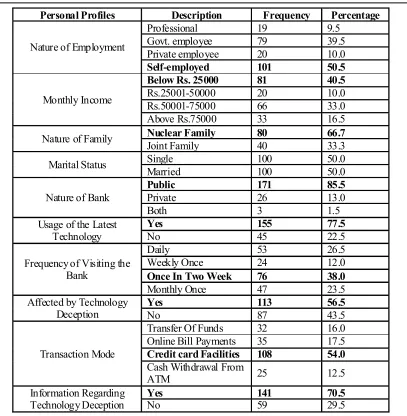
Table 1 - Personal Profile of the Respondents
Personal Profiles Description Frequency Percentage
Age
Below 25 55 27.5
Between 26-35 28 14.0
Between 36-45 73 36.5
Above 45 44 22.0
Gender Male 157 78.5
Female 43 21.5
Educational Qualification
Higher secondary 77 38.5
Diploma 21 10.5
Under Graduation 21 10.5
Personal Profiles Description Frequency Percentage
Nature of Employment
Professional 19 9.5
Govt. employee 79 39.5
Private employee 20 10.0
Self-employed 101 50.5
Monthly Income
Below Rs. 25000 81 40.5
Rs.25001-50000 20 10.0
Rs.50001-75000 66 33.0
Above Rs.75000 33 16.5
Nature of Family Nuclear Family 80 66.7
Joint Family 40 33.3
Marital Status Single 100 50.0
Married 100 50.0
Nature of Bank
Public 171 85.5
Private 26 13.0
Both 3 1.5
Usage of the Latest Technology
Yes 155 77.5
No 45 22.5
Frequency of Visiting the Bank
Daily 53 26.5
Weekly Once 24 12.0
Once In Two Week 76 38.0
Monthly Once 47 23.5
Affected by Technology Deception
Yes 113 56.5
No 87 43.5
Transaction Mode
Transfer Of Funds 32 16.0
Online Bill Payments 35 17.5 Credit card Facilities 108 54.0 Cash Withdrawal From
ATM 25 12.5
Information Regarding Technology Deception
Yes 141 70.5
No 59 29.5
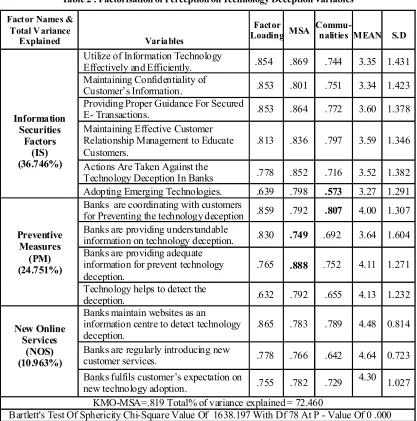
Table 2 : Factorisation of Perception on Technology Deception Variables
Factor Names & Total Variance
Explained Variables
Factor
Loading MSA
Commu-
nalities MEAN S.D
Information Securities
Factors (IS) (36.746%)
Utilize of Information Technology
Effectively and Efficiently. .854 .869 .744 3.35 1.431 Maintaining Confidentiality of
Customer’s Information. .853 .801 .751 3.34 1.423 Providing Proper Guidance For Secured
E- Transactions. .853 .864 .772 3.60 1.378 Maintaining Effective Customer
Relationship Management to Educate Customers.
.813 .836 .797 3.59 1.346
Actions Are Taken Against the
Technology Deception In Banks .778 .852 .716 3.52 1.382 Adopting Emerging Technologies. .639 .798 .573 3.27 1.291
Preventive Measures
(PM) (24.751%)
Banks are coordinating with customers
for Preventing the technology deception .859 .792 .807 4.00 1.307 Banks are providing understandable
information on technology deception. .830 .749 .692 3.64 1.604 Banks are providing adequate
information for prevent technology deception.
.765 .888 .752 4.11 1.271
Technology helps to detect the
deception. .632 .792 .655 4.13 1.232
New Online Services
(NOS) (10.963%)
Banks maintain websites as an
information centre to detect technology deception.
.865 .783 .789 4.48 0.814
Banks are regularly introducing new
customer services. .778 .766 .642 4.64 0.723 Banks fulfils customer’s expectation on
new technology adoption. .755 .782 .729
4.30
1.027
KMO-MSA=.819 Total% of variance explained = 72.460
Bartlett's Test Of Sphericity Chi-Square Value Of 1638.197 With Df 78 At P - Value Of 0 .000
Suggestions
The researcher suggested that those who are using online transaction with their bankers' online portals they should aware about the technologies used by the bankers for ignoring duplicate online portals, customers are should avoid their personal information sharing through websites. The customers when they are using the online portals of the bankers' they should change password time to time and the customers are should stay away from scam calls and e-mails for protecting online transaction through their online banking. The banker should provide guidance for secured online transaction, and to coordinate with the customers for preventing technology deceptions in banks.
Conclusion
Technology deception in bank is an important issue in the banking sector the main impact of technology deception for customers that losing lot of money, creating stress. The bank customers are using imaginable passwords to access to their accounts; it is easy task to the hackers. The hackers sending through phishing, smishing, and Vishing activities are easy to known about the bank customers account details for the online hacking. The Bankers should have to take steps for protect the online transactions with well-built passwords such as combination of lower case with upper case and letters, numbers with symbols. These are the security measures should be taken by the bankers. Whereas the customers are have to keep their personal information with their own and use their online banking transaction through secured Wi-Fi connections.
References
1. Adrienne Curry and Susan penman (2004), "The relative importance of technology in enhancing customer relationship in banking." An International Journal, Vol.14, ISS: 4, PP3.
2. Afzaal H. seyal and Mahbular Rahim (2016), "e-service Journal, Vol.7, No.3 PP.47- 68.
3. Allen N. Berger (2003), " The Economic effects of technology progress" Evidence from the banking industry. Vol. 35, No:2 PP141-176.
4. April Wright (2002), "Journal of International Marketing, Vol.10, No.2, PP83-98.
5. Arjan Reurink (2016), "financial fraud, e-services" ISSN 0944-2073
6. Chavda. V (2014), E-Banking System: Opportunities and Challenges - A Study, Research
7. Hub - International Multidisciplinary Research Journal, Volume-1, Issue-5, December 2014, Pg. No.1-4.
8. Damien Hutchinson and Matthew Warren (2003), "Security for internet banking", Logistics information management, Vol.16, ISS: 1 PP.64 - 73.
9. David J. Hand (2010), "Technometrics Vol.52. No.1,PP-34-38.
10. Doiphode. R, (2014), E-Crime in Banking Sector, Asian Journal of Management Sciences 02 (03 (Special Issue)); 2014; Pg. No.83-86.
12. Ioannis Koskosas (2011), Risk management Vol.13. No.1/2, PP81 - 99.
13. Jha et al (2014), " A survey on fraud and ID theft in Cyber Crime, JCSN International Journal of computer science and Network, Volume3, ISS3, PP112-114.
14. Linda S.goldberg (2009), IMF Staff paper 56, 171-197, DOI10, 1057 imfsp 2008. 31
15. Lorin M. Hitt and Frances X.Frei (2002), "Management Science, Vol: 48, No.6 PP732-748.
16. MuthuKurman (2008), "Cyber Crime Scenario In India, Criminal Investigation Department Review-January 2008 PP 18-20.
17. Paul M. Horvitz (1996), "Journal of money; Credit and Banking, Vol.28, No.4, PP 971-974.
18. Philip A. Dover (2006), "Innovation in banking: The in- home computerized Banking." International Journal of Banking Material, Vol 5 Issue 1 PP 39-54.
19. Ram N. Acharya, Albert Kagam, Marian.G Sobal and Vinod Kodepaka (2006), "e- services Journal, Vol.4, PP: 61-76
20. Ravi Nath. Paul Schrick and Monica Parzinger (2001), "e- service Journal, Vol.1 PP.21-36.
21. Ricard J. Bolton and David J.Hand. (2002), " Statistical Science, Vol.17, No.3 PP235-249.
22. Robert Grosse (1996), "Journal of International Business Studies, Vol.27, No.4, PP781-800.
23. Rupa Rega Nitsure (2003), "e-banking: Challenges and Opportunities Vol.38. No.51/52, PP5377-5381.
24. Shrinath. B (1997), "information security in Banks", Journal of financial Crime Vol.5 ISS: 1 PP.65-71
25. Singh MK (2005), "Housing Finance in India- A case study of LIC Housing Finance Limited.
26. Sitalakshmi Venkatraman and Indika Delpachitra (2008), "Biometrics in banking security "information management computer security, Vol.16, ISS: 4 PP. 415 - 430
27. Soni R.R and Soni Neena (2013), "An Investigative Study of Banking Cyber Fraud with spl Reference to private and public sector Banks. Vol:2(7) 22-27, ISSN 2319 -1171.
28. Stephen A.Rhoades (2000), "e-services of Industrial Organisation." Vol.16. No:4 PP 357-366)