JETIR1701055 Journal of Emerging Technologies and Innovative Research (JETIR) www.jetir.org 463
MANAGEMENT OF EXTERNAL
DEBT- THE INDIAN EXPERIENCE
*Dr Kamal Kishore
Post Graduate Department of Economics, DAV College, Amritsar, India [email protected], 9417091360
ABSTRACT
Growing external debt problem has been a cause of concern for the government since early 1970s with the oil price hike. Many factors had been responsible for the worsening of debt problem in the subsequent years. Development of basic industry, railways, power and manufacturing industries which compelled public authorities to contract growing amounts of foreign loans and credits. Deficit in balance of payments situation during planning period compelled India to resort to external borrowings leading to increase in external debt. Consequently a number of measures have been taken by the Government to ease the situation, specifically during the decade of 1990s. Although stern efforts have been made by the Government to ease the burden of external debt and the improvement was shown by a number of debt indicators, however, the absolute amount of debt did not show any reverse trend. Present paper attempts to study India's external debt problem and debt management policy in a comprehensive manner.
Key words
: concessional, debt, debt service, debt managementMANAGEMENT OF EXTERNAL DEBT- THE INDIAN EXPERIENCE
After independence India opted a model of development which stressed self-reliance. The volume of investment increased as the schemes of development were launched. However, this raised the need for foreign capital in the five year plans. The reliance on foreign borrowings was justified in terms of large imports needed for the rapid development of the industrial sector envisaged in the plan. The consequent trade deficits due to heavy imports made it essential to import capital from the developed countries who were ready to provide it to the developing ones.
JETIR1701055 Journal of Emerging Technologies and Innovative Research (JETIR) www.jetir.org 464
period compelled India to resort to external borrowings leading to increase in external debt, which further put pressure on balance of payments position in the subsequent years as the payments on the previous debt fell due. The balance of payment position of India came under strain as a result of quadrupling of oil prices during 1973-74 (World Bank, 1985; P.52). Like other economies, oil shock affected Indian economy too, by deteriorating its balance of payment position because India has been a major importer of oil. The international environment for India's economic development on the whole remained highly unfavourable in 1974-75.
Another oil price hike in 1979-80 added to the problem, resulting in rise of current account deficit .The subsequent borrowings from IMF, in the wake of these shocks, raised India's external debt from $18.0 billion in 1979 to $27.5 billion in 1982. Many steps have been taken by the Government, strategies have been formulated and policies have been followed from time to time to ease the situation. Keping in view the gravity of the problem, the present paper attempts to study the external debt situation of India specifically with the following objectives:
To understand the external debt situation of India with respect to various debt indicators
To analyse the debt management policy of the government
To suggest policy measures to contain the debt problem.
To meet the above objectives, the paper is divided into 3 sections. Section I concentrates on the magnitude and trends in the external debt and debt servicing of India. Section II brings out the debt management polict of the government. Section III summarises the study and brings out conclusion of the study along with suggested policy measures.
JETIR1701055 Journal of Emerging Technologies and Innovative Research (JETIR) www.jetir.org 465
External Debt - A Status Report, published annually by Department of Economic Affairs, Ministry of Finance, Government of India and various issues of Economic Survey, published annually by Economic Division, Ministry of Finance, Government of India. Some data regarding the foreign exchange reserves of India were collected from the latest issues of RBI Bulletin, published by Reserve Bank of India.
SECTION I
Magnitude of Total External Debt
Table 1 presents the behaviour of external debt of India since 1970. External Debt of India comprises multilateral and bilateral borrowings, export credit, external commercial borrowings IMF borrowings, non-resident deposits and rupee debt. These borrowings are both long term and short term. With the growing deficit in the current account of balance of payments, India's external debt registered a substantial increase over the years. The total magnitude of debt increased from just $8.4 billion in 1970-71 to $123.2 billion in 2004-05. It has also been observed that long term debt constituted the maximum share out of total debt and therefore, showed almost the similar behaviour as that of total debt. Long term debt, on the average, remained around or above 95 percent of the total debt except during 1990-91 when reliance on short term debt was increased to the extent of around 10 percent of the total debt.
Table 1
Composition of Cumulative External Debt of India (Billion US $)
Year Long Term Debt
(including IMF Credit)
Short-Term Debt
Total Debt Stock
1970-71 8.1 (96.4)
0.3 (3.6)
8.4 (100.00) 1980-81 19.5
(93.7)
1.3 (6.3)
20.7 (100.00) 1990-91 75.1
(89.8)
8.5 (10.2)
83.6 (100.00) 2000-01 95.6
(96.4)
3.5 (3.6)
99.1 (100.00) 2004-05(R) 115.7
(93.9)
7.5 (6.1)
123.2 (100.00) Note: Figures in parentheses are percentages to total
JETIR1701055 Journal of Emerging Technologies and Innovative Research (JETIR) www.jetir.org 466
Source: 1. World Bank, Global Development Finance, Various Issues.
2. Govt. of India, India's External Debt: External Debt Management Unit, Minister of Finance March, 2006.
Debt Service Payments
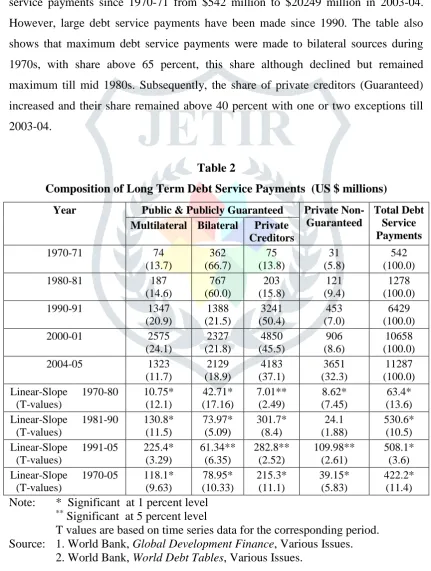
Details of debt service payments against long term debt to various sources have been presented in Table 2. The table shows a persistent increase in the total debt service payments since 1970-71 from $542 million to $20249 million in 2003-04. However, large debt service payments have been made since 1990. The table also shows that maximum debt service payments were made to bilateral sources during 1970s, with share above 65 percent, this share although declined but remained maximum till mid 1980s. Subsequently, the share of private creditors (Guaranteed) increased and their share remained above 40 percent with one or two exceptions till 2003-04.
Table 2
Composition of Long Term Debt Service Payments (US $ millions)
Year Public & Publicly Guaranteed Private Non- Guaranteed
Total Debt Service Payments Multilateral Bilateral Private
Creditors
1970-71 74
(13.7) 362 (66.7) 75 (13.8) 31 (5.8) 542 (100.0)
1980-81 187
(14.6) 767 (60.0) 203 (15.8) 121 (9.4) 1278 (100.0)
1990-91 1347
(20.9) 1388 (21.5) 3241 (50.4) 453 (7.0) 6429 (100.0)
2000-01 2575
(24.1) 2327 (21.8) 4850 (45.5) 906 (8.6) 10658 (100.0)
2004-05 1323
(11.7) 2129 (18.9) 4183 (37.1) 3651 (32.3) 11287 (100.0) Linear-Slope (T-values)
1970-80 10.75* (12.1) 42.71* (17.16) 7.01** (2.49) 8.62* (7.45) 63.4* (13.6) Linear-Slope (T-values)
1981-90 130.8* (11.5) 73.97* (5.09) 301.7* (8.4) 24.1 (1.88) 530.6* (10.5) Linear-Slope (T-values)
1991-05 225.4* (3.29) 61.34** (6.35) 282.8** (2.52) 109.98** (2.61) 508.1* (3.6) Linear-Slope (T-values)
1970-05 118.1* (9.63) 78.95* (10.33) 215.3* (11.1) 39.15* (5.83) 422.2* (11.4)
Note: * Significant at 1 percent level
** Significant at 5 percent level
T values are based on time series data for the corresponding period. Source: 1. World Bank, Global Development Finance, Various Issues.
JETIR1701055 Journal of Emerging Technologies and Innovative Research (JETIR) www.jetir.org 467
The more share of private creditors in total debt service also indicated the high external debt contracted from this source in the past alongwith the high cost of debt. Linear trend was worked out for debt service payments to all the sources at four periods of time viz. 1970-80, 1981-90, 1991-2005 and 1970-2005. The trend was found to be positive and significant for all the sources and for all the time periods taken into consideration except for PNG during 1981-90. However, the trend value of multilateral sources was highest during 1991-2005 and of bilateral, private creditors (guaranteed) and total debt service payments were higher during the eighties.
Debt Service to Exports and Debt Service to GNI Ratio (TDS/XGS and
TDS/GNI)
Debt to Exports ratio, also called debt service ratio, shows the proportion of debt service payments as a percentage of total exports of goods and services. Table 8 showed a persistent fall in debt service ratio of India from 26.8 percent in 1970-71 to 9.4 percent in 1980-81, however, during 1980-90, the figure increased, reaching 31.9 percent in 1990-91, indicating severe payment problems. Corrective measures adopted by the Government since early 1990s brought a gradual decline in it to 12.1 percent in 2001-02. However, later on it increased to 18.1 percent in 2003-04. Debt service to GNI ratio, on the other hand, showed somewhat different trend. The ratio fluctuated during 1970s but remained around one percent till 1980-81 but later sharply increased to 3.4 percent in 2003-04.
Table 8
Debt Service to Exports and Debt Service to GNI Ratio of India (%)
Year TDS/XGS
(%)
TDS/GNI (%)
1970-71 26.8 1.2 1980-81 9.4 0.8 1990-91 31.9 2.6 2000-01 14.9 2.4 2003-04 18.1 3.4
JETIR1701055 Journal of Emerging Technologies and Innovative Research (JETIR) www.jetir.org 468 SECTION – II
Domestic Adjustments and Export Promotion
India as a sovereign country honoured its commitments of debt servicing even during difficult times. The sound track record of debt servicing and optimal external debt management strategies have strengthened the debt indicators and resulted in improvement in the credit rating of India. In the wake of oil price hike in 1973-74, Government decided against borrowing from abroad by boosting domestic savings which was raised from 14 percent of GDP in 1965-72 to 19 percent in 1973-78 by raising taxes and interest rates alongwith a reduction in public spending and tightening of monetary policy (World Bank, 1985; P.52).
The primary policy of the Government has been to stress upon the exports so as to meet the debt service obligations of the country well in time. The same policy continued during the oil crisis. As a result the first oil shock was adjusted easily by the economy. World Bank (1985) confirmed sound economic position of India in 1978 having a small surplus in trade and current accounts, a comparatively low debt-GDP ratio and larger foreign exchange reserves equivalent to 11 months of imports.
Until early 1980s, Government resorted to mainly debt creating flows and credits under external assistance programmes from multilateral and bilateral sources which were largely on concessional terms
The 1991 Crisis and Recourse to Multilateral and Bilateral Concessional Finance
JETIR1701055 Journal of Emerging Technologies and Innovative Research (JETIR) www.jetir.org 469
The policy focus during early 1990s emphasised the funds on concessional terms from less expensive sources with longer maturities. Efforts were made to obtain additional finance from bilateral donors and multilateral institutions. India, accordingly negotiated a stand-by arrangement with IMF for SDRs 1656 million (US $ 2.3 billion) over a 20 month period (GOI, 1992; P.60). In another effort, Government leased 20 tonnes of gold to SBI which in turn went in for sale of it with repurchase option in international market. Foreign exchange raised was $ 200 million alongwith another $ 405 million against gold deposits to Bank of England and Bank of Japan.
A Shift to Non-Debt Creating Flows
One unique feature of debt strategy of the Government was the focus on foreign savings to supplement domestic savings to augment investment for higher rates of economic growth and financing the corresponding deficits in current account by debt creating flows in the pre-reform period while by non-debt creating flows in the post-reform period. In pursuance of this policy, the Government, for mobilising funds from abroad, decided to woo the foreign capital in the form of private foreign investment in general and FDI in particular under its globalisation policy (GOI, 1992; PP.106-115).
A discretionary mechanism of approval through the Foreign Investment Promotion Board (FIPB) and an automatic approval mechanism (mainly for investment in infrastructure) through the RBI were created. Yet most of the FDI came through the discretionary mechanism (Srinivasan, 2001; P.3). With progressive liberalisation, India succeeded in attracting a growing share of FDI inflows into the country. Compared to a meagre annual flow of less than $ 200 million in the pre-reform era, FDI flows reached a peak of $3.6 billion in 1997-98. Consequently, an increase in forex reserves to the extent of around $ 30 billion was experienced and the balance of payment problem was much eased.
Monitoring of Short Term Debt
JETIR1701055 Journal of Emerging Technologies and Innovative Research (JETIR) www.jetir.org 470
short term investment and debt which could sometimes vanish quicker than they arrived. Since the size of short term debt demanded due consideration while deciding the adequacy of foreign exchange reserves, monitoring of short term debt became an essential component of debt management strategy of India as external debt could have become vulnerable if short terms debt showed an upward trend. Short term debt, therefore, has been maintained within reasonable limits as there has been policy induced thrust by the Government to monitor it. Following the recommendations of the report of High Level Committee on Balance of Payments (1993) chaired by C.Rangarajan, short term credits were allowed strictly for import purposes.
Current Account Convertibility and Liberalisation of Capital Account
JETIR1701055 Journal of Emerging Technologies and Innovative Research (JETIR) www.jetir.org 471 Mobilisation of Non-Resident Indians' Deposits
The Gulf Crisis had negative impact on the movement of non-resident deposits to India. A special foreign currency Non-Resident Deposit Scheme (FCNR) was introduced by the Government in this regard in August 1990 with a view to mobilise more resources from abroad. Government mobilised a sum of $215 million through the issue of NRI bonds launched by SBI in November, 1990 having a validity of 7 years. Another scheme for mobilising additional foreign exchange resources was 'The Remittance in Foreign Exchange Scheme', 1991 under which the source of funds, purpose and nature of remittances were not subject to scrutiny under the exchange control regulations and direct tax laws (GOI, 1992; P.77).
As a result of the prudent policies of the Government concerning NRI deposits, the outstanding balances of these deposits increased from $10.2 billion in 1991 to $31.2 billion in 2004. The policy initiative regarding NRI deposits changed from attracting these deposits by offering a number of incentives, exchange guarantees and higher rates of interest in the initial years to revise maturity structure to encourage long term deposits and allowing banks to decide the interest rates on foreign currency deposits (GOI, 2005; P.27).
During 2003, the interest rates on Non-Resident External Rupee Account were revised three times in order to align these with international rates so as to remove arbitrage opportunities. Effective from April 17, 2003, the interest rates on NRE deposits for one to three years have been brought at par with LIBOR rates for US $ of corresponding maturity, keeping in view the sufficient amount of deposits and high forex reserves (GOI, 2004; P.35).
Policy Regarding External Commercial Borrowings
JETIR1701055 Journal of Emerging Technologies and Innovative Research (JETIR) www.jetir.org 472
economic activities. As per the Government of India Report (2004; P.37), ECBs can be raised under the Automatic Route for investment in industry, especially infrastructure sector. Under Approval Route, cases falling outside the purview of Automatic Route are considered on the basis of their limits and maturity periods. Financial institutions dealing exclusively with infrastructure or export finance are considered case by case basis. On June 03, 2005, ECB policy was raised to permit ECBs by NBFCs under the Approval Route from the multilateral financial institutions, reputed regional financial institutions, official export agencies and international banks towards import of infrastructural equipment for leasing for infrastructural projects with a minimum average maturity of 5 years. (GOI, 2005; P.30).
Certain modifications were made to the limits for raising ECBs which prevailed in 1991 to avoid excessive dependence on borrowings, because these were instrumental in 1991 balance of payments crisis. In March 1999, the list of sectors allowed to raise ECBs was expanded; limits for individual borrowers were raised, while interest rate limits were relaxed and restrictions on end use of the borrowings largely eliminated. However, the rule of thumb followed was to discourage the raising of short term debt. In 2000, the Government permitted raising of fresh ECBs upto $50 million and later delegated powers to RBI to approve ECBs upto $100 million while ECBs limit for equity investment in infrastructure projects was raised to $ 200 million. Reserve Bank of India (April, 2004; P.599) made it very clear that the primary responsibility to ensure that ECBs were raised/utilised in conformity with RBI's instructions is that of concerned borrowers and any contravention of the ECB guidelines would be viewed seriously and might invite panel action.
Pre-payment of Costly Loans
JETIR1701055 Journal of Emerging Technologies and Innovative Research (JETIR) www.jetir.org 473
prudently managing the external liabilities and of pro actively liquidating relatively higher cost component of our external debt" (The Economic Times, Budgetary Speech, 2003; P.1).
Fiscal Discipline
The stress on the external debt management since 1991, in fact, was a part of the broad economic stabilisation programme which had an immediate objective of restoration of macro economic stability and international confidence in the economy. The plethora of steps taken by the Government in order to combat balance of payment crisis were not merely related with external factors and external debt management rather the policies of the Government included structural reforms covering the areas of fiscal policy, industrial licensing, foreign trade, foreign investment, exchange rate management and reforms in financial sector.
On the other hand, there was also growing recognition of the role of expenditure management and expenditure switching policies in fiscal adjustment. The successful decrease in fiscal deficit as a percentage of GDP during 1991-92 could be attributed to steps taken by the Government to keep non-plan expenditure (including defence expenditure) into check. As a part of its expenditure control strategy, fiscal deficit ceiling was prescribed for 1992. Expenditure control policy of the Government included introduction of VRS for surplus staff, review of subsidies, review of budgetary support to autonomous institutions and encouragement to PSUs to maximise generation of internal resources. The raising of financial resources to mitigate fiscal deficit also emerged as a dominating motive behind the disinvestment policy of PSUs. It was argued that disinvestment would broad base the equity, improve management and enhance the availability of resources.
Section III
JETIR1701055 Journal of Emerging Technologies and Innovative Research (JETIR) www.jetir.org 474
outstanding debt, India is one of largest debtors but in terms of debt service payments, it does not rank so high.
At present, forex reserves stand at a record level of $163 billion as on June, 2006 as per RBI estimates, which can cover 100 percent of the external obligations. Relatively low level of short-term debt, a large part of concessional loans in the external debt portfolio, moderation in debt service payments as percentage of current receipts and no default in debt service payments so far, impacted India's favourable sovereign international credit rating .
From the above discussion, it can be concluded that external and internal shocks such as increase in petroleum prices, declining percentage of concessional loans, outflow of NRI deposits in the past, severe effect of Gulf Crisis, huge fiscal deficits, political uncertainly etc. put strains on the balance of payment position of India from time to time and consequently led to huge increase in the burden of debt over time along with deterioration in debt service ratios. However, prudent fiscal and exchange rate policies aimed at generating more resources internally, increasing exports, effective debt management policies stressing upon the pre-payment of costly debts, short term debt and monitoring of commercial loans etc. have brought debt ratio within reasonable limit. Inspite of the huge level of absolute debt, India is categorized as less indebted country by the World Bank.
JETIR1701055 Journal of Emerging Technologies and Innovative Research (JETIR) www.jetir.org 475 References
Government of India: Economic Survey, Economic Division, Ministry of Finance, Various Issues.
Government of India: India's External Debt-A Status Report, Department of Economic Affairs, External Debt Management Unit, Ministry of Finance, Various Issues.
Srinivasan, T.N. (2001): India's Reform of External Sector Policies and Future Multilateral Trade Negotiations, Centre Discussion Paper No. 830, Economic growth Centre, Yale University, New Haven http://www.econ.yale.edu/egcenter/research
World Bank: Global Development Finance, Washington DC, Various Issues. World Bank: World Debt Tables, Washington DC, Various Issues.