THE STUDY OF EUSTACHIAN TUBE FUNCTION IN SAFE OTITIS MEDIA
Department of ENT, Dr. D.Y Patil Medical College, Hospital and Research Centre, Pimpri, Pune, Maharasthra
ARTICLE INFO ABSTRACT
Introduction:
against nasopharyngeal pressure variations, ascending secretions and microorganisms. Patent and functioning Eustachian tube is the foremost requirement for success of tympanoplasty.
behind graftfailure is abnormal function of Eustachia chronic suppurative otitis media.
Objectives:
cases of safe otitis media. Materials and Methods
of them was assessed through simple, reliable
applicable Eustachian tube function tests,and each test was compared with the other individually and results were drawn accordingly.
Results: Valsalva
75% pressure could not be built up and rest 25% were subjected to Toynbee’s test, of which 64% showed “step
Conclusions:
tube, Toynbee’s maneuveris the only test which tells about function of Eustachian tube, opening and closing mechanism for equalisation of middle ear pre
Copyright©2016, Sphoorthi Basavannaiah. This is an open access article distributed under the Creative Commons Att unrestricted use, distribution, and reproduction in any medium, provided the original work is properly cited.
INTRODUCTION
Eustachian tube is a complex organ that forms a vital bridge between middle ear and nasopharynx and has the following 3 vital functions that is ventilatory, protective and
function. Multifactorial causes that can lead to abnormal Eustachian tube function as a result of middle ear infections are sinus and upper respiratory tract infections, nasopharyngeal mass. Otitis media is one of the most commonotological conditions encountered in our Otorhinolaryngology practice and abnormal Eustachian tube function being the prime etiology. Though there are many factors that influence graft uptake rate, a good preoperative tubal function is one of the prerequisite for high rate of success rates in terms of graft uptake following tympanoplasty. With the aid of many diagnostic procedures, it has now become easy, cost effective, consistent and convenient to find the cause behind graft failure. Hence, this topic was chosen for study and the prime
*Corresponding author: Sphoorthi
Department of ENT, Dr. D.Y Patil Medical College, Hospital and Research Centre, Pimpri, Pune, Maharasthra.
ISSN: 0975-833X
Article History:
Received 05th April, 2016
Received in revised form
20th May, 2016
Accepted 23rd June, 2016
Published online 16th July,2016
Key words:
Eustachian tube, Chronic otitis media, Mucosal type, Tympanometry, Toynbee maneuver.
Citation: Sphoorthi Basavannaiah, 2016. “The study of Eustachian tube function in safe Otitis media 34247-34253.
RESEARCH ARTICLE
THE STUDY OF EUSTACHIAN TUBE FUNCTION IN SAFE OTITIS MEDIA
*Sphoorthi Basavannaiah
Medical College, Hospital and Research Centre, Pimpri, Pune, Maharasthra
ABSTRACT
Introduction: Eustachian tube maintains equilibrium between middle ear and atmosphere, against nasopharyngeal pressure variations, ascending secretions and microorganisms. Patent and functioning Eustachian tube is the foremost requirement for success of tympanoplasty.
behind graftfailure is abnormal function of Eustachian tube, which is the main pathology behind chronic suppurative otitis media.
Objectives: The Eustachian tube patency is assessed here with various tubal function tests in all cases of safe otitis media.
Materials and Methods: A random sample of 100 patients were screened and tubal function of each of them was assessed through simple, reliable and cost effective and those which can be daily applicable Eustachian tube function tests,and each test was compared with the other individually and results were drawn accordingly.
Results: Among all 100 patients assessed, impression drawn were in terms Valsalva- 84%, Siegalisation- 86%, Ear drops- 87%, Nasopharyngoscopy
75% pressure could not be built up and rest 25% were subjected to Toynbee’s test, of which 64% showed “step-ladder” graph and 36% showed “flat” graph.
Conclusions: Of all the tests mentioned above that mainly comment on patency of the Eustachian tube, Toynbee’s maneuveris the only test which tells about function of Eustachian tube, opening and closing mechanism for equalisation of middle ear pressure.
is an open access article distributed under the Creative Commons Att use, distribution, and reproduction in any medium, provided the original work is properly cited.
Eustachian tube is a complex organ that forms a vital bridge between middle ear and nasopharynx and has the following 3 ventilatory, protective and mucociliary Multifactorial causes that can lead to abnormal result of middle ear infections are sinus and upper respiratory tract infections, nasopharyngeal Otitis media is one of the most commonotological itions encountered in our Otorhinolaryngology practice and abnormal Eustachian tube function being the prime etiology. Though there are many factors that influence graft uptake rate, a good preoperative tubal function is one of the te of success rates in terms of graft With the aid of many diagnostic procedures, it has now become easy, cost effective, consistent and convenient to find the cause behind graft failure.
dy and the prime
Department of ENT, Dr. D.Y Patil Medical College, Hospital and
objectives are-to assess patency of Eustachian tube in cases of safe otitis media, to analyse utility of different methods used to assess tube patency and to find out accurate method of assessing Eustachian tube function.
inferred their own pros and consregarding this topic chosen for the study. Though majority of the studies
detail below have opted in for Tympanometry as their choice for Eustachian tube function assessment, while Valsalva comes second in the row; but only one single study in literature has commented on Toynbee maneuver as the diagnostic test of choice for assessment of Eustachian tube function which is having resemblance to this study in terms of results arrived. Hence, due to rarity of literature available in this context, this age old, very basic Following confirmation of thtopic was considered apt for the study.
MATERIALS AND METHODS
A cross sectional study was conducted among randomly selected 100 patients who were screened on outpatient basis with discharging ear and decreased hearing. Following confirmation of the ear disease, tests were
International Journal of Current Research
Vol. 8, Issue, 07, pp.34247-34253, July, 2016
INTERNATIONAL
The study of Eustachian tube function in safe Otitis media”, International Journal of Current Research
THE STUDY OF EUSTACHIAN TUBE FUNCTION IN SAFE OTITIS MEDIA
Medical College, Hospital and Research Centre, Pimpri, Pune, Maharasthra
Eustachian tube maintains equilibrium between middle ear and atmosphere, protects against nasopharyngeal pressure variations, ascending secretions and microorganisms. Patent and functioning Eustachian tube is the foremost requirement for success of tympanoplasty. The reason n tube, which is the main pathology behind
The Eustachian tube patency is assessed here with various tubal function tests in all
A random sample of 100 patients were screened and tubal function of each and cost effective and those which can be daily applicable Eustachian tube function tests,and each test was compared with the other individually and
Among all 100 patients assessed, impression drawn were in terms of success rates : On 87%, Nasopharyngoscopy- 80%, Tympanometry- in 75% pressure could not be built up and rest 25% were subjected to Toynbee’s test, of which 64%
that mainly comment on patency of the Eustachian tube, Toynbee’s maneuveris the only test which tells about function of Eustachian tube, opening and
is an open access article distributed under the Creative Commons Attribution License, which permits
to assess patency of Eustachian tube in cases of utility of different methods used to assess tube patency and to find out accurate method of assessing Eustachian tube function. Various studies have inferred their own pros and consregarding this topic chosen for the study. Though majority of the studies as mentioned in detail below have opted in for Tympanometry as their choice for Eustachian tube function assessment, while Valsalva comes second in the row; but only one single study in literature has commented on Toynbee maneuver as the diagnostic test of choice for assessment of Eustachian tube function which is having resemblance to this study in terms of results arrived. Hence, due to rarity of literature available in this context, this age old, very basic Following confirmation of thtopic was
MATERIALS AND METHODS
A cross sectional study was conducted among randomly selected 100 patients who were screened on outpatient basis with discharging ear and decreased hearing. Following confirmation of the ear disease, tests were conducted on
INTERNATIONAL JOURNAL OF CURRENT RESEARCH
them – Valsalva test, Siegalisation, Ear drops test, Nasopharyngoscopy, Tympanometry with Toynbee maneuver. The criteria included in the study were of all age groups including children. Patients with enlarged adenoids, cleft palate and nasopharyngeal mass were come across. Also patients complaining of repeated and recurrent episodes of sinus and upper respiratory tract infections- allergic rhinitis, chronic sinusitis were considered. All cases of mucosal chronic suppurative otitis media with discharge were treated conservatively. The criteria excluded in the study were all traumatic, postoperative cases and atticoantral diseases.
Procedures
Valsalva maneuver: Mouth is closed tightly with nose
pinched and air is blown out forcibly and air leak appreciation is confirmed.
Pneumatic otoscopy/Siegalisation: The speculum is
connected to the side tube which is attached to a rubber bulb. The rubber bulb is passed and released to alter the pressure in the ear canal. The system is then made air-tight by making the speculum snugly fit into the ear canal. The pathology of the ear is then examined by pressing the rubber bulb. A magnified view of the tympanic membrane as well as the pathology and the mobility of tympanic membrane are assessed.
Ear drops test: In cases with perforated tympanic membrane,
on topical use of ear drops whether or not bitter sensation is felt in the throat is evaluated.
Tympanometry: All the patients were subjected to
Tympanometry. The patients, in whom the middle ear pressure was built up, were subjected to Toynbee’s test.
Toynbee test: The subject is asked to swallow when the nose
is pinched. If the Eustachian tube opens during the test, the middle-ear pressure changes is determined by the timing of the tubal opening and the nasopharyngeal pressure gradient and is documented by means of graphical representation.
Nasopharyngoscopy: Nasopharyngoscopy is done keeping the
patient nil by mouth for 3 hours. Nose is sprayed with 10% lignocaine spray and then packed with cotton patties saturated with 4% lignocaine solution. Patient is made to sit in an upright position with head supported. Cotton patties are removed and the scope is passed through from a roomy nasal cavity and made stationary into the nasopharynx. The patient is asked to swallow and Valsalva maneuver is done and then the opening of the Eustachian tube is visualized and also other pathologies in surrounding area are noted.
RESULTS
[image:2.595.308.562.53.206.2]Among 100 patients, 52 were male and the rest 48 were female. Among them 7 were children and the rest were adults.
Table 1. Distribution based on size of perforation
Size of Perforation Number of Patients
Small to Moderate (SM) 86 (Y)
Large (L) 14 (N)
Total 100
Graph 1. The size of perforation among sample size varied from small to moderate in 86 and large perforation in 14 patients
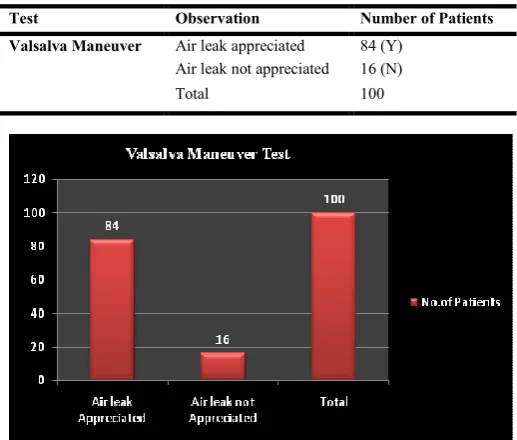
Table 2. ValsalvaManeuver
Test Observation Number of Patients
Valsalva Maneuver Air leak appreciated 84 (Y)
Air leak not appreciated 16 (N)
Total 100
[image:2.595.304.563.254.474.2]Graph 2. Valsalva test when performed among 100 patients, in 84 patients air leak was appreciated indicating Eustachian tube is patent. In the remaining 16 patients air leak was not appreciated as the Eustachian tube was blocked at the time of the test
Table 3. Siegalisation test
Test Observation Number of Patients
Siegalisation Tympanic membrane mobile 86 (Y)
Tympanic membrane not mobile 14 (N)
[image:2.595.305.558.547.760.2]Total 100
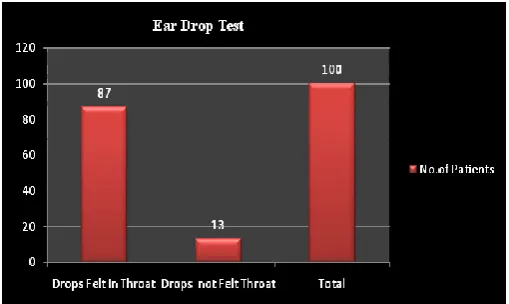
Table 4. Ear Drops Test
Test Observation Number of patients
Ear Drops Test Drops felt in Throat 87 (Y)
Drops not felt in Throat 13 (N)
Total 100
Table 5. Tympanometry
Table 5a.
Test Observation Number of Patients
Tympanometry Pressure could not be built up 75 (Y)
Pressure could be built up 25 (N)
[image:2.595.67.257.716.763.2]Graph 3. Siegalisation test when performed in 100 patients, in 86 patients there was active mobility of the tympanic membrane as they have small to moderate sized perforation indicating good patency of the Eustachian tube. In 14 patients, tympanic membrane did not move with pneumatic otoscopy. This was either due to Eustachian tube blockage or inability to assess the tympanic membrane mobility due to large perforation. Actively mobile tympanic membrane suggests that Eustachian tube is patent
[image:3.595.37.288.54.219.2]Graph 4. Ear drops test when performed in 11 patients, following instillation of ear drops, 87 patients felt the bitter sensation in the throat, within few minutes indicating patent Eustachian tube. The remaining 13 patients did not feel the presence of drops in the throat due to the blockage in the Eustachian tube
Table 5b.
Test Observation Number of patients
Toynbee test Step ladder pattern present 16 (Y)
No step ladder pattern 09 (N)
Total 25
Graph A:
Graph B:
When all 100 patients were subjected to tympanometry test (Table 7a). In 75 patients, pressure could not be built up hence suggesting patent Eustachian tube. But pressure was built up in the rest 25 patients suggesting blocked Eustachian tube. So, Toynbee’s test (Table 7b) was done on these 25 patients and among them 16 patients showed "step-ladder" type of graph (Graph A) suggesting normal Eustachian tube function. While the rest 9 showed a "flat" graph (Graph B) indicating
temporary Eustachian tube block due to allergic rhinitis (1 case), enlarged adenoids (5 cases), cleft palate (2 cases),
[image:3.595.37.292.309.461.2]nasopharyngeal mass (1 case).
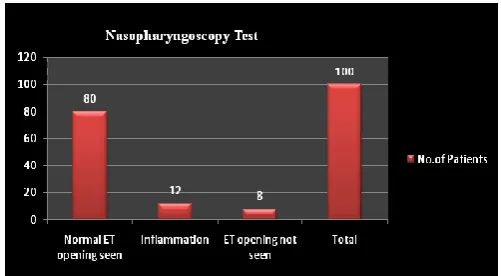
Table 6. Nasopharyngoscopy
Test Observation Number of Patients
Nasopharyngoscopy Normal Eustachian
tube opening seen
80 (Y)
Inflammation 12 (I)
Eustachian tube opening not seen
08 (N)
Graph 6. While performing the test, 300 angulated scope is graduated up to the nasopharyngeal end of the Eustachian tube to visualize its opening and when the patient was asked to swallow, active opening of the tube was noted in 80 patients, indicating good Eustachian tube function. While in 12 patients due to allergic rhinitis and chronic sinusitis, inflammation was seen around the Eustachian tube opening. In the remaining 8 cases with enlarged adenoids, cleft palate, soft tissue mass in the nasopharynx, obstruction was noted at the nasopharyngeal end of the tube indicating poor Eustachian tube function
Table 7. Tests performed on 100 patients
Test Observation Number of patients
Yes No/Inflammation
ValsalvaManouvre Air leak appreciation 84 16
Siegalisation Mobility of tympanic
membrane visualisation
86 14
Ear Drop Test Feeling in the throat 87 13
Tympanometry Pressure built up 25 75
Nasopharyngoscopy Eustachian tube opening
seen seen
80 20
Graph 7. Results of all the tests together depicted in the graph
DISCUSSION
According to the study by Yusuf et al. in 2011, he has said
that, Valsalva maneuver is the technique for middle ear pressure equalization and is considered highly sensitive and specific test. It also indicates patency of the Eustachian tube.
In the study done by Ding et al. in 1998, Valsalva maneuver is
easy and convenient test and does not need expensive instrument. It evaluates Eustachian tube function in accuracy,
which is fit for basic level hospital. In 2000 Bunne et al. has
mentioned in his study that, Valsalva maneuver's efficiency when performed single for assessment of Eustachian
tube opening and closing functions is of less prognostic value and yields good success rates when it is combined with Toynbee maneuver, as it shares a common physiological basis. As per Dhingra, failure of the test does not prove blockage of the tube because in only about 65%, subjects can successfully
perform this test. According to study by Uzun et al. in 2004,
Valsalva maneuver always gives good results when performed both preoperatively and postoperatively in cases of otitis media following surgery in order to assess tubal function irrespective of the graft material used and surgery performed. Pre-operatively, results of this test on assessment of tubal function
were 30%. According to the study by Yusuf et al.in 2011,
Valsalva maneuver is highly sensitive and specific for the
middle ear pressure equalization. Doyle et al.conducted the
study in 2013, Valsalva maneuver is the best reliable tool among all tests for Eustachian tube function to evaluate qualitatively and quantitatively the pressure opening and closing functions of the Eustachian tube. As per Doyle in another study has said that, in cleft palate children ability to alter middle ear pressure is deranged. As a result they have high prevalence of developing middle ear disease. So, one of the reasons for functional obstruction of the Eustachian tube is this anatomical abnormality. As cases of mucosal chronic otitis media are more common in our set up, we clinically evaluated all 100 patients with perforated tympanic membrane to look for tubal patency by Valsalva test. In this study, 84 % showed good results in terms of air leak appreciation. The results as per the study were better compared to the study done by Uzun
et al. Even in the study there were two cases of cleft palate
which correlates with the study as quoted by Doyle et al.
Marshall et al. conducted a study in 1984, otitis media and
otitis media with effusion are common disorders of childhood. Tube dysfunction plays an important role in otitis media. Pneumatic otoscopy is used to evaluate tubal function in cases with otitis media.
Based on the study conducted by Bluestone et al. in 1974, a
normal appearance of tympanic membrane is not necessarily indicating a normally functioning tube but normal tympanic membrane mobility on Siegalization indicates good patency of the Eustachian tube. Any middle-ear disease, presence of high negative middle- ear pressure, or both determined by a pneumatic otoscope gives presumptive evidence of the Eustachian tube dysfunction. In the study, 86% showed movement of tympanic membrane with small to moderate perforation indicating good tubal patency. In the remaining, who had large central perforation, mobility of tympanic membrane could not be assessed. According to studies
conducted by Prasad et al. 2009, Nishant et al. 2012 and
Shreyas et al (2012), ear drops test is done to look for patency
than in those with wet ear. While compared to the study done
by Shreyas et al. 87.5%, patients had good Eustachian tube
function with dry ear which very well matches with this study.
Virton et al. in his study in 1982 has mentioned that, this test is
used to assess Eustachian tube function. A good tubal function is when middle ear pressure is between 0 to -250mm H2O as majority of the tubes open during swallow, but a reduced tubal opening is noted as middle ear pressure decreased from 0 to -200mm H2O and this fluctuation of negative middle ear pressure is evaluated accurately by tympanometry. Shift in the peak pressure point in tympanogram between + /- 200 mm to +/- 400 mm H2O indicates relative efficiency of measurement of the Eustachian tube function by tympanometry and implies that Eustachian tube opens and equalizes middle ear air
pressure. According to the study by Bylander et al. in 1983,
impedance audiometry is a reliable tool to evaluate qualitatively and quantitatively the pressure opening and closing functions of the Eustachian tube. Based on the study
conducted by Takahashi et al. in 1991, the tube function was
analysed by tympanometry and in the case of dysfunction of the tube, altered tympanogram with overlapping pressure peaks are obtained and this indicates that ineffectively operating tube shows changes in the middle ear pressure suggesting that the tube is temporarily or permanently blocked.
In the study conducted by Lazo et al. in 2005 he has mentioned
that, tympanometry is readily available procedure that may be useful in patients to prevent chronic middle-ear disease. As per
the study done by Pelikan et al. in 2009, otitis media and otitis
media with effusion are common disorders of childhood. Frequent relapses of middle ear infection is due to anatomic and craniofacial abnormalities, enlarged adenoids, previous episodes of acute otitis media, allergic rhinitis, chronic sinusitis, all these contribute to Eustachian tube dysfunction. Diagnostic evaluation by tympanometry has a pivotal role that has proved to be more efficient than other air equalisation methods in assessing the course and prognosis of otitis media and also to evaluate tubal function.
According to the study by Renata et al. in 2010,
Tympanometry is based on acoustic immittance that measures positive and negative air pressure variations produced in the external acoustic meatus that leads to changes in physical properties in the middle ear and tympanic membrane. Immittance tests are also used to study ventilatory function of the Eustachian tube and hence this pressure equalization swallow test is accurate to assess the tube dysfunction. Shreyas
et al. in his study in 2012 has mentioned that, a modern
impedance audiometer offers facility to ascertain the physiological function of Eustachian tube not only in the intact tympanic membrane but also in the presence of perforation. Its advantages are that it is quick, non-invasive, patients compliance is not required, accurate and inexpensive and it offers the best means of assessing the Eustachian tube function. The results of the tympanometric assessment in their
study were 80%. As per study done by Kanagamuthu et al. in
2013, the Eustachian tube function is related to duration, type and location of tympanic membrane perforation in chronic suppurative otitis media. Impedance audiometry is a simple, invasion-free method to evaluate the Eustachian tube function. There is a strong association between tube functions and graft
uptake and is proven by Toynbee test whether the tube is patent or not. This suggests that Eustachian tube plays a major role in the success of tympanoplasty. When all 100 patients in the study, with perforated drum were subjected to tympanometry, in 75 patients pressure could not be built up indicating patent Eustachian tube. In the rest 25 patients, pressure was built up suggesting blocked Eustachian tube. So, Toynbee’s test was done in 25 patients, and among them 16 patients showed, "step-ladder" type of graph suggesting normal Eustachian tube function while the rest 9 showed, a "flat" graph indicating temporary Eustachian tube block due to allergic rhinitis, cleft palate, enlarged adenoids and nasopharyngeal mass. Our study also shows good results (75%) which are almost similar to the study conducted by
Shreyas et al.
According to the study by El-Guindy et al. in 1998, normal
endoscopic results indicate good tubal function, while abnormal results indicate organic tubal obstruction which is correctable. Any inflammation around the tubal opening due to the presence of recurrent episodes of otitis media, upper respiratory infections, chronic and occult sinusitis, presence of hypertrophied adenoids and craniofacial deformity such as cleft palate and nasopharyngeal mass all that can make the opening of the tube blocked and non-visualisable. Hence, Nasopharyngoscope has been a diagnostic tool in these cases. In this study, 1 case of allergic rhinitis, 2 cases of cleft palate, 5cases of adenoid hypertrophy and 1 case of nasopharyngeal mass have ben come across. Based on the study conducted by
Yuan et al. in 2007, morphological changes of pharyngeal
ostium of the eustachian tube plays an important role in the
genesis and development of otitis media. Hence,
Nasopharyngoscope is a very useful tool in the diagnosis and treatment of otitis media. As per the study done by Skotnica
et al. in 2007, Eustachian tube dysfunction plays an important
role in the development, persistence and recurrence of otitis media with effusion and chronic otitis media. Evaluation of the type of obstruction in the cartilagenous portion of the tube is important for decision concerning methods for treatment and prognosis of surgical outcome. To identify the characteristics of the dynamic function of the pharyngeal orifice of the tube in
children, transnasal endoscopic examination of the
nasopharyngeal opening of the tube with Nasopharyngoscope is done.
As per the study conducted by Marseglia et al. in 2011,
Nasopharyngoscope is an indispensable and diagnostic tool in localizing and treating the hidden lesions responsible for obstruction. In this study, similar results where noted. In 80 patients the tube opening was normal and visualised suggesting good Eustachian tube function. But in the remaining 20 patients, inflammatory changes were noted around the tube opening in 12 patients due to allergic rhinitis and chronic sinusitis. In the rest 8 patients, tubal opening was not visualised due to presence of enlarged adenoids, cleft palate and nasopharyngeal mass, indicating poor tube function. As
per studies done by Gimenez et al. in 1993, Xiao et al. in 2006
and Nishant Kumar et al. in 2012, Eustachian tube function is
antero-inferior quadrant. Doyle et al. in his study in 1980 has concluded that, cleft palate has a high prevalence of chronic otitis media due to limited ability of the tensor velipalatini muscle to dilate the tube actively on swallowing, which is the cause for functional obstruction of the Eustachian tube. In this study, 2 children with cleft palate have come across.
Conclusion
Valsalva test provides accurate results in 84% patients. However it is still felt that, this test was biased to some extent and depends on patient’s response. Siegalisation test provides correct status of the Eustachian tube in 86% patients having small to moderate perforation on tympanic membrane. This test does not hold good for cases with large central perforation because appreciation of the mobility of the tympanic membrane is difficult. Ear drops test yields good results and provides accurate status of the Eustachian tube function in 87% patients. Despite of good results, the duration of result varies depending on the size and site of the perforation on the tympanic membrane. Hence, delayed response is arrived at. Nasopharyngoscopy is an accurate, non-invasive test. In our study 80% patients, had normal tube opening while in the rest tubal opening was not visualized due to nasopharyngeal pathology and partially visualized due to inflammation. Tympanometry is a practical and easy test. In 75% patients, as patients were having perforated tympanic membrane, pressure could not be built indicating patency of the Eustachian tube. The remaining 25% patients were subjected to Toynbee test. Amongst them, Eustachian tube was patent and functioning in 64% of the patients showing a "step ladder" graph. A "flat type" of graph was noted in the remaining 36% patients with blocked tube at the time of the test. Thus, all 91% patients had a patent Eustachian tube.
All the above tests indicate patency of the Eustachian tube, while Toynbee test is the only test which gives idea of functioning of the Eustachian tube that is opening and closing mechanism for equalisation of pressure in middle ear. Among all the above mentioned tests, there were some or the other cons, but only Toynbee’s test gave accurate and reliable results.Hence, Toynbee’s maneuver was considered an ideal test of choice for assessment of Eustachian tube function. This test must be preferably preformed in all the patients who are wanting and willing for tympanoplasty in order to attain effective success results following surgery.
REFERENCES
Bluestone CD. and Shurin PA. 1974. Middle ear diseases in children: pathogenesis, diagnosis, and management.
PediatrClin North Am., 21:379-400.
Bunne M, Falk B, Magnuson B, Hellström S. 2000.
Variability of Eustachian tube function: comparison of
ears with retraction disease and normal middle ears.
Laryngoscope., Aug; 110(8):1389-95.
Bylander A, Tjernström O, Ivarsson A. 1983. Pressure
opening and closing functions of Eustachian tube in
children and adults with normal ears. ActaOtolaryngol.,
Jan-Feb; 95(1-2):55-62.
Ding J, Liang X, Guanzhong. 1998. Examination of
the Eustachian tube functions in chronic suppurative otitis media. Department of ENT, Sun Yat-Sen Memorial Hospital Sun Yat-Sen, University of Medical Science, Guangzhou 510120. Lin Chuang Er Bi Yan HouKeZaZhi., Nov; 12(11):505-7.
Doyle WJ, Swarts JD, Banks J, Casselbrant ML, Mandel EM, Alper CM. 2013. Sensitivity and specificity of Eustachian
tube function tests in adults. JAMA Otolaryngol Head Neck
Surg., Jul; 139(7):719-27.
Doyle WJ, Cantekin EI, Bluestone CD. 1980. Eustachian tube
function in cleft palate children. Ann OtolRhinolLaryngol
Suppl., May-Jun; 89(3 Pt 2):34-40.
El-Guindy A. 1998. A correlative manometric and endoscopic study of tubal function in chronic otitis media with effusion. Department of Otolaryngology, Head and Neck
Surgery, Tanta School of Medicine, Egypt. Acta
Otolaryngol., Sep; 118(5):692-6.
Giménez F. and Marco-AJ. 1993. The prognostic value of
mucociliary clearance in predicting success in
tympanoplasty. J Laryngol Otol., Oct; 107(10):895-7.
Kanagamuthu P, Padmanabhan K, Venkataramanujam NC, Alandur PS. 2013. Evaluation of Eustachian tube function in chronic suppurative otitis media (tubotympanic type) with reference to its treatment outcome. Department of ENT, Mahatma Gandhi Medical College and Research
Institute, Pondicherry, India. Indian J Otol., July, 12;
18(4):179-83.
Lazo-SJG, Galván-AAA, Martínez-OVA, Velasco-RVM,
Nieves-RA, Rincón-CC. 2005. Eustachian tube
dysfunction in allergic rhinitis. Otorhinolaryngology Department, Speciality Hospital No 71, Social Security
Mexican Institute, Torreón, Coahuila, México. Otolaryngol
Head Neck Surg., Apr;132(4):626-9.
Marseglia GL, Caimmi D, Pagella F, Matti E, Labó E, Licari A, Salpietro A, Pelizzo G, Castellazzi AM. 2011. Adenoids during childhood: the facts. Department of Pediatrics, University of Pavia - Foundation IRCCS Policlinico San
Matteo, Italy. Int J ImmunopatholPharmacol., Oct;
24(4):1-5.
Marshall SG, Bierman CW, Shapiro GG. 1984. Otitis
media with effusion in childhood. Ann Allergy, Nov;
53(5):370-8, 394.
Nishant K, Devashri C. and Puttewar MP. 2012. Clinical Profile of Tubotympanic CSOM and Its Management With Special Reference to Site and Size of Tympanic Membrane Perforation, Eustachian Tube Function and Three Flap Tympanoplasty. Department of Otorhinolaryngology and Head & Neck Surgery, Pravara Rural Hospital and Medical College, Loni, Ahmednagar, 413736 Maharashtra India , Department of Anesthesia, Pravara Rural Hospital and Medical College, Loni, Ahmednagar, 413736 Maharashtra India, Department of Otorhinolaryngology and Head and
Neck Surgery. Indian J Otolaryngol Head Neck Surg.,
Mar; 64(1): 5–12.
Maharashtra India, Ahmednagar, 413736 Maharashtra
India. Indian J Otolaryngol Head Neck Surg., Mar; 64(1):
13–16.
Pelikan Z. 2009. Role of nasal allergy in chronic secretory otitis media. Allergy Research Foundation,
Breda. Curr Allergy Asthma Rep., Mar;9(2):107-13.
Prasad KC, Hegde MC, Prasad SC, Meyappan H. 2009. Assessment of Eustachian tube function in tympanoplasty. Department of Otolaryngology-Head and Neck Surgery, Kasturba Medical Cillege, Mangalore, Manipal University,
Karnataka State, India. Otolaryngol Head Neck Surg.,Jun;
140(6): 889-93.
Renata RM, Jackeline YF, Daniela G. 2010. Eustachian tube function in adults with intact tympanic membrane. Braz. j.
otorhinolaryngol. São Paulo, May-June; 76(3):340-46.
Shreyas SJ, Mohan J, Saurabh A, Dnyaneshwar A. 2012. Tympanometry, a Prognostic Indicator of Myringoplasty with Assessment of Eustachian Tube Function. Department of ENT, Govt Grant Medical College and JJ Group of
Hospitals, Mumbai, India. International Journal of
Otolaryngology and Head &Neck Surgery, Nov,1;105-108.
Skotnicka B. and Hassmann-Poznańska E. 2007. Video endoscopic analysis of Eustachian tube functions in
children with middle ear pathology. Otolaryngol Pol.,
61(3):301-6.
Takahashi H, Honjo I, Hayashi M, Fujita A, Kurata K. 1991. Middle ear pressures of children with otitis media with effusion. Department of Otolaryngology, Faculty of
Medicine, Kyoto University, Japan. Ann Otol Rhinol
Laryngol., Jun; 100(6):469-71.
Uzun C, Cayé TP, Andersen J, Tos M. 2004. Eustachian tube patency and function in tympanoplasty with cartilage
palisades or fascia after cholesteatoma surgery.
OtolNeurotol., Nov; 25(6):864-72.
Virtanen H. and Marttila T. 1982. Middle-ear pressure and
Eustachian tube function. Arch Otolaryngol., Dec;
108(12):766-8.
Xiao S, Tan D, Liao M, Yang L, Tu X. 2006. Evaluation of Eustachian tube functions with impedance audiometry in
chronic suppurative otitis media. Department of
Otorhinolaryngology, Lecong Hospital, Shunde District,
Guangdong, 528315. Lin Chuang Er Bi Yan HouKeZaZhi.,
Apr; 20(7):306-8, 311.
Yuan Y, Li G, Zhou W, Xu Y. 2007. Study of morphological alterations in pharyngeal ostium of Eustachian tube and its surrounding tissue and its association with SOM. Department of Otolaryngology, the Wuxi First People's
Hospital, Wuxi, 214002, China. Lin Chung Er Bi Yan
HouTou Jing WaiKeZaZhi., Nov; 21(22):1024-5.
Yusuf H, Sergül U, Serdar K, Bulent S. 2011. A comparative study on efficiency of middle ear pressure equalization
techniques in healthy volunteers. AurisNasusLarynx.,
August; 38 (4): Pages 450–455.
PROFORMA
Name: Age:
Sex:
Religion: Ward:
OPD / IPD no:
Socioeconomic status: DOA:
DOD:
Address: Occupation:
Chief complaints:
History of presenting complaints: Past history:
Family history: Personal history: General Examination: Systemic Examination: Local Examination:
Examination of Ear: Right Left
1.Pre-auricular region 2.Post-auricular region 3.Pinna
4.External auditory canal
5.Otoscopic examination of tympanic membrane
Tuning fork tests:
512Hz (Rinne’s test, Weber’s test, Absolute bone conduction test)
Otoneurological examination- Facial nerve examination-
Examination of Eustachian tube patency:
1.By ear drops method- 2.Valsalvamanouver- 3.Siegalisation- 4.Nasopharyngoscopy- 5.Tympanometry-
Examination of Nose:
Examination of Throat: